Blog

  • Safari Photography Gear Guide 2026: 40+ Essential Terms

    Safari Photography Gear Guide 2026: 40+ Essential Terms

    TL;DR

    Safari photography gear includes everything from camera bodies and telephoto lenses to beanbags, dust covers, and memory cards. The most important gear decisions for an East African game drive involve choosing the right focal length (200mm minimum, 400mm+ preferred), proper camera support (beanbags, not tripods), and reliable dust protection. This glossary explains every term in plain language so first-time safari travelers can plan smarter and shoot better.


    Most safari photography gear guides are written by photographers. They assume you already know what “crop factor” means or why a beanbag matters more than a tripod when you’re sitting in a Toyota Land Cruiser with a pop-top roof. This glossary is written from the opposite direction: from the perspective of what safari operators see guests bring, what actually works on the vehicle, and what terms you need to understand before your first game drive.

    Whether you’re planning a Tanzania safari itinerary or researching what to pack for your first trip to the Serengeti, this reference will give you the vocabulary to make confident decisions about your photography kit.

    You don’t need to be a professional photographer to bring home extraordinary images. You do need to understand the gear.

    Quick Answer: What Safari Photography Gear Do You Actually Need?

    For most safari travelers, the essential photography kit is a camera with reliable autofocus, a 100-400mm or 200-600mm telephoto zoom, a wide-angle lens or second camera body, a beanbag for vehicle support, extra batteries, multiple memory cards, a portable SSD for backup, and basic dust and rain protection. A tripod is usually unnecessary on game drives.

    For wildlife, prioritize reach, autofocus, low-light performance, stabilization, and vehicle-friendly support over camera resolution. A 400mm-or-longer lens is particularly useful for distant animals and birds, while a 70-200mm or 100-400mm lens provides more flexibility when animals are closer.

    Bottom line: You do not need professional-level equipment to photograph wildlife on safari. A good telephoto zoom, stable beanbag support, sufficient storage, and dust protection will usually have a bigger practical impact than upgrading to the most expensive camera body.

    Safari Photography Gear at a Glance

    Gear

    Recommended for Safari

    Why It Matters

    Priority

    Camera body

    Mirrorless or DSLR

    Determines autofocus, image quality, battery life, and low-light performance

    Essential

    Telephoto lens

    100-400mm, 200-600mm, or similar

    Provides reach for distant wildlife

    Essential

    Wide-angle lens

    16-35mm, 20-70mm, 24-70mm, or similar

    Landscapes, camps, and environmental wildlife photos

    Useful

    Beanbag

    Vehicle-compatible

    Provides stable support without taking up much space

    Essential

    Second camera body

    Optional

    Reduces lens changes and protects against dust and equipment failure

    Recommended

    Extra batteries

    3-4+

    Long game drives and limited charging opportunities

    Essential

    Memory cards

    256GB+ total

    Burst shooting can consume storage quickly

    Essential

    Portable SSD

    1TB+

    Creates a second copy of photographs in the field

    Recommended

    Rocket blower

    Compact

    Removes loose dust without touching the lens

    Recommended

    Rain/dust cover

    Compact

    Protects gear from dust, rain, and spray

    Recommended

    Lens hood

    One per lens

    Reduces flare and protects the front element

    Recommended

    Tripod

    Usually unnecessary

    Difficult to use inside safari vehicles

    Usually Skip

    Monopod

    Situational

    More useful for walking safaris or fixed locations

    Optional

    Teleconverter

    Advanced users

    Extends reach at the cost of light and some image quality

    Optional

    What Safari Photography Gear Do You Really Need?

    You do not need every item in this glossary. For most first-time safari travelers, a practical kit can be built around one camera body, one versatile telephoto zoom, one wide-to-standard lens, a beanbag, spare batteries, multiple memory cards, and a simple field-backup system.

    Essential Safari Photography Gear

    • Camera body with reliable autofocus

    • 100-400mm, 200-500mm, or 200-600mm telephoto zoom

    • Beanbag

    • Extra batteries

    • Multiple memory cards

    • Camera bag or protective insert

    • Rocket blower

    • Lens hood

    • Dust/rain protection

    Recommended Upgrades

    • Second camera body

    • 70-200mm f/2.8 or similar fast zoom

    • Portable SSD

    • Weather-sealed lenses

    • Extra-long telephoto lens

    • Teleconverter

    Usually Optional

    • Tripod for game drives

    • Gimbal head

    • Monopod

    • Professional 500mm or 600mm prime

    • Large camera backpack

    The goal is not to carry the most gear. It is to carry the gear you can use quickly, safely, and comfortably from a moving safari vehicle.

    Safari Photography Gear by Trip Type

    Safari Type

    Best Lens Strategy

    Camera Priority

    Support

    Key Consideration

    First-time Tanzania safari

    100-400mm or 200-600mm

    Reliable AF and good high-ISO performance

    Beanbag

    Versatility

    Serengeti wildlife

    100-500mm or 200-600mm

    Fast subject tracking

    Beanbag

    Long reach

    Bird photography

    400-600mm+

    High burst rate and AF tracking

    Beanbag or vehicle mount

    Reach

    Tarangire elephants

    100-400mm

    Flexible framing

    Beanbag

    Animals can be relatively close

    Ngorongoro Crater

    100-500mm + wide angle

    Good low-light performance

    Beanbag

    Variable distances

    Gorilla trekking

    70-200mm f/2.8

    High-ISO performance

    Handheld/monopod where permitted

    Weight and low light

    Walking safari

    70-200mm or similar

    Lightweight body

    Monopod optional

    Portability

    Photography lodge/hide

    100-400mm or longer

    High-quality AF

    Tripod/gimbal possible

    Fixed shooting position

    Astrophotography

    Wide-angle fast lens

    Low-noise high ISO

    Tripod

    Long exposures

    Camera Bodies: Choosing the Right Foundation
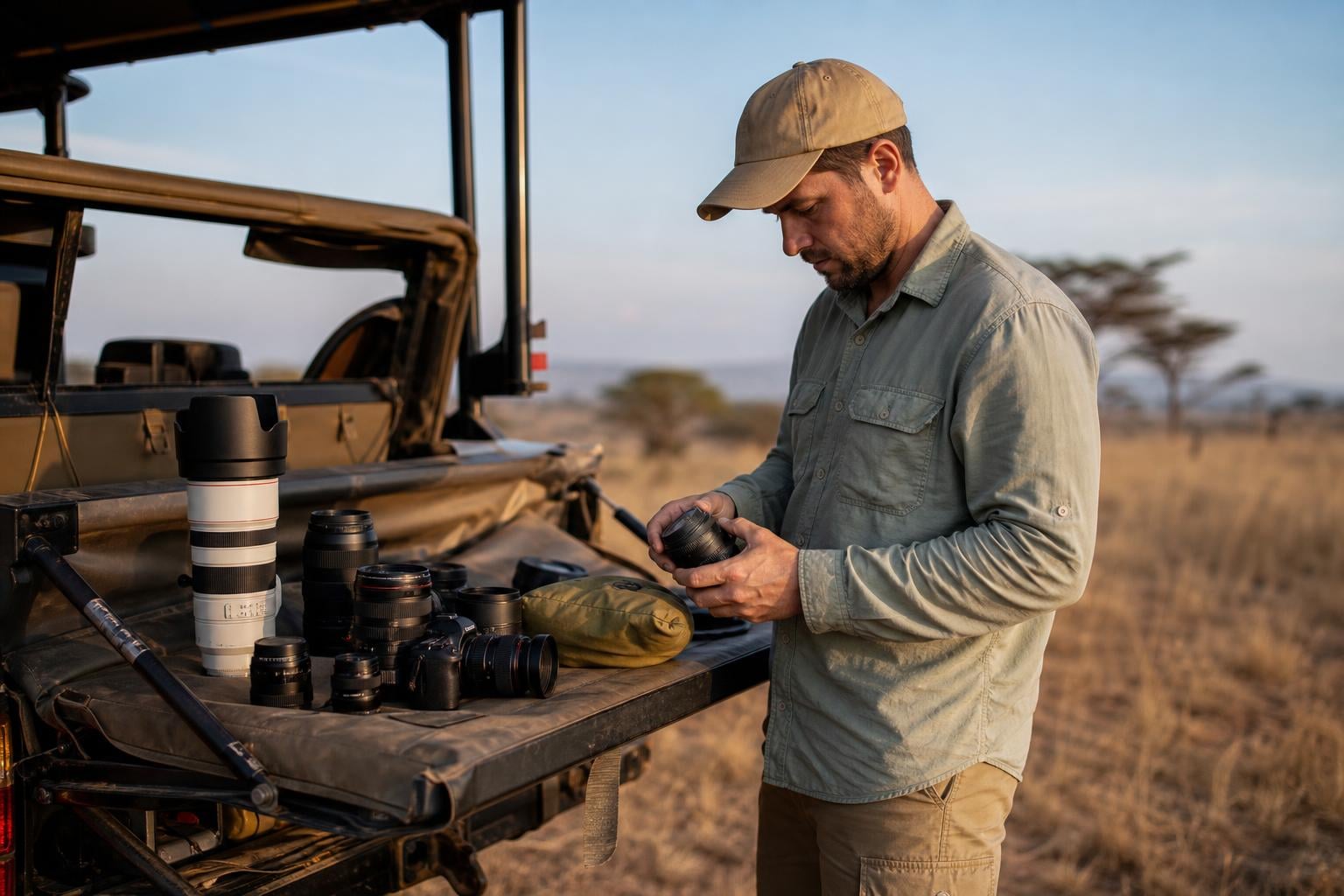
    Safari Photography Gear Guide 2026: 40+ Essential Terms

    Your camera body is the starting point for every other safari photography gear decision. Three main types dominate the conversation.

    DSLR (Digital Single-Lens Reflex)

    A DSLR uses a mirror mechanism to reflect light from the lens into an optical viewfinder. When you press the shutter button, the mirror flips up so light can reach the sensor.

    DSLRs ruled wildlife photography for decades. Their main advantage on safari is battery life, which is genuinely excellent. A single charge can last thousands of shots. The disadvantage in 2026: autofocus systems are a generation behind mirrorless cameras. If you already own a quality DSLR with good lenses, there’s no reason to abandon it. But if you’re buying new, mirrorless is the better investment.

    Mirrorless Camera

    Now the dominant recommendation for safari photography gear. A mirrorless camera removes the mirror entirely, using an electronic viewfinder instead. This design allows the autofocus system to cover nearly the entire sensor surface.

    The autofocus advantage is not subtle. Modern mirrorless cameras from Canon, Sony, and Nikon use AI-driven processors to recognize and track animals, birds, and even specific features like eyes. Practitioners on photography forums describe mirrorless animal eye AF as a genuine revolution: one photographer reported that their mirrorless camera kept perfect focus on a leopard’s eye as it stalked prey, even when partially obscured by vegetation. DSLRs simply cannot match that level of intelligent tracking.

    Bridge Camera

    A bridge camera sits between a point-and-shoot and an interchangeable-lens camera. It’s easier to operate, lighter to carry, and typically includes a built-in superzoom lens. The Sony RX10 IV is the most frequently recommended bridge camera for safari, offering a 24-600mm equivalent zoom range in a single, relatively compact body.

    Bridge cameras make sense for travelers who want good images without the complexity (or weight) of carrying multiple lenses. For family safaris where simplicity matters, they’re a strong choice.

    Full-Frame Sensor

    A full-frame sensor matches the size of traditional 35mm film (approximately 36mm x 24mm). Larger pixels capture more light, which means less noise and better detail at high ISO settings. This matters enormously during dawn and dusk game drives, when the light is low but the animals are most active.

    Crop Sensor (APS-C)

    An APS-C sensor is roughly two-thirds the size of a full-frame sensor. The field of view is multiplied by a factor of 1.5x to 1.6x compared to full frame. In practical terms, a 300mm lens on an APS-C body provides an effective field of view equivalent to 450mm on a full-frame camera.

    This “crop factor” is highly advantageous for capturing distant animals. The trade-off is worse low-light performance compared to full frame. For many safari travelers, especially those on a budget, an APS-C body with a good telephoto lens delivers excellent results.

    Micro Four Thirds

    A smaller sensor format (roughly half the area of full frame) with a 2x crop factor. A 150mm lens becomes effectively 300mm. These systems are significantly lighter, which matters when you’re traveling with luggage weight limits on bush flights. The Olympus/OM System and Panasonic Lumix lines are the main options here.

    Weather Sealing / Dust Sealing

    A design feature that uses gaskets and seals around buttons, dials, and body joints to resist moisture and dust penetration. African safari roads generate relentless fine dust, particularly in the Serengeti and Tarangire, and even sealed roads kick up clouds of red powder that penetrates camera bags and settles on sensor surfaces. Dust-sealed bodies and lenses are strongly preferred for safari photography gear.

    Which Camera Type Is Best for Safari?

    Camera Type

    Best For

    Main Advantage

    Main Limitation

    Mirrorless

    Most travelers buying new

    Excellent autofocus and subject tracking

    Battery consumption can be higher

    DSLR

    Travelers who already own one

    Battery life and proven reliability

    Older AF/viewfinder technology

    APS-C mirrorless

    Travelers wanting reach and lower weight

    Crop factor and smaller systems

    Less low-light flexibility than some full-frame systems

    Full-frame mirrorless

    Serious wildlife photographers

    Low-light performance and advanced AF

    Higher cost and weight

    Micro Four Thirds

    Lightweight travel setups

    2x crop factor and compact lenses

    Smaller sensor

    Bridge camera

    Beginners and families

    Built-in superzoom and simplicity

    Smaller sensor and less flexibility

    Best choice for most first-time safari travelers: A modern mirrorless or APS-C camera paired with a quality telephoto zoom offers an excellent balance of autofocus, reach, image quality, weight, and ease of use.


    Lenses: The Most Important Gear Decision

    If you have to choose between spending money on a better camera body or a better lens, choose the lens. Every experienced safari photographer will tell you the same thing.

    Focal Length

    The distance (in millimeters) from the optical center of a lens to the sensor when focused at infinity. In plain language: the higher the number, the more you can “zoom in” on distant subjects.

    For wildlife photography on safari, you want a lens that covers at least 70mm to 400mm. For bird photography, 500mm or 600mm is better. If you’re visiting Tanzania’s best parks, you’ll encounter everything from elephants at close range in Tarangire to distant lions on the Serengeti plains. Versatility in focal length matters more than most beginners expect.

    Safari Lens Focal Length Cheat Sheet

    Focal Length

    Best Use on Safari

    14-24mm

    Very wide landscapes and dramatic environmental scenes

    16-35mm

    Landscapes, camps, vehicle interiors

    24-70mm

    General photography and animals that are very close

    70-200mm

    Portraits, environmental wildlife, gorilla trekking

    100-400mm

    Versatile all-around safari wildlife lens

    100-500mm

    Flexible wildlife and landscape combination

    200-600mm

    Distant wildlife and birds

    400mm+

    Serious wildlife and bird photography

    500-600mm

    Maximum reach for distant subjects

    For most first-time safari travelers, a 100-400mm, 100-500mm, or 200-600mm zoom provides the best combination of reach and flexibility.

    Best Safari Lens Strategy by Budget

    Budget Setup

    Use an APS-C camera with a 70-300mm or 100-400mm telephoto zoom.

    This keeps weight and cost manageable while still providing enough reach for many large animals and closer sightings.

    Mid-Range Setup

    Pair a modern mirrorless camera with a 100-400mm, 100-500mm, or similar telephoto zoom.

    This is the sweet spot for many safari travelers because it provides useful reach without the weight and cost of professional super-telephoto primes.

    Long-Reach Setup

    Use a 200-600mm or 500-600mm lens when distant wildlife and birds are a major priority.

    The additional reach is particularly valuable on open plains and for small or distant subjects.

    Professional Setup

    Professional wildlife photographers may use two bodies with lenses such as a 100-500mm and 500mm or 600mm prime.

    The advantage is maximum reach, autofocus performance, low-light capability, and reduced lens swapping. The disadvantage is significantly greater weight, cost, and complexity.

    Telephoto Lens

    The workhorse of safari photography gear. Any lens with a focal length longer than about 70mm qualifies, but in the safari context, “telephoto” usually refers to lenses in the 100-600mm range.

    The minimum recommended focal length for wildlife is 200-300mm. Super-telephotos of 400-600mm are obviously better in many situations. Professional wildlife photographer Isak Pretorius recommends combining a long lens (500mm or longer) for close-up details and birds with a medium zoom like a 70-200mm or 100-400mm, and then a wide-angle lens like a 24-70mm or 16-35mm.

    Superzoom Lens

    A zoom lens with an unusually large focal length range, designed to cover multiple shooting scenarios in a single lens. Popular safari options include the Canon RF 100-500mm, Sony 200-600mm, and Sigma 60-600mm.

    Superzooms come with compromises. They’re not as fast (meaning their maximum aperture is smaller) as prime lenses, and they can be slightly less sharp at the extremes of their range. But the versatility matters more than most people think. Swapping lenses in a dusty safari vehicle is something you want to minimize.

    Wide-Angle Lens

    A lens with a short focal length (typically 14-35mm) that captures a broad field of view. Often overlooked in safari photography gear lists, but critical for landscape shots, camp photographs, and environmental wildlife images where you want to show the animal in its habitat.

    You may want a camera that can also shoot at around 20mm to capture sweeping Serengeti grasslands or the Ngorongoro Crater rim at sunrise.

    Prime Lens

    A lens with a fixed focal length (no zoom). Primes are typically sharper and faster (wider maximum aperture) than zoom lenses at the same focal length. A 500mm f/4 prime is the dream lens for many wildlife photographers, but it’s also heavy, expensive, and inflexible. On safari, most travelers are better served by zoom lenses.

    Zoom Lens

    A lens with a variable focal length. You rotate the zoom ring to change the framing without physically moving. All superzoom and telephoto zoom lenses fall into this category. The ability to quickly reframe from a full-body shot to a tight portrait without changing lenses is extremely valuable during fast-moving wildlife encounters.

    Aperture (f-stop)

    The size of the opening in the lens that allows light to reach the sensor. Written as f/2.8, f/4, f/5.6, and so on. The confusing part: smaller numbers mean larger openings and more light. An f/2.8 lens gathers four times more light than an f/5.6 lens.

    Aperture also controls depth of field. A wide aperture (f/2.8) creates a blurry background that isolates your subject. This is what gives professional wildlife photos that “the animal pops out of the frame” look.

    Fast Glass

    Photography slang for lenses with wide maximum apertures (f/2.8 or f/4). A faster lens can be a game-changer in early mornings or late evenings when light is limited. The term “fast” refers to the ability to use faster shutter speeds because more light enters the lens.

    Fast glass is expensive and heavy. A 70-200mm f/2.8 weighs roughly twice as much as a 70-300mm f/4.5-5.6. The trade-off between speed, weight, and cost is one of the central tensions in assembling safari photography gear.

    Teleconverter / Extender

    A small optical adapter placed between the camera body and lens that multiplies the focal length. A 1.4x teleconverter turns a 300mm lens into a 420mm lens. A 2x teleconverter turns it into 600mm.

    The cost: you lose light (one stop with a 1.4x, two stops with a 2x) and some sharpness. Teleconverters work best with high-quality prime lenses and are a popular way for professionals to extend a 300mm or 500mm prime without carrying a second massive telephoto.

    Image Stabilization (IS / VR / IBIS)

    Technology that compensates for camera shake, either in the lens or in the camera body. Canon calls it IS (Image Stabilization), Nikon calls it VR (Vibration Reduction), and in-body systems are called IBIS (In-Body Image Stabilization).

    This matters hugely on safari. You’re shooting from a vehicle that may be vibrating from the engine, other passengers shifting position, or wind. Modern stabilization systems can compensate for several stops of shake, making the difference between a sharp image and a blurry one.


    Camera Support and Stabilization

    Here’s a fact that surprises many first-time safari travelers: the single most important piece of safari photography gear is not your camera or your lens. It’s your camera support. Without stable support, nothing else matters.

    Beanbag (Photography Beanbag)

    The essential camera support for safari vehicles. A beanbag is exactly what it sounds like: a fabric bag filled with beans, rice, or similar granular material. You drape it over a vehicle’s door frame, window sill, or roof rail, then rest your lens on it.

    Beanbags conform to any surface, absorb vibration, and allow smooth panning. They’re simple, lightweight (you can pack them empty and fill them with rice after arrival), and extremely effective. In East Africa, where safari vehicles are typically Toyota Land Cruisers or minivans with pop-top roofs, beanbags are the standard support solution.

    For a deeper look at safari vehicle types and how they affect your shooting setup, that context helps explain why beanbags are universally preferred.

    Tripod (And Why You Probably Won’t Use One)

    A three-legged camera support designed for maximum stability. On safari, tripods are essentially useless. You’re not allowed to exit the vehicle during game drives in most East African parks, and there’s no room to set up a tripod inside a Land Cruiser. One photographer on a DPReview forum put it memorably: “A tripod in a safari vehicle is as popular as flatulence in an elevator.”

    Practitioners on Reddit confirm this. Multiple travelers report bringing a travel tripod on safari and never unpacking it once. The one exception is astrophotography at camp, if you want to photograph the Milky Way over the Serengeti.

    Window Mount / Door Clamp

    A rigid metal clamp that attaches to a vehicle’s door frame or window, providing a fixed mounting point for heavy telephoto lenses. Brands like Kirk, Eckla Eagle, and Camstedi are commonly discussed in photography forums.

    Window mounts offer more stability than beanbags for very heavy lenses but are less flexible. You’re locked into one angle until you reposition the clamp. Most safari travelers find beanbags more practical, but serious bird photographers sometimes prefer the rigidity of a clamp.

    Gimbal Head

    A specialized tripod head that counterbalances a heavy telephoto lens, allowing it to pivot smoothly in any direction with minimal effort. Gimbal heads revolutionized wildlife photography by making it effortless to track moving animals with massive lenses.

    On a standard game drive, you won’t use a gimbal head. But some photography-focused lodges provide gimbal setups in their hides and blinds, and if you’re spending time at a waterhole hide, a gimbal is transformative.

    Monopod

    A single-legged support. Lighter and more portable than a tripod, but still impractical inside a safari vehicle. Monopods occasionally help during walking safaris or gorilla trekking when you need quick, mobile stabilization.


    Storage, Power, and Backup

    Wildlife doesn’t wait for you to swap memory cards. Getting storage and power management right is boring but essential.

    Memory Card Write Speed

    How quickly your camera can transfer image data to the card, measured in megabytes per second (MB/s). Write speed matters more than storage capacity on safari. Things happen fast with wildlife, and opportunities last only seconds. If your card can’t keep up with your camera’s burst rate, the buffer fills and the camera freezes at the worst possible moment.

    Look for cards rated at UHS-II or faster. SanDisk Extreme Pro and Lexar Professional are the most recommended brands among wildlife photographers.

    CFexpress / SD Card

    The two main memory card formats. Most newer mirrorless cameras use CFexpress Type B cards, which are significantly faster than SD cards. Many bodies have dual card slots (one CFexpress, one SD), allowing you to write backup copies simultaneously.

    Burst Mode / Continuous Shooting (fps)

    A shooting mode where the camera takes multiple frames per second for as long as you hold the shutter button. Measured in frames per second (fps). Critical for action moments like hunts, river crossings, and birds in flight.

    A single lion hunt or wildebeest crossing can fill a 64GB card within minutes when shooting in burst mode. Bring significantly more memory card capacity than you think you need. Practitioners recommend at least 256GB of total storage for a two-week trip, spread across four to six cards from reputable brands.

    RAW vs. JPEG

    RAW files contain all the data captured by the sensor, with no in-camera processing. JPEG files are compressed and processed by the camera. RAW files are much larger (a single RAW from a 50-megapixel camera can exceed 50MB) but give you far more flexibility when editing.

    For safari, shooting RAW is worth the extra storage. The light changes dramatically from dawn to midday to dusk, and RAW files let you recover shadow detail, adjust white balance, and correct exposure after the fact in ways JPEG simply can’t match.

    Field Backup

    The process of copying your photos to a second storage device while still on safari. The cardinal rule of safari photography: never start a new day of shooting with the previous day’s photos only on a single memory card.

    In remote areas, internet access is often nonexistent, so cloud backup is not an option until you return to a city. A portable SSD (like a Samsung T7 or SanDisk Extreme) weighing just a few ounces provides reliable local backup. Copy your cards every evening.

    Portable SSD

    A small, solid-state external drive for field backup. Modern portable SSDs are pocket-sized, shock-resistant, and fast enough to transfer a full 128GB card in under ten minutes. This is the most weight-efficient insurance you can carry.

    Battery Management

    Most safari camps and lodges have charging facilities, but generators often run only at specific times of day (typically mornings and evenings). Many photographers prefer not to rely on camp power and travel with at least four batteries split between two camera bodies.

    Charge every battery every evening, even partially depleted ones. Cold mornings and heavy burst shooting drain batteries faster than you’d expect.

    If you’re weighing safari cost and budgeting, extra batteries and memory cards are among the cheapest investments that have the biggest impact on your photography.


    Protection and Maintenance
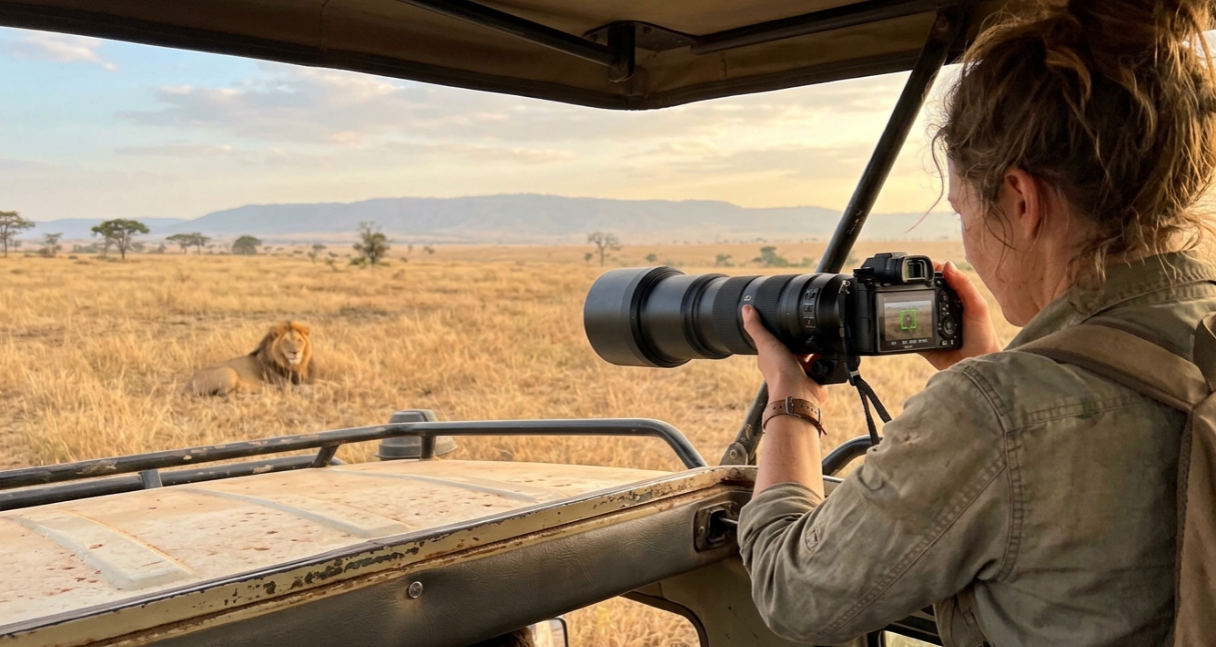
    Safari Photography Gear Guide 2026: 40+ Essential Terms

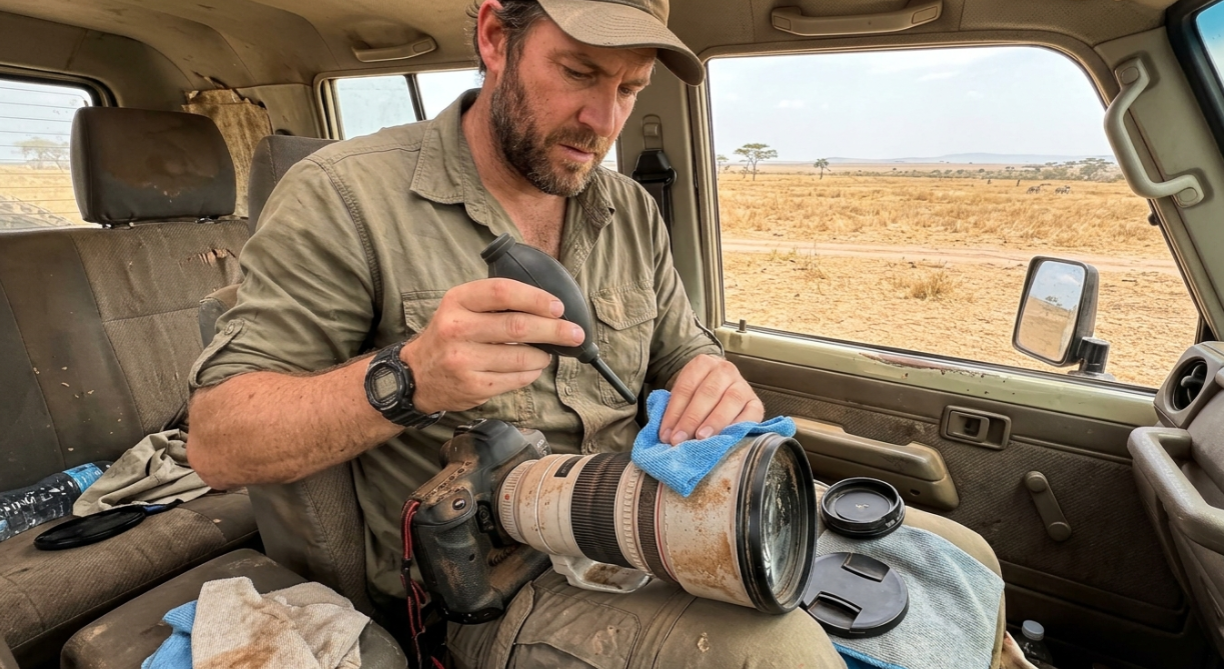
    Dust is the enemy. Every forum thread, every gear guide, every safari operator will tell you the same thing. Dust management is non-negotiable in your safari photography gear kit.

    Dust Cover / Rain Cover

    A fabric or nylon sleeve that fits over your camera and lens to protect them from dust and rain. On safari, dust covers serve double duty: protecting from the red African dust that coats everything during dry-season game drives, and from occasional afternoon rain showers.

    A practical tip from experienced safari travelers: an old pillowcase draped over your camera and lens works surprisingly well as a dust cover when you’re between sightings.

    Why Two Camera Bodies Matter for Dust

    Having two camera bodies isn’t just about convenience. It’s a dust-management strategy. Swapping lenses in the field exposes your sensor to Africa’s fine, penetrating dust. If you carry two bodies, each with a different lens (say a 100-400mm on one and a 24-70mm on the other), you eliminate most lens changes entirely.

    Rocket Blower

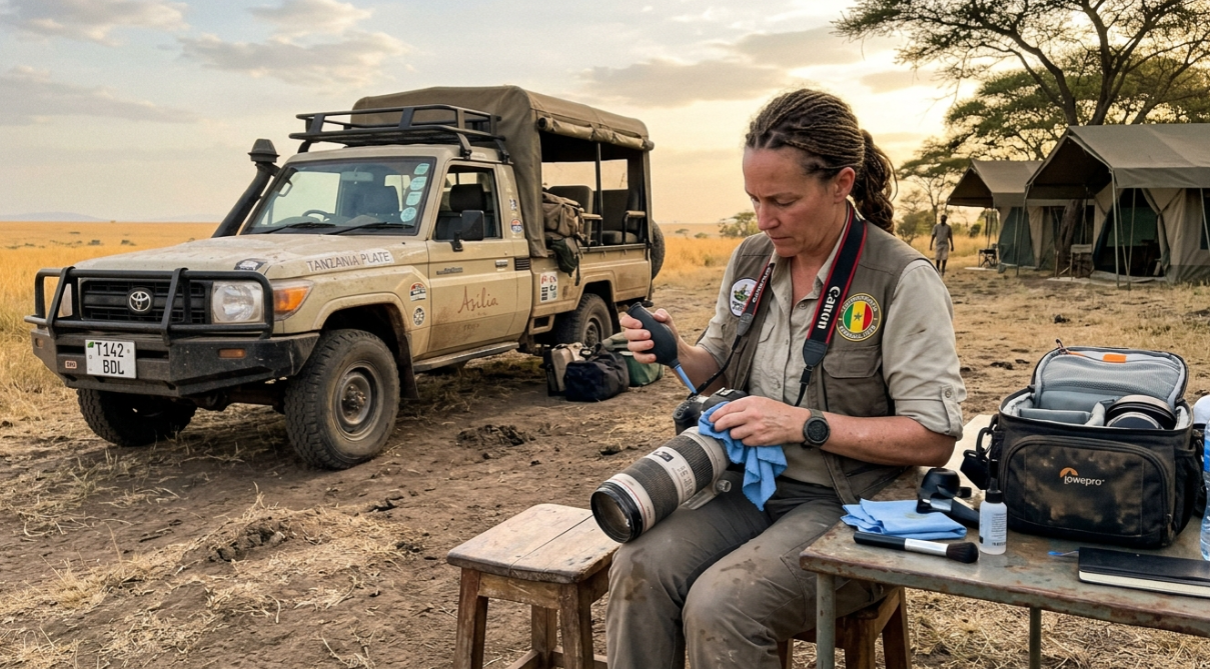
    A hand-powered air blower shaped like a rocket or bulb. The first line of defense against dust on your front lens element. A few puffs before shooting removes loose particles without touching (and potentially scratching) the glass. Carry one in an accessible pocket, not buried in your bag.

    Sensor Cleaning Kit

    Specialized swabs and solution for removing dust that accumulates on the camera sensor. Sensor dust shows up as dark spots in your images, most visible in shots with blue sky or smooth backgrounds. Bring a kit, but be cautious: sensor cleaning in a dusty camp environment can introduce more problems than it solves. Many photographers wait until they return home for thorough sensor cleaning.

    Lens Hood

    A plastic or metal shade that attaches to the front of a lens, blocking stray light that can cause flare and reducing contrast. On safari, lens hoods also provide physical protection for the front element against bumps, branches, and accidental contact.

    UV / Protective Filter

    A clear glass filter screwed onto the front of a lens. Its primary purpose on safari is physical protection. If a branch scrapes the front of your lens or dust scratches the surface, you’d rather replace a $30 filter than a $300 front element.

    Some photographers argue that adding glass in front of the lens degrades image quality slightly. The practical reality is that the protection is worth it in safari conditions.

    Silica Gel Packets

    Small packets of moisture-absorbing material placed inside your camera bag. In humid environments near lakes and forests (Ngorongoro Crater, Lake Manyara, Bwindi Impenetrable Forest during gorilla trekking), condensation can form on and inside your gear overnight. Silica gel packets absorb that moisture and keep your equipment dry.


    Safari-Specific Terms

    These terms connect your safari photography gear to the actual conditions you’ll face in East Africa. This is where an operator’s perspective adds something a gear reviewer simply can’t provide.

    Game Drive (Photography Context)

    A guided excursion in a safari vehicle through a wildlife area. Game drives typically happen in the early morning (6:00-10:00 AM) and late afternoon (3:30-6:30 PM), when animals are most active and the light is best for photography. Midday game drives are possible but the harsh overhead light produces flat, unflattering images.

    Knowing the best time for safari directly affects what light conditions you’ll encounter and, by extension, what gear choices make sense.

    Golden Hour / Blue Hour

    Golden hour is the period shortly after sunrise and before sunset when sunlight is warm, soft, and directional. Blue hour is the period just before sunrise and after sunset when the sky takes on deep blue tones. Both produce the most dramatic safari photographs.

    In East Africa near the equator, golden hour is shorter than in temperate latitudes. Sunrise and sunset happen fast, so you need to be in position with your gear ready.

    Pop-Top Vehicle

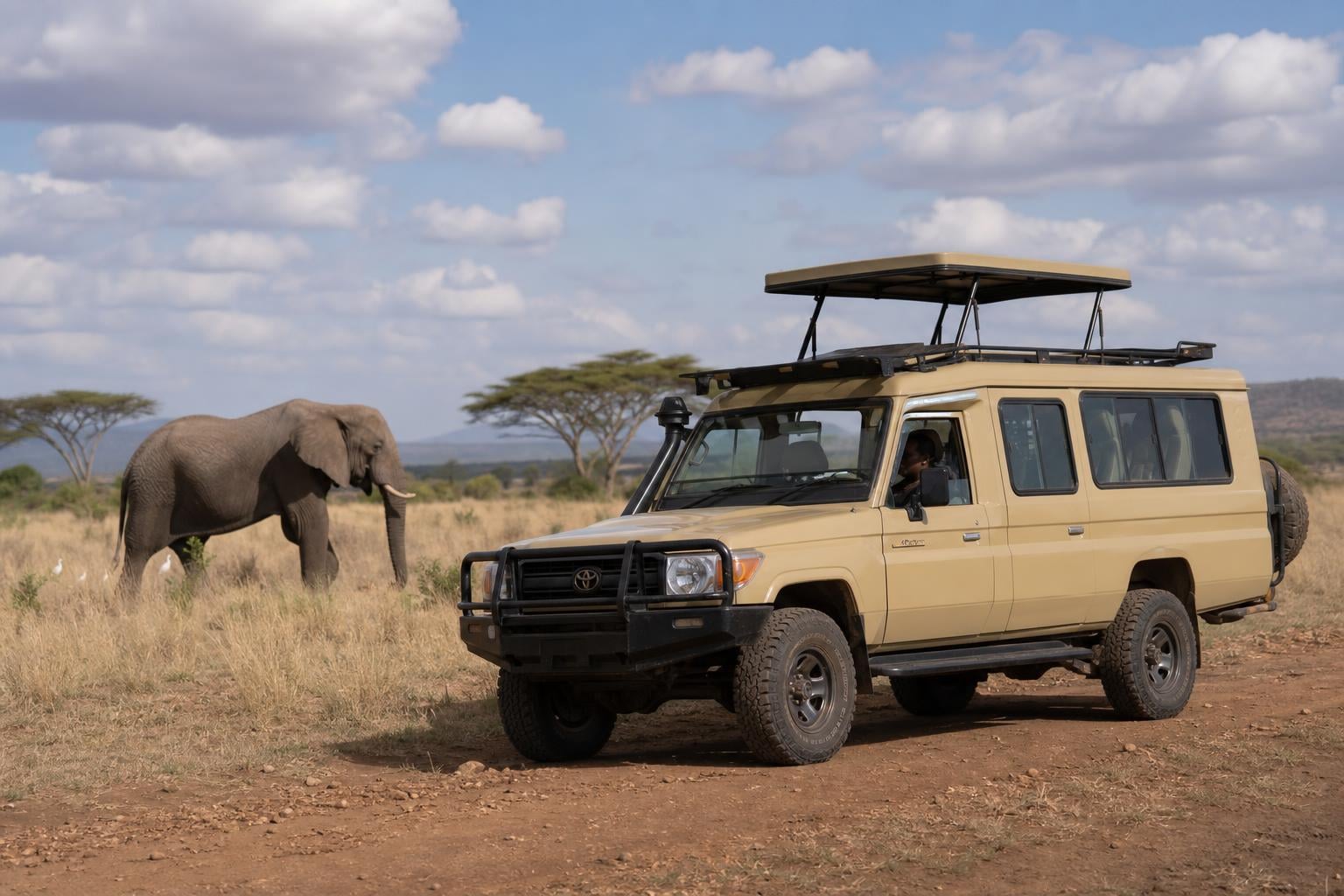
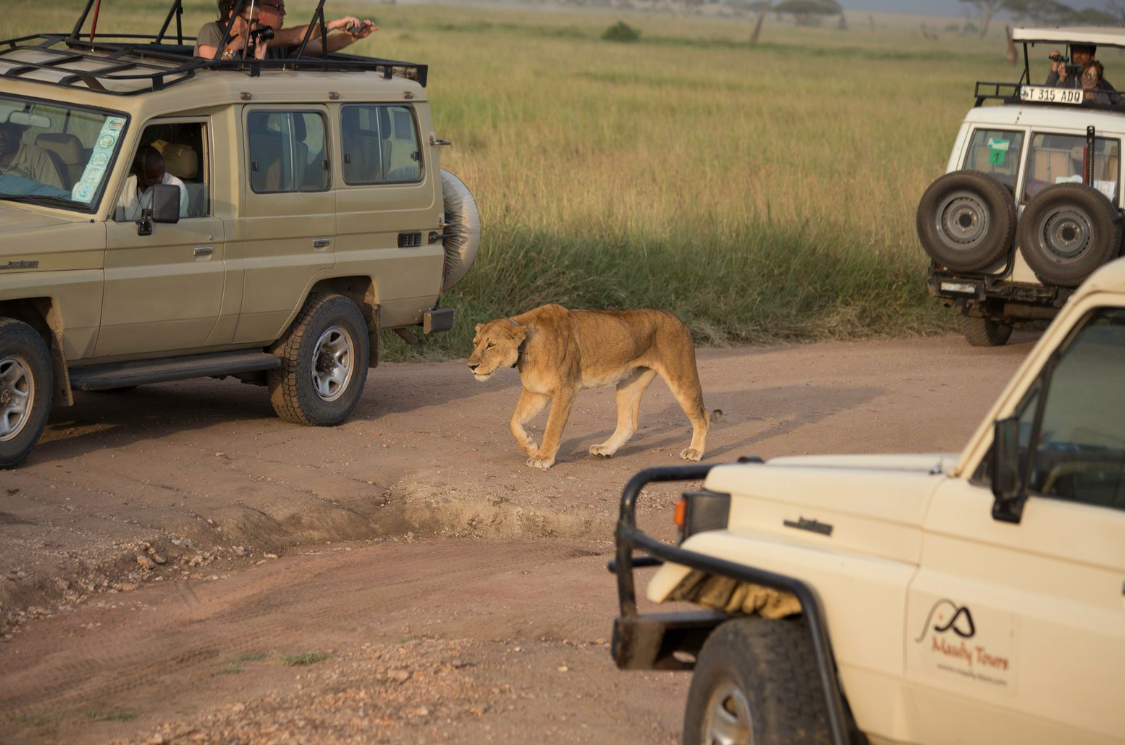
    The standard safari vehicle in East Africa, typically a Toyota Land Cruiser or minivan with a roof that pops up to allow passengers to stand and shoot in all directions. The pop-top frame provides natural resting points for beanbags and gives 360-degree shooting access.

    The vehicle you’re in shapes your photography more than most travelers realize. Pop-top Land Cruisers offer excellent flexibility. Open-sided 4x4s (common in southern Africa) provide unobstructed views but no roof to rest a beanbag on. For a full breakdown, see this guide to safari vehicle types and features.

    Private Vehicle vs. Shared Vehicle

    A private vehicle means your group has the vehicle and guide to yourselves. You decide when to wait at a sighting, when to move on, and how to position for the best light. The difference between good and unforgettable images often comes down to this single factor.

    In a shared vehicle, you’re compromising with other guests who may not share your patience for waiting 45 minutes until a leopard descends from a tree. For anyone serious about photography, a private vehicle is the strongest recommendation an operator can make.

    Understanding the costs and trade-offs of private vs. group safaris helps you make this decision with clear eyes.

    Photography Safari vs. Standard Safari

    A photography safari is specifically designed around capturing images. This means fewer guests per vehicle (so everyone gets a window seat and a clean angle), dedicated beanbags and camera mounts, longer time at sightings, and guides who understand photography concepts like backlighting and composition.

    Some luxury lodges offer photography-specific vehicles, editing space, charging stations, and access to sunken hides at waterholes. These lodges cater to serious photographers and can transform a good safari into an exceptional one.

    Hide / Blind

    A concealed structure (often at ground level or partially underground) positioned near a waterhole, salt lick, or feeding station. Hides allow photographers to shoot at eye level with wildlife, producing intimate, dramatic images impossible to achieve from a vehicle.

    Time spent in a hide is where gimbal heads and tripods actually become useful, since you’re in a fixed location with plenty of room.

    Engine Vibration

    A detail many gear guides miss entirely. Even with image stabilization active, engine vibration from an idling vehicle can ruin your images. When you settle into a sighting and prepare to shoot, ask your guide to turn off the engine.

    One practitioner on DPReview confirmed this bluntly: “Taking photographs with the engine running is a disaster, even at high shutter speeds and with IS.” Good safari guides know to kill the engine at important sightings without being asked.


    Camera Settings: Quick-Reference Definitions

    Understanding these terms helps you translate your safari photography gear knowledge into actual settings when the moment arrives.

    Shutter Speed

    How long the camera’s sensor is exposed to light, measured in fractions of a second. A useful rule of thumb: set your shutter speed to at least twice your focal length. If you’re shooting at 400mm, you want a minimum of 1/800th of a second to avoid motion blur from camera shake.

    For moving animals (running, flying, fighting), go faster: 1/2000th or higher. For stationary subjects in good light, you can drop lower and let more light hit the sensor.

    Aperture Priority Mode

    The most recommended shooting mode for safari. You set the aperture (controlling depth of field and light), and the camera automatically selects the appropriate shutter speed. This gives you creative control without the risk of missing a shot because you were fumbling with manual settings.

    ISO

    A measure of the sensor’s sensitivity to light. Low ISO (100-400) produces clean, noise-free images but requires more light. High ISO (3200-12800+) allows shooting in dim conditions but introduces noise (grain).

    On early morning and late evening game drives, you’ll push ISO higher than feels comfortable. Modern cameras handle high ISO remarkably well. A slightly noisy sharp image is always better than a clean blurry one.

    Animal Eye AF / Subject Detection

    The feature that makes modern mirrorless cameras so dominant for wildlife photography. Using on-sensor phase-detection autofocus combined with AI processors, the camera recognizes and tracks animal faces, eyes, birds, and even specific species in real time. You simply point the camera, and the system locks focus on the nearest eye.

    This technology has genuinely changed what’s possible for non-professional photographers on safari. Where focus accuracy once required years of skill development, the camera now handles the hardest part.

    Rule of Thirds (Composition Basic)

    A compositional guideline: imagine your frame divided into a 3×3 grid. Placing your subject at one of the four intersections (rather than dead center) generally produces more dynamic, visually interesting images. Most cameras can display this grid in the viewfinder.


    Gorilla Trekking: A Different Gear Scenario

    Everything above assumes open-vehicle game drives on savannas with long sight lines and good light. Gorilla trekking in Uganda and Rwanda is the opposite, and your safari photography gear needs shift dramatically.

    Dense equatorial forest means extremely low light. The canopy blocks most sunlight, and you’re shooting in conditions closer to a dimly lit room than an open plain. Fast lenses (f/2.8) are strongly preferred. The 70-200mm f/2.8 is the consensus lens for gorilla trekking because of the constant low-light situations.

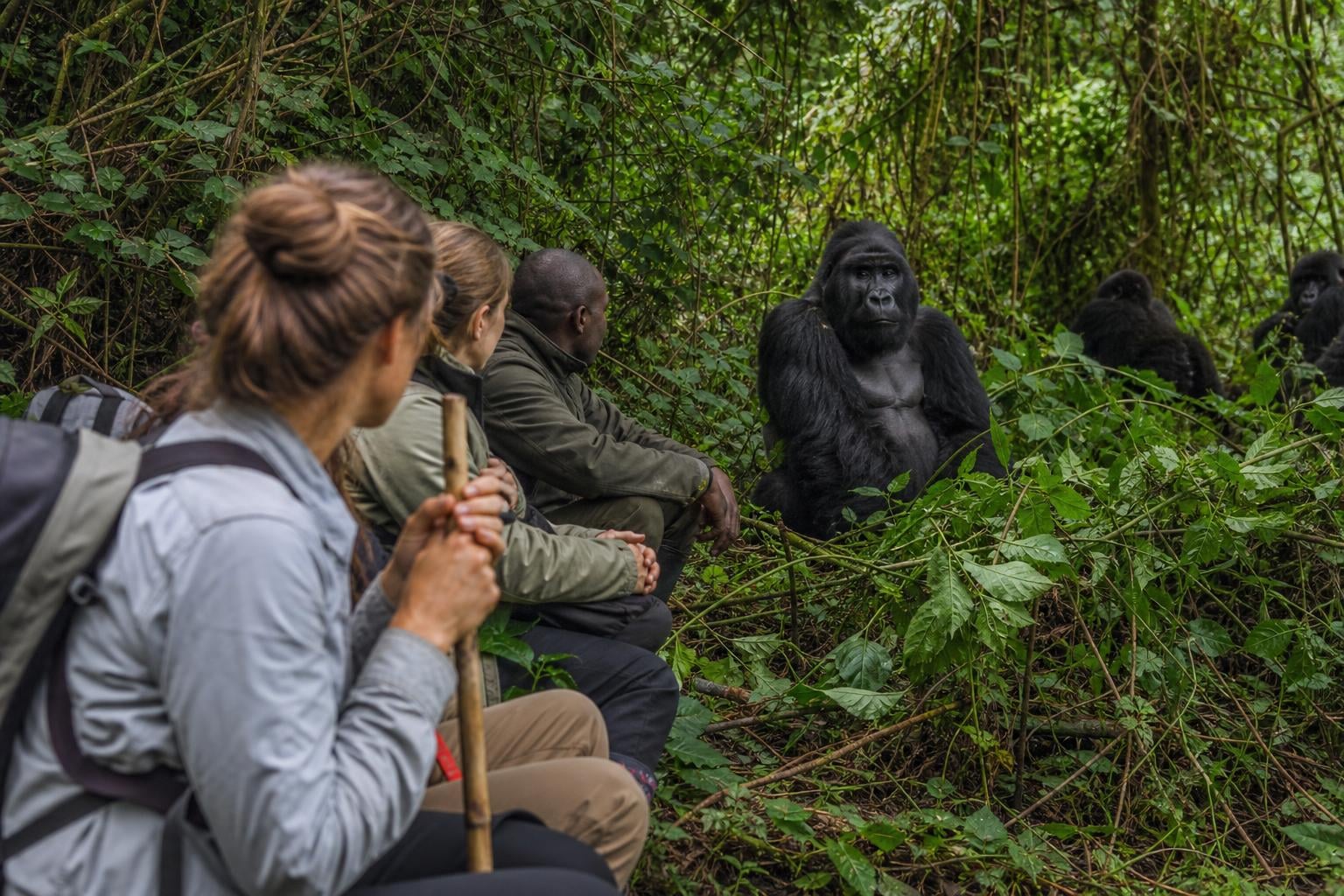
    Focal length requirements are shorter. You’ll be within 7-10 meters of the gorillas (park rules set a minimum distance), so 200mm is more than enough reach. A 70-200mm covers the range from environmental group shots to tight portraits.

    Weight matters more. You’re hiking through steep, muddy jungle terrain for one to six hours to reach a gorilla family. Every gram of gear you carry affects your energy and your ability to hold the camera steady when you arrive. Leave the 500mm prime at the lodge.

    For a complete breakdown of settings, rules, and recommended equipment, the gorilla trekking photography guide covers this niche in depth.


    Packing Your Safari Photography Gear: Practical Considerations

    A brief note on logistics, because the best gear in the world is useless if it doesn’t make it onto the vehicle.

    Camera bag for safari: Use a bag you can access quickly without standing up. A shoulder bag or soft insert that sits on the seat next to you works better than a backpack buried behind your row. You need to be able to swap lenses (when unavoidable), grab a second body, or reach a battery in seconds.

    Bush flight weight limits: Internal flights to remote airstrips in the Serengeti or Ruaha typically restrict luggage to 15-20kg in soft bags. Your camera gear counts toward this limit. Plan accordingly: carry cameras and lenses in your hand luggage and check non-essential clothing.

    Insurance: Camera gear is expensive and exposed to harsh conditions. Make sure your travel insurance covers equipment loss, damage, and theft. Some policies exclude “adventure activities,” which could theoretically include safari. Read the fine print.

    For a complete checklist beyond photography gear, the Tanzania safari packing list covers clothing, medications, and everything else you need.


    Frequently Asked Questions

    What is the most important piece of safari photography gear?

    A beanbag. It sounds unglamorous compared to choosing cameras and lenses, but without proper camera support, nothing else works properly. Beanbags are simple, lightweight, packable, and perfectly suited to the door frames and roof rails of East African safari vehicles.

    Do I need a full-frame camera for safari photography?

    No. A crop-sensor (APS-C) camera with a good telephoto lens produces excellent safari images. The 1.5x crop factor actually helps by giving you extra reach. Full-frame cameras perform better in low light, which matters at dawn and dusk, but they’re not a requirement for great results.

    What focal length lens should I bring on safari?

    At minimum, 200-300mm. Ideally, 400mm or longer. A superzoom like the Sony 200-600mm or Canon RF 100-500mm covers most safari scenarios in a single lens. If you photograph birds, stretching to 500-600mm is worth it.

    Should I bring a tripod on safari?

    Almost certainly not. You can’t exit the vehicle during game drives in most East African parks, and there’s no space for a tripod inside. A beanbag does the same job better. The only exception is if you plan to photograph stars at camp.

    How many memory cards should I bring?

    At least four to six cards of 64GB or 128GB each, for a minimum of 256GB total. Burst shooting during action sequences burns through storage fast. Use reputable brands (SanDisk Extreme Pro, Lexar Professional) and prioritize cards with high write speeds.

    How do I protect my camera from dust on safari?

    Use dust covers or even an old pillowcase when the camera is not in use. Carry a rocket blower for quick cleaning. Minimize lens changes (bring two camera bodies if possible). Store gear in sealed bags within your camera bag, and add silica gel packets in humid areas.

    Is safari photography gear different for gorilla trekking?

    Yes, significantly. Gorilla trekking requires shorter focal lengths (70-200mm), faster lenses (f/2.8 for low jungle light), and lighter overall weight since you’re hiking through steep terrain. It’s essentially the opposite gear profile from a savanna game drive.

    What camera settings should I use on a game drive?

    Start with Aperture Priority mode, set your aperture to the widest your lens allows (f/4 or f/5.6 for most zoom lenses), and let the camera manage shutter speed. Keep ISO on auto with a minimum shutter speed of 1/800th or faster. Enable burst mode and animal eye AF if your camera has it.


    What to Do Next

    Understanding safari photography gear is one step in planning a trip. The next steps are choosing where to go, when to go, and how to structure your itinerary so you’re in the right place at the right time for the images you want to capture.

    Ready to start planning? Explore Tanzania safari itineraries, costs, and logistics to see how the pieces fit together, or check out the East Africa packing list for a complete overview of everything beyond the camera bag.
  • Tanzania Safari Guides 2026: How to Choose & Costs

    Tanzania Safari Guides 2026: How to Choose & Costs

    TL;DR

    Tanzania safari guides are professional driver guides who combine wildlife interpretation, safe driving, route planning, park rule compliance, and daily logistics into a single role. Your guide shapes every part of the safari experience, from timing and sightings to safety and ethics. This glossary explains what the guide related terms actually mean, which qualifications carry real weight, what a private guide costs compared to group options, and what to ask an operator before booking.


    A Tanzania safari guide is not just the person driving the vehicle. In Tanzania’s Northern Circuit, the same person typically drives you between Tarangire, Ngorongoro, and the Serengeti, leads your game drives in a pop top 4×4, interprets wildlife behavior, manages timing and logistics, enforces park rules, and handles unexpected problems. Tanzania’s tourism regulations define a tour guide as a person who leads tourists through attractions and provides commentary on their history, features, and significance. On fly in safaris, you may instead use camp based lodge guides who know one area in extraordinary detail. The difference matters, and understanding it before booking can change your entire trip.

    This glossary covers the terms travelers encounter when comparing Tanzania safari guides, which qualifications and ethics signals matter, and the questions that separate a well planned safari from a disappointing one.

    If you are still building your overall trip plan, Tanzania safari itinerary options can help you understand routing before you evaluate guides.


    Quick Glossary: Tanzania Safari Guide Terms

    Term Plain English Meaning Why It Matters When Booking
    Driver guide One person who drives the safari vehicle and guides wildlife viewing This person controls road safety, sighting quality, timing, and daily decisions
    Private guide A guide assigned to one group with a private vehicle The guide learns your interests and adjusts pace, stops, and sightings
    Lodge/camp guide A guide based at a specific camp or lodge Deep local knowledge, but you may change guides when you change camps
    Ranger guide A park authority guide or armed ranger Required for walking safaris and certain regulated activities
    Walking safari guide A guide approved to lead guests on foot in wildlife areas Different skillset than vehicle based guiding; often accompanied by an armed ranger
    Naturalist guide A guide who interprets ecology, behavior, plants, birds, and geology Turns animal sightings into understanding
    Specialist guide A guide with deep expertise in birding, photography, migration, or families Important if you have niche goals
    Cultural visit guide A guide (sometimes local community based) who leads village, boma, or cultural heritage visits Required for meaningful Maasai and other cultural interactions; often separate from your safari driver guide
    Guide continuity Having the same guide for most or all of a private safari The guide remembers what you have seen and how you like to travel
    TATO Tanzania Association of Tour Operators A useful trust signal for operator legitimacy
    TATO Code of Conduct A guide ethics framework covering professionalism, safety, and wildlife respect Gives travelers a basis for asking about responsible guiding
    FGASA Field Guides Association of Southern Africa Voluntary professional development, not a legal requirement in Tanzania
    Mweka College of African Wildlife Management Tanzania based wildlife and tourism training institution
    Registered tour guide A guide registered under Tanzania’s tourism regulations Legal baseline, not proof of elite quality
    Ethical wildlife viewing Viewing wildlife without disturbing animals or breaking park rules Separates responsible guides from aggressive ones
    Off road driving Driving away from permitted roads or tracks Prohibited in Tanzania’s national parks
    Comfort zone The space an animal needs before it changes behavior due to vehicles A good guide reads this and repositions accordingly
    Migration guiding Guide skill specific to the Great Migration: herd timing, crowd management, crossing ethics Crossings are never guaranteed, and unethical crowding harms wildlife
    Pop top vehicle A closed 4×4 with a roof that lifts for standing wildlife viewing Standard for Tanzania driving circuits
    First aid / WFR Emergency medical training (Wilderness First Responder for remote settings) Critical because first responders may not reach remote areas quickly

    For a deeper breakdown of how FGASA, KPSGA, TALA, and WFR credentials compare across countries, see this safari guide qualifications overview.


    What Do Tanzania Safari Guides Actually Do?

    The job description is wider than most first time travelers expect. A Tanzania safari guide on a driving circuit handles all of the following across a typical day:

    Driving. Safe, legal driving on sometimes rough roads between parks and during game drives. This includes gate logistics, speed compliance, and navigating unpredictable conditions.

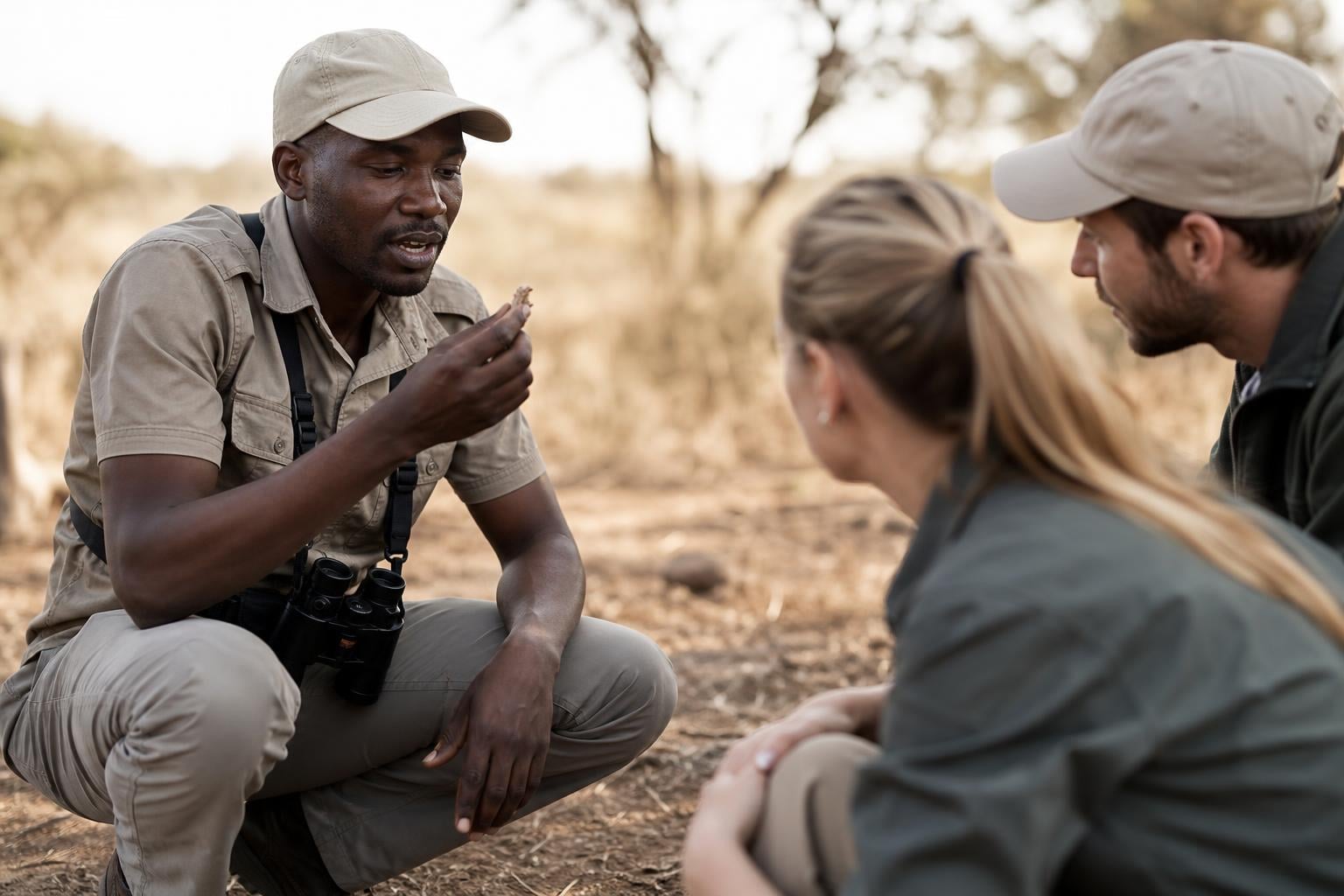
    Wildlife interpretation. Identifying mammals, birds, reptiles, and plants. Explaining animal behavior rather than simply pointing at it. A naturalist style guide can connect a leopard’s posture, a bird’s alarm call, and a dung beetle’s activity into a coherent story about the ecosystem you are sitting inside.

    Route strategy. Deciding which areas of the Serengeti to visit, when to leave a sighting, whether to push for an early start, and how to avoid crowds when possible. A guide who knows Tarangire’s seasonal elephant movements or Ngorongoro Crater’s descent timing can improve your experience dramatically.

    Safety management. Keeping guests inside the vehicle during game drives, following park rules, and knowing what to do in an emergency. The U.S. State Department notes that first responders may not reach remote areas quickly, which makes a guide’s judgment and emergency awareness genuinely important.

    Guest care. Managing picnic lunches, bathroom stops, camera angles, children’s attention spans, and the pace of the day.

    Cultural bridge. Communicating with lodge staff, park officials, and local communities. Explaining Maasai culture, Swahili phrases, and conservation context.

    A LinkedIn post from a Tanzania tourism practitioner described professional guides as people who interpret natural and cultural heritage, apply safety and crisis management protocols, promote conservation ethics, and protect destination integrity through responsible conduct. That framing is far more accurate than “driver who finds animals.”


    Why Tanzania Safari Guides Matter as Much as Your Lodge

    The same Serengeti itinerary can feel average or extraordinary depending on who is sitting behind the wheel. Lodges set the stage. The guide writes the script.

    Practitioners on Reddit who compare Tanzania operators for Northern Circuit safaris consistently say the same thing: when pricing and itinerary look similar, the meaningful differentiators are guide quality, English fluency, vehicle condition, and flexibility during game drives. One commenter noted that by day three or four, a good private guide already understands what guests have seen and what they care about, which means sightings become more targeted and personal.

    On the flip side, a Tripadvisor thread from 2025 described a traveler whose lodges and itinerary were fine, but whose guide was chronically late, refused early drives, gave incorrect animal information, missed sightings, and forgot a breakfast box. The entire safari felt like a failure despite everything else being in place.

    What poor guiding looks like:

    • Late starts when wildlife activity peaks at dawn
    • Unwillingness to leave camp early
    • Little or no wildlife interpretation
    • Relying only on radio chatter from other vehicles
    • Unsafe or aggressive driving near animals
    • Crowding sightings with other vehicles
    • Phone use during guest time
    • No clear emergency plan

    Reviews help when researching operators, but as one Reddit user put it after spending “countless hours” on review platforms: reviews do not tell you who will actually sit behind the wheel on your safari.

    When you are comparing similar quotes, the guide question is often the tiebreaker. Understanding Tanzania safari cost factors before you evaluate guide quality helps you see where the money goes.


    Private Guide vs Group Safari: The Decision That Shapes Everything

    This is one of the biggest structural choices when planning a Tanzania safari, and it affects the guide experience more than almost anything else.

    On a private guide safari, you get your own vehicle and driver guide for the duration of the trip. The guide works exclusively for your group. You set the pace: early starts, long sits at a leopard sighting, photography patience, or quick moves between areas. By day two, the guide knows whether you care about birds, big cats, or just soaking it in. That cumulative learning is impossible to replicate in a group setting.

    On a group (shared) safari, you share a vehicle with other travelers (typically four to seven passengers). The guide splits attention across different interests and comfort levels. Timing compromises are inevitable. If one person wants to watch a cheetah hunt develop and another is ready for lunch, the guide has to choose. Group safaris work well for solo travelers, budget conscious visitors, and people who enjoy meeting others on the road. But the guide dynamic is fundamentally different.

    Practitioners on Reddit who have done both formats report that private safaris feel more immersive specifically because the guide can adapt in real time. One user described the difference as “night and day” once the guide stopped having to manage group politics and could focus on wildlife.

    For a deeper comparison of both formats, private vs group safari breaks down the tradeoffs in detail.

    When a group safari still makes sense

    Group safaris are not inherently worse. They cost less per person, and a skilled guide can still deliver excellent game drives for a shared vehicle. The key is knowing what you are signing up for. If the operator caps vehicles at six passengers and assigns experienced Tanzania safari guides to group departures (not just whoever is available), the quality gap narrows. Ask whether the group guide is the same caliber as the private guide team, because at some operators, it is not.


    What Does a Private Guide Safari Cost?

    Guide quality and trip format are connected to price, and travelers deserve straight numbers.

    A private guide safari on Tanzania’s Northern Circuit (Tarangire, Serengeti, Ngorongoro) typically starts around $250 to $400 per person per day for mid range options, covering the private vehicle, fuel, driver guide, park fees, accommodations, and meals. High end private safaris using luxury lodges and camps can run $600 to $1,500+ per person per day depending on the properties and season.

    For context, Duma Explorer’s published starting points show a 5 day Northern Circuit safari from approximately $2,000 per person, which puts the per day cost in the mid range bracket. Fly in safaris with lodge based guides at premium camps push significantly higher.

    The private guide component itself is not usually broken out as a separate line item. It is bundled into the daily rate alongside the vehicle. But the cost difference between a private and group safari is real:

    Format Approximate daily cost per person (mid range) What you get
    Group/shared vehicle $150 to $250 Shared guide, shared vehicle (4 to 7 guests), fixed schedule
    Private vehicle and guide $250 to $400 Dedicated guide, flexible timing, personalized sightings
    Premium private (luxury lodges) $600 to $1,500+ Private guide, top tier camps, sometimes includes charter flights

    These are rough ranges. Actual pricing depends on season (July through October and December through March are peak), lodge tier, group size (couples pay more per person than groups of four), and trip length.

    The price gap between private and group shrinks as your group gets larger. A family of four on a private safari pays roughly the same per person as two people on a group trip, but gets a completely different guide experience.

    For full pricing breakdowns, safari cost in Tanzania covers fees, park entry, and accommodation tiers.


    Private Driver Guide vs Lodge Guide vs Specialist Guide

    This table clarifies the structural differences between guide setups, which matters when you are evaluating quotes from operators who employ different types of Tanzania safari guides.

    Guide Setup Best For Strengths Tradeoffs Questions to Ask
    Private driver guide Northern Circuit driving safaris, families, photographers, first timers, custom trips Continuity across parks, flexible pacing, one person learns your interests over several days Trip depends heavily on one guide’s quality Who is assigned? How long in these parks? Staff or freelance?
    Camp/lodge guide Fly in safaris, private concessions, lodge based stays Deep knowledge of immediate area; may offer walking or night drives where permitted New guide at each camp; less trip wide continuity Are drives shared or private? What is the guide to guest ratio?
    Specialist guide Birding, photography, Great Migration, family trips, walking safaris Deeper expertise matched to your goals May cost more or need advance booking What specialist experience can you document?
    Ranger/park guide Walking safaris, regulated activities Safety authority and local park knowledge Does not replace your main safari guide Is an armed ranger required? Who arranges it?

    A private driver guide is the most common setup on Northern Circuit road safaris. The same guide drives you from Arusha through Tarangire, the Serengeti, and Ngorongoro, leading game drives in a pop top 4×4 along the way. Guide continuity is the main advantage: by mid trip, the guide knows whether you want quiet observation, deep explanations, photography patience, or earlier starts.

    Camp and lodge guides work differently. On fly in safaris, you change guides at each camp. These guides often know a single concession or area with unusual depth, but you lose the cumulative relationship a private guide builds. Reddit users discussing this tradeoff specifically valued the continuity of a private driver guide because the guide remembers what guests have already seen and adjusts accordingly.

    For families planning their first safari, guide choice is especially important. A guide experienced with children knows how to keep younger travelers engaged during slower stretches and reads energy levels before anyone melts down. The first family safari planning guide covers what parents should prioritize.


    Cultural Visit Guides: A Separate and Important Role

    Most Tanzania safari itineraries include at least one cultural component, typically a visit to a Maasai boma, a village walk, or a market stop. The guide who leads these experiences is not always your safari driver guide, and that distinction matters.

    What a cultural visit guide does. A cultural visit guide (sometimes called a community guide or village guide) facilitates interactions between travelers and local communities. At a Maasai boma, this person explains daily routines, livestock practices, age set traditions, beadwork, and housing construction. At a village walk near Mto wa Mbu or Karatu, the guide introduces farming cooperatives, banana beer production, local schools, and market dynamics.

    Why it matters. Cultural visits done poorly feel transactional, like a human zoo. Done well, they create genuine exchange. The guide’s role is to translate context, set expectations for both sides, manage photography etiquette, and make sure the community actually benefits from the visit.

    Some operators build cultural experiences into the itinerary as authentic stops rather than tourist checkboxes. The guide’s ability (or inability) to bridge cultural gaps determines whether you leave with real understanding or just photos.

    What to ask about cultural visits

    • Is the cultural visit led by a local community guide or by the safari driver guide?
    • Does the community receive direct compensation from the visit?
    • How long is the visit, and is there genuine interaction or just a walkthrough?
    • Can the visit be adjusted for families with children?

    For a deeper look at Maasai cultural interactions and what ethical engagement looks like, Maasai safari glossary covers the terms, costs, and ethics involved.

    Cultural visit guides are especially valuable on longer itineraries where safari days are interspersed with non wildlife experiences. A 14 day Tanzania itinerary often includes two or three cultural stops alongside game drives and beach time.


    Tanzania Safari Guides: Qualifications That Matter and Those That Do Not

    Tanzania has legal registration and conduct requirements for tour guides, but guide quality grading is less standardized and visible to travelers than systems in some other African countries.

    Tanzania’s tourism regulations require guides to be registered with the Director of Tourism, enlisted under a licensed tour company or recognized association, and at least 21 years old with secondary education or relevant experience. The regulations also set conduct expectations: guides should be reliable, safety conscious, accurate, free from alcohol while on duty, and respectful of culture and environment.

    Beyond that legal baseline, several training signals add weight.

    Signal What It Means How Much Weight to Give It
    Tanzania guide registration Legal baseline Necessary but not enough on its own
    Licensed operator Company legitimacy Necessary
    TATO membership Industry association and code of conduct alignment Useful trust signal
    Mweka / local training Wildlife and tourism education at recognized institutions Strong positive signal
    FGASA / EcoTraining Voluntary professional development Strong signal when paired with Tanzania experience
    First aid / WFR Emergency preparedness Important for remote, walking, mountain, or family trips
    Years in specific parks Practical, hands on experience Often as important as certificates
    Recent client references Real world proof Very useful

    A note on FGASA: FGASA states clearly that its certification is voluntary and does not replace statutory or regulatory requirements. FGASA training can be a strong professional development signal, but in Tanzania it should be viewed alongside the country’s own registration and licensing requirements, local park experience, and operator training programs.

    The College of African Wildlife Management at Mweka offers tour guiding operations programs. Other institutions, such as Tropical Centre Institute in Arusha, teach subjects ranging from mammalogy and ornithology to vehicle maintenance and customer care. These formal credentials matter, but ongoing training matters more. Asilia Africa, for example, described annual guide training in Tarangire covering geology, ecology, astronomy, ethology, botany, birding, safe rifle handling, and bush walking techniques. That kind of continuous investment tells you more than a vague claim of “experienced guides.”


    Ethical Guiding: The Best Tanzania Safari Guides Are Not the Ones Who Get Closest

    This section matters because it affects both wildlife welfare and guest safety, and the conversation in Tanzania has become more urgent.

    TANAPA’s park rules are clear: do not exceed stipulated speed limits, do not drive off road, do not approach wild animals too closely, avoid loud noise, stay in vehicles unless allowed by guides, and do not feed or disturb animals. Walking safaris should use designated trails and be accompanied by an armed ranger.

    These are not suggestions. Good Tanzania safari guides follow them. A bad guide treats them as optional.

    In 2025, the Tanzania Association of Tour Operators completed Safari Guiding Code of Conduct and Ethics training for more than 530 driver guides, with topics covering professional guiding, guest care, emergency preparedness, ethical wildlife viewing, and environmental conservation. TATO then publicly condemned unethical behavior at a Mara River crossing in July 2025, stating that vehicles and guests obstructing wildebeest crossings compromised both wildlife and guest safety. By high season, training had reached more than 1,000 safari guides.

    This is the standard travelers should expect. A strong Tanzania safari guide knows when to hold back, reposition, wait, or leave a sighting entirely. The guide who gets closest is not always the best guide. The one who reads animal behavior, respects comfort zones, and avoids turning sightings into a vehicle scrum is.

    Tripadvisor forum discussions include repeated complaints about safari vehicles driving aggressively, going off road, and crowding animals. Travelers report that they sometimes need to tell their guide firmly when they disapprove of unethical behavior. That should not be necessary, but if it happens, say something. Your guide’s behavior reflects on the operator, the industry, and the animals.

    For more on park rules and safety protocols, Tanzania safari safety covers the broader picture.


    The 7 Layer Guide Quality Stack

    Most travelers evaluate Tanzania safari guides based on two things: “Are they licensed?” and “Do they know animals?” That covers layers one and three. The safari experience is usually won or lost in layers four through seven.

    1. Legal baseline. Registered guide, licensed operator, proper vehicle documentation, valid driver’s license, park rule compliance. Non negotiable.

    2. Safety and professionalism. Punctuality, sober conduct, first aid awareness, safe driving, emergency protocols, and respect for guest comfort.

    3. Wildlife knowledge. Mammals, birds, reptiles, plants, animal behavior, tracks, ecology, geology, and conservation context.

    4. Local area experience. Knowing Serengeti sectors and seasonal herd movement, Ngorongoro timing and descent logistics, Tarangire dry season elephant concentrations, gate schedules, picnic sites, road conditions, and crowd patterns. A guide who has worked the Serengeti for a decade will make different decisions than one who learned another park system and recently transferred.

    5. Interpretation skill. Explaining what guests are seeing in a way that is accurate, memorable, and appropriate for children, photographers, first timers, or specialists. There is a difference between “that’s a leopard” and “she’s been watching that impala herd for 20 minutes, and she’ll likely move when the wind shifts.”

    6. Ethical judgment. Respecting wildlife space. Refusing unsafe guest requests. Avoiding off road driving. Not turning sightings into a competition with other vehicles.

    7. Guest fit and emotional intelligence. Reading whether guests want quiet observation, deep explanations, photography patience, birding detail, family pacing, early starts, or cultural context. Adjusting without being asked.

    When you compare two safari quotes that look similar on paper, layers four through seven are where the real difference lives.


    How to Tell if Tanzania Safari Guides Are Likely to Be Good Before Booking

    Reviews are helpful, but they have limits. Practitioners on Reddit describe spending countless hours on review platforms and still feeling uncertain because some reviews may be coerced or incentivized. A better approach is to ask the operator direct, specific questions.

    Ask These Before Booking

    1. Who will our guide be, and when is that confirmed?
    2. Is the guide a full time employee, a regular contractor, or a freelance substitute? (A Tripadvisor destination expert noted that some operators expand quickly or use freelance guides when their own staff is booked, and travelers may not know whether the person in the branded vehicle is permanent or temporary.)
    3. How many years has the guide worked in the specific parks on this itinerary?
    4. What languages does the guide speak fluently?
    5. Does the guide have special strengths: birding, photography, families, migration, botany, geology?
    6. What training has the guide completed in the last 12 to 24 months?
    7. What happens if the guide is sick, unavailable, or not a good fit?
    8. How does the company enforce ethical wildlife viewing?
    9. Are game drives private or shared?
    10. What is the vehicle setup and maximum passengers per vehicle?

    The U.S. State Department recommends verifying whether a tour operator is a legally licensed TATO member, checking verifiable reviews, and asking direct questions rather than relying only on website claims.


    Red Flags When Comparing Tanzania Safari Guides and Operators

    • “Professional guides” with no further detail
    • No answer when asked whether the guide is staff or freelance
    • Reviews praise lodges but rarely mention a guide by name
    • Operator avoids questions about vehicle condition or age
    • Very low quote with vague inclusions
    • Guaranteed wildlife sightings (no guide can guarantee what wild animals do)
    • Willingness to promise off road driving inside national parks
    • Poor communication before booking
    • No clear emergency procedure
    • No clarity on whether the vehicle is private or shared

    Tanzania saw over 2 million national park visitors in 2024, up 12.3% from the previous year. International arrivals reached 2.29 million in 2025. That growth means more demand for Tanzania safari guides, and some operators may stretch their capacity by using temporary or undertrained staff during peak months like July through October.


    Green Flags of Strong Tanzania Safari Guides

    • Named guide or a clear guide assignment process explained before deposit
    • Repeated reviews that name specific guides and describe their knowledge, timing, ethics, and safety decisions
    • Experience in the specific parks on your route, not just general safari experience
    • Documented ongoing training (not just a certificate from years ago)
    • Calm, realistic communication before booking
    • A stated ethical stance on wildlife viewing and park rules
    • Ability to explain when not to chase a sighting
    • Strong English or relevant language fluency
    • Interest specific match: birding, children, photography, migration, culture, geology
    • Clean, well equipped vehicle with working pop top, charging ports, and a cooler

    For tipping guidance once you have experienced good guiding firsthand, Tanzania safari tipping covers amounts and etiquette.


    What Strong Guiding Looks Like in Practice

    In Duma Explorer’s first party guest reviews (Duma Explorer operates locally as Alika Africa in Tanzania), guests repeatedly name their guides as the reason the safari worked. Guide Msangi, with 30 years of guiding experience, is described as warm, genuine, and deeply knowledgeable. Halifa is praised for his knowledge of animals, birds, and flowers and his ability to navigate the Serengeti to find less crowded areas. Isack is described as having encyclopedic knowledge spanning animals, plants, ecosystems, and geology, with a skill for getting guests to the right place at the right time.

    The common thread across these reviews is not just spotting wildlife. It is timing, judgment, safety, interpretation, and respect for the animals.

    Duma Explorer’s Tanzania safari guides receive advanced training through EcoTraining, with an FGASA Level 1 rollout underway. The company is Travelife Certified and a KPAP founding partner. Owner led trip design by Stacy Readal, who has spent 15 years based in Tanzania and speaks fluent Swahili, means the planning side understands what strong guiding requires on the ground.

    None of this means every trip will be perfect. But the combination of trained guides, local operations through Alika Africa in Arusha, and a planning process that matches guide strengths to traveler priorities creates a meaningful difference.

    If guide quality is one of your top priorities, ask Duma Explorer to build a private safari around your travel dates and wildlife interests.

    Compare private Tanzania safari options


    Frequently Asked Questions

    Is a Tanzania safari guide the same as a driver?

    On road based Northern Circuit safaris, usually yes. The same person drives the vehicle and leads game drives, which means guide quality affects both safety and wildlife experience. On fly in safaris, you may have separate pilots and camp based guides.

    Can I choose my safari guide in Tanzania?

    Sometimes. Smaller custom operators may be able to assign a specific guide, especially with advance booking. Tripadvisor practitioners note that guide rosters may not be finalized far in advance and that guaranteeing a named guide can sometimes carry an additional fee. The best approach is to ask early and clearly.

    What qualifications should Tanzania safari guides have?

    At minimum: legal registration, a licensed operator, safe driving credentials, relevant park experience, and first aid awareness. Beyond that, training from institutions like Mweka or programs like EcoTraining and FGASA adds weight. Years of experience in your specific parks often matters as much as certificates.

    Are FGASA certified guides required in Tanzania?

    No. FGASA itself states that membership is voluntary and does not replace legal requirements. FGASA certification can be a valuable professional development signal, but it is not mandatory for guiding in Tanzania.

    Is a private safari guide worth the cost?

    For families, photographers, honeymooners, birders, and travelers with limited time, a private guide and vehicle give you control over timing, sightings, stops, and pace. You avoid group compromise. The guide also learns your preferences, which becomes increasingly valuable after the first day or two. The cost premium over a group safari is typically $50 to $150 per person per day at mid range levels, and that gap shrinks with larger groups.

    How much does a private guide safari cost in Tanzania?

    Expect roughly $250 to $400 per person per day for a mid range private safari including vehicle, guide, parks, accommodations, and meals. Luxury options run $600 to $1,500+ per person per day. Group safaris with shared guides start around $150 to $250 per person per day.

    Do I need a separate guide for cultural visits?

    Not always, but often yes. Visits to Maasai bomas, village walks, and community projects are frequently led by a local cultural guide rather than your safari driver guide. This person provides context that a wildlife focused guide may not have. Ask your operator how cultural stops are structured.

    What should I do if my guide behaves unethically during the safari?

    Speak up. Tell the guide clearly if you are uncomfortable with aggressive driving, crowding animals, or off road behavior. If the issue continues, contact the operator. A reputable company will address guide problems quickly. TATO’s Safari Guide Code of Conduct gives you a framework for what professional conduct looks like.

    How far in advance should I ask about guide assignment?

    For peak season travel (July through October, Christmas, and calving season in January through March), ask about guide assignment as early as possible during the planning process. Good Tanzania safari guides book up. Waiting until the last minute increases the chance of getting whoever is available rather than whoever is best suited to your trip.


    Ready to build a Tanzania safari around a guide who matches your pace, interests, and travel style?

    Request a custom safari itinerary

  • Tanzania Safari Photography: 11 Best Tips for 2026

    Tanzania Safari Photography: 11 Best Tips for 2026

    TL;DR

    Tanzania offers the best combination of wildlife density, open terrain, and reliable light for safari photography anywhere in Africa. Your guide matters more than your lens, a private vehicle is the single biggest upgrade you can make, and green season is the contrarian play that delivers more original images. This guide covers park selection, seasonal timing, gear, camera settings, and the logistics that make or break photo quality on the ground.

    Quick Answer: How Do You Take Better Photos on a Tanzania Safari?

    The best Tanzania safari photos come from choosing the right park, visiting during the right season, and working with an experienced guide rather than buying expensive camera equipment.

    If you only remember five things, remember these:

    Priority

    Recommendation

    Why It Matters

    1

    Book a private vehicle

    Better positioning and more time at sightings

    2

    Use a 100-400mm or 150-600mm lens

    Covers most wildlife situations

    3

    Shoot during golden hour

    Produces softer, warmer light

    4

    Visit during green season

    Creates more unique images

    5

    Protect your gear from dust

    Dust damages cameras faster than anything else

    Most photographers should plan their trip between June and October for easier wildlife photography or January through March for dramatic calving-season images.

    Why Tanzania Is One of the Best Places in the World for Safari Photography

    Three factors make Tanzania unique for wildlife photographers.

    Exceptional Wildlife Density

    Few destinations can match the concentration of animals found in Tanzania’s parks. The Serengeti ecosystem alone supports millions of large mammals, including the annual wildebeest migration.

    Diverse Landscapes

    Most safari destinations specialize in one type of landscape.

    Tanzania offers:

    • Endless grasslands

    • Volcanic craters

    • Ancient baobab forests

    • Lakes

    • River systems

    • Woodlands

    Photographers can create dramatically different images without leaving the country.

    Consistent Equatorial Light

    Because Tanzania sits close to the equator, sunrise and sunset occur at relatively consistent times throughout the year.

    This creates predictable golden-hour shooting windows that photographers can plan around.

    At-a-Glance: Best Tanzania Parks for Photography

    Park

    Best For

    Peak Photo Season

    Crowd Level

    Key Subjects

    Unique Angle

    Serengeti

    Migration, predator hunts

    Jun–Oct (dry), Aug–Sep (crossings)

    High at crossings

    Wildebeest, lions, cheetahs

    Endless-plain compositions, kopje backdrops

    Ngorongoro

    Dense Big Five in one frame

    Year-round

    Moderate–High

    Rhino, lion, elephant, flamingo

    Crater-rim landscape shots

    Tarangire

    Elephant herds + baobabs

    Jul–Oct

    Moderate

    Elephants, baobabs, birds

    Red earth + baobab framing

    Lake Manyara

    Tree-climbing lions, birds

    Jun–Oct

    Low–Moderate

    Lions, flamingos, baboons

    Alkaline lake reflections

    Ruaha

    Remote predator photography

    Jun–Nov

    Low

    Wild dogs, lions, elephants

    Fewer vehicles, intimate sightings

    Nyerere

    Boat safari photography

    Jun–Oct

    Low

    Wild dogs, hippos, crocs

    Water-level perspective

    Tanzania safari photography isn’t about owning the most expensive camera body or the longest lens. It’s about being in the right park, at the right time, with the right guide, making smart decisions about light, positioning, and patience. Professional photographers return year after year because the combination of wildlife density, open terrain, and reliable weather creates opportunities that simply don’t exist at this scale anywhere else.

    This isn’t a generic photography guide. Every tip below is grounded in the realities of shooting from a 4×4 in Tanzanian parks, where dust, equatorial light, bush-flight weight limits, and park regulations shape what’s actually possible.

    Wondering what a photography-focused trip might cost? See a full breakdown of Tanzania safari costs per person.

    1. Choose Your Parks for the Shots You Want

    Tanzania Safari Photography: 11 Best Tips for 2026

    The biggest mistake photographers make is treating all Tanzania parks the same. Each park rewards a different style of shooting, and knowing this before you book determines whether you come home with portfolio-worthy images or tourist snapshots.

    Serengeti National Park is the headliner for a reason. The annual Great Migration of wildebeest and zebras provides the most dramatic wildlife spectacle on Earth, but the Serengeti also delivers lions, leopards, cheetahs, elephants, and giraffes across diverse landscapes, from open grasslands to riverine forests and granite kopjes. Those kopjes make exceptional natural backdrops, especially at golden hour when the warm light turns the rock formations orange.

    Ngorongoro Crater, a UNESCO World Heritage Site, is the world’s largest unbroken volcanic caldera. The contained bowl means a high concentration of wildlife, including all of the Big Five, within a relatively small area. Compositions come easier here because the animals are closer together and the crater walls provide a dramatic frame.

    Tarangire National Park is a personal favorite among many photographers. The giant baobab trees and large elephant herds create images you won’t get anywhere else in East Africa. The contrast between red earth, lush vegetation, and ancient baobabs gives every frame a painterly quality. Shoot at f/8 with a baobab framing your elephant herd, and you have something distinctive.

    Ruaha National Park, Tanzania’s second-largest park, is where you go when you want remote, uncrowded sightings. It’s home to Tanzania’s largest elephant population, plus lions, cheetahs, leopards, and endangered wild dogs. Fewer vehicles means you can spend an hour with a predator without another tourist in your frame.

    Lake Manyara is small but punches above its weight. Famous for its tree-climbing lions and large flamingo gatherings, it offers a different visual palette, especially for bird photographers.

    Nyerere National Park (formerly Selous) is one of only two parks in East Africa where you can do a boat safari. Shooting from water level, with hippos surfacing and crocodiles on the banks, is a completely different photographic experience from vehicle-based game drives.

    For a deeper look at how these parks fit into circuits, read about Tanzania’s best safari parks.

    2. Time Your Trip to the Season and the Light

    Seasonal timing affects Tanzania safari photography more than any single piece of gear. The difference between the right week and the wrong one can mean the difference between a charging wildebeest crossing the Mara River and an empty riverbank.

    Dry season (June through October) is the default recommendation, and for good reason. Clear skies, thinner grass, and animals congregating around water sources make wildlife easier to spot and photograph. Short grass means clean backgrounds. Animals stand out against golden plains rather than disappearing into head-high vegetation.

    Green season (November through March) is the contrarian play, and it’s underrated. Fewer vehicles mean cleaner compositions without a row of Land Cruisers in the background. Dramatic storm clouds create the kind of skies that make landscape-integrated wildlife shots extraordinary. Colors are richer, more saturated. Migratory birds arrive. And in the Ndutu area of the southern Serengeti, calving season (January through March) produces newborn wildebeest, which in turn draws every predator in the region. The images you get during green season are more original precisely because fewer photographers are there to capture them.

    August and September bring the peak drama: Mara River crossings in the northern Serengeti. Thousands of wildebeest plunging into crocodile-infested water. This is the highest-action wildlife photography on the planet, but it comes with the highest vehicle congestion at crossing points. Plan to arrive early and stay late.

    For month-by-month detail, check our guide to the best time for safari in Tanzania.

    Dry Season vs. Green Season for Tanzania Safari Photography

    Factor

    Dry Season (June-October)

    Green Season (November-March)

    Wildlife visibility

    Excellent

    Good

    Predator activity

    High

    Very high during calving

    Crowds

    Heavy

    Light

    Landscapes

    Golden

    Green

    Bird photography

    Good

    Excellent

    River crossings

    August-September

    No

    Original compositions

    Moderate

    Excellent

    Difficulty level

    Easier

    More challenging

    3. Book a Private Vehicle (Your Single Biggest Photo Upgrade)

    This is the tip that changes everything. A private vehicle with a knowledgeable guide is worth more to your photography than any lens upgrade.

    When you control the vehicle, you control the schedule. You can leave camp at 5:45 AM for first light instead of waiting for a group breakfast at 7:00. You can stay at a leopard sighting for 45 minutes while it descends from a tree, instead of moving on because someone else wants to find elephants. Your guide can reposition the vehicle so the sun is behind you, not behind the animal.

    Group safaris are more affordable, typically $1,200 to $3,500 per day for photography-focused options versus $3,500 to $8,000 per person for dedicated multi-day photo safaris with specialist operators. But the compromises are real. You may have to leave a great scene early. You can’t ask the driver to wait through a predator stalk that might take 20 minutes to develop.

    A practical compromise that many photographers use: book a group vehicle for transit parks or less photography-intensive days, then upgrade to a private vehicle for your Serengeti time, where the highest-value sightings justify the cost.

    Read a detailed comparison of private vs. group safari options to figure out which model fits your budget and priorities.

    4. Build a Safari-Proof Camera Kit

    The Core Setup

    A mirrorless or DSLR body paired with a telephoto zoom is the foundation. The 100-400mm or 150-600mm range covers the vast majority of safari situations, from a full-frame elephant at 20 meters to a distant cheetah at 200 meters. This versatility, hand-held from a beanbag, is more valuable than raw reach from a 600mm prime that weighs twice as much and costs five times more.

    A second body with a shorter lens (24-70mm or 70-200mm) handles landscapes, cultural moments, and close encounters. Switching lenses in the field is slow and risky in dusty conditions, so two bodies eliminate that problem entirely.

    The Crop-Sensor Advantage

    Practitioners on YouTube and photography forums frequently point out that a crop-sensor camera like the Canon R7 gives you a built-in reach multiplier. A 400mm lens on a crop sensor behaves like a 640mm lens because the smaller sensor naturally “crops” into the center of the image. For photographers on a budget who need maximum reach without the weight and expense of a 600mm prime, this is a genuine advantage.

    Stability

    You’ll shoot almost everything from a vehicle, often hand-held with quick reactions. A beanbag draped over the window frame or roof hatch is the standard stabilization tool. Wildlife photographer Chris Martin recommends always using a support: “I rarely hand-hold a camera when working from my safari vehicle.” He also cautions that you should turn off the engine at sightings, as even idle vibrations can ruin sharpness.

    Tripods are impractical in vehicles. Leave them behind.

    Essential Accessories

    • Three or more batteries (cold mornings and hot afternoons both drain power)

    • High-capacity memory cards (expect to shoot thousands of frames per day)

    • Cleaning kit: blower and microfiber cloth, minimum

    • UV filter on every lens for dust and scratch protection

    Bush-Flight Weight Limits

    This catches photographers off guard. Many light aircraft sectors in Tanzania cap luggage at 15 to 20 kg per person, soft bags only, and that total includes your camera gear. If you’re flying between parks (say, Arusha to Ruaha or Serengeti to Zanzibar), you need to plan your kit weight carefully. A 150-600mm zoom, a second body with a 24-70mm, batteries, cards, and a cleaning kit can push close to 8 kg before any clothing.

    For a full gear and clothing checklist, see our Tanzania safari packing list.

    Smartphone Shooters

    Not everyone brings a dedicated camera, and that’s fine. Photographic safaris welcome everyone from beginners with a smartphone to professionals with long lenses. If you’re shooting on a phone, use burst mode for action, stabilize against the vehicle frame, and consider a clip-on telephoto lens attachment. Use your volume button as a shutter release to reduce camera shake. Phones actually excel at wide-angle landscape shots, especially the dramatic green-season skies.

    Tanzania Safari Photography Packing Checklist

    Camera Equipment

    • Camera body

    • Backup camera body

    • 100-400mm or 150-600mm lens

    • Wide-angle lens

    • Beanbag

    • Lens hood

    • UV filters

    Electronics

    • Portable SSD

    • Memory cards

    • Battery charger

    • International adapter

    • Power bank

    Protection

    • Rain cover

    • Microfiber cloth

    • Blower

    • Ziplock bags

    • Cleaning kit

    Clothing

    • Neutral-colored shirts

    • Lightweight layers

    • Hat

    • Sunglasses

    • Comfortable shoes

    5. Lock In These Camera Settings Before the Game Drive

    Don’t fumble with settings when a cheetah breaks into a sprint. Configure your camera before you leave camp each morning.

    Quick Reference by Scenario

    Scenario

    Mode

    Shutter Speed

    Aperture

    ISO

    Stationary animal

    Aperture Priority

    1/500s+

    f/5.6–f/8

    Auto (max 3200)

    Walking/grazing

    Shutter Priority

    1/1000s

    f/5.6–f/8

    Auto (max 3200)

    Trotting/running

    Shutter Priority

    1/1600s+

    Wide open

    Auto (max 6400)

    Birds in flight

    Shutter Priority

    1/2000s+

    Wide open

    Auto (max 6400)

    River crossing chaos

    Shutter Priority

    1/2000s+

    f/5.6

    Auto (max 6400)

    Portrait/close-up

    Aperture Priority

    1/500s+

    f/2.8–f/5.6

    Auto (max 3200)

    Burst mode stays on, always. Continuous shooting is the only way to capture the split-second peak of action, whether it’s a lion mid-pounce or a wildebeest launching off a riverbank.

    Auto ISO capped at 3200 gives you flexibility in changing light without introducing too much noise. On newer mirrorless bodies, you can push this to 6400 comfortably.

    Back-button focus separates your focus activation from your shutter release, making it faster to track moving subjects and then fire at the decisive moment.

    Shoot RAW. One experienced safari photographer on forums was unequivocal about this: don’t even think about using JPEG. RAW files give you the latitude to recover highlights in harsh midday light and pull detail from shadows in early-morning scenes. The storage cost is trivial compared to the editing flexibility.

    Use These Safari Composition Techniques

    Fill Only 60% to 70% of the Frame

    Many photographers zoom in too much.

    Leaving space around an animal creates a stronger composition and tells a better story.

    Use Environmental Portraits

    Don’t isolate every animal.

    Include:

    • Acacia trees

    • Baobabs

    • Kopjes

    • Rivers

    • Storm clouds

    Environmental portraits create a sense of place.

    Focus on the Eyes

    An image immediately becomes more engaging when the animal’s eyes are sharp.

    Shoot at Eye Level

    Whenever possible, lower your shooting position to create a more intimate perspective.

    6. Work With Your Guide, They’re Your Secret Weapon

    Your guide matters more than your lens. This is the single most underappreciated factor in Tanzania safari photography.

    A guide trained in wildlife behavior doesn’t just find animals. They predict what animals will do next. They see a lion’s posture shift 30 seconds before it stalks. They read the hesitation in a wildebeest herd approaching a river crossing. They know which tree a leopard returns to at dusk. This anticipation is what separates a great wildlife photo from a snapshot of an animal’s backside as it walks away.

    Practically speaking, here’s how to work with your guide for better photos:

    • Communicate priorities at the start of each day. Tell your guide whether you want predators at golden hour, bird close-ups, or landscape shots. A good guide adjusts the route and timing accordingly.

    • Ask for sun-behind-you positioning. Your guide can angle the vehicle so frontlight falls on the animal, not on the back of its head.

    • Request the engine-off policy at sightings. Even idling creates vibrations that degrade sharpness through a telephoto lens.

    • Trust their judgment on approach distance. A guide who knows an animal’s comfort zone gets you closer, for longer, than one who charges in and spooks it.

    Guides with advanced training, such as FGASA or EcoTraining certifications, translate their wildlife knowledge into better photo positioning. It’s worth asking about guide qualifications when booking.

    7. Master the Golden Hours (and Don’t Sleep Through Them)

    Tanzania sits close to the equator, which means sunrise and sunset happen fast, but the golden hours on either side are remarkably consistent and generous. Expect soft, warm light roughly from 6:00 to 7:30 AM and again from 4:30 to 6:30 PM.

    These windows produce the best safari images, period. The low-angle light wraps around animals, creates long shadows that add depth, and turns the Serengeti’s grasslands into a sea of gold. Dawn departures are non-negotiable for serious photographers. If your camp serves breakfast at 7:00, ask for a packed breakfast and leave at 5:45.

    Midday light (roughly 10:00 AM to 3:00 PM) is harsh, overhead, and unflattering. Use those hours for scouting, napping, charging batteries, and reviewing your morning shots. Some photographers use midday for high-contrast black-and-white compositions, but that’s a niche approach.

    Dusk in the Serengeti is particularly special for silhouettes. A lone acacia tree with a giraffe against a burning orange sky is one of the most iconic images in wildlife photography, and it only happens in a five-minute window. Be ready.

    8. Shoot Beyond the Big Five

    The images that stand out in portfolios are often not the obvious ones. Every photographer returns from Tanzania with a lion portrait. Fewer return with the dung beetle rolling its ball across the road, the weaver bird threading grass into an impossible nest, or the termite mound glowing red at sunset.

    Small wildlife: Dung beetles, chameleons, colorful agama lizards, and insects are everywhere and almost always ignored. They’re also much easier to photograph because they don’t run away.

    Landscapes without animals: The Ngorongoro crater rim at sunrise, kopjes in the Serengeti silhouetted against storm clouds, a line of baobabs in Tarangire against red earth. These images provide context and variety in your portfolio.

    Night sky: Remote camps in Ruaha or the southern Serengeti have almost zero light pollution. If your camp allows it, set up a tripod and shoot the Milky Way. The southern hemisphere sky is spectacular.

    Cultural photography: The Maasai people are often willing to be photographed, but always ask permission first, tip appropriately, and engage respectfully. Avoid treating people as props. A genuine interaction produces a genuine portrait. For more on ethical cultural encounters, read about Maasai safari experiences.

    If birdlife is a priority, Tanzania’s parks host over 1,000 species. Green season especially brings migratory arrivals and breeding plumage.

    9. Protect Your Gear from Tanzania’s Dust

    Tanzania Safari Photography: 11 Best Tips for 2026

    Dust is your real enemy on safari, not wildlife distance. Tanzania’s fine volcanic dust penetrates every crevice of every camera body. It gets into lens barrels, viewfinder seals, card slots, and sensor chambers. A $30 daily habit protects thousands of dollars of gear.

    The dust protocol:

    • Never swap lenses in open air. If you must change lenses, do it inside the vehicle with all windows closed.

    • Keep a UV filter on every lens at all times. The filter takes the scratches and dust abrasion, not your front element.

    • Use a blower (not compressed air) at the end of every game drive to clear dust from body seams and lens threads.

    • Wipe down lens surfaces with a microfiber cloth before each shooting session.

    • Store cameras in ziplock bags overnight if your accommodation doesn’t have sealed storage.

    • For green-season trips, bring a camera rain cover. Afternoon downpours come fast and hard.

    This routine takes five minutes per day and will save you a sensor-cleaning bill (or worse) when you get home.

    10. Leave the Drone at Home

    This disappoints some photographers, but the reality is clear: drones are prohibited in all TANAPA (Tanzania National Parks Authority) parks without pre-approved permits from both aviation and park authorities. These permits take months to process and are rarely granted for tourists.

    Even where Tanzania’s civil aviation authority might allow hobby drone operations, park rules override, and they typically ban drones outright. The risk of confiscation, fines, and ruined relationships with park authorities isn’t worth it.

    Focus your energy on what you can control from the vehicle. A pop-top roof gives you 360-degree shooting capability, and a skilled guide can position you for overhead-style angles on animals below kopjes or crater rims. For a deeper look at how different safari vehicle types affect your shooting angles, that’s worth reading before you book.

    11. Plan Your Post-Safari Photo Workflow

    Most photography guides stop at the moment you click the shutter. But managing thousands of images in the field is a real challenge, especially at remote camps with no WiFi and unreliable power.

    Back up every night. Bring a portable SSD and a card reader. Copy all cards to the SSD before bed. Don’t format cards until you’ve confirmed the backup. One practitioner on a photography forum described losing an entire day of Mara River crossing images to a corrupted card, something a 30-second nightly backup would have prevented.

    Cull ruthlessly. Expect a 5% keeper rate from thousands of shots. Burst mode at a river crossing can produce 500 frames in five minutes, and maybe 10 are worth keeping. Flag your favorites each evening while the memory is fresh.

    Label by park, day, and species for future reference. Six months later, you won’t remember whether that leopard was in the central or eastern Serengeti.

    Consider a Zanzibar extension as editing downtime. A few beach days with reliable WiFi, a comfortable chair, and no 5:00 AM wake-up calls is the perfect environment for your first editing pass. A 14-day Tanzania and Zanzibar itinerary builds in exactly this kind of balance.

    What Photography-Focused Safaris Actually Cost

    Photography-focused safaris in Tanzania range widely. Group photography tours with a shared vehicle and dedicated photography guide start around $1,200 to $3,500 per day. Specialist photography companies running multi-day dedicated trips charge $3,500 to $8,000 per person for the full experience, which typically includes private vehicles, extended game-drive hours, professional photography instruction, and premium lodge or tented-camp accommodations.

    The price difference mostly comes down to three things: whether your vehicle is private, how many hours per day you spend in the field, and the quality of your guide. A private custom safari designed around photography doesn’t have to be the most expensive option. It needs to prioritize the right things.

    To avoid common pitfalls that inflate costs without improving the experience, read about safari booking mistakes before you commit.

    Putting It All Together

    Three tips matter more than all the others combined. First, book a private vehicle with a guide who understands photography. Second, time your trip to match the photographic conditions you want, whether that’s dry-season simplicity or green-season drama. Third, protect your gear from dust with a simple daily routine.

    Everything else, the lenses, the settings, the parks, builds on that foundation. Tanzania rewards photographers who prepare, who communicate with their guides, and who stay patient when the light is right.

    Planning a photography-focused safari where every detail is designed around getting the best possible images? Start by exploring what a custom Tanzania safari costs and build from there.

    Seven Tanzania Safari Photography Mistakes to Avoid

    Mistake

    Better Approach

    Bringing only a wide-angle lens

    Carry a telephoto zoom

    Sleeping through sunrise

    Leave camp before first light

    Ignoring green season

    Consider January-March

    Changing lenses outside

    Change lenses inside the vehicle

    Shooting only the Big Five

    Photograph landscapes and birds

    Using JPEG

    Shoot RAW

    Waiting to back up images

    Back up every night

    Frequently Asked Questions

    What is the best camera lens for a Tanzania safari?

    A 100-400mm or 150-600mm telephoto zoom is the workhorse lens for Tanzania safari photography. It covers the range from full-frame elephants at close range to distant cheetahs across the plain. A second body with a 24-70mm or 70-200mm handles landscapes and close encounters. If weight is a constraint (especially for bush flights with 15-20 kg limits), prioritize one versatile telephoto over multiple specialized lenses.

    Can I take good safari photos with a smartphone?

    Yes. Smartphones excel at wide-angle landscape shots, especially dramatic green-season skies. For wildlife, use burst mode, stabilize the phone against the vehicle frame, and consider a clip-on telephoto lens attachment. You won’t match the reach of a dedicated telephoto, but you can absolutely come home with compelling images. Many safari operators welcome photographers of all levels and equipment.

    Is dry season or green season better for Tanzania safari photography?

    Dry season (June through October) is easier: clean backgrounds, short grass, concentrated wildlife. Green season (November through March) is more challenging but produces more original images: dramatic storm clouds, lush colors, fewer vehicles, newborn animals, and migratory birds. Most photographers default to dry season. Those who want distinctive portfolio images should seriously consider green season, especially the Ndutu calving period in January through March.

    Do I need a private vehicle for safari photography?

    You don’t need one, but it’s the single biggest upgrade a photographer can make. Private vehicles let you control timing (leave at first light), positioning (sun behind you), and pace (stay at a sighting as long as the action continues). Group vehicles save money but force compromises. A hybrid approach, group for some parks and private for the Serengeti, is a reasonable middle ground.

    Are drones allowed in Tanzania’s national parks?

    No. Drones are prohibited in all TANAPA parks without pre-approved permits from both aviation and park authorities. These permits are rarely granted for tourists, take months to process, and the penalties for flying without one include confiscation and fines. Plan to leave the drone at home for safari days.

    How do I protect my camera gear from dust on safari?

    Never change lenses in open air. Keep UV filters on every lens. Use a blower after each game drive to clear dust from body seams. Store cameras in ziplock bags overnight. Bring a microfiber cloth for daily lens cleaning. This five-minute daily routine prevents the fine volcanic dust of Tanzania from damaging sensors, lens barrels, and card slots.

    What should I tell my safari guide to get better photos?

    Communicate your priorities at the start of each day: species, type of shot (action vs. portrait), and lighting preference (golden hour vs. midday). Ask the guide to position the vehicle with the sun behind you, request the engine be turned off at sightings to eliminate vibration, and trust their judgment on approach distances. A guide who understands photography anticipates action and positions you for it before it happens.

    How many photos should I expect to take on a Tanzania safari?

    Serious photographers typically shoot 1,000 to 3,000 frames per day, especially during high-action sightings like river crossings or predator hunts. Expect a keeper rate of about 5%. Bring high-capacity memory cards, back up to a portable SSD every night, and cull your favorites each evening while the details are fresh.

  • Serengeti Safari Guide (2026): Zones, Fees & Migration

    Serengeti Safari Guide (2026): Zones, Fees & Migration

    TL;DR

    The Serengeti spans nearly 14,763 km² across northern Tanzania and hosts the largest terrestrial wildlife migration on earth, involving roughly 1.5 million wildebeest, 400,000 zebras, and 200,000 gazelles. This Serengeti safari guide breaks down every term, zone, fee structure, and seasonal pattern into a quick-reference glossary so you can plan smarter, communicate clearly with your operator, and know exactly what to expect on the ground. Park fees for foreign adults run $60 to $70 per 24-hour period depending on season, with additional concession fees for in-park accommodation.


    Planning a Serengeti safari means encountering dozens of unfamiliar terms. Kopjes, concession fees, calving season, fly camps, the 24-hour rule. These aren’t just vocabulary words. Each one shapes the trip you’ll actually experience.

    This Serengeti safari guide is organized by theme rather than alphabetically, so it works both as a reference you return to and as a planning walkthrough you read start to finish. Every entry gives you a clear definition, then explains why it matters for your trip.

    For a broader view of how the Serengeti fits into a full Tanzania itinerary, see our Tanzania safari itinerary glossary.

    Quick Answer: How to Plan a Serengeti Safari

    The best Serengeti safari depends on matching the right region to the right season.

    1. January to March: Southern Serengeti (calving season)

    2. May to June: Western Corridor (Grumeti crossings)

    3. July to October: Northern Serengeti (Mara River crossings)

    4. Year-round: Central Serengeti (best overall wildlife viewing)

    Most first-time visitors spend 4 to 6 days in the Serengeti as part of Tanzania’s Northern Circuit.

    Expect to budget:

    Expense

    Typical Cost

    Park fee

    $60-$70/day

    Concession fee

    $60/day

    Mid-range safari

    $350-$600/day

    Luxury safari

    $800-$2,000+/day

    Balloon safari

    $600-$799

    Takeaway: Don’t choose your travel dates first. Choose the wildlife experience you want, then select the month and Serengeti zone that matches it.


    Serengeti Basics: The Park Itself

    Serengeti National Park

    Tanzania’s most famous protected area, spanning nearly 14,763 km² in the country’s northern highlands. It was officially listed as a UNESCO World Heritage Site in 1981 and supports more than 500 bird species alongside its headline mammals. The park is bordered by Kenya’s Maasai Mara Game Reserve to the north, the Ngorongoro Conservation Area to the south, the Loliondo Game Controlled Area to the east, and Maswa Game Reserve to the west.

    Why it matters: The Serengeti is not a single homogeneous place but a mosaic of distinct ecological zones. Where you stay within it determines what you see.

    Siringit (“Endless Plains”)

    The name “Serengeti” comes from the Maasai term siringit, which translates to “endless plains.” The Maasai people are the reason the Serengeti has its name, and their cultural connection to this land predates the national park by centuries.

    Why it matters: You’ll hear this word from guides, see it on camp names, and encounter it in Maasai cultural contexts throughout your trip. Knowing its origin is a basic sign of respect.

    Serengeti Ecosystem

    The broader ~30,000 km² area that includes the national park plus all adjacent reserves, conservation areas, and game-controlled areas. The wildebeest migration doesn’t recognize park boundaries, so the ecosystem concept matters more than the park lines on a map.

    TANAPA (Tanzania National Parks Authority)

    The government body that manages all Tanzanian national parks, sets entry fees, and enforces park rules. TANAPA fees are fixed and non-negotiable. They are not set by tour operators. These fees directly support conservation, anti-poaching efforts, road maintenance, and wildlife protection.

    Northern Circuit

    The standard safari routing through northern Tanzania, typically running Arusha to Tarangire to Ngorongoro Crater to Serengeti. Most first-time visitors follow some version of this circuit. For a detailed breakdown of Tanzania’s safari parks and circuits, we have a separate guide.

    Serengeti at a Glance

    Category

    Information

    Size

    14,763 km²

    Ecosystem size

    30,000 km²

    UNESCO designation

    1981

    Annual wildebeest migration

    1.5 million

    Zebra population

    400,000

    Gazelle population

    200,000

    Best overall wildlife area

    Central Serengeti

    Peak river crossing season

    July-October

    Best calving months

    January-February

    Typical trip length

    4-6 days

    Nearest gateway city

    Arusha

    Serengeti Zones and Key Landmarks

    Understanding zones is arguably the single most important part of any Serengeti safari guide. From the open grass plains of the south to the rolling woodlands of the west, and from the granite kopjes of Seronera to the Mara River crossings in the north, each region has its own character, wildlife behavior, and seasonal spectacle.

    Central Serengeti (Seronera Valley)

    The park’s beating heart, offering year-round abundance of wildlife. The Seronera River draws animals throughout the year, and resident populations of lions, leopards, and cheetahs make this the most reliable zone for big cat sightings in any season.

    Why it matters: If your dates don’t align with migration timing, Central Serengeti still delivers. Lion density in these prime viewing areas can reach 20 lions per 100 km², compared to a park-wide average of about 3.5 per 100 km².

    Southern Serengeti (Ndutu Plains)

    Serengeti Safari Guide (2026): Zones, Fees & Migration


    Open short-grass plains stretching from Naabi Hill to Ndutu and Kusini, formed on volcanic ash deposits from the Ngorongoro Highlands. This zone features two seasonal lakes (Ndutu and Masek) and is the calving ground for the Great Migration.

    Why it matters: January through March, this is where roughly 500,000 wildebeest calves are born within a two-to-three-week window. Tanzania is the only place in Africa where this concentrated calving occurs.

    Western Corridor (Grumeti)

    The stage for one of nature’s most dramatic shows. Millions of wildebeest and zebras cross the Grumeti River here, braving crocodile-infested waters. The corridor is typically active from May through June.

    Northern Serengeti (Kogatende)

    The Kogatende area near the Mara River is the northern hotspot during river-crossing season, typically July through October. This is where you’ll see the iconic crossings photographed for wildlife documentaries.

    Why it matters: Practitioners on travel forums consistently identify camp positioning near crossing points as the single biggest decision for a northern Serengeti visit. One poster on Fodors noted wanting “mid-luxury accommodations near crossing points” with “great and flexible guiding.”

    Kopje (Pronounced “Copy”)

    Granite rock outcrops scattered across the plains, derived from the Afrikaans word for “small rocky hill.” These formations serve as predator lookout points, and lions are regularly spotted lounging on their sun-warmed surfaces.

    Moru Kopjes

    A specific kopje formation in the south-central Serengeti notable for two things: it’s a key rhino conservation area, and it contains ancient rock art. Worth a stop if your itinerary passes through.

    Naabi Hill Gate

    The main southern entrance to Serengeti National Park, where you’ll pay park fees and pass through a checkpoint. Other gates include Ndabaka (west), Fort Ikoma (northwest), Klein’s (northeast), Bolongoja, and Handajega.

    Seronera Airstrip

    The main air access point for the Central Serengeti. Fly-in safaris typically land here, cutting a full day of driving from Arusha.

    Private Concession

    Land bordering the national park where different activity rules apply. Inside Serengeti National Park, guests usually remain on the road network. In private concessions, your guide can follow wildlife more flexibly, explore after dark, and bring you into the landscape on foot.

    Why it matters: This is the most misunderstood concept among first-time planners. Forum discussions consistently show confusion about what activities are possible where. A travel agency on a popular safari forum recommended staying “in a conservancy as it is high season with crazy tourist traffic in the Reserve,” which validates the practical value of understanding this distinction. If walking safaris, night drives, or off-road tracking matter to you, you need a concession, not just a park booking.

    Which Serengeti Zone Is Right for You?

    If you want…

    Stay here

    The highest chance of seeing big cats

    Central Serengeti

    The Great Migration calving season

    Southern Serengeti

    Grumeti River crossings

    Western Corridor

    Mara River crossings

    Northern Serengeti

    Fewer crowds

    Eastern Serengeti

    Rhino sightings

    Moru Kopjes

    First safari

    Central Serengeti

    Photography

    Northern or Central Serengeti


    The Great Migration

    Great Migration (Great Wildebeest Migration)

    The largest movement of land animals on earth: approximately 1.5 million wildebeest, 400,000 zebras, and 200,000 gazelles traversing the Serengeti-Mara ecosystem in a continuous clockwise loop. There is no start or end date. The migration is always happening somewhere.

    One critical caveat: the migration follows the rain, and rain does not follow a calendar. The timing below is based on historical patterns, but nature is unpredictable.

    For a deeper look at crossing timing and viewing strategy, see our Great Migration safari guide.

    Migration Month-by-Month Calendar

    Month(s)

    Zone

    What to Expect

    January – March

    Ndutu (Southern Serengeti)

    Calving season, predator action, newborns everywhere

    April

    Southwest Serengeti

    Herds begin moving north, long rains start

    May – June

    Western Corridor (Grumeti)

    Grumeti River crossings, the rut/mating season

    July – October

    Northern Serengeti (Kogatende)

    Mara River crossings, peak drama

    November

    Eastern Serengeti

    Short rains, herds heading south

    December

    Southeast Serengeti

    Herds returning to calving grounds

    The best strategy, as one experienced operator advises, is not to target a specific week but to choose a month that aligns with your interests and trust your operator to position you correctly.

    Calving Season

    The period when wildebeest give birth, typically in February on the short-grass plains of the southern Ndutu region. Approximately 500,000 calves are born within a two-to-three-week window, attracting extraordinary predator activity. For predator action, January through February is unbeatable.

    The Rut (Mating Season)

    May through June, when bulls compete for mates in the Western Corridor. Less photographed than river crossings but dramatic in its own right, with constant territorial displays and fighting.

    River Crossing

    The dramatic moments when migration herds plunge into crocodile-filled rivers. The Grumeti crossings happen around June and July. The Mara River crossings, the most famous, run from July through October. For peak crossings in August and September, booking 12 or more months ahead is ideal.

    Herd Position / Herd Tracking

    How guides and operators track the real-time location of migration herds. Good operators communicate with camps and other guides across the Serengeti to position clients where the action is, rather than guessing based on calendar dates alone.


    Safari Activities and Formats

    Game Drive

    The standard safari activity: vehicle-based wildlife viewing in a 4×4 with a pop-up roof for photography. In Serengeti National Park, game drives run from 6 AM to 6 PM. Night drives are not permitted inside the park. The speed limit is 25 km/h.

    Why it matters: The 6-to-6 rule means your itinerary revolves around sunrise and sunset. Early mornings are best for predator activity. Midday often means returning to camp.

    When weighing whether to book a private or group safari, consider that vehicle flexibility directly affects your game drive experience.

    Walking Safari

    On-foot wildlife viewing with an armed TANAPA ranger. Tourists cannot walk freely outside lodges, camps, or designated picnic areas because of the presence of wild animals like buffalo, lions, and hyenas. Walking safaris are permitted in select zones within the park and more broadly in private concessions.

    Night Drive

    Vehicle-based wildlife viewing after dark, using spotlights to find nocturnal species. Not permitted inside Serengeti National Park. Only available in private concessions bordering the park, where regulations allow activities not usually permitted inside the national park, including walking safaris, night drives, and off-road tracking.

    Balloon Safari

    A dawn hot-air balloon flight over the Serengeti plains, typically launching around 6:00 AM and lasting approximately 50 to 70 minutes in the air. Prices for the 2026 season range from $600 to $799 per person and include a full English bush breakfast served in the open at the landing site.

    Launch sites operate across four zones: Central (year-round), Ndutu (December 25 to March 15), Western Corridor (June to October), and Northern Serengeti (July to October).

    Fly-In Safari

    Arriving at the Serengeti by scheduled light aircraft rather than driving from Arusha (which takes roughly 8 hours by road). Fly-in safaris save time and reduce fatigue, though they cost more and involve separate landing fees.

    Photographic Safari

    An itinerary designed specifically around wildlife photography, often with a specialist guide who understands animal behavior, lighting conditions, and vehicle positioning for optimal shots. These safaris typically use modified vehicles with camera mounts and extra roof space.

    Mobile Tented Camp

    A camp that physically relocates to follow the migration herds through different Serengeti zones seasonally. You get the migration experience without being locked into one location.

    Off-Road Tracking

    Driving off established roads to follow wildlife more closely. Only permitted in private concessions, never inside Serengeti National Park. This distinction alone can justify the premium of staying in a concession property.


    Wildlife Terms

    Big Five

    Lion, leopard, elephant, buffalo, and rhino. Originally a hunting term referring to the five most dangerous animals to hunt on foot, it’s now used as a sighting checklist. The Serengeti has all five, though rhino sightings are rare and concentrated around Moru Kopjes.

    Resident Wildlife

    Species that stay in one area year-round rather than migrating. In the Central Serengeti, resident populations of lions, leopards, cheetahs, elephants, and giraffes mean excellent game viewing even outside migration months.

    Lion Density

    A measure of how many lions occupy a given area, and therefore how likely you are to see one. The Serengeti sits near the top globally, with an average of 3.5 lions per 100 km². In the Central Serengeti’s prime lion viewing areas, density can reach 20 lions per 100 km².

    Wildebeest (Gnu)

    The blue wildebeest (Connochaetes taurinus) is the central protagonist of the Great Migration and the most numerous large mammal in the Serengeti ecosystem. Their annual migration is the largest movement of land animals on earth.

    Predator-Prey Dynamics

    The relationship between predators (lions, leopards, cheetahs, hyenas, wild dogs, crocodiles) and their prey species. This dynamic drives nearly every memorable safari moment, from cheetah hunts on the plains to crocodile ambushes at river crossings.

    Commonly Seen Antelope

    Dik-dik, topi, hartebeest, eland, Thomson’s gazelle, Grant’s gazelle, and impala are all regularly seen but rarely named in generic safari guides. Knowing these species makes game drives far more engaging.


    Seasons and Timing

    Understanding seasons is essential to any useful Serengeti safari guide. Your travel dates affect wildlife behavior, crowd levels, prices, and available activities.

    Dry Season (June Through October)

    The main safari season in Tanzania. Animals concentrate around permanent water sources as vegetation dries out, making wildlife easier to find. Visibility improves as grass shortens. This is when most visitors come.

    For a month-by-month breakdown, see our guide on the best time for safari in Tanzania.

    Green Season / Wet Season (March Through May)

    The period of long rains. The green season transforms the landscape with lush growth. Wildlife is more dispersed, but newborn animals are everywhere, predator action is extraordinary, birding is exceptional, and prices are significantly lower. This is the underrated season that experienced safari-goers deliberately target.

    Short Rains (November Through December)

    Brief afternoon showers, typically clearing quickly. A shoulder season offering good value, fewer crowds, and the return of migration herds to the southeastern Serengeti.

    Peak Season vs. Low Season

    For TANAPA fee purposes, peak season runs from May 16 through March 14, with low season covering March 15 through May 15. But operator demand peaks differently: July through October (dry season, river crossings) and January through February (calving) command the highest lodge rates and earliest bookings.

    How Many Days Should You Spend in the Serengeti?

    Trip length

    Recommended for

    2-3 days

    General wildlife viewing

    4-5 days

    First-time visitors

    6-7 days

    Migration-focused safaris

    8+ days

    Photography and multi-zone itineraries

    General rule: Every time you change Serengeti zones, you lose part of a day to travel. Fewer camp changes often produce better wildlife viewing.


    Park Fees and Logistics (2025-2026)

    Park Entry Fee

    For non-resident foreign tourists: $70 per adult per 24 hours during peak season (May 16 through March 14) and $60 per adult per 24 hours during low season (March 15 through May 15). Current TANAPA park fee schedules are published on their official site.

    For comparison, Tarangire and Lake Manyara charge $50 per entry.

    Concession Fee

    An additional $60 per adult per 24 hours charged when staying at a lodge or camp inside the national park. This is separate from the park entry fee.

    The full math: A foreign tourist staying inside the park during peak season would pay $83 (park fee) + $60 (concession fee) + 18% VAT, totaling approximately $160.40 per adult per 24 hours.

    For a complete breakdown of all safari-related costs, see our Tanzania safari pricing guide.

    The 24-Hour Rule

    Park fees are calculated per 24-hour period starting from your time of entry, not per calendar day. If you enter at 2 PM, your first 24-hour window runs until 2 PM the next day. This catches many travelers off guard and can add an extra day’s fees if not planned carefully.

    Vehicle Fee

    A separate charge for each safari vehicle entering the park. Your operator handles this, but it’s built into your trip cost.

    Entry Gates

    The park has multiple entry points: Naabi Hill (south, most common), Ndabaka (west), Fort Ikoma (northwest), Klein’s (northeast), Bolongoja, and Handajega. Which gate you use depends on your itinerary direction.

    What Does a Serengeti Safari Really Cost?

    Safari type

    Average cost per person per day

    Budget camping

    $200-$350

    Mid-range safari

    $350-$600

    Luxury lodge safari

    $800-$1,500

    Ultra-luxury safari

    $1,500-$3,000+

    Typical costs include:

    • Park fees

    • Accommodation

    • Transportation

    • Guide services

    • Meals

    Additional expenses may include:

    • Balloon safaris

    • Alcohol

    • Tips

    • International flights

    • Travel insurance

    When Should You Book a Serengeti Safari?

    Travel period

    Recommended booking window

    January-February

    6-9 months

    March-May

    3-6 months

    June

    6-9 months

    July-October

    12-18 months

    November-December

    4-6 months

    Accommodation Types

    Safari Lodge

    A permanent structure with hotel-like amenities: solid walls, running water, electricity, restaurant, sometimes a swimming pool. Lodges don’t move and tend to occupy prime locations with established infrastructure.

    For guidance on choosing between property tiers, our luxury Tanzania safari guide covers the top-end options in detail.

    Luxury Tented Camp

    Serengeti Safari Guide (2026): Zones, Fees & Migration

    Upscale canvas structures with en-suite bathrooms, proper beds, and often better locations than lodges because their lighter footprint allows placement in more remote areas. The term “tented camp” does not imply budget accommodation. Many luxury tented camps are the most exclusive properties in Tanzania, running between $300 and $1,000 per person per night.

    Commonly confused: A tented camp is not camping. Think of it as a boutique hotel under canvas.

    Mobile / Semi-Permanent Camp

    A camp that relocates seasonally to track the migration herds. These camps break down and reassemble in different zones, giving guests the best wildlife positioning without committing to a single location year-round.

    Fly Camp

    A temporary, minimalist camp set up specifically for walking safari overnights. Stripped down to essentials: a small tent, basic bedding, campfire dinner. The experience is about immersion, not luxury, though it’s typically offered as a premium add-on.

    Public Campsite

    TANAPA-managed campsites within the park, available for approximately $20 per night for foreign tourists. Basic facilities. Bring your own equipment or have your operator set up camp.


    Guide Qualifications and Safari Team

    Driver-Guide

    The combined role standard in Tanzania: one person drives the safari vehicle and interprets wildlife, birding, and ecology. This person’s skill level is the single biggest variable in your safari experience. When evaluating operators, ask about guide training, experience, and certification. For tipping norms, see our safari tipping guide.

    FGASA (Field Guides Association of Southern Africa)

    A formal guide certification system with progressive levels starting at NQF2 Level 1. FGASA certification signals that a guide has passed standardized assessments in animal behavior, ecology, safety, and interpretation. Not yet widespread in Tanzania, but a growing number of quality-focused operators are investing in it.

    For more on what different certifications mean, our safari guide qualifications guide breaks down the major systems.

    EcoTraining

    A professional safari guide training program based in Southern and East Africa. Graduates receive practical field skills in tracking, birding, ecology, and guest management.

    Spotter / Tracker

    A specialist who locates wildlife, separate from the driver-guide in some higher-end operations. Having a dedicated spotter in addition to your guide dramatically increases sighting quality.

    Armed Ranger

    A TANAPA ranger required for any walking activity inside the park. This is not optional. The ranger carries a firearm for safety given the presence of dangerous game.


    Useful Swahili and Maasai Terms

    You will encounter Swahili greetings and wildlife terms throughout your safari. Knowing even a handful earns genuine warmth from your crew.

    Term

    Meaning

    Safari

    Swahili for “journey”

    Simba

    Lion

    Tembo

    Elephant

    Duma

    Cheetah

    Jambo

    Hello

    Asante

    Thank you

    Hakuna Matata

    No worries (yes, it’s real and commonly used)

    Kopje

    From Afrikaans, widely adopted; small rocky hill

    Boma

    Enclosed area, used for Maasai homesteads and camp dining areas


    How These Terms Connect to Planning Your Safari

    Every term in this Serengeti safari guide exists because it affects a decision you’ll make. Knowing the difference between a concession and the national park shapes what activities are available to you. Understanding the 24-hour fee rule prevents a surprise charge. Recognizing that “tented camp” means luxury, not roughing it, changes your accommodation expectations entirely.

    The best safari plans start with clear communication between you and your operator. When you speak the same language about zones, seasons, and logistics, you end up with an itinerary that actually matches what you want, not a generic package.

    If you want help building a Serengeti itinerary from someone who knows these terms from the ground up, explore our Tanzania safari cost and planning guide as a starting point.


    Frequently Asked Questions

    What is the best month to visit the Serengeti?

    It depends on what you want to see. For Mara River crossings, visit July through September. For calving and predator action on the Ndutu plains, January and February are unbeatable. For lower prices and fewer crowds with lush green scenery, March through May offers surprising value.

    How much does it cost to enter Serengeti National Park?

    Foreign adult visitors pay $70 per 24-hour period during peak season (May 16 through March 14) and $60 during low season (March 15 through May 15). If you stay at an in-park lodge or camp, add a $60 concession fee plus 18% VAT, bringing the total to roughly $160 per day.

    Can you do a walking safari in the Serengeti?

    Yes, but with restrictions. Inside the national park, walking requires an armed TANAPA ranger and is limited to select areas. Private concessions bordering the park offer more flexibility for walking safaris, along with night drives and off-road tracking.

    What is a kopje and why do safari guides stop at them?

    A kopje (pronounced “copy”) is a granite rock outcrop rising from the plains. Lions, leopards, and other predators use them as lookout points and resting spots. They’re some of the most reliable locations for big cat sightings.

    How far in advance should I book a Serengeti safari?

    For peak periods (August through September for river crossings, February for calving), book 12 or more months ahead. Popular camps in prime locations sell out quickly. Shoulder season trips can sometimes be arranged with shorter lead times.

    Is the Great Migration one event or ongoing?

    It’s continuous. The roughly 1.5 million wildebeest, 400,000 zebras, and 200,000 gazelles are always moving somewhere within the Serengeti-Mara ecosystem. Different months put the herds in different zones, which is why matching your travel dates to the right zone matters more than picking a single “migration week.”

    What is the difference between a concession fee and a park entry fee?

    The park entry fee ($60 to $70 per adult) is charged to every visitor entering Serengeti National Park. The concession fee ($60 per adult) is an additional charge that applies only if you sleep at a lodge or camp located inside the park boundaries. Both are per 24-hour period and set by TANAPA.

    What should I pack for a Serengeti safari?

    Neutral-colored clothing (khaki, olive, tan), layers for cool mornings, sun protection, binoculars, and a good camera. For a detailed checklist, our Tanzania safari packing list covers everything you need.

  • Ngorongoro Crater Safari – Complete 2026 Planning Guide

    Ngorongoro Crater Safari – Complete 2026 Planning Guide

    TL;DR

    The Ngorongoro Crater is actually a volcanic caldera in northern Tanzania, home to over 25,000 large animals including all of the Big Five. A Ngorongoro Crater safari typically involves a five to six hour game drive on the 260-square-kilometer crater floor, with fees running roughly $400 to $550+ per couple before vehicle and guide costs. The best strategy is staying on the crater rim to descend at 6:00 AM, beating the crowds that arrive from Karatu an hour later.

    Quick Answer: Is a Ngorongoro Crater Safari Worth It?

    Yes. A Ngorongoro Crater safari is one of the best one-day wildlife experiences in Africa.

    The crater’s enclosed ecosystem supports more than 25,000 large animals, including lions, elephants, buffalo, hippos, hyenas, flamingos, and one of Africa’s most accessible black rhino populations.

    Most visitors spend five to six hours on the crater floor during a single game drive.

    For the best experience:

    – Stay on the crater rim.

    – Enter at 6:00 AM.

    – Visit in January-February or June.

    – Budget $220-$380 per person, excluding accommodations.

    – Combine the crater with Serengeti and Tarangire for a complete Northern Circuit safari.

    If your goal is to maximize wildlife sightings in a single day, Ngorongoro offers one of the highest animal densities anywhere in Africa.

    Ngorongoro Crater Safari at a Glance

    Category

    Details

    Location

    Northern Tanzania

    Protected area

    Ngorongoro Conservation Area

    UNESCO status

    Yes

    Crater size

    260 km²

    Elevation

    2,300 m (rim)

    Time on crater floor

    5-6 hours

    Wildlife

    25,000+ animals

    Big Five

    All five species present

    Best months

    January-February and June

    Typical visit

    Half-day game drive

    Best accommodation

    Crater rim lodges

    Distance from Arusha

    190 km

    Self-drive

    Technically possible but not recommended

    What “Ngorongoro Crater Safari” Actually Means

    A Ngorongoro Crater safari is a guided game drive inside the world’s largest intact volcanic caldera, located in northern Tanzania about 190 kilometers from Arusha. Most visitors experience it as one stop on the Northern Circuit, a popular safari route that also includes Tarangire National Park, Lake Manyara, and the Serengeti.

    The crater sits within the Ngorongoro Conservation Area (NCA), a protected zone covering 8,292 square kilometers. It was designated a UNESCO World Heritage Site in 1979. Unlike Tanzania’s national parks, the NCA allows human habitation. Maasai pastoralists have lived here for centuries, grazing livestock alongside wildlife.

    If you’re early in the process of planning a Tanzania safari, this glossary covers every term, fee, rule, and logistical detail you need before booking.

    Geography and Formation

    Caldera vs. Crater

    The single most misunderstood fact about Ngorongoro: it is not a crater. It is a caldera. The distinction matters because it explains why the ecosystem works the way it does.

    A crater is a bowl-shaped depression caused by an impact or explosion. A caldera forms when a volcano’s magma chamber empties and the entire structure collapses inward. Two to three million years ago, a massive volcano (estimated at 4,500 to 5,800 meters tall) did exactly that, creating a self-contained basin with walls rising 600 meters above the floor. Those walls trap water, nutrients, and many of the animals inside, producing one of the densest wildlife concentrations on Earth.

    Crater Floor

    The floor spans roughly 260 square kilometers (100 square miles) and sits about 610 meters below the rim. It contains four distinct habitat zones: short-grass plains in the east, the alkaline Lake Magadi in the south, highland swamps and forest along the western wall, and the Lerai Forest near the lake. This habitat diversity in a relatively compact space is why a single morning’s game drive can produce sightings of lions, rhinos, elephants, flamingos, and hippos.

    Crater Rim

    The rim sits at approximately 2,300 meters elevation. This is where the premium lodges are located, and it’s the staging area for every descent into the crater. Temperatures drop sharply at night, sometimes reaching 0 to 5°C, so packing layers is essential. Check the Tanzania safari packing list for specifics on what to bring for high-altitude safari conditions.

    Northern Circuit

    The Northern Circuit is Tanzania’s most popular safari route, linking Tarangire, Lake Manyara, the Ngorongoro Conservation Area, and the Serengeti. Most Ngorongoro Crater safaris are built into multi-day Northern Circuit itineraries rather than visited in isolation. The drive from Arusha takes about 3.5 to 4 hours, and operators typically schedule the crater visit between Serengeti days and the return to Arusha.

    For a broader view of how this route fits together, see the guide to Tanzania’s safari parks and circuits.

    Wildlife Glossary

    Ngorongoro Crater Safari - Complete 2026 Planning Guide

    Big Five

    All five are present in the crater: lion, leopard, Cape buffalo, African elephant, and black rhino. This concentration in such a small area is what makes the Ngorongoro Crater safari famous. Seeing four of the five in a single morning is realistic. The leopard is the holdout, present in small numbers but secretive and rarely spotted due to limited suitable habitat on the floor.

    Black Rhino

    The star attraction. Approximately 26 to 40 black rhinos live on the crater floor under 24-hour ranger protection. This represents one of the healthiest and most accessible black rhino populations on the continent. Sightings are never guaranteed, but your chances here are better than almost anywhere else in Africa. Rhinos are most commonly spotted near Gorigor Swamp and the surrounding dense shrub.

    Crater Lions

    The crater supports over 55 lions, making it one of the densest lion populations in the world. What makes these lions genuinely unusual is their genetic isolation. The crater walls limit gene flow with outside populations, producing a distinct phenotype: darker, heavier manes than their Serengeti cousins. This isolation is fascinating from a biological perspective, though it also raises conservation concerns about inbreeding.

    Elephant Bulls

    The crater serves as something of a retirement ground for old elephant bulls. Many sport outsized tusks of dimensions now seldom seen elsewhere in Africa. The breeding herds mostly remain in the highlands above, so nearly all elephants you see on the floor will be solitary males. Around 300 elephants inhabit the crater, and the best place to find them is in and around the Lerai Forest.

    No Giraffes

    A surprising fact that catches many visitors off guard: there are no giraffes inside the crater. Despite being common throughout the broader conservation area, giraffes presumably cannot navigate the steep crater walls. It’s a small detail, but worth knowing so you don’t spend the drive wondering where they are.

    Lake Magadi Flamingos

    Lake Magadi is a shallow soda (alkaline) lake that attracts thousands of lesser flamingos. The pink concentrations are most dense during the wet season, when algae blooms flourish. The lake also draws other waterfowl and is a reliable stop on any crater game drive.

    Predator Density

    The crater floor has the highest per-capita predator concentration in Africa. Lions, spotted hyenas (over 6,000 of them), jackals, and the occasional cheetah all hunt the resident herds of roughly 7,000 wildebeest, 4,000 zebras, 3,000 elands, and 3,000 gazelles. Total large animal count exceeds 25,000.

    Wildlife Viewing Expectations

    Animal

    Likelihood

    Lion

    Very high

    Elephant

    Very high

    Buffalo

    Very high

    Black rhino

    High

    Hippo

    Very high

    Hyena

    Very high

    Flamingo

    Seasonal

    Leopard

    Low

    Cheetah

    Low

    Giraffe

    None

    Key Locations on the Crater Floor

    Lerai Forest

    A stand of yellow fever acacia trees near Lake Magadi. This is the best area for elephant sightings and the most likely place to spot a leopard (if your luck is running hot). Monkeys are common here too. The forest creates a visual contrast against the open plains that makes for excellent photography.

    Lake Magadi

    The shallow alkaline lake in the southern part of the crater floor. Beyond flamingos, it attracts various waterfowl and wading birds. During the dry season, the lake shrinks considerably, concentrating birdlife along the remaining water’s edge.

    Gorigor Swamp

    A marshy area that attracts hippos and elephants. The surrounding dense vegetation is prime rhino territory. Guides often route through or past Gorigor when tracking rhino sightings reported over the radio.

    Hippo Pool

    The most commonly mentioned lunch stop on a Ngorongoro Crater safari. This is one of the designated picnic areas where visitors are allowed to exit their vehicles. Hippos are reliably present, making it a more interesting lunch break than most.

    Seneto Descent and Lemala Ascent Roads

    These are the two access roads connecting the crater rim to the floor. You descend via Seneto (on the western side) and ascend via Lemala (on the eastern side). They are one-way roads, which helps manage traffic flow. The descent gate at Seneto closes for entry at 4:00 PM, and all vehicles must be out of the crater by 6:00 PM.

    Best Photography Locations in the Ngorongoro Crater

    Location

    Best subjects

    Lerai Forest

    Elephants

    Lake Magadi

    Flamingos

    Gorigor Swamp

    Rhinos

    Hippo Pool

    Hippos

    Eastern grasslands

    Lions

    Western wall

    Landscape photography

    Photographers should prioritize early morning game drives. The best light occurs between 6:30 AM and 8:30 AM.

    Fees and Cost Structure

    The fee structure for a Ngorongoro Crater safari is layered and, frankly, confusing. Here is how it breaks down.

    NCA Entry Fee

    Every person entering the Ngorongoro Conservation Area pays a daily entry fee. Adult rates (ages 16+) are approximately $70.80 to $83 per day, depending on the fee category. Children ages 5 to 15 pay around $24 per day. Children under 5 enter free. These fees change periodically, so confirm current rates with your operator before travel.

    Crater Service Fee

    A one-time fee of $295 per vehicle for each descent into the crater. This is the big-ticket item and applies regardless of how many people are in the vehicle. It’s charged per descent, not per day, which is why most operators structure the visit as a single half-day game drive rather than multiple short trips.

    Concession Fee

    If you stay at a lodge on the crater rim (inside the NCA), an additional concession fee of approximately $59 per person per night applies on top of the entry fee.

    What It Actually Costs: Worked Examples

    Day trip from Karatu (couple, 2 adults):
    (2 x $70.80 NCA entry) + $295 crater service fee = approximately $436.60 in fees alone, before vehicle, guide, or accommodation costs.

    One night on the crater rim (couple, 2 adults):
    (2 x $70.80 NCA entry) + (2 x $59.00 concession fee) + $295 crater service fee = approximately $554.60 in fees alone.

    Daily all-in crater safari costs (including vehicle and guide but not accommodation) range from roughly $220 to $380 per person for budget to mid-range experiences. For a full breakdown of what safaris cost across different budget levels, see this Tanzania safari cost guide.

    Rules and Regulations

    The Ngorongoro Conservation Area Authority enforces strict rules inside the crater. Breaking them can result in fines or ejection.

    Six-Hour Rule

    Each vehicle may stay on the crater floor for up to six hours per game drive. In practice, this is more of a soft logistical limit than a hard legal cutoff. The real constraints are the gate times: Seneto descent opens at 6:00 AM, closes for new entries at 4:00 PM, and all vehicles must be out by 6:00 PM. The $295 crater service fee is a one-time charge per descent, which makes a single extended game drive the most cost-efficient approach.

    The total excursion, including the drive from your lodge, descent, game viewing, picnic lunch, and the climb back up, typically takes seven to eight hours.

    Speed Limit

    25 km/h throughout the Ngorongoro Conservation Area. This is enforced and matters both for safety and to minimize dust disturbance for wildlife.

    Five-Vehicle Rule

    No more than five safari vehicles should cluster around a single animal or kill at any time. The reality, according to travelers, is different. An AFAR community reviewer noted seeing 27 other jeeps jockeying for position at a lion sighting, with estimates of up to 50 vehicles at a single spot during peak season. This is worth knowing as you set expectations.

    Other Rules

    You must remain inside the vehicle at all times except at designated picnic areas like Hippo Pool. Off-roading is not allowed anywhere on the crater floor. All visitors must be accompanied by a licensed guide. No walking safaris are permitted inside the crater itself.

    When to Go: Seasonality Terms

    Timing a Ngorongoro Crater safari involves trade-offs between wildlife visibility and crowd levels. For a deeper month-by-month breakdown, see the guide on the best time for safari.

    Dry Season (June to October)

    Peak wildlife visibility because animals concentrate around permanent water sources. Lion and rhino sightings are most reliable. This is also peak tourist season, meaning maximum vehicle density on the crater floor and higher lodge prices.

    Green Season (November to March)

    Lush scenery, migratory birds, and fewer crowds. January through February is a particularly attractive window: the landscape is green, wildebeest and zebra herds are active, and visitor numbers haven’t peaked.

    Calving Season (January to March)

    An important distinction: the famous calving season happens primarily on the Ndutu Plains (at the NCA’s border with the Serengeti), not on the crater floor itself. Thousands of wildebeest and zebras give birth in Ndutu, attracting dense predator activity. If your trip falls in this window, pairing a crater game drive with a day in Ndutu is a strong combination.

    Shoulder Season (April to June)

    The “long rains” fall in April and May, but by late May and June conditions are excellent. Fewer crowds than peak dry season, good visibility, and lower prices. Many experienced safari-goers prefer this window for Ngorongoro specifically because the crater’s permanent water means wildlife doesn’t disperse the way it does in other parks during wet months.

    Where to Stay: Rim vs. Karatu

    This is one of the most consequential decisions in planning a Ngorongoro Crater safari, and the trade-offs are real.

    Crater Rim Lodges

    Staying on the rim means you can be on the crater floor by 6:30 AM, often beating the crowds from Karatu by 45 minutes to an hour. That early window matters enormously. Animal activity peaks in the early morning, and big cats and rhinos are most visible before the sun climbs and the air warms.

    TripAdvisor community discussions consistently support this approach. The consensus: “The best place to sleep the night before a crater visit is on the crater rim since you will get to the crater floor before most tourists.” Practitioners on travel forums report that the experience of exploring the crater with few vehicles, before the late-morning wave arrives, is transformative.

    The downsides: rim lodges are significantly more expensive (partly due to the concession fee), and nighttime temperatures can be genuinely cold at 2,300 meters.

    For travelers considering premium rim properties, the luxury Tanzania safari guide covers what to expect at this price tier.

    Karatu

    A town about 50 kilometers (30 miles) from the crater, home to a wide range of mid-range and budget accommodations, many set on coffee farms. The only real downside is the additional driving time, which means arriving on the crater floor later and encountering more vehicles. For budget-conscious travelers, Karatu is the obvious choice. Just accept that you’ll share the crater with more company.

    The Afternoon Descent Tactic

    A strategy almost no competing content mentions: some outfitters offer back-to-back descents, one in the afternoon of arrival day and a second the next morning. The afternoon light is beautiful, crowds thin out as vehicles leave for the day, and you get a completely different atmosphere. Combined with an early morning descent the next day, this gives you two distinct experiences of the crater. It does mean paying the crater service fee twice, but travelers who’ve done it report it’s worth the cost.

    Crater Rim vs. Karatu: Which Is Better?

    Factor

    Crater Rim

    Karatu

    Cost

    Higher

    Lower

    Wildlife access

    Excellent

    Good

    Morning entry

    6:00 AM

    7:00-7:30 AM

    Crowds

    Lower

    Higher

    Lodge options

    Limited

    Extensive

    Best for

    Luxury travelers

    Budget travelers

    Recommended Ngorongoro Crater Safari Itineraries

    One-Day Safari

    Best for travelers based in Arusha.

    • Depart Arusha at 5:00 AM.

    • Arrive at the crater around 9:00 AM.

    • Spend five to six hours on the crater floor.

    • Return to Arusha in the evening.

    Two-Day Safari

    Best for first-time safari travelers.

    Day 1:

    • Stay in Karatu or on the crater rim.

    Day 2:

    • Descend into the crater at 6:00 AM.

    • Complete a full game drive.

    • Continue toward the Serengeti.

    Three-Day Safari

    Best overall experience.

    Day 1:

    • Tarangire National Park.

    Day 2:

    • Ngorongoro Crater.

    Day 3:

    • Serengeti National Park.

    Five- to Seven-Day Northern Circuit Safari

    • Tarangire.

    • Lake Manyara.

    • Ngorongoro Crater.

    • Serengeti.

    This is the most popular safari itinerary in Tanzania.

    The Honest Experience: Crowds and Expectations

    One reviewer in The Traveler captured the Ngorongoro Crater safari experience with useful nuance: “The crater is extraordinary and, in short bursts, it absolutely lives up to its reputation. But it is also regimented, expensive, busy and at times strangely rushed.”

    This is accurate. The combination of the six-hour soft limit, the one-descent-per-day structure, and the sheer number of vehicles (especially July through September) creates a more managed experience than open-ended game drives in the Serengeti or Tarangire. It doesn’t diminish the wildlife spectacle. It just means expectations should be calibrated.

    One useful piece of advice from the AFAR community: “Work with your guide/driver to get in the position YOU want. This is your trip, not theirs. You’re in charge of where the vehicle goes (within reason) and when it stops.” Good communication with your driver-guide makes a meaningful difference.

    For thoughts on whether a private vs. group safari makes more sense for the crater specifically, the private option gives you more control over timing and positioning.

    Beyond the Crater

    Ngorongoro Crater Safari - Complete 2026 Planning Guide

    The Ngorongoro Conservation Area is far more than the crater itself. Travelers on TripAdvisor forums regularly emphasize this point: “There is a lot more to Ngorongoro than just the crater!”

    Olduvai Gorge

    One of the most important paleoanthropological sites in the world, located within the NCA. This is where Louis and Mary Leakey discovered early human fossils that reshaped our understanding of human evolution. A small museum at the site provides context. Most safari itineraries pass through on the route between Ngorongoro and the Serengeti.

    Empakaai Crater

    A smaller caldera with a deep soda lake, accessible by hiking. The trek down to the lake offers views of flamingos from above and, on clear days, a line of sight to both Kilimanjaro and Mount Lengai. This is a genuinely underrated addition to any Ngorongoro itinerary.

    Olmoti Crater

    Another walking safari destination, less visited than Empakaai. The hike leads to the Munge Waterfall, which feeds the Ngorongoro Crater floor. Guided walks here are led by NCA rangers and offer a physical, immersive alternative to vehicle-based game drives.

    Ndutu Plains

    Located on the NCA’s border with the Serengeti, Ndutu is the epicenter of the Great Migration’s calving season (January to March). If your timing aligns, adding a day in Ndutu to your Ngorongoro Crater safari is highly recommended.

    Maasai Boma Visits

    Cultural visits to Maasai homesteads (bomas) are widely offered in the NCA. The Maasai have lived here for centuries, and the conservation area’s dual-use model, protecting wildlife while allowing pastoral habitation, is globally unique.

    It’s worth noting the ethical complexity. Between June 2022 and September 2024, roughly 10,000 Maasai were relocated from the NCA. In December 2024, President Samia Suluhu Hassan met with Maasai leaders, acknowledged past human rights violations, and promised to address land disputes. Travelers who want deeper context on this topic should read the Maasai cultural safari guide.

    Practical Planning Terms

    Game Drive

    A guided vehicle safari on the crater floor, typically lasting five to six hours of actual wildlife viewing. The full excursion, door to door from your lodge, runs seven to eight hours. Most operators include a boxed picnic lunch eaten at one of the designated spots.

    4×4 Safari Vehicle

    A sturdy four-wheel-drive vehicle with a pop-up roof for standing and photography. Required for the crater’s unpaved roads. All reputable operators provide these as standard. For more detail on vehicle types and what to look for, see the safari vehicles glossary.

    Driver-Guide

    A licensed professional who both drives the vehicle and interprets wildlife behavior, tracks, and habitat. In the Ngorongoro Crater, a licensed guide is mandatory. The quality of your guide has an outsized impact on the experience, particularly for rhino tracking and finding less obvious species. Tipping your driver-guide is expected. The safari tipping guide covers standard amounts and etiquette.

    Picnic Lunch

    A boxed lunch eaten at designated areas on the crater floor. Hippo Pool is the most common stop. You’re allowed to exit the vehicle only at these spots. Lunches are typically prepared by your lodge or camp and include sandwiches, fruit, juice, and a snack.

    Five Common Ngorongoro Crater Safari Mistakes

    1. Staying in Karatu the Night Before

    You’ll arrive after many of the vehicles descending from the crater rim.

    2. Visiting Only During Peak Season

    July through September offers excellent wildlife viewing, but it also produces the highest vehicle density.

    3. Expecting a Full-Day Safari

    Most game drives last five to six hours.

    4. Packing Only for Warm Weather

    Temperatures on the crater rim can fall to 0-5°C.

    5. Expecting to See Giraffes

    There are no giraffes inside the crater.

    Frequently Asked Questions

    How long should I spend at Ngorongoro Crater?

    Most travelers spend one game drive (five to six hours) on the crater floor. Two nights in the area, with one full morning on the crater floor and a second day exploring Empakaai, Olmoti, or Ndutu, gives a much richer experience than a single rushed visit.

    Can I see all of the Big Five in one game drive?

    Four of the five (lion, elephant, buffalo, black rhino) are realistic in a single morning. Leopard sightings are rare due to low numbers and the animal’s secretive nature. Don’t plan around seeing all five.

    Is the Ngorongoro Crater safari worth the high fees?

    Yes, for most travelers. The crater’s wildlife density is genuinely unmatched, and black rhino sightings alone justify the visit for many. The fees are steep, but they fund conservation of an irreplaceable ecosystem. Just understand that you’re paying for a managed, time-limited experience rather than an open-ended wilderness day.

    What’s the best month to visit?

    January and February offer green scenery, active wildlife, and smaller crowds than peak dry season. June offers excellent visibility with moderate tourist numbers. July through September delivers the most reliable big cat and rhino sightings but also the heaviest vehicle traffic.

    Should I stay on the rim or in Karatu?

    If budget allows, the rim. Being first on the crater floor at 6:30 AM, ahead of the Karatu wave, produces a fundamentally different experience. If budget is a constraint, Karatu is perfectly fine. You’ll just share the crater with more vehicles.

    Are there giraffes in the Ngorongoro Crater?

    No. Despite being abundant in the surrounding conservation area, giraffes cannot navigate the steep crater walls. Every other classic safari animal is present.

    How does Ngorongoro fit into a longer Tanzania itinerary?

    Most commonly, it’s combined with Tarangire and the Serengeti on a Northern Circuit safari of five to ten days. Many travelers add Zanzibar beach time afterward. A 14-day Tanzania itinerary can comfortably include all of these.

    Do I need to book a tour operator, or can I self-drive?

    A licensed guide is required inside the crater. While self-drive is technically possible within the NCA, the crater descent requires a permit, and the logistics (vehicle type, guide licensing, fee payments) make booking through an operator far more practical for the vast majority of visitors.

  • Zanzibar Spice Tour 2026 Guide: Glossary, Costs, Tips

    Zanzibar Spice Tour 2026 Guide: Glossary, Costs, Tips

    TL;DR

    A Zanzibar spice tour is a 2 to 3 hour sensory experience through a demonstration garden (not a commercial plantation) where you touch, smell, and taste spices that shaped centuries of Indian Ocean trade. This glossary covers every spice, fruit, food term, farm name, and practical detail you’ll encounter, including the Swahili names that most guides expect you to try pronouncing. Tours cost $15 to $85 depending on format, and the dry season (June through October) offers the best conditions.


    Zanzibar earned its “Spice Island” nickname for good reason. For nearly two centuries, this small archipelago off the Tanzanian coast was the engine room of the global spice trade, pumping cloves, cinnamon, and black pepper into markets from Muscat to Mumbai. Today, a Zanzibar spice tour is the most popular half-day activity on the island, and nearly every tour operator offers one.

    But here’s what most visitors don’t realize until they arrive: these spice “farms” are demonstration gardens, not working commercial plantations. They’re compact plots designed to showcase dozens of plants in a short walk, giving you the chance to see, smell, and taste spices growing in their natural state. That’s not a criticism. It’s just worth knowing so your expectations match reality.

    This glossary covers everything you’ll see, hear, taste, and need to know, organized by theme. Whether you’re still deciding if a spice tour is worth it or you’ve already booked and want to prepare, this is your reference.

    Planning a broader trip around your Zanzibar visit? Our Swahili Coast travel glossary covers the wider regional context.

    Quick Answer

    If you’re wondering whether a Zanzibar spice tour is worth it, the answer is yes for most visitors. A typical tour lasts 2–3 hours and takes place in a demonstration spice garden where you’ll smell, taste, and handle spices such as cloves, cinnamon, vanilla, nutmeg, turmeric, and black pepper. Expect to pay around $15–$85 depending on whether you choose a group, private, or cooking-class tour. The best months are June through October for comfortable weather, while December through February offers the chance to see clove harvesting. Most travelers consider the fruit tasting, knowledgeable guides, and cultural history to be the highlights.

    Zanzibar Spice Tour at a Glance

    Topic

    Quick Answer

    Tour length

    2–3 hours

    Cost

    $15–85 USD

    Best months

    June–October

    Harvest season

    December–February

    Good for children

    Yes

    Walking difficulty

    Easy

    Main spices

    Cloves, cinnamon, vanilla, nutmeg, pepper, turmeric

    Main starting point

    Stone Town

    Best upgrade

    Cooking class combination

    Typical tips

    $5–15 total

    What You’ll Actually Do on a Zanzibar Spice Tour

    Many first-time visitors imagine endless spice plantations stretching over the horizon. The reality is different—but arguably better.

    A typical Zanzibar spice tour follows a simple sequence:

    1. Hotel pickup from Stone Town or nearby beaches.

    2. Guided walk through a demonstration spice garden.

    3. Smelling and tasting fresh spices directly from the plants.

    4. Watching a coconut climbing demonstration.

    5. Sampling tropical fruits.

    6. Shopping for spices and handmade souvenirs.

    7. Optional Swahili lunch or cooking class.

    Understanding this flow helps set realistic expectations before booking.

    Historical and Geographic Terms

    Zanzibar Spice Tour 2026 Guide: Glossary, Costs, Tips

    Understanding a few historical terms will make your guide’s narration far more meaningful. The spice tour is really a history tour in disguise.

    Spice Island / Spice Islands

    The nickname given to Zanzibar (primarily Unguja island) because of its dominance in the global spice trade from the mid-1800s onward. You’ll sometimes see “Spice Islands” used more broadly to include Pemba Island, which actually grows more cloves than Unguja today. The original “Spice Islands” in global history were the Maluku Islands in Indonesia, the birthplace of cloves.

    Sultan Seyyid Said and the Omani Sultanate

    The single most important figure in Zanzibar’s spice history. In 1840, Sultan Seyyid Said moved the capital of his Omani empire to Stone Town and mandated the establishment of clove plantations on both public and private land. He forced Zanzibar’s enslaved population to grow and harvest the crops. By mid-century, Zanzibar was the world’s leading producer of cloves, and spices like cloves were considered more valuable than gold.

    The Spice Trade

    Centuries-old trade networks connecting Zanzibar to India, the Arabian Peninsula, China, and Europe. Spices were first introduced by the Portuguese in the 16th century, transported from colonies in Goa and Brazil. The Omanis arrived later and turned spice cultivation into an industrial operation. The British colonial period expanded crops like black pepper. Your guide will likely compress all three eras into a quick speech at the farm entrance.

    Stone Town

    The UNESCO-listed historic center of Zanzibar City and the departure point for almost every spice tour. Most tours include pickup from Stone Town hotels. If you’re staying at a beach resort on the east or north coast, expect a longer transfer (sometimes 45 minutes to an hour each way). For deeper context on what to explore here, see our Stone Town travel guide.

    Darajani Market

    Stone Town’s central market, a riot of fresh fish, tropical fruit, and spice stalls. Some spice-and-cook tours include a market stop where you shop for ingredients before heading to the farm. Even if your tour doesn’t include Darajani, it’s worth a solo visit to see how the spices you encountered on the farm appear in everyday Zanzibari commerce.

    Zanzibar State Trading Corporation (ZSTC)

    The government body that historically controlled clove marketing and exports. It’s relevant because Zanzibar’s clove industry remains a significant economic force. Clove export volumes rose to 6,400 tonnes in the year ending May 2026, up from just 700 tonnes the previous year, while the average export price climbed 36.2% to over $6,500 per tonne. The “declining spice industry” narrative you’ll read in older travel guides is outdated.


    The Spice Glossary

    This is the core of any Zanzibar spice tour. Each entry below includes the Swahili name (which your guide will quiz you on), what the plant looks like growing, and how it’s used. One note worth flagging: the “King of Spices” and “Queen of Spices” labels are inconsistent from guide to guide. Some call cloves the King and cinnamon the Queen. Others give those titles to black pepper and cardamom. Both versions are “correct” in the sense that local guides genuinely vary. Don’t argue with your guide about it.

    Cloves (Karafuu)

    Zanzibar’s signature export and the spice that built the island’s wealth. What you see growing are the dried flower buds of the clove tree, picked before they open. The trees take 5 to 7 years to produce their first harvest. Once the world’s most valuable spice, cloves remain a pillar of Zanzibar’s agricultural economy, with export earnings reaching $32.7 million in recent reporting periods. Your guide will likely hand you a bud to crush and smell.

    Cinnamon (Mdalasini)

    Often called the “Queen of Spices” on Zanzibar tours. What makes the local presentation special is learning that every part of the tree is used: leaves brewed for tea, bark peeled and dried for the spice you know, roots processed for traditional medicine. Your guide will peel a thin strip of bark and let you taste it fresh, which is sweeter and more fragrant than anything from a supermarket jar.

    Nutmeg (Kungumanga)

    The seed hidden inside a fleshy fruit, wrapped in a bright red web-like covering called mace. So you get two spices from one fruit. Guides enjoy explaining that nutmeg aids digestion and sleep in small doses but can cause hallucinogenic effects in large quantities. They usually add a dramatic pause before that second part.

    Cardamom (Iliki)

    Small green pods that are among the world’s most expensive spices by weight. Often chewed whole for fresh breath. Some guides call cardamom the “Queen of Spices” rather than cinnamon. The plant grows close to the ground in shady spots, so you’ll usually crouch down to see it.

    Black Pepper (Pilipili Manga)

    Vine-grown berries that climb up tree trunks or support poles. Green, black, and white pepper all come from the same plant, just harvested and processed at different stages. Its cultivation on Zanzibar expanded during the British colonial period.

    Turmeric (Manjano)

    A vibrant yellow rhizome that your guide will slice open and rub on your hand or arm, staining it bright yellow. Valued for its earthy flavor and anti-inflammatory properties. The stain washes off eventually. Eventually.

    Ginger (Tangawizi)

    Another rhizome, similar in appearance to turmeric but with a completely different flavor profile. Introduced via Indian trade routes, ginger is both a culinary and medicinal staple across East Africa, used to make spiced tea or season fish and curry dishes. The popular Tangawizi Spice Farm takes its name from this word.

    Vanilla

    An orchid vine that produces the long pods you’d recognize from baking. What surprises most visitors is that vanilla pods need months of careful curing after harvest to develop their characteristic aroma. The fresh green pods on the vine smell like almost nothing. Guides explain the labor-intensive process, which is why real vanilla is so expensive.

    Lemongrass (Mchaichai)

    Tall, sharp-edged grass that releases a strong citrus scent when you crush a blade between your fingers. Popular in Zanzibari teas and soups, with health benefits ranging from boosting metabolism to treating colds, according to local tradition.

    Annatto / Achiote

    Known as the “lipstick tree” because the bright orange-red seeds were historically used as face paint and natural dye. Your guide will probably rub some on a visitor’s cheek for a photo opportunity. In cooking, it adds color rather than strong flavor.

    Ylang Ylang

    A tree whose fragrant flowers are distilled into essential oil used in perfumes (including, famously, Chanel No. 5). You’ll see it on some farms but not all. The scent is intense, floral, and slightly sweet.

    Iodine Tree

    Guides break open a fruit or leaf and show the dark liquid inside, explaining its traditional use as an antiseptic. It stains skin a deep brown, similar to iodine solution, which is how it got its common name.

    Neem

    A tree whose leaves are a traditional remedy for malaria and fever across East Africa. The taste is extraordinarily bitter, and guides sometimes dare visitors to chew a leaf. Do it once for the experience.

    Pili Pili (Chili Peppers)

    Multiple chili varieties grow on Zanzibar, ranging from mild to genuinely painful. “Pili pili” is the general Swahili term. Bird’s eye chilies are the most common variety you’ll encounter on the farm and later in your food.

    Cocoa

    Grows well in Zanzibar’s humid climate. Guides crack open a cocoa pod so you can taste the sweet, slimy pulp surrounding the beans, which tastes nothing like chocolate. The beans need fermentation and roasting before they become anything resembling what you know.

    Coffee (Robusta)

    Some farms grow a few coffee plants for demonstration purposes. Zanzibar isn’t a major coffee producer (mainland Tanzania is), but seeing the red cherries on the bush helps visitors understand what coffee looks like before processing.


    Tropical Fruits You’ll Encounter

    Most Zanzibar spice tours end with a fruit tasting. A farm worker will have been preparing plates while you walked the garden, and the variety is often the highlight for visitors who’ve never tasted tropical fruit this fresh.

    Jackfruit (Fenesi): Enormous, spiky green fruit with sweet, sticky yellow flesh inside. It can weigh 30 kilograms or more.

    Durian: The love-it-or-hate-it fruit banned from many Southeast Asian hotels because of its pungent smell. It grows in Zanzibar’s climate, and your guide will enjoy watching reactions.

    Rambutan: Red, hairy exterior concealing sweet, translucent flesh. Easy to eat, hard to stop eating.

    Breadfruit: Starchy when cooked, similar to potato. Not typically eaten raw on the tour.

    Starfruit (Carambola): Tart, juicy, with that distinctive star-shaped cross-section when sliced.

    Pineapple, Mango, Papaya, Banana, Coconut: The staples. The difference between a mango ripened on the tree in Zanzibar’s equatorial heat and one from a supermarket in Europe or North America is staggering.

    If you’re curious about the broader food scene, our Zanzibar food guide covers what to eat and where beyond the farm.


    Tour and Experience Terms

    Demonstration Garden vs. Commercial Farm

    This distinction matters. Spice farms in Zanzibar visited by tourists are not vast plantations. They have a demonstrative character, with a variety of plants grown on a relatively small area so visitors can see the diversity quickly. Setting this expectation beforehand makes the experience more enjoyable, not less. You’re there to learn and taste, not to witness industrial agriculture.

    Coconut Climber / “Human Butterfly”

    At nearly every spice farm, a young man will climb a coconut palm barefoot at remarkable speed, sometimes weaving palm fronds into crowns, baskets, or neckties while up in the tree. Visitors call this the “human butterfly” because of the acrobatic movements. It’s a performance element, and yes, a tip is expected afterward.

    Spice-and-Cook Tour

    The extended format that combines a farm visit with a Swahili cooking class, typically lasting 5 to 6 hours instead of 2 to 3. Practitioners on Reddit and TripAdvisor consistently say this is the higher-value experience. One travel blogger noted that the standout version “took visitors into a local village to meet a family and taste food, then learn to cook in their kitchen.” If you can spare the extra time and $20 to $30, this is the upgrade most visitors wish they’d known about beforehand.

    Swahili Lunch

    Many tours include a communal lunch of spiced rice, coconut fish curry, and other local dishes. It’s usually simple but flavorful, and you’ll recognize the spices you just encountered on the farm. Some tours charge extra for lunch; confirm what’s included before booking.

    Tipping (Bakshishi)

    The single most discussed friction point among travelers who’ve done a Zanzibar spice tour. Multiple reviewers on TripAdvisor describe being asked to tip 3 to 5 separate people during a single 90-minute tour: the main guide, the coconut climber, the fruit preparer, and sometimes others. One solo traveler wrote that “having to hand over money to five different people as a solo tour participant was frustrating.” Budget roughly 5,000 to 10,000 Tanzanian shillings ($2 to $4) per person you tip. It’s not unreasonable, but it helps to have small bills ready.

    For broader tipping norms across Tanzania, our tipping guide breaks down expectations by situation.

    Spice Basket / Spice Necklace

    Woven gifts made by farm workers during the tour, typically from palm fronds. They’re charming souvenirs, and accepting one implies a small tip. The spice packets sold at the farm exit are consistently described as overpriced compared to Stone Town markets, so buy there if you want to stock up.

    Allergy Considerations

    A genuine gap that almost no tour operator addresses. Spice tours involve handling raw spices, rubbing turmeric on your skin, tasting unfamiliar fruits, and inhaling concentrated scents. One TripAdvisor reviewer noted that “the tour should ask participants about allergies, as they are dealing with spices.” If you have known sensitivities to specific plants, latex, or tropical fruits, mention this to your guide at the start.


    Swahili Food Terms from Spice Tours

    Zanzibar Spice Tour 2026 Guide: Glossary, Costs, Tips

    The spices you encounter on the farm are the same ones that define Zanzibari cuisine. Learning a few dish names will serve you well at restaurants all week. For those exploring Zanzibar’s culture and traditions, food vocabulary is a natural entry point.

    Pilau: Spiced rice cooked with cardamom, cloves, cinnamon, and cumin. The single most common dish at Swahili lunch tables. Indian-influenced but distinctly Zanzibari.

    Biryani: Layered rice dish, richer and more complex than pilau, with meat or fish between spiced rice layers. Also Indian-influenced.

    Urojo: A tangy, turmeric-yellow street-food soup unique to Stone Town. It’s a mix of lentil broth, bhajia (fritters), boiled egg, potato, mango, and coconut chutney, all in one bowl. Strange-sounding, deeply satisfying.

    Mchuzi wa Samaki: Coconut fish curry. The coconut milk you watched being pressed from fresh coconut on the farm? This is where it ends up.

    Samaki wa Kupaka: Grilled fish basted with a spiced coconut sauce. A cooking-class favorite.

    Chapati: Unleavened flatbread, pan-fried until golden. Used to scoop up curries and stews.

    Kashata: Coconut candy or sweets, often made with sugar and grated coconut. You might receive some as a sample on the tour.

    Mandazi: Fried doughnut, lightly sweetened, sometimes flavored with cardamom. A common snack and breakfast item across East Africa.

    Kisamvu: Cassava leaves, pounded and slow-cooked in coconut milk. Some cooking-class tours include harvesting and preparing cassava leaves from scratch.

    Mishkaki: Grilled meat skewers, marinated in spices and charcoal-grilled. Common at Forodhani Night Market in Stone Town.

    Zanzibar Pizza: Not Italian pizza at all. It’s a thin dough filled with meat, vegetables, egg, cheese, or even Nutella, folded and fried on a flat griddle. A street-food icon.

    Maharage: Bean stew cooked in coconut milk with spices. A staple side dish.

    Kachumbari: Fresh tomato, onion, and chili salad. Appears alongside almost every meal.


    Named Spice Farms at a Glance

    Different farms emphasize different things. These are the names that come up most often in traveler discussions. None of these are rankings, just honest descriptions.

    Tangawizi Spice Farm: Named after the Swahili word for ginger. Consistently praised for its tastings and guide quality. Practitioners on TripAdvisor forums say that “of all the spice tours, this one is the best.” Located a short drive from Stone Town.

    Kizimbani Spice Farm: A government-run operation focused on heritage and agricultural training. Feels more institutional and educational than some of the private farms. Good for visitors interested in the policy side of spice production.

    Kidichi Plantation: The main draw here goes beyond spices. The site includes historic Persian-era baths that tell stories of royal luxury, set amid gardens of vanilla and turmeric. Worth choosing if you want a Zanzibar spice tour that blends agriculture with architecture.

    Jambo Spice Farm: Located in Dole village, northeast of Zanzibar City. Popular on booking platforms like Expedia and GetYourGuide. Well-organized for larger groups.

    Shabuta Spice Farm: Recommended in forums for its smaller, more authentic feel. Less polished than some competitors, which is exactly what some visitors prefer.

    Shamba Spice Farm: Sustainability-focused, with an emphasis on organic growing methods and environmental stewardship.

    Hakuna Matata Spice Farm: Named for the Swahili phrase meaning “no worries.” Also located in Dole village. Family-friendly and relaxed in tone.


    Practical Planning Terms

    Best Season for a Spice Tour

    The dry season from June through October offers comfortable conditions with less humidity and minimal rain. The harvest months of December through February add the bonus of seeing cloves and other spices actively being picked and dried. March through May (the long rains) brings lush greenery but regular afternoon showers that can make muddy farm paths slippery. A spice tour works year-round, but timing affects comfort.

    For help matching your travel dates to weather patterns across the region, see our best time to visit East Africa guide.

    Typical Cost

    Basic group spice tours start around $15 per adult. Private tours range from $35 to $85 or more. Premium options that combine the farm visit with a cooking class and village visit run $50 to $69 and up. The price difference between group and private mostly comes down to pace and attention from the guide, not what you see.

    Duration

    Standard spice farm tours take 2 to 3 hours, including travel time from Stone Town. The spice-and-cook combination stretches to 5 to 6 hours.

    What’s Typically Included

    A farm guide, spice tastings, tropical fruit plate, water, and farm entry fee. Some tours include a basic Swahili lunch. Transport from Stone Town hotels is usually included; transport from beach hotels may cost extra.

    What’s Typically NOT Included

    Tips (budget for 3 to 5 recipients), personal souvenir purchases, transport from beach hotels on the east or north coast, and meals on the basic tour format.

    Common Mistakes First-Time Visitors Make

    Many disappointments come from unrealistic expectations rather than the tour itself.

    Avoid these common mistakes:

    • Expecting a commercial plantation instead of a demonstration garden.

    • Forgetting small cash for tips.

    • Buying all spices at the farm without comparing Stone Town prices.

    • Wearing white clothing that may get stained by turmeric.

    • Assuming every farm offers identical experiences.

    • Booking only by price instead of guide quality.

    • Skipping the fruit tasting because you’re full after breakfast.

    Who Will Enjoy a Zanzibar Spice Tour Most?

    A spice tour is especially worthwhile if you enjoy:

    • Food and cooking

    • Local culture

    • History

    • Photography

    • Tropical plants

    • Family-friendly activities

    It may be less appealing if you’re looking for adventure activities or expect a large commercial plantation experience.

    Group Tour vs Private Tour Comparison

    Feature

    Group Tour

    Private Tour

    Price

    Lower

    Higher

    Pace

    Fixed

    Flexible

    Questions

    Limited

    Unlimited

    Personal attention

    Moderate

    Excellent

    Photography time

    Less

    More

    Best for

    Budget travelers

    Couples, photographers, families

    How a Spice Tour Fits Into a Zanzibar Itinerary

    A spice tour is a natural half-day activity, best done early in your Zanzibar stay. Once you’ve handled fresh turmeric, crushed a clove bud, and tasted cinnamon bark still warm from the tree, every meal you eat for the rest of the week makes more sense. You’ll recognize the flavors in your pilau, understand why the fish curry tastes like that, and actually know what lemongrass tea is made from.

    It pairs well with a Stone Town walking tour on the same day or the day before. Together, the two experiences ground you in the history and culture of the island before you head to the beaches.

    For visitors combining Zanzibar with a mainland Tanzania safari itinerary, the spice tour works perfectly as a first or last day activity. Many travelers fly into Zanzibar after a week on safari and use the spice tour to shift gears from wildlife to culture.

    Couples planning a honeymoon safari and beach trip will find the spice tour adds a shared experience that goes beyond sunbathing, one where you’re learning something together and laughing at each other’s reactions to durian.

    Families traveling with children should know that kids generally love the coconut climber, the fruit tasting, and getting turmeric rubbed on their arms. Our Zanzibar family travel glossary covers what else works well with younger travelers.

    Sample Half-Day Zanzibar Spice Tour Itinerary

    Time

    Activity

    8:30 AM

    Hotel pickup

    9:00 AM

    Guided spice garden walk

    10:15 AM

    Coconut climbing demonstration

    10:45 AM

    Fruit tasting

    11:15 AM

    Spice shopping

    11:45 AM

    Return to hotel

    Optional

    Swahili lunch or cooking class

    Frequently Asked Questions

    Is a Zanzibar spice tour worth it?

    Yes, with caveats. It’s a genuine sensory education, not just a walking lecture. The tipping expectations and souvenir pressure can be annoying, but the experience of handling fresh spices at their source is something you can’t replicate anywhere else. Opt for the cooking-class extension if your schedule allows. That’s where the real value multiplies.

    How much does a Zanzibar spice tour cost?

    Group tours start at roughly $15 per person. Private tours range from $35 to $85. Cooking-class combinations run $50 to $69 and up. Budget an additional $5 to $15 for tips across multiple recipients.

    What should I wear on a spice tour?

    Closed-toe shoes or sturdy sandals (farm paths can be muddy in the rainy season), lightweight clothing that covers your shoulders and knees (respectful in a predominantly Muslim community), and something you don’t mind getting turmeric stains on.

    Can I buy spices on the tour?

    Yes, but the prices at the farm are marked up significantly compared to Stone Town. Multiple travelers report that you can buy the same spice packets at Darajani Market or small shops in Stone Town for a fraction of the farm price. Buy a small souvenir at the farm if you want to support the workers directly, but stock up in town.

    Are spice tours suitable for children?

    Generally yes. Kids enjoy the hands-on elements, especially the coconut climber, fruit tasting, and the “lipstick tree” face painting. The walking distances are short. Just be mindful of allergies and keep an eye on younger children around chili plants.

    How do I choose between spice farms?

    Tangawizi is the most consistently praised. Kidichi stands out if you want to see the Persian baths. Shabuta appeals to visitors who prefer a smaller, less commercialized setting. For most first-time visitors, the guide matters more than the farm. Ask your tour operator who will be guiding, and prioritize experience over the specific location.

    Should I book in advance or arrange on arrival?

    Either works. Booking through your hotel or a local operator in Stone Town the day before is fine and often cheaper than international booking platforms. If you want a private tour or the cooking-class extension, booking 2 to 3 days ahead ensures availability, especially during peak season (July through September and December through January).

    What’s the difference between a group tour and a private tour?

    Group tours are cheaper and social but move at the group’s pace. Private tours let you ask more questions, linger at plants that interest you, and skip what doesn’t. The farm itself and the spices you see are the same either way.

  • 10 Best Gorilla Trekking Lodges in Uganda & Rwanda (2026)

    10 Best Gorilla Trekking Lodges in Uganda & Rwanda (2026)

    TL;DR

    The best gorilla trekking lodges depend on your permit sector, budget, and country. Uganda offers better value with permits at $800 (versus Rwanda’s $1,500) and more lodge variety across Bwindi’s four trekking sectors. Rwanda is easier logistically and has a polished ultra-luxury lodge scene near Volcanoes National Park. Never book a lodge before confirming your permit and sector, because a beautiful lodge in the wrong location creates painful early-morning transfers.

    Quick Answer: Best Gorilla Trekking Lodges in Uganda and Rwanda

    The best gorilla trekking lodge depends first on where your gorilla permit is issued, not which lodge looks the nicest. In Uganda, travelers should book a lodge in the same Bwindi sector as their permit (Buhoma, Ruhija, Rushaga, or Nkuringo) to avoid long transfers. Uganda offers better value with permits starting at $800 and lodges from around $250 per night, while Rwanda focuses on luxury experiences with $1,500 permits and premium lodges near Volcanoes National Park. For most travelers, Buhoma Lodge and Nkuringo Gorilla Lodge are the best value choices in Uganda, while Bisate Lodge and Wilderness Sabyinyo are among Rwanda’s best luxury options.

    Lodge Choice Starts With Your Permit, Not a Pretty Photo

    Most gorilla trekking lodge guides get the decision backwards. They show stunning photos and write aspirational descriptions, then leave travelers to figure out whether the lodge actually works for their trip.

    The reality is more practical. In Uganda, Bwindi Impenetrable National Park is divided into four trekking sectors: Buhoma, Ruhija, Rushaga, and Nkuringo. A lodge in Buhoma is not convenient if your permit is assigned to Rushaga. In Rwanda, most lodges serve Volcanoes National Park, but drive times to park headquarters still vary from 15 minutes to over an hour.

    Gorilla permits are also date-specific and expensive. Uganda Wildlife Authority suspended its seven-day unpaid reservation window on March 1, 2026, meaning permits now require full payment at booking. Falling in love with a lodge before checking permit availability is a recipe for frustration.

    This guide compares 10 gorilla trekking lodges by country, sector, price, proximity, and traveler type, so the lodge decision follows the right sequence: permit first, sector second, lodge third.

    Deciding between Uganda and Rwanda for your gorilla trek? Read the full Uganda vs Rwanda comparison to sort out permits, costs, and logistics before choosing a lodge.

    At-a-Glance Comparison Table

    Lodge

    Country

    Trek Sector

    Luxury Level

    Approx. Drive to Trek

    Best For

    Buhoma Lodge

    Uganda

    Buhoma

    Luxury

    5 mins

    First-time visitors

    Gorilla Forest Lodge

    Uganda

    Buhoma

    Luxury

    10 mins

    Forest immersion

    Nkuringo Gorilla Lodge

    Uganda

    Nkuringo

    Mid-Luxury

    15 mins

    Families

    Clouds Mountain

    Uganda

    Nkuringo

    Ultra Luxury

    10 mins

    Views

    Gorilla Safari Lodge

    Uganda

    Rushaga

    Mid-range

    10 mins

    Value

    Bisate

    Rwanda

    Volcanoes

    Ultra Luxury

    30 mins

    Honeymoon

    Wilderness Sabyinyo

    Rwanda

    Volcanoes

    Luxury

    15 mins

    Convenience

    Singita Kwitonda

    Rwanda

    Volcanoes

    Ultra Luxury

    20 mins

    Premium safari

    Virunga Lodge

    Rwanda

    Volcanoes

    Luxury

    1 hour

    Scenic location

    One&Only Gorilla’s Nest

    Rwanda

    Volcanoes

    Ultra Luxury

    20 mins

    Resort experience

    All rates are per person per night sharing. Gorilla permits are extra unless a package explicitly includes them.

    Which Gorilla Lodge Should You Book?

    • Lowest overall trip cost → Uganda + Gorilla Safari Lodge

    • Classic Bwindi experience → Buhoma Lodge

    • Luxury safari atmosphere → Gorilla Forest Lodge

    • Volcano views → Clouds Mountain Gorilla Lodge

    • Family travel → Nkuringo Gorilla Lodge

    • Highest-end Rwanda experience → Bisate Lodge

    • Resort luxury → One&Only Gorilla’s Nest

    • Closest to Volcanoes headquarters → Wilderness Sabyinyo

    How to Choose a Gorilla Trekking Lodge

    Match Your Lodge to Your Permit Sector

    This matters most in Uganda. Bwindi’s four sectors each have different gorilla families, different terrain, and different lodge options. A great lodge in Buhoma does nothing for a traveler with a Rushaga permit. Read the full breakdown of Bwindi gorilla trekking sectors before committing.

    In Rwanda, sector matching is simpler because most lodges serve the same park headquarters near Kinigi. The variable is drive time.

    Budget Lodge and Permit Together

    The lodge rate alone is misleading. Uganda’s standard foreign non-resident gorilla permit costs $800 ($600 in the low-season months of April, May, and November). Rwanda’s standard mountain gorilla tracking permit is $1,500. At Rwanda’s top lodges, two nights plus a permit can exceed $8,000 per person before transfers and tips.

    Plan for the Hardest Trek, Not the Easiest

    Rangers assign trekking groups based on gorilla location, guest fitness, and daily conditions. Practitioners on Reddit repeatedly report that one group may find gorillas within 30 minutes while another hikes for hours through dense forest. A traveler in a Rwanda thread described how their group had a short, easy encounter while another group in the same park endured a multi-hour slog up difficult terrain. Don’t choose a lodge assuming the trek will be gentle.

    Recovery Services Are Not Fluff

    After several hours of hiking through mud and brambles, the details that matter most are boot cleaning, hot showers, laundry, a massage, and a warm meal. A recent Tripadvisor review of Buhoma Lodge praised exactly these things: staff organized a post-trek massage, cleaned muddy boots, and arranged a birthday celebration. Understanding how long gorilla trekking really takes helps explain why post-trek lodge quality is a serious decision factor, not a marketing bullet point.

    Gorilla Trek Booking Timeline

    Before Trip

    What to Book

    9–12 months

    Gorilla permit (peak season)

    8–10 months

    Lodge

    6 months

    Flights

    3 months

    Travel insurance

    2 months

    Vaccinations

    1 month

    Packing

    1 week

    Confirm permit and lodge

    Uganda vs Rwanda: Which Country for Gorilla Trekking Lodges?

    For most travelers, Uganda is the better value. The permit is $800 versus $1,500, and lodge options range from $250 per night to ultra-luxury tier pricing. Uganda also has more variety in setting and sector, from deep rainforest camps to ridgetop lodges with Virunga volcano views.

    Rwanda is easier but more expensive. Kigali is a well-connected international hub, the drive to Volcanoes National Park is about two hours on good roads, and the lodge scene is dominated by world-class luxury brands. Practitioners on Reddit’s FATSafari forum put it simply: Uganda is “insane” value, while Rwanda is more upscale and easier for travelers who want polished logistics.

    The right country depends on priorities. Choose Uganda for value, rugged forest atmosphere, and more lodge tiers. Choose Rwanda for short transfers, ultra-luxury properties, and a more streamlined planning experience.

    Still weighing the two countries? See the detailed permit costs and booking rules for Uganda to understand the full cost picture.

    Best Gorilla Trekking Lodges by Traveler Type

    Traveler Type

    Best Lodge

    Best Overall Uganda

    Buhoma Lodge

    Best Overall Rwanda

    Bisate Lodge

    Best Value

    Gorilla Safari Lodge

    Best Luxury

    Singita Kwitonda

    Best Honeymoon

    Bisate Lodge

    Best Families

    Nkuringo Gorilla Lodge

    Best Views

    Clouds Mountain Gorilla Lodge

    Closest to Trek Start

    Buhoma Lodge

    Best for Photography

    Gorilla Forest Lodge

    Best for Conservation

    Wilderness Sabyinyo

    Best Gorilla Trekking Lodges in Uganda

    Uganda’s gorilla trekking lodges are concentrated around Bwindi Impenetrable National Park, a UNESCO World Heritage Site that is home to roughly half the world’s mountain gorillas. The global wild population stands at about 1,063 individuals, making every trekking experience both rare and conservation-critical.

    1. Buhoma Lodge

    Buhoma Lodge Screenshot

    Best for: First-time Uganda gorilla trekkers who want a comfortable, proven Buhoma base.

    Sector: Buhoma, Bwindi.

    Starting rate: From $380 per person per night sharing in low season. High season (January, February, July, August, September, December) is higher. Rates include full-board accommodation, three multi-course meals, house drinks, bar snacks, and one complimentary massage per stay. Buhoma Lodge rates

    Key features:

    • Minutes from the Buhoma trekking briefing point

    • Uninterrupted forest views from the lodge

    • Complimentary post-trek massage included in the rate

    • Full-board with house drinks, which reduces hidden costs

    • Strong staff reputation for post-trek care

    Tradeoffs:

    • Not ultra-luxury compared to Rwanda’s top properties

    • Wrong base if your permit is in Rushaga or Nkuringo

    • Buhoma sector is popular, so permits can book up in peak season

    User perspective: Tripadvisor shows 4.9 out of 5 from 409 reviews, with recent guests praising boot cleaning, the complementary massage, spacious rooms, and attentive staff. This is the kind of practical, post-trek hospitality that separates a good gorilla trekking lodge from a generic hotel.

    2. Gorilla Forest Lodge (Sanctuary Gorilla Forest Camp)

    Gorilla Forest Lodge (Sanctuary Gorilla Forest Camp) Screenshot

    Best for: Luxury travelers who want an iconic Bwindi forest immersion and the chance of gorillas wandering through camp.

    Sector: Buhoma, Bwindi.

    Starting rate: From approximately $720 per person per night sharing for 1-3 nights in low season (April-May, November). High-demand periods rise to $1,170. Stays of 4-6 nights drop to around $575 per night in low season. Rate sheet

    Key features:

    • Positioned within/near the Bwindi forest, not just at the edge

    • Gorilla families have been known to pass through the lodge grounds

    • High-end tented safari atmosphere with spa and recovery facilities

    • Strong photographic and wildlife-watching positioning

    Tradeoffs:

    • Expensive by Uganda standards

    • Remote rainforest conditions mean occasional power outages (noted in Tripadvisor reviews)

    • Connectivity can be limited, which is either a feature or a frustration

    • Must still match the correct permit sector

    User perspective: Tripadvisor reviewers love the forest setting and the possibility of gorilla sightings at the lodge, but some mention extended power interruptions. This is a genuine rainforest lodge, not a resort with forest views.

    3. Nkuringo Gorilla Lodge

    Nkuringo Gorilla Lodge Screenshot

    Best for: Active travelers who want ridgetop views, family-friendly options, and better value than Rwanda’s ultra-luxury tier.

    Sector: Nkuringo/southern Bwindi, with access to Rushaga.

    Starting rate: Deluxe rooms from $405 per person sharing in low season, $575 in high season. Forest suites from $700-$935. Family villas from $1,365-$1,950 per villa.

    Key features:

    • Panoramic views over the Bwindi canopy and Virunga volcanoes

    • Fireplaces and family villa options

    • Strong southern Bwindi access for Nkuringo and Rushaga permits

    • Community experiences and walking routes nearby

    • Good for travelers considering altitude and elevation factors

    Tradeoffs:

    • Nkuringo terrain can be steep and physically serious

    • One Reddit commenter described the Nkuringo gate hike as “no joke”

    • Less polished resort feel than Rwanda’s top lodges

    • If assigned a different sector, transfers may reduce convenience

    User perspective: Tripadvisor shows 4.9 out of 5 from 1,114 reviews, ranked number one among specialty lodgings in Bwindi. Reddit users also praise the service, views, and family villa setup. This is the strongest value-luxury gorilla trekking lodge in Uganda.

    4. Clouds Mountain Gorilla Lodge

    Best for: Luxury travelers who want dramatic scenery, exclusivity, and are comfortable with a more demanding trekking sector.

    Sector: Nkuringo, southern Bwindi.

    Starting rate: Ultra-luxury tier, typically quote-based. Competitor guides consistently place Clouds in the highest price category.

    Key features:

    • One of Uganda’s highest-elevation lodges with expansive Virunga volcano views

    • Individual cottage fireplaces

    • Personal butler service and spa

    • Local Ugandan art throughout the property

    • Strong conservation and community partnership story

    Tradeoffs:

    • Likely among the most expensive Uganda lodges

    • Nkuringo sector trekking is physically demanding

    • If a traveler primarily wants value, Nkuringo Gorilla Lodge is a better fit

    • Quote-based pricing makes budget planning harder

    User perspective: Reddit users in luxury safari communities discuss Clouds as dramatic and exclusive, but consistently flag the physical demands of the Nkuringo sector. This lodge rewards fit, adventure-oriented travelers with views that rival anything in Rwanda.

    5. Gorilla Safari Lodge

    Gorilla Safari Lodge Screenshot

    Best for: Travelers who want a practical Rushaga base with transparent pricing and clear inclusions.

    Sector: Rushaga, southern Bwindi.

    Starting rate: Full-board chalet from $250 per person per night in low season, $375 in high season. Fully inclusive rate (meals, activities, local drinks, transport to trek, massage, laundry) from $580 low season, $700 high season. Gorilla Safari Lodge rates

    Key features:

    • Clear, published rate structure with defined inclusions and exclusions

    • Fully inclusive option reduces surprise costs

    • Rushaga Batwa village visits, community walks, and nature trails available

    • Gorilla permits excluded at $800 plus a $25 service fee

    • Porter fees and tips listed as extra

    Tradeoffs:

    • Less iconic than Sanctuary, Clouds, or Rwanda’s top names

    • Service and design are more practical than ultra-luxury

    • Verify current reviews before booking, as the Rushaga area has similarly named properties

    • Brand recognition is lower among international travelers

    User perspective: This lodge stands out for price transparency. Many gorilla trekking lodges publish vague “from” rates with unclear inclusions. Gorilla Safari Lodge lists exactly what is covered and what costs extra, which is rare and valuable when the permit alone runs $800.

    Also Consider in Uganda

    Gorilla Heights Lodge is a newer southern Bwindi option at roughly 2,400 meters, within a 10-minute walk of the trekking start point. It offers 15 cottages with large windows and balconies, plus family layouts. Rates are typically quote-based.

    Mahogany Springs sits just a 2-minute drive from the Buhoma park entrance, making it one of the most convenient alternatives for Buhoma-sector trekkers.

    Best Gorilla Trekking Lodges in Rwanda

    Rwanda’s gorilla trekking lodges cluster around Volcanoes National Park, roughly two hours from Kigali by road. The lodge scene skews heavily toward luxury and ultra-luxury. The standard gorilla tracking permit is $1,500 for international visitors, though Rwanda offers a 30% low-season discount (November through May) for travelers who combine trips with stays in Akagera or Nyungwe national parks.

    1. Bisate Lodge

    Bisate Lodge Screenshot

    Best for: Travelers who want Rwanda’s signature conservation-design lodge and have the budget to match.

    Drive to park HQ: Approximately 30 minutes.

    Starting rate: From $2,569 per person per night sharing (March-April), rising to $3,795 in peak season (June-October, late December through February). Fully inclusive of accommodation, meals, selected local drinks, laundry, and lodge-based experiences. Bisate rates

    Key features:

    • Six pod-like villas with volcano views

    • Strong reforestation and conservation story

    • Design-forward architecture that has become a reference point for luxury lodges in Africa

    • High-end service and curated lodge experiences

    • Permits are separate

    Tradeoffs:

    • Very expensive, even by Rwanda standards

    • Not the value choice under any framing

    • The design can overshadow practical logistics if the trip is not planned carefully

    User perspective: Tripadvisor reviewers say Bisate exceeded expectations. On Reddit, a traveler familiar with Rwanda’s luxury lodges described Bisate as feeling “especially special.” In a FATTravel thread, members debated whether lodges above $2,000 per night are worth it. Bisate consistently appears in the “yes” column for those who can afford it.

    2. Wilderness Sabyinyo

    Wilderness Sabyinyo Screenshot

    Best for: Rwanda travelers who want proven luxury and convenience near park headquarters without paying the very top tier.

    Drive to park HQ: Less than two miles, roughly a 15-minute drive.

    Starting rate: From $1,521 per person per night sharing (March-April), up to $2,235 in peak season. Fully inclusive of accommodation, meals, local drinks, laundry, tourism tax, and lodge activities. Conservation levy, park fees, and gorilla permits are extra. Sabyinyo rates

    Key features:

    • One of the closest gorilla trekking lodges to Volcanoes National Park headquarters

    • Community ownership and conservation story

    • Established reputation as a Rwanda classic

    • Fully inclusive rate (excluding permits and park fees) simplifies budgeting

    Tradeoffs:

    • The lodge sits on a hillside with a steep walk back after trekking

    • Permits are extra at $1,500 per person

    • Still expensive compared with any Uganda option

    • Some Tripadvisor room reviews mention the uphill trek to suites

    User perspective: Guests praise the suite quality and the convenience of being close to the park. The hillside layout is mentioned repeatedly, both as scenic and as tiring after a long trek day.

    3. Singita Kwitonda Lodge

    Singita Kwitonda Lodge Screenshot

    Best for: Ultra-luxury travelers, honeymooners, and Singita loyalists who prioritize top-tier service above all else.

    Starting rate: From $2,720 per person per night (January-May, November-mid December) to $3,630 in peak season. Gorilla permits are listed separately at $1,500 per person per trek. Minimum stay of two nights for one park activity, three nights for two activities. Singita rates

    Key features:

    • Singita’s signature service standard applied to gorilla trekking

    • Suites and the private Kataza House option

    • Meals, beverages, laundry, and Wi-Fi included

    • Strong sustainability and conservation positioning

    • Good fit for travelers combining multiple Singita properties across Africa

    Tradeoffs:

    • One of the most expensive gorilla trekking lodges anywhere

    • Permits, transfers, some levies, and some activities are extra

    • Minimum-stay rules raise total trip cost quickly

    • Two nights at Kwitonda plus a permit can exceed $7,000 per person before transfers

    User perspective: Reddit luxury travel discussions praise Singita as being in a league of its own, but sticker shock is real. On the FATTravel subreddit, travelers debate whether the Singita premium is justified when other Rwanda lodges deliver excellent service at lower rates.

    4. Virunga Lodge

    Virunga Lodge Screenshot

    Best for: Rwanda travelers who want atmosphere, ridgetop views, and a strong lodge identity without the highest price tag.

    Drive to park HQ: Approximately one hour, farther than Sabyinyo or Bisate.

    Starting rate: Standard banda from $1,220 per person sharing in low season, $2,205 in high season. Deluxe banda from $1,455-$2,640. A $50 community fee applies. Rates include accommodation, meals, drinks, laundry, lodge activities, and massages (subject to availability). Virunga Lodge rates

    Key features:

    • Bills itself as “The Original Gorilla Lodge in Rwanda”

    • Ridge-top setting with views over the Virunga volcanoes, Musanze valley, Lake Bulera, and Lake Ruhondo

    • Massages included in the rate (subject to booking)

    • Characterful Afro-chic design

    • Strong conservation and community project identity

    Tradeoffs:

    • Longer morning transfer to park headquarters, about an hour

    • Not ideal if minimizing drive time is the top priority

    • Still expensive by Uganda standards

    • Early morning wake-ups will be earlier than at lodges closer to HQ

    User perspective: Tripadvisor shows 4.8 out of 5 from 667 reviews, with consistent praise for service, food, views, and massages. Reddit users recommend Virunga as a strong alternative when Singita-level rates feel excessive. The view alone makes it a standout among gorilla trekking lodges.

    5. One&Only Gorilla’s Nest

    One&Only Gorilla's Nest Screenshot

    Best for: Travelers who want polished resort luxury and wellness amenities around the gorilla trekking experience.

    Starting rate: Dynamic pricing, with third-party estimates suggesting $3,000-$4,000+ per person per night sharing. Treat as a planning estimate.

    Key features:

    • Resort-style luxury rather than traditional safari-lodge feel

    • Strong wellness, design, and hospitality positioning

    • Polished amenities that feel different from bush-camp experiences

    • Good for travelers who want a high-end base before and after treks

    Tradeoffs:

    • High cost with opaque public pricing

    • Less “classic safari lodge” atmosphere than Bisate, Sabyinyo, or Virunga

    • Rate transparency is poor compared with Wilderness or Singita properties

    • Lower review volume to evaluate than more established competitors

    User perspective: Google Hotels shows a 4.6 rating. The resort-style approach appeals to travelers who prefer hotel luxury over safari-lodge character, but it may feel disconnected from the gorilla trekking experience for travelers who want that immersion.

    Hidden Costs Most Gorilla Lodge Lists Miss

    The published nightly rate is only part of the total cost. Here is what gets left out:

    • Gorilla permit: $800 in Uganda, $1,500 in Rwanda

    • Permit service/sourcing fee: Some lodges and operators charge $25-50 on top of the permit face value

    • Porter: Hired at the trekking start, typically $15-20 per trek, though tips are separate

    • Guide and ranger tips: Practitioners on Reddit’s travel forums note that the $800 Uganda permit is “only part of the cost” and travelers should budget for tipping

    • Driver-guide tips: Separate from the ranger tip, usually calculated per day

    • Lodge staff gratuity: Often suggested at a per-night rate

    • Domestic flights or long road transfers: Driving from Entebbe to Bwindi takes 8-10 hours; a charter flight is faster but adds cost

    • Laundry and boot cleaning: Included at some lodges, extra at others

    • Spa/massage: Complimentary at Buhoma Lodge, included at Virunga Lodge, but extra at many properties

    • Single supplement: Solo travelers pay significantly more per night at most lodges

    • Premium drinks: Some “fully inclusive” rates only cover house wines and local spirits

    • Travel insurance: Essential for protecting an $800 or $1,500 non-refundable permit

    A Reddit thread about potential permit loss showed real traveler anxiety about losing money when plans change. Permits are generally non-refundable close to the travel date. Get travel insurance that covers cancellation and interruption for expensive permits, and confirm your operator’s terms in writing. More detail is in the gorilla trekking insurance guide.

    Sample Cost Stack: Uganda Rushaga, Low Season

    Cost Item

    Approximate Amount

    Gorilla Safari Lodge, 2 nights full-board low season

    $500 ($250 x 2)

    Uganda gorilla permit (low-season rate, April/May/Nov)

    $600

    Permit service fee

    $25

    Porter + tips

    ~$30-50

    Ranger/guide tip

    ~$20-30

    Driver-guide (daily rate varies)

    Variable

    Total estimate for 2 nights + one trek: Roughly $1,200-1,300+ per person before transport to Bwindi.

    Sample Cost Stack: Rwanda Bisate, Low Season

    Cost Item

    Approximate Amount

    Bisate Lodge, 2 nights low season

    $5,138 ($2,569 x 2)

    Rwanda gorilla permit

    $1,500

    Tips, transfers, activities

    Variable

    Total estimate for 2 nights + one trek: Roughly $7,000+ per person.

    The difference is stark. Uganda is the clear value leader. Rwanda is for travelers who prioritize convenience and ultra-luxury.

    Need help coordinating permits, lodge selection, and transfers into one workable itinerary? See the full breakdown of gorilla trekking costs in Uganda.

    How Many Nights to Stay

    The minimum is two nights near the trekking area for one gorilla trek. Three nights is better, especially after long road transfers from Entebbe or Kigali.

    Singita Kwitonda requires a minimum of two nights if doing one Volcanoes National Park activity and three nights if doing two. Other Rwanda lodges may have similar policies during peak season.

    Serious photographers and once-in-a-lifetime travelers should consider two gorilla treks if the budget allows, because sighting conditions, gorilla behavior, and photo opportunities vary wildly from day to day. Two treks at $800 each in Uganda still costs less than one night at several Rwanda lodges.

    For guidance on timing your trip around weather and permit availability, the best time to visit East Africa guide covers seasonality across both countries.

    Conservation Context

    Mountain gorillas are among the rarest great apes. The global wild population stands at roughly 1,063 individuals, with about 459 in the Bwindi-Sarambwe ecosystem and the remainder in the Virunga Massif shared by Rwanda, Uganda, and the Democratic Republic of Congo. Gorillas and chimpanzees contribute over 60% of Uganda Wildlife Authority’s internally generated revenue, making tourism directly responsible for funding conservation.

    Every gorilla permit purchase funds ranger patrols, veterinary care, community programs, and habitat protection. Many of the lodges on this list go further: Bisate invests in reforestation, Sabyinyo has a community ownership model, Virunga Lodge runs local development projects, and Buhoma Lodge supports surrounding communities. Choosing a gorilla trekking lodge with genuine conservation commitments makes the trip worth more than just the experience itself.

    Visits are limited to a maximum of 8 visitors per gorilla group and a maximum of 1 hour per visit. Children under 15 cannot trek. These rules exist to protect habituated gorilla families and keep human-gorilla disease transmission risk low. If traveling with younger children, choose a lodge with child-friendly activities or babysitting options, since the kids cannot join the trek. More on these regulations is in the gorilla trekking etiquette guide.

    Uganda vs Rwanda Lodge Pros and Cons

    Uganda

    Pros

    • Lower permit cost

    • Better overall value

    • Wider lodge price range

    • More authentic rainforest atmosphere

    Cons

    • Longer transfers

    • More rugged travel

    • Permit sector logistics matter more

    Rwanda

    Pros

    • Easy access from Kigali

    • Luxury lodge selection

    • Better roads

    • Simpler logistics

    Cons

    • Higher permit price

    • Higher accommodation costs

    • Fewer mid-range options

    FAQ

    Are gorilla permits included in lodge rates?

    Usually not. Most lodge rates exclude gorilla permits. Singita explicitly lists permits as $1,500 per person per trek on top of the room rate. Gorilla Safari Lodge excludes the Uganda permit from all rate tiers and charges a $25 service fee for permit sourcing. Always confirm in writing whether a package includes the permit or just the lodge.

    Which is cheaper for gorilla trekking, Uganda or Rwanda?

    Uganda, by a significant margin. The standard foreign non-resident permit is $800 (or $600 in low-season months of April, May, and November). Rwanda’s standard permit is $1,500. Uganda’s lodges also start lower, from $250 per person per night at the practical end.

    What is the minimum age for gorilla trekking?

    15 years old in both Uganda and Rwanda. Rwanda’s official booking portal states this clearly, and Uganda follows the same standard. Families with younger children need to plan alternative activities during the trek.

    Can gorillas come near the lodges?

    Some Bwindi lodges, particularly those on the forest edge like Gorilla Forest Lodge, report gorilla families occasionally passing through or near the grounds. This should be treated as a lucky possibility, not a guarantee. Do not choose a lodge on the assumption that gorillas will visit.

    Which Bwindi sector is best?

    There is no universal best. Buhoma is the most established with the best infrastructure. Rushaga offers good permit availability and is strong for southern Bwindi logistics. Nkuringo is scenic but physically demanding. Ruhija is quieter and popular with birders. The right sector depends on permit availability, fitness, and your broader itinerary.

    Should I book the lodge or permit first?

    Check both simultaneously, but do not assume a lodge booking guarantees a permit. Since UWA eliminated the unpaid seven-day reservation window in March 2026, paid permit confirmation is essential before finalizing lodge dates. Working with an operator who coordinates both prevents mismatches.

    How hard is the gorilla trek itself?

    Unpredictable. Rangers assign groups based on gorilla location that morning. One group may walk 30 minutes on flat terrain while another hikes for hours through steep, muddy forest. Plan for the harder version. The gorilla trekking photography guide covers gear prep for challenging conditions.

    Is it worth doing two gorilla treks?

    Yes, if the budget allows. Sighting quality, gorilla behavior, light conditions, and group dynamics differ every day. Two treks in Uganda at $800 each still costs less than one night at most Rwanda ultra-luxury lodges, and the second encounter often yields better photos and a more relaxed experience.

    Choosing the Right Lodge for Your Trip

    A gorilla trekking lodge is not just a place to sleep. It is the base that determines how smoothly trek day goes, how well the body recovers, and how much friction the logistics create. The best gorilla trekking lodges reduce that friction: short transfers, good food before dawn, clean boots waiting at the door, and a massage when you return covered in mud.

    Do not pick the lodge until the permit, sector, and dates are clear. And do not plan the permit in isolation from the rest of the trip.

    Duma Explorer coordinates gorilla trekking permits, lodge selection, transfers, and East Africa safari extensions into one itinerary. Start with the Uganda gorilla safari planning guide to see how it all fits together.

  • Gorilla Trekking Itineraries 2026: The Complete Glossary

    Gorilla Trekking Itineraries 2026: The Complete Glossary

    TL;DR

    Gorilla trekking itineraries range from 2-day standalone trips in Rwanda to 14-day multi-country circuits combining safaris and gorilla encounters. Permits cost $800 in Uganda, $1,500 in Rwanda, and $400 in the DRC (2026 prices). The country you choose, the sector you trek in, and the season you travel all fundamentally shape your itinerary’s length, cost, and structure. This glossary defines every term you’ll encounter while planning.

    Quick Answer: Gorilla Trekking Itineraries Explained

    A gorilla trekking itinerary is a travel plan built around a fixed gorilla permit date and includes transportation, accommodation, trekking logistics, and optional wildlife experiences. Most Rwanda itineraries last 2–4 days because Volcanoes National Park is only about 2.5 hours from Kigali. Uganda itineraries usually require 3–5 days due to longer travel times to Bwindi Impenetrable National Park, although charter flights can reduce travel time. Travelers often extend gorilla trekking with chimpanzee tracking, golden monkey trekking, or a Tanzania safari.

    Gorilla Trekking Itinerary Comparison

    Feature

    Rwanda

    Uganda

    DRC

    Typical Trip Length

    2–4 Days

    3–5 Days

    3–5 Days

    Gorilla Permit

    $1,500

    $800

    $400

    Drive From Airport

    2.5 Hours

    8–10 Hours (or 1-hour charter)

    Varies

    Gorilla Habituation

    No

    Yes

    No

    Best For

    Short luxury trips

    Budget & wildlife lovers

    Adventure travelers

    Main Park

    Volcanoes NP

    Bwindi NP

    Virunga NP

    Why a Gorilla Trekking Itinerary Glossary Exists

    Most planning guides throw sample day-by-day itineraries at you. That’s useful, but only after you understand the vocabulary those itineraries are built on. What’s a “transfer day,” and why does it eat half your trip in Uganda but barely registers in Rwanda? What’s the difference between a habituation experience and a standard trek, and how does choosing one over the other reshape your entire schedule?

    With roughly 1,063 mountain gorillas left in the wild, gorilla trekking involves more logistics, permits, and advance planning than a typical safari. This glossary covers the terms and concepts you’ll encounter as you evaluate operators, compare itineraries, and decide how to structure your trip. Think of it as your decoder ring for every gorilla trekking itinerary you’ll read from here on.

    👉 Exploring where to go gorilla trekking across Rwanda, Uganda, and the DRC? Start with that comparison before diving into itinerary terms below.


    Itinerary Structure Terms

    These are the building blocks of every gorilla trekking itinerary. Understanding them helps you evaluate whether a proposed trip is realistic, rushed, or well-paced.

    Gorilla Trekking Itinerary

    The overall trip plan that encompasses permits, travel days, trek days, accommodations, and any extensions like safaris or beach stays. A gorilla trekking itinerary can be as short as 2 days (Rwanda, with a Kigali base) or as long as 14+ days when combined with a Tanzania safari and Zanzibar. The structure always revolves around one fixed point: the day you hold a gorilla permit.

    Transfer Day

    A full day dedicated to road travel between your arrival city and the gorilla park. This is the single biggest factor that separates Uganda itineraries from Rwanda itineraries. Driving from Entebbe or Kampala to Bwindi Impenetrable National Park takes 8 to 10 hours each way, meaning Uganda trips lose two full days to road transfers. Rwanda is dramatically tighter: Kigali to Volcanoes National Park is about 2.5 hours. Practitioners on Reddit’s r/FATSafari frequently highlight this contrast, with travelers noting that Rwanda’s short transfer makes it possible to fly in one afternoon, trek the next morning, and fly out that evening.

    The alternative in Uganda is a charter flight from Entebbe to the Kihihi or Kisoro airstrip (roughly 1 hour), which saves a full day in each direction but adds significant cost.

    Trek Day

    The actual gorilla trekking day. It starts with a morning briefing at park headquarters (typically 7:00 to 7:30 AM), followed by a forest hike that ranges from 30 minutes to 6+ hours depending on where the gorillas are. Once you find them, you get exactly one hour of viewing time. The total experience from briefing to return usually spans 4 to 8 hours. Most itineraries leave the afternoon of trek day free for rest.

    Briefing

    The mandatory orientation session at park headquarters before each trek. Rangers explain safety protocols, assign trekking groups to specific gorilla families, and review the rules (distance requirements, no flash photography, behavior if a gorilla approaches). In both Uganda and Rwanda, the briefing typically begins between 7:00 and 7:30 AM. You must arrive on time or risk losing your permit for the day. For a full breakdown of what the briefing covers, read our guide to gorilla trekking etiquette and rules.

    Standalone Itinerary

    A gorilla-only trip without safari or beach extensions. In Rwanda, a standalone gorilla trekking itinerary can work in as few as 2 days: arrive in Kigali in the afternoon, trek the next morning, depart that evening. In Uganda, the minimum is 3 days due to longer transfers. Most travelers find 4 to 5 days more comfortable for either country, especially when adding a golden monkey trek or a recovery day.

    Extension / Add-On

    Additional days tacked onto a core gorilla trek. Common add-ons include chimpanzee tracking at Kibale (Uganda) or Nyungwe (Rwanda), a golden monkey trek, a beach stay at Lake Kivu, or a full Tanzania safari. The term appears constantly in operator itineraries and directly affects total trip length and cost.

    Multi-Country Itinerary

    A trip crossing at least two East African countries. The most popular gorilla trekking combo is a Tanzania safari (Serengeti, Ngorongoro, Tarangire) plus a Rwanda or Uganda gorilla extension. Other common combinations pair Kenya’s Maasai Mara with Uganda gorillas, or link Rwanda and Uganda for gorilla treks in both countries. Multi-country gorilla trekking itineraries require careful visa planning, connecting flights, and permit sequencing.

    Gorilla Trekking Itineraries 2026: The Complete Glossary

    Destination and Park Terms

    Three countries offer mountain gorilla trekking. Each park has different logistics, costs, and itinerary implications.

    Bwindi Impenetrable National Park

    Uganda’s primary gorilla trekking destination, home to roughly 459 mountain gorillas spread across four trekking sectors. Bwindi is a UNESCO World Heritage Site and holds about half the world’s mountain gorilla population. Its four sectors (detailed below) offer different experiences, difficulty levels, and lodge options, making sector choice a critical itinerary decision.

    Volcanoes National Park

    Rwanda’s sole gorilla trekking park, set in the Virunga Massif. It hosts 14 habituated gorilla families with a daily cap of 112 permits (8 visitors per family per day). The park’s proximity to Kigali (about 2.5 hours by road) makes it the most accessible gorilla trekking destination, which is why Rwanda works well for shorter itineraries and multi-country combos.

    Mgahinga Gorilla National Park

    Uganda’s smaller gorilla park, also in the Virunga Massif. Fewer habituated gorilla groups mean fewer available permits, but the park offers golden monkey treks and sits close to the Rwanda border, making it an option for cross-border gorilla trekking itineraries starting from Kigali (about 4 hours via the Cyanika border crossing).

    Virunga Massif

    The volcanic mountain chain spanning Rwanda, Uganda, and the Democratic Republic of Congo. Home to roughly 604 of the world’s mountain gorillas. The Virunga Massif connects Volcanoes National Park (Rwanda), Mgahinga (Uganda), and Virunga National Park (DRC) into a single ecological unit, though each country manages permits and access independently.

    Bwindi Sectors: Buhoma, Rushaga, Ruhija, and Nkuringo

    Bwindi is divided into four trekking sectors, and which one you’re assigned to shapes your lodging options, drive times, and trek difficulty. This is one of the most under-discussed aspects of Uganda gorilla trekking itineraries.

    Buhoma (northern sector) is the most popular and widely regarded as the best for first-time trekkers. It has four habituated gorilla families and relatively moderate terrain. Lodge options are the most developed here.

    Rushaga (southern sector) has the highest number of habituated gorilla families, making permit availability more flexible. Many operators and experienced trekkers prefer Rushaga for this reason. It’s also the only sector where the gorilla habituation experience is available.

    Ruhija (eastern sector) sits at about 2,500 meters above sea level and is the most physically demanding sector. High altitude and rugged terrain make it the toughest option. For detail on how altitude varies by park, that’s worth reviewing before committing to a sector.

    Nkuringo (also southern) offers steep terrain with rewarding views. It’s less crowded than Buhoma but requires more physical effort.

    For a deeper look at how each sector affects your plans, see the full Bwindi sectors guide.

    Which Country Is Best for Your Gorilla Trekking Itinerary?

    Choose Rwanda if you:

    • Have limited vacation time

    • Want luxury lodges

    • Prefer short transfers

    • Are combining gorillas with Kenya or Tanzania

    Choose Uganda if you:

    • Want lower permit prices

    • Plan multiple primate experiences

    • Want the habituation experience

    • Prefer longer wildlife-focused trips

    Choose the DRC if you:

    • Are comfortable with adventurous travel

    • Want the lowest permit prices

    • Understand the current travel advisories

    Permit and Booking Terms

    Gorilla Trekking Itineraries 2026: The Complete Glossary

    Permits are the non-negotiable centerpiece of every gorilla trekking itinerary. Get this part wrong and the rest falls apart.

    Gorilla Permit

    The non-transferable, non-refundable authorization required for each trekker to visit a habituated gorilla family. As of 2026, permit costs for foreign non-residents are:

    • Uganda: $800 per person

    • Rwanda: $1,500 per person

    • DRC: $400 per person

    Each permit is valid for one trek on one specific date at one specific park. You cannot transfer it to another person or change the date easily. Given these stakes, many travelers work with operators who handle permit acquisition as part of the itinerary planning process, reducing the risk of scams or booking errors.

    For the full breakdown of Uganda permit costs and booking rules, that guide covers current pricing, payment procedures, and cancellation policies.

    Because permits are non-refundable, gorilla trekking insurance that covers trip cancellation is worth serious consideration.

    Gorilla Habituation Experience

    A premium, Uganda-only option that allows you to spend up to four hours with semi-habituated gorillas, four times longer than the standard one-hour trek. It costs $1,500 per person (matching Rwanda’s standard permit price) and is only available in Bwindi’s Rushaga sector. The daily limit is just 4 trekkers, split into groups of 4, compared to over 150 standard trekking permits issued daily across Bwindi.

    Choosing habituation changes your itinerary structure significantly. It’s a full-day commitment, the gorillas may be deeper in the forest (longer hikes to reach them), and availability is extremely limited. Book this 6 to 12 months ahead.

    Permit Availability Window

    The booking timeline you should follow based on your travel season. For peak months (June through September and December through February), book at least 12 months ahead. Permits for these periods sell out furthest in advance. For shoulder and low-season months, 3 to 6 months of lead time is usually sufficient, though popular dates can still fill.

    Low-Season Discount

    A cost-saving opportunity that directly affects itinerary budgeting. In Uganda, gorilla permits drop to $600 during April, May, and November. Rwanda offers roughly 30% off its standard $1,500 price (bringing it to about $1,050) when you bundle your gorilla trek with two nights at accommodations in Akagera and Nyungwe national parks. The low-season discount can free up budget for extending your itinerary with additional experiences.


    Logistics and Travel Terms

    Getting to the gorillas involves flights, border crossings, and sometimes long drives. These terms show up in every gorilla trekking itinerary proposal.

    East Africa Tourist Visa (EATV)

    A $100 joint visa valid for 90 days that allows multiple entries between Uganda, Kenya, and Rwanda. For travelers building multi-country gorilla trekking itineraries across these three nations, the EATV eliminates the need for separate visa applications and saves money. One important caveat: Tanzania is not part of this visa. If your itinerary includes a Tanzania safari plus gorilla trekking in Rwanda or Uganda, you’ll need a separate Tanzania visa in addition to the EATV.

    Full details on requirements and application steps are in our East Africa visa guide.

    Domestic Connecting Flight

    A short commercial or scheduled flight that links major airports to regional airstrips near gorilla parks. Examples include Kilimanjaro to Kigali (for Tanzania-to-Rwanda combos), Entebbe to Kihihi or Kisoro airstrip (for Bwindi access), and Nairobi to Entebbe (for Kenya-to-Uganda combos). These flights are the critical logistics link in multi-country itineraries, and their schedules often dictate which days you can trek.

    Charter Flight

    A small-plane option to skip long road transfers. The most common gorilla trekking charter route is Entebbe to Kihihi airstrip (about 1 hour), replacing the 8- to 10-hour drive to Bwindi. Charter flights cost more but can save an entire transfer day in each direction, effectively making a 5-day Uganda itinerary feel like what would otherwise require 7 days.

    Kigali Gateway

    Kigali serves as the starting hub for both Rwanda gorilla treks and many cross-border Uganda itineraries. From Kigali, Volcanoes National Park is about 2.5 hours north. For travelers heading to Uganda’s Bwindi via the Cyanika border crossing, the drive from Kigali is roughly 4 hours. This makes Kigali a practical starting point for gorilla trekking itineraries in either country, especially for travelers arriving on international flights.


    Seasonal and Timing Terms

    When you go affects everything from trail conditions to permit prices to which wildlife you can combine with gorillas.

    Peak Season

    June through September and December through February. These months bring the driest conditions and the firmest trails, making treks less muddy and generally shorter. They also bring the highest permit demand. If you want a peak-season trek, build your itinerary around a permit booked 12 months in advance.

    For broader seasonal guidance across the region, the best time to visit East Africa guide covers rainfall patterns, wildlife movements, and crowd levels by month.

    Green Season / Low Season

    March through May and October through November. Trails are muddier, treks can take longer, and rain is more frequent. The trade-off: Uganda’s permit price drops to $600 (from $800), Rwanda offers bundled discounts, and the parks are noticeably less crowded. For budget-conscious travelers willing to embrace muddy boots, green season gorilla trekking itineraries offer real value.

    Great Migration Overlap

    The June through September window when Tanzania’s northern Serengeti sees the Great Wildebeest Migration’s river crossings, coinciding with the dry season for gorilla trekking. This overlap creates the ideal timing for combo itineraries that pair a Serengeti safari with a Rwanda or Uganda gorilla trek. It’s the most popular (and most expensive) multi-country itinerary window, which is why permits and lodges for this period book out fastest.


    On-the-Ground Terms

    These terms describe what happens during the actual trek. Understanding them ahead of time sets realistic expectations and helps you prepare.

    Habituated Gorilla Family

    A gorilla group that has been gradually trained over several years to tolerate the presence of human observers. Only habituated families can be visited by tourists. The habituation process typically takes 2 to 3 years of daily ranger visits before a family is opened to trekkers. Rwanda currently has 14 habituated families in Volcanoes National Park. Bwindi has over 20 across its four sectors.

    Silverback

    The dominant adult male gorilla who leads a family group. Identifiable by the silver-grey hair on his back (which develops around age 12), the silverback makes decisions about the family’s movement, feeding, and rest. During your trek, the silverback will likely be the most visible and closely watched gorilla. He may charge, beat his chest, or simply sit and eat. Your guides will read his behavior to keep the group safe.

    Porter

    A locally hired assistant who carries your daypack and provides physical support on steep sections. Hiring a porter is standard practice in both Uganda and Rwanda, and it’s one of the most important ways gorilla trekking supports local communities. Porters typically cost $15 to $20 in a direct fee, with an additional tip of $5 to $10 expected. On steep, muddy trails in Bwindi, a good porter makes the difference between an exhausting hike and a manageable one.

    Tracker

    A specialized park ranger who heads into the forest before dawn to locate the gorilla family. Trackers follow the gorillas’ trail from the previous day’s nesting site, radio back the family’s position, and guide the trekking group in the right direction. Their work is why some treks find gorillas in 30 minutes while others take 6 hours. The trackers’ skill directly shapes your trek day experience.

    Seven-Meter Rule

    The mandatory minimum distance trekkers must keep from gorillas, roughly 23 feet. Guides enforce this strictly, though gorillas don’t know the rule. If a gorilla approaches you, the standard instruction is to stay still, avoid eye contact, and let the animal move past. In practice, many trekkers report that gorillas come much closer than 7 meters on their own terms.

    One-Hour Rule

    The strict time limit with a gorilla family during standard trekking. Once your group reaches the gorillas and the guide starts the timer, you have exactly 60 minutes for observation and photography. This rule exists to minimize human impact on the gorillas. It applies regardless of how long it took to hike in. The only exception is the gorilla habituation experience, which allows up to four hours.


    Common Itinerary Add-Ons

    Most gorilla trekking itineraries include at least one extension. These are the options you’ll see most often.

    Golden Monkey Trek

    A lighter primate experience available in Volcanoes National Park (Rwanda) and Mgahinga Gorilla National Park (Uganda). Permits cost around $100 in Uganda. Golden monkeys are endemic to the Virunga Massif and live in bamboo forests at high altitude. The trek is shorter and less strenuous than gorilla trekking, making it a good half-day pairing on the day before or after your gorilla trek. Many travelers describe it as a highlight in its own right, not just a filler activity.

    Chimpanzee Tracking

    Most commonly done at Kibale National Park in Uganda (home to over 1,500 chimpanzees) or Nyungwe Forest in Rwanda. Permits run $150 to $250. Adding chimpanzee tracking to a gorilla trekking itinerary typically requires 1 to 2 extra days plus a transfer, since Kibale is a full day’s drive from Bwindi. In Rwanda, Nyungwe is about 5 hours from Volcanoes NP. The combination of gorillas and chimps gives you encounters with two of humanity’s closest living relatives in a single trip.

    Lake Bunyonyi / Lake Kivu

    Post-trek recovery stops commonly built into gorilla trekking itineraries. Lake Bunyonyi in Uganda sits about 1.5 hours from Bwindi and offers canoe trips, island walks, and relaxation after days of hiking. Lake Kivu in Rwanda provides beaches, boat rides, hot springs, and lakeside towns. Both work perfectly as decompression after the physical and emotional intensity of a gorilla trek.

    Northern Circuit Safari

    Tanzania’s classic safari loop covering Tarangire, Lake Manyara, Ngorongoro Crater, and the Serengeti. This is the most frequently combined safari extension with gorilla trekking, particularly when the Serengeti migration aligns with gorilla trekking’s dry season (June through September). A typical combo adds 5 to 7 safari days before or after the gorilla trek, with a connecting flight between Kilimanjaro (or Arusha) and Kigali.

    👉 Planning a Tanzania safari itinerary to pair with gorilla trekking? That guide covers route options, park sequencing, and cost frameworks.


    Sample Gorilla Trekking Itinerary Frameworks

    These are structural outlines, not full day-by-day schedules. They show how the terms above fit together into real trips.

    3-Day Standalone Gorilla Trek

    Best for: Travelers with limited time or adding a quick gorilla extension to another trip.

    • Rwanda version: Day 1, arrive Kigali, drive to Musanze/Volcanoes NP area. Day 2, gorilla trek. Day 3, optional golden monkey trek or depart Kigali.

    • Uganda version: Day 1, arrive Entebbe, charter flight to Kihihi airstrip, transfer to lodge. Day 2, gorilla trek. Day 3, charter back to Entebbe.

    Without a charter flight, Uganda requires at minimum 5 days for this same core experience due to transfer days.

    5-Day Gorilla + Primate Combo

    Best for: Travelers wanting multiple primate encounters.

    Adds a golden monkey trek (Rwanda or Mgahinga) or chimpanzee tracking (Kibale or Nyungwe) to the core gorilla trek. Includes a transfer or travel day between primate parks. This is the sweet spot for travelers focused on gorilla trekking itineraries that go beyond a single species.

    10-12 Day Gorilla + Tanzania Safari

    Best for: Travelers combining East Africa’s two signature wildlife experiences.

    Typically structured as 5 to 7 days on the Northern Circuit safari (Tarangire, Ngorongoro, Serengeti) followed by a connecting flight to Kigali and 3 to 4 days of gorilla trekking in Rwanda. The reverse order works too. This is the most popular multi-country itinerary framework, especially during the June to September peak when the Great Migration and dry gorilla trekking conditions overlap.

    14+ Day Grand East Africa Circuit

    Best for: Once-in-a-lifetime travelers covering multiple countries.

    A traveler on Reddit’s r/FATSafari shared a two-week itinerary that included gorilla treks in both Rwanda and Uganda, plus a Tanzania safari. Published trip reports from travel writers like Ella McKendrick document similar routes with detailed costs. These longer gorilla trekking itineraries typically combine 3 to 4 countries, multiple primate species, and a beach or lake recovery stop. The East Africa Tourist Visa covers Uganda, Kenya, and Rwanda, but remember that Tanzania requires a separate visa.

    For multi-country itinerary inspiration and route logic, see our East Africa itinerary decoder.

    Which Gorilla Trekking Itinerary Is Right for You?

    If You Want…

    Choose…

    Cheapest trip

    Uganda

    Luxury short break

    Rwanda

    Long wildlife adventure

    Uganda + Tanzania

    Best photography

    Uganda Habituation Experience

    Minimal travel time

    Rwanda

    Chimpanzees + Gorillas

    Uganda

    Safari + Gorillas

    Tanzania + Rwanda

    Family-friendly logistics

    Rwanda

    Practical Planning Tips

    When to Book

    For June through August travel, book permits 12 months ahead. For other peak months (December through February), 6 to 9 months is usually safe. Low-season months offer more flexibility, but 3 to 6 months of lead time is still wise.

    Age Minimum

    Trekkers must be at least 15 years old. No exceptions. This applies in Uganda, Rwanda, and the DRC. Families with younger children should plan alternative activities for non-trekking members on trek day.

    Fitness Reality

    Gorilla trekking is not a casual walk. Hikes can last 6+ hours through dense forest at altitudes between 2,000 and 2,500+ meters. Ruhija sector in Bwindi is the toughest, while Buhoma and Volcanoes NP tend to offer more moderate terrain. For an honest assessment, read our guide on gorilla trekking fitness requirements.

    Why Operators Matter for Permits

    Gorilla permits are non-refundable and non-transferable. Buying directly from a national park authority requires wire transfers and specific procedures that vary by country. Booking through an experienced operator reduces the risk of payment errors, missed deadlines, and outright scams. Reddit’s gorilla trekking communities regularly feature cautionary tales of travelers who lost money to fraudulent permit sellers.

    Duma Explorer handles permit acquisition for both Uganda and Rwanda as part of their itinerary planning process, which removes that friction entirely.

    Mountain Gorilla Population Context

    The global mountain gorilla population has recovered from fewer than 400 individuals in the 1980s to over 1,063 today. This conservation success story is directly enabled by trekking tourism revenue, which funds anti-poaching patrols, habitat protection, and community development. The permit costs, group size limits, and time restrictions that shape every gorilla trekking itinerary exist because they work.

    Gorilla Trekking by the Numbers

    Statistic

    Value

    Mountain gorillas remaining

    1,063+

    Countries offering trekking

    3

    Gorilla viewing time

    1 Hour

    Habituation viewing

    4 Hours

    Minimum trekking age

    15 Years

    Rwanda permit

    $1,500

    Uganda permit

    $800

    DRC permit

    $400

    Maximum visitors per gorilla family

    8

    Common Gorilla Trekking Itinerary Mistakes to Avoid

    Many first-time visitors underestimate the logistics involved in gorilla trekking. Avoid these common planning mistakes:

    Booking flights before securing permits

    Always obtain your gorilla permit first. Flights and accommodation should be built around the permit date.

    Choosing a lodge in the wrong Bwindi sector

    Each trekking permit is tied to a specific sector. Staying several hours away can create unnecessary early-morning drives.

    Underestimating transfer times

    Road transfers in Uganda often take 8–10 hours. Many travelers regret trying to squeeze everything into three days without charter flights.

    Ignoring fitness requirements

    Some gorilla families require several hours of hiking over steep terrain. Choose accommodations and sectors that match your fitness level.

    Waiting too long to book

    Peak-season permits regularly sell out months in advance.

    Frequently Asked Questions

    What is the ideal length for a gorilla trekking itinerary?

    For most travelers, 3 days is the minimum for a gorilla-only trip (including travel). Four to five days is more comfortable and allows for add-ons like a golden monkey trek. If you’re combining gorillas with a Tanzania safari, plan 10 to 14 days total. Practitioners and operators consistently recommend not rushing the experience.

    How far in advance should I book a gorilla trekking permit?

    Book 12 months ahead for peak season (June through September, December through February). For low-season travel, 3 to 6 months usually works. Gorilla habituation permits are even more limited (only 4 per day) and should be booked as early as possible regardless of season.

    Is Rwanda or Uganda better for gorilla trekking itineraries?

    Rwanda is better for shorter itineraries and multi-country combos because transfers are quick (2.5 hours from Kigali). Uganda is better for budget-conscious travelers ($800 vs. $1,500 permits), those wanting the habituation experience, or travelers who want to combine gorillas with chimpanzee tracking. Our detailed Rwanda vs. Uganda comparison breaks down every factor.

    Can I combine gorilla trekking with a Tanzania safari?

    Yes, and it’s the most popular multi-country gorilla trekking itinerary. The standard approach is to fly between Kilimanjaro (or Arusha) and Kigali, adding 3 to 4 gorilla trekking days to a 5- to 7-day Northern Circuit safari. June through September is the optimal window because Tanzania’s migration and gorilla trekking’s dry season overlap.

    What does a gorilla trekking day actually look like?

    You arrive at park headquarters by 7:00 AM for a briefing, get assigned to a gorilla family, then hike into the forest with your group and guides. The hike to reach the gorillas ranges from 30 minutes to 6+ hours. Once you find them, you have exactly one hour. Total time from briefing to return is typically 4 to 8 hours.

    Are gorilla permits refundable if I get sick or my flight is canceled?

    No. Gorilla permits are non-refundable and non-transferable in all three countries. This is why travel insurance that covers trip cancellation or interruption is strongly recommended. Some policies specifically cover lost permit costs, which can protect up to $1,500 per person.

    What is the gorilla habituation experience, and is it worth it?

    The habituation experience lets you spend up to 4 hours (instead of 1 hour) with semi-habituated gorillas in Bwindi’s Rushaga sector. Only 4 people per day are allowed, making it far more exclusive than standard trekking. It costs $1,500, the same as a Rwanda standard permit. For wildlife enthusiasts and photographers, the extended time is often worth the premium.


    👉 Ready to build your gorilla trekking itinerary? Duma Explorer designs custom trips across Uganda and Rwanda, handling permits, logistics, and multi-country routing. Explore options for Uganda gorilla safari trips or Rwanda gorilla trekking permits to start shaping your trip.

  • Safari Vehicles Africa: 2026 Guide to Types & Features

    Safari Vehicles Africa: 2026 Guide to Types & Features

    TL;DR

    The vehicle you ride in on an African safari is largely determined by geography and park regulations, not just operator preference. East Africa relies on closed pop top Land Cruisers because open vehicles are banned on public roads and in certain parks. Southern Africa favors open sided game viewers with tiered seating because safaris happen inside private concessions. This glossary covers every type of safari vehicles Africa operators use, including modifications and alternative transport modes, plus the questions to ask before you book.


    The vehicle shapes your entire safari. It determines what you see, how you photograph it, whether you’re comfortable at 6 AM in the Ngorongoro Highlands cold, and whether dust coats everything you own by day three. Yet most travelers book a safari without knowing the difference between a pop top Land Cruiser and an open sided game viewer, or why those two vehicles exist in different parts of the continent.

    Understanding safari vehicles Africa wide is the gap this glossary fills. Every vehicle type, every modification term, and every alternative mode of safari transport, explained with enough context to help you compare operators and ask the right questions.

    Planning a trip and want to understand safari costs in Tanzania alongside vehicle options? That pricing context pairs well with what follows.

    Quick Answer

    There is no single “best” safari vehicle in Africa because the right vehicle depends on the country, park regulations, road conditions, and the type of safari you book.

    • East Africa (Tanzania, Kenya, Uganda, Rwanda) primarily uses enclosed Toyota Land Cruisers with pop up roofs because safaris include long road transfers and many national parks prohibit fully open vehicles.
    • Southern Africa (Botswana, South Africa, Zambia, Zimbabwe, Namibia) mainly uses open sided game viewers with tiered seating because game drives take place inside private reserves where road regulations are different.
    • Travelers focused on photography generally benefit from open sided vehicles, while families, older travelers, and those taking long driving itineraries often find enclosed pop top vehicles more comfortable.

    For most first time safari visitors, a Land Cruiser with a pop up roof offers the best balance of comfort, visibility, reliability, and off road capability.

    Vehicle Best For Countries Comfort Photography Budget
    Pop top Land Cruiser First time safari Tanzania, Kenya ⭐⭐⭐⭐⭐ ⭐⭐⭐⭐ $$$
    Open Game Viewer Wildlife photography Botswana, South Africa ⭐⭐⭐⭐ ⭐⭐⭐⭐⭐ $$$$
    Safari Minibus Budget safari Kenya ⭐⭐⭐ ⭐⭐ $$
    Photography Vehicle Professional photographers Kenya, Tanzania ⭐⭐⭐⭐⭐ ⭐⭐⭐⭐⭐ $$$$$
    Overland Truck Budget overland tours Africa wide ⭐⭐ ⭐⭐ $
    Mokoro Water safaris Botswana ⭐⭐⭐⭐ ⭐⭐⭐⭐ $$$
    Boat Safari River wildlife Botswana, Tanzania ⭐⭐⭐⭐ ⭐⭐⭐⭐ $$$

    Safari Vehicle Types: A Complete Glossary

    Below is a full breakdown of every category of safari vehicles Africa travelers are likely to encounter, from balloon baskets to overland trucks.

    Balloon Safari Basket

    A hot air balloon safari begins at dawn (around 6 AM) and lasts roughly one hour, drifting at low altitude over wildlife rich areas. The wicker basket typically holds 8 to 16 passengers in compartments. This is a signature experience in the Serengeti and Masai Mara, where flights cost approximately $450 to $600 per person. Most balloon safaris include a champagne bush breakfast after landing.

    Where used: Serengeti (Tanzania), Masai Mara (Kenya), Pilanesberg (South Africa)
    Best for: Once in a lifetime aerial perspective, special occasions, photography of migration herds from above

    Boat Safari Vessel

    River based game viewing using motorboats, pontoons, or smaller craft. Boat safaris are ideal for spotting hippos, crocodiles, and waterbirds that you simply won’t see well from land vehicles. Sessions typically last two to three hours, often timed for late afternoon when animals congregate at the water’s edge.

    Where used: Rufiji River (Selous/Nyerere), Chobe River (Botswana), Lake Manyara (Tanzania), Zambezi River (Zambia/Zimbabwe)
    Best for: Birding enthusiasts, photographers wanting water level angles, travelers who want variety beyond game drives

    For a unique combination of boat and bush safari, Saadani National Park on Tanzania’s coast offers both in a single destination.

    Closed Safari Vehicle (Pop Top Land Cruiser)

    The standard safari vehicle across East Africa. These are enclosed 4WD Toyota Land Cruisers fitted with a pop up roof that passengers raise during game drives for standing, viewing, and photography. The sides stay closed, with large windows that can be opened at sightings. Typically seats six to seven passengers plus a driver guide.

    Pop top Land Cruisers dominate in Tanzania because game drives often involve long distances on tarmac and dirt roads between parks like Serengeti, Ngorongoro, and Tarangire. The vehicles offer air conditioning and onboard refrigerators for comfort during multi hour transfers. They also provide great vantage points for photography when the roof is up.

    Where used: Tanzania, Kenya (national parks), Uganda, Rwanda
    Best for: Multi park itineraries with long driving days, cold weather highland drives, travelers who want protection from dust and wind between sightings
    Typical capacity: 6 to 7 passengers

    Practitioners on TripAdvisor forums offer a useful perspective on these vehicles. One experienced safari goer noted that a closed vehicle lets you shut out dust and wind on transfers and open up when it counts, while in a fully open vehicle you’re exposed the entire journey. “Over several days, that difference adds up.”

    There’s a catch, though. A 6’5″ traveler reported on TripAdvisor that he dislikes pop top vehicles because “the top of the side windows on all of these vehicles are below my eye line. Meaning I have to slouch, crouch forward, or bend my neck down to see.” If you’re tall, this is worth raising with your operator before departure.

    Electric Safari Vehicle (EV)

    A growing category of safari vehicles Africa operators are beginning to adopt. Electric safari vehicles are converted diesel Land Cruisers or purpose built EVs that run on battery power, producing almost no noise. They are noticeably quieter than vehicles with combustion engines, which means closer wildlife encounters without the rumble of a diesel motor.

    Natural Habitat Adventures began converting older diesel Land Cruisers in Botswana’s Okavango Delta starting in late 2021, bringing their first EV fully online in 2023. The technology is moving beyond small scale pilot projects as reduced conversion costs and rising fuel prices accelerate adoption.

    Where used: Select luxury lodges in Botswana, South Africa, Kenya
    Best for: Wildlife photography (silent approach), eco conscious travelers, luxury safari experiences
    Current limitation: Primarily available at high end properties, with higher per vehicle costs than diesel equivalents

    Extended Land Cruiser

    A Toyota Land Cruiser with a chassis extension that stretches the body to accommodate more passengers and features. The extension allows the originally five seat vehicle to carry six passengers (excluding the driver guide) while adding larger windows, USB charging points, a cooler box or fridge, and extra legroom. This is the most common premium safari vehicle in Tanzania and Kenya.

    Where used: Tanzania, Kenya
    Best for: Private safaris, families, anyone prioritizing interior space and comfort

    Game Viewer (Open Sided 4×4)

    The standard safari vehicle in Southern Africa. Open sided game viewers are typically Land Cruisers or Land Rovers with no doors, no enclosed windows, and tiered bench seating that rises from front to back (theatre style). Most seat six to eight passengers. Some feature a tracker seat mounted on the front bumper.

    Open vehicles are the norm in Southern Africa because camps and lodges are generally located within private concessions rather than along public roads. You’re never driving on highways, so there’s no legal or safety requirement for enclosed bodywork.

    Where used: Botswana, South Africa (private reserves like Sabi Sand, Timbavati), Zambia, Zimbabwe, Namibia, and Kenya’s private conservancies (Mara North, Ol Pejeta)
    Best for: Photography (unobstructed sightlines on all sides), feeling immersed in the bush, Southern African safaris
    Typical capacity: 6 to 8 passengers

    A TripAdvisor contributor with experience in both vehicle types offered this nuance: for general safari enjoyment, the stepped theatre style seating with a canopy roof is best. But for serious photography, the optimal setup is “the coach body with pop top with most of the sides removed.” That distinction matters if photography is your primary goal.

    Not everyone prefers open vehicles, though. Another forum contributor with bad knees found pop top vehicles “more comfortable for me getting in and out” while finding “the open sided vehicles less comfortable for sitting for hours.” Physical comfort is personal, and there’s no universal winner.

    Horseback Safari

    Guided game viewing on horseback through wildlife areas. Horses allow closer approaches to certain species (zebra, giraffe, antelope) because the animals perceive the horse and rider silhouette differently than a vehicle. Riders typically need intermediate experience or better.

    Where used: Private conservancies in Kenya (Laikipia, Masai Mara), Botswana (Okavango Delta), South Africa (Waterberg)
    Best for: Experienced riders seeking a unique, intimate bush experience

    Land Cruiser 70 Series (76, 78, 79)

    The backbone of the African safari industry. In Kenya’s tourism sector, the Toyota Land Cruiser 70 Series is the gold standard for safari operations. Often called the “workhorse,” it is designed for extreme durability and off road performance.

    • 76 Station Wagon: The most common converted safari vehicle. Solid axles, leaf spring suspension, available with pop top roof modifications.
    • 78 Hardtop (Troopcarrier): A longer body designed for larger groups or family safaris with ample seating and storage space. Popular for group safari transfers.
    • 79 Single/Double Cab: Pickup configuration sometimes used for supply logistics or as a base for custom safari builds with open rear seating.

    These models run on diesel, carry fuel tanks of approximately 130 liters, and are serviceable at bush mechanics across the continent. Parts availability is a key reason operators choose Toyota over other brands.

    Land Cruiser 76 and 79 for Self Drive Safaris

    The 76 and 79 are increasingly popular with self drive renters in East Africa, though availability varies by country. In Tanzania, some rental outfits offer the 76 Station Wagon with a pop top conversion for self guided trips through parks like Serengeti and Tarangire. The 79 double cab, with its flatbed configuration, appeals to overlanders who mount rooftop tents and carry extended camping gear.

    The reality is that self driving a 70 Series through remote African parks requires real off road confidence. These vehicles have manual transmissions, heavy steering without power assist on older models, and stiff leaf spring suspensions that punish you on corrugated roads. Practitioners on Reddit who have self driven 70 Series trucks in Namibia and Botswana consistently mention that the vehicle is “indestructible but not comfortable,” and that anyone expecting SUV like handling will be surprised. The trade off is reliability: if something breaks, virtually any bush mechanic in sub Saharan Africa can fix it.

    For self drive planning, renting through a reputable outfitter that provides two spare tires, a comprehensive tool kit, and satellite communication is non negotiable.

    Land Rover Defender

    The classic British alternative to the Land Cruiser. Defenders are common in Southern African safari fleets, particularly in South Africa, Botswana, and Zimbabwe, where they serve as open sided game viewers. The Defender’s boxy frame and solid axles make it capable off road, though spare parts can be harder to source in East Africa, which is why Toyota dominates there.

    Where used: South Africa, Botswana, Zimbabwe, Zambia
    Best for: Open vehicle game drives in Southern African private reserves

    Land Rover Defender for Self Drive

    The classic Defender (pre 2020 models) shows up in self drive rental fleets across Southern Africa, particularly in Namibia and Botswana. Companies like Safari Car Rental in Windhoek offer Defender 110s and 130s outfitted with rooftop tents, dual batteries, and long range fuel tanks for multi week overland trips.

    The Defender’s short overhangs give it excellent approach and departure angles on rocky terrain, but the driving experience is agricultural. There’s no power steering on many older models, the ride is harsh, and the cabin noise is considerable. One YouTube overlander who drove a Defender 110 from Windhoek to Maun described it as “the loudest, most tiring, most rewarding road trip of my life.”

    Spare parts for older Defenders are reasonably available in South Africa and Namibia but scarce in East Africa. If a self drive route crosses into Tanzania or Kenya, a Land Cruiser is the safer mechanical bet.

    Mokoro (Makoro)

    A traditional dugout canoe used in the Okavango Delta and along the Chobe River in Botswana. The mokoro is propelled through shallow water by a poler who stands in the stern and pushes against the riverbed with a long pole. Each mokoro carries two passengers plus the poler.

    Traditionally carved from single tree trunks (ebony, sausage tree), modern mokoros are increasingly made from fiberglass to help preserve large trees. The experience is utterly silent, which means close encounters with elephants, hippos, and water birds.

    Where used: Okavango Delta (Botswana), occasionally Chobe River
    Best for: Quiet, intimate water level wildlife viewing paired with open vehicle game drives on islands

    Overland Truck

    Among the largest safari vehicles Africa travelers will encounter. Overland trucks are purpose built expedition vehicles designed for long journeys over rough roads, carrying 12 to 30 passengers on multi country camping trips. They feature elevated seating with large windows, storage lockers underneath, and often a built in kitchen area.

    Where used: Pan African routes (Cape Town to Nairobi, East Africa circuits, Southern Africa loops)
    Best for: Budget conscious travelers, young travelers on extended trips, anyone prioritizing social travel over exclusivity
    Trade off: Less flexibility than private vehicles, fixed itineraries, less intimate wildlife viewing due to vehicle size

    Photography Vehicle

    safari photography vehicle

    A modified safari vehicle specifically outfitted for wildlife photography. Modifications include camera bean bag rests or clamp mounts on window ledges, extra large roof hatches (sometimes the entire roof removed), and limited passenger numbers (often capped at three or four) so each photographer gets a full side of the vehicle.

    Some operators in Kenya’s Masai Mara and Tanzania’s Serengeti offer dedicated photography vehicles with professional guides who understand positioning for light, background, and animal behavior. For a deeper look at gear and setup, the safari photography gear guide covers lenses, mounts, and settings in detail.

    Where used: Kenya, Tanzania, South Africa, Botswana
    Best for: Serious photographers willing to pay a premium for unobstructed shooting positions and guides who think in terms of f stops, not just species identification

    Safari Minibus / Van (Toyota HiAce)

    The budget option among safari vehicles Africa operators run, mainly in Kenya. The Toyota HiAce van is modified with a pop up roof for game viewing. It typically seats six to eight passengers and costs approximately $100 per day less than a Land Cruiser.

    The trade offs are real. Minibuses sit lower to the ground, lack four wheel drive, and struggle on rough terrain. On Tanzania’s infamous black cotton soil after rain, a minibus can get stuck where a Land Cruiser pushes through. Windows are smaller, and the interior feels more cramped.

    Where used: Kenya (national parks and reserves), some budget operators in Tanzania
    Best for: Budget conscious travelers on well maintained park roads
    Not recommended for: Rainy season safaris, off road heavy itineraries, photography focused trips

    Self Drive Safari Vehicle

    A rental 4×4 (usually a Toyota Hilux, Land Cruiser Prado, or Suzuki Jimny) that you drive yourself through national parks and reserves. Self drive safaris give you complete control over timing, route, and stops.

    Where used: Most popular in Namibia (Etosha, Sossusvlei) and South Africa (Kruger). Possible but less common in Tanzania (Serengeti, Ngorongoro require capable vehicles and navigation confidence).
    Best for: Independent travelers, road trip enthusiasts, repeat visitors who know the parks
    Practical note: You lose the guide’s animal tracking expertise. In big parks, that knowledge is the difference between seeing a leopard and driving past one hidden in a sausage tree.

    Walking Safari

    On foot game viewing with an armed professional guide. Walking safaris strip away the vehicle entirely, putting you at ground level with wildlife. Professional walking guides are highly trained, including in rifle use (purely for safety), and follow established protocols: pre walk safety briefings, single file movement, and clear hand signals for communication.

    Where used: Zambia (South Luangwa, birthplace of the walking safari), Tanzania (Serengeti, Ruaha, Nyerere), Zimbabwe (Mana Pools), South Africa (Kruger wilderness trails)
    Best for: Experienced safari goers seeking a deeper, more sensory bush experience

    For more on staying safe in the bush, see this guide to safari safety rules and tips.

    Field of View and Shooting Angles by Seat Position

    Most safari vehicle guides talk about comfort and capacity but ignore the thing that actually matters once you’re parked next to a pride of lions: what can you see from your seat, and at what angle can you shoot?

    Field of View Per Seat

    In a pop top Land Cruiser, field of view varies dramatically depending on where you sit. The front passenger seat (next to the driver guide) offers the widest forward view but limited lateral vision because of the A pillar and dashboard. Middle row seats give decent side views through windows but are constrained by window frames. The rear bench provides the highest vantage point when standing through the pop top, but when seated, the view is the most restricted of all positions.

    In an open sided game viewer with tiered seating, every row has an unobstructed lateral view because there are no doors or window frames. The back row sits highest and sees furthest, but the front row is closest to the action and closest to ground level animals. Practitioners on Reddit who photograph regularly from open game viewers report that the second row is the sweet spot: high enough for an unblocked view over the front passengers, low enough for a natural shooting angle on medium sized animals.

    The practical takeaway: if photography matters to you, ask your operator whether seat rotation happens between game drives. Good operators rotate passengers so everyone gets time in each position.

    Shooting Angle from the Vehicle

    Shooting angle describes the vertical angle between the camera and the subject. It’s the reason photos taken from open game viewers often look more natural than shots from pop top Land Cruisers.

    In an open game viewer, your camera sits roughly 1.2 to 1.8 meters above ground depending on the row. This puts you nearly at eye level with lions, leopards, and large antelope, which creates the intimate, immersive look that wildlife photographers prize. In a pop top Land Cruiser, standing through the roof hatch places your camera at roughly 2.5 to 3 meters above ground. That’s fine for elephants, giraffes, and wide scene shots, but it creates a steep downward angle on smaller or lying animals that looks less flattering.

    For detailed photography tips specific to East African parks and lighting conditions, that guide covers camera settings alongside vehicle positioning.

    When booking a dedicated photography vehicle, ask specifically about the hatch dimensions and whether the roof can be fully removed. A full roof removal gives 360 degree shooting freedom at the cost of sun and rain exposure.

    Key Vehicle Features: A Quick Reference Glossary

    Regardless of which safari vehicles Africa travelers end up in, certain features and modifications are worth understanding before departure.

    Bull Bar

    A heavy duty metal guard mounted on the front of the vehicle. It protects the radiator and engine bay from impacts with animals, fallen branches, or rocks. Standard on virtually all safari vehicles across the continent.

    Cooler Box vs. Onboard Fridge

    Some vehicles carry a passive cooler box (ice required), while higher end vehicles have a 12V electric fridge powered by the vehicle’s battery. On a hot day in Amboseli or the Serengeti, cold water versus lukewarm water is a bigger deal than it sounds. Ask your operator which they provide.

    First Aid Kit

    Every properly outfitted safari vehicle should carry a first aid kit. This sounds obvious, but the contents and quality vary enormously between operators. At minimum, the kit should include wound dressings, antiseptic, burn gel, oral rehydration salts, antihistamines, a tourniquet, and a snakebite bandage (pressure immobilization type). In Southern Africa, where open sided vehicles put passengers within reach of thorn branches and biting insects, kits typically also include tweezers, sting relief, and eye wash.

    The South African National Parks (SANParks) regulations require all guided game drive vehicles to carry a stocked first aid kit. This requirement doesn’t exist uniformly across East African national parks, so asking your operator “what’s in your vehicle’s first aid kit?” is a legitimate pre booking question. Operators who take safety seriously, like those with FGASA qualified guides, are more likely to maintain properly stocked medical supplies.

    Pop Up / Hatch Roof

    The signature feature of closed body safari Land Cruisers. The roof section can be raised during game drives, allowing passengers to stand up and enjoy unobstructed 360 degree views. When lowered, it seals the cabin against dust, rain, and cold. This single modification is what makes an enclosed vehicle viable for game viewing.

    Raised Air Intake (Snorkel)

    A tube that extends the engine’s air intake to roof height. It prevents water from flooding the engine during river crossings and reduces dust ingestion on dry trails. Essential for off road vehicles operating in areas with seasonal flooding.

    Roof Rack

    Mounted on top of the vehicle for securing luggage, spare fuel jerry cans, and sometimes a spare tire. On extended safari routes between parks, roof racks free up interior space for passenger comfort. Soft bags are preferred over hard suitcases because they compress and fit more easily.

    Don’t forget that what you pack affects how well it fits on the rack. Soft duffel bags are the universal recommendation.

    Shade Awning or Canopy

    A retractable or fixed canvas covering that extends over the passenger area. On open sided game viewers, the canopy provides critical sun and rain protection. Without it, passengers in the back rows absorb direct equatorial sun for hours, which gets dangerous fast in places like the Kalahari or Hwange where midday temperatures exceed 35°C.

    Some premium vehicles carry a secondary side awning that extends horizontally from the vehicle during bush stops, creating a shaded area for tea breaks or lunch in the field. This is common on vehicles operated by luxury lodges in Botswana and the Sabi Sand reserve in South Africa.

    In pop top Land Cruisers, the closed roof itself acts as the canopy when the hatch is lowered. When the hatch is open, passengers standing through it are fully exposed. Bringing a wide brimmed hat solves the problem.

    Tiered / Theatre Style Seating

    Rows of bench seats that rise progressively from front to back, so every passenger sees over the heads of those in front. This is standard on open sided game viewers in Southern Africa and ensures everyone gets a clear sightline to animals.

    Tracker Seat

    A specialized bucket seat bolted to the front bumper of open sided game viewers, positioned ahead of and below the driver. The tracker sits here, watching the road surface for fresh tracks and spoor, and communicates findings to the driver guide through hand signals. This role is unique to Southern African safari traditions.

    USB / Charging Ports

    Now standard on most quality safari vehicles. Multiple USB ports or 12V outlets let passengers charge cameras, phones, and power banks during drives. On multi day safaris where lodge generator hours are limited, in vehicle charging becomes essential.

    VHF / Two Way Radio

    Mounted in the dashboard or clipped to the guide’s belt. The VHF radio lets the guide communicate with park officials and other guides to share recent sightings. When a leopard appears on a kopje, word travels fast across radio channels. This is one of the most valuable tools for maximizing your game viewing.

    Window Seat Guarantee

    A booking stage detail that matters more than people expect. Reputable operators cap passengers at six per vehicle so that everyone gets a window seat. The back row bench seat is the bumpiest ride, so experienced travelers rotate rows each game drive to share the different vantage points. Always ask your operator about maximum occupancy before you book.

    Off Road Access and Restrictions by Park Type

    Not all safari parks treat vehicle access the same way. Where you can drive, how far off the road you can go, and what type of vehicle is allowed depends on whether you’re in a national park, a private concession, or a conservancy.

    National Parks

    National parks across Africa (run by government agencies like TANAPA in Tanzania, KWS in Kenya, and SANParks in South Africa) enforce strict rules. Vehicles must stay on designated tracks and roads. Off road driving is prohibited in most national parks, with penalties ranging from fines to expulsion. In Tanzania’s Serengeti, for example, TANAPA regulations prohibit leaving marked tracks, and rangers patrol to enforce this.

    The reason is conservation. Uncontrolled off road driving damages fragile grassland ecosystems, disrupts animal behavior, and creates erosion channels that worsen with each rainy season. National park roads are maintained (to varying degrees), and vehicles must be roadworthy and registered for park entry.

    Private Concessions

    Private concessions and community conservancies operate under different rules. In Botswana’s Okavango Delta concessions, vehicles can drive off designated tracks to follow predators or position for better wildlife viewing, at the guide’s discretion. This off road freedom is one of the biggest advantages of private concessions over national parks.

    The same applies to South Africa’s private reserves bordering Kruger. In the Sabi Sand, Timbavati, and Manyeleti, open game viewers routinely leave the road to follow leopard or wild dog sightings through the bush. The vehicle’s design matters here: open sided game viewers with short wheelbases navigate between trees and through narrow bush gaps that a long wheelbase Land Cruiser with a pop top cannot.

    Conservancy vs. Reserve Vehicle Rules

    The terms “conservancy” and “reserve” are often used interchangeably by travelers, but they carry different vehicle implications.

    Conservancies (common in Kenya) are community or privately managed wildlife areas adjacent to national parks. The Mara North Conservancy, Olare Motorogi, and Naboisho in Kenya’s Greater Mara ecosystem each set their own vehicle rules. Most limit the total number of vehicles allowed in the conservancy at any time and restrict access to vehicles from partner lodges only. Open sided game viewers are permitted because there’s no public road traffic. Vehicle density caps (often no more than five vehicles at a sighting) mean the experience feels exclusive.

    Reserves (like South Africa’s provincial nature reserves or Tanzania’s game reserves such as Selous/Nyerere) are government managed but often grant private concessions within their boundaries. Vehicle rules vary by zone. In the general use areas of Nyerere Game Reserve, standard closed top safari vehicles are required. Inside private concession blocks within the same reserve, open vehicles may be permitted.

    The bottom line: where you stay determines what vehicle rules apply to you. Booking a lodge inside a private conservancy gives access to open vehicles and off road driving. Booking a lodge on the boundary of a national park means closed vehicles and strict track adherence inside park gates.

    Country by Country Safari Vehicle Guide

    safari vehicles by country

    The type of safari vehicles Africa destinations offer is determined more by where you’re going than by what you prefer. Park regulations, road conditions, and concession structures all dictate vehicle type.

    Tanzania

    Pop top Land Cruisers are the standard across all northern circuit parks (Serengeti, Tarangire, Lake Manyara, Ngorongoro). Open sided vehicles are specifically banned in the Ngorongoro Crater and on all public roads between parks. This is partly a safety regulation (cheetahs and other predators have been known to jump onto vehicles) and partly a practical one (you’re sharing tarmac roads with commercial traffic when driving between parks).

    For a detailed look at what to expect in Tanzania’s most popular parks, the Serengeti safari guide and the Ngorongoro Crater planning guide cover park specific logistics including vehicle access.

    If you’re comparing private versus group safari options, know that vehicle allocation changes significantly between the two. Private safaris mean a dedicated vehicle; group safaris mean shared seating.

    Kenya

    Three main types of safari vehicles Africa visitors will find in Kenya: the Toyota Land Cruiser (closed side, for road travel and national park game drives), the Toyota HiAce safari van (budget option), and the open sided game viewer. Open vehicles are permitted in private conservancies like Mara North and Ol Pejeta but not in national parks like Amboseli or Lake Nakuru. The price gap between a minivan and a Land Cruiser is roughly $100 per day.

    Uganda & Rwanda

    Pop top Land Cruisers serve as transfer vehicles to gorilla trekking starting points. The terrain is hilly and roads can be rough, so smaller, more agile 4x4s sometimes replace full size Land Cruisers. Once you begin the trek itself, you’re on foot. Learn more about gorilla trekking in Uganda and Rwanda.

    Botswana

    A combination of open sided game viewers for land based drives and mokoros for water based game viewing in the Okavango Delta. Many lodges also offer boat safaris on deeper channels. Botswana’s safari model is low volume, high value, so vehicles are well maintained and passenger counts are low.

    South Africa

    Open game viewers dominate in private reserves adjacent to Kruger (Sabi Sand, Timbavati, Manyeleti). Inside Kruger National Park itself, self drive is the most common option, using rental 4x4s or sedans on paved and gravel roads. Guided drives in open vehicles are available through Kruger rest camps but must be booked separately.

    Zanzibar & the Swahili Coast

    Minivans for road transfers, dhows (traditional sailing boats) for island hopping and snorkeling excursions, and speedboats for reef trips. No traditional game drive vehicles here, though nearby Saadani National Park offers Land Cruiser game drives combined with boat safaris.

    Best Safari Vehicle for Different Types of Travelers

    Traveler Recommended Vehicle
    First safari Pop top Land Cruiser
    Wildlife photographer Photography Vehicle
    Family Closed Land Cruiser
    Seniors Closed Land Cruiser
    Budget traveler Safari Minibus
    Luxury safari Open Game Viewer
    Solo traveler Shared Land Cruiser
    Birdwatcher Boat Safari
    Adventure traveler Mokoro + Walking Safari
    Self drive enthusiast Land Cruiser 76 or Defender

    How to Choose the Right Safari Vehicle

    Let the Destination Decide

    The most important thing to understand about safari vehicles Africa wide is this: the park dictates the vehicle, not your personal preference. If you’re visiting the Ngorongoro Crater, you’re in a closed pop top Land Cruiser. If you’re in Sabi Sand, you’re in an open game viewer. Knowing this up front prevents disappointment.

    Match Vehicle to Purpose

    Photography priority: Open sided game viewers with tiered seating give the best unobstructed views. In East Africa where closed vehicles are mandatory, request a vehicle with a large pop top hatch and ask about maximum passenger count (fewer passengers means more room to position yourself).

    Family with young children: Closed vehicles are safer and more practical. Doors that lock, windows that close, air conditioning for cranky toddlers. For family specific advice, see this guide to family safaris in Africa.

    Budget: Safari minibuses are the cheapest option in Kenya. Land Cruisers cost more but handle terrain better. Fly in safaris with open game viewers at private lodges sit at the premium end.

    Mobility concerns: Travelers with bad knees or limited mobility often find pop top Land Cruisers easier to board (step up into a seat) than open game viewers (climb up tiered benches). There’s more detail in this guide to accessible safari options for seniors.

    Tall travelers: If you’re over 6 feet, closed vehicles may feel restrictive. The window line can sit below eye level, forcing you to crouch for side views. Ask your operator about window height and headroom before booking.

    Questions to Ask Your Operator Before Booking

    No competing guide includes this, so here’s a checklist drawn from real traveler experiences shared on forums:

    1. What vehicle model and year will be used? Older vehicles break down more often. A 2018 Land Cruiser and a 2008 Land Cruiser are very different experiences.
    2. What is the maximum number of passengers? If the answer is more than six or seven, you may not get a window seat.
    3. Does everyone get a window seat? Ask directly.
    4. Fridge or cooler box? Matters on hot weather safaris.
    5. Are USB charging ports available? Critical for camera batteries and phones.
    6. How many spare tires does the vehicle carry? Two is standard for remote area safaris. One is a risk.
    7. Will the same vehicle stay with us between parks, or will we switch? Consistency means your gear stays settled.
    8. Is the guide also the driver, or are they separate roles? In Southern Africa, a dedicated tracker plus driver guide is common. In East Africa, one person typically fills both roles.
    9. Does the vehicle have a shade canopy or awning? Especially important for open sided vehicles on full day drives.
    10. What first aid equipment is carried? A well stocked kit signals an operator who takes safety seriously.

    Skipping these questions is one of the most common safari booking mistakes travelers make.

    Choosing Your Safari and Vehicle with Confidence

    The vehicle is not a minor detail. It’s the platform for every wildlife sighting, every photograph, and every hour of your day in the bush. Now that you understand what each type of safari vehicles Africa operators offer, the differences between regions, and the features that matter, you’re equipped to have a much more productive conversation with any operator.

    If you’re planning a Tanzania safari and want a dedicated, well maintained Land Cruiser with a knowledgeable guide, explore private Tanzania safari options to see how custom itineraries come together.

    Frequently Asked Questions

    What is the most common safari vehicle in Africa?

    The Toyota Land Cruiser 70 Series with a pop up roof is the most widely used safari vehicle across East Africa. In Southern Africa, open sided Land Cruisers and Land Rover Defenders with tiered seating are the standard. The vehicle you encounter depends almost entirely on which country and park you visit.

    Are open or closed safari vehicles better?

    Neither is universally better. Open sided game viewers provide unobstructed views and a more immersive experience, making them preferred for photography and bush atmosphere. Closed pop top vehicles offer protection from dust, wind, and cold on long transfer drives, and are legally required in most East African national parks. Your destination determines which you’ll use.

    Why can’t I use an open vehicle in the Ngorongoro Crater?

    Tanzania’s park regulations prohibit open sided vehicles in the Ngorongoro Crater and on public roads for safety reasons. Predators, particularly cheetahs, have been known to jump onto vehicles. The regulation also reflects the reality that you’re sharing tarmac roads with commercial traffic when driving between parks.

    How many people fit in a safari vehicle?

    Pop top Land Cruisers typically seat six to seven passengers. Open sided game viewers seat six to eight. Safari minibuses hold six to eight. Overland trucks carry 12 to 30. The key number to ask about is maximum passengers per vehicle, because that determines whether everyone gets a window seat and adequate personal space.

    Are electric safari vehicles available?

    Yes, though availability is limited to select luxury properties in Botswana, South Africa, and Kenya. The first fully operational electric converted Land Cruiser came online in 2023 in Botswana’s Okavango Delta. The technology is expanding as conversion costs decrease, but for now, expect to find EVs primarily at premium lodges.

    Should I choose a Land Cruiser or a minibus for a Kenya safari?

    If your budget allows, choose the Land Cruiser. It handles rough terrain with higher ground clearance, four wheel drive, and more power for muddy or rocky conditions. The price difference is roughly $100 per day, but the comfort and reliability difference, particularly in rainy season, is substantial.

    What is a tracker seat on a safari vehicle?

    A tracker seat is a bucket seat mounted on the front bumper of open sided game viewers in Southern Africa. A specialist tracker sits here, reading the ground for fresh animal tracks and spoor, then communicates findings to the driver guide through hand signals. This role significantly increases your chances of finding predators and rare species.

    Can I do a self drive safari in Africa?

    Yes, most commonly in Namibia (Etosha, Sossusvlei) and South Africa (Kruger National Park). Self drive is possible in parts of Tanzania and Kenya but requires a capable 4×4, confidence on unpaved roads, and acceptance that you’ll miss sightings a trained guide would catch. The Land Cruiser 76 and Land Rover Defender are the most common self drive rental options for off road heavy routes. For first time visitors, a guided safari almost always delivers better wildlife encounters.

    What’s the best seat position for wildlife photography?

    In an open game viewer, the second row tends to offer the best balance of elevation and shooting angle. In a pop top Land Cruiser, standing through the roof hatch gives 360 degree access, but side window positions matter when the hatch is down. Ask your operator about seat rotation policies so every passenger gets time in the best positions across multiple game drives.

    Can safari vehicles go off road?

    It depends entirely on the park or concession. National parks in Tanzania, Kenya, and South Africa prohibit off road driving and enforce this with ranger patrols and fines. Private concessions in Botswana, South Africa’s Sabi Sand, and Kenya’s conservancies generally allow off road driving at the guide’s discretion. This distinction is one of the biggest practical differences between a national park safari and a private concession safari.

  • Safari Guide Qualifications 2026: FGASA, KPSGA & TALA

    Safari Guide Qualifications 2026: FGASA, KPSGA & TALA

    TL;DR

    Your safari guide will shape your trip more than the lodge, the vehicle, or even the wildlife itself. But most travelers have no idea what separates a properly qualified guide from someone who just knows how to drive a Land Cruiser. The three major certification systems are FGASA (Southern Africa), KPSGA (Kenya), and Tanzania’s TALA licensing. Each country runs its own standards, and the best operators invest heavily in guide training beyond the legal minimums. Knowing what these credentials mean, and how to verify them, gives you a real edge when choosing a safari operator.

    Quick Answer

    When evaluating safari operators, look for guides who hold credentials well above the legal minimum. In South Africa, that means FGASA NQF4 or higher (not just the entry-level NQF2). In Kenya, look for KPSGA Silver or Gold certification, not just Bronze. In Tanzania, guides must hold TALA licenses and be Tanzanian citizens, but top operators go further with additional training through programs like EcoTraining and FGASA Level 1. For walking safaris, your guide should carry Trails Guide certification with firearms proficiency (PFTC). For Kilimanjaro climbs, Wilderness First Responder (WFR) certification is a critical safety credential. Specialist skills like CyberTracker tracking often mean the difference between a good game drive and an extraordinary one. Any reputable operator should be able to tell you exactly what qualifications their guides hold. If they can’t, that’s a red flag.

    Major Safari Guide Qualification Systems

    Country Primary Qualification Legal Minimum What Top Operators Aim For
    South Africa FGASA + CATHSSETA CATHSSETA NQF2 NQF4 or Professional Field Guide
    Kenya KPSGA KPSGA Bronze Silver or Gold
    Tanzania TALA TALA License TALA + EcoTraining/FGASA + WFR
    Botswana Botswana Qualification Authority National Licensing National License + FGASA
    Uganda UWA Wildlife Authority Licensing Gorilla specialist training
    Rwanda RDB Wildlife Authority Licensing Gorilla specialist training

    Why Safari Guide Qualifications Matter to You as a Traveler

    safari guide in the field

    A safari guide shapes your trip more than the lodge, the vehicle, or the weather. Experienced travelers on safari forums say it bluntly: a skilled guide will create an amazing experience regardless of what wildlife shows up, because they know how to read the bush, tell its stories, and find what others miss. A poorly qualified guide, on the other hand, can turn a week in the Serengeti into little more than an expensive drive through tall grass.

    The problem is that the alphabet soup of guide credentials (FGASA NQF4, KPSGA Silver, WFR, TALA, CyberTracker) looks impenetrable from the outside. Most travelers skip the research entirely and hope their operator has sorted it out. Some operators have. Many haven’t.

    This guide breaks down every major safari guide qualification system so you can ask the right questions before you book, spot the operators who invest in their guides, and understand exactly what you’re paying for when one company charges more than another. Because much of that price difference often comes down to guide caliber.

    Operators like Duma Explorer invest in advanced training programs (including EcoTraining and FGASA Level 1 certification) for their private Tanzania safari teams precisely because they know the right credentials translate directly into better guest experiences and stronger safety outcomes. Not every operator makes this investment.

    What to Look For: The Five Credentials That Matter Most

    You don’t need to become an expert in guide certification. But knowing these five things will immediately separate the best operators from the rest:

    • FGASA is the most internationally recognized safari guide qualification. If an operator in Southern or East Africa mentions FGASA-trained guides, that’s a strong quality signal. NQF4 or higher means the guide has logged at least 260 days in the field.
    • KPSGA Silver or Gold is what distinguishes top guides in Kenya. Bronze is just the entry level. When booking a Maasai Mara safari, ask whether your guide holds Silver or Gold certification.
    • Tanzania requires all guides to hold TALA licenses and be Tanzanian citizens. That’s the legal minimum. The best operators layer additional training on top, like EcoTraining or FGASA programs.
    • Walking safari guides need Trails Guide certification and firearms proficiency (PFTC). If you’re booking a walking safari and the operator can’t confirm these credentials, reconsider.
    • For Kilimanjaro and mountain guiding, Wilderness First Responder (WFR) is the safety credential that matters. Altitude emergencies happen. You want a guide trained to manage them.

    How Guide Qualifications Affect Your Safari Experience

    safari guide qualification levels

    Understanding the difference between qualification levels helps explain why some safaris feel transformative and others feel routine. Here’s what each level means for your experience as a guest.

    Entry-Level Guides (NQF2 / KPSGA Bronze)

    These guides have completed basic training covering fundamental ecology, animal identification, navigation, and guest safety. NQF2 is the legal minimum for paid guiding in South Africa. KPSGA Bronze requires at least six months of field experience before the exam, which covers mammals, birds, plants, reptiles, cultures, geography, conservation, and first aid. As of September 2024, there were 881 Bronze-certified guides in Kenya.

    An entry-level guide can run a competent game drive. They’ll identify the major species, follow the common routes, and keep you safe. But they’re less likely to track a leopard off the beaten path, explain the ecological dynamics that connect a termite mound to a cheetah hunt, or time your arrival at a river crossing with the precision that comes from years of experience.

    Budget safaris and large group tours often staff with entry-level guides. That’s a trade-off worth understanding before you book.

    Intermediate Guides (NQF4 / KPSGA Silver)

    This is where guide quality jumps noticeably. FGASA NQF4 requires at least 260 days of logged fieldwork at a lodge, plus passing both a written exam and a practical test (a simulated game drive). KPSGA Silver requires three additional years beyond Bronze. These guides have spent real time in the bush under professional conditions before earning the credential.

    For your safari, the difference shows up in specifics. An NQF4 or Silver guide reads animal behavior more accurately, anticipates where wildlife will move, positions the vehicle for better photography angles, and narrates the bush in a way that turns a sighting into a story. This is the level that quality operators look for when staffing private safari experiences, and it’s the level where your trip shifts from good to genuinely memorable.

    Expert Guides (Professional Field Guide / KPSGA Gold)

    FGASA’s highest tier requires NQF4 plus multiple additional years of documented professional experience. A guide holding this credential has typically been working in the bush for the better part of a decade. KPSGA Gold requires at least six years of practical experience and an exceptionally difficult exam. A Gold-certified KPSGA guide is genuinely rare.

    These are the guides guests request by name, the ones featured in travel magazine profiles, and the ones luxury lodges compete to employ. If an operator tells you they have Professional Field Guides or Gold-certified guides on staff, you’re looking at a serious investment in quality.

    Trails Guides: Walking Safari Specialists

    Walking safaris are one of the most thrilling (and highest stakes) forms of safari. Your guide carries a rifle, makes split-second judgment calls about dangerous game, and is responsible for your safety on foot in places where lions, buffalo, and elephants move freely.

    To become a Professional Trails Guide under FGASA, a guide must already hold Professional Field Guide status, plus a minimum of three years’ additional experience and PFTC firearms certification. If an operator offers walking safaris, asking about Trails Guide credentials is one of the most important safety questions you can raise.

    KPSGA Bronze, Silver, and Gold: Kenya’s Exam-Based System

    KPSGA is Kenya’s independent, non-profit certification body, founded in 1996. The progression from Bronze to Gold typically spans six or more years of active guiding, with progressively harder examinations at each stage.

    When booking a Kenya safari, particularly in prime areas like the Maasai Mara, Amboseli, or Laikipia conservancies, ask your operator about the KPSGA level of the guides they assign. Silver or Gold certification costs the operator more in guide salaries, but it correlates directly with the depth and quality of your wildlife experience.

    The Certification Bodies: What Each One Means

    FGASA (Field Guides Association of Southern Africa)

    FGASA, established in 1990, is the most widely recognized professional body for safari guides. It sets standards of conduct and ethics while issuing tiered qualifications. Its influence now extends well beyond South Africa, with many East African operators sending guides through FGASA training even though it’s not legally required there.

    Duma Explorer, for example, is rolling out a 55-day FGASA Level 1 (NQF2) certification program for its Tanzania safari guides starting in late 2025, layered on top of EcoTraining coursework their team already completed. When you see an operator investing in FGASA training for guides in a country that doesn’t require it, that tells you something about their commitment to quality.

    The certification pathway works in three tiers:

    • Apprentice Field Guide (NQF2): The entry level. Covers basic ecology, animal identification, navigation, and guest safety. Many training providers offer this as a standalone course lasting 28 to 55 days.
    • Field Guide (NQF4): The intermediate qualification. Requires at least 260 days of logged fieldwork, plus passing both written and practical exams. FGASA will not issue this certificate without a valid first aid qualification.
    • Professional Field Guide: The highest FGASA tier. Requires NQF4 plus additional years of practical experience and advanced ecological knowledge. Reaching this level typically takes five or more years.

    KPSGA (Kenya Professional Safari Guides Association)

    KPSGA certifies Safari Driver Guides, Lodge Naturalists, and other tourism professionals through a rigorous examination process. If you’re booking a Kenya safari, KPSGA certification is what you should ask about.

    The three tiers:

    • Bronze (Entry Level): Requires six months of field experience. The test covers 100 multiple-choice questions spanning mammals, birds, plants, reptiles, cultures, geography, conservation, and first aid.
    • Silver (Intermediate): Requires three additional years as a working Bronze guide. Tests deeper ecological understanding and advanced guiding techniques. This is the level that top Kenyan operators prefer.
    • Gold (Expert): Requires at least six years of practical experience and exceptionally deep knowledge. Gold-certified guides are rare. They command the highest salaries and are typically assigned to the most discerning guests.

    CATHSSETA (South Africa’s Legal Framework)

    CATHSSETA stands for the Culture, Arts, Tourism, Hospitality, and Sport Sector Education and Training Authority. In South Africa, the CATHSSETA Nature Site Guide qualification (NQF2) is the legal minimum for any paid guiding work. Think of it as the baseline compliance standard. FGASA certification builds on top of it. If an operator in South Africa only mentions CATHSSETA compliance but not FGASA, their guides may meet the legal minimum but little more.

    IFGA (International Field Guide Association)

    IFGA was established in 2023 with a focus that older certification systems largely miss: soft skills. While FGASA and KPSGA test ecological knowledge and technical guiding ability, IFGA evaluates storytelling, guest experience management, emotional intelligence, and the interpersonal qualities that separate a knowledgeable guide from a truly memorable one.

    IFGA offers three certification tiers (Guide, Advanced Guide, Ambassador) using a 1 to 100 scoring scale. Because it’s new, it hasn’t achieved the recognition of FGASA or KPSGA yet. But as a traveler, an operator who mentions IFGA certification is signaling that they care about the guest experience side of guiding, not just the technical knowledge.

    TATO (Tanzania Association of Tour Operators)

    TATO is Tanzania’s primary trade body for safari operators. It doesn’t certify individual guides, but it publishes and enforces a Safari Guide Code of Conduct covering professionalism, vehicle safety, environmental impact, respectful wildlife interaction, and cultural sensitivity. When you book with a TATO-member operator, you have an additional layer of professional accountability.

    TALA (Tourism Agent Licensing Authority, Tanzania)

    TALA is Tanzania’s government licensing body. Every safari operator in Tanzania must hold a valid TALA license to operate legally, and individual guides need TALA licenses alongside first aid certification and training from recognized wildlife institutions. A 2025 Government Order stipulates that only Tanzanian citizens are eligible to be licensed as safari tour guides. For a deeper look at how Tanzania’s safari safety regulations work in practice, that link covers the broader regulatory framework.

    The TALA requirement is the legal floor. What separates premium operators is the training they add on top. This is why operators that invest in EcoTraining or FGASA programs for their Tanzanian guides deliver noticeably different safari experiences than those who stop at the minimum.

    Specialist Credentials That Signal a Superior Safari

    Beyond the core certifications, several specialist credentials directly affect the quality and safety of your trip. Here’s what to look for.

    CyberTracker Certification

    CyberTracker is a practical, field-based assessment of animal tracking ability. No classroom component, no multiple choice. Guides are evaluated on their ability to follow tracks and find animals, tested on spoor recognition, anticipation, situational awareness, alertness, and stealth. Since 1994, more than 20,000 CyberTracker certificates have been issued to over 12,000 trackers worldwide.

    For your safari, a CyberTracker-certified guide is the person who can track a leopard for an hour on foot and position your vehicle for a close encounter. This skill is especially valuable on remote safaris where wildlife is less habituated and finding animals requires genuine tracking ability rather than just following the crowd of other vehicles. If you care about wildlife photography or seeing the big cats, asking about tracking credentials is worth your time.

    EcoTraining Programs

    EcoTraining is Africa’s leading guide training school, running courses in unfenced wilderness camps across South Africa, Botswana, and Kenya. They were the first guide training school to receive formal accreditation from South Africa’s Council for Higher Education, and their programs are both FGASA-endorsed and CATHSSETA-accredited.

    When an operator mentions that their guides have completed EcoTraining, it signals a real investment in guide development. Duma Explorer completed an EcoTraining program for its Tanzania guides in April 2025, with a FGASA Level 1 55-day certification following from December 2025. Not every operator spends the time and money to put working guides through residential training programs. The ones that do tend to charge more, but the safari experience reflects it.

    Mweka College (College of African Wildlife Management)

    Founded in 1963, Mweka is a pioneer institution for training African wildlife managers. Located in Tanzania near Kilimanjaro, it offers hands-on training through field experiences in iconic conservation areas including Serengeti, Ngorongoro, Tarangire, Lake Manyara, and Mkomazi.

    Given Tanzania’s citizen-only guiding rule, Mweka-trained guides form the backbone of the country’s safari industry. If your Tanzanian operator mentions Mweka-trained guides, that’s a solid quality indicator. The training goes beyond guiding into conservation science and park management, producing guides with deeper ecological understanding.

    Professional Driving Permit (PrDP)

    In South Africa, any guide who drives guests must hold a Professional Driving Permit, a commercial license specifically for carrying paying passengers. This is separate from a standard driver’s license and involves additional testing on vehicle handling, passenger safety, and defensive driving. It’s a legal requirement, and any reputable South African operator will ensure their guides have one.

    Wilderness First Responder (WFR)

    The WFR certification is the gold standard in wilderness medicine for outdoor professionals. This 70 to 80 hour course prepares guides to manage medical emergencies where advanced care may be hours or even days away. Certification remains valid for two years, requiring regular recertification.

    WFR matters most for Kilimanjaro climbs (where altitude emergencies are common), walking safaris in remote areas, and any trip where evacuation to a hospital takes more than an hour. Quality Kilimanjaro operators require their lead guides to hold WFR certification. Duma Explorer’s Kilimanjaro guides carry WFR, and this credential is increasingly expected for top mountain guiding positions.

    If you’re planning a Kilimanjaro climb, ask the operator directly: are your lead guides WFR-certified? If the answer is vague or evasive, look elsewhere. Altitude sickness can escalate quickly, and a guide trained in wilderness medicine could save your life.

    Wilderness First Aid (WFA)

    A shorter alternative to WFR, typically around 16 hours. WFA covers basic backcountry emergencies: wound management, splinting, and basic assessment protocols. Many vehicle-based safari guides hold WFA as their primary medical credential. For standard game drives near well-equipped lodges, WFA is adequate. For mountain guiding and remote walking safaris, WFR is what you want.

    Country-by-Country: What to Expect and What to Ask

    Safari guide qualifications differ significantly from country to country. Here’s what travelers should know about the standards in each major destination.

    Tanzania

    Tanzania requires all operators to hold TALA licenses, and individual guides need TALA licensing, first aid certification, and training from recognized institutions (typically Mweka College). The 2025 Government Order mandating Tanzanian citizenship for guides means your safari guide will always be a local, someone with deep cultural knowledge and a personal connection to the land.

    There is no mandatory FGASA equivalent in Tanzania, which is why the additional training choices operators make tell you so much. Forward-thinking companies send their guides through FGASA or EcoTraining programs voluntarily, at significant cost and time investment. Tanzania’s TATO code of conduct adds an additional layer of standards for guides at member operators.

    For safaris in remote Tanzania parks like Katavi, Ruaha, or the western Serengeti, guide training in wilderness medicine and vehicle recovery becomes especially important because backup infrastructure is farther away. Ask your operator about these capabilities before committing to a remote itinerary.

    Kenya

    KPSGA certification is Kenya’s primary standard. Bronze is the legal entry level, but top operators and lodges in prime conservancies actively prefer Silver-certified guides or higher. Kenya’s exam-based system makes it straightforward for travelers to evaluate: ask what KPSGA level your assigned guide holds.

    One practical note from travelers on Reddit: in Kenya, the quality gap between a Bronze guide and a Silver or Gold guide can be dramatic. Silver and Gold guides tend to have deep knowledge of specific ecosystems, know individual animals by sight, and understand migration timing at a level that transforms the quality of game viewing. If your Maasai Mara safari matters to you, the guide’s KPSGA level should matter too.

    South Africa

    South Africa has the most formalized system. CATHSSETA NQF2 is the legal minimum for any paid guiding. FGASA serves as the dominant quality benchmark, with NQF4 and Professional Field Guide certifications distinguishing experienced guides from beginners. Trails guides conducting walking safaris must hold PFTC firearms proficiency certification and specialized dangerous game training. A PrDP is required for vehicle-based guiding.

    South Africa also has the most developed training infrastructure, which means there’s a larger pool of well-qualified guides to choose from. When booking a South African safari, operators should be able to tell you the exact FGASA level of the guide assigned to your trip.

    Botswana

    Botswana runs its own guiding certification through the Botswana Qualification Authority. Many high-end Botswana lodges also require or strongly prefer FGASA certification, especially for guides working in the Okavango Delta and Chobe. The country’s low-volume, high-value tourism model means guide standards tend to be above average across the board.

    Uganda and Rwanda

    Both countries have their own guiding licensing requirements, administered through their respective wildlife authorities (UWA in Uganda, RDB in Rwanda). Gorilla trekking guides undergo specialized training in primate behavior, group dynamics, and strict habituation protocols that protect mountain gorillas.

    Gorilla trekking guides are typically assigned by the wildlife authority rather than chosen by operators. Your safari operator can’t control which trekking guide you get, but a good operator handles all the logistics, permits, and briefings that make the experience smooth. Practitioners on Reddit warn that permit scams exist in this space, which is one reason booking gorilla permits through a vetted operator rather than independently is worth the added cost. Understanding gorilla trekking etiquette and rules before your trip will also help you get the most from the experience.

    How Guide Qualifications Map to Safari Types

    Different safari experiences demand different guide credentials. Here’s what to look for based on the type of trip you’re planning:

    Vehicle safari (game drives): At minimum, FGASA NQF2 or KPSGA Bronze. Ideally, NQF4 or Silver. First aid certification and a professional driving permit should be standard. CyberTracker certification is a strong bonus that directly improves wildlife sightings.

    Walking safari: Trails Guide certification is non-negotiable. This includes PFTC firearms proficiency, dangerous game assessment training, and emergency protocols. WFR certification adds another safety layer. If an operator offers walking safaris, ask specifically about these credentials.

    Kilimanjaro climb: WFR certification, altitude sickness management training, and extensive summit experience measured in years. Understanding optimal guide-to-climber ratios is also important, because the best credentials matter less if one guide is stretched across too many climbers. TALA licensing and Tanzanian citizenship are legal requirements.

    Gorilla trekking: Country-specific UWA or RDB licensing, plus specialized primate behavior training. These guides are assigned by the wildlife authority, so your focus here should be on choosing a reputable operator who handles permits and logistics well.

    Birding safari: FGASA or KPSGA base certification plus advanced birding specialization. Birding specialists are in high demand because relatively few guides pursue this niche. If birding is a priority, ask specifically whether the assigned guide has birding credentials or a known specialty in ornithology.

    Remote or off-the-beaten-path safaris: Guides working in remote parks should carry WFR or WFA, have vehicle recovery skills, and ideally hold CyberTracker certification for tracking in areas with less habituated wildlife.

    How to Evaluate an Operator’s Guide Quality

    Knowing what credentials exist is useful. Knowing how to verify them is what gives you a real advantage when comparing operators. Here are the questions worth asking.

    ✔ “What formal certifications do your guides hold?” A serious operator gives specific answers: FGASA NQF4, KPSGA Silver, WFR-certified. Vague claims about “fully qualified” or “experienced” guides without specifics are a warning sign.

    ✔ “How many years has my assigned guide worked in this specific park or region?” A guide with deep local knowledge of animal movement patterns, hidden water sources, and seasonal behaviors in a particular ecosystem is worth more than certification alone. The best operators match guides to specific parks based on their field knowledge.

    ✔ “What first aid or wilderness medicine training do your guides maintain?” For multi-day safari itineraries or mountain operations, WFR should be the standard. For vehicle-based game drives near well-equipped lodges, WFA at minimum.

    ✔ “Do any of your guides hold CyberTracker or specialist tracking certification?” This is especially relevant if you prioritize wildlife photography or finding specific species like leopard, wild dog, or pangolin.

    ✔ “What ongoing training do you invest in for your guide team?” Operators who fund annual refresher courses, send guides through EcoTraining, or pursue new certifications like FGASA are signaling long-term commitment to quality. This is exactly the kind of investment that separates a $200/day safari from a $600/day one.

    Understanding how safari pricing works helps here too. A significant portion of what you pay goes toward guide salaries, training, and certification maintenance. Operators who invest in guide development charge accordingly, but you get a meaningfully better experience.

    Why Experience and Credentials Both Matter

    Experienced travelers and practitioners in the guiding community consistently emphasize that formal credentials and years of field experience are complementary, not interchangeable. A freshly NQF4-certified guide with 260 days of field time is competent but still developing. A guide with fifteen years in the bush but no formal certification may have extraordinary instinctive knowledge but may lack the structured ecological framework and emergency protocols that training provides.

    The best guides have both: formal safari guide qualifications stacked on top of years (often decades) of daily fieldwork. They know the Latin name for a martial eagle and they know the specific tree where one has nested for six years running.

    Soft skills matter at least as much. As IFGA’s emergence in 2023 reflects, the industry is recognizing that technical knowledge alone does not create great guest experiences. Your guide’s ability to read the mood of the group, adjust the pace of a drive, tell a compelling story about a dung beetle, or know when silence is the best commentary: these are the qualities that turn a competent safari into one you’ll talk about for years.

    Reviews are your friend here. Multiple languages also factor in. If you prefer guiding in a specific language, ask the operator whether they have guides who speak it fluently, rather than at a basic level.

    How Credentials Affect Your Experience: A Quick Comparison

    Guide Profile Wildlife Knowledge Safety Guest Experience
    Entry-level certified Adequate Meets legal standard Competent but limited depth
    Experienced without advanced certification Very High Variable Often excellent, but inconsistent
    Experienced and certified (NQF4+/Silver+) Excellent Excellent Consistently outstanding

    The takeaway: operators who invest in guide training and credentials deliver more reliable experiences. When you’re spending thousands on a safari, guide quality is not the place to economize.

    How to Verify a Guide’s Qualifications

    Reputable operators will share guide credentials proactively. But if you want to verify independently:

    • FGASA and KPSGA both maintain membership databases. You can request a guide’s certification card or number directly from the operator.
    • CATHSSETA qualifications are registered on South Africa’s National Learners’ Records Database.
    • TALA licensing in Tanzania can be confirmed through license numbers that operators should be able to provide on request.
    • WFR certification is issued by organizations like NOLS Wilderness Medicine, and guides can show current certification cards.
    • Operator memberships in TATO, KPAP (Kilimanjaro Porters Assistance Project), or Travelife provide additional verification that the company operates to professional standards.

    One practical tip from travelers on Reddit: don’t be shy about asking these questions. Legitimate operators welcome them. It’s the shady ones who bristle at being asked for specifics.

    Red Flags: When Guide Credentials Don’t Add Up

    Watch for these warning signs when evaluating operators:

    • Vague claims like “all our guides are fully trained” without specifying which certifications they hold.
    • Walking safaris offered without any mention of Trails Guide certification or firearms proficiency.
    • Kilimanjaro operators who can’t confirm WFR or equivalent wilderness medicine training for their lead guides.
    • Extremely low pricing that makes it hard to see how the operator could fund proper guide salaries and ongoing training.
    • No affiliation with recognized trade bodies (TATO, KPAP, Travelife) that provide external accountability.

    Duma Explorer, for comparison, is a KPAP founding partner, Travelife Certified, and publicly documents its investment in EcoTraining and FGASA programs. That kind of transparency is what responsible operators look like.

    What Quality Guide Training Costs (and Why It Affects Your Price)

    Residential training programs for guides typically cost between $3,000 and $12,000 or more depending on duration and provider. A full one-year professional course at EcoTraining can run $10,000 to $15,000+. FGASA exam and certification fees add to this. WFR recertification is required every two years.

    When an operator invests in sending guides through these programs, those costs are reflected in safari pricing. This is one reason why a quality Tanzania safari costs more than a bare-bones budget option. Part of what you’re paying for is the confidence that your guide has been properly trained, tested, and recertified. Think of it the same way you’d think about a surgeon’s training. You want the one who invested in the credentials.

    Frequently Asked Questions

    What is the most recognized safari guide qualification?

    FGASA (Field Guides Association of Southern Africa) is the most widely recognized certification system across the continent. Within Kenya specifically, KPSGA holds that position. Neither is universally required everywhere, but both are respected internationally as quality benchmarks. When comparing operators, ask which of these systems their guides are certified under.

    How can I verify my guide’s qualifications before a trip?

    Ask the operator directly for specific certification names and levels (e.g., “FGASA NQF4” or “KPSGA Silver,” not just “qualified”). FGASA and KPSGA both maintain membership databases. CATHSSETA qualifications are registered on South Africa’s National Learners’ Records Database. For TALA licensing in Tanzania, operators should provide license numbers on request. Reputable operators welcome these questions.

    Does a more qualified guide actually make a difference on safari?

    Yes, and the difference is often dramatic. An NQF4 or KPSGA Silver guide has spent at least a year (often much more) in the field before earning the credential. They read animal behavior more accurately, know where to position the vehicle for photography, understand the ecological stories behind every sighting, and handle safety situations with more confidence. Experienced travelers consistently say the guide made or broke their trip.

    What qualifications should a walking safari guide have?

    At minimum, a Trails Guide certification (which includes PFTC firearms proficiency and dangerous game assessment), Wilderness First Responder (WFR) or equivalent wilderness medicine training, and several years of on-foot guiding experience. Walking safaris put you in close proximity to dangerous wildlife without a vehicle as a barrier, so these credentials are non-negotiable for your safety.

    What qualifications should Kilimanjaro guides have?

    TALA licensing (legally required in Tanzania), Wilderness First Responder (WFR) certification, altitude sickness management training, and extensive summit experience. Ask how many summits your lead guide has completed and whether they hold WFR. Also check the guide-to-climber ratio, because even the best-qualified guide can’t provide adequate support if they’re responsible for too many climbers simultaneously.

    Why do some operators charge more than others?

    Guide quality and training is one of the biggest variables. An operator that employs NQF4 or Silver-certified guides, funds ongoing training through EcoTraining or FGASA programs, maintains WFR certification, and supports fair wages will charge more than one staffing with entry-level guides at lower salaries. You’re also paying for vehicle maintenance, safety equipment, park-specific expertise, and logistical reliability. The full breakdown of safari costs explains where your money goes.

    Do Tanzania safari guides need FGASA certification?

    No. Tanzania has its own licensing system through TALA, and FGASA is not a legal requirement there. However, some Tanzanian operators voluntarily invest in FGASA training for their guides as a quality differentiator. Guides in Tanzania must be Tanzanian citizens under a 2025 government order, hold TALA licenses, and maintain first aid certification. Operators who add FGASA or EcoTraining on top of these requirements are going beyond the minimum, which is exactly what you want.

    Should I ask about guide qualifications when booking?

    Absolutely. It’s one of the most important questions you can ask, and serious operators will answer it readily. Ask for specific certification names and levels, years of experience, and any specialist skills (tracking, birding, photography guidance). If an operator can’t or won’t give you specific answers, consider that a red flag. Operators like Duma Explorer publicly share their investment in EcoTraining and FGASA programs because they know it’s a genuine differentiator.

    What is the Wilderness First Responder (WFR) and why should I care?

    WFR is a 70 to 80 hour wilderness medicine certification that trains guides to manage medical emergencies far from hospitals. You should care because safaris and mountain climbs happen in remote areas where a hospital may be hours away. For Kilimanjaro climbs and walking safaris in particular, having a WFR-certified guide means someone nearby has the training to manage altitude sickness, snakebite, fractures, or allergic reactions until evacuation is possible. For standard vehicle-based safaris near well-serviced lodges, Wilderness First Aid (WFA) is typically sufficient, but WFR is always better.

    Are safari guide qualifications the same across all African countries?

    No. Each country has its own system. South Africa uses CATHSSETA and FGASA. Kenya uses KPSGA. Tanzania uses TALA licensing and Mweka College training. Botswana has its own qualification authority. There is no single pan-African certification. If your trip spans multiple countries, your guides will change as you cross borders, and each guide will hold credentials from their respective country’s system. A well-organized multi-country operator handles these transitions seamlessly.

    How do gorilla trekking guides work?

    Gorilla trekking guides are assigned by the national wildlife authority (UWA in Uganda, RDB in Rwanda), not by your safari operator. They undergo specialized training in primate behavior and strict habituation protocols. Your operator handles permits, logistics, and getting you to the right place at the right time, but the trekking guide is provided by the park. Understanding gorilla trekking etiquette and rules before arrival will help you get the most from the experience.

    What makes Duma Explorer’s guides different?

    Duma Explorer invests in training beyond Tanzania’s legal requirements. Their safari guides complete EcoTraining programs and are moving through FGASA Level 1 (NQF2) 55-day certification starting in late 2025. Their Kilimanjaro guides carry Wilderness First Responder certification and have 15+ years of mountain experience. The company is a KPAP founding partner (verified fair porter treatment) and Travelife Certified. These aren’t just claims on a website: they represent specific, verifiable investments in guide quality and operational ethics. Explore how they structure their Tanzania safari operations to see what this looks like in practice.