Blog

  • Planning Large Group Safari: 2026 Guide & Glossary

    Planning Large Group Safari: 2026 Guide & Glossary

    In short

    Planning a large group safari involves coordinating vehicles, accommodation, park fees, payments, activities, and travel schedules for eight or more people. Understanding key safari terms helps group leaders compare quotes accurately, allocate costs fairly, and avoid booking surprises.

    This 2026 large group safari glossary explains more than 30 essential terms, from private group safaris and vehicle capacity to lodge buyouts, per-person-per-night pricing (PPPN), deposits, tipping, and itinerary planning. It also includes practical cost examples and a checklist to help you prepare before contacting a safari operator.

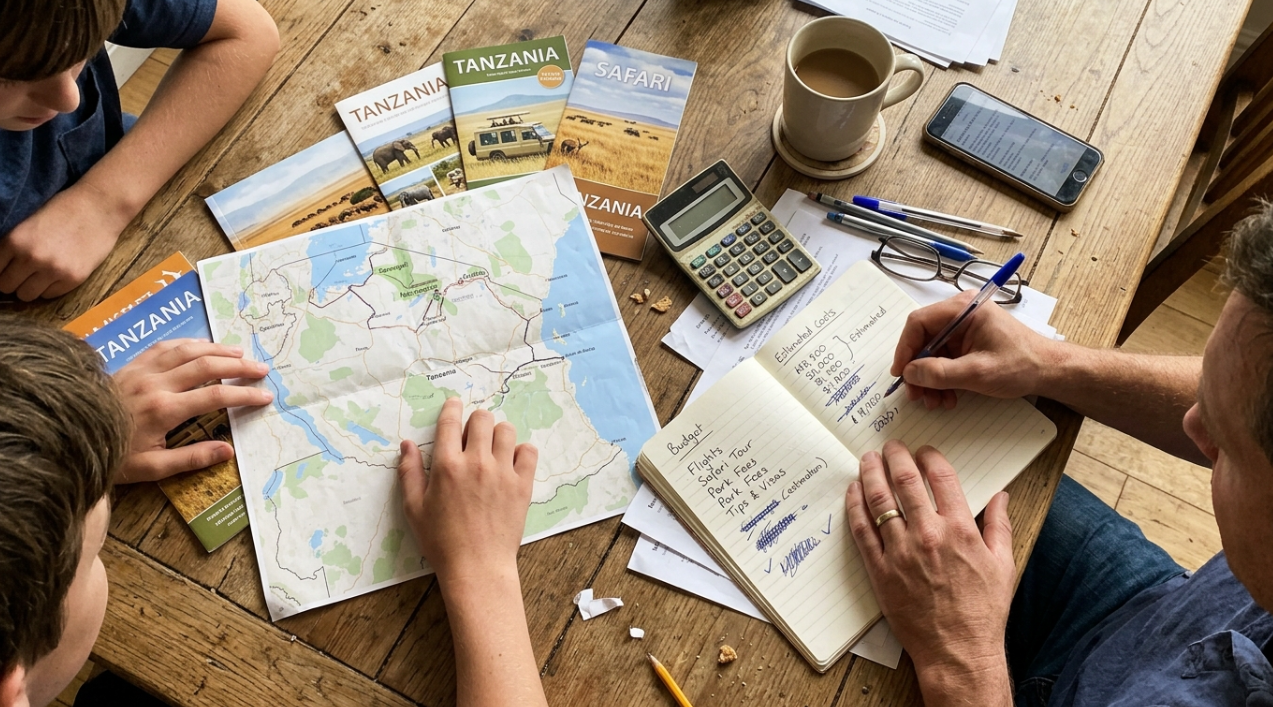
    Whether you’re organizing a family reunion, a friends’ trip, or a corporate safari in Tanzania, use this guide to understand your options and ask the right questions before booking.

    Before diving into planning details, Duma Explorer’s guide to safari planning for large families covers family-specific terms like child rates and age restrictions.

    Quick-Reference Table: 12 Large Group Safari Terms

    Term

    Meaning

    Why It Matters for Groups

    Private group safari

    A safari arranged exclusively for your party

    Gives your group more control over vehicles, guides, and schedules

    Joining safari

    A trip shared with other independently booked travelers

    May reduce costs but offers less itinerary flexibility

    Vehicle capacity

    The maximum number of passengers allowed in a safari vehicle

    Determines how many vehicles your group needs

    Vehicle allocation

    How travelers are distributed across vehicles

    Affects comfort, photography, and group coordination

    Exclusive-use lodge

    A property or camp booked exclusively for your party

    Can provide privacy and more flexible scheduling

    PPPN

    Per person per night

    Helps compare accommodation rates and calculate total costs

    Park conservation fee

    A fee charged for park entry or conservation access

    Must be budgeted separately where it is not included in a package

    Concession fee

    A charge that may apply to accommodation or activities within a designated area

    Check whether it is included in the quoted price

    Bush flight

    A small-aircraft flight connecting safari destinations

    Introduces passenger-weight, baggage, and aircraft-capacity constraints

    Baggage allowance

    The weight and size permitted by the airline

    Every traveler must follow the operating carrier’s policy

    Group deposit

    An initial payment securing bookings

    Requires clear collection deadlines and payment responsibilities

    Tipping coordinator

    The person responsible for organizing pooled tips

    Helps distribute contributions transparently and consistently

    Important: Vehicle capacities, baggage allowances, park fees, concession charges, and tipping recommendations vary by provider, destination, season, and applicable policy. Confirm the details for your specific itinerary before paying.

    Group Structure and Sizing Terms

    Private Group Safari vs. Joining (Shared) Safari

    A joining safari (also called a shared or group departure safari) means your travelers share a vehicle, guide, and fixed itinerary with strangers who independently booked the same departure. You follow set dates, set routes, and a set pace. If the group wants to linger at a cheetah sighting, that’s not your call.

    A private group safari means every vehicle, guide, and itinerary decision belongs to your party. For groups of 8 or more, private is almost always the right choice. The per-person cost difference shrinks as group size grows because vehicle and guide fees are divided among more people, and the flexibility gain is enormous.

    For a deeper comparison of these two formats, see this guide on shared vs. private group safaris.

    Group Leader / Trip Coordinator
    Planning Large Group Safari: 2026 Guide & Glossary

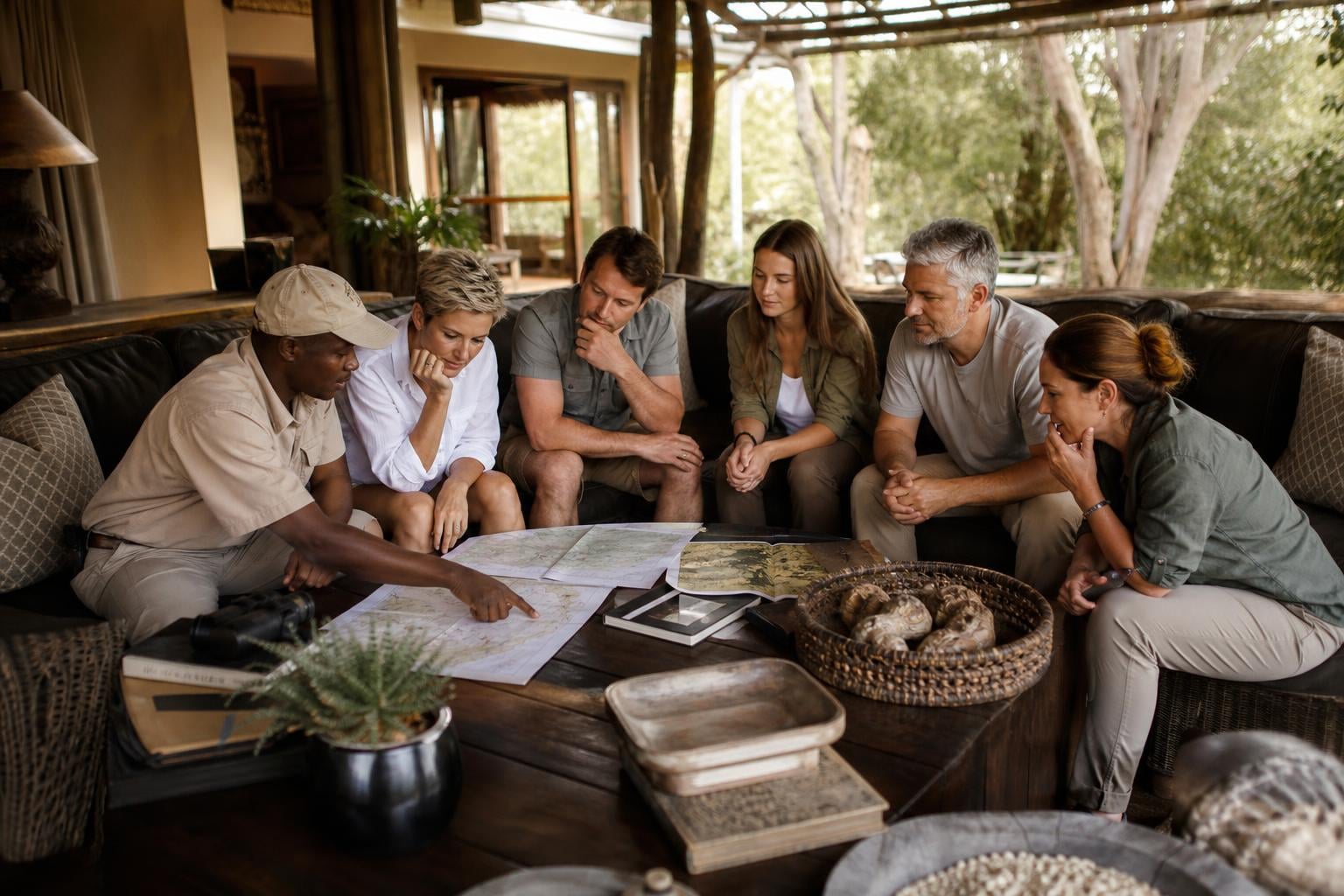
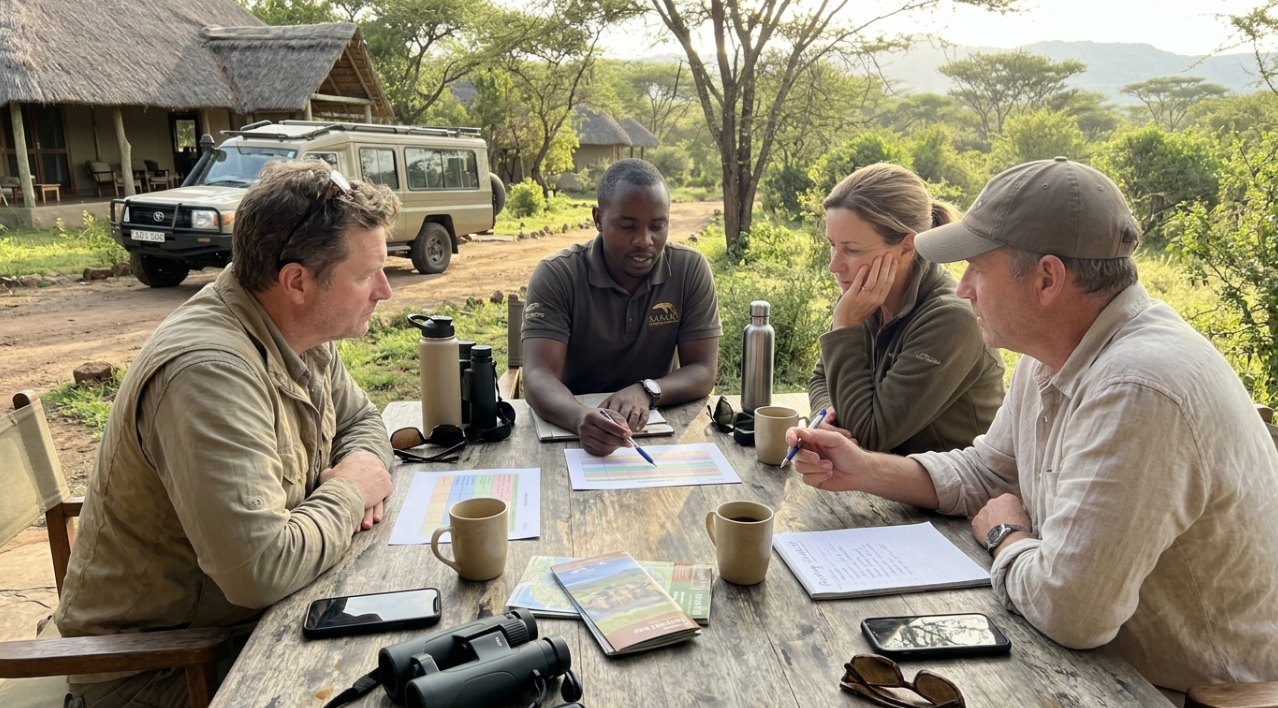
    The group leader is the person who initiates planning, communicates with the safari operator, collects preferences, and (usually) handles payment logistics. Safari advisors typically work directly with this coordinator first, then loop in other participants as the itinerary takes shape.

    Practitioners on travel planning forums emphasize that large groups benefit from designating specific people responsible for different coordination tasks, like one person handling accommodation preferences and another managing the activity wish list. Without defined roles, a group of 12 adults with 12 equal votes tends to stall.

    One past Duma Explorer client, Linda, put it well after coordinating a 13-person family safari spanning ages 11 to 62: “Trying to please so many people and organize a trip with so many demands is an art.”

    Why 12 Is the Natural Group Size Ceiling

    Travel advisors who specialize in Africa consistently recommend capping groups at around 12 people. The number isn’t arbitrary. It aligns with two hard constraints:

    • Vehicle math: 12 people fit neatly into either 2 vehicles (at 6 per vehicle) or 3 vehicles (at the quality standard of 4 per vehicle)

    • Bush plane capacity: Domestic bush flights in Tanzania and Kenya typically seat 12 passengers, with a hard maximum of 14

    Groups of 13 or more start hitting logistical friction. You need to split across flights, coordinate additional vehicles, and manage a party large enough that it begins to affect other guests at lodges and wildlife sightings.

    Sub-Group

    A sub-group is any smaller unit within the larger party that does a different activity on a given day. This might mean splitting by energy level (a walking safari for the adventurous half, a pool day for the rest), by interest (birders vs. big-cat enthusiasts), or by age (kids on a junior ranger program while adults do a sundowner drive).

    Building sub-group options into the itinerary from the start, rather than treating them as disruptions, is one of the biggest quality-of-life improvements for large group travel. Read more about pacing for mixed-age groups.

    Vehicle and Transport Terms

    Safari Vehicle Capacity (6 Max, 4 Quality Standard)

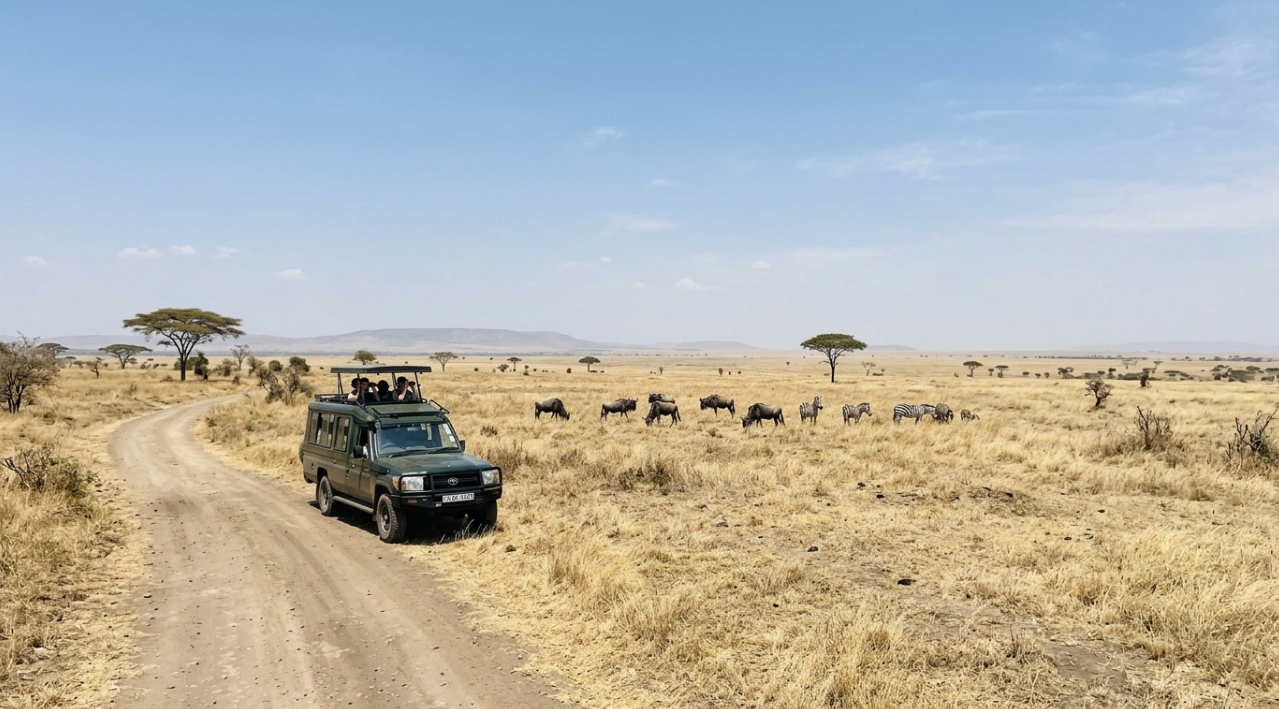
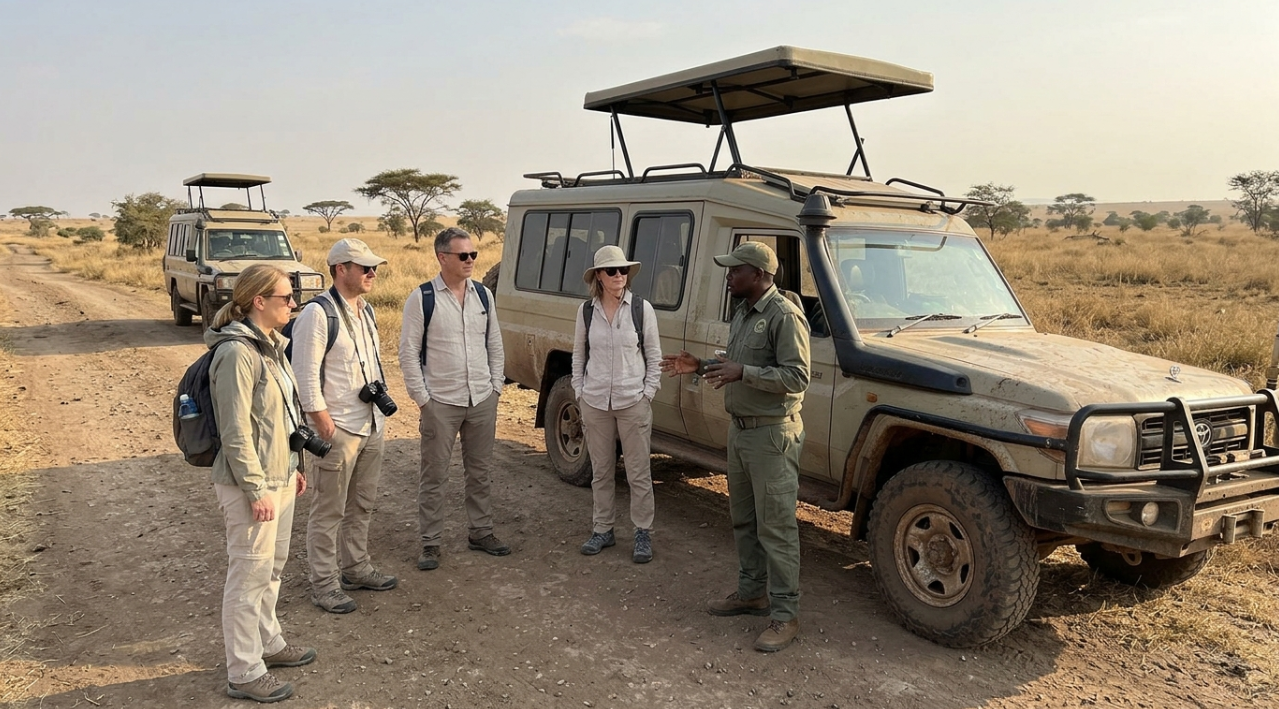
    The standard safari vehicle across Tanzania is the Toyota Land Cruiser 4×4, modified with a pop-up roof hatch for game viewing. It seats a maximum of 6 passengers.

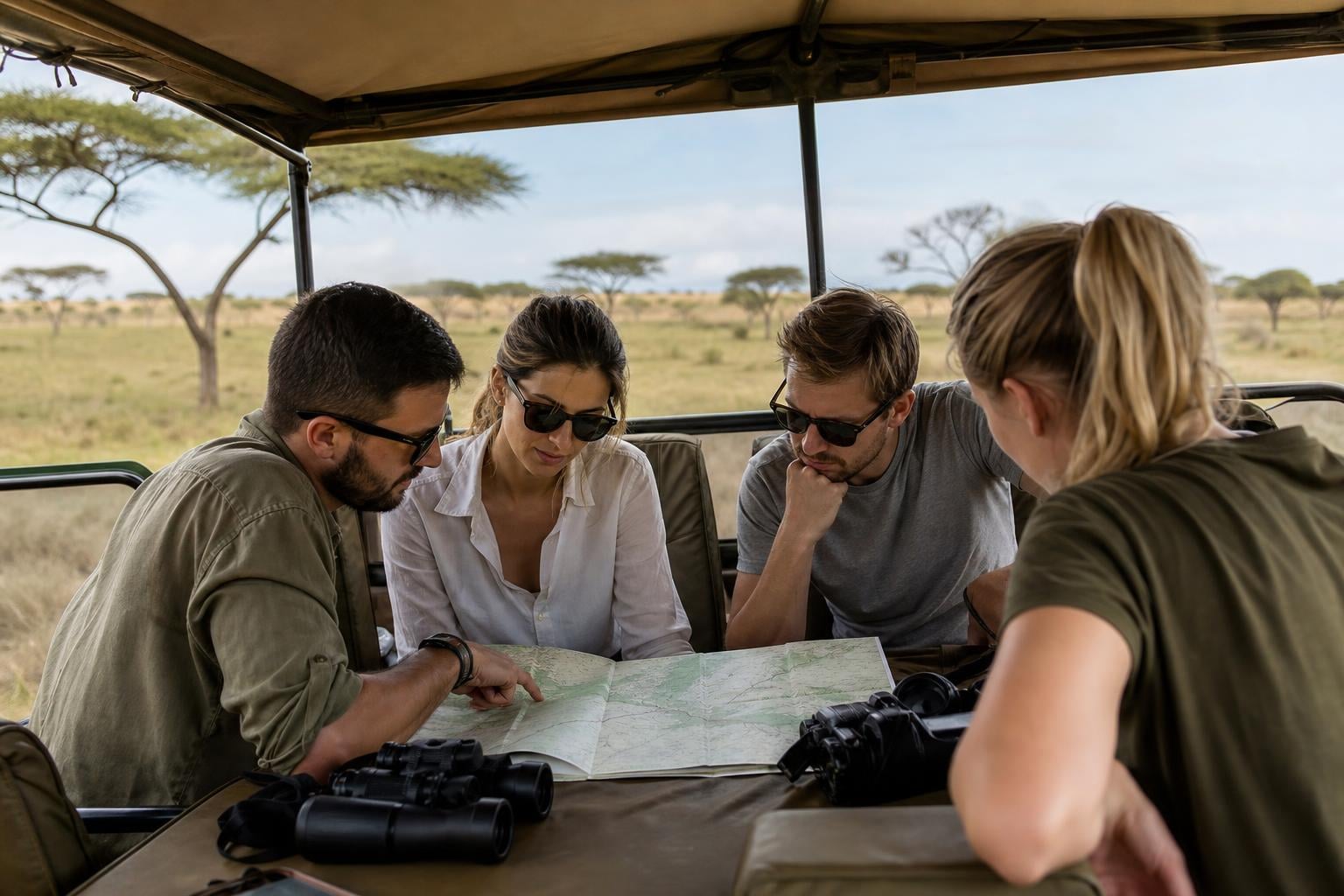
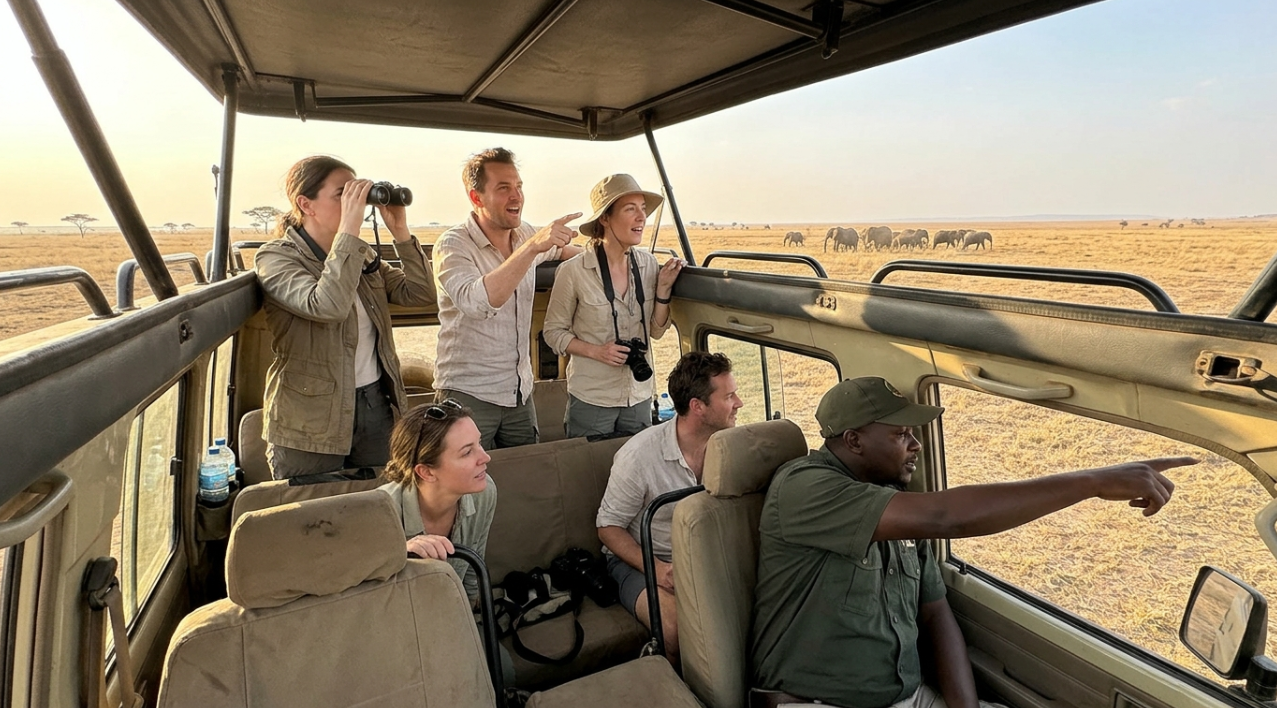
    But maximum capacity and ideal capacity are different things. In practice, 4 passengers per vehicle is the quality standard for a serious safari. With 4 people, every guest gets a dedicated window seat, an unobstructed position at the roof hatch, and enough room to handle a telephoto lens without elbowing a neighbor. With 6 people, two guests on each row are stuck in the middle. Photography is compromised. Personal space disappears.

    For a complete breakdown of vehicle types and configurations, see the safari vehicle glossary.

    How Many Safari Vehicles Does a Large Group Need?

    The number of vehicles required depends on the operator’s approved passenger capacity and how much space your group wants. For planning purposes, the examples below compare a maximum of six passengers per vehicle with a more spacious target of four passengers per vehicle.

    Assuming each private safari vehicle costs $250 per day, the following table illustrates the vehicle-cost share only.

    Group Size

    Vehicles at Up to 6 Passengers Each

    Vehicles at Up to 4 Passengers Each

    Daily Vehicle Cost per Person at 6-Passenger Capacity

    Daily Vehicle Cost per Person at 4-Passenger Capacity

    8

    2

    2

    $62.50

    $62.50

    10

    2

    3

    $50.00

    $75.00

    12

    2

    3

    $41.67

    $62.50

    14

    3

    4

    $53.57

    $71.43

    How to read the table: The vehicle cost per person is calculated by multiplying the number of vehicles by $250 and dividing the total by the number of travelers. The four-passenger scenario uses enough vehicles to accommodate everyone without exceeding four passengers in any vehicle.

    For example, a group of 12 could use two vehicles carrying six passengers each or three vehicles carrying four passengers each. The three-vehicle option costs more per traveler but offers more space.

    These figures are illustrative, not supplier quotations. Actual vehicle rates and permitted passenger numbers depend on the operator and vehicle configuration. The calculation excludes accommodation, park fees, guides or services billed separately, flights, meals not included in the vehicle rate, and other trip expenses.

    Inter-Vehicle Communication

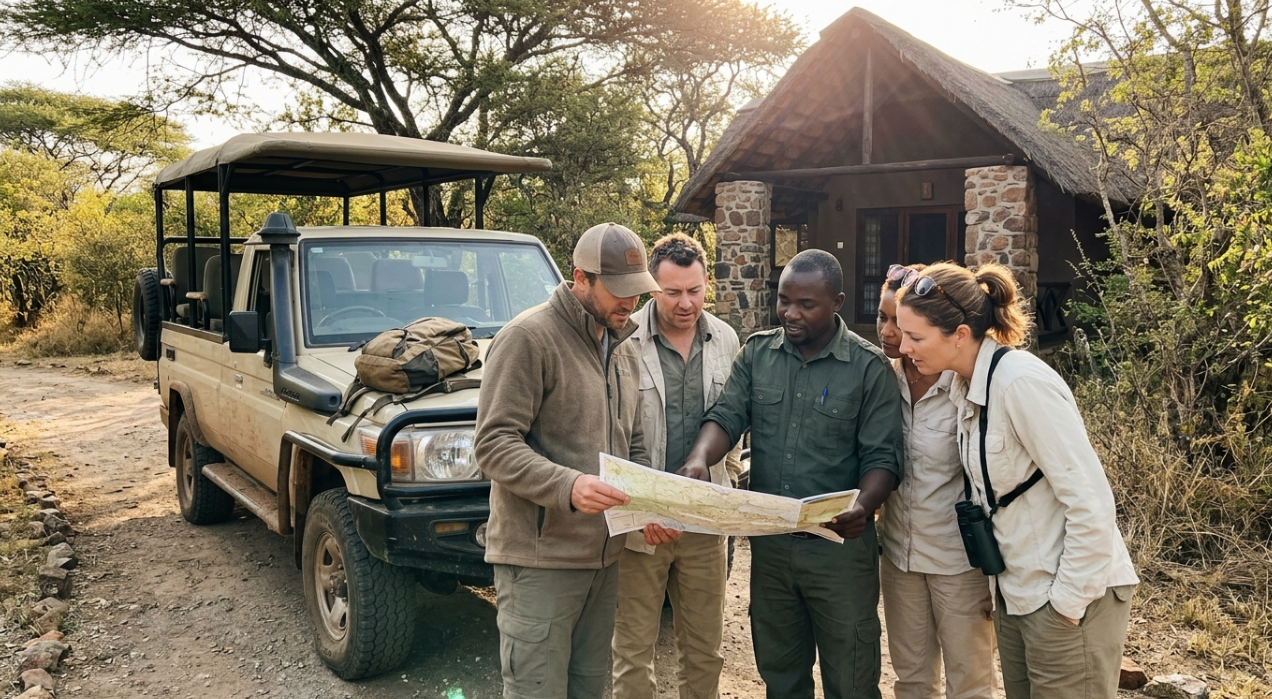
    A couple in one vehicle can respond to a sighting in seconds. Three vehicles carrying 14 people need to communicate by radio, reposition without blocking each other’s sightlines, and take turns at the sighting. The gap between a well-coordinated multi-vehicle group and a poorly managed one is the difference between an extraordinary shared experience and a frustrating logistical exercise.

    Good operators ensure their guides have a communication protocol for exactly this. When evaluating quotes, ask how guides coordinate across vehicles.

    Bush Plane Capacity and the 15 kg Rule

    Bush plane capacity: Domestic bush flights (Coastal Aviation, Auric Air, Air Excel) typically seat 12 passengers with an absolute maximum of 14. Groups of 13 or more will almost certainly need to split across two flights, which may depart at different times.

    The 15 kg rule: This is the single most misunderstood packing constraint for Tanzania safaris. Bush flights enforce strict per-person luggage limits, and that 15 kg includes everything: your soft-sided duffel and your day pack combined. Hard-shell suitcases are not allowed. This matters more for large groups because coordinating 12 people’s packing compliance is harder than coordinating two.

    Road Safari vs. Fly-In Safari (Group Implications)

    A road safari means driving between parks and camps. It’s cheaper, more flexible for stops, and doesn’t have luggage weight restrictions. But it’s slower, and drive days can eat 4 to 6 hours.

    A fly-in safari uses bush flights between destinations. It saves time and opens up remote areas. For large groups, fly-in logistics are trickier because of the 12-seat plane capacity and luggage limits, but they compress the itinerary and reduce fatigue, which matters when you’re managing energy levels across a dozen people.

    Accommodation Terms

    Exclusive-Use Lodge / Lodge Buyout

    An exclusive-use booking (also called a lodge takeover or lodge buyout) means your group books the entire property: every suite, every guide, the chef, the vehicles, the fire pit. For the duration of your stay, the lodge and its surrounding wilderness belong to your group alone.

    This is the accommodation format most recommended for large groups, multigenerational families, and corporate retreats. Benefits include:

    • Complete privacy: No navigating shared dining schedules or common areas with strangers

    • Custom scheduling: Meals, game drives, and activities run on your group’s clock

    • Personalized service: Private guides, a dedicated chef, and activities tailored to your mix of ages and interests

    Cost range: A stand-alone exclusive-use camp (6 to 12 guests) typically runs from approximately $9,000 to $25,000+ per night for the whole property, all-inclusive with dedicated staff. A private villa within a larger lodge (4 to 8 guests) ranges from roughly $4,500 to $12,000 per night. These figures vary widely by season, location, and lodge tier.

    Minimum Age Restriction Waiver

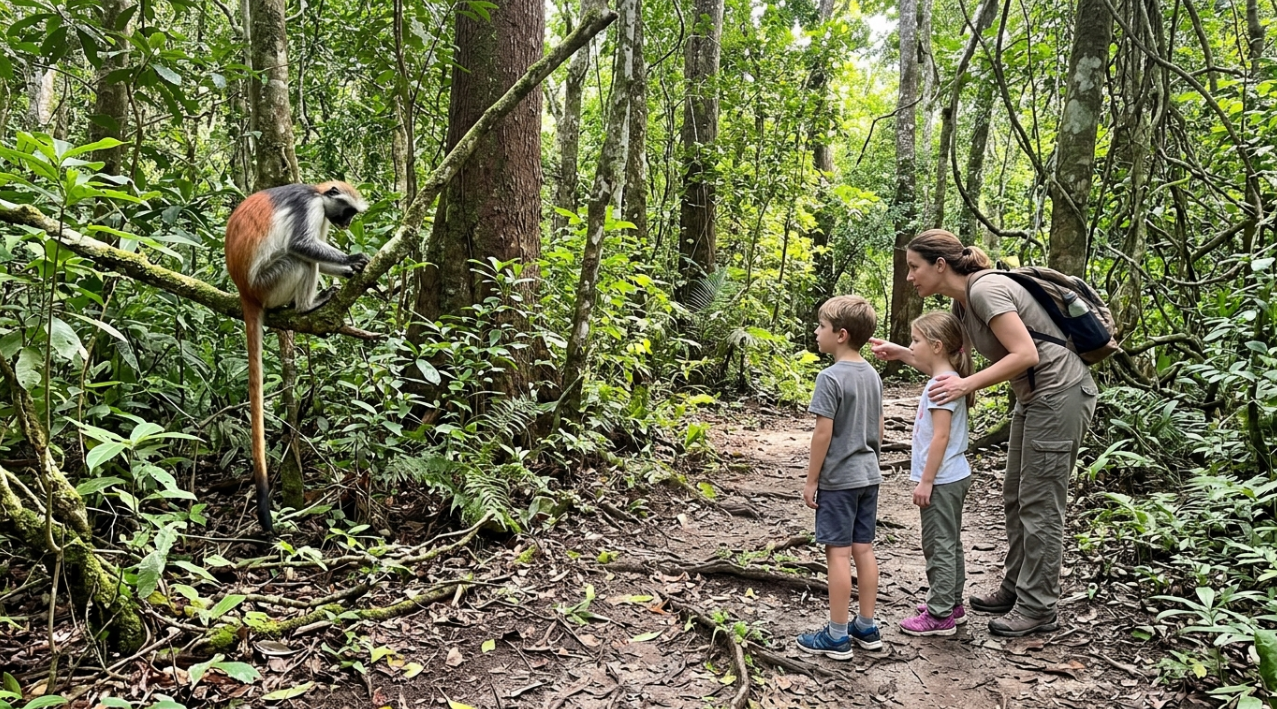
    Many safari lodges enforce minimum age requirements (often 6, 8, or even 12 years old) to protect the experience for other guests. When a lodge is booked for exclusive use, these restrictions are typically waived. The logic is simple: the only guests affected by a toddler’s noise are your own family.

    This is a critical detail for multigenerational groups traveling with young children. If you’re planning a trip with grandchildren, the safari with toddlers planning guide covers park-specific age rules in detail.

    Family Suite and Interconnecting Rooms

    A family suite is an accommodation unit designed for parents and children, typically with a master bedroom and a connected children’s sleeping area. Interconnecting rooms are two standard rooms with an internal door between them.

    For large groups, room configuration is a planning constraint, not an afterthought. Luxury tented camps usually have only 8 to 12 tents total, with a maximum capacity around 20 guests. If your group is 14 people, you’re filling the majority of a camp, which means booking early or considering an exclusive-use arrangement. For family-specific room options, see the family safari room guide.

    PPPN (Per-Person-Per-Night)

    PPPN is the standard pricing metric for safari accommodation. Unlike hotels priced per room, safari lodges and camps quote per person per night because the rate typically includes meals, drinks, game drives, and sometimes laundry.

    For group budget planning, the key insight is that PPPN costs scale linearly with headcount. Adding one more person adds one more PPPN charge. Vehicle and guide costs, by contrast, are shared, which is where groups gain economies of scale.

    Cost and Payment Terms

    Park Fees (Non-Negotiable, Per Person)

    Park entry fees in Tanzania are set by the Tanzania National Parks Authority (TANAPA) and charged per person per 24-hour period. There is no group discount.

    Current rates for adult visitors:

    • Premium parks (Serengeti, Ngorongoro): $82.60 per adult per day

    • Select parks (Tarangire, Lake Manyara, Arusha): $59.00 per adult per day

    These fees are the same whether you’re two people or twenty. For a group of 12 spending three days in the Serengeti, park fees alone total nearly $3,000. It’s a line item that surprises coordinators who assume larger groups get bulk pricing.

    For a full breakdown of what makes up a Tanzania safari price, see the safari cost guide.

    Concession Fee

    A concession fee is a mandatory charge of $70.80 per person per 24-hour period, levied by TANAPA for every lodge and tented camp operating inside the Serengeti. This is separate from and in addition to the $82.60 park entry fee. It is not optional, and it applies to every person for every night spent inside the park.

    Many group coordinators see the accommodation PPPN rate and assume that’s the total. The concession fee is the hidden line item that inflates the real cost.

    Vehicle Cost Sharing (Economies of Scale)

    This is where large groups actually save money. A private safari vehicle costing $200 to $300 per day works out to $33 to $50 per person when six passengers share it. The same vehicle with only two passengers costs $100 to $150 per person.

    The larger the group, the more these fixed vehicle and guide costs are diluted across participants. Park fees, accommodation, and flights remain per-person regardless of group size, but vehicle-related costs drop significantly per head. This is the core financial argument for traveling as a group.

    Large Group Safari Budget: Which Costs Are Shared?

    When planning a large group safari, separate costs that are charged per traveler from those shared by the group. This makes it easier to compare proposals and calculate what each person owes.

    Expense

    Typical Pricing Basis

    How to Allocate It

    Safari vehicle

    Per vehicle per day or trip

    Divide shared vehicle costs among assigned passengers

    Private guide

    Per day or trip, depending on the operator

    Share if the service is booked for the group

    Accommodation

    Per person, per room, or per property

    Allocate according to the actual room or occupancy arrangement

    Park and conservation fees

    Per person, age category, and applicable entry period

    Calculate for each eligible traveler

    Bush flights

    Per passenger, sometimes with baggage or charter charges

    Assign according to each person’s booking

    Meals and drinks

    Included in the package or charged separately

    Check the inclusions before dividing the balance

    Optional activities

    Per person or per activity

    Charge participating travelers only

    Travel insurance

    Individual policy

    Each traveler pays for their own cover

    Tips

    Voluntary, based on local guidance and service

    Agree on a transparent pooling method

    Card processing fees

    Depends on the payment method and operator

    Confirm the amount and agree how it will be allocated

    Example: Calculating a Shared Vehicle Expense

    Suppose 12 travelers book three safari vehicles at $250 per vehicle per day.

    • Total daily vehicle cost: 3 × $250 = $750

    • Number of travelers: 12

    • Shared daily vehicle cost per traveler: $750 ÷ 12 = $62.50

    This example covers only the vehicle charge. It is not a complete safari price estimate.

    Before collecting money, ask your operator for an itemized quotation showing what is included, which charges are mandatory, what is billed separately, and whether the price changes with group size or room occupancy.

    Safari Deposit and Balance Schedule

    A safari deposit is an upfront payment, typically 20% to 30% of the total trip cost, that secures your booking with lodges, camps, and ground operators. The remaining balance is usually due 60 to 90 days before departure.

    For large groups, the deposit stage is where coordination gets real. The group leader needs to collect deposits from 8 to 14 people, often with different comfort levels about committing money months in advance. Missing the deposit deadline can mean losing availability, especially for exclusive-use properties during peak season.

    Group Cost-Splitting Methods

    Practitioners on group travel forums consistently report that payment collection is the single biggest friction point for group coordinators. Data from SquadTrip, a platform built for group trip payments, confirms this.

    For most safari groups, a hybrid cost-splitting approach works best:

    • Shared equally: Private vehicles, driver-guide fees, fuel, and other common services

    • Allocated by room: Accommodation costs, assigned by actual room occupancy (a couple in a double room pays differently than a solo traveler)

    • Individual responsibility: International flights, travel insurance, personal purchases, optional activities, and tips beyond the pooled amount

    One practical tip from group travel coordinators: avoid Venmo or Zelle for groups over 5 people. There’s no booking page, no way to charge installments, and disputes become personal. A shared spreadsheet with clear deadlines and a designated collection method (bank transfer or a group payment platform) keeps things professional.

    Credit Card Surcharge

    Many safari operators accept credit cards but pass along a processing surcharge, typically around 3% to 5%. For a group trip totaling $40,000 or more, that surcharge adds $1,200 to $2,000. Wire transfers usually avoid this fee. Worth discussing with your operator early.

    Tipping Terms for Groups

    Guide Tipping Rates

    Tipping norms differ for large groups:

    • Small groups (2 to 4 people): $10 to $20 per traveler per day for the safari guide

    • Large groups (5+ people): A collective tip of $30 to $40 per group per day is standard

    The per-group approach keeps things proportional. A guide working with 12 people works harder than one with 2, but not six times harder. The collective amount recognizes the effort without creating the expectation that every person tips as if they were on a private safari for two.

    Lodge Tip Box

    Most safari lodges and camps have a communal tip box at reception. Tips placed here are distributed among all camp staff (housekeeping, kitchen, servers, laundry). The standard range is $10 to $15 per guest per night. For a group of 12 staying two nights, that’s $240 to $360 for the staff pool.

    Tipping Coordinator

    On day one or two of the safari, designate one person to coordinate the group tip. This doesn’t need to be a big conversation. Just: “Shall we pool the guide tip at the end?” works. The coordinator collects contributions, consolidates the cash, and presents it to the guide and camp staff at the appropriate time.

    One etiquette point from TripAdvisor forum discussions: do not over-tip conspicuously in front of a shared group. If you want to give more than the pooled amount, do it privately.

    If your trip includes Kilimanjaro, the Kilimanjaro tipping guide covers the separate (and more complex) tipping ceremony for mountain crews.

    Activity and Itinerary Terms

    Sighting Limit (5 Vehicles Maximum)

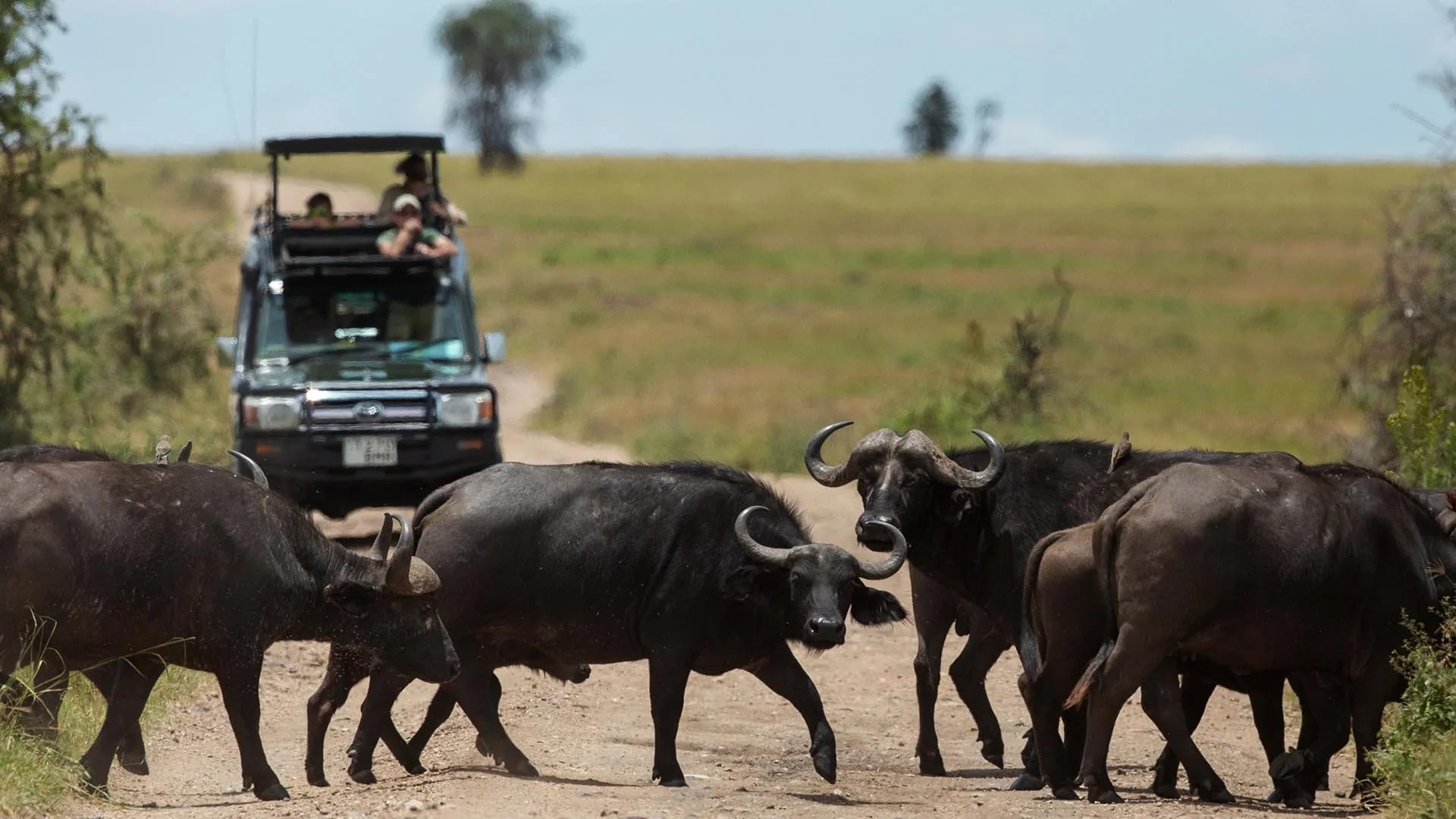
    Tanzania’s national parks enforce a maximum of five vehicles at any single wildlife sighting. The rule exists to reduce stress on animals and maintain the wilderness experience.

    This is especially relevant for large groups. A party traveling in 3 vehicles already occupies 60% of the sighting limit. If two other vehicles are already at a leopard sighting, only one of your three vehicles can join. Good guides manage this with communication and patience, hanging back and rotating positions rather than crowding in. But it’s a constraint that group coordinators should understand upfront.

    Gorilla Trekking Group Cap (8 People Per Family)

    If gorilla trekking in Uganda or Rwanda is part of the plan, a hard rule applies: a maximum of 8 visitors are permitted per gorilla family per day. Groups of 9 or more will be split into separate trekking groups, each assigned to a different gorilla family.

    This means the sub-groups will have different trekking experiences, possibly on different trails of varying difficulty and duration. It also means the group needs enough gorilla permits for everyone, and permits are limited. For a group of 12, that’s 12 permits that need to be secured, potentially across two gorilla families. Book these early.

    Details on permit costs, booking rules, and what to expect are covered in the gorilla trekking FAQ.

    Pacing and Split-Day Itinerary
    Planning Large Group Safari: 2026 Guide & Glossary

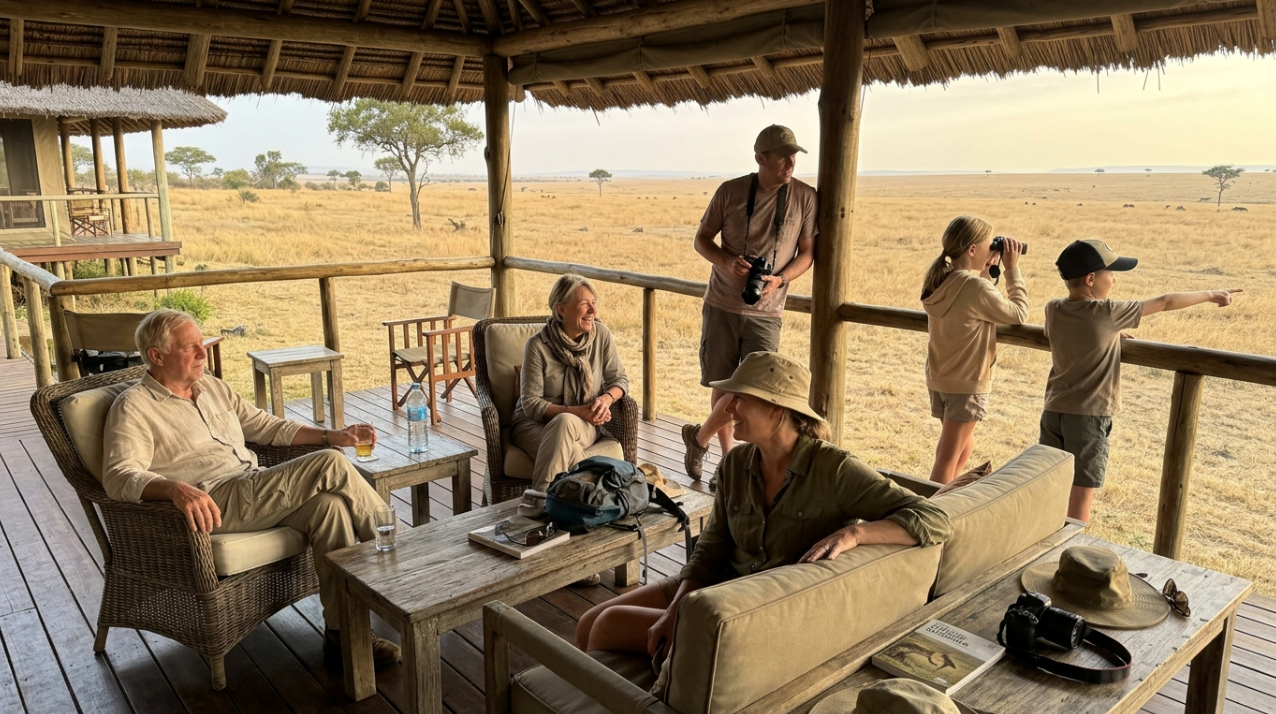
    A split-day itinerary builds in optional time so that not everyone has to do the same thing at the same time. One family member may be ready for an afternoon game drive while someone else needs to rest. The itinerary should treat this as a feature, not a problem.

    For multigenerational groups especially, pacing is the difference between a trip everyone remembers fondly and one where half the group felt dragged through someone else’s vacation.

    Celebration Logistics

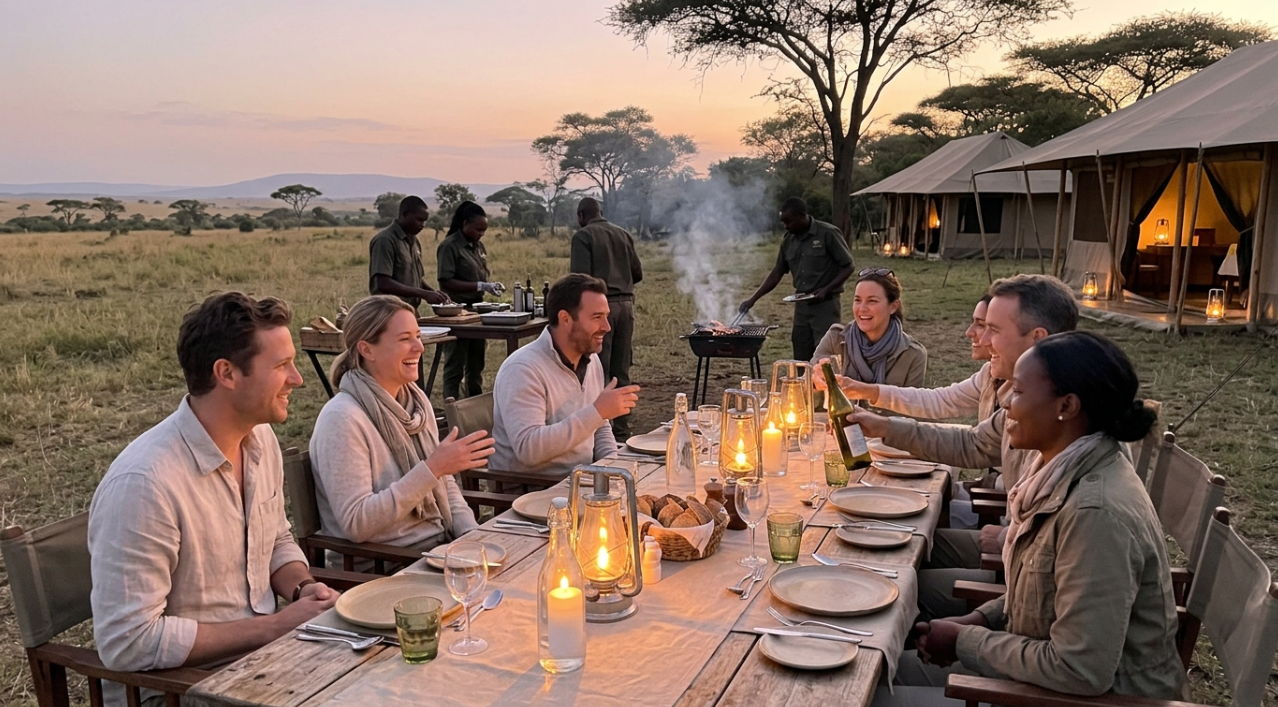
    Many large group safaris are built around a milestone: a 50th birthday, a retirement, an anniversary, a family reunion. The term “celebration logistics” covers the practical details of making that happen on safari. Think: a bush dinner under the stars, a private sundowner setup, a cake that somehow appears in the middle of the Serengeti.

    These are entirely possible, but they need to be communicated to your operator early. Lodge staff can work wonders with advance notice. They cannot improvise a surprise dinner for 14 people.

    Booking Lead Time for Large Groups

    Going as a group means booking as early as possible. For standard large group safaris during shoulder season, 6 months ahead is a reasonable minimum. For peak season (July through October in East Africa) or for exclusive-use lodge buyouts, 9 to 12 months is safer.

    The constraint isn’t just availability. It’s coordination. A group of 12 needs flights, 2 to 3 vehicles, guides, accommodation that can handle the full party, and possibly permits. Every week of delay narrows the options.

    Large Group Safari Planning Checklist

    Use this checklist before requesting quotations or paying a group deposit.

    Group Details

    • Confirm the number of travelers and the ages of all participants.

    • Appoint a group leader and identify a backup contact.

    • Collect each traveler’s preferred dates and approximate budget.

    • Record dietary requirements, accessibility needs, and other important requests.

    • Agree on the group’s main priorities, such as wildlife viewing, photography, cultural visits, or celebrations.

    Vehicles and Flights

    • Confirm the passenger capacity and configuration of each safari vehicle.

    • Decide whether comfort, photography space, or the lowest possible cost is the priority.

    • Ask how vehicles will communicate and coordinate during game drives.

    • Confirm passenger limits, baggage allowances, and baggage dimensions with each airline.

    • Find out whether travelers may need to depart on separate flights.

    Accommodation and Activities

    • Compare private-use accommodation with individually booked rooms.

    • Confirm room configurations, occupancy limits, and child policies.

    • Check which meals, drinks, game drives, and other services are included.

    • Reserve any limited-capacity activities or permits early.

    • Allow for different activity preferences and rest periods.

    Budget and Payments

    • Request an itemized quote for the entire group.

    • Identify park fees, concession charges, taxes, and other mandatory expenses.

    • Confirm deposit deadlines, final-payment dates, and accepted payment methods.

    • Review cancellation, refund, and traveler-substitution policies.

    • Agree how shared costs, room upgrades, optional activities, and tips will be allocated.

    • Decide what happens financially if a traveler withdraws.

    Final Confirmation

    • Verify passport, entry, visa, and travel-insurance requirements.

    • Confirm the final itinerary, accommodation, transport, and booking references.

    • Share the packing list, baggage rules, and emergency contacts with everyone.

    • Give the group one final statement of costs, payment deadlines, and responsibilities.

    Planning tip: Do not collect non-refundable payments until the group understands the booking terms and has agreed on how cancellations or withdrawals will be handled.

    What Your Operator Should Ask You

    A good operator doesn’t just send you a brochure. They ask the questions that shape an accurate, well-matched proposal. If your operator isn’t asking these, consider it a red flag:

    • Total number of travelers and ages of all participants (including children)

    • Preferred accommodation tier (midrange, premium, luxury, or a mix)

    • Budget range per person (even a rough range helps enormously)

    • Priority activities (Great Migration, big cats, gorilla trekking, cultural visits, beach extension)

    • Dietary requirements and food allergies (across all travelers)

    • Mobility considerations (anyone with limited mobility, recent surgery, or fitness concerns)

    • Any celebration or milestone (birthday, anniversary, retirement)

    • How the group wants to handle cost splitting

    • Whether everyone has passports with 6+ months validity

    • Travel insurance status

    Duma Explorer’s owner, Stacy Readal, has managed exactly this kind of complexity. For a 13-person family trip spanning ages 11 to 62, she patiently customized the itinerary with multiple revisions until every family need was met, including special food requests, all while working within the group’s budget. That process happened over Zoom calls, phone conversations, and email threads, reflecting the kind of responsiveness a group coordinator needs from their operator.

    Plan a large group safari with Duma Explorer

    Frequently Asked Questions

    How far in advance should a large group book a safari?

    Six months is a minimum for shoulder-season travel. For peak season (July to October) or exclusive-use lodge buyouts, aim for 9 to 12 months. The earlier you book, the more lodge and vehicle options remain available for a group of 8 or more.

    How many people fit in one safari vehicle?

    A standard Toyota Land Cruiser 4×4 seats a maximum of 6 passengers. However, 4 passengers per vehicle is the widely recognized quality standard, giving everyone a window seat and unobstructed roof-hatch access for photography and viewing.

    Is an exclusive-use lodge worth it for a large group?

    For groups of 8 or more, exclusive use is often the best way to travel. It eliminates schedule conflicts with other guests, removes minimum age restrictions for young children, and gives the group complete control over meals, activities, and pace. The per-person cost can actually be reasonable when split across 10 to 12 travelers.

    How should a large group split safari costs?

    A hybrid approach works best. Split vehicle, guide, and fuel costs equally. Allocate accommodation by room occupancy. Keep flights, insurance, optional activities, and personal expenses individual. Agree on payment deadlines early and designate one person to collect funds.

    Do park fees decrease for larger groups?

    No. Tanzania’s park entry fees are set per person per day by TANAPA and apply regardless of group size. There is no bulk discount. The Serengeti charges $82.60 per adult per day, and the concession fee adds $70.80 per person per night for camps inside the park.

    How does tipping work for a large group safari?

    Large groups (5+ people) typically pool a collective guide tip of $30 to $40 per group per day, rather than each person tipping $10 to $20 individually. Designate one tipping coordinator early in the trip to collect contributions and present the tip.

    Can a large group do gorilla trekking together?

    Only if the group is 8 people or fewer. Gorilla trekking permits are capped at 8 visitors per gorilla family per day. A group of 12 would be split into two trekking groups assigned to different gorilla families, potentially with different trail difficulties and durations. Permits should be secured well in advance.

    What happens if someone drops out after the deposit is paid?

    This depends on the operator’s cancellation terms and how close to the departure date the withdrawal occurs. Most operators require the remaining balance 60 to 90 days out, and cancellation penalties increase as the travel date approaches. The group should agree in advance on whether the departing member forfeits their deposit or whether the group absorbs the difference. Discuss this scenario before anyone sends money.
  • Corporate Safari Retreat Tanzania: 2026 Planning Glossary

    Corporate Safari Retreat Tanzania: 2026 Planning Glossary

    TL;DR

    A corporate safari retreat in Tanzania is a custom group trip that pairs private wildlife experiences with a business purpose, whether that’s leadership alignment, sales incentive rewards, team bonding, or client hosting. The design challenge is balancing safari logistics (vehicles, flights, camps, park fees, early mornings) with corporate needs (meeting time, connectivity, privacy, varied fitness levels). This glossary explains the key terms planners will encounter in proposals and shows how each one affects the attendee experience, budget, and overall trip quality.

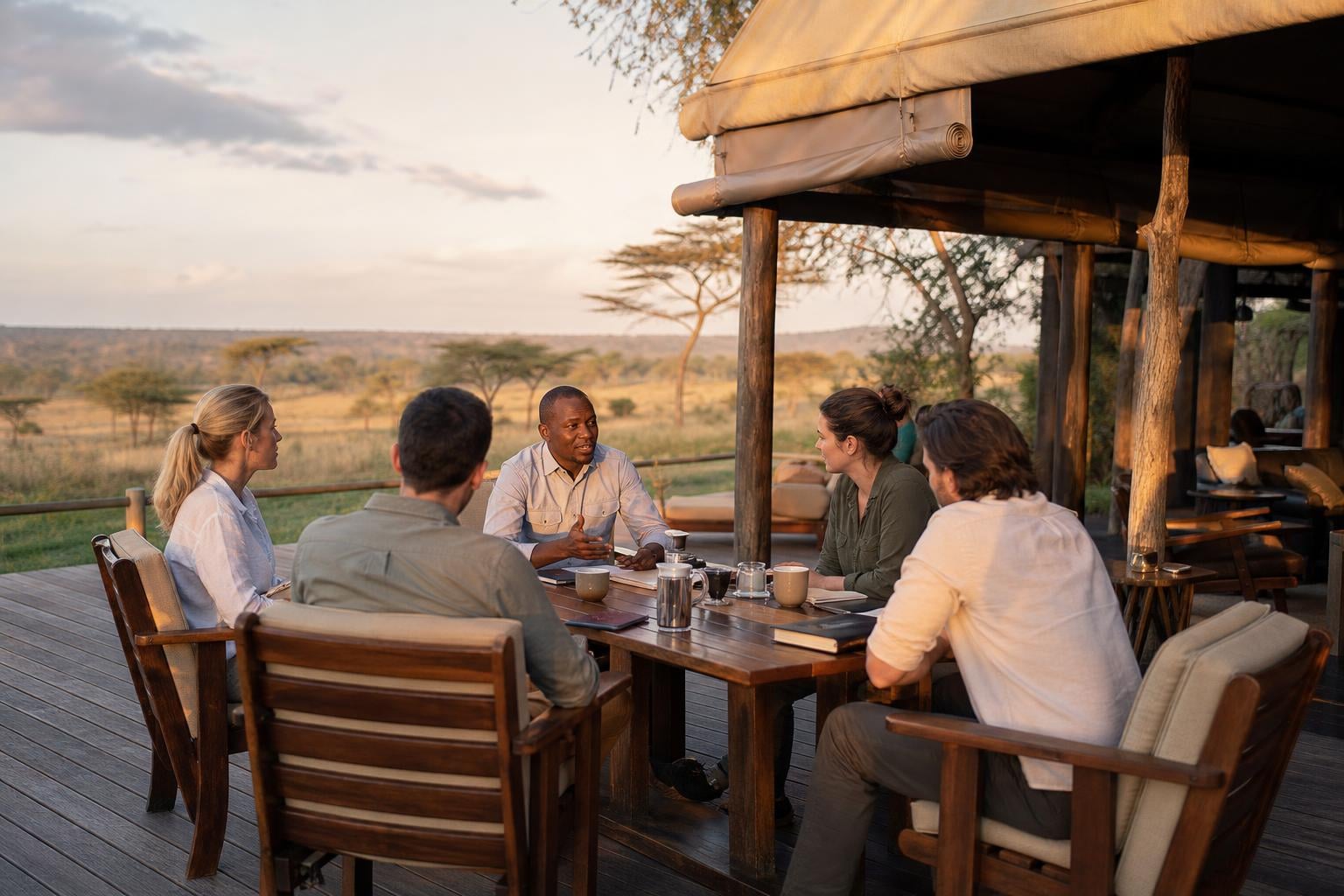
    A corporate safari retreat in Tanzania is not a standard company offsite with a safari bolted on. It is a custom group itinerary that combines private wildlife experiences with a clear business objective: leadership alignment, team connection, incentive travel, board strategy, or client hosting. Unlike a regular conference or a leisure safari, the agenda is shaped around safari logistics. Private vehicles, lodge capacity, park fees, long transfer days, domestic flights, rooming lists, meal requirements, guide assignments, Wi-Fi realities, and downtime all determine whether the retreat feels polished or exhausting. The best programs start with the objective, not the destination. A leadership team may need a quiet Arusha or Ngorongoro Highlands base with private meeting time, while a reward group may prioritize Serengeti game drives, sundowners, a balloon safari, and a Zanzibar beach finish.

    The terms below are organized by planning category to help corporate planners, HR leaders, executive assistants, and incentive travel managers navigate proposals with confidence.

    A corporate safari retreat in Tanzania is a customized group trip that combines guided wildlife experiences with a business objective, such as leadership alignment, team bonding, incentive travel, or client hosting. Planning one involves choosing the right safari destinations, coordinating private vehicles and accommodation, balancing meeting time with game drives, and budgeting for park fees, domestic flights, meals, and optional experiences. The best itinerary depends on the group’s size, budget, travel dates, privacy requirements, and primary business goal.

    Corporate Safari Retreat Terms at a Glance

    Term

    Plain meaning

    Why it matters for corporate groups

    Corporate safari retreat

    A group safari designed around a business objective

    Determines the itinerary, meeting schedule, and overall experience

    Incentive travel

    A trip rewarding employees, partners, or top performers

    Prioritizes recognition, comfort, and memorable experiences

    Private safari vehicle

    A dedicated safari vehicle and guide for a group or subgroup

    Allows flexible schedules, better coordination, and personalized guiding

    Fly-in safari

    A safari itinerary using domestic flights between destinations

    Reduces lengthy road transfers but increases transportation costs

    Lodge buyout

    Reserving an entire property or its available accommodation for exclusive use

    Improves privacy and can support confidential meetings

    Rooming list

    A document assigning accommodation to each attendee

    Prevents booking errors and clarifies single-room and twin-share needs

    Bush dinner

    An arranged outdoor dinner in a safari setting

    Creates a memorable setting for recognition and networking

    Sundowner

    Drinks and refreshments served around sunset

    Provides an informal opportunity for connection and conversation

    Safari fatigue

    Tiredness caused by early starts, travel, heat, and extended game drives

    Makes realistic pacing and rest periods essential

    Buffer night

    An extra overnight stay protecting the itinerary against travel disruptions

    Reduces the risk of missed flights or disrupted group departures

    Zanzibar extension

    A beach stay added before or after a safari

    Provides relaxation and can extend the incentive experience

    Single supplement

    The additional accommodation charge for one person occupying a room alone

    Can materially affect the total budget for corporate groups

    Group brief

    A planning document outlining the group’s needs and objectives

    Helps an operator prepare a more accurate proposal

    Contingency budget

    Funds reserved for unexpected costs or changes

    Helps manage logistical uncertainty and unplanned expenses

    What Is a Corporate Safari Retreat in Tanzania?

    A corporate safari retreat is a purpose-built group itinerary combining Tanzania’s wildlife, landscapes, and remote settings with a defined business goal. It can serve team bonding, executive alignment, sales incentive rewards, board retreats, partner rewards, client hosting, or leadership development.

    It is not the same as a conventional conference. There is no ballroom. The “venue” is a national park, a tented camp on the Serengeti plains, or a lodge overlooking the Ngorongoro Crater. And it is not the same as a normal leisure safari, where two or four people hire a guide and follow wildlife at their own pace. Corporate retreats involve group coordination, vehicle logistics, dietary matrices, VIP handling, meeting time, and attendee communications that leisure trips rarely require.

    Tanzania has strong destination credibility for this kind of program. The country recorded over 2.29 million international tourist arrivals in 2025 with tourism earnings reaching USD 4.41 billion, according to Tanzania’s National Bureau of Statistics. Tanzania Tourist Board’s S!TE 2026 buyer program explicitly includes incentive travel representatives involved in corporate travel and destination experience planning, signaling that the country is actively positioning itself for business-events tourism.

    The main design challenge is balancing wildlife time, meeting time, rest, privacy, and logistics. Get the balance wrong and the trip either feels like a conference that happens to be in Africa or like a vacation where nobody discussed anything meaningful.

    If your team is considering Tanzania for an incentive trip, leadership retreat, or private group safari, compare Tanzania safari itinerary structures to understand how routing and pacing shape the experience before asking for a proposal.

    Corporate Safari Retreat vs. Incentive Trip vs. MICE Program

    These terms overlap and planners often confuse them. The distinction matters because each format requires different design choices.

    Term

    Definition

    Best for

    Corporate safari retreat

    Safari-based offsite for connection, strategy, or team development

    Leadership teams, people teams, founders, boards

    Incentive travel

    Reward trip for top performers, partners, or milestone achievers

    Sales incentives, channel partners, executive recognition

    MICE

    Meetings, Incentives, Conferences, and Exhibitions

    Larger corporate or association programs

    Executive retreat

    Small, confidential, privacy-focused trip

    Board, C-suite, founders, investors

    Client-hosting safari

    Safari used for relationship building with customers or partners

    High-value relationships

    Workation

    Longer stay blending remote work and leisure

    Less ideal for remote safari camps unless Wi-Fi is carefully vetted

    The IRF’s 2026 trends report found that 35% of end-users say incentive travel is not integrated with HR initiatives, while 24% view it as a core part of people strategy. This split matters because it changes how the trip should be designed. A sales incentive is about reward and recognition. A leadership retreat is about alignment and privacy. A team-bonding safari is about shared experience and organic connection. Applying the wrong template produces frustration.

    If the trip is primarily about reward, design around awe, comfort, recognition, and minimal friction. Don’t schedule meetings.

    If it is about leadership alignment, design around privacy, meeting rhythm, and decompression between sessions. Shorter game drives work better than full-day ones.

    If it is about team bonding, avoid forced activities and use safari’s natural shared experiences as the foundation. Practitioners on Reddit consistently report that forced fun at company retreats backfires, and that optional blocks with proper downtime are far better received.

    If it is about client hosting, invest in guide quality, vehicles, dining, and smooth transfers. Every logistical hiccup erodes the impression you are trying to create.

    Retreat Format Glossary

    Private Safari Retreat

    A custom wildlife-focused itinerary with private vehicles, private guide arrangements, and flexible pacing. Best for small to mid-sized teams that want connection without a formal conference feel. The emphasis is on shared experience rather than structured agendas.

    Safari + Strategy Retreat

    A retreat that reserves blocks for facilitated meetings, leadership sessions, or board-level discussion. Game drives are shorter or alternated with meeting mornings. Properties are chosen partly for meeting space, shade, power, and connectivity rather than purely for wildlife positioning.

    Safari + Incentive Reward

    A recognition trip designed to feel special. Premium camp choices, sundowners, bush dinners, optional balloon safari, private guide, and sometimes a Zanzibar finish. The goal is that participants retell the experience for years. As one LinkedIn practitioner noted about executives on a Kenya/Tanzania safari, incentive luxury is often about listening to personal preferences and creating moments participants retell later, not simply the suite or lodge brand.

    Safari + Conservation / CSR

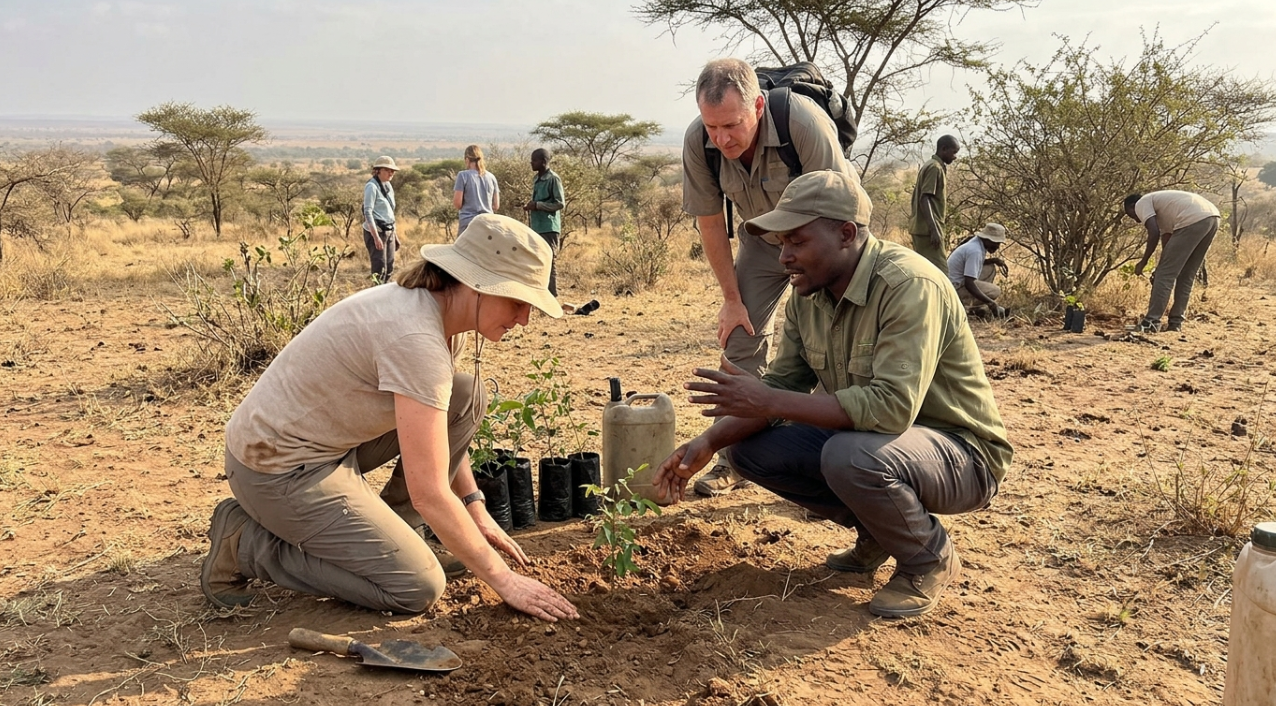
    A program that includes a responsible, well-vetted community or conservation element. Use caution here. Community visits should be dignified, mutually beneficial, and never performative. Travelers on Reddit have described feeling uncomfortable when community experiences in Tanzania felt staged or exploitative. If the goal is genuine ESG alignment, vet the partner organization thoroughly and ensure fair compensation flows to the community.

    Safari + Coast

    A bush-and-beach itinerary that ends in Zanzibar, Pangani, or Saadani for decompression after early mornings and long game-drive days. This is one of the most popular corporate safari retreat formats in Tanzania because it gives attendees a recovery arc. You can explore Zanzibar excursion options to understand what the beach portion can include beyond sunbathing.

    Safari + Kilimanjaro

    A physically active retreat that may include a Kilimanjaro day hike or a full summit attempt for fit teams. A full climb is a separate expedition requiring proper fitness screening, safety planning, and appropriate guide ratios. A day hike on the lower slopes works well as an active add-on without the logistical weight of a multi-day climb.

    Executive Fly-In Retreat

    A time-efficient safari that uses domestic flights or charters to reduce long overland transfers. Often the best choice for senior teams with limited days and high opportunity cost. The incremental flight cost is usually justified by the hours saved and the reduced physical toll on participants.

    Safari Logistics Glossary

    These terms determine comfort, timing, and cost more than any lodge branding or itinerary headline.

    Private Safari Vehicle

    Corporate Safari Retreat Tanzania: 2026 Planning Glossary

    A dedicated 4×4 and guide for one group or sub-group. Corporate groups usually need multiple vehicles, with group assignments planned by department, role, photography needs, mobility, or VIP status. Practitioners on Reddit repeatedly emphasize that vehicle quality and guide skill affect satisfaction more than lodge branding when comparing Tanzania safari operators. For corporate retreats, this effect is amplified because every vehicle becomes a small social unit for hours at a time. To understand the vehicle options, review safari vehicle types and features.

    Pop-Top Vehicle

    A safari vehicle with a roof that opens for wildlife viewing and photography. Standard for Tanzania game drives. The pop-top is what turns a vehicle into a viewing platform rather than a car with windows.

    Guide Allocation

    The plan for how many guides and vehicles the group needs. For corporate retreats, this goes beyond simple headcount. Certain travelers may need a senior guide, a photographer-friendly guide, or a private VIP vehicle. Guide allocation is where the retreat either feels personal or feels like a bus tour.

    Convoy

    Multiple safari vehicles moving along the same route. Convoys need radio coordination but should not feel rigid. Vehicles often separate for wildlife sightings and regroup for meals or transfers. Good convoy management preserves the feeling of a private experience while keeping the group loosely connected.

    Fly-In Safari

    Using scheduled domestic flights or charters to reach the Serengeti, Zanzibar, or other airstrips rather than driving every leg. Reddit travelers regularly recommend flying into or out of the Serengeti to avoid long return drives. The IRF’s 2026 trends report confirms this pattern at scale: direct air access is the most cited incentive travel “must-have,” while difficult air access is a major deterrent when selecting destinations for corporate programs.

    Domestic Safari Flight

    A small-plane flight between Arusha, Serengeti airstrips, Zanzibar, or other points. These flights have luggage limits and typically require soft-sided bags. For corporate groups, the logistics of coordinating 15 or 20 people onto small aircraft require advance planning and sometimes multiple flight departures.

    Charter Flight

    A private aircraft movement arranged specifically for the group. Useful for executive teams, larger incentive groups, or tight schedules where commercial flight times do not align with the itinerary.

    Transfer Day

    A day primarily spent moving between locations, even if game viewing happens en route. Corporate planners should not overload transfer days with important meetings or late-night dinners. Attendees who have spent six hours in a vehicle on bumpy roads are not in the right state for a strategy session.

    Safari Fatigue

    The cumulative tiredness from early morning wake-ups (often 5:30 or 6:00 a.m.), long drives, dust, heat, bumpy roads, and altitude changes. For leisure couples, this is manageable. For corporate groups with mixed fitness levels, varied enthusiasm, jet lag, and social obligations at dinner, safari fatigue can erode the retreat’s value quickly. Reddit safari discussions consistently flag this as the most underestimated planning factor. Build rest blocks into every day.

    Arrival Night

    A first night near Arusha or Kilimanjaro International Airport (JRO) used to recover from international travel before entering the parks. This is especially important for groups arriving from multiple continents on different flights. Kilimanjaro International Airport serves as the gateway for Northern Circuit safaris and is located near both Arusha and Moshi.

    Buffer Night

    An extra night before or after safari to protect against flight delays, baggage issues, or missed connections. For a corporate group, one person’s lost luggage or delayed arrival can disrupt the entire convoy departure. Buffer nights are cheap insurance.

    For time-sensitive executive groups, Duma Explorer can compare a road-based Northern Circuit retreat with a fly-in Serengeti version so your team can see what it gains in comfort, time, and flexibility.

    Lodging, Venue, and Privacy Glossary

    Lodge

    A fixed safari property with permanent infrastructure. Lodges often have better meeting space, more reliable Wi-Fi, consistent power, and larger common areas than tented camps. For corporate retreats that need a projector, printed materials, or reliable connectivity, lodges are usually the safer choice.

    Tented Camp

    A safari camp with canvas-style accommodation. “Tented” does not mean basic. High-end tented camps can include en-suite bathrooms, hardwood floors, private decks, and excellent dining. The distinction matters because tented camps often offer more atmosphere and intimacy, which suits smaller groups and recognition-focused incentive trips.

    Mobile Camp

    A camp that moves seasonally to follow wildlife patterns, particularly the Great Migration. Good for unique positioning but typically less ideal for formal meetings. Mobile camps are best for reward-focused trips where the priority is wildlife access, not AV equipment.

    Exclusive-Use Camp / Lodge Buyout

    Booking all rooms or units so the group has full privacy. This improves confidentiality for board meetings, allows custom branding or signage, provides complete dining flexibility, and prevents the awkwardness of mixing with other guests during sensitive discussions. Buyouts require early booking, especially during peak season.

    Room Block

    A reserved set of rooms within a larger property where other guests may also be present. Less private than a buyout but more affordable. Corporate planners need to confirm single and twin room requirements early because remote properties have limited inventory.

    Rooming List

    The working document showing each attendee’s room assignment, bed preference, dietary notes, arrival and departure details, and special needs. For corporate groups, the rooming list also needs to account for seniority, reporting relationships, and whether certain people should or should not be assigned adjacent rooms. Get this right and nobody notices. Get it wrong and the retreat starts with a complaint.

    Twin Share

    Two people sharing one room with separate beds. This is common in safari pricing but sensitive in corporate settings. Not all employees want to share a room with a colleague. Seniority expectations, gender, personal comfort, and relationship dynamics all factor in. Discuss this with your operator early rather than defaulting to twin share to save budget.

    Single Supplement

    The extra cost for solo occupancy. This is the per-person premium for having a room to yourself. For incentive budgets, single supplements across 20 travelers can add meaningful cost. For executive retreats, singles are usually expected.

    Meeting-Ready Lodge

    A lodge with realistic space, seating, shade, power, Wi-Fi, and backup plans for meetings or presentations. Not every beautiful safari property is suitable for a projector-heavy strategy session. Some lodges have purpose-built conference areas. Others can arrange outdoor meeting setups under thatched shelters. The key is confirming the specific capabilities before booking, not assuming.

    Wi-Fi Reality Check

    Remote safari locations may have limited or inconsistent connectivity. Satellite internet is common at premium properties, and it can handle email and basic browsing, but video calls, large file transfers, and real-time collaboration tools often struggle. If meeting productivity depends on connectivity, run a tech audit with the property and prepare offline backups.

    Tanzania Destination Glossary for Corporate Retreats

    These are not generic destination descriptions. They explain what each location offers and demands in corporate planning terms.

    Arusha

    The common staging area for Northern Circuit safaris, arrival nights, briefing dinners, and some meeting sessions. Arusha has strong hotel infrastructure, meeting venues, and proximity to Kilimanjaro International Airport. It is more logistically practical than scenic, which makes it useful as a briefing point and recovery base rather than the centerpiece of the retreat.

    Serengeti

    Best for the highest-impact safari experience. The Serengeti is a UNESCO World Heritage Site and home to the world’s largest terrestrial mammal migration, with more than 1.5 million wildebeest, zebra, and associated predators moving across the ecosystem. For corporate retreats, the Serengeti delivers the “wow” factor that makes an incentive trip memorable or a client-hosting safari worth the investment. Experiences include game drives, walking safaris, and hot air balloon flights. Plan the Serengeti portion carefully by reviewing the Serengeti safari planning guide because the park is vast and positioning matters.

    Ngorongoro Crater

    Best for a concentrated wildlife day and dramatic landscape. The crater, described by UNESCO as the world’s largest caldera, offers exceptional wildlife density in a confined area. First-time safari groups often find the crater deeply impressive. Logistically, crater days start early and involve a descent fee, vehicle limits, and a mandatory six-hour time restriction inside the crater floor. Learn how a Ngorongoro day fits into a broader safari itinerary before committing to it as a full retreat day.

    Tarangire

    Best for elephants, baobab landscapes, and a strong first wildlife day. TANAPA describes Tarangire as “The Paradise of Elephants” with one of Africa’s highest elephant concentrations during the dry season. Tarangire is closer to Arusha than the Serengeti, which makes it practical as a first stop that introduces the group to safari without immediately requiring a long drive or domestic flight. See why Tarangire works well as a first game drive destination.

    Lake Manyara

    Best as a shorter wildlife stop or scenic add-on. Known for tree-climbing lions, large-tusked elephants, flamingos, and over 400 bird species according to TANAPA. Not always the centerpiece of a corporate retreat, but useful for a half-day experience en route between Arusha and Ngorongoro.

    Arusha National Park

    Best for a short pre- or post-retreat nature activity when time is limited. TANAPA lists walking safaris, canoeing on Momella Lakes, guided hikes, and photography as available activities. A morning in Arusha National Park works well as an icebreaker before the group departs for the main safari circuit.

    Zanzibar

    Best for post-safari decompression, incentive rewards, client hosting, or a gala dinner close. The shift from bush to beach gives the retreat an emotional arc. Do not overpromise meeting infrastructure on Zanzibar unless verified for the chosen property. The island is better used as a reward and recovery element than as a working session location. Check Zanzibar weather and season patterns before selecting dates for a beach extension.

    Kilimanjaro

    A corporate retreat element only for groups with the right fitness, risk tolerance, and time. A full climb is a separate multi-day expedition. A day hike on the lower slopes can work as an active team challenge if properly planned and screened.

    Experience Glossary

    Game Drive

    A guided wildlife drive in a safari vehicle. Game drives come in several formats: early morning (starting before sunrise), half-day, full-day with picnic lunch, and en-route drives conducted while transferring between destinations. For corporate groups, morning drives work best when the afternoon is reserved for meetings, rest, or informal socializing.

    En-Route Game Drive

    Wildlife viewing conducted while the group is transferring between parks or camps. This sounds efficient on paper, but it is still a transfer day. The group will be tired on arrival, and the game viewing is often secondary to covering distance.

    Sundowner

    Drinks and snacks served at sunset in a scenic outdoor setting. Corporate uses include informal debriefs, recognition moments, and client-hosting conversations. Sundowners feel effortless to attendees but require advance coordination between the guide, camp staff, and event coordinator.

    Bush Dinner

    Corporate Safari Retreat Tanzania: 2026 Planning Glossary

    A private or semi-private outdoor dinner, often arranged in a clearing away from the main camp, lit by lanterns or a fire. Corporate uses include awards presentations, founder speeches, client appreciation moments, and group storytelling. Bush dinners create the kind of setting that would cost a fortune to fabricate in a hotel but happens naturally in the Serengeti.

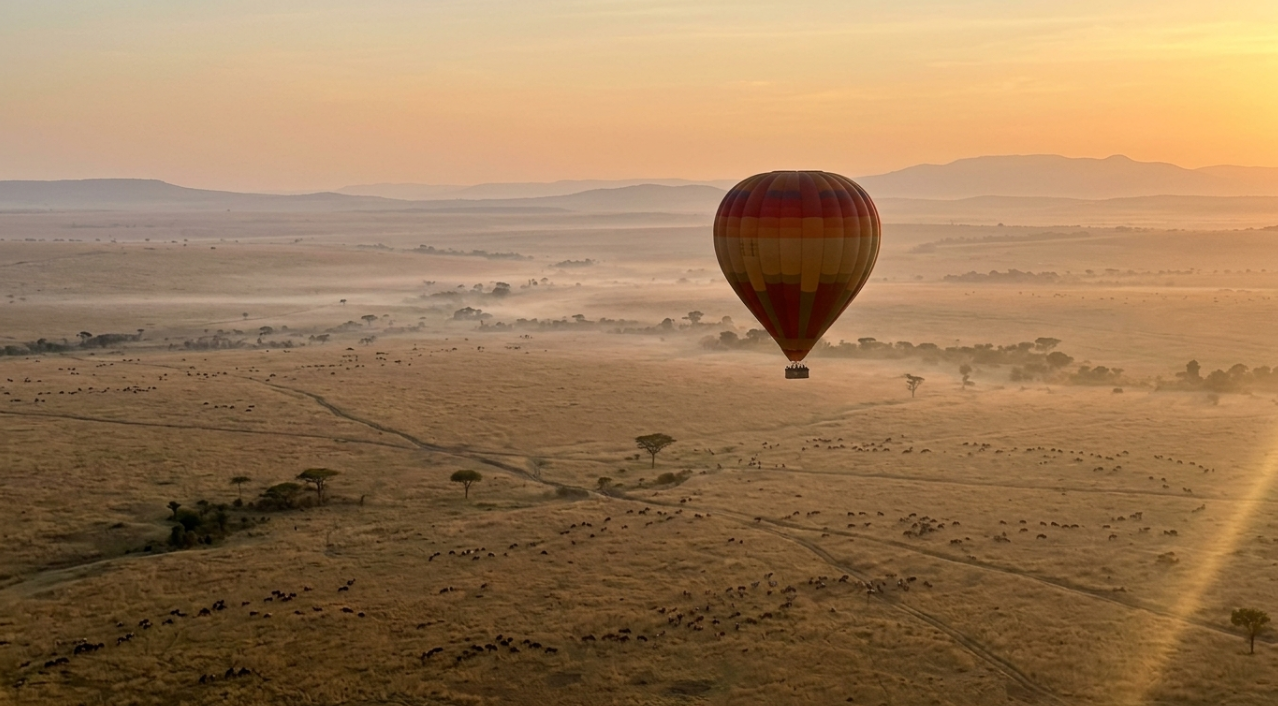
    Hot Air Balloon Safari

    A sunrise balloon flight over safari landscapes, often followed by a champagne breakfast on the plains. This is a high-impact experience commonly used in incentive programs. Opinions among travelers are mixed but generally emotional. Some call it “worth every penny,” while others question whether a morning game drive might be more productive when safari time is limited. Best suited for groups with enough safari nights and budget to treat the balloon as a bonus rather than a replacement for ground-level wildlife viewing.

    Walking Safari

    A guided activity on foot, led by an armed ranger and a qualified walking guide. Walking safaris offer a completely different sensory experience than vehicle-based game drives. Best for small groups and active teams, but not appropriate for every attendee. Fitness, comfort with wildlife proximity, and footwear all matter.

    Cultural Visit

    A structured visit with local communities or cultural sites. When designed ethically (with consent, fair compensation, and genuine exchange), these can be meaningful. When designed poorly, they feel exploitative. Responsible planning matters more than the Instagram photo.

    Facilitated Debrief

    A structured conversation after a shared experience, translating observations into leadership or team insights. This is what turns a safari into a retreat rather than just a reward trip. A skilled facilitator can connect what the group observed during a game drive to themes of patience, teamwork, adaptability, or strategic awareness.

    Do not make the trip feel like a corporate ropes course in safari clothing. The strongest team bonding usually comes from shared awe, private time, and a thoughtful debrief, not contrived competitions.

    Group Operations Glossary

    Group Brief

    The starting document for the operator. A complete group brief accelerates planning and prevents wasted proposal cycles. It should include travel dates, number of travelers, arrival and departure cities, number of executives or VIPs, rooming preferences, budget range, accommodation level, trip objective, required meeting time, dietary restrictions, mobility needs, photography or media needs, branding preferences, extension interest, and preferred level of privacy.

    Delegate Profile

    A corporate-event term for who is traveling. Are they executives, employees, sales winners, clients, partners, spouses, or a mix? The delegate profile determines vehicle assignments, room grades, activity pacing, and the level of formality at meals.

    VIP Handling

    Special planning for senior leaders, founders, board members, investors, or key clients. This may include a private vehicle with the best guide, a premium room or suite, flexible scheduling that allows them to skip certain activities, and priority transfers.

    Dietary Matrix

    A consolidated list of meal restrictions and preferences for the entire group. Important in remote safari camps because advance notice matters. Lodges in the Serengeti cannot run to a supermarket. Allergies, vegetarian and vegan needs, halal or kosher requirements, and strong preferences all need to be collected and communicated weeks before arrival.

    Attendee Communications

    Pre-trip emails or packets that explain packing, visas, insurance, vaccination guidance, tipping, weather expectations, Wi-Fi limitations, dress codes, and safari etiquette. Good attendee communications reduce anxiety and prevent the “I didn’t know I needed a visa” emergencies that derail group departures.

    On-Site Coordinator

    A dedicated person who manages group timing, meals, vehicle assignments, rooming, changes, and attendee questions throughout the trip. For corporate retreats, this person is the buffer between the group and the operational complexity happening behind the scenes.

    Duma Explorer handles full-service planning including itinerary design, lodge and camp selection, airport transfers, domestic flights, permits, and on-the-ground guiding. The company also provides pre-trip resources like packing lists, tipping guides, and Q&A, which reduces planning friction for groups coordinating across departments and time zones.

    Corporate Safari Retreat Planning Timeline

    Planning a corporate safari retreat in Tanzania involves coordinating accommodation, domestic flights, group transportation, attendee requirements, and the business agenda. The timeline below is a starting point for organizing the process. Large groups, exclusive-use properties, and peak-season travel may require additional lead time.

    Planning stage

    Recommended timing

    Key actions

    Define objectives and budget

    9–12 months before travel

    Confirm the business goal, approximate budget, group size, and preferred travel dates

    Request initial proposals

    6–12 months before travel

    Compare itineraries, accommodation options, vehicle allocation, and transportation

    Secure key bookings

    6–9 months before travel

    Confirm priority lodges, room inventory, flights, and any exclusive-use requirements

    Finalize the itinerary

    3–6 months before travel

    Confirm meeting blocks, activities, destination sequence, and transfer arrangements

    Collect attendee details

    2–4 months before travel

    Gather passport information through appropriate secure channels, room preferences, dietary needs, and mobility requirements

    Confirm operational arrangements

    1–2 months before travel

    Reconfirm flights, rooming lists, meals, emergency contacts, and meeting equipment

    Send attendee briefing

    2–4 weeks before travel

    Share packing guidance, travel documentation requirements, schedules, insurance reminders, and emergency procedures

    Complete final checks

    1 week before travel

    Reconfirm arrivals, transfers, guide assignments, weather-related contingencies, and key contacts

    What Can Change the Timeline?

    • Large groups: More attendees mean more room inventory, vehicles, and flight coordination.

    • Peak-season dates: Popular camps and exclusive-use properties can have limited availability.

    • Executive privacy: Board-level retreats may require additional venue checks and confidentiality arrangements.

    • Complex itineraries: Combining the Serengeti, Zanzibar, and international connections adds more coordination.

    • Special requirements: Dietary restrictions, accessibility needs, and meeting technology should be discussed early.

    Treat these timings as planning guidance rather than booking guarantees. Confirm availability and deadlines with your safari operator and individual properties.

    Seasonality Glossary

    Dry Season

    Generally favored for classic safari conditions: lower grass means easier wildlife spotting, roads are more passable, and dust is a factor. Most corporate groups prefer dry season for reliability, but it also means higher demand and tighter availability.

    Green Season

    Can mean greener landscapes, fewer crowds, and sometimes better value. Rain affects road conditions and can change plans. For corporate retreats, the trade-off is lower pricing versus higher logistical risk.

    Great Migration

    The large-scale annual movement of wildebeest, zebra, and other animals through the Serengeti-Mara ecosystem. Timing the retreat around the migration adds spectacle but reduces flexibility because the group needs to be in the right Serengeti region at the right time. Choose the best time for a Tanzania safari based on your corporate calendar, not just the wildlife calendar.

    Mara River Crossings

    A high-demand migration event in the northern Serengeti where herds cross the crocodile-filled Mara River. Crossings are unpredictable. Reddit users repeatedly warn that more nights near the Mara River improve the chances of witnessing a crossing, and that a rushed one-day attempt often results in disappointment. For corporate planners, do not promise a crossing in incentive marketing materials.

    Peak Season

    Popular travel months when availability and pricing are most constrained. Corporate groups need longer lead times during peak periods, sometimes six to twelve months in advance for buyouts or large room blocks.

    Shoulder Season

    The transition between peak and green seasons. Can offer better availability, calmer pacing, and occasionally better value while still delivering good wildlife viewing.

    Cost and Proposal Glossary

    This section explains the terms that appear in safari proposals, not specific prices. Corporate retreat costs vary widely based on group size, season, accommodation level, vehicle requirements, and routing.

    Per-Person Sharing

    The price based on two people sharing a room. This is the default pricing unit in safari proposals. For corporate groups where many attendees expect private rooms, the actual per-person cost will be higher.

    Single Supplement

    The extra charge for solo room occupancy. Across a group of 20 people, single supplements can add thousands of dollars to the total program cost.

    Included / Excluded

    Park fees, conservation fees, transfers, domestic flights, meals, drinks, premium activities, gratuities, visas, travel insurance, and optional upgrades may be included or excluded depending on the proposal. Reddit safari travelers frequently ask whether Tanzania quotes include park fees, crater descent fees, private vehicles, meals, water, tips, drinks, and balloon rides. Every proposal should make this explicit.

    Park Fees

    Government or park authority charges for entering protected areas. These are per-person, per-day fees that apply to every attendee and are typically non-negotiable.

    Crater Descent Fee

    A specific additional fee for descending into the Ngorongoro Crater. This is a common surprise cost if it is not itemized in the proposal.

    Optional Activities

    Balloon safari, private bush dinner, cultural program, spa treatments, or charter flights. These are typically priced separately and can be offered as attendee upgrades or covered by the company as part of the incentive package.

    Contingency Budget

    A budget line for last-minute changes, delays, extra vehicles, medical support, or VIP needs. Remote logistics make surprises more expensive. A 5-10% contingency is practical.

    Cost Drivers to Understand

    Rather than quoting specific prices (which change with season, availability, and group configuration), understand that total corporate safari retreat costs in Tanzania are driven by: number of travelers, single rooms versus twin share, season, camp and lodge level, number of private vehicles, domestic flights or charters, Serengeti positioning, exclusive-use requirements, balloon safaris or special dining, Zanzibar extensions, number of guides and coordinators, and any meeting or AV needs.

    Corporate Safari Retreat Budget Breakdown

    A corporate safari retreat budget should separate core travel costs from optional experiences and contingency funds. This makes it easier to compare proposals and identify where an itinerary can be adjusted without undermining the group’s primary objective.

    Budget category

    What to include

    Questions to ask the operator

    Accommodation

    Lodges, tented camps, room blocks, and single supplements

    Are rooms priced per person sharing or per person in single occupancy?

    Safari operations

    Guides, private vehicles, fuel, and vehicle allocation

    How many vehicles and guides are included?

    Park and conservation fees

    Applicable park entry and conservation charges

    Which fees are included, and which may change before travel?

    Transportation

    Airport transfers, domestic flights, and charter flights

    Are baggage limits, transfers, and flight connections included?

    Meals and beverages

    Included meals, drinks, and special dining arrangements

    Are premium drinks, bush dinners, and other special meals extra?

    Meetings and facilitation

    Meeting rooms, equipment, facilitators, and materials

    Is the meeting setup included in the quoted rate?

    Optional experiences

    Balloon safaris, walking safaris, cultural activities, and beach excursions

    Which activities are optional, and what are their cancellation terms?

    Travel protection

    Travel insurance, medical evacuation arrangements, and related coverage

    What protection must the company or attendees arrange separately?

    Operations and contingency

    Coordination, last-minute changes, and emergency reserves

    What additional charges could arise, and how are they approved?

    How to Compare Corporate Safari Proposals

    Compare proposals on the same basis. Check the number of nights, accommodation category, room occupancy, vehicle arrangements, included meals, flights, applicable fees, activities, and cancellation terms.

    A lower headline price may exclude items that another proposal includes. Ask each operator to identify exclusions and any costs that depend on final group size or availability before approving the budget.

    Risk, Health, Visa, and Compliance Glossary

    Tourist Visa / Business Visa

    Corporate retreat attendees may travel on tourist visas depending on the trip’s purpose. If the program includes business meetings, conferences, or commercial activities, visa requirements may differ. Tanzania’s eVisa guidelines advise applicants who are unsure of visa type to read guidelines or contact immigration for clarification. Confirm the correct category with official sources before attendees apply.

    Mandatory Inbound Travel Insurance

    As of the current research period, foreign nationals entering mainland Tanzania (excluding residents of EAC or SADC partner states) are required to purchase mandatory inbound travel insurance. This is a government-provided insurance product, separate from any corporate travel insurance the company may already carry. Official NIC guidance provides current details. Review Tanzania travel insurance considerations for a fuller overview, and re-check official sources close to your travel dates because this requirement is subject to change.

    Medical Evacuation

    Emergency transport coverage from remote safari locations to a hospital or out of the country. Do not assume this is covered by standard corporate travel insurance. Confirm evacuation coverage explicitly and communicate the policy to all attendees before departure.

    Wildlife Safety Briefing

    Guide instructions about wildlife behavior, vehicle conduct, and walking protocols. These are not optional suggestions. TANAPA’s park guidelines tell visitors to follow guide instructions for wildlife safety. Corporate groups need to understand that safari guides have authority over the group’s movement in wildlife areas, regardless of anyone’s job title.

    Crisis Plan

    Corporate groups need documented contacts, decision-makers, insurance details, flight-change procedures, and emergency communication channels. A clear chain of command matters when someone needs medical attention at 6 a.m. in a remote camp.

    Inbound Travel Insurance

    Before traveling to Tanzania, confirm the travel insurance requirements that apply to each attendee’s nationality, residency status, and itinerary. Distinguish any government-mandated inbound insurance from the company’s existing corporate travel policy.

    Corporate planners should also check whether the policy covers medical treatment, emergency medical evacuation, trip interruption, and activities included in the itinerary. Do not assume that a standard travel policy automatically covers every safari activity or emergency scenario.

    Verify the current requirements with the relevant official Tanzanian authorities and insurer before booking, and repeat the check shortly before departure.

    Common Planning Mistakes

    Designing the trip around a park checklist instead of the retreat objective. A reward trip, leadership offsite, and client-hosting safari should not share the same itinerary by default. Start with the purpose and work backward to the route.

    Too many one-night stays. Community safari discussions consistently warn that single-night stops create rushed pacing, excessive packing and unpacking, and transfer fatigue. Two or three nights at key locations gives the group time to settle in and actually enjoy each destination.

    Underestimating long drives. The distance between Arusha and the central Serengeti, for example, can mean 8 or more hours on unpaved roads. Reddit users describe these transfers as long, bumpy, and dusty, and recommend flying when the budget allows. Corporate groups tolerate this less well than adventurous backpackers.

    Treating Wi-Fi as guaranteed. Remote lodges may support email and basic browsing but cannot handle a full Zoom board meeting with screen sharing. Tech-heavy meetings require venue checks, backup plans, and offline-ready materials.

    Scheduling serious meetings after full-day game drives. An all-day safari drive involves early rising, heat, dust, concentration, and physical movement. Stacking a two-hour strategy session at 8 p.m. after that kind of day produces glazed eyes, not strategic breakthroughs.

    Forcing team-building activities. Practitioners on Reddit’s HR and corporate forums report that mandatory fun generates resentment, especially when it consumes personal time or feels compulsory. Safari provides natural shared context. A facilitated debrief or optional photography challenge works better than a contrived obstacle course.

    Not collecting dietary, medical, and mobility needs early. Remote logistics make last-minute changes harder. A severe food allergy disclosed two days before departure creates real problems when the camp is hours from the nearest town.

    Treating community visits as easy CSR. Poorly designed school or village visits can feel uncomfortable or exploitative for both the visitors and the community. Responsible planning, fair compensation, and genuine mutual benefit are non-negotiable.

    Which Tanzania Corporate Safari Retreat Format Fits Your Team?

    Primary objective

    Recommended format

    Key priority

    Main trade-off

    Executive alignment

    Safari + strategy retreat

    Privacy, reliable meeting facilities, and protected discussion time

    Less time available for extended game drives

    Employee or sales recognition

    Safari + incentive reward

    Memorable experiences, comfort, and recognition

    Premium activities and accommodation can increase the budget

    Team connection

    Private safari retreat

    Shared experiences, flexible pacing, and downtime

    Less structured interaction than a conventional workshop

    Client relationship building

    Premium private safari

    Guide quality, smooth transfers, and personalized service

    Greater emphasis on service and privacy may raise costs

    Active leadership development

    Safari + suitable hiking activity

    Safety, fitness suitability, and facilitated reflection

    Not every attendee will want or be able to participate

    Conservation-focused program

    Safari + vetted conservation experience

    Credible local partnerships and measurable benefits

    Requires due diligence and careful program design

    Reward and relaxation

    Safari + Zanzibar extension

    A comfortable transition from wildlife activities to beach time

    Additional flights, transfers, and nights increase complexity

    Most corporate safari retreats combine more than one objective. Choose the primary objective first, then use the secondary objectives to refine the itinerary rather than trying to accommodate every possible activity.

    How to Brief a Tanzania Safari Operator

    The quality of the proposal you receive depends almost entirely on the quality of the brief you provide. An operator cannot design a meaningful corporate safari retreat in Tanzania from a one-line email that says “20 people, sometime in September.”

    Group Brief Checklist

    Prepare these details before reaching out:

    • Preferred travel dates and flexibility

    • Number of travelers

    • Traveler mix (employees, executives, partners, spouses, clients)

    • Departure markets and arrival windows

    • Total trip length

    • Primary objective: reward, strategy, bonding, client hosting, ESG, or mixed

    • Approximate budget range per person

    • Accommodation style (lodge, tented camp, or a mix)

    • Single vs. twin room expectations

    • Meeting requirements (frequency, duration, AV needs)

    • Wi-Fi and connectivity requirements

    • Mobility and medical needs

    • Dietary requirements

    • Privacy requirements

    • Destination priorities (Serengeti, Ngorongoro, Tarangire, Kilimanjaro, Zanzibar)

    • Interest in balloon safari, bush dinner, or special experiences

    • Desired pace (active, balanced, or relaxed)

    • Whether the group needs a coast decompression finish

    • Decision timeline and internal approval process

    A LinkedIn practitioner working in East Africa incentive travel noted that site inspections are used to refine timing, validate venues, and anticipate challenges before the group arrives. If your budget allows, a site inspection trip (or having your operator conduct a ground check) is worth the investment for high-stakes programs.

    Duma Explorer is well suited for this kind of complex planning. The company is led by Stacy Readal, who has 15 years based in Tanzania and speaks Swahili. Duma operates locally as Alika Africa in Tanzania with a dual U.S. and Tanzanian ownership structure, which means corporate planners in North America get responsive communication across time zones while the ground execution happens through a local team with deep relationships at camps, lodges, and parks. Safari guides receive advanced training through EcoTraining and FGASA programs. The company is Travelife Certified and a founding partner of KPAP for porter welfare, which matters for companies with ESG or procurement standards. Duma’s product breadth, covering private safaris, Kilimanjaro, Zanzibar, gorilla trekking in Uganda and Rwanda, and Maasai Mara extensions, means a single planning relationship can handle a multi-destination corporate program without handing the group off to unfamiliar subcontractors.

    Request a Custom Corporate Safari Retreat Itinerary

    Frequently Asked Questions

    How many days does a corporate safari retreat in Tanzania need?

    Most meaningful programs run 5 to 8 safari days, depending on whether the group includes the Serengeti, Ngorongoro, Tarangire, meeting blocks, or a Zanzibar extension. Shorter trips of 3 to 4 days can work near Arusha, Tarangire, and Ngorongoro. Programs that combine the Serengeti with Zanzibar need more time or domestic flights to avoid excessive driving.

    Can you hold meetings at safari lodges in Tanzania?

    Some lodges have meeting-friendly spaces with power, seating, and connectivity. Others are better suited for informal sessions, fireside conversations, or outdoor debriefs. Confirm Wi-Fi bandwidth, AV support, backup power, seating capacity, and privacy before choosing a property for a working session.

    Should a corporate group drive or fly between safari areas?

    Driving is scenic and cost-effective but creates long transfer days. Flying is often better for executive or incentive groups with limited time, especially when the Serengeti or Zanzibar is included. The cost difference is real, but so is the time and energy saved. For senior teams, the flight usually pays for itself in reduced fatigue and recovered hours.

    What is the best Tanzania destination for a first corporate safari?

    For many groups, the Arusha, Tarangire, Ngorongoro, Serengeti sequence is the classic framework. Serengeti adds the biggest impact, Ngorongoro provides dramatic scenery and dense wildlife, and Tarangire offers elephants and baobab landscapes with easier access from Arusha.

    Is a Zanzibar extension worth adding to a corporate safari retreat?

    Yes, when the group needs decompression, recognition, beach time, or a softer close after early safari mornings. It is less useful when the retreat has only a few days and the primary purpose is leadership work that requires focused meeting time.

    What makes Tanzania a strong destination for corporate incentive travel?

    Tanzania was named World’s Leading Safari Destination 2025 by World Travel Awards, and the Serengeti won World’s Leading National Park. The country recorded over 2.29 million international arrivals in 2025. The combination of wildlife spectacle, varied landscapes, premium camp and lodge infrastructure, and beach extension options makes Tanzania competitive against more conventional incentive destinations. GBTA projects global business travel spending at $1.57 trillion in 2025, and Tanzania is actively positioning itself within that market.

    What information should we give a safari operator first?

    Dates, traveler count, arrival cities, trip objective, budget range, rooming expectations, meeting needs, dietary and mobility requirements, desired destinations, and whether the group prefers privacy, high activity, or a relaxed pace. The more specific the brief, the more useful the first proposal will be.

    What group size works best for a corporate safari retreat in Tanzania?

    The ideal group size depends on the retreat’s objectives, accommodation availability, budget, and transportation arrangements. Smaller executive groups may prioritize privacy and flexibility, while larger incentive groups need coordinated vehicle assignments, room allocations, and potentially staggered domestic flights. Ask the operator to confirm how many vehicles, guides, and rooms are required for your specific group.

    How much meeting time should we schedule during a safari retreat?

    The right amount depends on whether the trip is primarily a leadership offsite, team-bonding retreat, or incentive reward. Strategy-focused programs should reserve protected meeting blocks and choose properties with suitable facilities. Reward-focused programs generally benefit from a lighter agenda with optional activities and sufficient downtime. Avoid scheduling important discussions immediately after long transfers or full-day game drives.

    Can a corporate safari retreat accommodate different fitness levels and mobility needs?

    Yes, provided these requirements are considered during itinerary design. Vehicle-based game drives can suit many different fitness levels, but walking safaris, hikes, and certain camp layouts may have additional physical requirements. Discuss accessibility, medical needs, activity alternatives, and emergency arrangements with the operator before confirming the itinerary.

    When should a company book a Tanzania corporate safari retreat?

    Start planning as early as practical, particularly if the group needs exclusive-use accommodation, peak-season travel dates, or coordinated domestic flights. A lead time of 6–12 months is a useful starting point for complex programs, but availability varies by property, season, and group size. Confirm the actual booking deadlines and deposit requirements with the operator.

    What should a corporate safari retreat proposal include?

    A detailed proposal should outline the itinerary, accommodation, room configuration, number of vehicles and guides, transfers, domestic flights, applicable park fees, meals, optional activities, meeting arrangements, exclusions, payment terms, and cancellation conditions. It should also identify assumptions that could change the price, such as final group size, availability, and single-room requirements.

  • Friends Safari Trip Tanzania: 2026 Cost & Vehicle Guide

    Friends Safari Trip Tanzania: 2026 Cost & Vehicle Guide

    Planning a friends safari trip to Tanzania means balancing everyone’s budget, choosing the right 4×4 safari vehicle, and agreeing on an itinerary that works for the whole group. From splitting vehicle costs to deciding between the Serengeti, Ngorongoro Crater, and Tarangire, a little planning can make the experience more comfortable and affordable.

    This guide explains how to plan a Tanzania safari with friends in 2026, including estimated costs, vehicle capacity, accommodation options, park fees, and practical tips for organizing a group of four to eight travelers. You’ll also learn which expenses can be shared, which are charged per person, and what to confirm before booking.

    Whether you’re organizing a group holiday, a milestone birthday trip, or a wildlife adventure with friends, use this guide to compare options and build a safari budget that works for everyone.

    How Much Does a Friends Safari Trip to Tanzania Cost?

    A friends safari trip to Tanzania can cost several hundred dollars per person per day, depending on group size, accommodation, season, park fees, and whether the safari is private or shared. For a private safari, sharing a vehicle among four to six friends can reduce the per-person share of vehicle and guide costs. However, accommodation, meals, and most park entry fees are still charged per traveler.

    For an accurate group budget, compare the full package price for your travel dates and group size, and check whether park fees, crater fees, accommodation, meals, transfers, and activities are included. A seven-day safari budget should also account for international flights, travel insurance, tips, and optional experiences if these are not included in the operator’s quote.

    What Is the Best Safari Vehicle Size for a Group of Friends?

    For most friends traveling together in Tanzania, the best vehicle arrangement depends on the group size, luggage, photography needs, and whether everyone wants to stay in one vehicle. A standard safari Land Cruiser often accommodates up to six passengers, but the operator should confirm the actual passenger configuration and available window seats.

    Group Size

    Suggested Arrangement

    Main Consideration

    2 friends

    One private 4×4

    More space and flexibility, but a higher vehicle cost per person

    3–4 friends

    One private 4×4

    A good balance of comfort, photography access, and shared costs

    5–6 friends

    One suitable 4×4, subject to configuration

    Lower vehicle cost per person, but potentially less space

    7–8 friends

    Usually two vehicles

    More room and flexibility; ask how the guides will coordinate

    9–12 friends

    Usually two vehicles

    Confirm passenger capacity, luggage space, and communication arrangements

    13+ friends

    Multiple vehicles

    Requires a clear plan for guide assignments, stops, and group coordination

    These are planning guidelines rather than universal vehicle-capacity rules. Ask the operator how many passengers each vehicle is designed to carry, whether every passenger has a window seat, and how much room remains for camera equipment and luggage.

    Questions to Ask Before Choosing a Vehicle

    • How many passengers can the vehicle comfortably accommodate?

    • Does every passenger have a dedicated window seat?

    • Is there enough space for daypacks, camera bags, and personal items?

    • Will our group have a private vehicle and dedicated driver-guide?

    • If we need two vehicles, will both follow the same itinerary?

    • Can the guides communicate by radio and coordinate wildlife sightings?

    For photography-focused groups, prioritize passenger comfort and viewing access over maximizing vehicle occupancy. For budget-conscious groups, compare the total package price for one vehicle against the price of two vehicles before deciding.

    Key Terms at a Glance

    Term

    One-Line Definition

    Private Group Safari

    Your friend group gets a dedicated vehicle, guide, and flexible itinerary

    PPPD

    Per Person Per Day, the standard pricing unit for Tanzania safaris

    Northern Circuit

    The classic route through Tarangire, Ngorongoro, and Serengeti

    Vehicle Allocation

    How your group is distributed across one or more 4×4 Land Cruisers

    Cost-Splitting

    The math that makes private safaris dramatically cheaper as group size increases

    For a full breakdown of Tanzania safari itinerary and cost planning, that guide covers the broader picture. What follows here is specifically framed for friend groups.


    Safari Format Terms

    Private Group Safari

    Friends Safari Trip Tanzania: 2026 Cost & Vehicle Guide

    A private group safari means your friend group gets a dedicated 4×4 vehicle, a private driver-guide, and the ability to customize your itinerary. You decide when to linger at a leopard sighting, when to stop for lunch, and whether to add a sunrise game drive. This is the format that works for a Tanzania friends safari trip, and it’s what you should be requesting when you contact operators.

    The alternative, a joining safari, puts you in a shared vehicle with strangers on a fixed schedule. That’s fine for solo travelers on a budget, but it defeats the purpose of traveling with friends. On a joining safari, you can’t customize the route, swap parks based on migration timing, or add a Zanzibar extension. The itinerary is set.

    The good news: at six people, a private group safari often costs about the same per person as a joining safari. The vehicle cost that makes private safaris expensive for couples gets diluted across a larger group.

    Joining Safari (Shared Vehicle Safari)

    You buy a single seat in a shared 4×4 with travelers you’ve never met. The operator controls the pace. This option works well for backpackers and solo travelers who want to see Tanzania’s parks without paying for a whole vehicle. For a pre-formed friend group, it’s almost always the wrong choice unless you’re two people who genuinely can’t find a third or fourth friend to join.

    Drive-In Safari vs. Fly-In Safari

    A drive-in safari moves between parks by road in your private 4×4. The drive from Arusha to the Serengeti takes 6 to 8 hours, but the road itself passes through interesting terrain (including the Ngorongoro Conservation Area). For friend groups, drive-in safaris are usually more economical because you’re already splitting the vehicle cost.

    A fly-in safari uses small charter planes to hop between parks, cutting travel time dramatically (Arusha to Serengeti drops to about one hour). Flight costs run roughly $650 to $950 per person, compared to $1,050 to $1,470 per person for a private 4×4 shared between two. But with six friends splitting vehicle costs, the drive-in option becomes significantly cheaper per head, and you get the experience of the road.

    For more detail on how these formats compare financially, the private vs. group safari comparison breaks down the trade-offs.


    Vehicle and Logistics Terms

    Safari Vehicle (4×4 Land Cruiser)

    Most Tanzania safari packages use modified Toyota Land Cruiser 4x4s with a pop-up roof. The terrain in national parks doesn’t allow for larger vehicles. A standard game-viewing configuration has three rows and seats a maximum of six passengers, with every seat having access to the roof hatch for standing, viewing, and photography. Some operators run customized stretch vehicles with an extra row that accommodate up to eight people.

    For a deeper look at configurations, see this guide to safari vehicle types and features.

    The 4 vs. 6 Passenger Trade-Off

    This is one of the most important decisions for a friends safari trip in Tanzania, and most planning content ignores it entirely.

    Factor

    4 Passengers

    6 Passengers

    Comfort

    Spacious; room for camera bags, extra layers, binoculars

    Tighter; gear needs to be stowed

    Photography

    Everyone gets a window with good angles

    Middle-row passengers have compromised angles

    Roof hatch access

    Plenty of room at the pop-up roof

    Crowded standing room; you’ll bump elbows

    Cost per person (vehicle only)

    ~$75 to $100/person/day

    ~$50 to $67/person/day

    Best for

    Photography-focused groups, longer trips

    Budget-conscious groups, shorter safaris

    Four passengers per vehicle is the quality standard for serious game viewing. Six is the maximum, and it works fine for groups that prioritize being together over having perfect photography angles. Safari photography tips become much more relevant when you’re deciding how many people to put in each vehicle.

    Pop-Up Roof (Roof Hatch)

    The opening in the vehicle roof that lets passengers stand and observe wildlife from an elevated position. This is where most of your best wildlife viewing and photography happens. With four people, everyone can stand comfortably. With six, you’ll be taking turns or rotating positions.

    Window Seat Rotation

    When a vehicle carries five or six passengers, the driver-guide should run a window seat rotation so nobody gets stuck in the middle row for the entire trip. This is worth asking your operator about before booking. A good operator will bring it up unprompted; if they don’t, that’s a signal.

    Vehicle Allocation

    How your group is distributed across vehicles. A group of four or five fits in one Land Cruiser. A group of seven or eight splits across two. This is a straightforward logistics term, but it has real implications for trip quality.

    Multi-Vehicle Group

    Once your Tanzania friends safari trip reaches seven or more people, you’ll need two vehicles. At 13 or more, three. The coordination challenge is real: a couple in one vehicle can respond to a wildlife sighting in seconds, but three vehicles carrying fourteen people need to communicate by radio, reposition without blocking sightlines, and manage lunch stops and bathroom breaks across a larger group.

    The gap between a well-coordinated multi-vehicle safari and a poorly managed one is significant. Ask your operator how guides communicate between vehicles and whether a head guide oversees the group.

    If your group is 7 or more and needs multi-vehicle coordination, Duma Explorer’s ground team in Arusha handles vehicle allocation, guide assignment, and radio communication between vehicles. Request a custom friends safari itinerary to see how this works for your group size.


    Cost and Financial Terms

    PPPD (Per Person Per Day)

    The standard pricing unit for Tanzania safaris. A Tanzania safari costs between $250 and $1,500+ per person per day depending on accommodation tier, group size, and season. Most travelers on a mid-range private safari should budget $400 to $800 per person per day.

    Cost-Splitting: The Math That Makes Friend Trips Smart

    This is the single most important financial concept for a friends safari trip in Tanzania. The vehicle, guide, fuel, and certain park fees are fixed costs that don’t change whether two people or six people ride in the Land Cruiser. More people means a lower per-person share.

    Group Size

    Vehicle Cost Per Person Per Day

    Mid-Range PPPD (Approximate)

    2 people

    $100 to $150

    $400 to $450

    4 people

    $50 to $75

    $300 to $350

    6 people

    $33 to $50

    $250 to $300

    A couple paying $450 per person per day on a 7-day safari spends $6,300 total per person. The same itinerary with six friends might run $300 per person per day, or $2,100 per person. That’s a $4,200 difference per person, all from splitting fixed costs.

    Practitioners on Reddit repeatedly note that traveling with friends is the most direct way to reduce per-person safari costs. The savings are not marginal; they’re transformative.

    Single Supplement

    An extra charge for a traveler occupying a room or tent alone. Lodges and tented camps price per room (usually double occupancy), so a solo traveler pays more. In a friend group, this mainly affects anyone who doesn’t want to share a room. If everyone pairs up, nobody pays it. If one person insists on a private room, budget an extra $50 to $200 per night depending on the accommodation tier.

    Tanzania Safari Park Fees and Conservation Charges

    Park and conservation fees are an important part of a Tanzania safari budget. The amount depends on the destination, traveler category, applicable tariff, and the activities included in the itinerary.

    Fee Type

    What It Covers

    What to Check

    National park entry fee

    Entry to a TANAPA-managed national park

    The current tariff for each park and traveler category

    Ngorongoro Conservation Area fee

    Applicable entry and conservation charges

    The current NCAA fee schedule and itinerary requirements

    Crater service fee

    Applicable vehicle-based charge for a crater visit

    The current rate, vehicle category, and number of chargeable visits

    Camping or concession fee

    Applicable campsite or concession charges

    Whether the charge is per person, per night, per vehicle, or included in accommodation

    Activity fee

    Optional activities such as balloon safaris or guided excursions

    Whether the activity is included in the operator’s quote

    Before booking, ask your safari operator for an itemized breakdown of government fees and confirm the current rates using the official TANAPA park tariffs and Ngorongoro Conservation Area Authority fee schedule.

    Government tariffs may change. Avoid relying on older fee tables or assuming that every park uses the same rate.

    Crater Service Fee (NCAA Fee)

    The Ngorongoro Conservation Area Authority charges a separate service fee for vehicles entering the crater. This fee is per vehicle, which means it splits differently depending on group size.

    On a joining safari with six passengers, the crater service fee works out to about $49 per person. On a private safari for two, it’s $147.50 each. This single fee is one of the clearest examples of why group size matters for Tanzania safari costs. For full Ngorongoro Crater planning details, that guide covers access logistics and timing.

    Concession Fee

    A fee charged by private conservation areas or wildlife management areas that operate outside the national park system. These areas often offer exclusive game-viewing experiences with fewer vehicles. The concession fee is typically included in your accommodation cost at camps located within these areas.

    Tipping (Safari Crew)

    Tipping your driver-guide, cook, and other staff is customary in Tanzania. Standard guidance is $15 to $25 per group per day for the driver-guide, with smaller amounts for camp/lodge staff. In a friend group, pool the tip fund to avoid awkwardness. Designate one person to manage it. For detailed amounts and etiquette, see this safari tipping guide.

    Deposit Structure

    Most operators require a 25% deposit to confirm a booking, with the balance due 60 to 90 days before departure. For a group of friends, this means the organizer either collects deposits from everyone and sends one payment, or each person pays the operator individually. Clarify this with your operator early. Some accept split payments; others prefer a single point of contact.

    Full Board (FB) and Half Board (HB)

    Full board means all three meals are included. Half board covers breakfast and either lunch or dinner. Almost all safari packages in Tanzania are full board because you’re eating at your camp or lodge (there aren’t restaurants in the middle of the Serengeti). Drinks, especially alcohol, are usually extra.


    Itinerary and Destination Terms

    Northern Circuit

    The classic Tanzania safari route covering Tarangire National Park, Ngorongoro Crater, and the Serengeti. A four-day version is the minimum for touching all three, but five to seven days is what most friend groups should target for a satisfying experience. Rushing the Northern Circuit means spending too much time in the vehicle and not enough time actually watching wildlife.

    For a comprehensive look at routing and park sequencing, the Northern Circuit safari guide covers it thoroughly.

    Game Drive

    A game drive is a guided excursion in your safari vehicle through a national park or conservation area, searching for wildlife. Most itineraries include morning and afternoon game drives (roughly 6 AM to noon, then 3 PM to 6 PM), with a midday rest at camp during the hottest hours. Full-day game drives are also common, particularly in the Serengeti where distances between areas of activity can be significant.

    Great Migration

    The annual movement of over 1.5 million wildebeest (plus hundreds of thousands of zebra and gazelle) through the Serengeti ecosystem. Planning a friends group trip around the migration gives your safari a shared focal point. The dramatic Mara River crossings happen roughly July through October in the northern Serengeti; calving season in the southern Serengeti runs January through March.

    One Duma Explorer client called a Mara River crossing “the most memorable experience of my life,” and another client documented seeing 42 big cats in three days during a well-timed visit. These outcomes aren’t guaranteed, but timing your trip around migration patterns dramatically increases the odds.

    For month-by-month timing, see the best time for safari in Tanzania guide.

    Ngorongoro Crater Descent

    The drive down into the Ngorongoro Crater floor, a collapsed volcanic caldera roughly 19 kilometers across that contains one of the densest concentrations of wildlife in Africa. Vehicle access is controlled, and the crater service fee applies. Most itineraries spend half a day in the crater.

    Zanzibar Extension

    A post-safari beach trip to the Zanzibar archipelago, typically three to five days. Forum posts on Fodors and TripAdvisor show that friend groups commonly combine safari with beach time in Zanzibar, and for good reason: after a week of early mornings and dusty game drives, a few days of swimming, seafood, and Stone Town exploration is a natural counterbalance.

    Flights from Arusha or the Serengeti to Zanzibar run about an hour. For activity ideas on the island, the Zanzibar day trips and excursions guide covers the main options.

    Cultural Add-On (Maasai Village, Hadzabe Visit)

    Visits to local communities that offer a different dimension beyond game viewing. Maasai village visits are the most common, but more experienced travelers might consider visits to the Datoga or Hadzabe communities for something less touristic. Duma Explorer reviewers have specifically highlighted Maasai village experiences at Mysigio Camp and Lake Natron hikes as group favorites.

    These add-ons work well for friend groups because they create shared experiences that are completely different from game drives, breaking up the rhythm of the trip.

    Sample 7-Day Tanzania Safari Itinerary for Friends

    Friends Safari Trip Tanzania: 2026 Cost & Vehicle Guide

    A seven-day Northern Circuit safari gives a group of friends time to explore several major wildlife destinations without rushing every day. The exact route should depend on the season, wildlife movements, accommodation availability, and your group’s budget.

    Day

    Suggested Plan

    Planning Consideration

    Day 1

    Arrive in Arusha and prepare for the safari

    Allow time to recover from international travel

    Day 2

    Visit Tarangire National Park

    Enjoy game viewing and travel to your overnight accommodation

    Day 3

    Travel toward the Ngorongoro Conservation Area

    Include a game drive or scenic stops as appropriate

    Day 4

    Explore the Ngorongoro Crater

    Confirm crater access, fees, and the day’s schedule

    Day 5

    Travel to the Serengeti

    Account for road travel and the distance to your camp

    Day 6

    Enjoy a full Serengeti game-drive day

    Choose the area based on season and wildlife movements

    Day 7

    Continue game viewing or begin the return journey

    Confirm departure logistics before booking flights

    This is an illustrative route, not a fixed seven-day schedule. Travel distances, overnight locations, and the amount of time available for game viewing vary considerably. Some itineraries require an additional day to make the route comfortable.

    Should Your Group Add More Safari Days?

    Consider extending the trip if your friends want more time in the Serengeti, a migration-focused itinerary, additional photography opportunities, or a slower travel pace.

    If you also want Zanzibar, compare the cost of adding beach days with the cost of flying directly from the safari circuit. Treat Zanzibar as a separate itinerary component when comparing accommodation, transfers, and activities.

    Before confirming the itinerary, ask your operator to specify the overnight location for every day, estimated driving times, included game drives, and the final airport transfer plan.

    Accommodation Terms

    Tented Camp

    This trips up first-time safari planners. A “tented camp” in Tanzania is not camping in the backpacker sense. Mid-range and luxury tented camps have en-suite bathrooms, proper beds with linens, hot water, and often electricity (solar or generator). The “tent” part refers to canvas walls, which provide an immersive bush atmosphere while still delivering hotel-level comfort.

    Duma Explorer reviewers have praised Nyumbani Camp in Central Serengeti for “the best food and hot water 24 hours a day” (Teresa A., 2025) and Lion’s Paw as a group favorite (Taylor P., 2025). These are the kinds of camps that change people’s perception of what “tented” means.

    Lodge

    A permanent structure (stone, wood, concrete) with standard hotel-style rooms. Lodges tend to be larger than tented camps and often have swimming pools, bars, and other amenities. They’re a good choice for friend groups where some members are hesitant about staying in tents, even fancy ones.

    Mobile Camp

    A temporary tented camp that moves seasonally to follow wildlife patterns, particularly the Great Migration. Mobile camps offer some of the most exclusive wildlife access in the Serengeti because they’re positioned exactly where the action is. Availability is limited, so book early if this interests your group.

    Camp Buyout / Exclusive Use

    For larger friend groups (10+), some camps allow you to book every room, giving your group exclusive use of the entire property. One experienced safari planner has organized group safaris ranging from 6 people sharing two vehicles to 22 people requiring a full private camp buyout. This is a premium option, but for milestone birthdays or reunions, it creates an unforgettable experience.

    Special Campsite

    A private campsite within a national park, separate from the public campsite areas. Costs roughly $50 to $100 per person per night, about double the public campsite rate. Worth considering for small friend groups who want a more exclusive bush experience without jumping to lodge pricing. You’ll still need your own camping equipment (operators handle this), but you get a private location.


    Guide and Safety Terms

    Driver-Guide

    The person who both drives your 4×4 and leads wildlife interpretation. This is the single most important person on your safari. A skilled driver-guide knows where to find wildlife, when to be patient, how to position the vehicle for photography, and how to read animal behavior for safety.

    Every vehicle gets a dedicated driver-guide. If your friend group splits across two vehicles, a head guide or tour leader might move between vehicles throughout the trip to ensure coordination. For understanding what separates good guides from great ones, the safari guide qualifications guide explains the certification standards.

    Duma Explorer’s safari guides undergo advanced training through EcoTraining, with a FGASA Level 1 certification program currently rolling out. Their Kilimanjaro guides hold Wilderness First Responder (WFR) certification, which speaks to the company’s approach to safety and guide development.

    FGASA (Field Guides Association of Southern Africa)

    An internationally recognized certification for safari guides. FGASA Level 1 involves a 55-day training program covering wildlife identification, ecology, tracking, and guest management. When comparing operators, asking whether guides hold FGASA or equivalent certifications is a reasonable quality indicator.


    Group Planning Terms

    Trip Organizer (Group Coordinator)

    The friend who takes point on communication with the safari operator, collects deposits, relays information to the group, and makes tie-breaking decisions. If you’re reading this glossary, this is probably you.

    Practical advice: establish a shared document or group chat thread specifically for trip decisions. Keep the operator in one communication channel (email is best for records) and the group in another. You’ll lose your mind trying to relay every detail in both directions simultaneously.

    What to Agree on Before You Book

    This checklist is specific to a friends safari trip in Tanzania and covers the decisions that cause friction if left unresolved:

    • Budget ceiling: Agree on a per-person maximum before requesting quotes

    • Comfort tolerance: Tented camps vs. lodges, budget vs. mid-range vs. luxury

    • Daily pace: Some friends want 12-hour game-drive days; others want pool time by noon

    • Photography seriousness: This directly affects whether you want 4 or 6 per vehicle

    • Zanzibar yes or no: Adding beach days changes the trip length and budget significantly

    • Alcohol budget: Full board rarely includes drinks; some friends won’t care, others will

    • Room sharing: Who pairs with whom, and is anyone paying the single supplement?

    • Tipping fund: Pool it or handle individually?

    Pacing (Game-Drive Fatigue)

    This term rarely appears in safari planning content, but it matters enormously for friend groups. A full game-drive day starts before dawn (around 6 AM) and can run until sunset (6 PM), with a midday break. That’s 8 to 10 hours in a vehicle on rough roads.

    One Duma Explorer reviewer (Pritpal C., 2026) specifically noted “long days on safari” as something to prepare for. In a group of friends with mixed energy levels, attention spans, and interests, this can create tension. Some friends will want to chase every sighting; others will be ready for camp by lunchtime.

    The solution is building flexibility into the itinerary. A private group safari lets some friends return to camp early while others continue the afternoon drive. Discuss this possibility with your operator during planning, and be honest about your group’s dynamics.


    Group-Specific Add-On Experiences

    Beyond standard game drives, several experiences work particularly well for a friends group safari in Tanzania:

    Hot-Air Balloon Over the Serengeti. A sunrise balloon ride over the Serengeti plains, followed by a champagne bush breakfast. This is a premium add-on (typically $500 to $600 per person), but it creates one of those shared moments that everyone talks about for years.

    Maasai Village Visit. A cultural experience that breaks up the game-drive routine and gives the group a completely different perspective on the region. Best when arranged through your operator to ensure the visit is ethical and benefits the community.

    Lake Natron Hike. A more adventurous add-on for active friend groups. The alkaline lake is home to massive flamingo populations and sits beneath Ol Doinyo Lengai, an active volcano. This works best as a pre- or post-safari day trip.

    Zanzibar Beach Days. Three to five days of snorkeling, Stone Town exploration, spice tours, and general recovery from early safari mornings. For groups that want the complete East Africa experience, this is almost mandatory.


    Estimated 7-Day Tanzania Safari Budget for Friends

    The total cost of a private Tanzania safari depends on accommodation standards, travel season, itinerary, and group size. The following table is an illustrative planning example, not a live quote or a verified operator price list.

    Expense

    2 Friends

    4 Friends

    6 Friends

    Vehicle and guide

    Higher per-person share

    Lower per-person share

    Lower per-person share

    Park entry fees

    Charged per traveler

    Charged per traveler

    Charged per traveler

    Accommodation and meals

    Depends on room sharing and camp rates

    Depends on room sharing and camp rates

    Depends on room sharing and camp rates

    Crater and other vehicle-based fees

    Shared among fewer travelers

    Shared among more travelers

    Shared among more travelers

    Optional activities

    Usually charged per participant

    Usually charged per participant

    Usually charged per participant

    Final package cost

    Request a quote for 2

    Request a quote for 4

    Request a quote for 6

    How to Calculate Your Group’s Safari Cost

    To compare safari quotes fairly, separate the expenses into three categories:

    1. Shared costs: Vehicle hire, driver-guide costs, and applicable vehicle-based fees.

    2. Per-person costs: Park entry fees, activities, and many accommodation charges.

    3. Optional or excluded costs: International flights, travel insurance, drinks, tips, and any activities not included in the package.

    Divide shared expenses by the number of travelers paying for them, then add each person’s individual costs. This produces a more realistic comparison than dividing the total quote by group size without checking what is included.

    Request a written quote showing the total group price and the per-person price for your exact travel dates, itinerary, accommodation level, and room-sharing arrangements.

    What Makes a Tanzania Friends Safari More or Less Expensive?

    Five factors have the biggest impact on your final safari price:

    • Group size: More travelers can reduce each person’s share of vehicle-based expenses, provided you do not need additional vehicles.

    • Accommodation: Public campsites, budget tented camps, mid-range lodges, and luxury camps have different nightly rates.

    • Travel season: Demand and accommodation availability vary throughout the year, particularly around popular wildlife-viewing periods.

    • Itinerary length: Longer safaris increase the total trip cost, while some fixed expenses may be spread over more days.

    • Package inclusions: Park fees, crater fees, meals, transfers, drinks, and activities may be included or billed separately.

    When comparing quotes, make sure every operator is pricing the same route, dates, accommodation level, and inclusions. The lowest headline price is not necessarily the least expensive option once excluded charges are added.


    Frequently Asked Questions About Tanzania Safaris With Friends

    How many people should go on a Tanzania safari together?

    Four to six friends can be a practical group size for a private safari because they may share one suitably configured vehicle. Smaller groups have more space, while larger groups may need multiple vehicles. Confirm passenger capacity and window-seat arrangements with the operator.

    How much does a seven-day Tanzania safari cost per person?

    The cost depends on accommodation, season, itinerary, park fees, and group size. A useful estimate should include the safari vehicle, driver-guide, accommodation, meals, park fees, and other required charges. Request a dated quote with itemized inclusions rather than relying on a single general price range.

    Is a private safari worth it for a group of friends?

    A private safari can be worthwhile if your group wants to control the itinerary, spend more time at wildlife sightings, and travel at its own pace. A shared safari may cost less for travelers who are comfortable following a fixed itinerary with other guests.

    Should we book one safari vehicle or two?

    Groups of up to six may be able to share one standard safari vehicle, depending on its configuration and the operator’s passenger limits. Larger groups should compare the cost and comfort of multiple vehicles. Ask about radio communication and whether both vehicles can follow the same itinerary.

    What is the best time of year for a friends safari in Tanzania?

    June through October is generally a popular period for wildlife viewing during the drier season. January through March can be a good time to visit the southern Serengeti during the wildebeest calving season. Migration timing and sightings vary, so choose travel dates based on the specific experience your group wants.

    Can we combine a Tanzania safari with Zanzibar?

    Yes. Many itineraries combine a Northern Circuit safari with several beach days in Zanzibar. Budget separately for domestic flights, transfers, accommodation, meals, and activities that are not included in the safari package.

    How far ahead should our group book?

    Book as early as practical if you are traveling during a popular season or want specific camps and lodges. Six to twelve months can be a useful planning window, but availability depends on your dates, destination, group size, and accommodation preferences.

    How should friends split the cost of a safari?

    Start by dividing shared expenses, such as the vehicle and guide, among the travelers who share those costs. Then add individual charges, including accommodation differences, optional activities, and any single-room supplements. Agree on the payment schedule and cancellation rules before anyone pays a deposit.


    A friends safari trip to Tanzania is one of those rare travel experiences that actually gets better and cheaper as you add people. The planning complexity is real, but the reward, splitting a sundowner with your closest friends while watching a Serengeti sunset, is worth every spreadsheet and group-chat debate.

    Request a Custom Friends Safari Itinerary — Duma Explorer’s team in Arusha builds private group safaris for friends traveling together, handling vehicle allocation, guide selection, and multi-vehicle coordination so you can focus on the trip itself.

  • Family Reunion Safari Tanzania: 2026 Planning Guide

    Family Reunion Safari Tanzania: 2026 Planning Guide

    In brief

    A family reunion safari in Tanzania is a private or customized wildlife trip designed for relatives traveling together across multiple households and generations. Most groups benefit from private 4×4 safari vehicles, accommodation with enough rooms or shared gathering spaces, and an itinerary with fewer camp changes and time for rest.

    For a group of 8–20 travelers, planning typically involves five key decisions:

    • Group size and vehicles: Choose vehicle numbers based on passenger capacity, comfort, luggage, and whether family members want different game-drive schedules.

    • Accommodation: Compare family suites, multi-room lodge bookings, safari houses, and exclusive-use camps.

    • Budget: Calculate accommodation, park and conservation fees, transport, activities, meals, and tips rather than comparing headline rates alone.

    • Itinerary: Allow enough time at each destination for wildlife viewing, rest, and shared family activities.

    • Booking and logistics: Coordinate travel dates, ages, dietary needs, mobility requirements, deposits, insurance, and visas.

    For many multigenerational groups, Tanzania’s Northern Circuit is a practical starting point because it combines established safari destinations with a range of accommodation and transport options. The right itinerary depends on your group’s ages, interests, budget, travel dates, and preferred pace.

    Reunion Planning at a Glance

    Group Size

    Suggested Vehicle Setup

    Accommodation Approach

    Suggested Trip Length

    8 travelers

    2 vehicles with 4 passengers each

    Family suites or multiple rooms

    7–10 days

    10–12 travelers

    3 vehicles with 3–4 passengers each

    Multi-room lodge booking or private safari house

    7–10 days

    13–16 travelers

    4 vehicles with approximately 3–4 passengers each

    Large safari house or exclusive-use camp

    8–12 days

    17–20 travelers

    5 vehicles with approximately 3–4 passengers each

    Exclusive-use property or coordinated accommodation

    10–14 days

    These are planning examples, not fixed requirements. Final vehicle numbers depend on the operator’s approved passenger capacity, luggage, vehicle configuration, mobility needs, and the group’s preferred level of comfort.

    The length of the trip also depends on how many parks you want to visit, whether you include a beach extension, and how much time the group wants to spend resting together.

    Reunion Planning at a Glance

    Group Size

    Vehicles Needed

    Accommodation Approach

    Recommended Trip Length

    Budget Range Per Person

    8 travelers

    2 vehicles

    Family suites or small lodge

    7–10 days

    $2,800–$4,500

    10–12 travelers

    2–3 vehicles

    Exclusive-use camp or lodge buyout

    7–10 days

    $2,200–$4,000

    15 travelers

    3–4 vehicles

    Exclusive-use property

    8–12 days

    $1,800–$3,500

    20 travelers

    5 vehicles

    Full lodge buyout or split sub-groups

    10–14 days

    $1,800–$3,200

    Per-person costs drop as group size increases because fixed expenses like vehicle hire, guide fees, and crater descent charges get shared across more people. But the total trip cost rises, which means reunion organizers need to think in both directions.

    If your reunion involves 10 or more travelers across multiple generations, Duma Explorer can design the route, vehicle allocation, and accommodation around the specific ages and needs in your group.

    Plan a private family safari in Tanzania

    How to Plan a Family Reunion Safari in Tanzania

    Planning a family reunion safari is easier when the group makes the major decisions in the right order. Start with the people, dates, and budget before selecting camps or finalizing the route.

    Step 1: Confirm the Group Size and Travel Dates

    Create a preliminary list of travelers, including adults, children, and older relatives. Collect each person’s likely availability and identify the dates that work for the largest number of family members.

    Keep a small amount of flexibility if possible. Different arrival dates can affect transfers, accommodation, and the start of the safari.

    Step 2: Set a Realistic Budget

    Agree on an approximate budget per traveler or family household before requesting detailed proposals. Decide whether the budget includes international flights, accommodation, meals, park fees, domestic flights, activities, tips, and travel insurance.

    If relatives have different budgets, ask the safari operator whether the group can share some experiences while using different room categories or optional activities.

    Step 3: Choose the Vehicle Arrangement

    Decide whether everyone should follow the same game-drive schedule or whether smaller groups should have more flexibility. Ask the operator to confirm passenger capacity, window access, luggage space, and whether vehicles can return to camp separately when needed.

    Step 4: Select Accommodation for the Whole Group

    Compare family suites, connecting rooms, multiple rooms at one lodge, private safari houses, and exclusive-use camps.

    Check room capacity, bathroom arrangements, accessibility, child policies, dining facilities, and whether the property can host the entire group comfortably.

    Step 5: Build an Itinerary With Time to Rest

    Choose destinations based on the group’s wildlife interests, travel season, budget, and tolerance for long transfers. Avoid changing camps every night when possible.

    Include time for meals together, relaxed mornings, celebration activities, and optional game drives for family members who want additional flexibility.

    Step 6: Confirm Fees, Deposits, and Payment Responsibilities

    Request a written quotation that identifies what’s included and excluded. Confirm the deposit amount, payment deadlines, cancellation policy, currency, and whether the operator can invoice separate family households.

    Assign one lead organizer to coordinate decisions, while giving each household responsibility for its own passport details, insurance, and travel documents.

    Step 7: Finalize Special Requests Before Arrival

    Share dietary requirements, allergies, mobility limitations, child ages, room preferences, and celebration plans with the operator in advance.

    Confirm any age restrictions for activities and accommodation directly with the providers. Keep a copy of the final itinerary, emergency contacts, and payment schedule available to the group.

    Planning tip: Before paying a deposit, ask for a written itinerary and a total trip estimate for the entire group—not just a per-person starting price.

    People and Group Structure

    Family Reunion Safari

    A safari designed for multiple family units traveling together, typically 8 to 20 or more people spanning two or three generations. This is distinct from a standard family safari (one household, four to six people) because it involves coordinating across separate families with different budgets, physical abilities, and interests.

    One real-world example: a 13-person family reunion spanning ages 11 to 62, requiring multiple vehicles, accommodation that kept the group together for meals and downtime, and enough flexibility for grandparents to skip an early morning game drive without affecting everyone else’s schedule.

    Multigenerational Safari

    A trip that includes grandparents, parents, and children. Most reunion safaris are multigenerational by nature, but not every multigenerational safari is a reunion. The distinction matters because reunions add a celebration element and group-coordination layer.

    Age Bracket (Park Fee Implications)

    Tanzania’s national parks structure fees by age. Children under five enter all parks free of charge. Children aged 5 to 15 pay reduced rates (roughly 20 to 50 percent of the adult fee). In premium parks like Serengeti and Ngorongoro, non-resident adults pay $83 per person per 24-hour period, while children 5 to 15 pay $24 per day.

    For reunion groups with several children, these savings add up quickly. A reunion of 12 that includes four kids under 15 saves hundreds of dollars in park fees compared to an all-adult group.

    Group Coordinator / Lead Traveler

    The person managing communication between the reunion group and the safari operator. This role matters more than people expect. Someone needs to collect passport details, confirm dietary requirements, relay physical limitations, and coordinate payment across multiple households. Most operators work with a single lead traveler rather than fielding requests from eight different email addresses.

    Vehicle Split

    How your group gets divided across multiple safari vehicles. This is arguably the most important logistical decision for a Tanzania reunion safari, and it deserves careful thought rather than a last-minute assignment.

    Vehicles and Transfers

    Private Safari Vehicle

    A 4×4 Toyota Land Cruiser (the standard in Tanzania) with a pop-up roof for game viewing, assigned exclusively to your group with a dedicated driver-guide. A standard game-viewing configuration seats a maximum of six passengers, though modified versions can hold six to seven.

    Practitioners on Reddit consistently identify private vehicles as the single most important booking decision for multigenerational groups. The reason is control: your vehicle stops when you want, for as long as you want, and returns to the lodge when the youngest (or oldest) member is ready.

    How Many Safari Vehicles Does a Family Reunion Need?

    The number of safari vehicles depends on the group’s size, the vehicle’s approved passenger capacity, and how much space and flexibility travelers want. A vehicle that can legally carry six passengers may not be the most comfortable arrangement for a long game drive.

    For planning purposes, many groups can use the following estimates:

    Travelers

    Vehicles at 6 Passengers per Vehicle

    Vehicles at Approximately 4 Passengers per Vehicle

    8

    2

    2

    10

    2

    3

    12

    2

    3

    15

    3

    4

    16

    3

    4

    20

    4

    5

    These figures are planning estimates, not universal vehicle-capacity rules. Ask the safari operator to confirm the configuration of the actual vehicles assigned to your group.

    Four passengers per vehicle can offer additional space for camera equipment, personal belongings, and comfortable wildlife viewing. Larger groups may also benefit from multiple vehicles because relatives can choose different game-drive schedules.

    Before booking, ask whether the vehicles will be dedicated to your family, whether all passengers have suitable viewing positions, and how the operator handles luggage during transfers.

    For deeper context on vehicle types and features, see this safari vehicles glossary.

    Pop-Up Roof

    The retractable roof on a safari Land Cruiser that allows passengers to stand up and view (or photograph) wildlife from an elevated position. Every game-viewing vehicle in Tanzania has one.

    Fly-In Safari

    Using small bush planes (Cessna Caravans, typically) to move between parks instead of driving. Fly-in transfers eliminate long road days, which makes them particularly valuable for reunion groups that include elderly travelers or young children. The trade-off is cost: bush flights run $200 to $500 per person per sector, and with 12 or 15 people, that multiplies fast.

    Road Transfer

    Driving between parks or from Arusha to the first game area. The Arusha-to-Ngorongoro drive takes roughly three to four hours. Arusha to Serengeti is a full day by road. For large reunion groups, road transfers mean a convoy of three to five vehicles, which requires coordination at fuel stops and park gates.

    Convoy Challenge

    Beyond 20 people, the vehicle convoy creates its own logistical problems at park gates, narrow tracks, and camp arrivals. Experienced operators recommend splitting groups of 20 or more into sub-groups with slightly different schedules, perhaps departing 15 minutes apart, to avoid bottlenecks and preserve the feeling of a private wilderness experience.

    Accommodation for Reunion Groups

    Exclusive-Use Lodge or Camp

    This is the single most important accommodation concept for reunion safaris. An exclusive-use booking means the entire property, every room, every vehicle, every guide, runs exclusively for your group on your schedule.

    As one Africa travel specialist noted: “A safari villa or family house can be ideal for several generations travelling together, combining private bedrooms with the places that make a reunion feel like a reunion, a dining table, lounge, pool, deck and fire.”

    Exclusive-use properties transform the experience in ways that matter specifically for reunions. Meal times shift to match your group. Game drives start when you’re ready. The kids can be loud at breakfast without worrying about other guests. And critically, exclusive-use bookings typically remove minimum age restrictions, because the only guests affected by a crying baby are your own family.

    Camp Buyout

    Booking every room in a small tented camp (usually 6 to 12 tents) so it functions as exclusive-use even if the camp doesn’t normally market itself that way. Smaller camps are often willing to negotiate buyout rates during shoulder season.

    Family Suite

    A room configuration with connecting or adjacent bedrooms, usually with a shared living space. Useful for individual family units within the reunion, but not a replacement for exclusive-use when the goal is keeping the whole group together.

    Interconnecting Rooms

    Rooms with a door between them. Important for families with younger children who need to be within earshot. Not all lodges offer them, so this needs to be specified during booking. Our family safari rooms guide covers what different properties offer.

    PPPN (Per Person Per Night)

    The standard pricing unit in East African safari accommodation. A lodge quoting $450 PPPN for your reunion of 12 means $5,400 per night, not $450 total. Reunion organizers new to safari pricing sometimes misread this, so confirm whether a quote is PPPN or per-room.

    Minimum Age Policy

    Many upscale tented camps restrict children under 5, 8, or even 12 from staying at the property. This exists because unfenced camps in wildlife areas carry real risks for young children, and because other guests may not want young children at dinner.

    Exclusive-use bookings sidestep this entirely. When your family is the only group in camp, age restrictions typically don’t apply.

    Unfenced Camp

    A camp without physical barriers between tents and the surrounding bush. Wildlife moves freely through camp, which is part of the experience but means young children need supervision. Reunion groups with toddlers should clarify fencing status when selecting accommodation. More on this in the safari with toddlers guide.

    Itinerary and Pacing

    Northern Circuit

    Tanzania’s most popular safari route, connecting Arusha, Tarangire, Lake Manyara, Ngorongoro Crater, and Serengeti. The Northern Circuit remains the best option for a multigenerational reunion because it combines world-class wildlife viewing with manageable driving distances and the widest range of accommodation options for large groups.

    For a full breakdown of this route, see the Northern Circuit safari guide.

    Pacing

    How quickly the itinerary moves between destinations. This is where reunion safaris most commonly go wrong. The instinct is to pack every park into the trip, but as one experienced safari planner emphasized: “For a large family, fewer, longer, more comfortable stays beat a packed route every time.”

    Three nights at each location lets a family settle, find a rhythm, and actually rest. Two safari areas at three nights each, plus an optional beach finish, puts most reunion groups in the 10 to 14 day range.

    Sample 8-Day Northern Circuit Family Reunion Safari

    An eight-day itinerary can provide a starting point for a reunion group that wants to experience several Northern Circuit destinations without moving camp every night. The route below is illustrative; the final schedule should account for arrival times, accommodation availability, ages, and the group’s interests.

    Day

    Suggested Plan

    Reunion-Friendly Consideration

    Day 1

    Arrive in Arusha

    Gather the group, rest after flights, and review the itinerary

    Day 2

    Transfer to Tarangire National Park

    Start wildlife viewing after the group has recovered from travel

    Day 3

    Tarangire game drives

    Allow flexible drive times and a relaxed afternoon

    Day 4

    Travel toward the Ngorongoro area

    Keep the transfer day manageable and settle into camp

    Day 5

    Ngorongoro Crater excursion

    Confirm vehicle arrangements, entry fees, and physical comfort needs

    Day 6

    Travel toward the Serengeti

    Consider the road time carefully or ask about a suitable flight alternative

    Day 7

    Serengeti game viewing

    Offer an optional rest period for relatives who prefer not to join every drive

    Day 8

    Depart or continue the trip

    Arrange transfers according to the group’s departure logistics

    This itinerary is a starting framework, not a guarantee that every destination can be covered comfortably in eight days. Driving distances, road conditions, flight schedules, and the group’s arrival and departure times may require adjustments.

    For a slower-paced reunion, consider adding nights to the itinerary or extending the trip to include Zanzibar after the safari.

    Rest Day / Lodge Day

    A day with no scheduled game drive, spent at the lodge using the pool, reading, playing cards, or napping. These matter far more for reunion groups than for couples. Not everyone in a group of 15 wants to be in a vehicle at 6:00 AM every morning. Building in a lodge day gives people permission to do nothing, which is often what makes a reunion feel like a reunion rather than a forced march.

    Two-Night Minimum Stay

    The shortest practical stay at any single safari camp. One night means you arrive late, do an evening drive if you’re lucky, then pack up and leave. Two nights gives you a full day of game viewing. Three nights is the sweet spot for reunions.

    Zanzibar Extension

    Adding beach days on Zanzibar (or sometimes Pangani/Saadani on the mainland coast) after the safari portion. For reunions, a few days on the beach provides unstructured time that the bush portion can’t, where the group can actually sit together, swim, eat long meals, and celebrate. The family safari Zanzibar guide covers logistics for adding this to a reunion trip.

    Arusha Stopover

    A night in Arusha at the start or end of the trip to recover from international flights before heading to the parks. For reunion groups arriving on different flights from different cities, an Arusha night also serves as the gathering point where the group actually assembles.

    Costs and Fees

    Understanding cost structure is critical for reunion organizers because the economics of large groups are fundamentally different from those of a couple or single family.

    How Much Does a Family Reunion Safari in Tanzania Cost?

    The cost of a family reunion safari in Tanzania depends on the number of travelers, trip length, accommodation category, park fees, transportation, season, and optional activities. Larger groups may share some fixed expenses, but they still need enough vehicles, rooms, and guides for their chosen itinerary.

    When comparing safari quotations, distinguish between the price per person, the total cost for the group, and expenses that are not included.

    What Determines the Cost of a Reunion Safari?

    Cost Component

    What to Check

    Accommodation

    Room category, number of nights, meal plan, and exclusive-use charges

    Safari vehicles and guides

    Number of vehicles, driver-guide services, and transfer arrangements

    Park and conservation fees

    Applicable entry fees, vehicle charges, concession fees, and crater-related fees

    Transfers and flights

    Airport transfers, road transfers, and any domestic or bush flights

    Activities

    Balloon safaris, walking safaris, cultural visits, and celebration experiences

    Meals and drinks

    Included meals, beverages, special menus, and dietary requirements

    Gratuities

    Suggested tipping arrangements for guides and camp staff

    Insurance and international travel

    Travel insurance, international flights, visas, and other personal expenses

    How to Compare Safari Quotes

    Family Reunion Safari Tanzania: 2026 Planning Guide

    Ask each operator to quote the same travel dates, destinations, accommodation level, group size, and number of nights. Confirm whether the price includes park fees, transfers, meals, and taxes.

    A lower per-person price does not necessarily mean a lower total cost if it excludes essential expenses or assumes more passengers per vehicle.

    For a reunion group, request both the total trip estimate and the per-person estimate. If relatives are paying separately, ask whether the operator can also show the amount payable by each household.

    Per-Person-Per-Day Cost

    Private tailor-made safaris in Tanzania typically run $350 to $500 per person per day, depending on accommodation tier, park selection, and group size. A 7-day private safari for a family of four might run roughly $9,000 to $13,500 total. A reunion of 12 on the same itinerary could see per-person costs drop 20 to 30 percent because vehicle and guide expenses are shared.

    For reunion groups wanting a clear cost picture before committing, the family safari cost guide breaks down what drives pricing.

    Park Entry Fee

    The daily fee charged by TANAPA for each person entering a national park. In premium parks (Serengeti, Ngorongoro), non-resident adults pay $83 per 24-hour period. Children 5 to 15 pay $24. Children under 5 are free.

    For a reunion of 12 adults spending three days in the Serengeti, park fees alone total nearly $3,000. These fees are typically included in an operator’s quoted price, but it’s worth understanding what portion of your per-day cost goes directly to park access.

    Crater Service Fee

    A per-vehicle fee charged for each descent into the Ngorongoro Crater: $295 per vehicle, regardless of how many passengers are inside. This is one of the clearest examples of how reunion groups benefit from cost-sharing.

    Scenario

    Crater Fee Per Person

    Couple (1 vehicle)

    ~$148 each

    Family of 4 (1 vehicle)

    ~$74 each

    Reunion of 12 (3 vehicles)

    ~$74 each

    Reunion of 16 (4 vehicles)

    ~$74 each

    The per-person cost flattens once you reach four people per vehicle. Full crater logistics are covered in the Ngorongoro Crater planning guide.

    How Shared Vehicle Fees Affect the Cost Per Person

    Some safari charges apply per vehicle rather than per passenger. When that is the case, the per-person cost depends on how many travelers share the charge.

    For illustration, if a confirmed vehicle-level fee were $295, the cost would be divided as follows:

    Passengers Sharing One Vehicle

    Illustrative Cost Per Person

    2

    $147.50

    4

    $73.75

    6

    $49.17

    These calculations illustrate cost-sharing only. Confirm the current applicable Ngorongoro fees, the number of chargeable vehicles, and any additional fees with your safari operator before using this table to prepare a budget.

    Concession Fee

    A fee charged by private wildlife concessions (areas adjacent to national parks that operate under different management). Concession camps often offer walking safaris, night drives, and off-road driving that national parks don’t permit, but they add a separate fee layer.

    Vehicle Fee

    A daily charge for each safari vehicle. Since reunion groups need multiple vehicles, this is a significant line item. Some operators bundle it into the per-person price; others list it separately. Ask for clarity.

    Single Supplement

    An extra charge when one person occupies a room designed for two. In a reunion context, this usually applies to a widowed grandparent, an aunt traveling solo, or a teenager who wants their own space. It typically adds 30 to 50 percent to that person’s accommodation cost.

    Children’s Rate

    Reduced pricing for children, usually 30 to 50 percent off the adult rate for ages 5 to 15 at most safari lodges. Children under 5 often stay free or at a heavily discounted rate when sharing a room with parents. The specifics vary by property and need to be confirmed at booking.

    Tipping

    Gratuities for safari guides, camp staff, and drivers. Standard practice in Tanzania is to tip guides $15 to $25 per group per day and camp staff $10 to $15 per guest per day. For a reunion with multiple vehicles and guides, tipping adds up. The lead traveler should coordinate this so the group contributes fairly and no guide feels overlooked.

    Payment Splitting

    Dividing the total trip cost across multiple family units. This is a reunion-specific challenge that standard family safaris don’t face. Some operators can invoice each family separately; others require a single payment from the lead traveler. Clarify this before booking to avoid awkward money conversations within your family.

    Activities and Wildlife

    Game Drive

    Family Reunion Safari Tanzania: 2026 Planning Guide

    The core safari activity: driving through wildlife areas in an open-roof vehicle with a guide, typically in early morning (6:00 to 10:00 AM) and late afternoon (3:30 to 6:30 PM). Game drives work for all ages and fitness levels, which is why they’re the backbone of reunion safaris.

    Walking Safari

    A guided walk through the bush on foot with an armed ranger. Walking safaris offer a completely different perspective, but most operators require participants to be at least 12 or 16 years old. This makes them an activity that splits the reunion group by age, which is fine as long as it’s planned for.

    Hot Air Balloon Safari

    A sunrise balloon flight over the Serengeti, followed by a champagne bush breakfast. Spectacular but expensive ($500 to $600 per person) and restricted to passengers over a certain weight and age (typically 7 or older). For a reunion of 15, putting everyone in the balloon basket costs $7,500 to $9,000. Some reunion groups send a subset up while others do a morning game drive.

    Bush Breakfast

    A full breakfast set up in the wild, usually after an early morning game drive. The vehicles pull up to a spot where staff have arranged a table with linens, hot food, and coffee under an acacia tree. Bush breakfasts are included at many camps and work well as a reunion gathering moment.

    Sundowner

    Drinks at sunset, typically set up on a hillside or riverbank with chairs, a bar table, and a view. This is one of the most natural celebration moments on a reunion safari, where the whole group gathers with a glass in hand as the sun drops over the Serengeti.

    Cultural Visit

    A visit to a Maasai village or local community, often including traditional dance, conversation through a guide-translator, and a chance to see daily life. These visits work for all ages and give the reunion a shared experience beyond wildlife.

    Great Migration

    The annual movement of roughly 1.5 million wildebeest and hundreds of thousands of zebra through the Serengeti ecosystem. If your reunion timing overlaps with the migration (generally June through October in the Northern Serengeti for river crossings, December through March in the southern Serengeti for calving), it adds an unforgettable wildlife layer. Read more in the Serengeti safari guide.

    Celebration and Special Touches

    This is where a reunion safari separates from a standard group trip. Most quality safari camps can arrange celebration elements that turn a wildlife holiday into a genuine family milestone. These terms rarely appear in standard safari glossaries, but they’re essential for reunion planning.

    Bush Dinner

    A multi-course dinner set up outdoors, often under a canopy of stars or lanterns, away from the main camp dining area. The camp’s chef prepares a special menu, the table is set with full place settings and candles, and the sounds of the bush replace background music. For reunion groups with exclusive-use bookings, bush dinners can be arranged at the property itself or at a scenic spot nearby.

    Private Sundowner

    A sundowner setup exclusively for your group, with drinks, snacks, and sometimes a fire, at a scenic location chosen by the guide. Ideal for toasts, group photos, or simply a quiet hour together.

    Celebration Setup

    A catch-all term for what camps can arrange for birthdays, anniversaries, or the reunion itself. This might include a decorated dining table, a cake (ordered in advance through your operator), custom menus, a bonfire gathering, or even a local choir performance. The key is giving the camp enough advance notice so they can source what’s needed.

    Private Chef

    Some exclusive-use properties offer a dedicated chef who can customize menus to the group’s dietary needs and preferences. This is particularly valuable for reunions where ages range from 11 to 70+ and food preferences vary widely.

    Group Photography

    Several camps offer guided photography sessions or can arrange for a professional photographer to document the reunion. Given the setting, these photos tend to become the family images that hang on walls for decades. For photography-focused groups, the safari photography gear guide covers what to bring.

    Booking and Logistics

    Custom Safari

    A fully tailor-made itinerary designed around your group’s specific dates, ages, interests, and budget, as opposed to a pre-set group departure. Every reunion safari should be custom-built.

    One past traveler described the planning process this way: the operator “planned the perfect safari with the right amount of days at each park and listened to what type of accommodations we needed, not so high end, not so basic.” That collaborative design process is what makes a reunion work. Different families have different expectations, and the itinerary needs to accommodate all of them.

    Booking Lead Time

    How far in advance you need to book. Exclusive-use properties and multi-room blocks at popular camps during peak season (June through October) fill 8 to 12 months ahead. For a reunion safari in Tanzania, early booking isn’t just recommended; it’s often the difference between getting the property you want and settling for a Plan B.

    Forum users on Fodor’s repeatedly warn against procrastinating on bookings for large groups. One commenter discussing a 9-person family emphasized the vehicle question: “Also, please tell me that you will be in two vehicles, rather than 10 people in a single vehicle.” The same urgency applies to accommodation, where popular exclusive-use properties have limited inventory.

    Deposit Structure

    Most operators require a 25 percent deposit at booking, with the balance due 60 to 90 days before arrival. For a reunion totaling $30,000 to $50,000 or more, that initial deposit represents a significant commitment, so the lead traveler should have financial coordination sorted out before confirming.

    Travel Insurance

    Non-negotiable for reunion groups. Policies should cover trip cancellation (with various family members, someone’s health issue could cancel the trip for everyone), medical evacuation from remote safari areas, and emergency medical treatment. Multi-age groups need to verify that policies cover travelers across the full age range, from children to grandparents, as some policies have upper age limits or require medical screening for travelers over 70. For more on coverage specifics, see the Tanzania travel insurance guide.

    Tanzania e-Visa

    All non-East African visitors need a visa. Tanzania’s e-Visa system allows online application before travel. The lead traveler should send application instructions and deadlines to the entire reunion group well in advance, because someone will inevitably leave it to the last week.

    Best Time of Year

    The dry season, June through October, remains the standard recommendation for family reunion safaris. Warm days, cool evenings, minimal rain, and animals concentrated around water sources make for excellent game viewing. The best time for a Tanzania safari guide covers month-by-month trade-offs.

    However, reunion organizers are often constrained by school holidays across multiple families in different school systems. The reality is that your reunion will happen when the most people can attend, not when the wildlife calendar is theoretically perfect. Tanzania delivers strong game viewing year-round on the Northern Circuit.

    Frequently Asked Questions

    How many vehicles does a family reunion of 10 to 15 need?

    For the best experience, plan on one vehicle for every four passengers. A reunion of 10 should have at least three vehicles; a group of 15 needs four. You can fit six per vehicle to cut costs, but everyone’s comfort and viewing angles suffer. Two vehicles is the absolute minimum for any group of eight or more.

    Can we book an entire lodge for our reunion?

    Yes. Many smaller tented camps (6 to 12 tents) and safari houses in Tanzania offer exclusive-use buyouts. This gives your group total privacy, flexible meal times, and the freedom to set your own game drive schedule. Availability is limited during peak season, so booking 8 to 12 months ahead is important.

    What does a family reunion safari in Tanzania cost per person?

    Expect $350 to $500 per person per day for a private, tailor-made safari. Per-person costs drop with larger groups because vehicle and guide fees are shared. A 7-day reunion for 12 people might run $2,200 to $4,000 per person depending on accommodation tier, while the same itinerary for a couple could cost $4,000 to $7,000 per person.

    Are there age restrictions for children on safari?

    Game drives in private vehicles have no age limit. Walking safaris typically require participants to be 12 to 16 or older. Hot air balloon rides usually start at age 7. Many upscale tented camps set minimum ages of 5 to 12, but exclusive-use bookings usually waive these restrictions.

    How far in advance should we book a reunion safari?

    Eight to twelve months is the safe window, especially for peak season (June through October). Exclusive-use properties have limited availability, and multi-room blocks at popular camps disappear quickly. The more people in your group, the earlier you should lock in dates.

    Can a reunion safari include Zanzibar?

    Absolutely. A Zanzibar beach extension of three to five days after the safari is one of the most popular ways to round out a reunion trip. It gives the group unstructured time together, which is harder to find during busy game-drive days. Direct flights connect Serengeti and Arusha to Zanzibar in about an hour.

    What information do we need to start planning?

    A reunion organizer should gather: approximate travel dates, total number of travelers, ages of all children, preferred trip length (7 to 14 days is typical), budget expectations per family unit, accommodation preferences, any mobility limitations, and whether the trip marks a specific celebration like a birthday or anniversary.


    Reunion organizers who want to turn this planning into a real itinerary can share their group details, travel dates, and celebration goals with Duma Explorer, which designs custom reunion safaris across Tanzania’s Northern Circuit.

    Build My Family Reunion Safari

  • Incentive Travel Tanzania Safari: 2026 Planner’s Guide

    Incentive Travel Tanzania Safari: 2026 Planner’s Guide

    TL;DR

    Incentive travel is a performance-based reward trip, not a standard business trip, and a Tanzania safari is one of the most compelling destinations for it. This glossary covers every term corporate planners need, from exclusive-use lodge buyouts and vehicle allocation to park fees, group sizing, and the bush-to-beach itinerary arc that makes Tanzania stand apart. Ideal group size for Tanzania is 10 to 40 people, per-person costs range from $5,000 to $12,000+ for a luxury program, and lead times of 12 to 18 months are standard.

    A Tanzania safari incentive trip sits at the intersection of two specialized worlds: corporate reward travel and East African wildlife logistics. If you’re an event planner, HR director, or incentive buyer evaluating this destination, you’ll encounter terminology from both sides. Some of it is straightforward. Some of it, like crater service fees or multi-camp splits, only makes sense once you understand how safaris actually operate on the ground.

    This glossary defines the terms that matter most, organized by category, with Tanzania-specific context woven into every entry. The goal is to give you the vocabulary and practical knowledge to evaluate proposals, ask sharper questions, and build a program that actually works.

    What Is Incentive Travel in Tanzania?

    Incentive travel in Tanzania is a corporate reward trip that recognizes employees, sales teams, distributors, or business partners for achieving defined performance goals. A Tanzania safari incentive program typically combines guided wildlife experiences in destinations such as the Serengeti and Ngorongoro with private group activities, luxury lodge stays, and optional beach extensions to Zanzibar.

    For planning purposes, corporate organizers should evaluate group size, travel dates, accommodation availability, transportation, and the total cost per participant. A luxury safari incentive program may cost $8,000–$12,000 or more per person for a five- to six-night program, excluding international airfare, depending on the accommodation, season, and experiences selected. Start planning 12–18 months in advance if the program requires exclusive-use properties during peak season.

    If you’re already comparing Tanzania safari itinerary options and costs, that guide covers routing and pricing in detail.

    Tanzania Safari Incentive Travel at a Glance

    Planning factor

    Practical guideline

    Best-fit group size

    Around 10–40 participants can be a useful starting point; confirm actual lodge capacity before setting the final group size

    Indicative luxury budget

    Approximately $8,000–$12,000+ per person for a 5–6-night program, depending on inclusions

    Recommended lead time

    Begin planning 12–18 months ahead for peak-season travel or exclusive-use properties

    Common safari season

    June–October is popular for dry-season wildlife viewing

    Typical trip length

    Approximately 5–8 nights for a safari; 8–12 nights for a safari and Zanzibar combination

    Signature experiences

    Guided game drives, a hot-air balloon safari, a private bush dinner, and optional cultural or conservation activities

    Common safari regions

    Tarangire, Serengeti, and Ngorongoro, depending on the itinerary

    Beach extension

    Zanzibar for additional beach, cultural, and marine experiences

    International access

    Routing depends on the departure city and airline schedules; common connection points may include Nairobi, Amsterdam, Dubai, and Istanbul

    Main budget variables

    Accommodation, season, park and conservation fees, domestic flights, vehicle allocation, private events, and international airfare

    These figures are preliminary planning guidelines, not fixed quotes. Group size, itinerary, exchange rates, supplier availability, and inclusions affect the final cost. Confirm current fees and flight schedules before booking.

    Core Incentive Travel Terms

    Incentive Travel

    The Incentive Research Foundation (IRF) defines incentive travel as “a motivational tool to enhance productivity or achieve other business objectives.” The key distinction from other corporate trips: participants earn the reward by hitting a defined performance target. It’s not a conference, not a team meeting, and not a perk that comes with the job. That earned quality is exactly what makes it motivating.

    In the Tanzania safari context, incentive travel means a company sends its top performers (salespeople, dealers, distributors, or key clients) on a group safari designed to recognize achievement. The experience itself, watching a lion hunt at dawn or floating over the Serengeti in a hot air balloon, becomes the reward.

    According to the IRF, incentive programs deliver an average performance lift of 22%, and non-cash rewards yield approximately three times the revenue gains of equivalent cash bonuses.

    MICE

    MICE stands for Meetings, Incentives, Conferences, and Exhibitions. Incentive travel is the “I” in MICE. While corporate meetings aim to inform or educate, incentive travel aims to motivate and inspire. Tanzania’s government has been investing heavily in MICE infrastructure, including plans for the Kilimanjaro International Conference Centre (KMICC) in Arusha, designed to host 5,000 people.

    For safari incentive planners, the MICE label matters because it signals that Tanzania has the institutional support, ground operators, and venue pipeline to handle corporate groups, not just independent tourists.

    Qualification Period

    The window during which employees or partners must hit their targets to earn the trip. Most programs run qualification periods of 6 to 12 months. The trip itself typically takes place several months after the period closes, which is why lead times for Tanzania incentive safaris stretch to 12 to 18 months from initial planning to departure.

    Buy-In

    An option allowing participants who fall short of full qualification to purchase part of the trip at their own expense. The IRF defines this as an “opportunity for travel incentive participants to purchase part of trip if they do not fully qualify by sales performance.” Buy-ins can expand group size (helpful for hitting minimum numbers at exclusive-use properties) but dilute the exclusivity of the reward if overused.

    Group Incentive Travel vs. Individual Travel

    Group incentive travel means all qualifiers travel together to a single destination. This is the standard format for a Tanzania safari incentive because shared experiences (game drives, bush dinners, Zanzibar beach days) are the whole point.

    Individual incentive travel gives earners a certificate or travel card to use on their own schedule. This works for some destinations but loses the bonding effect that makes a safari incentive powerful. Most corporate team-building fails because it feels artificial. The bush solves this problem because the bonding happens as a by-product of genuinely shared experience, not scripted exercises.

    Non-Cash Reward

    The broader category that incentive travel falls under. A non-cash reward is any performance incentive that isn’t a cash bonus. Research consistently shows that experiences, especially travel, outperform cash as motivators. People spend cash and forget it. They talk about a Serengeti sunrise for years.

    DMC (Destination Management Company)

    The local operator that handles ground logistics: vehicles, guides, accommodation bookings, park permits, charter flights, restaurant reservations, and event production. For a Tanzania safari incentive, your DMC is the single most important vendor. They determine vehicle allocation, guide quality, lodge selection, and whether a bush gala dinner actually happens or falls apart.

    A strong DMC will have direct relationships with lodges and camps, own or control their vehicle fleet, and employ guides with recognized qualifications. For context on what guide certifications actually mean, that breakdown covers FGASA, KPSGA, and field guide training standards.

    Tanzania Safari Planning Terms

    Northern Circuit

    The most popular safari route in Tanzania, typically connecting Tarangire National Park, Serengeti National Park, and Ngorongoro Conservation Area. Most incentive safari itineraries use some variation of the Northern Circuit because it delivers the highest concentration of iconic wildlife in the shortest time frame.

    A standard Northern Circuit incentive itinerary runs 5 to 7 nights. Adding Zanzibar extends it to 8 to 12 nights. The Northern Circuit safari guide covers park-by-park routing in detail.

    Exclusive Use / Lodge Buyout

    Instead of sharing a lodge with other guests, the company takes the entire property: every suite, every guide and vehicle, the chef, the deck, the fire. For the duration of the stay, the lodge and its surrounding wilderness belong to the group and no one else.

    Exclusive use is the gold standard for incentive safaris because it gives planners total control over the schedule, meal timing, and group activities. It also eliminates the awkwardness of mixing corporate guests with honeymooners.

    Typical exclusive-use sizing: 8 to 16 people in a single camp or villa, 17 to 50 in a full lodge buyout. Properties with only 8 to 12 rooms are common in Tanzania, which is why the destination works best for groups of 10 to 40.

    Fly-In Safari

    A safari where participants fly between parks on light aircraft (Cessna Caravans, typically) rather than driving overland. For incentive groups, fly-in safaris save hours of road time, reduce fatigue, and allow tighter itineraries. The trade-off is cost: domestic charter flights in Tanzania can add $300 to $800+ per person per leg.

    For groups of 20+, chartering a full aircraft (12 to 14 seats) can be more cost-effective than buying individual seats on scheduled bush flights.

    PPPD Pricing (Per Person Per Day)

    The standard pricing unit for Tanzania safari accommodations. A lodge quoting $800 PPPD means $800 per person per day, typically including accommodation, all meals, house drinks, and two game drives. Park fees are usually separate.

    Understanding PPPD is critical for incentive budgeting because it makes cost comparisons between properties straightforward. A camp at $600 PPPD for 4 nights costs $2,400 per person in accommodation alone, before park fees, transfers, or flights.

    Vehicle Allocation

    A standard Toyota Land Cruiser 4×4, the vehicle used on virtually all Tanzania safaris, seats a maximum of 6 passengers in its game-viewing configuration (pop-up roof open, window seats for photography). For comfort and optimal viewing, most operators recommend 4 passengers per vehicle.

    Practical math for incentive groups: 6 people need 1 to 2 vehicles. 12 people need 3 vehicles. 20 people need 5 vehicles. Each vehicle requires its own driver-guide, and vehicle convoys larger than 4 or 5 need careful spacing to avoid crowding at wildlife sightings. For more on safari vehicle types and configurations, that guide covers the differences.

    Ground Handling / Ground Operator

    The company physically executing the safari on Tanzanian soil. In incentive travel, a North American or European agency often designs the program and sells it to the client, then contracts a Tanzanian ground operator to run the trip. Understanding who your ground operator is (and whether your DMC actually owns their own fleet and employs their own guides versus subcontracting everything) is one of the most important due-diligence steps in incentive planning.

    How to Choose a Tanzania Safari DMC for Incentive Travel

    A destination management company (DMC) coordinates the local services needed to deliver a Tanzania safari incentive program. For corporate groups, the right DMC should demonstrate operational experience, reliable supplier relationships, clear budgeting, and the ability to manage unexpected changes.

    Before appointing a DMC, evaluate the following:

    Evaluation area

    Questions to ask

    Corporate group experience

    How many incentive groups of a similar size have you managed in Tanzania?

    Vehicle and guide capacity

    Can you confirm the number of vehicles, qualified driver-guides, and backup arrangements required?

    Accommodation access

    Can you secure the required room inventory and confirm exclusive-use terms in writing?

    Financial transparency

    Are park fees, domestic flights, taxes, gratuities, and event costs itemized?

    Emergency support

    Who is available during the trip if a flight, transfer, or accommodation arrangement changes?

    Supplier responsibility

    Which services are operated directly, and which are delivered by subcontractors?

    Safety procedures

    What are the vehicle, wildlife, medical evacuation, and incident-response procedures?

    Sustainability and community engagement

    How are conservation activities and community partnerships selected and evaluated?

    Group coordination

    How will rooming lists, dietary requirements, VIP guests, and schedule changes be handled?

    Request a written itinerary, a fully itemized quotation, cancellation terms, payment milestones, and named operational contacts before making a commitment.

    For a large or complex group, ask the DMC to explain how it will handle vehicle allocation, split accommodation, flight delays, and the coordination of shared events. These operational details can have a greater impact on the participant experience than the itinerary alone.

    Park Entry Fees

    Fixed per-person costs charged by TANAPA (Tanzania National Parks Authority) for each day spent in a national park. These are non-negotiable and don’t decrease with group size.

    Current ranges:

    • Premium parks (Serengeti, Ngorongoro): $70 to $83 per adult per day

    • Mid-range parks (Tarangire): $53 to $59 per adult per day

    For a 5-day Northern Circuit safari, park fees alone can total $300 to $400+ per person.

    Crater Service Fee

    A one-time fee of $295 per vehicle to descend into the Ngorongoro Crater floor. This is charged per vehicle, not per person, so larger groups spread the cost more efficiently. For a vehicle carrying 6 passengers, that’s roughly $49 per person. The Ngorongoro Crater planning guide covers logistics and what to expect.

    Concession Fee

    A fee charged by private conservancies or wildlife management areas (as opposed to national parks) for access to their land. Some of Tanzania’s best safari camps sit on private concessions bordering the Serengeti, where vehicle density is lower and off-road driving is permitted, both significant advantages for an incentive group wanting a more exclusive experience.

    Rooming List

    The finalized list of participant names, room assignments, dietary requirements, and special requests submitted to lodges before arrival. Most operators need final rooming lists 30 days before the trip. For incentive programs, this timeline can be tight because qualification periods often close only 3 to 4 months before departure.

    Multi-Camp Split

    Dividing a group across two or more camps within the same area. This becomes necessary when groups exceed a single camp’s room count (common at 20+ people). The risk: splitting a group between two lodges even a short drive apart complicates shared meals, group activities, and logistics. Good DMCs mitigate this by selecting camps with adjacent locations and coordinating vehicle schedules to bring groups together for key moments.

    Season and Timing Terms

    Peak Season (June Through October)

    Tanzania’s dry season, when wildlife concentrates around water sources and grass is short, making animals easier to spot. This is also when the Great Migration moves through the central and northern Serengeti, including the famous Mara River crossings. Peak season commands the highest lodge rates and fills up fastest, which is why incentive programs targeting this window need 12 to 18 months of lead time.

    For a month-by-month breakdown, the guide on best time for a Tanzania safari covers wildlife patterns and pricing by season.

    Shoulder Season

    The transitional months between peak and off-peak: typically November and March through May. Shoulder season offers lower rates (sometimes 20 to 40% less than peak) and fewer crowds, but comes with higher rainfall risk. For incentive planners on tighter budgets or those prioritizing exclusivity over Migration timing, shoulder season can be a smart choice.

    Great Migration Timing

    The annual movement of roughly 1.5 million wildebeest and hundreds of thousands of zebra through the Serengeti ecosystem. The migration follows predictable seasonal patterns but not a fixed calendar. Generally:

    • December through March: Calving season in the southern Serengeti/Ndutu area

    • June through July: Herds move through the western corridor

    • August through October: River crossings in the northern Serengeti

    Multiple travelers describe the Mara River crossing as one of the most memorable experiences of their lives. Timing an incentive trip to coincide with the migration adds a layer of spectacle that no hotel ballroom can match.

    Choosing the Best Month for a Tanzania Safari Incentive

    The best travel month depends on the experience the company wants to prioritize, the budget, and the group’s flexibility. The Great Migration follows seasonal patterns rather than a guaranteed timetable, so wildlife sightings should never be promised for a specific date.

    Planning priority

    Period to consider

    What planners should know

    Dry-season wildlife viewing

    June–October

    A popular period for safari travel, with strong demand for accommodation

    Southern Serengeti calving season

    Approximately December–March

    Herd locations and calving activity vary with rainfall and grazing conditions

    Western corridor migration

    Often around May–July

    Timing varies, and some travel periods overlap with changing seasonal conditions

    Northern Serengeti migration

    Often around July–October

    River crossings are unpredictable and cannot be guaranteed

    Potentially lower seasonal rates

    Selected shoulder or green-season dates

    Savings depend on the property, exact dates, weather, and availability

    Safari plus beach extension

    Any suitable safari period paired with Zanzibar

    Flight connections, beach conditions, and the preferred safari region affect routing

    Use these periods as starting points for itinerary planning, not as fixed wildlife schedules. Ask the local operator to recommend camp locations based on recent conditions and the group’s preferred travel dates.

    For incentive programs, also compare the expected experience against peak-season pricing and accommodation availability. Moving the departure date by a few weeks may create more suitable options without compromising the program’s main objective.

    Lead Time

    The total planning runway from initial program conception to departure. The 2025 Incentive Travel Index reports that most incentive travel programs need 6 to 12 months of lead time, with luxury destinations requiring up to 18 months. For Tanzania specifically, exclusive-use bookings at small camps during peak season often need 12+ months.

    Timeframe

    Action

    12 to 18 months out

    Set objectives, budget ceiling, destination selection; announce program to participants

    9 to 12 months out

    Select DMC/operator; book lodges and exclusive-use properties

    6 to 9 months out

    Confirm accommodations, international flights, domestic charter transfers

    3 to 4 months out

    Close qualification period; confirm earner names

    30 days out

    Submit final rooming lists, dietary needs, passport copies to operator

    Experience and Reward Elements

    These are the building blocks of what participants actually do on a Tanzania safari incentive. They’re also the elements that separate an incentive trip from an ordinary vacation.

    Game Drive

    The core safari activity: guided drives through national parks or conservancies in a 4×4 vehicle, typically at dawn (6:00 to 6:30 AM departure) and in the late afternoon (3:30 to 4:00 PM departure). Morning and afternoon light is best for wildlife activity and photography. For incentive groups, game drives are where the shared storytelling happens, the “did you see that leopard?” moments that become company lore.

    Sundowner

    An evening drinks stop at a scenic viewpoint, usually arranged by the guide at a location with wide views. The vehicle pulls over, the guide unpacks a cooler, and the group watches the sun drop below the horizon with drinks in hand. Sundowners are a natural networking moment for incentive groups and cost almost nothing to arrange but deliver outsized atmosphere.

    Bush Gala / Bush Dinner

    A formal or semi-formal dinner set up outdoors, often on a plain or riverbank, with lanterns, white linen, and a multi-course meal prepared by a camp chef. Bush galas are the signature incentive event in the safari world, replacing the traditional hotel awards banquet with something genuinely unforgettable. Some operators can arrange live Maasai performances, fire-lit dance, and star-gazing presentations.

    Hot Air Balloon Safari

    Incentive Travel Tanzania Safari: 2026 Planner’s Guide

    A dawn flight over the Serengeti plains, typically lasting about an hour, followed by a champagne bush breakfast. Multiple practitioners and past travelers describe this as one of the peak experiences of any Tanzania trip. For incentive groups, a balloon flight is often the “wow” moment that gets talked about back at the office. Capacity is limited (balloon baskets hold 16 passengers), so groups larger than 16 need multiple baskets or staggered flights.

    Walking Safari

    A guided walk through the bush on foot, accompanied by an armed ranger. Walking safaris shift the perspective from vehicle-based observation to ground-level immersion: tracking animal prints, identifying medicinal plants, reading the landscape. For corporate groups, a walking safari functions as a natural team-building activity without the forced feeling of trust falls.

    Cultural Immersion (Maasai Village Visit)

    A guided visit to a Maasai boma (homestead), typically including traditional songs, demonstrations of daily life, and conversation with community elders. Multiple travelers cite Maasai village visits as among the most discussed memories from their trips. For incentive groups with CSR objectives, cultural encounters ground the experience in local reality.

    Zanzibar Beach Finale

    The classic Tanzania incentive structure: bush days followed by Indian Ocean beach days. A Serengeti safari followed by a Zanzibar beach close gives a group the adventure high and the relaxation reward, back to back. The transition usually involves a short domestic flight from the Serengeti or Arusha to Zanzibar (roughly 1.5 to 2 hours).

    Zanzibar adds 2 to 4 nights and opens up additional experience options: Stone Town heritage walks, spice tours, snorkeling, and private beach dinners. For planners structuring a safari-to-Zanzibar combination, that guide covers the logistics of connecting both halves.

    Conservation Encounter

    Guided activities tied to wildlife protection: rhino monitoring, tree-planting projects, anti-poaching briefings, or community conservation fund visits. These experiences add substance to an incentive program and generate content for corporate ESG and CSR reporting. According to practitioners in the corporate travel space, conservation encounters often become the most discussed memories, more than the game drives themselves.

    Kilimanjaro Team Challenge

    A corporate Kilimanjaro climb serving as an elite incentive add-on or standalone reward. This works for smaller groups (6 to 12 participants) with higher fitness levels and is typically positioned as a leadership challenge rather than a mass-participation event. The climb requires 6 to 9 days depending on route, and can be paired with a 3- to 5-day safari for a combined program.

    Budget and ROI Terms

    Per-Person Spend Benchmarks

    The global average per-person spend for incentive travel is approximately $5,100, with North American programs averaging around $6,000 per person. For a premium Tanzania safari incentive (5 to 6 nights), realistic per-person costs fall between $8,000 and $12,000+, with ultra-premium programs exceeding $20,000.

    The incentive travel market reached $60.85 billion in 2025 and is projected to hit $70.49 billion in 2026, growing at 15.8% annually.

    What Should a Tanzania Safari Incentive Budget Include?

    A corporate safari incentive budget should account for more than the nightly lodge rate. Domestic transfers, park fees, private group events, international travel, and contingency costs can materially change the final program price.

    Budget category

    What to confirm with the operator

    Accommodation

    Room category, single or shared occupancy, meals, and drinks

    Safari activities

    Game drives, guide services, balloon flights, walking safaris, and other optional experiences

    Park and conservation fees

    Applicable entry fees, concession fees, crater-related charges, and taxes

    Ground transportation

    Safari vehicles, driver-guides, airport transfers, and road transfers

    Domestic flights

    Scheduled bush flights, charter flights, baggage limits, and transfer connections

    Group events

    Private bush dinners, awards presentations, entertainment, and event setup

    Zanzibar extension

    Additional accommodation, flights, transfers, excursions, and meals

    International travel

    International airfare, baggage, and any overnight stays needed for connections

    Participant requirements

    Travel insurance, entry requirements, dietary needs, and accessibility arrangements

    Contingency

    A reserve for unexpected changes, supplier adjustments, or operational disruptions

    Before comparing proposals, ask each operator to separate included costs, optional upgrades, excluded expenses, taxes, and payment deadlines. Compare the full program cost per participant rather than the accommodation rate alone.

    Vehicle Cost Sharing

    One of the clearest economies of scale in Tanzania safari planning. Because vehicle and guide costs are shared across passengers, per-person safari costs drop significantly as group size increases:

    Group Size

    Per-Person Cost (7-day mid-range Northern Circuit)

    2 people

    $4,000 to $7,000

    4 people

    $3,000 to $5,500

    8 people

    $2,300 to $4,200

    12 people

    $2,100 to $3,800

    16 people

    $1,900 to $3,400

    20 people

    $1,800 to $3,200

    These figures cover mid-range accommodation. Luxury and ultra-premium properties will push the per-person cost higher, but the group-size discount still applies to vehicle and guide components.

    Non-Cash vs. Cash ROI

    The business case for incentive travel over cash bonuses is well-documented. The IRF reports that non-cash rewards yield approximately three times the revenue gains of equivalent cash payouts. Cash bonuses blend into payroll. A sunrise over the Serengeti becomes a story people tell for decades, reinforcing the emotional connection to the company that sent them there.

    Why Tanzania for Incentive Travel

    Tanzania was named Africa’s Leading Destination at the 2026 World Travel Awards, with Serengeti National Park winning Africa’s Leading National Park and Zanzibar named Africa’s Leading Beach Destination. The country’s MICE credentials are growing, with investment in conference infrastructure and a government push to position Tanzania as a continental leader in business events.

    But the real case for Tanzania as an incentive destination isn’t awards. It’s the combination of three things no other country delivers in one package: the Serengeti’s unmatched wildlife density, the Ngorongoro Crater’s geological drama, and Zanzibar’s Indian Ocean beaches, all within a single country and connected by short domestic flights.

    How Tanzania Compares to Other Safari Destinations

    Factor

    Tanzania

    Kenya

    South Africa

    Botswana

    Best group size

    10 to 40

    15 to 100+

    20 to 150+

    6 to 20

    Safari character

    Remote, vast wilderness

    Classic, accessible

    City + safari hybrid

    Ultra-exclusive

    Air access

    Via Nairobi, Dubai, Amsterdam

    Direct from many hubs

    Direct to Johannesburg, Cape Town

    Regional connections

    Beach add-on

    Zanzibar (same country)

    Kenyan coast

    Garden Route

    None

    Unique draw

    Serengeti Migration, Ngorongoro Crater

    Maasai Mara crossings

    Conference + safari

    Okavango Delta

    Kenya offers stronger infrastructure for very large corporate groups, with direct international flights into Nairobi. South Africa works well for conference-heavy programs that add a short safari. Botswana suits ultra-premium small groups but lacks scalability. Tanzania hits the sweet spot for mid-sized incentive groups (10 to 40 people) who want genuine wilderness immersion paired with a beach reward.

    For groups of 6 to 20 evaluating exclusive-use camps or Migration timing, Duma Explorer can compare specific properties and build a costed proposal. The team operates locally in Tanzania through Alika Africa, with U.S.-based trip design for easier communication across time zones.

    Request a Custom Safari Itinerary

    Planning a Tanzania Safari Incentive: What to Get Right

    How to Plan a Tanzania Safari Incentive Program

    A successful Tanzania safari incentive program begins with the participant experience and works backward to accommodation, transport, budget, and operational logistics. The best itinerary is not necessarily the one with the most activities; it is the one that gives the group a memorable experience without creating unnecessary transfers or scheduling pressure.

    Match Group Size to the Program Format

    Group size

    Possible setup

    Key planning consideration

    8–16 participants

    Exclusive-use villa or small camp

    Confirm room inventory, private dining arrangements, and the cost of exclusive use

    17–40 participants

    Larger lodge or coordinated accommodation across nearby properties

    Confirm vehicle capacity, group dining arrangements, and shared activity logistics

    41–80 participants

    Larger lodge, multiple properties, or a carefully coordinated camp arrangement

    Assess aircraft capacity, luggage handling, group transfers, and event-production needs

    More than 80 participants

    Multi-property program with phased transfers and coordinated activities

    Validate local capacity and operational feasibility before selecting the destination

    These are preliminary planning categories, not guaranteed capacity limits. A property may accommodate a group overnight but lack the dining space, vehicles, staff, or private-event facilities required to serve everyone together.

    Build an Itinerary Around the Participant Experience

    Plan the itinerary around a manageable number of transfers, sufficient time for wildlife viewing, and a clear reward experience. A short program might focus on one or two safari regions, while a longer program may combine multiple parks with a Zanzibar extension.

    When comparing routes, evaluate the time spent traveling against the value of each additional destination. More stops do not automatically create a better incentive trip.

    Confirm Accommodation and Transport Together

    Lodge capacity and transport capacity must be planned as one system. Confirm the number of rooms, single-occupancy requirements, vehicle allocation, domestic flight schedules, luggage restrictions, and backup arrangements before finalizing the participant count.

    Create a Clear Plan for Group Activities

    Identify which activities the entire group will share and which will be optional. Private dinners, award presentations, conservation visits, and balloon safaris may require advance reservations, separate capacity checks, or staggered schedules.

    Prepare for Operational Changes

    Safari programs depend on weather, wildlife conditions, road access, and domestic flight operations. Establish a clear communication process, identify the on-the-ground decision-maker, and agree on contingency arrangements before departure.

    A detailed itinerary should make the experience feel effortless to participants while allowing the local operator enough flexibility to manage conditions safely.

    Air Access

    The 2025 Incentive Travel Index found that air access is the most commonly cited “must-have” for destination selection (41% of planners), and difficult air access was the second most significant deterrent (40%). Tanzania doesn’t have direct flights from most North American or European cities. Participants typically connect through Nairobi (Kenya Airways), Amsterdam (KLM), Dubai (Emirates), or Istanbul (Turkish Airlines). This adds travel time but also creates an opportunity: the journey itself builds anticipation.

    For context on planning larger group safaris, that guide covers logistics that apply equally to incentive and family groups.

    Sustainability and CSR Reporting

    Incentive Travel Tanzania Safari: 2026 Planner’s Guide

    Corporate incentive programs increasingly need to demonstrate social and environmental responsibility. Tanzania offers genuine conservation stories to tell: the Serengeti ecosystem’s protection model, community conservancy partnerships, and carbon offset programs. For companies with ESG reporting requirements, a well-structured incentive safari generates credible content about the impact of the trip, not greenwashing.

    Frequently Asked Questions

    How far in advance should a Tanzania safari incentive be planned?

    Start 12 to 18 months before the intended travel dates. Exclusive-use camps during peak season (June through October) fill early, and qualification periods typically run 6 to 12 months before the trip. Working backward from a September departure, that means beginning the planning process in March of the previous year.

    What group size works best for a Tanzania safari incentive?

    Tanzania’s sweet spot is 10 to 40 participants. Camps and lodges are smaller than in Kenya or South Africa, which makes exclusive-use buyouts feasible for mid-sized groups but challenging for groups over 50. Smaller groups (8 to 16) get the most intimate experience; groups of 20 to 40 typically need two to three camps in close proximity.

    How much does a Tanzania safari incentive cost per person?

    For a 5- to 6-night luxury program including accommodation, game drives, park fees, and domestic flights, expect $8,000 to $12,000+ per person. Mid-range options run lower, and ultra-premium programs with exclusive-use camps, balloon safaris, and Zanzibar extensions can exceed $20,000 per person. International airfare is usually additional.

    Can you combine a Kilimanjaro climb with a safari incentive?

    Yes, but it requires careful participant selection. A Kilimanjaro summit attempt needs 6 to 9 days and moderate-to-high fitness. It works best as a parallel track: one group climbs Kilimanjaro while another does the safari, then both groups reunite for the Zanzibar finale. Or it can be positioned as an elite add-on for a subset of the group.

    What is exclusive use, and is it necessary for a corporate group?

    Exclusive use means booking an entire lodge or camp so only your group occupies it. It isn’t strictly necessary, but it’s strongly recommended for incentive programs. Without it, your group shares dining areas, guides, and vehicles with other guests, which limits scheduling flexibility and makes private events (bush galas, award ceremonies) difficult to arrange.

    Is Tanzania safe for corporate incentive groups?

    Tanzania is one of the most stable countries in East Africa and has welcomed safari tourists for decades. The northern safari circuit and Zanzibar are well-established tourism zones with strong safety records. Standard precautions apply: use reputable operators with qualified guides, carry appropriate travel insurance, and follow in-park safety protocols. A good DMC handles all of this as part of ground operations.

    What makes a Tanzania safari incentive different from a beach resort incentive?

    Two things. First, the shared intensity: watching a cheetah hunt or a river crossing together creates a bonding effect that poolside cocktails simply cannot replicate. Second, the storytelling value. Practitioners on Reddit and in corporate travel forums consistently report that safari incentive trips generate more internal buzz, more social media content, and more “I want to earn that next year” motivation than traditional resort programs. The experience is genuinely out of the ordinary, and that’s the whole point of an incentive reward.

    Design a Private Safari Incentive

  • Family Safari Cost Tanzania: 2026 Budget & Price Guide

    Family Safari Cost Tanzania: 2026 Budget & Price Guide

    At a Glance

    A family of four on a private Tanzania safari typically spends between USD 7,000 and USD 20,000+ for five to seven days before international flights. The final number depends on children’s ages, room configuration, season, route, whether you fly or drive between parks, and what the quote excludes. This guide breaks down every term you will see in a safari proposal so you can compare quotes accurately and spend where it actually matters for your family.


    A family safari in Tanzania can cost anywhere from about USD 200 to USD 1,500+ per person per day, but that range is so wide it barely helps a parent trying to budget. What families actually need is total trip math: what will this cost for four people, for five days, with two kids under ten?

    A family of four on a 5-day private safari might see market quotes from roughly USD 4,000 to USD 12,000+ before international flights, while a well-paced 7-day private safari with stronger camps, a dedicated guide, and real Serengeti time can move considerably higher. The final price depends on children’s ages, room setup, season, park fees, private vehicle costs, internal flights, and what is excluded from the quote.

    The problem is that most families receive two or three proposals that look completely different, and the pricing language can be confusing. “Per person sharing,” “land cost,” “crater service fee,” “single supplement,” “exclusions.” If you have never booked a safari before, these terms make it hard to know whether a cheaper quote is genuinely better value or just missing important line items.

    This glossary exists to fix that. It explains every cost term families encounter when planning a private family safari in Tanzania, gives realistic budget ranges by travel style, and shows where spending more actually improves the experience for your kids.

    Tanzania Family Safari Cost by Budget Level

    The cost of a Tanzania family safari depends on the level of comfort, itinerary, accommodation, and transport. The following ranges are illustrative planning estimates for a family of four, not guaranteed operator prices.

    Safari style

    Illustrative cost per person per day

    Estimated 5-day total for 4

    Typical experience

    Budget

    USD 200–350

    USD 4,000–7,000

    Simpler accommodation, fewer upgrades, and possible shared transport

    Mid-range private safari

    USD 350–700

    USD 7,000–14,000

    Private vehicle, comfortable lodges or camps, and a flexible itinerary

    Premium private safari

    USD 700–1,200

    USD 14,000–24,000

    Higher-end camps, better locations, and more convenient transfers

    Luxury fly-in safari

    USD 1,200+

    USD 24,000+

    Luxury camps, premium guiding, and flights between safari areas where applicable

    Family Safari Cost Tanzania: 2026 Budget & Price Guide

    Planning assumptions: four travelers, five safari days, and comparable daily rates for all four family members. These are simplified estimates; actual child rates, accommodation arrangements, park fees, and inclusions can change the total. Confirm whether the quoted trip price includes VAT and all required park and conservation charges. International flights are excluded unless specifically stated.

    These are market benchmarks, not fixed prices. Actual quotes depend on dates, camp availability, children’s ages, room configuration, and route.

    How Much Does a Tanzania Family Safari Cost in 2026?

    A Tanzania family safari typically costs around USD 7,000–20,000+ for a family of four on a 5- to 7-day private safari, excluding international flights. Budget trips may cost less, while luxury lodges, peak-season travel, internal flights, and longer itineraries can increase the total substantially.

    The main factors affecting your family safari cost are:

    • Accommodation: Budget camps, comfortable lodges, and luxury tented camps have different rates and family-room availability.

    • Children’s ages: Park authorities and accommodation providers use different child pricing rules.

    • Safari vehicle: A private vehicle costs more than joining a shared safari but gives your family greater flexibility.

    • Travel season: Peak demand and school holidays can increase prices and limit room availability.

    • Itinerary: More park days, internal flights, and premium activities increase the total cost.

    • What’s included: Park fees, meals, transfers, tips, visas, and international flights may be treated differently in each quote.

    For an accurate comparison, request a total price for your entire family, with the children’s ages, room configuration, itinerary, inclusions, and exclusions clearly stated.

    Why Family Safari Pricing Works Differently Than Couple Pricing

    Safari pricing is not simply “per person times number of travelers.” Families change the math in ways that can work both for and against you.

    The vehicle advantage. A safari vehicle, fuel, guide, and daily operating costs are partly fixed. A family of four sharing one private vehicle pays less per person than a couple in the same vehicle, because the cost is spread across more seats. Industry data suggests that two travelers sharing a private vehicle pay roughly USD 120 to USD 200 more per person per day than four travelers sharing the same vehicle. For families, this is good news: your per-person rate can actually be lower than a couple’s.

    The room complication. Children need beds. A family of four rarely fits into one standard double room, so you may need a family room, a family tent, interconnecting rooms, or a second room entirely. Family rooms are limited at most camps, and during school holidays they book early. An odd-numbered family (three or five travelers) can trigger a single supplement on the extra room.

    The park-fee savings. Children under five enter TANAPA national parks free, and child rates apply for ages 5 to 15. But park fees are only one part of the total cost. A child still needs transport, a bed, meals, a guide, and logistics. Reduced park fees help, but they will not cut your total quote in half.

    The private vehicle question. This is the single biggest cost and quality decision for families. Practitioners on Reddit consistently recommend private vehicles for families with children because they allow later starts, earlier returns, bathroom stops, snack breaks, and a pace set by your kids rather than strangers. One commenter in a thread about game drives with kids ages 9 to 11 called a private vehicle and family-experienced guide “highly recommended,” noting it let the family leave after breakfast and adapt the entire day around their rhythm.

    For families, a private vehicle is often the first upgrade worth paying for. It changes the trip more than a nicer room because it controls the pace of every day. Learn more about safari vehicle types and features to understand what you are comparing.

    Private vs. Shared Tanzania Safari: Which Is Better for Families?

    Choosing between a private and shared safari affects both your total budget and your family’s flexibility. A shared safari can reduce the cost per traveler, while a private safari gives your family more control over daily timing and activities.

    Factor

    Private family safari

    Shared or group safari

    Vehicle

    Reserved for your family

    Shared with other travelers

    Daily schedule

    More flexible, within park rules and the agreed itinerary

    Usually follows a fixed schedule

    Bathroom and snack breaks

    Easier to arrange around your children’s needs

    Must be coordinated with the group

    Game-drive duration

    Can often be shortened or adjusted

    Usually follows the group itinerary

    Cost structure

    Family shares the cost of a dedicated vehicle and guide

    Vehicle costs are distributed among travelers

    Accommodation

    Can be selected around your family’s room needs

    May follow a fixed package

    Best suited to

    Families who value flexibility and privacy

    Families prioritizing price and comfortable sharing arrangements

    Which option offers better value?

    A shared safari may be worth considering for families with older children who are comfortable following a fixed schedule. A private safari is often a better fit when traveling with younger children, when family members have different energy levels, or when you want greater control over the pace.

    Compare the total cost for all family members rather than comparing only the advertised per-person rate. Also check whether both options include the same park fees, accommodation level, meals, and transport.

    The best option is the one that fits your budget without compromising the travel experience your family wants.


    Tanzania Family Safari Cost Glossary: Quote and Pricing Terms

    When you receive a family safari proposal, these are the terms you will see. Understanding them is the difference between comparing apples to apples and accidentally booking a trip that costs thousands more than you expected.

    Land Cost

    The safari price once you are in Tanzania. This usually excludes international flights and often excludes visas, tips, insurance, medical costs, and some optional activities. When a quote says “land cost,” ask what is and is not included.

    Per Person Sharing

    A price based on two adults sharing a room or tent. This is the standard pricing unit in the safari industry, but it does not translate cleanly to families. If your children share your room, the per-person-sharing rate may not apply to them. If you need a second room, you need to know whether the same rate applies or whether a single supplement kicks in.

    Child Rate

    A reduced price for a child, often based on age and room-sharing arrangements. Child rates vary by park authority, lodge, camp, and airline. TANAPA uses one age band (5 to 15 for reduced fees). Ngorongoro uses another (5 to below 17). Lodges set their own policies. Do not assume one child discount applies to the whole trip.

    Single Supplement

    An added cost when one traveler occupies a room alone. This matters for odd-numbered families, grandparents traveling with the group, solo parents, or families needing multiple rooms. It can add USD 50 to USD 300+ per night depending on the camp.

    Private Vehicle

    A safari vehicle reserved exclusively for your family, with your own driver-guide. It costs more than a shared vehicle but gives you control over timing, stops, and game-drive pace.

    Shared Safari (Group Joining Safari)

    A safari where unrelated travelers share a vehicle, guide, schedule, and often a fixed itinerary. It can lower the family safari cost in Tanzania significantly, but it is usually less flexible. Your kids’ bathroom stops become everyone’s bathroom stops. Your early return becomes a negotiation.

    Full Board

    Accommodation including breakfast, lunch, and dinner. Ask whether children’s meals, packed lunches, drinks, and snacks are included or extra.

    All-Inclusive

    This term means different things in different quotes. In safari proposals, it may include accommodation, meals, guide, vehicle, and park fees but still exclude tips, visas, insurance, premium drinks, laundry, balloon rides, and international flights. Always read the exclusions list.

    Exclusions

    Costs not included in the quote. For families, exclusions can add thousands of dollars. The most common: international flights, visas, tips, travel insurance, medical preparation, optional activities, premium drinks, laundry, and sometimes internal flights.


    Park Fee and Government Fee Terms

    Park fees are a significant line item in any Tanzania family safari cost breakdown, and the terminology trips up many parents. Different authorities charge different fees with different age bands.

    Conservation Fee (Park Fee)

    A per-person fee charged by TANAPA for entering national parks. According to official TANAPA guidance, conservation fees are valid for 24 hours from entry, not per calendar day. This matters when your route enters a park in the afternoon and exits the next day.

    Are Tanzania Safari Park Fees Up to Date for 2026?

    Park and conservation fees can change, and different authorities manage different areas of a Tanzania safari. TANAPA manages Tanzania’s national parks, while the Ngorongoro Conservation Area has a separate fee structure.

    Before booking, ask your safari operator to confirm the applicable fees for your travel dates, including adult and child rates, concession charges, crater service fees, and any applicable taxes. Check whether the figures in your quote are VAT-inclusive and whether the listed fees cover every planned park entry and overnight stay.

    Do not rely on an older tariff table alone when calculating your 2026 family safari budget. Request an itemized quote with the applicable fees confirmed in writing.

    Ngorongoro Conservation Area Entry Fee

    Ngorongoro is managed separately from TANAPA national parks. The Ngorongoro tariff lists non-East African entry at USD 70.80 for ages 17+, USD 23.60 for children ages 5 to below 17, and free for children under 5. For a deeper look at what this destination involves, see the Ngorongoro Crater safari planning guide.

    Crater Service Fee

    A per-vehicle fee for descending into Ngorongoro Crater, currently listed at USD 295 per non-EAC vehicle. This fee is the same whether you have two people or six in the vehicle, which makes it another area where larger families get slightly better per-person economics. It also explains why a Ngorongoro day can look expensive even when your children receive lower entry rates.

    Concession Fee / Camping Fee

    A fee associated with staying in certain accommodations inside protected areas or on special campsites. The exact amount depends on the authority, camp, and itinerary. Always ask whether concession or camping fees are included in your quote.

    24-Hour Fee Validity

    Many park and conservation fees are charged on a 24-hour basis rather than per calendar day. An operator who routes your family efficiently can sometimes save a day of park fees by timing entries and exits carefully.


    Family Rooming Terms That Affect Your Budget

    Room configuration is where family safari costs in Tanzania can surprise you. Two adults in one room is straightforward. Two adults and two children is not.

    Family Room / Family Tent

    A room or tent designed for parents and children together. These are limited in number at most safari camps, so they should be confirmed (not just “requested”) early, especially during school holidays. If the camp has only two family tents and they are booked, you may need to switch camps or dates.

    Interconnecting Rooms

    Two rooms with an internal connecting door. Useful for older children and multigenerational travel. Often more expensive than one family room because you are paying for two full rooms, but it gives everyone more space and privacy.

    Child Sharing with Parents

    A child sleeps in the same room or tent as one or two adults. This may reduce accommodation cost, but policies vary by lodge and child age. Some camps allow one child sharing, not two. Some charge a supplementary bed fee.

    Unfenced Camp

    A safari camp without a perimeter fence. These can be wonderful, but they require close supervision of children. Some camps restrict younger children for safety reasons. For example, &Beyond Serengeti Under Canvas does not accept children under six because the camp is unfenced and children must be accompanied by an adult at all times.

    For families with specific lodging needs, the guide to family safari lodges in Tanzania covers age policies and room options in more detail.


    Transport and Timing Terms

    How you move between parks is one of the biggest cost variables, and for families it is also one of the biggest comfort variables.

    Road Safari

    A safari that travels by vehicle between parks. Usually better value than flying, but drive days can be long. The drive from Ngorongoro to central Serengeti, for example, can take most of a day. For adults, that is manageable. For a six-year-old, it can be miserable.

    In a Reddit thread about Tanzania with kids, commenters pushed back on itineraries that pack in Tarangire, Ngorongoro, Ndutu, Serengeti, and Zanzibar without enough rest days. One noted the challenge of Christmas-week dust, crowds, and full-day transfers with children, recommending that families get exclusions in writing before committing.

    Fly-In Safari

    A safari using light aircraft to reach or leave safari areas. It adds cost but can save a full day of driving. Families should consider flying when the route includes northern Serengeti, when vacation time is limited, when traveling with younger children or grandparents, or when combining safari with a Zanzibar extension.

    The tradeoff: higher cost, strict soft-bag luggage limits (usually 15 kg per person), but significantly less fatigue. A YouTube cost breakdown video highlights how much Tanzania pricing shifts depending on whether you drive or fly between destinations.

    Internal Flight

    A domestic or regional flight within East Africa, such as Arusha to Serengeti or Serengeti to Zanzibar. For a family of four, internal flights can add USD 1,000 to USD 3,000+ to the total trip cost depending on route and season. Confirm luggage rules before packing.

    High Season

    The most expensive safari period, driven by demand, favorable wildlife conditions, and school holidays. Family rooms book early.

    Green Season

    Lower-demand months with greener scenery and potential savings. Rain is possible, and some roads can be challenging, but wildlife patterns can be excellent (calving season in the southern Serengeti runs through green season months). For more on timing, see best time for a Tanzania safari.

    School-Holiday Premium

    Higher demand and less availability during Christmas/New Year, summer holidays, and spring break. Tanzania’s tourism earnings grew to USD 4.41 billion in 2025, with arrivals rising year over year. That growing demand means popular family rooms and preferred guides can sell out months ahead during school breaks.

    When Is the Cheapest Time for a Tanzania Family Safari?

    The cost of a Tanzania family safari depends partly on when you travel. Accommodation availability, seasonal rates, route conditions, and school holidays can all affect the final quote. The least expensive dates are not necessarily the best choice for every family, so compare both price and the wildlife experience you want.

    Travel period

    Potential budget advantage

    What families should consider

    Peak demand periods

    Limited savings, with greater demand for popular camps

    Book family rooms early and compare alternative dates

    Shoulder periods

    Some camps may offer more competitive rates

    Check wildlife priorities and seasonal availability

    Green season

    Selected lodges may offer lower rates or special packages

    Rain can affect road conditions and travel times

    School holidays

    More convenient for families tied to school calendars

    Popular accommodation may sell out early, and prices can be higher

    How families can save by choosing travel dates

    • Ask for quotes for two alternative date ranges if your schedule is flexible.

    • Compare the same itinerary across different accommodation options.

    • Confirm whether seasonal discounts apply to children as well as adults.

    • Prioritize the wildlife experiences your family wants rather than choosing dates based on price alone.

    • Check the location of wildlife sightings before deciding whether a long transfer or internal flight is worthwhile.

    For a more detailed breakdown of seasonal conditions, wildlife viewing, and travel timing, read our guide to the best time for a Tanzania safari.

    The best-value dates are those that balance the total trip price, accommodation availability, and your family’s wildlife priorities.

    How Your Children’s Ages Affect Tanzania Safari Costs

    Children’s ages affect a family safari budget in several ways, including park entry fees, accommodation rates, room-sharing rules, and eligibility for certain activities. There is no single child discount that applies to the entire trip.

    Children’s age

    What to check when budgeting

    Planning considerations

    Under 5

    Park entry eligibility, lodge rates, extra beds, and transport costs

    Confirm camp age policies, sleeping arrangements, and whether long drives suit your family

    5–8

    Child park fees, child-sharing rates, and family-room availability

    Prioritize flexible game drives, rest time, and shorter transfers

    9–12

    Child rates for each park and accommodation provider

    Consider wildlife-focused activities and a balanced mix of game drives and downtime

    13–16

    Whether the park, camp, or activity provider classifies your child as a child or adult

    Verify age cutoffs separately for every component of the quote

    17 and older

    Adult rates and room-sharing arrangements

    Budget for adult park fees and check whether a separate room affects the total

    Why age-based discounts do not apply to every cost

    A child may qualify for reduced park entry fees but still incur substantial accommodation, meal, transport, and flight costs. A lodge might charge by room, by person, or according to a child-sharing policy.

    Before booking, provide the exact ages of every child on the travel dates. Ask the operator to show how each age affects the quote and whether any age restrictions apply to the proposed camps or activities.

    In a Reddit thread about taking two kids on safari, several travelers recommended waiting until the youngest is at least five and booking a private vehicle. Another emphasized that a guide experienced with families is as important as the itinerary itself.

    All Tanzanian parks permit children, according to SafariBookings, but lodges may have age restrictions, and activities like walking safaris or night drives often have minimum age requirements. Families should not assume every camp works for every age.

    For age-specific guidance, the article on the best age for safari in Tanzania covers this in much more depth.


    Sample Tanzania Family Safari Budgets

    These are planning ranges based on market data, not fixed quotes. Use them to set realistic expectations before requesting proposals.

    5-Day Private Northern Circuit Family Safari

    A focused route, often Tarangire, Lake Manyara, and Ngorongoro, sometimes with a short Serengeti stop. Good for families with limited time.

    Market planning range for a family of four: roughly USD 7,000 to USD 14,000 for a comfortable private safari. Budget options can go lower; peak-season luxury can go higher.

    [FACT CHECK REQUIRED: Confirm whether the supplied 5-day Northern Circuit starting price of about USD 2,000 per person is still current and whether child pricing differs.]

    7-Day Private Family Safari

    Better value for families who want real Serengeti time because travel days are spread over more wildlife days. Practitioners on Reddit note that stretching to six or seven days can transform the trip because families get meaningful time in the Serengeti rather than simply passing through.

    Market planning range for a family of four: roughly USD 10,000 to USD 20,000+ for a comfortable private safari. Luxury and fly-in options push higher.

    10–12 Day Safari Plus Zanzibar

    Best for families wanting safari plus beach recovery time. Higher total cost but better pacing, and the beach days give children (and parents) a reset after early mornings and long game drives.

    Internal flights between the Serengeti and Zanzibar are common on these longer itineraries and should be budgeted separately unless confirmed as included.

    Example: How to Build a 7-Day Tanzania Family Safari Budget

    Family Safari Cost Tanzania: 2026 Budget & Price Guide

    A seven-day Tanzania safari budget should account for more than accommodation. Families need to consider park entry and conservation charges, vehicle and guide costs, meals, transfers, and any flights between destinations.

    The following table shows the main cost categories to request in a family safari quote.

    Cost category

    What to include in your estimate

    Accommodation

    Seven nights, including the confirmed family room, family tent, or interconnecting rooms

    Safari vehicle and guide

    Private 4×4, driver-guide, fuel, and agreed itinerary

    Park and conservation fees

    Applicable adult and child fees for each park and conservation area

    Ngorongoro charges

    Applicable entry, crater service, and other required charges

    Meals and drinking water

    Confirmed meal plan, packed lunches, and drinking water

    Internal flights

    Flights required by the itinerary, including applicable baggage restrictions

    Transfers

    Airport pickups, drop-offs, and transfers between accommodation or destinations

    Tips and gratuities

    A separate allowance for guides and camp staff

    Visas and insurance

    Costs based on each traveler’s nationality and chosen coverage

    Optional activities

    Balloon safaris, cultural visits, or other activities selected by the family

    Contingency

    A reserve for unexpected expenses and changes

    How to calculate your family safari total

    Add the confirmed costs for accommodation, transport, park fees, meals, and transfers. Then add the expenses excluded from the operator’s proposal, such as international flights, visas, tips, insurance, and optional activities.

    Estimated family trip total = safari package + excluded travel costs + optional activities + contingency.

    For an accurate estimate, ask the operator to provide separate totals for adults and children, explain the room configuration, and identify any taxes or fees that are not included.

    This approach helps you compare proposals on a like-for-like basis instead of choosing a safari simply because its headline price is lower.

    What Is Usually Included in a Family Safari Quote

    A well-structured private family safari quote typically covers:

    • Accommodation (lodges, tented camps, or a mix)

    • Meals on a full-board basis

    • Private 4×4 vehicle and driver-guide

    • Park and conservation fees

    • Airport transfers and in-country logistics

    Some operators also include select activities, drinking water, and a domestic flight or two on longer routes. The key is reading the inclusions list carefully, because what is included in one quote may be excluded in another.

    What Is Usually Not Included

    This is where the family safari cost in Tanzania can grow well beyond the initial quote. Common exclusions:

    • International flights. Often the single largest excluded cost. A family of four flying from the U.S. to Kilimanjaro International Airport can spend USD 4,000 to USD 10,000+ on airfare alone.

    • Visas. The official Tanzania eVisa guidance states that U.S. passport holders must apply for a Multiple Visa at USD 100 per person. For a U.S. family of four, that is USD 400 before you land. Most other nationalities pay USD 50 for an ordinary visa.

    • Tips. Guides, camp staff, and drivers expect gratuities. Budget several hundred dollars total for a week-long safari.

    • Travel insurance. The CDC recommends travel health and medical evacuation insurance for Tanzania travelers. Medical evacuation from remote safari areas is expensive without coverage. For more, see Tanzania travel insurance considerations.

    • Medical preparation. Travel clinic visits, vaccines, boosters, and children’s malaria medication are real costs. The CDC recommends malaria prescription medicine for travelers visiting certain areas of Tanzania and advises consulting a clinician at least a month before travel.

    • Optional activities. Hot-air balloon rides over the Serengeti (often USD 500+ per person), cultural visits, walking safaris, and night drives.

    • Premium drinks and laundry. Some camps include house wines and beer; many do not.

    • Internal flights if not listed in the inclusions.

    • Extra hotel nights before or after the safari due to flight schedules.


    Family Safari Quote Comparison Checklist

    Before choosing a Tanzania safari package, check that every operator has priced the same basic requirements. Two quotes may appear to offer similar trips while including different accommodation, park fees, transport arrangements, and exclusions.

    What to compare

    Questions to ask the operator

    Total family price

    What is the complete price for all travelers, not just the per-person rate?

    Children’s rates

    Were the exact ages of all children used to calculate the quote?

    Accommodation

    Are the family room or interconnecting rooms confirmed?

    Transport

    Is the vehicle private, and are all transfers included?

    Park and conservation fees

    Are all applicable charges and taxes included?

    Ngorongoro

    Are the entry and crater service fees clearly itemized?

    Meals

    Which meals, drinks, and packed lunches are included?

    Internal flights

    Are flights included, and what are the baggage restrictions?

    Itinerary

    How many hours of driving are expected each day?

    Exclusions

    Are visas, tips, insurance, optional activities, and extra hotel nights excluded?

    Flexibility

    Can the family return to camp early or skip an afternoon game drive?

    Payment terms

    What are the deposit, cancellation, and amendment policies?

    Compare the final totals, not the advertised prices

    Ask each operator to provide a written breakdown of the same itinerary, with the same travel dates, accommodation level, room configuration, and child ages.

    If one proposal is substantially cheaper, identify exactly which items explain the difference before making a decision. A lower headline price is not necessarily better value if essential fees, transfers, or accommodation costs are missing.

    In a Reddit thread about planning a Tanzania safari and Zanzibar trip, travelers expressed confusion about what was included, specifically around Ngorongoro Crater service fees, concession fees, park fees, and guide-entry costs. Getting these line items clarified in writing before booking prevents the worst surprises.

    Families who want to avoid hidden fee surprises can ask Duma Explorer to price the same route at two or three comfort levels, with child ages, room configuration, park fees, and optional flights clearly separated. Build a custom family safari that matches your budget and your children’s ages.


    Where Spending More Matters for Families

    Not every upgrade improves a family safari equally. Here is where additional spending genuinely changes the experience.

    Spend more here

    Why it matters for families

    Private vehicle and guide

    Controls pace, bathroom breaks, meals, stops, and game-drive length

    Family-friendly camp selection

    Prevents age-policy surprises and awkward room setups

    Better itinerary pacing (fewer moves)

    Reduces meltdowns and transfer fatigue

    One strategic internal flight

    Can save a full day of driving on longer routes

    Inside-park or well-located nights

    Less commuting, more time viewing wildlife

    Travel insurance with medical evacuation

    Protects against the most expensive what-ifs of family travel

    Where to Spend More and Where to Save on a Family Safari

    A successful family safari is not necessarily the most expensive one. The goal is to spend on the parts of the trip that improve comfort, flexibility, and wildlife viewing while avoiding upgrades that add little value for your family.

    Budget decision

    Worth prioritizing?

    Why

    Private vehicle and experienced family guide

    Often yes

    Makes it easier to adjust game drives, stops, and daily timing

    Suitable family accommodation

    Yes

    Reduces rooming problems and helps everyone rest comfortably

    Better itinerary pacing

    Yes

    Fewer unnecessary transfers leave more time for wildlife viewing

    Well-located camps

    Often yes

    Can reduce commuting time and make game drives more convenient

    One strategic internal flight

    Depends on the route

    May save substantial driving time, but increases transport costs

    Ultra-luxury accommodation

    Depends on your priorities

    Extra amenities may not be worth the premium for every family

    Multiple optional activities

    Not always

    Choose activities that suit your children’s ages and interests

    The cheapest quote with unclear exclusions

    No

    Missing fees and extra costs can erase the apparent savings

    Practical ways to reduce the total cost

    • Travel outside peak-demand periods if your school schedule allows.

    • Ask about child-sharing rates and family accommodation options.

    • Compare a shorter, focused itinerary with a longer route covering more parks.

    • Avoid unnecessary one-night stays and long transfers.

    • Request a detailed list of inclusions and exclusions before paying a deposit.

    The most effective savings usually come from choosing the right itinerary and accommodation, rather than cutting essential services or accepting a schedule that does not suit your family.

    Where Families Can Save Without Hurting the Safari

    You might not need to pay more for

    Better approach

    Ultra-luxury rooms if kids just need comfort and a pool

    Choose well-located, family-friendly camps instead

    Too many one-night stays

    Use fewer bases and spend two nights at each

    Multiple expensive activities for young kids

    Pick one or two high-value experiences; skip the rest

    A second Ngorongoro Crater descent

    One well-planned crater visit is usually enough

    The cheapest quote with unclear inclusions

    Compare quotes line by line before assuming one is better value

    Travel in shoulder or green season if school schedules allow. Choose comfortable, well-located camps over the most expensive name-brand lodges. Ask about child-sharing rates and family rooms early, when there is still availability. And consider whether planning a safari for a larger family or traveling with another family could improve per-person economics, as long as group pace is compatible.


    The Cost Mistake Most Families Make

    The most common family safari cost mistake is not overspending. It is saving money by adding drive time.

    A cheaper quote that routes your family through five parks in five days, with long transfers between each one, will feel like a road trip, not a safari. Children lose patience. Parents lose patience. Everyone arrives at each camp tired, and the first game drive the next morning starts before anyone has recovered.

    A slightly more expensive quote with fewer moves, two-night stays at each camp, and one or two well-chosen parks can deliver a better wildlife experience and a more enjoyable family trip. As one contributor in a safari cost discussion on Reddit put it, stretching to six or seven days gives families real Serengeti time rather than simply passing through.

    The cheapest route is not always the best family route. A child-friendly safari is usually designed around pacing before price.


    Family Safari Quote Red Flags

    If you spot several of these in a single proposal, ask more questions before booking.

    • The quote does not say whether the vehicle is private

    • Child ages were not requested before pricing

    • “All-inclusive” is used but exclusions are vague or missing

    • Ngorongoro Crater service fee is not clearly included or excluded

    • Park fees are not listed or described

    • Family room is “requested” but not confirmed

    • Long transfers are hidden behind short daily descriptions

    • The route has too many one-night stays

    • No plan for early returns, rest time, snacks, or downtime

    • Optional activities are bundled without checking child age restrictions

    • No mention of travel insurance, medical preparation, or luggage limits


    When to Ask for a Custom Family Safari Quote

    Some families can plan a straightforward safari with minimal help. Others are dealing with variables that make custom planning genuinely worthwhile:

    • Traveling with children under 10

    • Traveling during school holidays when family rooms book early

    • Needing family rooms or interconnecting rooms confirmed (not just requested)

    • Combining Serengeti, Ngorongoro, and Zanzibar in one trip

    • Traveling with grandparents who need different pacing or comfort levels

    • Comparing fly-in versus drive-based options

    • Planning around a special occasion

    • Working with a defined total family budget

    If any of these apply, a conversation with an operator who plans private family safaris in Tanzania regularly, one who asks your children’s ages before quoting a price, will save time and prevent expensive surprises.

    Build My Family Safari


    Frequently Asked Questions

    How much does a Tanzania family safari cost for a family of four?

    A comfortable private 5- to 7-day family safari typically falls between USD 7,000 and USD 20,000+ before international flights, depending on route, season, accommodation level, child ages, and inclusions. Short basic options can start lower, while luxury and fly-in safaris run higher. Industry sources commonly use USD 200 to USD 600 per person per day as a family planning range, though broader Tanzania pricing extends well beyond that for premium trips.

    Do children pay less on a Tanzania safari?

    Often, but not consistently across the whole trip. Official TANAPA park fees are reduced for children ages 5 to 15, and children under 5 enter national parks free. Ngorongoro lists reduced fees for children 5 to below 17. However, lodges, camps, flights, and rooming policies each set their own child rates. A child who enters parks for free still needs a bed, meals, and transport.

    Is a private safari vehicle worth the cost for families?

    Yes, for most families. A private vehicle lets you control start times, stop for bathroom breaks, carry snacks, shorten game drives when kids are tired, and return to camp early without affecting other travelers. Community discussions from family travelers repeatedly recommend private vehicles as the single most important family comfort upgrade.

    What is the best age for a Tanzania family safari?

    There is no single perfect age, but children around six and older tend to handle safari routines, including early mornings, vehicle time, and patience during wildlife sightings, more comfortably than toddlers. All Tanzanian parks permit children, but individual camps and activities set their own age restrictions. Some unfenced camps do not accept children under six.

    What hidden costs should families budget for beyond the safari quote?

    The most commonly excluded costs are international flights, Tanzania visas (currently USD 100 per person for U.S. passport holders), tips, travel insurance, medical preparation and malaria medication, optional activities like balloon rides, premium drinks, laundry, and sometimes internal flights and extra hotel nights.

    Is five days enough for a Tanzania family safari?

    Five days works for a focused Northern Circuit safari (Tarangire, Lake Manyara, Ngorongoro), but it can feel rushed if the Serengeti is included. Six to eight days is generally more comfortable for families, especially with younger children. The extra days reduce the ratio of travel time to wildlife time, which matters more for kids than adults.

    Should we add Zanzibar after a family safari?

    A safari followed by beach days works well for families because it adds downtime after early mornings and long game drives. Budget for domestic flights or transfers, beach accommodation, extra meals, and activity costs. The combination changes the total trip budget significantly but can make the overall experience much more balanced for children.

  • Family Safari Zanzibar: Complete A–Z Planning Guide 2026

    Family Safari Zanzibar: Complete A–Z Planning Guide 2026

    A family safari Zanzibar trip combines mainland Tanzania wildlife parks (Serengeti, Ngorongoro, Tarangire) with a Zanzibar beach extension, typically running 10 to 14 days. Most families do bush first, beach second. This glossary defines the key terms, age restrictions, logistics, and planning concepts parents encounter when putting this combination trip together.


    A family safari in Tanzania combined with a Zanzibar beach holiday gives parents and children the chance to experience African wildlife, explore local culture, and relax by the Indian Ocean in one trip. Most itineraries need around 10 to 14 days, including five to six nights on safari and four to five nights in Zanzibar, plus travel time.

    The best itinerary depends on your children’s ages, travel dates, budget, and preferred pace. Families with younger children often benefit from shorter game drives, a private safari vehicle, and fewer camp changes. Older children and teenagers may enjoy longer wildlife excursions, snorkeling, and cultural activities.

    This guide explains the key terms, age restrictions, transport arrangements, accommodation choices, health precautions, and costs involved in planning a family safari and Zanzibar beach holiday. Use it as a practical reference before booking your flights, safari camps, and beach accommodation.

    For a trip tailored to your family, explore Duma Explorer’s private family safari planning guide.

    What Is a Family Safari in Zanzibar?

    A family safari in Zanzibar usually combines a wildlife safari in mainland Tanzania with a beach holiday on Zanzibar Island. Families typically spend five to six nights exploring parks such as Tarangire, Ngorongoro, and the Serengeti, followed by four to five nights enjoying Zanzibar’s beaches and family-friendly activities. A total trip of 10 to 14 days allows time for wildlife viewing, transfers, and relaxation.

    Family Safari Zanzibar: Planning at a Glance

    Planning factor

    Practical starting point

    Recommended trip length

    10–14 days, including travel time

    Safari duration

    Around 5–6 nights

    Zanzibar beach stay

    Around 4–5 nights

    Parks to consider

    Tarangire, Ngorongoro, and the Serengeti

    Best travel periods to compare

    June–October and December–February

    Safari transport

    Private 4×4 vehicle or fly-in transfers, depending on budget

    Accommodation

    Family tents, connecting rooms, or family suites

    Zanzibar beach choice

    North coast for more reliable swimming; east coast for tidal exploration and selected water sports

    Health preparation

    Consult a travel health professional before departure

    Flights and luggage

    Check each airline’s baggage allowance and soft-bag requirements

    Travel insurance

    Check the current mandatory insurance rules for your first point of entry into Tanzania

    Booking priority

    Confirm children’s age restrictions and family-room availability before paying deposits

    These are planning guidelines rather than fixed rules. The best itinerary depends on your children’s ages, the season, the camps’ policies, and the activities your family wants to prioritize.

    Sample 12-Day Family Safari and Zanzibar Itinerary

    Family Safari Zanzibar: Complete A–Z Planning Guide 2026

    A 12-day itinerary gives families a practical starting point for combining wildlife viewing with beach time. This example prioritizes manageable travel days and a relaxed finish in Zanzibar. Actual routing depends on flight schedules, camp locations, and your children’s ages.

    Day

    Destination

    Suggested activity

    1

    Arusha

    Arrive, meet your driver, and rest after the international flight

    2

    Tarangire National Park

    Take a game drive focused on elephants and other wildlife

    3

    Tarangire or nearby area

    Enjoy a shorter morning game drive and relaxed afternoon

    4

    Ngorongoro Conservation Area

    Travel toward the crater region and stay near the crater rim or Karatu

    5

    Ngorongoro Crater

    Explore the crater floor on a guided game drive

    6

    Serengeti National Park

    Travel to the Serengeti by road or suitable flight connection

    7

    Serengeti National Park

    Enjoy a morning game drive and a rest period at camp

    8

    Serengeti to Zanzibar

    Transfer to the appropriate airstrip and connect to Zanzibar, subject to available flights

    9

    Zanzibar

    Relax on the beach and recover from travel

    10

    Zanzibar

    Choose a family-friendly boat excursion or guided island activity

    11

    Zanzibar

    Visit Jozani Forest, take a spice tour, or enjoy a relaxed beach day

    12

    Zanzibar

    Depart from Zanzibar Airport, allowing enough time for your international connection

    How to adapt this itinerary for children: For younger children, consider reducing the number of camp changes and choosing shorter game drives. For teenagers, additional Serengeti time may be worthwhile, particularly if wildlife migration is a priority. Families with limited time can simplify the mainland route rather than attempting to visit every major park.

    Before booking, confirm the actual flight schedule between your safari destination and Zanzibar. Some routes operate seasonally or require connections.

    What Is the Best Age for a Tanzania Safari and Zanzibar Holiday?

    There is no single best age for every family. Younger children can enjoy a safari with the right transport, accommodation, and pacing, while older children have more options for longer game drives and water activities.

    Children’s age

    What to prioritize

    Planning considerations

    Under 3

    Short outings, comfortable accommodation, and flexible rest periods

    Confirm camp policies, medical access, transport arrangements, and age-appropriate activities

    3–5

    Short private game drives, easy wildlife viewing, and simple beach activities

    Check minimum ages at every camp and activity provider

    6–10

    Wildlife-focused game drives, guided nature walks where permitted, and selected snorkeling trips

    A private vehicle provides flexibility when children need breaks

    11–15

    Longer game drives, selected water sports, cultural activities, and age-appropriate adventure experiences

    Verify activity-specific age, swimming ability, and supervision requirements

    16+

    A wider range of safari, walking, diving, and adventure options

    Check the rules for each activity and destination rather than assuming all activities are available

    Planning principle: Choose camps and activities based on each child’s age, energy level, swimming ability, and interests. An age recommendation is not necessarily a legal minimum, and an operator’s policy may be stricter than a park’s rules.

    Glossary A to Z

    Age Brackets (Safari)

    There is no universal minimum age for a Tanzania safari. Individual parks and camps set their own policies, which catches many parents off guard.

    Key thresholds:

    • Vehicle game drives: No legal minimum under TANAPA. However, many luxury tented camps set a minimum of 6 or 8 for shared game drives. If your children are younger, you’ll need a private vehicle.

    • Hot air balloon safari: Minimum age 7, per TANAPA regulation.

    • Walking safari: Minimum age 16 under TAWA regulations. Some operators allow 12 and up for shorter guided walks, but this varies.

    Why families care: If you’re traveling with children under 6, your park and camp selection narrows significantly. Tarangire and Ngorongoro Crater tend to work better than deep Serengeti camps for young kids. For a full breakdown by age group, the best age for safari guide covers this in detail.

    Age Brackets (Zanzibar)

    Ages 0 to 2 are doable but not ideal given malaria risk, limited medical infrastructure, and heat. Ages 6 to 10 are the sweet spot: old enough to snorkel, handle a boat trip, and absorb a spice tour. Teenagers (11 and up) get more from diving courses, kitesurfing, and independent Stone Town exploration.

    The Zanzibar family travel glossary breaks this down in granular detail by activity.

    Balloon Safari

    A hot air balloon flight over the Serengeti, typically launching at dawn and lasting about an hour. The experience includes a champagne bush breakfast after landing. The minimum age is 7. Children must be able to stand and brace in the basket during landing, which can be bumpy.

    Why families care: This is often the single most memorable moment of a safari trip, but it’s not cheap (roughly $500 to $600 per person) and younger siblings will need to stay behind at the lodge with a babysitter or parent.

    Bush-to-Beach

    The standard travel pattern for a family safari Zanzibar combination: safari first, beach second. The logic is simple. Early-morning game drives, bumpy roads, and constant movement are exhausting for kids (and adults). Zanzibar provides the reset everyone needs before flying home.

    Practitioners on Reddit and family travel forums consistently recommend this sequence. One family travel blogger noted that trying beach-first, safari-second left their kids too wiped out to enjoy the wildlife. The safari-first approach also means you fly from safari airstrips directly to Zanzibar rather than backtracking to Arusha.

    A well-paced trip runs 10 to 12 days total: five to six nights on safari followed by four to five on the beach. One Duma Explorer reviewer (Janice K., 2025) described a 10-day family safari for four and would “heartily recommend” the experience, which aligns with this standard pacing.

    Bush Flight

    A domestic flight on a small propeller aircraft (typically 12 to 14 seats) connecting remote safari airstrips with Kilimanjaro or Arusha airports, and from there to Zanzibar. Operators like Coastal Aviation and Auric Air run these routes.

    Critical for families: Luggage limits are strict, usually 15 to 20 kilograms per person in soft-sided bags only. Hard-shell suitcases are not permitted. With kids, you’re packing for two completely different climates (cool bush mornings, tropical beach days), so this requires genuine discipline. Roll clothes tightly. Ship anything non-essential home. See the family safari packing list for practical guidance.

    Changuu Island (Prison Island)

    A small island roughly 20 minutes by boat from Stone Town. The main draw for families is the colony of Aldabra giant tortoises, some over 100 years old. Kids can feed and touch them under supervision. The surrounding waters are calm enough for short swims.

    This is one of the most reliable half-day outings for all ages. Even toddlers enjoy the tortoises, and the boat ride is short enough to avoid seasickness.

    Coastal Aviation / Auric Air

    The two primary domestic carriers connecting safari airstrips to Zanzibar. Flights typically take one to two hours. Expect small aircraft, open seating, and potentially multiple stops at bush airstrips.

    Why families care: Booking these flights early matters during peak season (July to October). A missed connection can mean an unplanned night in Arusha. An experienced operator coordinates these transfers so you don’t have to worry about the handoff.

    Another Duma Explorer reviewer (Mike R., 2026) described seamless handling “from the moment we landed at Kilimanjaro until we departed from Zanzibar Airport,” noting that previous operators on earlier safaris didn’t compare. That bush-to-beach handoff is precisely where trip coordination makes or breaks a family holiday.

    Connecting Flights

    A connecting flight is a journey that requires passengers to transfer between two or more flights before reaching their destination. On a Tanzania safari and Zanzibar holiday, families may need to connect from an international arrival airport to a domestic safari flight, or travel from a remote airstrip to Zanzibar.

    Why families care: Short connections can be stressful when traveling with children, particularly if flights are delayed or baggage must be transferred between carriers. Check whether your tickets are issued on one itinerary, whether baggage is transferred automatically, and how much time is available between flights.

    Whenever possible, leave a comfortable buffer between separate flight bookings and avoid scheduling a long game drive immediately before an important international departure.

    Dhow Cruise

    A sailing trip on a traditional wooden vessel (dhow) used in Zanzibar for centuries. Sunset dhow cruises from Stone Town or Nungwi are popular family outings, usually lasting two to three hours. Some include snorkeling stops.

    Family suitability: Good for kids 5 and up who can sit reasonably still on a boat. Younger children may find the limited shade and movement challenging. Ask about life jacket availability for children before booking.

    Which Zanzibar Beach Is Best for Families?

    The best Zanzibar beach for a family depends on whether you prioritize swimming throughout the day, quieter surroundings, water sports, or exploring the coastline at low tide. The north and east coasts offer different experiences, so choose accommodation based on your family’s preferred activities rather than photographs alone.

    Factor

    North Coast: Nungwi and Kendwa

    East Coast: Paje, Jambiani, and Matemwe

    Tides

    Generally less exposed to dramatic tidal retreat, though local conditions vary

    Often experiences more pronounced tidal changes

    Swimming

    A practical choice for families who want more consistent beach access

    Swimming conditions depend more on the location, tide, and reef

    Activities

    Beach time, boat excursions, and selected water sports

    Tidal-flat exploration, snorkeling excursions, and kitesurfing in suitable conditions

    Atmosphere

    Ranges from lively resort areas to quieter stretches

    Ranges from peaceful villages to activity-focused beach areas

    Family considerations

    Check swimming conditions, currents, and resort facilities

    Check tide tables, reef access, and how far the water retreats

    How to Choose

    • For families with young children: Prioritize easy beach access, a suitable swimming area, shade, and accommodation with appropriate facilities.

    • For families with older children: ConsJozani Forestider snorkeling trips, boat excursions, or water sports that match the children’s swimming ability and age.

    • For families seeking a quieter stay: Compare individual properties and nearby villages rather than assuming the entire coast has the same atmosphere.

    Tidal conditions differ by location and date. Check local tide tables and follow lifeguard or boat-operator advice before swimming or participating in water activities.

    For additional destination information, consult the Zanzibar Commission for Tourism.

    Family Room / Family Tent

    Accommodation configurations designed for parents traveling with children. On safari, this might mean a large tent with an additional cot or a connected tent for older kids. In Zanzibar resorts, family rooms typically include a separate sleeping area or an interconnecting door.

    Why families care: Availability varies enormously. Many premium safari camps have only one or two family-configured tents, so these book out months in advance during high season. If you’re traveling with children under 12, confirm family room availability before finalizing any camp.

    For larger groups, the safari for large families planning guide covers accommodation logistics for five or more travelers.

    Fly-in Safari

    A safari where you fly between parks and camps rather than driving. Instead of spending five hours on the road from Arusha to the Serengeti, you take a 90-minute bush flight.

    Why families care: Fly-in safaris dramatically reduce travel time, which matters enormously with kids. Less time on bumpy roads means better moods, more energy for game drives, and fewer “are we there yet” moments. The trade-off is cost: fly-in itineraries run significantly more than road-based alternatives. For a family of four, the premium can be $3,000 to $6,000 depending on the route.

    Game Drive Duration

    How long a single game drive lasts. Standard game drives run three to four hours (morning: roughly 6:30 to 10:00 a.m., afternoon: roughly 3:30 to 6:30 p.m.). Full-day drives with a packed lunch can run six to eight hours.

    Age-based guidance: For children under 7, two hours is plenty. One or two good animal sightings will create more lasting excitement than a six-hour circuit that ends in tears. For kids 7 to 12, a standard three-hour morning drive works well. Teenagers can handle full-day drives, especially during the Great Migration.

    This is one of the strongest arguments for a private vehicle: you control when you go back.

    Choosing between a north coast resort and an east coast escape, or deciding how many safari days work for a 6-year-old, is easier with an operator who builds family itineraries regularly. Duma Explorer’s trip designers can walk you through the trade-offs.

    Inbound Travel Insurance (Zanzibar)

    Effective October 1, 2024, all foreign visitors to Zanzibar must purchase mandatory travel insurance from the Zanzibar Insurance Corporation before arrival. Travelers without this insurance will be refused entry.

    Cost breakdown for a typical family of four (two adults, two children aged 5 and 8):

    Traveler

    Cost

    Adult 1

    $44

    Adult 2

    $44

    Child (age 5)

    $22

    Child (age 8)

    $22

    Family total

    $132

    Children under 2 are free. The insurance is valid for 92 days and covers multiple stays within that period. For broader travel insurance considerations, see the Tanzania travel insurance guide.

    [FACT CHECK REQUIRED: The purchase process and enforcement details for Zanzibar mandatory insurance continue to evolve. Verify current procedures before publication.]

    Jozani Forest

    Family Safari Zanzibar: Complete A–Z Planning Guide 2026

    Zanzibar’s only national park, home to the endemic Zanzibar red colobus monkey. Tours are easy-paced and educational, typically lasting one to three hours along a boardwalk through mangrove forest.

    Why families care: This is one of the few Zanzibar activities that works for every age. Toddlers in carriers, school-age kids, teenagers. The monkeys are habituated to visitors and often come within a few meters, making it reliable for photos and genuine wildlife engagement. A useful bridge between the safari half of the trip and the beach half. The Zanzibar day trips guide covers logistics and timing.

    Kendwa Beach

    A north coast beach adjacent to Nungwi with minimal tidal variation, making it one of the best swimming beaches in Zanzibar for families. Kendwa tends to be slightly quieter than Nungwi, with a handful of resort properties and beachfront restaurants.

    Family pros: Swimmable at all tide levels. Sandy bottom without the rock and coral that characterizes parts of the east coast. Several resorts here accept young children, though facilities vary.

    Kids’ Club

    On-site supervised childcare programs at some larger Zanzibar resorts. These typically accept children ages 3 to 12 and run structured activities (crafts, beach games, local storytelling) for a few hours each day.

    Notable resorts with kids’ clubs include Baraza Resort & Spa, Meliá Zanzibar, The Residence Zanzibar, and Gold Zanzibar Beach House & Spa.

    Why families care: Kids’ clubs give parents a few hours of downtime during the beach portion of the trip, which is especially welcome after the intensive pace of the safari days. Most safari camps do not have kids’ clubs, so this is a Zanzibar-specific benefit.

    Malaria Prevention and Travel Health

    Malaria prevention is an important part of planning a family safari in Tanzania and a Zanzibar beach holiday. The CDC identifies malaria transmission risk in parts of Tanzania below 1,800 metres, including Zanzibar. Infants and young children need particular care because malaria can become severe quickly.

    Before departure, consult a qualified travel health professional about your itinerary, children’s ages, medical history, recommended vaccines, and appropriate malaria-prevention medication. Arrange this consultation well in advance, ideally at least a month before travel, or earlier if advised.

    Families should also plan to reduce mosquito bites by using an age-appropriate insect repellent, wearing suitable clothing during mosquito-active hours, and sleeping in screened or properly netted accommodation where appropriate.

    Important: No single medication or prevention plan is right for every traveler. Follow your clinician’s advice and the current guidance for your destination. If anyone develops a fever during or after travel to a malaria-risk area, seek prompt medical assessment and tell the clinician about the trip.

    For the latest destination-specific recommendations, consult the CDC’s Tanzania travel health guidance.

    Mnemba Atoll

    A protected marine area off Zanzibar’s northeast coast, widely considered the best snorkeling spot on the island. Boat trips depart from nearby beaches and typically last two to three hours.

    Family suitability: Best for confident swimmers aged 6 and up. The snorkeling takes place in open water (not a shallow lagoon), so younger or nervous swimmers may struggle. Life jackets are available. One Duma Explorer reviewer specifically mentioned snorkeling with dolphins as a highlight of the Zanzibar portion.

    Multi-City Booking

    Flying into one airport and out of another. For a family safari Zanzibar trip, this means arriving at Kilimanjaro International Airport (JRO) near Arusha and departing from Abeid Amani Karume International Airport (ZNZ) in Zanzibar.

    Why families care: A multi-city booking eliminates the need to backtrack to Arusha after Zanzibar, saving a full day of travel. Most international carriers (Ethiopian Airlines, KLM, Turkish Airlines, Qatar Airways) allow multi-city routing, though it sometimes requires a phone call rather than online booking.

    Neap Tide

    A tide with the smallest difference between high and low water, occurring during quarter moons. If you’ve chosen an east coast Zanzibar beach, timing your stay around neap tides means less dramatic water retreat, which translates to more swimming time for kids.

    Practical tip: Check a tide chart for your travel dates. If your Zanzibar stay falls during spring tides (full or new moon), the east coast tidal flats can extend enormously. The north coast is largely unaffected either way.

    Ngorongoro Crater

    A collapsed volcanic caldera in northern Tanzania with extraordinary wildlife density. Because the crater floor is relatively compact (about 260 square kilometers), game drives here are shorter and sightings are more frequent than in the vast Serengeti. That makes it one of the best safari stops for young children.

    Important note for families: The crater rim sits at roughly 2,300 meters, and early morning temperatures can drop to 8 to 10°C. Pack warm layers for kids, even in the dry season. The Ngorongoro Crater planning guide covers what to expect.

    Nungwi Beach

    The northernmost tip of Zanzibar and the island’s most popular beach for families. Tidal variation is just 1 to 2 metres, the smallest on the entire island, meaning kids can swim at virtually any time. Good restaurant and shop infrastructure. Several family-friendly hotels.

    The trade-off: Nungwi is the busiest beach on the island. If you want quiet, Kendwa (adjacent) or the east coast may suit better, depending on your family’s priorities.

    Park Fees (Children)

    Tanzania’s national parks charge reduced entry fees for children aged 5 to 15. Children under 5 are typically free. These fees are included in most safari package prices, but it’s worth confirming with your operator.

    Why families care: Park fees add up quickly. A family of four spending three days in the Serengeti will pay hundreds of dollars in fees alone. The child discount meaningfully reduces this, but the exact amount varies by park and changes periodically.

    Private Vehicle

    A dedicated safari vehicle (typically a 4×4 Land Cruiser with a pop-up roof) for your family only, rather than sharing with other travelers.

    For families with children under 10, a private vehicle is not a luxury. It is a practical necessity. It allows you to control drive duration, make bathroom stops on your schedule, return to the lodge when kids hit their limit, and linger at a lion sighting that has your 7-year-old transfixed.

    Most lodges enforce a 6-plus age minimum for shared game drives specifically because young children can disrupt other guests’ experience. A private vehicle removes that conflict entirely. The guide to safari vehicles explains the different vehicle types you’ll encounter.

    Reef Shoes

    Water shoes that protect feet from sea urchins, sharp coral, and rocky seabeds. Essential kit for kids in Zanzibar, particularly on the east coast where reef platforms are exposed at low tide.

    Pack a pair that each child has already worn. New reef shoes can cause blisters, which is the last thing you need on a beach holiday.

    Safari Blue

    A popular full-day boat excursion from Fumba (southwest Zanzibar) that includes snorkeling, a sandbank picnic, and sailing on a traditional dhow. It’s one of Zanzibar’s most booked group tours.

    Family considerations: Best for kids aged 6 and up. It’s a long day on the water (roughly 9 a.m. to 5 p.m.), and younger children may find the heat and sun exposure difficult. Seafood lunch is included but options for picky eaters may be limited. Ask about private Safari Blue bookings if your family needs flexibility.

    Serengeti

    Tanzania’s most famous national park and the anchor of most family safari Zanzibar itineraries. The Serengeti is vast (14,763 square kilometers) and distances between camps can be significant.

    Family considerations: Older kids (7 and up) tend to get more from the Serengeti because game drives here can run longer and wildlife isn’t always immediately visible like it is in Ngorongoro Crater. The Great Migration (wildebeest herds) adds drama but requires careful timing. The Serengeti safari guide covers seasonal positioning in detail.

    For families with very young children, some operators recommend limiting Serengeti time and spending more days in Tarangire and Ngorongoro instead.

    Soft-Sided Bag

    A duffel bag or similar luggage without a rigid frame. Required for bush flights because small aircraft have limited, irregularly shaped cargo holds. Hard-shell suitcases will not fit and will be refused.

    Family planning tip: One large soft duffel per parent plus a smaller one per child works well. Pack a small day bag with in-flight essentials (snacks, entertainment, a change of clothes) in case checked bags are delayed. With a 15 to 20 kg limit per person, you genuinely cannot overpack.

    Spice Tour

    A family-friendly half-day visit to a spice farm in the Zanzibar countryside. Guides walk families through plantations of clove, vanilla, cinnamon, nutmeg, and turmeric, letting children smell, taste, and sometimes climb trees for fresh coconut.

    Best for ages 5 and up (younger children may lose interest after 30 minutes). The interactive, sensory nature of the tour makes it more engaging than most cultural activities for school-age kids. See the spice tour guide for costs and what to expect.

    Stone Town

    Zanzibar’s UNESCO World Heritage old quarter, a maze of narrow alleys, carved wooden doors, and bustling markets. A walking tour takes two to three hours and covers the slave market memorial, Freddie Mercury’s birthplace, and the Darajani market.

    Family considerations: Stone Town is hot, humid, and crowded. With children under 5, it can be miserable. With kids aged 8 and up, it’s fascinating. Keep the walking tour to 90 minutes for younger children and build in an ice cream or fresh juice stop. Late afternoon is cooler than midday.

    Tarangire National Park

    A northern Tanzania park known for enormous elephant herds and ancient baobab trees. Wildlife density is high and sightings come quickly, often within 30 minutes of entering the park.

    Why families care: Tarangire is widely considered the best “first safari” park for young kids. It’s only about two hours from Arusha (no bush flight needed), elephants are dramatic and easy for small children to appreciate, and game drives can be shorter without sacrificing quality. Many family safari Zanzibar itineraries start here for exactly this reason.

    Tipping

    Gratuities for safari guides, camp staff, drivers, boat crews, and Zanzibar activity providers. Budget roughly $300 to $500 or more for a family over a 10 to 14 day safari and Zanzibar trip. This should be set aside in cash (U.S. dollars are standard) before departure.

    Tipping can feel awkward, but it’s an important part of the local tourism economy. Your operator should provide guidelines specific to your itinerary.

    Walking Safari

    A guided walk through the bush on foot, accompanied by an armed ranger. This is a fundamentally different experience from a vehicle-based game drive: quieter, closer to the ground, focused on tracks, plants, and smaller wildlife.

    The minimum age is 16 under TAWA regulations for Tanzania, though some operators allow children aged 12 and up for shorter, less remote walks. Walking safaris are best positioned as a teen activity within a family safari Zanzibar trip. For families with teenagers, the safari with teenagers guide covers appropriate activity options.


    Activity Age-Restriction Quick Reference

    Activity

    Minimum Age

    Notes

    Vehicle game drive

    No legal minimum (lodges often 5 to 6+)

    Private vehicle recommended under 10

    Hot air balloon

    7

    TANAPA regulation

    Walking safari

    12 to 16

    TAWA regulation; varies by operator

    Kitesurfing

    14+

    East coast (Paje), steady trade winds

    PADI diving courses

    8+ (Bubblemaker); 10+ (Junior Open Water)

    Multiple dive centers on island

    Snorkeling at Mnemba Atoll

    6+ (confident swimmer)

    Open-water boat trip required

    Jozani Forest walk

    All ages

    Easy paced, 1 to 3 hours

    Prison Island tortoises

    All ages

    20-minute boat from Stone Town

    Spice tour

    All ages

    Better for 5+ (attention span)

    Safari Blue excursion

    6+ recommended

    Full day on the water

    Stone Town walking tour

    All ages (8+ ideal)

    Hot and crowded; keep short for young kids


    Which Zanzibar Coast for Which Family?

    Factor

    North Coast (Nungwi/Kendwa)

    East Coast (Paje/Jambiani/Matemwe)

    Tidal impact

    Minimal (swim anytime)

    Dramatic (up to 2 km retreat at low tide)

    Best for

    Toddlers, first-time visitors, guaranteed swimming

    Older kids (8+), nature explorers, kitesurfing teens (14+)

    Resort infrastructure

    More family resorts, restaurants, shops

    Quieter, often better value, fewer kids’ clubs

    Vibe

    Social, livelier

    Peaceful, more authentic Zanzibari feel

    Main activity advantage

    Water sports, boat trips, reliable beach time

    Tidal pool exploration, kitesurfing, cycling

    The north coast is the default recommendation for families visiting Zanzibar for the first time, especially those with children under 8. The east coast rewards families who are willing to work around tidal schedules and who have older, more adventurous kids.


    How Much Does a Family Safari and Zanzibar Holiday Cost?

    The cost of a family safari in Tanzania combined with a Zanzibar beach stay depends on the season, children’s ages, accommodation category, group size, domestic flights, and the number of nights spent in each destination.

    Rather than comparing package prices alone, check whether the quote includes accommodation, meals, park and conservation fees, a private safari vehicle, domestic flights, airport transfers, and guided activities.

    Main Costs to Budget For

    Cost component

    What to check before booking

    International flights

    Arrival airport, departure airport, baggage allowance, and connection times

    Safari accommodation

    Number of nights, room configuration, meals, and family occupancy rules

    Park and conservation fees

    Which parks are included, applicable child rates, and current tariffs

    Safari transport

    Private vehicle, shared vehicle, or fly-in transfers

    Domestic flights

    Baggage limits, additional airstrip stops, and transfer arrangements

    Zanzibar accommodation

    Room category, meal plan, beach location, and children’s facilities

    Excursions

    Boat trips, snorkeling, guides, equipment, and transport

    Travel insurance

    Mandatory inbound policies, personal travel cover, and medical evacuation protection

    Other expenses

    Tips, drinks, souvenirs, visas where applicable, and unplanned overnight stays

    How to Compare Family Safari Packages

    Ask each operator for a written quote based on the same travel dates, number of travelers, children’s ages, accommodation category, and itinerary. Request a clear breakdown of included and excluded costs.

    For a family of four, the total can change substantially depending on whether you choose road transfers or fly-in safari connections and whether the children qualify for reduced accommodation or park rates. Use current operator quotes rather than relying on a single generic price range.

    Planning tip: Set your budget before choosing the camps, then compare where additional spending makes a meaningful difference to your family’s comfort, travel time, and wildlife experience.


    Best Time for a Family Safari and Zanzibar Beach Holiday

    The best time for a family safari and Zanzibar beach holiday depends on your priorities. June to October is a popular choice for combining wildlife viewing with beach time, while January and February can suit families interested in warm weather and seasonal wildlife experiences.

    Travel period

    What families can expect

    Planning considerations

    June–October

    A popular period for safari game viewing and Zanzibar beach activities

    High demand during many school holidays; book accommodation and flights early

    January–February

    Warm conditions and opportunities to plan around seasonal wildlife viewing

    Confirm wildlife locations and local weather for the exact dates

    March–May

    Wetter conditions during much of the long-rains period

    Check camp operating schedules, road conditions, and flexible booking terms

    November–December

    Short rains may affect some areas, with conditions varying by location

    Check forecasts, flight schedules, and the timing of school holidays

    Which Season Should Families Choose?

    Choose June to October if you prioritize a classic dry-season safari and beach combination. Consider January or February if the timing suits your family and you want to plan around seasonal wildlife events.

    The Great Migration moves throughout the Serengeti ecosystem, so sightings depend on the month and the herds’ location rather than a fixed annual schedule.

    For the best result, match your travel dates to your preferred wildlife experiences, Zanzibar beach conditions, children’s school holidays, and budget. Check the latest local forecasts and camp availability before booking.

    For more detail, see Duma Explorer’s Zanzibar weather and seasons guide.


    Swahili Phrases for Kids

    A small but meaningful way to help children engage with the trip:

    English

    Swahili

    Pronunciation

    Hello

    Jambo

    JAHM-bo

    Thank you

    Asante

    ah-SAHN-teh

    Lion

    Simba

    SIM-bah

    Elephant

    Tembo

    TEM-bo

    Let’s go

    Twende

    TWEN-deh

    Good

    Nzuri

    n-ZOO-ree

    Water

    Maji

    MAH-jee

    Kids who use even a few Swahili words get warmer receptions from guides, camp staff, and market vendors. It also makes the trip feel more real and less like a spectator experience.


    Frequently Asked Questions

    What is the best age for a family safari and Zanzibar trip?

    The sweet spot is 6 to 10. Children in this range can handle three-hour game drives, snorkel at Mnemba Atoll, and engage meaningfully with a spice tour or Jozani Forest walk. That said, families travel with toddlers and teenagers successfully. The trip just needs to be designed differently for each age group. The best age for safari guide explores this in depth.

    How many days should a family safari Zanzibar trip be?

    Ten to fourteen days is standard. Five to six nights on safari, four to five nights in Zanzibar, plus travel days. Going shorter than 10 days means rushing one half or the other, which defeats the purpose of the combination.

    Is Zanzibar safe for children?

    Zanzibar is generally safe for family travel. The primary health concerns are malaria (take prophylaxis, use repellent and bed nets), sun exposure (the equatorial sun is intense), and sea urchins on some beaches (bring reef shoes). Petty theft exists in Stone Town, as in any tourist area. Standard travel precautions apply.

    Do kids need malaria medication for Zanzibar?

    Yes. The CDC classifies all of Zanzibar as a malaria transmission area, and infants and young children face higher risk of severe complications from Plasmodium falciparum. Consult a travel doctor for age-appropriate prophylaxis at least four to six weeks before departure.

    Can toddlers go on safari in Tanzania?

    They can, but it requires careful planning. Many camps enforce minimum ages of 6 or 8, so your options narrow. A private vehicle is essential, game drives should be kept to one to two hours, and nap schedules will dictate your daily rhythm. The safari with toddlers guide covers what’s realistic.

    Is a private vehicle necessary for a family safari?

    For families with children under 10, yes. It’s the difference between a safari that works around your kids’ energy levels and one where you’re hostage to a fixed schedule with other guests. The extra cost is worth it for bathroom stops alone, never mind the flexibility to leave a sighting when attention spans run out.

    When is the best time for a family safari Zanzibar trip?

    June to October (dry season) offers the best combination of safari game viewing, Zanzibar weather, and alignment with school holidays. December to February is an excellent alternative, particularly for families interested in the wildebeest calving season. Avoid April and May.


    A family safari Zanzibar trip is one of the most rewarding holidays a family can take, but it rewards planning. The right coast, the right camp, the right drive length for your children’s ages, and the right sequence between bush and beach all make a measurable difference.

    Build My Family Safari + Zanzibar Trip

    When you’re ready to start planning, it helps to have your travel dates, children’s ages, preferred accommodation level, and approximate trip length in mind. Those four details let a trip designer build something that actually fits your family rather than a generic package.

  • Family Safari School Holidays 2026: Tanzania A–Z Guide

    Family Safari School Holidays 2026: Tanzania A–Z Guide

    TL;DR

    School holidays align well with Africa’s best safari seasons. The dry season (June to October) overlaps Northern Hemisphere summer breaks, making it the most popular window for family safaris. Easter, half-term, and Christmas holidays each offer distinct wildlife highlights and pricing. This glossary covers every term families encounter when planning, from park fees and age restrictions to migration timing and accommodation types.

    Planning a family safari during school holidays means learning a new vocabulary fast. Dry season, calving season, concession fees, pop-top vehicles, TANAPA park fees, minimum age policies. These terms show up in every quote, itinerary, and camp description, and understanding them changes how you evaluate options.

    The good news: school holiday calendars and Africa’s safari seasons fit together remarkably well. The European and North American summer break falls squarely within East Africa’s peak wildlife-viewing months. Easter lines up with a value-rich shoulder season. Even February half-term catches one of the Serengeti’s most dramatic events.

    What Are the Best School Holidays for a Family Safari in Tanzania?

    The best school holidays for a family safari in Tanzania depend on your wildlife priorities, budget, and children’s ages. June to August is ideal for families seeking dry-season game viewing and the chance to see the Great Migration, while January to February is best for wildebeest calving in the southern Serengeti. Easter can offer greener scenery and potentially lower accommodation rates, although heavier rainfall may affect travel conditions in March and April. October can provide excellent wildlife viewing toward the end of the dry season. Christmas and New Year are also good options, but festive surcharges and limited family-room availability make early booking important.

    Before choosing dates, check the latest seasonal conditions, camp availability, child-age policies, and park fees for your specific itinerary.

    This glossary organizes the terms by planning stage so you can move from “when should we go?” through “what will it cost?” without hitting jargon walls along the way.

    Exploring a private family safari in Tanzania? That planning guide covers the full decision framework.

    Quick Reference: Tanzania Safari Seasons During School Holidays

    Tanzania offers good safari opportunities throughout the year, but the best travel window depends on whether your family prioritizes dry weather, the Great Migration, fewer crowds, or budget flexibility.

    School holiday

    Typical timing

    Seasonal conditions

    Wildlife highlights

    Planning considerations

    US summer break

    June–August

    Dry season develops and wildlife viewing is often excellent

    Migration movement through the Western Corridor and, later, the northern Serengeti

    High demand at popular camps; book family rooms and private vehicles early

    UK summer holidays

    Late July–August

    Generally dry in northern Tanzania

    Potential Great Migration river crossings in the northern Serengeti

    Popular camps can fill well in advance; crossings are never guaranteed

    Easter / spring break

    March–April

    Green landscapes and variable rainfall

    Calving may continue in early March; wildlife remains present year-round

    April can be particularly wet; confirm road conditions and seasonal camp closures

    UK February half-term

    February

    Generally part of the southern Serengeti calving period

    Wildebeest calves and increased predator activity

    Consider the Ndutu area; exact conditions depend on rainfall

    UK October half-term

    October

    Often late dry season, with the short rains possible later in the month or beyond

    Wildlife viewing can remain excellent; migration may be moving south

    A useful option for families seeking dry-season conditions outside the busiest summer weeks

    Christmas / New Year

    Late December–early January

    Short rains may occur; conditions vary

    Herds are often in the southern Serengeti as the calving period approaches

    Festive supplements and limited availability are common

    Australian winter break

    June–July

    Dry-season transition

    Wildlife viewing improves in many northern Tanzania parks as conditions dry

    Late June may offer different rates from July; confirm actual dates and lodge pricing

    Important: The Great Migration follows rainfall and grazing conditions rather than a fixed calendar. These periods are seasonal guides, not guarantees of particular sightings. Prices and availability depend on the exact dates, accommodation, and itinerary.

    Which School Holiday Is Best for Your Family Safari?

    The right time to visit Tanzania depends on your family’s priorities. Some families want the best chance of seeing the Great Migration, while others prefer quieter parks, greener landscapes, or a safari that fits a tighter budget.

    Your priority

    Holiday period to consider

    Why it may work

    Dry weather and easier wildlife viewing

    June–October

    Shorter vegetation and generally drier conditions can make animals easier to spot

    Great Migration river crossings

    July–October

    Herds may be in the northern Serengeti, although crossings are unpredictable

    Wildebeest calving and predator activity

    January–February

    The southern Serengeti and Ndutu area are important calving locations

    Potentially lower accommodation rates

    April–May

    This is generally the long-rains period, when some lodges offer lower rates

    Festive family travel

    Late December–early January

    The southern Serengeti can offer excellent wildlife viewing, but festive rates may apply

    A safari and beach holiday

    June–October

    Northern Tanzania safari routes can be combined with Zanzibar during its generally drier season

    Three Questions to Ask Before Booking

    1. Which wildlife experience matters most? If seeing the Great Migration is your main goal, choose the region as well as the month. River crossings, calving, and general herd movement happen in different parts of the Serengeti ecosystem.

    2. How much flexibility do you have? Families travelling during fixed school holidays may need to book earlier and accept less flexibility on accommodation. If your dates are flexible, compare prices just before or after the busiest weeks.

    3. How well do your children handle long journeys? A shorter itinerary with fewer hotel changes may be more enjoyable than trying to visit every major park. Consider private game drives, domestic flights where practical, and time to rest between activities.

    Family Safari School Holidays 2026: Tanzania A–Z Guide

    School Holiday Calendar Terms

    Summer Holidays (June to August)

    The six to eight weeks from mid-June through August overlap directly with Africa’s prime safari months. For US families, a useful pricing detail: late June (roughly June 25 to July 10) often sits in a lower pre-peak rate band before high-season pricing kicks in on July 1. Booking six to ten months ahead is critical during this window, and twelve to eighteen months is better.

    UK summer holidays start later (typically late July) and land in the most competitive period for family suites and private vehicles.

    Easter and Spring Break (March to April)

    Easter holidays often hit a shoulder-season sweet spot, providing green-season vibrancy with thinning vegetation and noticeably better pricing than peak months. March and April bring lush landscapes, newborn animals from late calving, and far fewer vehicles in the parks. The trade-off: some roads can still be soft from recent rains, and afternoon showers are possible.

    For families comfortable with a bit of unpredictability, Easter represents genuine value. You’ll find wider availability at the best family safari lodges in Tanzania and lower per-night rates.

    Half-Term (UK-Specific)

    October half-term falls at the tail end of Tanzania’s dry season. Game viewing remains excellent, the migration is heading south through the Serengeti, and family demand is lower than summer. Tanzania is at its best from late June to early October, so October half-term just catches the final stretch.

    February half-term works for families wanting to see the Serengeti’s calving season. One family travel blog noted choosing “February half-term plus an extra week to escape our winter,” combining safari with beach time in Zanzibar afterward.

    Christmas and Winter Break (December to January)

    Mid-December to early January offers great wildlife viewing, with many animals more active during the warmer months. In Tanzania, this coincides with the buildup to calving season in the southern Serengeti. Expect festive surcharges at most camps, sometimes 20–30% above standard rates, and very limited availability at popular family properties. Booking twelve months or more ahead is standard for Christmas departures.

    Australian Winter Break (June to July)

    Australian school holidays in June and July align with the start of Tanzania’s dry season. Late June can offer pre-peak pricing before the July surge, making it a smart window for Australian families willing to travel at the beginning of winter break rather than the end.

    Safari Season Terms

    Dry Season

    In northern Tanzania, the main dry season generally runs from June to October. Rainfall is typically lower, vegetation becomes thinner, and wildlife can be easier to spot around remaining water sources. This is a popular time for family safaris, particularly for travellers hoping to see the Great Migration.

    Mornings and evenings can be cool, so children should have warm layers for early game drives. Dry-season conditions vary by location, and individual parks can offer good wildlife viewing at other times of year.

    Green Season

    The green season broadly covers November to May, although rainfall patterns vary and January and February can include relatively dry periods. Lush vegetation, migratory birds, and seasonal wildlife activity make this an attractive alternative to the busiest months.

    March to May is generally associated with the long rains. Some roads may become difficult, and certain camps may close temporarily. Confirm accessibility and operating dates before booking a family itinerary.

    Shoulder Season

    Shoulder season refers to periods between the busiest travel weeks and quieter seasonal periods. Depending on the itinerary, late October, November, early June, or other transition dates may provide a balance between wildlife viewing, availability, and accommodation costs.

    There is no universal shoulder-season discount. Compare actual quotes for your dates and check whether park fees, lodge rates, and seasonal supplements differ.

    Peak Season

    Peak season is the period when demand and accommodation prices are typically highest. July and August are particularly popular with families travelling during Northern Hemisphere summer holidays, while other dates can also be busy depending on the park and lodge.

    For school-holiday trips, book early if you need adjoining rooms, a family suite, or a private safari vehicle. Always compare the total itinerary cost rather than relying on a general seasonal percentage.

    Calving Season

    Wildebeest calving typically takes place around January and February on the southern Serengeti plains and in the Ndutu area, although conditions vary from year to year. The concentration of newborn calves can attract predators and create memorable wildlife-viewing opportunities.

    Families interested in calving season should choose accommodation based on likely herd locations and current conditions, rather than assuming that every camp offers the same access to wildlife.

    Wildlife and Migration Terms

    Great Migration

    The annual movement of roughly 1.5 million wildebeest, hundreds of thousands of zebras, and gazelles around the Serengeti-Mara ecosystem, following rainfall and fresh grazing. The timing is circular and year-round, but the most dramatic moments for families align with school holidays:

    • June to July: Western Corridor and Grumeti River crossings

    • August to October: Northern Serengeti and Mara River crossings (the iconic footage you’ve seen)

    • January to February: Calving in the southern Serengeti

    Travelling June to September may be more expensive, but the guaranteed dry conditions and uncomplicated overland logistics make the whole trip easier with children. The Great Migration safari guide maps this timing in detail.

    Big Five

    Lion, leopard, elephant, Cape buffalo, and black rhinoceros. The term originates from colonial-era hunting (these were considered the five most dangerous animals to hunt on foot) but now refers to the most sought-after wildlife sightings. Ngorongoro Crater is one of the few places in East Africa where all five can realistically be seen in a single game drive.

    River Crossing

    The dramatic moments when wildebeest herds plunge into crocodile-filled rivers during the Great Migration. Practitioners on safari forums are clear about expectations: you cannot book a crossing for a specific morning. What you can do is stack the odds by travelling in the right window. September and October are the most reliable for Mara River crossings, August is very good, and July is early. Families should plan several days in the northern Serengeti rather than a single night if crossings are a priority.

    Migration Timing Versus Migration Location

    The Great Migration is a year-round movement of wildebeest and other grazing animals through the Serengeti ecosystem and into Kenya’s Maasai Mara. Its location changes as herds respond to rainfall, fresh grazing, and seasonal conditions.

    For families planning around school holidays, the key is to match the travel month with the region where the herds are most likely to be found.

    Approximate period

    Region to consider

    What families may see

    January–February

    Southern Serengeti and Ndutu

    Wildebeest calving and predator activity

    March–May

    Southern and central Serengeti, with movement varying by rainfall

    Herd movement, green landscapes, and resident wildlife

    June–July

    Western and central Serengeti, depending on conditions

    Herd movement toward the north and possible river activity

    July–October

    Northern Serengeti

    Potential Mara River crossings and large herds

    November–December

    Central and southern Serengeti as herds move south

    Herd movement and the approach of the calving period

    These are approximate seasonal patterns, not fixed dates. Families with a particular wildlife goal should allow enough time in the relevant region and ask their safari operator about recent herd movements before finalizing accommodation.

    A river crossing is a natural event that cannot be scheduled. Spending several nights in the appropriate area may improve your opportunity to witness one, but no operator can guarantee that a crossing will happen during a specific game drive.

    Game Drive

    A guided wildlife-viewing excursion in a 4×4 vehicle, typically lasting three to four hours. For families, pacing matters enormously. Experienced operators recommend a lodge lunch plus downtime from roughly 11am to 3:30pm. Pushing through without a break risks meltdowns by day three. Morning drives (departing at 6:30am) offer the best light and animal activity. Afternoon drives pick up again around 3:30 to 4pm when temperatures drop.

    Accommodation and Logistics Terms

    Family Suite and Family Tent

    Interlinked tents, adjoining rooms, or multi-bedroom suites designed so families stay together. Whether a camp is fenced or unfenced affects how freely children can roam between meals and activities. Family suites vary enormously, from simple canvas-walled tents with a shared bathroom to elaborate multi-room villas with private plunge pools. When evaluating quotes, always ask for the specific room configuration, not just “family room.”

    One past Duma Explorer traveller noted that the trip planner “listened to what type of accommodations we needed, not so high end that we didn’t feel like we were on a safari and not so basic that the kids wouldn’t want to return to Africa when they got older.” That calibration matters more than star ratings.

    Exclusive-Use

    A property or villa booked entirely for one family group. This eliminates age-restriction issues (most minimum-age rules apply to shared camps, not exclusive bookings), gives full flexibility on meal timing and activity scheduling, and means children can be children without worrying about disturbing other guests. Exclusive-use properties are particularly valuable for large family safari groups or multigenerational trips.

    Private Vehicle

    A dedicated 4×4 and driver-guide assigned to your family alone. This is non-negotiable for families with children. You need the flexibility to leave a sighting early when a child needs the bathroom, to skip a long drive when energy is depleted, and to alter timing without affecting other guests.

    One Duma Explorer client (a family of four on a 10-day private tour) described it simply: “We would heartily recommend it to anyone wanting to go on safari.” Private vehicles typically add $150–$300 per day over shared options but transform the experience for families.

    Duma Explorer designs private family safari itineraries around your specific school holiday dates and children’s ages, including accommodation choices that work for kids without compromising the safari experience.

    Pop-Top Vehicle

    A vehicle with a roof that pops upward, allowing passengers to stand and photograph through the opening while remaining enclosed on all sides. This is distinct from open-sided vehicles, which look great in photos but create real safety concerns around predators with small children who cannot be relied on to stay seated. For families, pop-top is the correct choice.

    Fly-In Safari

    Using small bush planes (typically Cessna Caravans carrying 12–14 passengers) to move between parks instead of driving. A flight from Arusha to the northern Serengeti takes about 90 minutes versus a full day of driving. Fly-in safaris reduce travel fatigue significantly for families, though they cost more and impose strict luggage limits (usually 15–20kg per person in soft bags). The safari vehicle and transport glossary explains the full range of options.

    Northern Circuit

    Tanzania’s most popular safari route, connecting Tarangire, Lake Manyara, the Serengeti, and Ngorongoro Crater. The circuit works as a 10–12 day loop because the distances between parks are manageable and the variety keeps kids absorbed. One family with two teenagers completed a well-paced Northern Circuit itinerary with Duma Explorer: a walking safari at Arusha National Park, then two nights each at Western Serengeti, Central Serengeti, Ngorongoro, and Tarangire.

    For families working within a shorter school holiday window, a 7-day version focusing on Serengeti and Ngorongoro is the most common structure. The full Tanzania safari itinerary guide covers routing options and costs.

    Zanzibar Extension

    Adding two to four nights on the Zanzibar archipelago after safari is one of the most popular patterns for family safari school holidays trips. Tanzania is one of the best and easiest countries to combine safari and beach. June to October is Zanzibar’s cooler, drier season with daytime temperatures around 26–28°C and low humidity, overlapping European summer holidays perfectly.

    The flight from Serengeti to Zanzibar takes about two hours with a connection through Arusha or Dar es Salaam. Check Zanzibar weather and when to go to match your school holiday dates with beach conditions.

    Swahili Coast

    Alternative beach destinations to Zanzibar, including Pangani and Saadani National Park. Less crowded, often more affordable, and Saadani uniquely combines beach and bush (it’s the only national park in East Africa bordering the Indian Ocean). For families wanting something off the beaten path after safari, these are worth considering.

    Age, Safety, and Booking Terms

    Minimum Age

    Most safari camps in East Africa enforce a minimum age of six years old, and many luxury lodges raise that bar to twelve. However, most camps on Tanzania’s Northern Circuit accept children from five on shared vehicles, and some from three on exclusive bookings. The key distinction: minimum ages often apply to shared game drives and communal dining, not to the entire property. Exclusive-use bookings and private vehicles frequently lower or eliminate these restrictions.

    For families with younger children, the guide to safari with toddlers in Tanzania covers which parks and camps are most accommodating.

    Age Brackets for Pricing

    Children aged 5–15 typically pay 20–50% of the adult rate at Tanzania’s national parks. Children under 5 enter free at all TANAPA parks. Lodge pricing varies more widely, with some properties charging 50% for children sharing a family suite and others offering free stays for under-5s. Always confirm the specific child policy at each camp in your itinerary.

    Walking Safari Age Limit

    Safari walks through the bush with an armed ranger are best suited to families with older children. The minimum age for this activity is usually 12 or 16 years, depending on the park and operator. Walking safaris add a completely different dimension to the trip, but they require the ability to stay quiet, walk steadily for one to three hours, and follow instructions without hesitation.

    Balloon Safari Age Limit

    Hot air balloon flights over the Serengeti are a popular family add-on. The minimum age is seven years old. Flights depart at dawn, last about an hour, and end with a champagne breakfast (juice for the kids) in the bush. Cost runs approximately $500–$600 per person.

    Booking Lead Time

    Peak-season family safari school holidays trips should be booked twelve to eighteen months ahead. Off-peak trips can often be arranged six to nine months out. Because family logistics are more complex (connecting rooms, private vehicles, age-appropriate camps, specific school holiday dates), earlier planning gives the widest choice. One Duma Explorer client described how the planning process involved “multiple revisions until every family need was met, including special food requests and wonderful lodges inside each park.” That level of customization takes time.

    Recommended Safari Duration

    A 7 to 14-day Tanzania itinerary is ideal for families. However, experienced practitioners recommend not extending your safari time beyond 8 nights because of early rises and fatigue with children. The pattern that works best: 6–8 nights on safari followed by 2–4 nights on a beach in Zanzibar or the Swahili Coast. That gives kids time to decompress, swim, and process what they’ve seen.

    Age Bracket Sweet Spots

    Ages 6 to 9 are the sweet spot for a first family safari. Children are old enough to sit through a full game drive, curious enough to ask brilliant questions, and young enough to be completely unjaded by what they’re seeing.

    Ages 10 to 13 can handle the full 7-day Northern Circuit itinerary without modification. They’re ready for early mornings, longer drives, and more complex wildlife discussions with guides.

    Ages 14 to 17 benefit from adding active elements: walking safaris, cultural visits, and potentially a Zanzibar snorkeling excursion to keep the trip from feeling like a passive observation exercise.

    Planning a Tanzania Safari by Your Children’s Ages

    Family Safari School Holidays 2026: Tanzania A–Z Guide

    Children of different ages have different needs on safari. Rather than choosing an itinerary based on age alone, consider how long your children can comfortably travel, their interest in wildlife, and whether they can follow safety instructions.

    Children’s age

    What to prioritize

    Planning tips

    Under 5

    Shorter drives, flexible meal times, and suitable accommodation

    Confirm minimum ages, child-minding arrangements, and whether private activities are available

    Ages 5–9

    Wildlife-rich parks, comfortable family rooms, and a flexible daily schedule

    Consider a private vehicle and regular breaks between activities

    Ages 10–13

    A varied itinerary with wildlife viewing and age-appropriate educational experiences

    Longer game drives may work well, depending on the child’s interests and stamina

    Ages 14–17

    More varied activities, photography, wildlife learning, and selected cultural experiences

    Ask about walking safaris, balloon flights, and other activities with minimum-age requirements

    Multigenerational groups

    Comfortable accommodation, flexible pacing, and accessible transport arrangements

    Balance early game drives with rest time and confirm the needs of every traveller

    How Long Should a Family Safari Last?

    A safari of approximately six to eight nights is a useful starting point for many families, although the ideal duration depends on the children’s ages, travel time, budget, and destinations.

    A family with limited time might focus on two or three parks rather than trying to cover the entire Northern Circuit. Families with longer holidays could add a few nights in Zanzibar or along the Swahili Coast for swimming, beach time, and a slower pace after the safari.

    Before booking, ask your operator to estimate daily driving times and explain which activities are optional. A well-paced itinerary is often more rewarding than trying to fit in as many destinations as possible.

    Cost and Fee Terms

    Tanzania Safari Park Fees: What Families Need to Budget For

    Park and conservation fees are an important part of a Tanzania safari budget. The amount depends on the destination, visitor category, children’s ages, length of stay, and activities included in the itinerary.

    Cost category

    What it covers

    What to confirm

    National park entry fee

    Admission to a national park for the applicable period

    Current tariff, visitor category, and child rate

    Conservation area entry fee

    Entry to a conservation area such as Ngorongoro

    Applicable fees and rules for your itinerary

    Crater descent or vehicle-related fee

    Additional charges associated with specific activities or access

    Current amount, whether it is charged per vehicle or another unit, and whether it is included in your quote

    Overnight concession or camping fee

    Applicable charges for certain overnight stays

    Whether the fee applies to your accommodation and whether it is included in the quoted rate

    Special activities

    Experiences such as balloon flights or guided walks

    Minimum age, per-person price, and advance-booking requirements

    Important: Fees and regulations can change. Check the applicable official tariff before booking and ask your safari operator to itemize compulsory charges in the quotation.

    For national park charges, consult the official TANAPA park fees and tariffs page. For Ngorongoro Conservation Area charges, consult the Ngorongoro Conservation Area Authority.

    Concession Fee

    An additional fee charged per person per night for overnight stays within national parks or conservation areas. Serengeti and Ngorongoro concession fees run approximately $59 per person per night. Tarangire and Lake Manyara are approximately $47.20 per person per night. These are separate from entry fees and are typically included in your lodge rate, but it’s worth confirming.

    Ngorongoro Crater Vehicle Service Fee

    A separate charge of $295 per vehicle to descend into the Ngorongoro Crater floor. This applies per descent, not per person. For a family sharing one private vehicle, this is a single flat charge, making it more cost-effective than it first appears. The crater floor game drive typically lasts 5–6 hours.

    Family Safari Cost Benchmarks

    How Much Does a Family Safari in Tanzania Cost?

    The total cost of a family safari depends on travel dates, accommodation standards, the number of nights, park fees, transport, and children’s ages. Peak school-holiday periods can also affect availability and lodge rates.

    When comparing quotations, check whether each price includes:

    • Accommodation and meals.

    • A private safari vehicle and driver-guide.

    • Park and conservation fees.

    • Airport transfers and domestic flights, if applicable.

    • Child rates and family-room supplements.

    • Optional activities and any compulsory additional charges.

    • Tips, drinks, and other excluded expenses.

    A seven-day safari quotation should clearly state the travel dates, number of adults and children, accommodation category, and inclusions. Compare the total price for your family rather than relying only on a per-person rate.

    If you are travelling during school holidays, request a quotation early enough to compare suitable family rooms and transport options before availability becomes limited.

    Families wanting a clear, all-inclusive price that accounts for park fees, children’s rates, and private vehicle costs can ask Duma Explorer to build a custom family safari quote.

    Tipping

    Budget approximately $50 per vehicle per day for the driver-guide, plus $10–$15 per guest per day for lodge staff. For a 7-day family safari, that means roughly $350 for your guide and $280–$420 for lodge staff across the trip. Tipping is customary and expected in Tanzania’s safari industry. Many families put tipping envelopes together with their children as part of the trip experience.

    Planning Decisions That Depend on School Holiday Timing

    Different school holiday windows change which terms matter most. Here’s how to focus your research based on when you’re travelling.

    Travelling during US/UK summer holidays (June to August)?
    Focus on: dry season, peak season, Great Migration crossings, Mara River crossing windows, booking lead time (12–18 months), private vehicle availability, Zanzibar extension timing, and high-season cost benchmarks.

    Travelling during Easter or spring break (March to April)?
    Focus on: shoulder season, green season, calving season tail end, moderate pricing, road conditions, camp closures (some properties close in April), and wider lodge availability.

    Travelling during UK October half-term?
    Focus on: late dry season, migration heading south, moderate-to-high pricing, and the transition toward short rains (usually starting mid-November, so October is still safe).

    Travelling during February half-term?
    Focus on: calving season, Ndutu area access, southern Serengeti camp availability, predator concentrations, and short dry spell timing.

    Travelling during Christmas and New Year?
    Focus on: festive surcharges, short rains transition, southern Serengeti positioning, booking lead time (12+ months minimum), and reduced availability at top family properties.

    A family of 13 (ages 11 to 62) successfully completed a multi-generational Duma Explorer trip, demonstrating that even complex group logistics can be managed when planning starts early enough. The key is matching your school holiday window to the right parks, camps, and pacing for your specific family.

    Plan Your Tanzania Family Safari Around School Holidays

    The best family safari is one that matches your school holiday dates, children’s ages, wildlife priorities, and budget. Whether you’re planning a summer trip to see the Great Migration, a February safari during calving season, or a Christmas getaway, choosing the right parks and accommodation can make the experience more comfortable for everyone.

    Duma Explorer can help you compare safari seasons, select family-friendly camps, and build an itinerary around your available travel dates.

    Plan Your Private Family Safari in Tanzania

    Start planning early if you need family suites, connecting accommodation, or a dedicated safari vehicle during popular school holiday periods.

    Frequently Asked Questions

    Which school holidays align best with safari season in Tanzania?

    UK and US summer holidays (June to August) offer the strongest alignment with East Africa’s dry season and Great Migration crossings. Easter provides a shoulder-season value window with good wildlife viewing. February half-term catches the dramatic calving season in the southern Serengeti. All major school holiday periods can work for a family safari; the wildlife highlights and pricing simply shift.

    What is the minimum age for a family safari in Tanzania?

    Most camps enforce a minimum age of five or six for shared game drives. Many luxury lodges set the bar at twelve. However, exclusive-use bookings and private vehicles frequently lower or remove age restrictions entirely. Children under five enter all TANAPA national parks for free.

    How far ahead should we book a family safari during school holidays?

    For peak-season travel (July to October), book twelve to eighteen months ahead. The best family suites, connecting tents, and private vehicles at popular camps fill quickly during school holiday periods. Off-peak holidays like Easter or February half-term can sometimes be arranged six to nine months out.

    How much does a family safari cost during school holidays?

    A 7-day mid-range safari for a family of four typically costs $9,000 to $13,500 during peak season. This includes accommodation, meals, a private vehicle, park fees, and transfers. Shoulder-season travel (Easter, February) can reduce costs by 15–25%. Children aged 5–15 receive reduced park fees at all Tanzanian national parks.

    Can you see the Great Migration during school holidays?

    Yes. The Great Migration is a year-round phenomenon, and its most dramatic moments coincide with several school holiday periods. Summer holidays (June to August) align with river crossings in the Western Corridor and northern Serengeti. February half-term catches the calving season. Christmas and New Year find the herds in the southern Serengeti.

    Is Zanzibar a good add-on during school holidays?

    Zanzibar works exceptionally well as a post-safari extension during summer holidays. June to October is the island’s cooler, drier season with daytime temperatures around 26–28°C, low humidity, and calm seas. Two to four nights is the typical family add-on, giving children time to swim, snorkel, and unwind after early-morning game drives.

    What is the best age to take children on safari?

    Ages six to nine represent the sweet spot for a first family safari. Children are old enough for full game drives, engaged enough to absorb what they’re seeing, and young enough to find genuine wonder in every sighting. Children aged ten and above can handle longer itineraries and more active elements like walking safaris (minimum age 12–16) and cultural visits.

  • Best Family Safari Rooms Tanzania 2026: Lodge Guide

    Best Family Safari Rooms Tanzania 2026: Lodge Guide

    TL;DR

    Tanzania’s top safari parks have lodges with genuine family rooms, but they fall into three distinct categories: connecting tents, dedicated family suites, and exclusive-use private houses. Many camps restrict children under 6 to 12, and family room inventory is limited at most properties. This guide covers actual room configurations, age policies, and pricing across the Serengeti, Ngorongoro, and Tarangire so you can book the right setup on the first try.

    Finding family safari rooms in Tanzania is harder than most parents expect. The phrase “family room” means wildly different things at different camps. At one lodge it’s two standard tents linked by a wooden walkway. At another it’s a multi-bedroom villa with a private chef and infinity pool. And at many of Tanzania’s most celebrated camps, children under a certain age simply aren’t allowed.

    What Are the Best Family Safari Rooms in Tanzania?

    The best family safari rooms in Tanzania depend on your children’s ages, group size, budget, and preferred safari parks. Accommodation options include interconnected safari tents, two-bedroom family suites, and exclusive-use private houses. Four Seasons Safari Lodge Serengeti is an option for families seeking resort-style facilities, Kubu Kubu Tented Lodge offers interconnected tent accommodation, and private houses such as Mkombe’s House Lamai suit larger family groups seeking exclusive-use space.

    Before booking, confirm the lodge’s minimum child age, exact sleeping arrangements, bathroom setup, maximum occupancy, and current family-room rates. Family accommodation is often limited, so checking these details before finalizing your itinerary can help prevent booking problems.

    This guide breaks down exactly what each major family-friendly lodge offers: bed configurations, age restrictions, children’s programs, and price ranges. Everything is organized by park, because that’s how families actually plan safari itineraries. If you’re trying to match age limits, room types, and park choices across a multi-day route, a private family safari built around your specific group solves all three at once.


    Quick Comparison: Family Safari Accommodation in Tanzania

    Lodge or Camp

    Safari Area

    Family Accommodation

    Best For

    Child-Age Policy

    Four Seasons Safari Lodge Serengeti

    Central Serengeti

    Multi-bedroom villas and suites; confirm category

    Families wanting resort facilities

    Confirm for the selected room and activities

    Kubu Kubu Tented Lodge

    Central Serengeti

    Interconnected family tents; confirm configuration

    Families seeking a tented safari

    Confirm directly

    Serengeti Serena Safari Lodge

    Serengeti

    Family accommodation; confirm available layout

    Families wanting lodge-style facilities

    Confirm directly

    Singita Sasakwa Lodge

    Grumeti Reserve

    Family suites and multi-bedroom cottages; confirm availability

    Luxury and multigenerational travel

    Confirm directly

    Singita Serengeti House

    Grumeti Reserve

    Exclusive-use, multi-suite house

    Larger families seeking privacy

    Confirm directly

    Mawe Camp

    Serengeti

    Family tent configuration; confirm current offering

    Families preferring a smaller camp

    Confirm directly

    Mkombe’s House Lamai

    Northern Serengeti

    Exclusive-use family house

    Larger families and migration-season trips

    Confirm directly

    The Highlands

    Ngorongoro area

    Interconnected family suite; confirm eligibility

    Families seeking a distinctive highland stay

    Confirm directly

    Ngorongoro Lodge, Meliá Collection

    Ngorongoro Crater rim

    Family and connecting room options; confirm layout

    Families wanting hotel-style amenities

    Confirm directly

    Gibbs Farm

    Karatu and Ngorongoro Highlands

    Family accommodation; confirm house configuration

    Families combining safari and farm activities

    Confirm directly

    Entamanu Ngorongoro

    Ngorongoro area

    Family tent units; confirm availability

    Families seeking a small camp

    Confirm directly

    Tarangire Ndovu Tented Lodge

    Tarangire

    Interconnected family tent suites; confirm details

    Families starting a Northern Circuit safari

    Confirm directly

    Oliver’s Camp

    Tarangire

    Dedicated family tents; confirm current offering

    Families seeking a premium safari

    Confirm directly

    Tarangire Safari Lodge

    Tarangire

    Family tent options; confirm occupancy

    Families seeking a classic safari lodge

    Confirm directly

    Important: Accommodation layouts, child-age policies, availability, and rates can change. Contact each property to confirm its current family configuration and the terms for your travel dates.

    Best Tanzania Safari Accommodation for Different Family Types

    The right family safari accommodation depends on the ages of your children, the number of people traveling, and how much privacy your family needs. Use these categories to narrow your shortlist before comparing individual lodges.

    Best for Families With Toddlers

    Families traveling with toddlers should prioritize properties that explicitly accept young children, offer safe sleeping arrangements, and can accommodate flexible meal times and private game drives. Gibbs Farm, Four Seasons Safari Lodge Serengeti, and Tarangire Safari Lodge are options to investigate, subject to confirmation of current policies and suitable room availability.

    Before booking, ask about cot availability, childproofing, babysitting, access between sleeping areas, and whether the property requires a private vehicle.

    Best for Families With School-Age Children

    School-age children may enjoy a mix of wildlife viewing, educational activities, swimming, and time outdoors. Compare properties based on their children’s programs, family room layouts, and the length of game drives from camp.

    Four Seasons Safari Lodge Serengeti is worth considering for resort-style facilities, while Kubu Kubu Tented Lodge is an option for families interested in a tented safari experience.

    Best for Large Families

    Families traveling with three or more children, or with several generations, should look beyond standard family rooms. Multi-bedroom suites, interconnected units, and exclusive-use houses can provide more space and flexibility.

    Consider Mkombe’s House Lamai and Singita Serengeti House, and request a complete quote for your group. Compare the total cost of the property with the cost of booking multiple rooms, including private vehicles, meals, transfers, and other required services.

    Best for Families on a Mid-Range Budget

    Families seeking to manage accommodation costs should compare properties with family tents or interconnected rooms rather than assuming a private villa is necessary.

    Kubu Kubu Tented Lodge and Tarangire Safari Lodge are useful starting points for a comparison. Request rates for the same dates and group size, and check which meals, drinks, park fees, transfers, and activities are included.

    Best for Multigenerational Safari Trips

    When grandparents, parents, and children travel together, prioritize easy access, comfortable common areas, flexible game drives, and enough bedrooms and bathrooms for everyone.

    An exclusive-use house can simplify shared meals and daily schedules, while a lodge with interconnected rooms may offer a more economical alternative. Confirm mobility requirements and room locations before booking.

    Three Types of Family Safari Rooms in Tanzania

    Before comparing individual lodges, it helps to understand the three accommodation models available to families. Every property in the table above falls into one of these categories, and each suits a different family size, budget, and travel style.

    1. Connecting or Interconnecting Tents

    Two standard canvas tents linked by a shared porch, walkway, or internal door. Each tent typically has its own beds and bathroom. Parents sleep in one tent, children in the other, with easy access between them.

    Best for: Families of 3 to 4 who want a tented bush experience without sharing a single room. Usually the most affordable family option.

    Examples: Kubu Kubu Tented Lodge, Tarangire Ndovu Tented Lodge, Farm House Valley Lodge.

    Watch out for: Some “connecting” tents are linked only by an external walkway, meaning you step outside to reach the kids’ tent. Ask specifically whether the connection is internal or external.

    2. Dedicated Family Suites

    Purpose-built larger units with a master bedroom, a children’s bedroom (or bunk area), a shared lounge, and one or two bathrooms. These feel more like a hotel family room than a tented camp.

    Best for: Families of 4 to 5 who want everyone under one roof with separate sleeping areas. Mid-range to luxury budgets.

    Examples: Four Seasons Safari Lodge (villas), Serengeti Serena Safari Lodge, Singita Sasakwa (family suite), Mawe Camp.

    3. Exclusive-Use Private Houses

    An entire property booked for one family or group. Comes with dedicated staff: private chef, guide, vehicle, and house manager. These range from 3 to 4 bedrooms and sleep 6 to 10 guests.

    Best for: Large families, multigenerational groups, or families with very young children (many properties waive age restrictions when booked exclusively, since the only guests affected are your own family). If you’re traveling with grandparents, an exclusive-use house often simplifies logistics.

    Examples: Singita Serengeti House, Mkombe’s House Lamai, Jabali Private House.

    Cost insight that surprises most families: Practitioners on safari forums and operators like Asilia Africa note that for groups of six to ten, the total cost of an exclusive-use property (which bundles guide, vehicle, chef, and house manager) often comes in on par with or lower than booking equivalent individual rooms at a lodge. Run the comparison before assuming a private house is out of budget.


    Serengeti Family Rooms

    The Serengeti has the widest selection of family safari rooms in Tanzania, which makes sense given that it’s the park most families build their trip around. For detailed park planning, see our Serengeti safari guide.

    1. Four Seasons Safari Lodge Serengeti

    Four Seasons Safari Lodge Serengeti Screenshot

    Best for: Families wanting resort-level facilities, pool time between game drives, and no age restrictions.

    • Location: Central Serengeti

    • Room configuration: 77 rooms total. One-bedroom and two-bedroom villas with separate living areas, full kitchens, and private pool decks. Standard Savannah Rooms also available for couples or smaller families.

    • Age policy: Children of all ages welcome.

    • Kids’ program: “Kids For All Seasons” (locally called Kijana Klub), plus a Discovery Centre with educational wildlife activities.

    • Key amenities: Infinity pool overlooking a watering hole, child-friendly menus, babysitting available.

    • Pricing: Approximately $800 to $1,500 per person per night depending on room category and season. Savannah Rooms sit at the lower end; Terrace Suites and Villas climb higher.

    Tradeoffs:

    • The most expensive family option in the Serengeti.

    • Resort feel means less of a “bush camp” atmosphere. Kids who want the classic tent experience might feel this is too much like a hotel.

    • High demand during July through October means villas book out months ahead.

    2. Kubu Kubu Tented Lodge

    Kubu Kubu Tented Lodge Screenshot

    Best for: Families wanting good-value family tents in a strong wildlife location on a mid-range budget.

    • Location: Central Serengeti (Seronera area)

    • Room configuration: 25 total units, including 6 two-bedroom family tents and 2 quadruple tents. The family tent consists of two interconnected tents, a shared bathroom, and a private porch.

    • Age policy: Children of all ages welcome.

    • Pricing: From $334 per person per night in shoulder season (April/May), full board with drinking water, tea, coffee, soft drinks, and house wines.

    Tradeoffs:

    • Shared bathroom between the two tent sections means less privacy for parents.

    • No dedicated kids’ program, so you’re responsible for keeping children entertained during downtime.

    • Seronera area gets busy during peak season.

    One travel forum contributor on Fodor’s noted that “some of the camps don’t allow kids below 12 years of age,” which is exactly why camps like Kubu Kubu, with no age restriction and purpose-built family tents, end up on so many shortlists.

    3. Serengeti Serena Safari Lodge

    Serengeti Serena Safari Lodge Screenshot

    Best for: Families wanting a solid upper-mid-range lodge with family suites and organized kids’ activities.

    • Location: Central Serengeti

    • Room configuration: Family suite with two adjoined bedrooms (one master, one kids’ room), a furnished shared sitting area, and a bathroom.

    • Age policy: Children of all ages welcome.

    • Kids’ activities: Board games, short bush walks, volleyball and football, and visits to a local school.

    • Pricing: Mid-range; ranked #1 Best Value of 111 Family Hotels in Serengeti National Park on TripAdvisor.

    Tradeoffs:

    • Family suite inventory is limited, so book early.

    • The lodge is large, which means it can feel less intimate than smaller camps.

    4. Singita Sasakwa Lodge

    Singita Sasakwa Lodge Screenshot

    Best for: Ultra-luxury families and multigenerational groups willing to invest in an extraordinary setting.

    • Location: Grumeti Reserve (private concession bordering western Serengeti)

    • Room configuration: Family suite with one master bedroom, connecting children’s room, lounge area, private bathroom, and balcony. Also offers 3-bedroom and 4-bedroom cottages designed for multigenerational groups.

    • Age policy: Children of all ages welcome.

    • Kids’ program: Kijana Club with arts and crafts focused on African wildlife.

    • Pricing: Starting above $2,000 per person per night.

    Tradeoffs:

    • Price point puts it beyond reach for most family budgets.

    • Private concession location means it works best as part of a longer Serengeti itinerary, not a quick stop.

    For families considering the multi-bedroom cottages, our large family safari planning guide covers the logistics of coordinating vehicles and rooms for bigger groups.

    5. Singita Serengeti House

    Best for: Families wanting a complete private house with their own staff in a premier wildlife area.

    • Location: Grumeti Reserve

    • Room configuration: Exclusive-use villa accommodating up to 8 guests in 4 luxury suites.

    • Key amenities: Private infinity pool, tennis court, gym, Mini Rangers Course for kids, dedicated guide and vehicle.

    • Age policy: All ages welcome (exclusive-use).

    Tradeoffs:

    • Must book the entire house, so it requires a group of at least 4 to 6 to make financial sense.

    • Availability is extremely limited.

    6. Mawe Camp

    Mawe Camp Screenshot

    Best for: Eco-conscious families wanting Serengeti access with a boutique feel.

    • Location: Serengeti

    • Room configuration: Spacious family tents with two separate bedrooms, two en-suite bathrooms, and a lounge area.

    • Age policy: Check directly with the camp; best suited for families with school-age children.

    Tradeoffs:

    • Small camp means fewer family tents available.

    • No dedicated kids’ program.

    7. Mkombe’s House Lamai

    Best for: Large families targeting Great Migration river crossings (July through October).

    • Location: Northern Serengeti (Lamai wedge)

    • Room configuration: Four en-suite bedrooms split between two units, accommodating 4 adults and 6 children. Described as the only safari house in the Serengeti designed specifically for families.

    • Age policy: All ages welcome (exclusive-use).

    • Key feature: Exceptional positioning for Mara River crossings during migration season.

    Tradeoffs:

    • Northern Serengeti location means a domestic flight from Arusha or a long drive.

    • Only relevant for river crossings season unless you’re specifically seeking the quieter northern bush experience.

    For timing your family trip around the Great Migration, check the best time for safari in Tanzania.


    Ngorongoro Crater Area Family Rooms

    The Ngorongoro Conservation Area is nearly always paired with the Serengeti on family itineraries. Fewer lodges here have dedicated family rooms, so booking early matters. For broader crater planning, see our Ngorongoro Crater safari guide.

    1. The Highlands (Asilia)

    The Highlands (Asilia) Screenshot

    Best for: Families wanting a unique, design-led crater-rim experience.

    • Location: Ngorongoro Crater rim

    • Room configuration: 8 domed suites total, including an interconnected family suite.

    • Age policy: Children aged 5 and older welcome.

    Tradeoffs:

    • Only one family suite, so availability is a real constraint.

    • Not suitable for families with children under 5.

    • Minimalist design may feel spartan compared to full-service lodges.

    2. Ngorongoro Lodge Meliá Collection

    Best for: Families wanting modern hotel-style facilities on the crater rim with flexible room configurations.

    • Location: Ngorongoro Crater rim

    • Room configuration: Interconnecting Rim Rooms, dedicated Family Rooms, and multi-bedroom suites.

    • Kids’ activities: Children’s safari activities and cultural storytelling, flexible dining, child-friendly menus.

    • Age policy: All ages welcome.

    Tradeoffs:

    • Larger property with a more commercial feel.

    • Crater rim can be cold and foggy, especially at night, so pack warm layers for kids.

    3. Gibbs Farm

    Gibbs Farm Screenshot

    Best for: Families with young children who want a break from pure game driving, with farm and cultural activities mixed in.

    • Location: Ngorongoro Highlands (Karatu area, outer slopes of the crater)

    • Room configuration: Two family houses on a working coffee plantation.

    • Age policy: Children of all ages welcome.

    • Activities beyond safari: Farm walks, painting, coffee tours, swimming pool.

    Tradeoffs:

    • Located outside the crater and the Serengeti, so game drives require travel time to reach parks.

    • Better as a rest stop between parks than a primary wildlife base.

    4. Entamanu Ngorongoro

    Best for: Intimate crater-rim experience for families who prefer smaller camps.

    • Location: Above the Ngorongoro Crater

    • Room configuration: 7 heated tents total, including 2 family units.

    • Age policy: Check directly with the camp.

    Tradeoffs:

    • Very small camp, so family units book out quickly.

    • Heated tents are welcome at altitude, but the camp is remote and basic compared to full lodges.


    Tarangire Family Rooms

    Tarangire is often the first park on a Northern Circuit safari, and it’s one of the best parks in Tanzania for families. Elephant herds are large and active, game drives are less crowded than in the Serengeti, and several lodges here accept younger children. Our Tarangire safari guide covers the park in detail.

    1. Tarangire Ndovu Tented Lodge

    Tarangire Ndovu Tented Lodge Screenshot

    Best for: Value-focused families starting the Northern Circuit who want purpose-built family suites.

    • Location: Central Tarangire National Park

    • Room configuration: 12 permanent tents total, including 2 family suites. Each family unit comprises two interleading en-suite tented suites connected by a wooden platform between verandas, with wooden safety rails to prevent children from falling.

    • Age policy: Children aged 6 and above.

    • Key amenity: Swimming pool.

    Tradeoffs:

    • Only 2 family suites in the entire lodge.

    • Not suitable for families with children under 6.

    2. Oliver’s Camp (Asilia)

    Oliver's Camp (Asilia) Screenshot

    Best for: Families wanting premium Tarangire game viewing combined with walking safaris for older kids.

    • Location: Tarangire National Park

    • Room configuration: 2 specially designed family tents.

    • Age policy: Children aged 5 and older.

    • Pricing: $950 to $1,480 per person per night.

    Tradeoffs:

    • Premium pricing puts it in the luxury tier.

    • Walking safaris have a minimum age of 16 under TAWA regulations, so younger children are limited to vehicle-based drives.

    3. Tarangire Safari Lodge

    Tarangire Safari Lodge Screenshot

    Best for: Families wanting elephant viewing from camp with no age restrictions.

    • Location: Tarangire National Park

    • Room configuration: Family tents available. TripAdvisor reviewers confirm comfortable setups for 2 adults and 2 children.

    • Age policy: Children of any age welcome.

    Tradeoffs:

    • Older property, so don’t expect cutting-edge design.

    • Limited family tent inventory.


    Exclusive-Use Private Houses for Families

    For families who want an entire home to themselves, Singita Serengeti House and Mkombe’s House Lamai (both covered in the Serengeti section above) are top choices. One additional property stands out:

    Jabali Private House (Ruaha National Park): 3 bedrooms, sleeps 6, with a private chef, guide, vehicle, and house manager. Best for families seeking off-the-beaten-path wildlife in Tanzania’s largest national park.

    The key advantage of exclusive-use properties goes beyond space and privacy. Many lodges that enforce age minimums of 8 or 12 for standard bookings will waive those restrictions when a family books the entire property, because the only guests affected are your own group.

    If your family has six or more travelers, Duma Explorer can compare whether booking individual family rooms across separate lodges or a single exclusive-use property works better for your group and budget.

    Plan a family safari itinerary

    How to Choose Family Safari Accommodation for a Tanzania Itinerary

    Choosing the right family room is only part of planning a successful safari. The location of each lodge affects travel time, wildlife-viewing opportunities, and how much time children spend in a vehicle.

    Serengeti: For a Classic Wildlife Safari

    The Serengeti is a strong choice for families who want several game drives and the opportunity to explore different wildlife areas. Central Serengeti accommodation may suit itineraries focused on year-round wildlife viewing, while northern Serengeti properties are worth comparing for trips planned around the Great Migration’s river crossings.

    Check transfer times, the location of the camp relative to planned game drives, and whether your family is comfortable with domestic flights or long road transfers.

    Ngorongoro: For Crater Wildlife and Highland Stays

    Ngorongoro accommodation can provide access to crater game drives and the surrounding highlands. When comparing properties, check the actual driving time to your planned activities rather than assuming every lodge described as a crater-area property is equally close.

    A stay in the highlands can also provide a different pace between longer safari drives.

    Tarangire: For Elephant Viewing and Northern Circuit Trips

    Tarangire can be a useful part of a Northern Circuit itinerary, especially for families interested in elephants and varied landscapes. Compare lodge locations, seasonal wildlife patterns, and the amount of driving required before and after your stay.

    Build the Route Around Your Family

    For younger children, avoid choosing lodges based on wildlife alone. Consider travel days, meal schedules, rest time, and how easily your family can return to camp when children need a break.

    A practical itinerary should balance the location of each lodge with its room configuration, child-age policy, and the activities your family actually wants to experience.

    Tanzania Safari Age Restrictions: What Families Need to Know

    There is no single minimum age policy that applies to every safari lodge, accommodation type, and activity in Tanzania. Families should distinguish between park-entry requirements, accommodation policies, and activity-specific restrictions.

    A lodge may welcome children of all ages for an overnight stay but impose a higher minimum age for walking safaris or other activities. Some camps may also require a private vehicle or additional supervision for younger children.

    Before booking, confirm three separate requirements:

    1. Accommodation: The minimum age for staying at the property and the room types available to children.

    2. Game drives and activities: The minimum age, supervision rules, and any private vehicle requirements.

    3. Transport and logistics: Transfer arrangements, child seats where applicable, flight restrictions, and the practical suitability of the itinerary for your children’s ages.

    Do not assume that a lodge’s general family-friendly policy automatically applies to every activity. Confirm current requirements directly with the lodge, safari operator, and activity provider.

    Questions to Ask Before Booking

    • Can children of our exact ages stay in the selected room?

    • Are children allowed on shared game drives, or is a private vehicle required?

    • Are there minimum ages for walking safaris, balloon safaris, or children’s activities?

    • Can the lodge provide child-friendly meals, cots, and flexible departure times?

    • Are any age restrictions waived for exclusive-use bookings, and can that exception be confirmed in writing?

    National Park Rules vs. Lodge Policies

    Tanzania’s national park authority (TANAPA) does not set a legal minimum age for vehicle-based game drives. A 2-year-old can technically enter the Serengeti in a safari vehicle. However, individual lodges and camps set their own age minimums, and most tented camps require children to be somewhere between 8 and 12 years old. This catches many families off guard, especially those planning multigenerational trips with young grandchildren.

    Activity-Specific Age Minimums

    Activity

    Minimum Age

    Authority

    Vehicle-based game drives

    No minimum (TANAPA)

    National parks

    Hot air balloon safari (Serengeti)

    7 years

    TANAPA regulation

    Walking safaris

    16 years

    TAWA (Tanzania Wildlife Authority)

    The Private Vehicle Factor

    Some camps welcome families with children aged 5 and up but require a private safari vehicle for children under 12 during high season. This is an additional cost that’s rarely mentioned upfront. Families with children aged 5 and older are generally welcome at most properties with private vehicles guaranteed for groups of 4 or more in low season, but during peak months (July through October), the private vehicle surcharge can add $150 to $300 per day.

    Practical Age Guidance

    Most safari operators agree that the ideal age for a Tanzania safari falls between 6 and 10 years old. Taking children younger than this is possible, but it increases both cost and complexity. For families with toddlers, our guide to safari with toddlers in Tanzania covers what’s realistic and what’s not.


    What to Look for When Choosing Family Safari Rooms

    Beyond the obvious question of “does this lodge have a family room,” here’s a practical checklist:

    • Internal vs. external connection: Can you reach the kids’ sleeping area without stepping outside?

    • Separate bathrooms: One shared bathroom between two tents works for small families but becomes an issue with teenagers.

    • Safety rails and platforms: Properties like Tarangire Ndovu add wooden rails around elevated tent platforms, a meaningful detail for families with younger children.

    • Pool access: A pool transforms downtime between game drives, especially for children who hit their wildlife-watching limit by mid-afternoon.

    • Dining flexibility: Some camps serve meals at fixed times. Families with young children need lodges willing to adjust.

    • Distance between tent and main area: At some camps, family tents are a 5-minute walk from the dining area. That’s fine for adults, less ideal at night with a 6-year-old.

    • Generator and lighting hours: Bush camps often run generators only during certain hours. If your children need a nightlight, ask.

    • Kids’ program quality: A “kids’ club” at a safari lodge might mean a dedicated building with trained staff, or it might mean a box of crayons. Ask for specifics.


    Family Safari Cost Context

    A mid-range private safari for a family of four typically runs between $9,000 and $13,500 total, plus park fees. Budget trips start around $6,700 for five days; luxury fly-in itineraries begin at $14,400 and climb from there. Family rooms at mid-range camps like Kubu Kubu ($334 per person per night) cost significantly less than luxury options like Four Seasons ($800+ per person per night) or Singita ($2,000+).

    What Affects the Cost of Family Safari Rooms in Tanzania?

    The total cost of family safari accommodation depends on the lodge category, number of travelers, children’s ages, season, room configuration, and services included in the rate. A family suite may be more economical than two separate rooms, but exclusive-use accommodation may offer better value for a larger group when private guiding and other services are included.

    Use the following comparison when requesting quotes.

    Cost Factor

    What to Compare

    Why It Matters

    Room configuration

    One family suite, connecting rooms, or an exclusive-use house

    Determines the total accommodation cost and privacy

    Number of guests

    Adult and child rates, occupancy limits, and extra-bed charges

    Affects the final room price

    Travel season

    Rates for the exact travel dates

    Peak-season prices may be higher

    Meals and drinks

    Full board, all-inclusive terms, and exclusions

    Prevents unexpected food and beverage costs

    Park fees

    Conservation, entry, and applicable concession fees

    May be separate from the lodge rate

    Transport

    Domestic flights, road transfers, and luggage charges

    Remote lodges may require additional travel

    Safari vehicle

    Shared versus private vehicle and any supplements

    Can significantly affect family flexibility and total cost

    Activities

    Balloon safaris, guided walks, and children’s programs

    Optional activities may carry additional charges

    How to Compare Family Room Quotes

    Ask each lodge or operator to quote the same travel dates, number of adults, number and ages of children, room requirements, and meal plan. Compare the final total for the entire stay rather than relying solely on the advertised per-person rate.

    For larger families, request two versions of the quote: one using family rooms or connecting units and another using an exclusive-use property. Include park fees, transport, and required private vehicles in both estimates.

    For a broader breakdown of safari budgets, see our Tanzania safari cost guide.

    For a full breakdown of what drives pricing, see the Tanzania safari cost guide.


    Frequently Asked Questions

    Do all Tanzania safari lodges have family rooms?

    No. Most tented camps and safari lodges have limited family room inventory, often just 1 to 3 family units out of 10 to 20 total rooms. Some camps have no family configuration at all. This means family rooms book out early, especially for July through October travel. Start searching at least 6 to 9 months ahead.

    What’s the minimum age for a Tanzania safari?

    There is no legal minimum age for vehicle-based game drives in Tanzania’s national parks. The restriction comes from individual lodges, which typically set minimums between 5 and 12 years old. Hot air balloon safaris require children to be at least 7. Walking safaris require a minimum age of 16 under TAWA regulations.

    Can a family of 5 stay in one room on safari?

    Rarely. Most family tents and suites accommodate 4 (2 adults, 2 children). Families of 5 usually need to book a family suite plus an additional standard room, or opt for an exclusive-use property. This is a common pain point raised on TripAdvisor forums by parents with three children.

    Are family rooms more expensive than booking two standard rooms?

    It depends on the property. At some lodges, a family suite costs slightly more than a single standard room but less than two separate rooms. At others, two connecting tents are priced as two standard rooms. Always ask for both configurations when requesting quotes.

    Should we book a private vehicle when traveling with kids?

    For families with children under 12, a private vehicle is strongly recommended and often required during high season. Beyond the policy requirement, a private vehicle means you can return to camp whenever your children have had enough, take bathroom breaks without inconveniencing other guests, and drive at your own pace.

    Can toddlers go on game drives in Tanzania?

    Legally, yes. Practically, it depends on the lodge. Most tented camps enforce age minimums of 5 to 12, but some lodges (Four Seasons, Gibbs Farm, Tarangire Safari Lodge) accept children of all ages. Exclusive-use properties are the most flexible option for families with toddlers, since age restrictions are typically waived for private bookings. Our guide to the best age for safari in Tanzania goes deeper on this question.

    Is travel insurance important for a family safari?

    Yes. Medical evacuation from a remote bush camp can cost $50,000 or more without insurance. With children, the risk of unexpected illness or injury is higher. Make sure your policy covers emergency evacuation by air from national parks. See the Tanzania travel insurance guide for what to look for.


    Matching the right family safari rooms in Tanzania to your group’s ages, budget, and park preferences takes real planning. The difference between a trip that flows and one that frustrates often comes down to room configurations and age policies that nobody mentioned until check-in.

    Build My Family Safari

  • Kid Friendly Serengeti Camps: 2026 Parents’ Guide Checklist

    Kid Friendly Serengeti Camps: 2026 Parents’ Guide Checklist

    A kid-friendly Serengeti camp is one whose room layout, safety procedures, guiding style, and location work for your children’s specific ages, not just one that “allows children.” The most important factors are family tent configuration (connected vs. adjacent), private vehicle access, camp fencing and after-dark escort rules, flexible meals, and choosing the right Serengeti region for your travel month. For younger children, permanent camps with family suites and pools work best. For teens, more adventurous mobile or migration camps can be excellent. Start booking 9 to 12 months ahead for peak season family tents.

    A kid-friendly Serengeti camp is not simply a camp that permits children to stay. It is a camp whose room layout, safety rules, guiding approach, meal flexibility, drive schedule, and location genuinely work for your children’s ages. For younger children, that often means a family tent or interconnecting rooms, a private vehicle, a pool or downtime space, flexible meals, and clear after-dark escort policies. For older children and teenagers, it may mean a more adventurous tented camp, photography-friendly guiding, migration access, or walking safari eligibility. The best choice depends less on star rating and more on child age, camp layout, vehicle privacy, and how much time your family can realistically spend in a safari vehicle each day.

    Quick answer: The best kid-friendly Serengeti camps are those that match your children’s ages, accommodation needs, and preferred safari pace. Before booking, check the camp’s minimum age policy, family tent or interconnecting-room layout, private vehicle availability, after-dark safety procedures, meal flexibility, and proximity to wildlife areas relevant to your travel dates. Lodges and permanent camps with family accommodation and downtime facilities often suit younger children, while older children and teenagers may enjoy more remote tented camps. Always confirm current age restrictions and family room availability directly with the camp.

    Quick Answer: What Makes a Serengeti Camp Kid-Friendly?

    Feature

    What Parents Should Check

    Why It Matters

    Minimum age policy

    Minimum age to stay and join each activity

    Prevents booking restrictions and unexpected exclusions

    Family accommodation

    Family tent, connected rooms, or separate tents

    Keeps children close to parents, especially at night

    Private safari vehicle

    Whether it is included or costs extra

    Allows flexible drives, snack stops, and early returns

    Camp safety

    Fencing, wildlife movement, and after-dark escorts

    Helps families understand how children can move around camp

    Meals

    Early dinners, children’s meals, and packed lunches

    Makes long safari days easier for younger travelers

    Downtime

    Pool, lounge, books, or other facilities

    Gives children time to rest between game drives

    Guide experience

    Experience guiding families and children

    Makes wildlife viewing engaging at different ages

    Seasonal location

    Distance to wildlife areas during your travel dates

    Reduces unnecessary transfers and excessive driving

    Health and emergency planning

    First aid, evacuation arrangements, and medical access

    Helps parents assess the practical risks of a remote safari

    Best Kid-Friendly Serengeti Camps: How to Compare Your Options

    The best Serengeti camp for families depends on your children’s ages, preferred comfort level, and travel dates. Some properties offer extensive family facilities, while others focus on an immersive tented safari experience. Use the comparison below as a starting point, then confirm the current child policy and accommodation setup with each property.

    Camp or Lodge

    Best Fit to Investigate

    What to Verify Before Booking

    Four Seasons Safari Lodge Serengeti

    Families seeking lodge facilities and structured children’s activities

    Current family room options, children’s program availability, activity age limits, and vehicle arrangements

    Sayari Camp

    Families seeking a tented safari in the northern Serengeti

    Current minimum age, family tent configuration, and seasonal wildlife access

    &Beyond Serengeti Under Canvas

    Families seeking a mobile, canvas-based safari experience

    Minimum age, connected family accommodation, and supervision requirements

    Singita’s Serengeti properties

    Families comparing luxury accommodation options

    Policies for the specific property, family suite availability, and child activity restrictions

    Olakira Migration Camp

    Families prioritizing seasonal migration viewing

    Current age policy, family tent availability, camp location during your dates, and transfer logistics

    How to Choose Between These Camps

    • For younger children: Start by investigating lodge facilities, connected family accommodation, meal flexibility, and private vehicle options.

    • For school-age children: Look for camps with engaging guides, comfortable family tents, manageable drive times, and activities appropriate for their ages.

    • For teenagers: Consider seasonal migration locations, wildlife photography opportunities, and more adventurous tented camps, subject to the camp’s policies.

    • For multi-generational families: Prioritize room configuration, private vehicles, flexible schedules, and accommodation that can comfortably fit everyone.

    Booking tip: Ask each camp to confirm its current minimum age, exact family room layout, private vehicle cost, and any activity restrictions in writing. Policies and availability can change, so do not rely on a property’s name or general reputation alone.

    What Does “Kid-Friendly Serengeti Camp” Actually Mean?

    There is a meaningful difference between four descriptions that camps and operators use interchangeably, and understanding them prevents expensive booking mistakes.

    Children allowed means the camp does not forbid children above a certain age. It says nothing about whether the camp is set up for them.

    Children welcomed means the camp is open to families and may have some family-oriented features, but the primary experience is still designed for adults.

    Children actively catered for means the camp has a kids’ program, child-specific meals, babysitting, or structured activities for different age groups.

    Children safely accommodated means the room layout, camp design, and operational rules make it genuinely practical for children to stay, sleep, and move around.

    A camp can allow children and still be a poor fit for a four-year-old. Camp policies vary substantially across Serengeti properties. Sayari Camp in northern Serengeti welcomes children aged five and older and offers family tents alongside private-use Retreats. &Beyond Serengeti Under Canvas states it cannot accommodate children under six because of the nature of the camp, and its family tent connects two sleeping areas with an enclosed walkway. Singita’s properties have different child policies depending on the specific lodge: children of all ages are welcome at some, while others require children to be 10 or older. Four Seasons Safari Lodge Serengeti runs a Kids For All Seasons program for ages 2 to 17.

    The takeaway: never assume. Always ask the specific camp for its current age policy, shared-drive rules, and family room configuration.

    If you are weighing camps across multiple parks, Duma Explorer’s guide covers the broader picture:

    Plan a private family safari in Tanzania

    The 6-Part Serengeti Family Camp Fit Test

    Rather than relying on a camp’s marketing description, use these six questions to evaluate whether any Serengeti camp genuinely fits your family. This framework works for kid-friendly Serengeti camps across every price range and camp style.

    Fit Factor

    What Parents Should Ask

    Why It Matters

    Age policy

    What is the minimum age to stay? To join shared drives? To walk? To balloon?

    Policies vary by camp and activity, sometimes within the same property.

    Room layout

    Is it a true family tent, connected tents, adjacent tents, or separate rooms?

    Night safety and sleep logistics matter in unfenced camps.

    Vehicle setup

    Is a private vehicle included, optional, or unavailable?

    Families need flexible timing, bathroom stops, and early returns.

    Camp safety

    Is the camp fenced? Are escorts required after dark?

    Children need clear movement rules, especially at night.

    Downtime

    Is there a pool, lounge, games, books, or child-friendly space?

    Children cannot game-drive all day.

    Location

    Does the camp match your travel month and transfer tolerance?

    Wrong location creates long, exhausting travel days.

    This test is more useful than any “Top 10” list because it forces the right questions before you commit.

    Family Tent, Connected Tent, Adjacent Tent: What Is the Difference?

    This is one of the most important and most overlooked details when selecting Serengeti camps for kids.

    Family tent: A single tent designed for families, typically with two sleeping areas, two bathrooms, and a shared sitting space, all under one structure. Children can reach parents without going outside.

    Interconnecting tent: Two separate tents physically connected by an enclosed walkway or canvas corridor. Similar safety benefit to a family tent, though the specific layout varies by camp.

    Adjacent tent: Two tents placed near each other but not connected. Getting from one to the other requires stepping outside, which matters significantly in unfenced camps where wildlife may pass through at night.

    Separate tents: Standard booking where family members are in different tents, potentially across camp. Usually unsuitable for younger children.

    Family suite or retreat: A private-use unit (sometimes an entire small camp) designed for families or groups. Maximum flexibility and privacy, at a higher cost.

    Practitioners on Tripadvisor forums repeatedly focus on this issue. One detailed Serengeti thread recommends family tents with two bedrooms, two ensuite bathrooms, hot and cold running water, and a sitting area. Another discussion warns that if families do not book a connected setup, parents may have to split between tents or worry about children leaving tents after dark.

    The key question to ask any camp: “If my child wakes up at night, can they reach us without stepping outside?”

    Many camps have only one or two family tents. Tripadvisor reviews for Nomad Serengeti Safari Camp, for example, mention just two family tents and recommend booking early. For families needing multiple connected units or traveling with extended family, the logistics get more complex.

    See the guide for planning safaris with larger families

    Private Safari Vehicle vs. Shared Game Drive

    For families with younger children, this may be the single most important decision, more important than upgrading the room.

    A private safari vehicle is reserved for your family alone, with a guide who can adapt everything: drive length, stop timing, bathroom breaks, sighting priorities, snack stops, and return time.

    A shared game drive puts guests from different bookings into one vehicle. Fine for patient teenagers or adults, but risky with younger children who cannot control when the group returns, how long to wait at a sighting, or when to stop for a bathroom break.

    Experienced safari operators make this point consistently. Practitioners on Reddit report that children under five typically need a fully private setup with shorter drives and guides who understand family travel. One r/FATFamilyTravel discussion emphasized that children do not run on fixed schedules and shared vehicles create pressure for everyone. Safari planners on LinkedIn reinforce this: multi-generational families have different energy levels, and private safaris work because the rhythm of each day can be adapted to the group.

    For families with children under about 10, a private vehicle is not a luxury upgrade. It is the practical foundation of a successful Serengeti safari. Understanding how safari vehicle types affect comfort helps families make better choices here.

    Best Serengeti Camp Style by Child Age

    There are no universal rules, because children’s temperaments vary as much as camp designs. But these age bands reflect what most families and safari planners report working well.

    Child Age

    Best Camp Style

    Use Caution With

    Planning Note

    Under 5

    Lodge or permanent camp with family suite, pool, private vehicle, flexible meals

    Remote mobile camps, shared drives, separate tents

    Consider whether Serengeti should be a shorter stay paired with an easier destination.

    5 to 7

    Permanent tented camp or lodge with family tent, pool, guide good with kids

    Long full-day drives, frequent camp moves

    Build in short morning and afternoon drives with downtime between.

    8 to 12

    Family tented camp, central or migration-region camp, private vehicle

    Camps with strict shared-drive age rules

    Strong age for wildlife learning, photography, and animal tracking games.

    13 to 17

    Mobile camps, migration camps, photography-focused camps, more remote areas

    Overly resort-like stays if teens want adventure

    Consider walking safaris where camp and park rules allow (12+ for TANAPA).

    Reddit discussions show wide variation within these bands. Several travelers noted that ages six to ten can be a “sweet spot” for safari if children love nature, while others reported five-year-olds doing beautifully and six-year-olds struggling with attention spans on game drives. The answer is always child-specific and camp-specific.

    For a deeper look at how age affects the whole trip, the guide on best safari age for kids is worth reading.

    Which Serengeti Camp Is Best for Your Child’s Age?

    The youngest child in your group is often the best starting point when choosing a Serengeti camp. A teenager may be happy with long game drives and a remote tented camp, but a preschooler may need more downtime, shorter drives, and easier access to family facilities.

    Your Family’s Situation

    What to Prioritize

    What to Avoid

    Traveling with a child under 5

    Confirmed age eligibility, family accommodation, private vehicle, flexible meals, and downtime

    Assuming all camps accept preschoolers or allow them on shared drives

    Traveling with children aged 5–7

    Shorter game drives, engaging guides, connected family tents, and predictable routines

    Frequent camp changes and long transfer days

    Traveling with children aged 8–12

    Wildlife education, photography, comfortable accommodation, and flexible drive lengths

    Booking activities without checking minimum ages

    Traveling with teenagers

    Wildlife-focused camps, seasonal migration access, photography, and eligible walking activities

    Choosing a remote camp without checking transfers and activity restrictions

    Traveling with several generations

    Private vehicle, suitable room configurations, flexible schedules, and easy logistics

    Assuming one accommodation or activity plan suits every age

    These are planning guidelines, not universal age rules. The camp’s actual policy, your child’s temperament, and your itinerary should determine the final choice.

    Lodge, Permanent Tented Camp, Mobile Camp, or Private-Use Retreat?

    Kid Friendly Serengeti Camps: 2026 Parents' Guide Checklist

    Each camp type creates a different experience for children, and families should match the style to their youngest traveler.

    Camp Type

    Best For

    Pros

    Watch-Outs

    Large lodge

    Younger children, first safari, families wanting pool and services

    More facilities, easier downtime, often reassuring for nervous parents

    Less intimate; may feel less “wild”

    Permanent tented camp

    School-age children wanting real safari feel with comfort

    Good balance of wilderness and infrastructure

    Often unfenced; check family layout and escort rules

    Mobile migration camp

    Older children, teens, wildlife-focused families

    Excellent wildlife positioning in season

    Fewer child amenities; may have higher minimum ages

    Private-use camp or retreat

    Multi-generational families, large groups, special occasions

    Full flexibility on schedule, meals, and guides

    Higher cost; needs early booking

    For many families, a permanent tented camp is the middle ground: wilder than a hotel-style lodge but more comfortable and predictable than a simple mobile camp. A lodge like Four Seasons Safari Lodge Serengeti represents one end of the spectrum, with a structured kids’ program, raised protected walkways, and hot-air balloon safaris available for children aged seven and older. A mobile migration camp like Olakira, which welcomes children as young as five and has a family-sized tent, represents the other end. Neither is automatically “better.” The right choice depends on your children.

    How Much Does a Family Serengeti Safari Cost?

    The cost of a family safari in the Serengeti depends on accommodation, children’s ages, travel season, park fees, flights, and whether you book a private vehicle. The lowest advertised per-person rate is not necessarily the least expensive option for a family once room configurations and required extras are included.

    Cost Factor

    What to Check Before Booking

    Accommodation

    Whether the quoted rate covers a family suite, family tent, or multiple rooms

    Child rates

    How accommodation and children’s discounts are calculated

    Private vehicle

    Whether the vehicle and guide are included or charged separately

    Park and conservation fees

    Current rates for each traveler and applicable age category

    Domestic flights

    Child fares, baggage limits, and the cost of reaching the camp’s nearest airstrip

    Meals and drinks

    Whether meals, packed lunches, snacks, and drinks are included

    Activities

    Age restrictions and additional charges for eligible activities

    Transfers

    Road transfers, airstrip pickups, and any extra overnight stays

    Insurance and contingency

    Medical cover, evacuation provisions, and disruption costs

    How to Compare Family Safari Quotes

    Request an itemized quote showing the total price for all travelers, each child’s age, accommodation arrangements, private vehicle costs, park fees, flights, and included activities.

    Compare the final trip total rather than relying only on a per-person headline rate. Before paying a deposit, confirm cancellation terms, seasonal surcharges, and whether the proposed family accommodation is actually available for your dates.

    Which Serengeti Region Works Best for Families?

    Serengeti National Park covers about 14,763 square kilometers, with air access via airstrips at Seronera, Kusini, Lobo, Kirawira, Kogatende, and Lamai. Choosing the wrong region can mean exhausting transfers that eat into safari time and children’s patience.

    Region

    Family Use Case

    General Timing

    Family Notes

    Central Serengeti (Seronera)

    First Serengeti safari, shorter stay, reliable resident wildlife

    Year-round

    Reduces pressure to chase sightings. Good for shorter drives.

    Southern Serengeti (Ndutu)

    Calving season, baby animals, predator action

    Roughly Dec to Mar

    Great for children interested in baby animals. Confirm drive distances.

    Western Corridor

    Transitional migration, fewer crowds

    Often May to Jul

    Can work for families wanting space. Routing needs care.

    Northern Serengeti (Kogatende/Lamai)

    Mara River crossings, older children and teens

    Usually Jul to Oct

    Great drama but longer transfers, higher demand, fewer family units.

    For a first family safari, do not chase the migration at all costs. A camp with reliable resident wildlife, shorter drives, and good guiding may produce a better experience for children than a dramatic but exhausting migration itinerary.

    How to Choose the Right Serengeti Region for Your Family

    Choose your Serengeti region based on your travel dates, your children’s tolerance for transfers, and the wildlife experience you want most.

    • Central Serengeti: A practical starting point for first-time family safaris because resident wildlife makes it possible to enjoy game viewing without planning the entire trip around a seasonal migration event.

    • Southern Serengeti and Ndutu: Worth considering during the calving season, generally from December through March, for families interested in young wildebeest and predator activity. Confirm seasonal camp operations and access for your dates.

    • Western Corridor: Consider this region when the migration’s seasonal movement and your itinerary make it a sensible fit. Check the actual camp location rather than relying on a broad regional label.

    • Northern Serengeti: A strong option for families hoping to see the migration near the Mara River, particularly during the usual July-to-October window. River crossings are unpredictable, however, and are never guaranteed.

    Before choosing a camp, ask for the estimated transfer time from the arrival airstrip, the expected driving time to wildlife-viewing areas, and whether a domestic flight can reduce long road transfers.

    For younger children, one well-positioned camp with good guiding can be a better choice than moving between several regions in pursuit of a specific sighting. Build your itinerary around a realistic daily pace rather than assuming every game drive needs to be a full day.

    Duma Explorer’s first-party traveler feedback has praised Nyumbani in Central Serengeti for its food quality and 24-hour hot water, and described Elwai Camp as feeling like being invited into someone’s home. These are comfort details, not child-policy endorsements, but they are exactly the kind of practical signals that matter when families are comparing camps.

    Matching your travel month to the right region is critical. The guide on best time for a Tanzania safari explains seasonal wildlife movement in detail.

    Camp Features Parents Should Ask About

    Kid Friendly Serengeti Camps: 2026 Parents' Guide Checklist

    Beyond tent layout and vehicle arrangements, these details separate a good family experience from a frustrating one.

    Pool or safe downtime area. Children cannot game-drive all day every day. A pool, a deck with board games, or a shaded common area gives families breathing room between drives.

    Flexible meal times. Some camps serve dinner at 8 p.m. or later. Tired children need earlier options or the ability to eat in their tent.

    Packed breakfasts and lunches. These allow families to skip formal dining and eat on the move or whenever hunger hits. Duma’s traveler feedback highlights that camps like Nyumbani and Elwai provided very good packed meals, a small but meaningful comfort detail for families.

    Hot water and reliable bathrooms. This matters more with children than most parents expect. Cold showers and temperamental plumbing are manageable for adults but unpleasant for young kids after a dusty game drive.

    Guide quality. The guide often determines whether a child loves safari or merely tolerates it. Guides who work well with children keep drives engaging by slowing down, focusing on small details, switching to animal tracking games when attention dips, and giving children tools like binoculars or cameras. First-hand family accounts from the Serengeti show children staying engaged through photography and memorable wildlife moments when the guide adjusts the pace.

    Airstrip proximity. Families with young children often benefit from flying into the Serengeti rather than driving for hours. Proximity to an airstrip reduces road transfer time significantly.

    Safety and Health Checklist for Serengeti Camps with Kids

    Before booking a Serengeti camp with children, distinguish between three types of safety information: the camp’s own operating procedures, Tanzania National Parks (TANAPA) regulations, and medical advice for your destination and travel dates. These are not interchangeable. A camp may have its own minimum ages or supervision requirements even when a particular activity is permitted under park rules.

    Ask the camp or safari operator to explain its emergency communication arrangements, nearest practical medical support, evacuation procedures, and what happens if a child becomes unwell during a remote stay. Confirm the answers for your specific itinerary rather than assuming every property has the same facilities.

    Camp Safety

    Most Serengeti tented camps are unfenced, meaning wildlife can move through or near the property. &Beyond Serengeti Under Canvas explicitly notes that because the lodge is not fenced, children must be accompanied by an adult at all times. This kind of policy is common across unfenced Serengeti properties.

    Parents should confirm before booking:

    • Whether the camp is fenced or unfenced

    • Whether after-dark escorts are required and how they work

    • Whether children can reach parents’ sleeping area without going outside

    Park Rules Children Need to Know

    TANAPA park rules include a 50 kph speed limit, no night driving from 7 p.m. to 6 a.m., staying on designated roads, not feeding wildlife, and not getting out of or standing on vehicles near animals. Prepare children before arrival: stay seated, keep voices down near animals, never leave the vehicle without the guide’s permission.

    Walking Safaris

    TANAPA’s walking safari guidelines restrict walking safaris to people above age 12, conducted on designated trails with armed park rangers and professional guides. Walking safaris are an older-child or teen activity, not a general family option.

    Health Planning

    The CDC recommends prescription malaria medicine for travelers visiting certain areas of Tanzania. CDC guidance for children specifies that kids traveling to malaria areas should take prevention medicine and use EPA-registered insect repellents. Consult a travel doctor or pediatrician well before departure.

    Additional considerations include motion sickness on bumpy roads, dust protection (a bandana or buff works well for children), sun exposure, hydration in the vehicle, and travel insurance with emergency evacuation coverage. Families should review Tanzania travel insurance options before finalizing plans.

    Car Seats

    Do not assume car seats or booster seats will be available. Ask your operator in advance and specify the child’s age and weight requirements.

    Questions to Ask Before Booking a Kid-Friendly Serengeti Camp

    This checklist covers the details most parents only think about after booking.

    1. What is the minimum age to stay at this camp?

    2. What is the minimum age for shared game drives?

    3. Is a private vehicle included, optional at extra cost, or required for children?

    4. Is the family unit truly connected, or are tents only placed nearby?

    5. Is the camp fenced or unfenced?

    6. Are staff escorts required after dark?

    7. Can children reach their parents without stepping outside?

    8. How many family tents does the camp have?

    9. Are flexible meals or early dinners possible?

    10. Is there a pool or safe downtime area?

    11. Can the guide shorten drives based on children’s energy?

    12. What is the nearest airstrip and estimated transfer time?

    13. Are walking safaris, balloon rides, or cultural visits age-restricted?

    14. Are mosquito nets, screens, or fans provided?

    15. What happens if one parent wants to skip a drive with a tired child?

    16. Are child rates itemized separately for park fees and accommodation?

    On that last point, TANAPA’s current tariff states that children under 5 enter Serengeti free of charge and child rates apply to ages 5 to 15. Practitioners on Reddit note that child discounts can be hidden inside bundled per-person rates, so always ask for an itemized breakdown in writing.

    Common Mistakes Families Make When Choosing Serengeti Camps

    Choosing the camp before choosing the right region

    A beautiful camp in the wrong part of the Serengeti can mean long, empty drives to reach wildlife or exhausting transfers that waste a full day. Match the region to your travel month first, then find the right camp within that region. The Serengeti safari guide explains regional wildlife patterns in detail.

    Treating “children allowed” as “kid-friendly”

    A camp that accepts children aged eight and older is not the same as a camp designed for families. Always check the specific policies, room configurations, and activity restrictions before assuming a camp works for your kids.

    Skipping the private vehicle to save money

    For families with children under 10, this is often a false economy. A shared game drive that runs too long, cannot stop for bathroom breaks, or forces the family to follow another group’s pace can undermine the entire safari experience.

    Booking separate tents without understanding after-dark rules

    In unfenced camps, this creates real stress. Children in separate tents must follow strict rules about not leaving after dark, and parents may need to request staff escorts for basic needs. A connected family tent or suite avoids this entirely.

    Moving camps every two nights

    Safari operators who work with families consistently recommend fewer camp moves and longer stays. Children settle in, build a relationship with the guide, and accumulate less travel fatigue. A LinkedIn practitioner planning a 21-person family safari emphasized that back-to-back long days in a vehicle are simply not ideal for many families. Consider two to three nights at each camp rather than one.

    How Duma Explorer Helps Families Choose Kid-Friendly Serengeti Camps

    Duma Explorer (operating locally as Alika Africa in Tanzania) designs private, custom safaris with family pacing, private guides and vehicles, camp selection, in-country transfers, domestic flights, and park logistics handled from start to finish.

    Owner-led trip design by Stacy Readal, who has spent 15 years based in Tanzania and speaks fluent Swahili, means families work with someone who knows the camps, regions, and guides from direct experience. Duma’s safari guides hold advanced training, including EcoTraining and an FGASA Level 1 certification rollout, which translates to stronger wildlife interpretation and safety awareness when guiding children.

    Duma does not claim every camp is kid-friendly. The team compares comfort signals, family layouts, and regional timing to find the camp that fits each family’s youngest child, travel month, and tolerance for vehicle time. Small details like reliable hot water, good packed lunches, and a camp team that feels genuinely welcoming matter more than glossy marketing descriptions.

    If you already know your children’s ages and travel month, Duma Explorer can compare Serengeti camps by family layout, drive time, private vehicle options, and the wildlife region that makes sense for your dates.

    Build your family safari itinerary

    FAQs

    Are Serengeti tented camps safe for children?

    Yes, when the camp layout, age policy, guide, vehicle arrangement, and after-dark escort rules match the child’s age. Many tented camps are unfenced, so parents should confirm whether children sleep in a connected family tent and whether escorts are required after dark. &Beyond Serengeti Under Canvas, for example, requires that children be accompanied by an adult at all times because the camp is unfenced.

    What age is best for a Serengeti safari with kids?

    There is no universal answer. Children under five can have a wonderful experience with a fully private setup, flexible meals, and patient guiding, but it requires more planning. Ages six to twelve are often strong for wildlife learning and engagement. Teenagers can handle more remote camps and longer drives. Personality matters as much as age: some five-year-olds thrive while some eight-year-olds struggle sitting still during game drives.

    Do families need a private safari vehicle in the Serengeti?

    Not always, but it is strongly recommended for younger children. A private vehicle lets the family shorten drives, return early, stop for snacks, and avoid putting pressure on other guests. For children under about 10, it is often the most important investment of the entire trip.

    Are walking safaris allowed for children in the Serengeti?

    TANAPA walking safari guidelines restrict walking safaris to people above age 12. Walks are conducted on designated trails with armed park rangers and professional guides. Families should treat walking safaris as an older-child or teen activity only.

    Should families stay in Central or Northern Serengeti?

    Central Serengeti (around Seronera) is often easier for first-time families because it has reliable resident wildlife, simpler logistics, and shorter transfer times. Northern Serengeti is excellent for older children and during migration season (roughly July to October), but families should plan around longer transfers, high demand, and limited family tent availability.

    How early should families book Serengeti family tents?

    For peak school holidays (June to August), migration season, and festive dates (December to January), start planning 9 to 12 months ahead. Large or multi-generational families should begin even earlier. Many camps have only one or two family tents, and these fill quickly. Get the specific tent layout confirmed in writing when you book.

    Do children pay Serengeti park fees?

    TANAPA’s current tariff states that children under 5 enter free and child rates apply to ages 5 to 15. Conservation fees are valid for 24 hours from entry. Fees can change, so confirm current rates through your operator or directly with TANAPA before travel.