TL;DR
A corporate safari retreat in Tanzania is a custom group trip that pairs private wildlife experiences with a business purpose, whether that’s leadership alignment, sales incentive rewards, team bonding, or client hosting. The design challenge is balancing safari logistics (vehicles, flights, camps, park fees, early mornings) with corporate needs (meeting time, connectivity, privacy, varied fitness levels). This glossary explains the key terms planners will encounter in proposals and shows how each one affects the attendee experience, budget, and overall trip quality.
A corporate safari retreat in Tanzania is not a standard company offsite with a safari bolted on. It is a custom group itinerary that combines private wildlife experiences with a clear business objective: leadership alignment, team connection, incentive travel, board strategy, or client hosting. Unlike a regular conference or a leisure safari, the agenda is shaped around safari logistics. Private vehicles, lodge capacity, park fees, long transfer days, domestic flights, rooming lists, meal requirements, guide assignments, Wi-Fi realities, and downtime all determine whether the retreat feels polished or exhausting. The best programs start with the objective, not the destination. A leadership team may need a quiet Arusha or Ngorongoro Highlands base with private meeting time, while a reward group may prioritize Serengeti game drives, sundowners, a balloon safari, and a Zanzibar beach finish.
The terms below are organized by planning category to help corporate planners, HR leaders, executive assistants, and incentive travel managers navigate proposals with confidence.
A corporate safari retreat in Tanzania is a customized group trip that combines guided wildlife experiences with a business objective, such as leadership alignment, team bonding, incentive travel, or client hosting. Planning one involves choosing the right safari destinations, coordinating private vehicles and accommodation, balancing meeting time with game drives, and budgeting for park fees, domestic flights, meals, and optional experiences. The best itinerary depends on the group’s size, budget, travel dates, privacy requirements, and primary business goal.
Corporate Safari Retreat Terms at a Glance
Term | Plain meaning | Why it matters for corporate groups |
|---|---|---|
Corporate safari retreat | A group safari designed around a business objective | Determines the itinerary, meeting schedule, and overall experience |
Incentive travel | A trip rewarding employees, partners, or top performers | Prioritizes recognition, comfort, and memorable experiences |
Private safari vehicle | A dedicated safari vehicle and guide for a group or subgroup | Allows flexible schedules, better coordination, and personalized guiding |
Fly-in safari | A safari itinerary using domestic flights between destinations | Reduces lengthy road transfers but increases transportation costs |
Lodge buyout | Reserving an entire property or its available accommodation for exclusive use | Improves privacy and can support confidential meetings |
Rooming list | A document assigning accommodation to each attendee | Prevents booking errors and clarifies single-room and twin-share needs |
Bush dinner | An arranged outdoor dinner in a safari setting | Creates a memorable setting for recognition and networking |
Sundowner | Drinks and refreshments served around sunset | Provides an informal opportunity for connection and conversation |
Safari fatigue | Tiredness caused by early starts, travel, heat, and extended game drives | Makes realistic pacing and rest periods essential |
Buffer night | An extra overnight stay protecting the itinerary against travel disruptions | Reduces the risk of missed flights or disrupted group departures |
Zanzibar extension | A beach stay added before or after a safari | Provides relaxation and can extend the incentive experience |
Single supplement | The additional accommodation charge for one person occupying a room alone | Can materially affect the total budget for corporate groups |
Group brief | A planning document outlining the group’s needs and objectives | Helps an operator prepare a more accurate proposal |
Contingency budget | Funds reserved for unexpected costs or changes | Helps manage logistical uncertainty and unplanned expenses |
What Is a Corporate Safari Retreat in Tanzania?
A corporate safari retreat is a purpose-built group itinerary combining Tanzania’s wildlife, landscapes, and remote settings with a defined business goal. It can serve team bonding, executive alignment, sales incentive rewards, board retreats, partner rewards, client hosting, or leadership development.
It is not the same as a conventional conference. There is no ballroom. The “venue” is a national park, a tented camp on the Serengeti plains, or a lodge overlooking the Ngorongoro Crater. And it is not the same as a normal leisure safari, where two or four people hire a guide and follow wildlife at their own pace. Corporate retreats involve group coordination, vehicle logistics, dietary matrices, VIP handling, meeting time, and attendee communications that leisure trips rarely require.
Tanzania has strong destination credibility for this kind of program. The country recorded over 2.29 million international tourist arrivals in 2025 with tourism earnings reaching USD 4.41 billion, according to Tanzania’s National Bureau of Statistics. Tanzania Tourist Board’s S!TE 2026 buyer program explicitly includes incentive travel representatives involved in corporate travel and destination experience planning, signaling that the country is actively positioning itself for business-events tourism.
The main design challenge is balancing wildlife time, meeting time, rest, privacy, and logistics. Get the balance wrong and the trip either feels like a conference that happens to be in Africa or like a vacation where nobody discussed anything meaningful.
If your team is considering Tanzania for an incentive trip, leadership retreat, or private group safari, compare Tanzania safari itinerary structures to understand how routing and pacing shape the experience before asking for a proposal.
Corporate Safari Retreat vs. Incentive Trip vs. MICE Program
These terms overlap and planners often confuse them. The distinction matters because each format requires different design choices.
Term | Definition | Best for |
|---|---|---|
Corporate safari retreat | Safari-based offsite for connection, strategy, or team development | Leadership teams, people teams, founders, boards |
Incentive travel | Reward trip for top performers, partners, or milestone achievers | Sales incentives, channel partners, executive recognition |
MICE | Meetings, Incentives, Conferences, and Exhibitions | Larger corporate or association programs |
Executive retreat | Small, confidential, privacy-focused trip | Board, C-suite, founders, investors |
Client-hosting safari | Safari used for relationship building with customers or partners | High-value relationships |
Workation | Longer stay blending remote work and leisure | Less ideal for remote safari camps unless Wi-Fi is carefully vetted |
The IRF’s 2026 trends report found that 35% of end-users say incentive travel is not integrated with HR initiatives, while 24% view it as a core part of people strategy. This split matters because it changes how the trip should be designed. A sales incentive is about reward and recognition. A leadership retreat is about alignment and privacy. A team-bonding safari is about shared experience and organic connection. Applying the wrong template produces frustration.
If the trip is primarily about reward, design around awe, comfort, recognition, and minimal friction. Don’t schedule meetings.
If it is about leadership alignment, design around privacy, meeting rhythm, and decompression between sessions. Shorter game drives work better than full-day ones.
If it is about team bonding, avoid forced activities and use safari’s natural shared experiences as the foundation. Practitioners on Reddit consistently report that forced fun at company retreats backfires, and that optional blocks with proper downtime are far better received.
If it is about client hosting, invest in guide quality, vehicles, dining, and smooth transfers. Every logistical hiccup erodes the impression you are trying to create.
Retreat Format Glossary
Private Safari Retreat
A custom wildlife-focused itinerary with private vehicles, private guide arrangements, and flexible pacing. Best for small to mid-sized teams that want connection without a formal conference feel. The emphasis is on shared experience rather than structured agendas.
Safari + Strategy Retreat
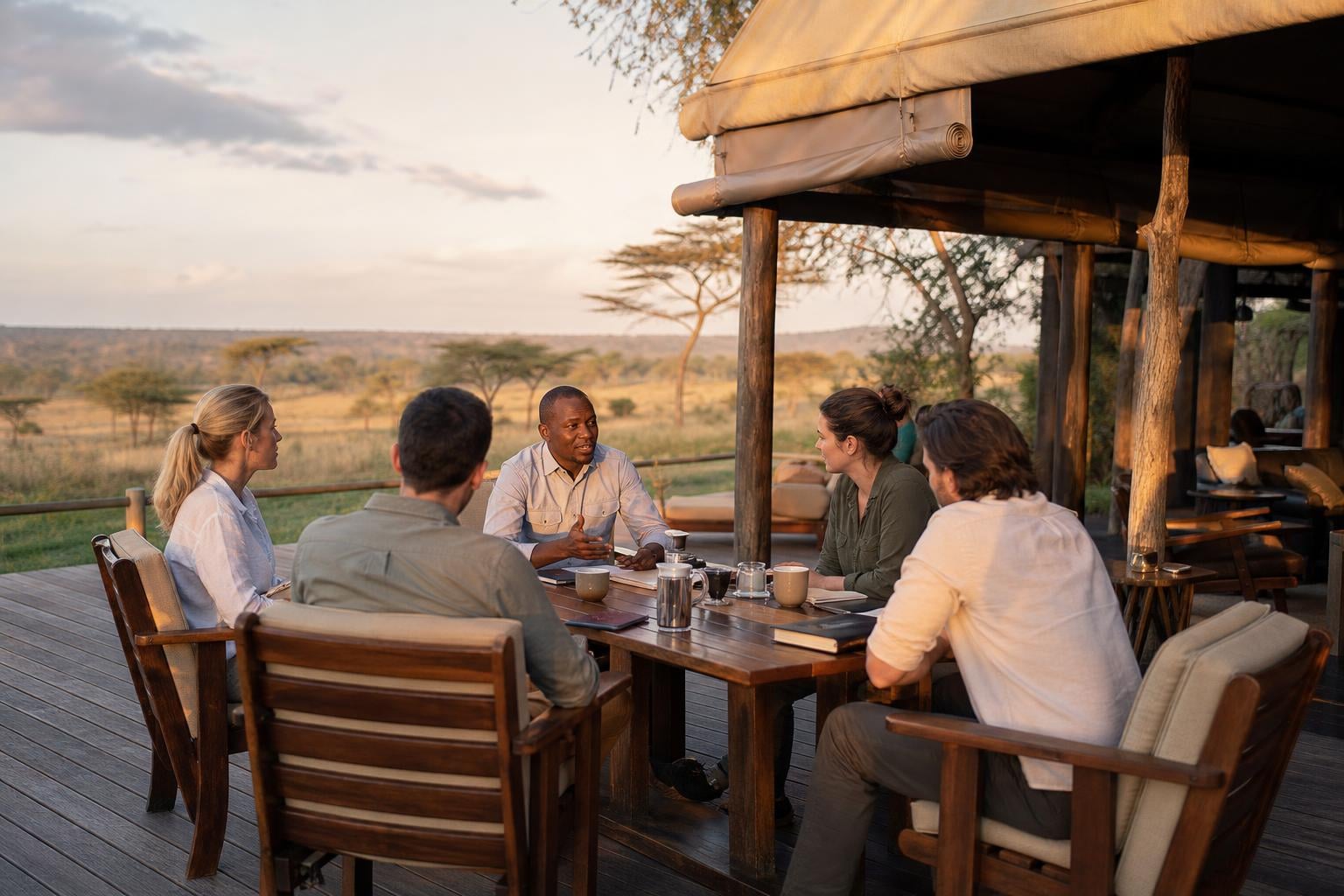
A retreat that reserves blocks for facilitated meetings, leadership sessions, or board-level discussion. Game drives are shorter or alternated with meeting mornings. Properties are chosen partly for meeting space, shade, power, and connectivity rather than purely for wildlife positioning.
Safari + Incentive Reward
A recognition trip designed to feel special. Premium camp choices, sundowners, bush dinners, optional balloon safari, private guide, and sometimes a Zanzibar finish. The goal is that participants retell the experience for years. As one LinkedIn practitioner noted about executives on a Kenya/Tanzania safari, incentive luxury is often about listening to personal preferences and creating moments participants retell later, not simply the suite or lodge brand.
Safari + Conservation / CSR
A program that includes a responsible, well-vetted community or conservation element. Use caution here. Community visits should be dignified, mutually beneficial, and never performative. Travelers on Reddit have described feeling uncomfortable when community experiences in Tanzania felt staged or exploitative. If the goal is genuine ESG alignment, vet the partner organization thoroughly and ensure fair compensation flows to the community.
Safari + Coast
A bush-and-beach itinerary that ends in Zanzibar, Pangani, or Saadani for decompression after early mornings and long game-drive days. This is one of the most popular corporate safari retreat formats in Tanzania because it gives attendees a recovery arc. You can explore Zanzibar excursion options to understand what the beach portion can include beyond sunbathing.
Safari + Kilimanjaro
A physically active retreat that may include a Kilimanjaro day hike or a full summit attempt for fit teams. A full climb is a separate expedition requiring proper fitness screening, safety planning, and appropriate guide ratios. A day hike on the lower slopes works well as an active add-on without the logistical weight of a multi-day climb.
Executive Fly-In Retreat
A time-efficient safari that uses domestic flights or charters to reduce long overland transfers. Often the best choice for senior teams with limited days and high opportunity cost. The incremental flight cost is usually justified by the hours saved and the reduced physical toll on participants.
Safari Logistics Glossary
These terms determine comfort, timing, and cost more than any lodge branding or itinerary headline.
Private Safari Vehicle
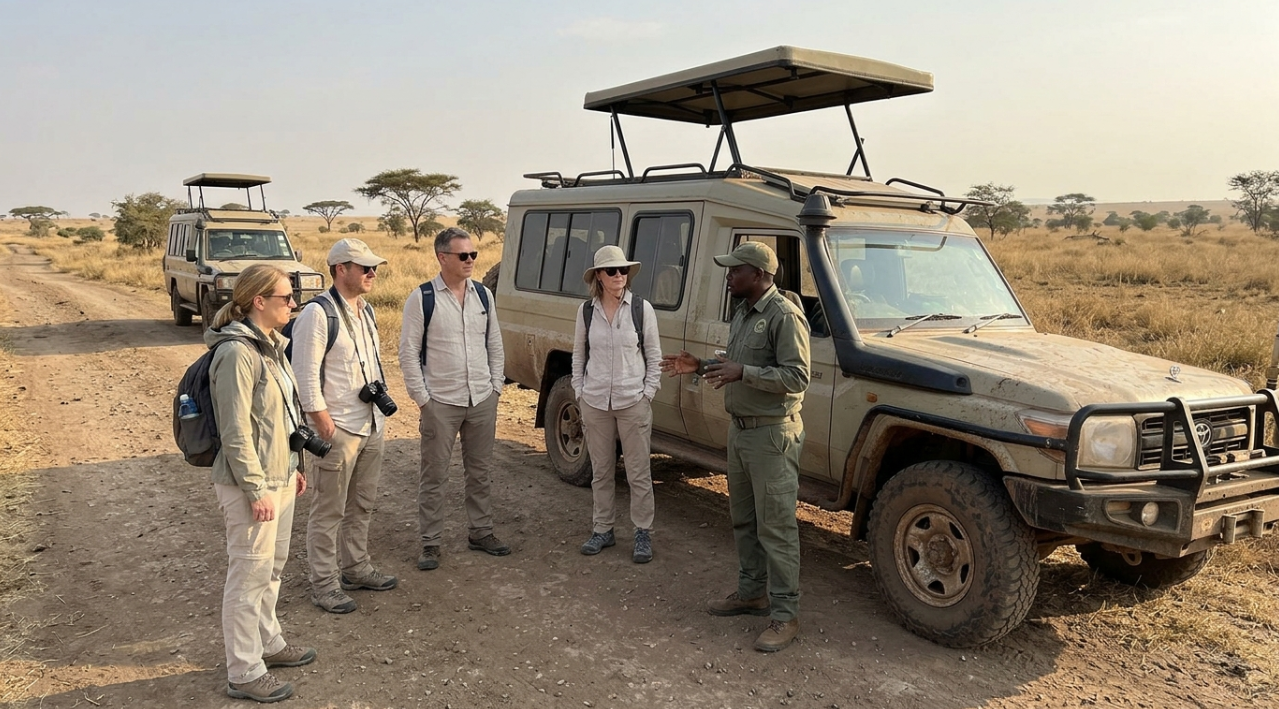
A dedicated 4×4 and guide for one group or sub-group. Corporate groups usually need multiple vehicles, with group assignments planned by department, role, photography needs, mobility, or VIP status. Practitioners on Reddit repeatedly emphasize that vehicle quality and guide skill affect satisfaction more than lodge branding when comparing Tanzania safari operators. For corporate retreats, this effect is amplified because every vehicle becomes a small social unit for hours at a time. To understand the vehicle options, review safari vehicle types and features.
Pop-Top Vehicle
A safari vehicle with a roof that opens for wildlife viewing and photography. Standard for Tanzania game drives. The pop-top is what turns a vehicle into a viewing platform rather than a car with windows.
Guide Allocation
The plan for how many guides and vehicles the group needs. For corporate retreats, this goes beyond simple headcount. Certain travelers may need a senior guide, a photographer-friendly guide, or a private VIP vehicle. Guide allocation is where the retreat either feels personal or feels like a bus tour.
Convoy
Multiple safari vehicles moving along the same route. Convoys need radio coordination but should not feel rigid. Vehicles often separate for wildlife sightings and regroup for meals or transfers. Good convoy management preserves the feeling of a private experience while keeping the group loosely connected.
Fly-In Safari
Using scheduled domestic flights or charters to reach the Serengeti, Zanzibar, or other airstrips rather than driving every leg. Reddit travelers regularly recommend flying into or out of the Serengeti to avoid long return drives. The IRF’s 2026 trends report confirms this pattern at scale: direct air access is the most cited incentive travel “must-have,” while difficult air access is a major deterrent when selecting destinations for corporate programs.
Domestic Safari Flight
A small-plane flight between Arusha, Serengeti airstrips, Zanzibar, or other points. These flights have luggage limits and typically require soft-sided bags. For corporate groups, the logistics of coordinating 15 or 20 people onto small aircraft require advance planning and sometimes multiple flight departures.
Charter Flight
A private aircraft movement arranged specifically for the group. Useful for executive teams, larger incentive groups, or tight schedules where commercial flight times do not align with the itinerary.
Transfer Day
A day primarily spent moving between locations, even if game viewing happens en route. Corporate planners should not overload transfer days with important meetings or late-night dinners. Attendees who have spent six hours in a vehicle on bumpy roads are not in the right state for a strategy session.
Safari Fatigue
The cumulative tiredness from early morning wake-ups (often 5:30 or 6:00 a.m.), long drives, dust, heat, bumpy roads, and altitude changes. For leisure couples, this is manageable. For corporate groups with mixed fitness levels, varied enthusiasm, jet lag, and social obligations at dinner, safari fatigue can erode the retreat’s value quickly. Reddit safari discussions consistently flag this as the most underestimated planning factor. Build rest blocks into every day.
Arrival Night
A first night near Arusha or Kilimanjaro International Airport (JRO) used to recover from international travel before entering the parks. This is especially important for groups arriving from multiple continents on different flights. Kilimanjaro International Airport serves as the gateway for Northern Circuit safaris and is located near both Arusha and Moshi.
Buffer Night
An extra night before or after safari to protect against flight delays, baggage issues, or missed connections. For a corporate group, one person’s lost luggage or delayed arrival can disrupt the entire convoy departure. Buffer nights are cheap insurance.
For time-sensitive executive groups, Duma Explorer can compare a road-based Northern Circuit retreat with a fly-in Serengeti version so your team can see what it gains in comfort, time, and flexibility.
Lodging, Venue, and Privacy Glossary
Lodge
A fixed safari property with permanent infrastructure. Lodges often have better meeting space, more reliable Wi-Fi, consistent power, and larger common areas than tented camps. For corporate retreats that need a projector, printed materials, or reliable connectivity, lodges are usually the safer choice.
Tented Camp
A safari camp with canvas-style accommodation. “Tented” does not mean basic. High-end tented camps can include en-suite bathrooms, hardwood floors, private decks, and excellent dining. The distinction matters because tented camps often offer more atmosphere and intimacy, which suits smaller groups and recognition-focused incentive trips.
Mobile Camp
A camp that moves seasonally to follow wildlife patterns, particularly the Great Migration. Good for unique positioning but typically less ideal for formal meetings. Mobile camps are best for reward-focused trips where the priority is wildlife access, not AV equipment.
Exclusive-Use Camp / Lodge Buyout
Booking all rooms or units so the group has full privacy. This improves confidentiality for board meetings, allows custom branding or signage, provides complete dining flexibility, and prevents the awkwardness of mixing with other guests during sensitive discussions. Buyouts require early booking, especially during peak season.
Room Block
A reserved set of rooms within a larger property where other guests may also be present. Less private than a buyout but more affordable. Corporate planners need to confirm single and twin room requirements early because remote properties have limited inventory.
Rooming List
The working document showing each attendee’s room assignment, bed preference, dietary notes, arrival and departure details, and special needs. For corporate groups, the rooming list also needs to account for seniority, reporting relationships, and whether certain people should or should not be assigned adjacent rooms. Get this right and nobody notices. Get it wrong and the retreat starts with a complaint.
Twin Share
Two people sharing one room with separate beds. This is common in safari pricing but sensitive in corporate settings. Not all employees want to share a room with a colleague. Seniority expectations, gender, personal comfort, and relationship dynamics all factor in. Discuss this with your operator early rather than defaulting to twin share to save budget.
Single Supplement
The extra cost for solo occupancy. This is the per-person premium for having a room to yourself. For incentive budgets, single supplements across 20 travelers can add meaningful cost. For executive retreats, singles are usually expected.
Meeting-Ready Lodge
A lodge with realistic space, seating, shade, power, Wi-Fi, and backup plans for meetings or presentations. Not every beautiful safari property is suitable for a projector-heavy strategy session. Some lodges have purpose-built conference areas. Others can arrange outdoor meeting setups under thatched shelters. The key is confirming the specific capabilities before booking, not assuming.
Wi-Fi Reality Check
Remote safari locations may have limited or inconsistent connectivity. Satellite internet is common at premium properties, and it can handle email and basic browsing, but video calls, large file transfers, and real-time collaboration tools often struggle. If meeting productivity depends on connectivity, run a tech audit with the property and prepare offline backups.
Tanzania Destination Glossary for Corporate Retreats
These are not generic destination descriptions. They explain what each location offers and demands in corporate planning terms.
Arusha
The common staging area for Northern Circuit safaris, arrival nights, briefing dinners, and some meeting sessions. Arusha has strong hotel infrastructure, meeting venues, and proximity to Kilimanjaro International Airport. It is more logistically practical than scenic, which makes it useful as a briefing point and recovery base rather than the centerpiece of the retreat.
Serengeti
Best for the highest-impact safari experience. The Serengeti is a UNESCO World Heritage Site and home to the world’s largest terrestrial mammal migration, with more than 1.5 million wildebeest, zebra, and associated predators moving across the ecosystem. For corporate retreats, the Serengeti delivers the “wow” factor that makes an incentive trip memorable or a client-hosting safari worth the investment. Experiences include game drives, walking safaris, and hot air balloon flights. Plan the Serengeti portion carefully by reviewing the Serengeti safari planning guide because the park is vast and positioning matters.
Ngorongoro Crater
Best for a concentrated wildlife day and dramatic landscape. The crater, described by UNESCO as the world’s largest caldera, offers exceptional wildlife density in a confined area. First-time safari groups often find the crater deeply impressive. Logistically, crater days start early and involve a descent fee, vehicle limits, and a mandatory six-hour time restriction inside the crater floor. Learn how a Ngorongoro day fits into a broader safari itinerary before committing to it as a full retreat day.
Tarangire
Best for elephants, baobab landscapes, and a strong first wildlife day. TANAPA describes Tarangire as “The Paradise of Elephants” with one of Africa’s highest elephant concentrations during the dry season. Tarangire is closer to Arusha than the Serengeti, which makes it practical as a first stop that introduces the group to safari without immediately requiring a long drive or domestic flight. See why Tarangire works well as a first game drive destination.
Lake Manyara
Best as a shorter wildlife stop or scenic add-on. Known for tree-climbing lions, large-tusked elephants, flamingos, and over 400 bird species according to TANAPA. Not always the centerpiece of a corporate retreat, but useful for a half-day experience en route between Arusha and Ngorongoro.
Arusha National Park
Best for a short pre- or post-retreat nature activity when time is limited. TANAPA lists walking safaris, canoeing on Momella Lakes, guided hikes, and photography as available activities. A morning in Arusha National Park works well as an icebreaker before the group departs for the main safari circuit.
Zanzibar
Best for post-safari decompression, incentive rewards, client hosting, or a gala dinner close. The shift from bush to beach gives the retreat an emotional arc. Do not overpromise meeting infrastructure on Zanzibar unless verified for the chosen property. The island is better used as a reward and recovery element than as a working session location. Check Zanzibar weather and season patterns before selecting dates for a beach extension.
Kilimanjaro
A corporate retreat element only for groups with the right fitness, risk tolerance, and time. A full climb is a separate multi-day expedition. A day hike on the lower slopes can work as an active team challenge if properly planned and screened.
Experience Glossary
Game Drive
A guided wildlife drive in a safari vehicle. Game drives come in several formats: early morning (starting before sunrise), half-day, full-day with picnic lunch, and en-route drives conducted while transferring between destinations. For corporate groups, morning drives work best when the afternoon is reserved for meetings, rest, or informal socializing.
En-Route Game Drive
Wildlife viewing conducted while the group is transferring between parks or camps. This sounds efficient on paper, but it is still a transfer day. The group will be tired on arrival, and the game viewing is often secondary to covering distance.
Sundowner
Drinks and snacks served at sunset in a scenic outdoor setting. Corporate uses include informal debriefs, recognition moments, and client-hosting conversations. Sundowners feel effortless to attendees but require advance coordination between the guide, camp staff, and event coordinator.
Bush Dinner
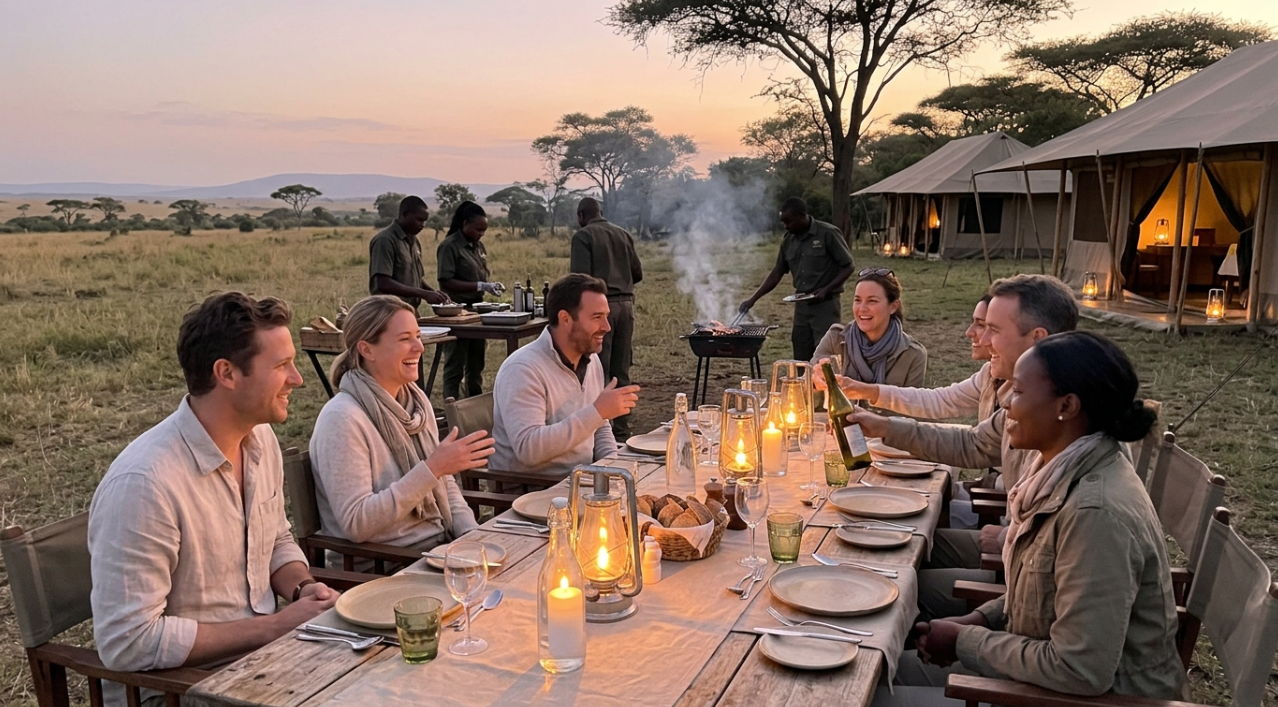
A private or semi-private outdoor dinner, often arranged in a clearing away from the main camp, lit by lanterns or a fire. Corporate uses include awards presentations, founder speeches, client appreciation moments, and group storytelling. Bush dinners create the kind of setting that would cost a fortune to fabricate in a hotel but happens naturally in the Serengeti.
Hot Air Balloon Safari
A sunrise balloon flight over safari landscapes, often followed by a champagne breakfast on the plains. This is a high-impact experience commonly used in incentive programs. Opinions among travelers are mixed but generally emotional. Some call it “worth every penny,” while others question whether a morning game drive might be more productive when safari time is limited. Best suited for groups with enough safari nights and budget to treat the balloon as a bonus rather than a replacement for ground-level wildlife viewing.
Walking Safari
A guided activity on foot, led by an armed ranger and a qualified walking guide. Walking safaris offer a completely different sensory experience than vehicle-based game drives. Best for small groups and active teams, but not appropriate for every attendee. Fitness, comfort with wildlife proximity, and footwear all matter.
Cultural Visit
A structured visit with local communities or cultural sites. When designed ethically (with consent, fair compensation, and genuine exchange), these can be meaningful. When designed poorly, they feel exploitative. Responsible planning matters more than the Instagram photo.
Facilitated Debrief
A structured conversation after a shared experience, translating observations into leadership or team insights. This is what turns a safari into a retreat rather than just a reward trip. A skilled facilitator can connect what the group observed during a game drive to themes of patience, teamwork, adaptability, or strategic awareness.
Do not make the trip feel like a corporate ropes course in safari clothing. The strongest team bonding usually comes from shared awe, private time, and a thoughtful debrief, not contrived competitions.
Group Operations Glossary
Group Brief
The starting document for the operator. A complete group brief accelerates planning and prevents wasted proposal cycles. It should include travel dates, number of travelers, arrival and departure cities, number of executives or VIPs, rooming preferences, budget range, accommodation level, trip objective, required meeting time, dietary restrictions, mobility needs, photography or media needs, branding preferences, extension interest, and preferred level of privacy.
Delegate Profile
A corporate-event term for who is traveling. Are they executives, employees, sales winners, clients, partners, spouses, or a mix? The delegate profile determines vehicle assignments, room grades, activity pacing, and the level of formality at meals.
VIP Handling
Special planning for senior leaders, founders, board members, investors, or key clients. This may include a private vehicle with the best guide, a premium room or suite, flexible scheduling that allows them to skip certain activities, and priority transfers.
Dietary Matrix
A consolidated list of meal restrictions and preferences for the entire group. Important in remote safari camps because advance notice matters. Lodges in the Serengeti cannot run to a supermarket. Allergies, vegetarian and vegan needs, halal or kosher requirements, and strong preferences all need to be collected and communicated weeks before arrival.
Attendee Communications
Pre-trip emails or packets that explain packing, visas, insurance, vaccination guidance, tipping, weather expectations, Wi-Fi limitations, dress codes, and safari etiquette. Good attendee communications reduce anxiety and prevent the “I didn’t know I needed a visa” emergencies that derail group departures.
On-Site Coordinator
A dedicated person who manages group timing, meals, vehicle assignments, rooming, changes, and attendee questions throughout the trip. For corporate retreats, this person is the buffer between the group and the operational complexity happening behind the scenes.
Duma Explorer handles full-service planning including itinerary design, lodge and camp selection, airport transfers, domestic flights, permits, and on-the-ground guiding. The company also provides pre-trip resources like packing lists, tipping guides, and Q&A, which reduces planning friction for groups coordinating across departments and time zones.
Corporate Safari Retreat Planning Timeline
Planning a corporate safari retreat in Tanzania involves coordinating accommodation, domestic flights, group transportation, attendee requirements, and the business agenda. The timeline below is a starting point for organizing the process. Large groups, exclusive-use properties, and peak-season travel may require additional lead time.
Planning stage | Recommended timing | Key actions |
|---|---|---|
Define objectives and budget | 9–12 months before travel | Confirm the business goal, approximate budget, group size, and preferred travel dates |
Request initial proposals | 6–12 months before travel | Compare itineraries, accommodation options, vehicle allocation, and transportation |
Secure key bookings | 6–9 months before travel | Confirm priority lodges, room inventory, flights, and any exclusive-use requirements |
Finalize the itinerary | 3–6 months before travel | Confirm meeting blocks, activities, destination sequence, and transfer arrangements |
Collect attendee details | 2–4 months before travel | Gather passport information through appropriate secure channels, room preferences, dietary needs, and mobility requirements |
Confirm operational arrangements | 1–2 months before travel | Reconfirm flights, rooming lists, meals, emergency contacts, and meeting equipment |
Send attendee briefing | 2–4 weeks before travel | Share packing guidance, travel documentation requirements, schedules, insurance reminders, and emergency procedures |
Complete final checks | 1 week before travel | Reconfirm arrivals, transfers, guide assignments, weather-related contingencies, and key contacts |
What Can Change the Timeline?
Large groups: More attendees mean more room inventory, vehicles, and flight coordination.
Peak-season dates: Popular camps and exclusive-use properties can have limited availability.
Executive privacy: Board-level retreats may require additional venue checks and confidentiality arrangements.
Complex itineraries: Combining the Serengeti, Zanzibar, and international connections adds more coordination.
Special requirements: Dietary restrictions, accessibility needs, and meeting technology should be discussed early.
Treat these timings as planning guidance rather than booking guarantees. Confirm availability and deadlines with your safari operator and individual properties.
Seasonality Glossary
Dry Season
Generally favored for classic safari conditions: lower grass means easier wildlife spotting, roads are more passable, and dust is a factor. Most corporate groups prefer dry season for reliability, but it also means higher demand and tighter availability.
Green Season
Can mean greener landscapes, fewer crowds, and sometimes better value. Rain affects road conditions and can change plans. For corporate retreats, the trade-off is lower pricing versus higher logistical risk.
Great Migration
The large-scale annual movement of wildebeest, zebra, and other animals through the Serengeti-Mara ecosystem. Timing the retreat around the migration adds spectacle but reduces flexibility because the group needs to be in the right Serengeti region at the right time. Choose the best time for a Tanzania safari based on your corporate calendar, not just the wildlife calendar.
Mara River Crossings
A high-demand migration event in the northern Serengeti where herds cross the crocodile-filled Mara River. Crossings are unpredictable. Reddit users repeatedly warn that more nights near the Mara River improve the chances of witnessing a crossing, and that a rushed one-day attempt often results in disappointment. For corporate planners, do not promise a crossing in incentive marketing materials.
Peak Season
Popular travel months when availability and pricing are most constrained. Corporate groups need longer lead times during peak periods, sometimes six to twelve months in advance for buyouts or large room blocks.
Shoulder Season
The transition between peak and green seasons. Can offer better availability, calmer pacing, and occasionally better value while still delivering good wildlife viewing.
Cost and Proposal Glossary
This section explains the terms that appear in safari proposals, not specific prices. Corporate retreat costs vary widely based on group size, season, accommodation level, vehicle requirements, and routing.
Per-Person Sharing
The price based on two people sharing a room. This is the default pricing unit in safari proposals. For corporate groups where many attendees expect private rooms, the actual per-person cost will be higher.
Single Supplement
The extra charge for solo room occupancy. Across a group of 20 people, single supplements can add thousands of dollars to the total program cost.
Included / Excluded
Park fees, conservation fees, transfers, domestic flights, meals, drinks, premium activities, gratuities, visas, travel insurance, and optional upgrades may be included or excluded depending on the proposal. Reddit safari travelers frequently ask whether Tanzania quotes include park fees, crater descent fees, private vehicles, meals, water, tips, drinks, and balloon rides. Every proposal should make this explicit.
Park Fees
Government or park authority charges for entering protected areas. These are per-person, per-day fees that apply to every attendee and are typically non-negotiable.
Crater Descent Fee
A specific additional fee for descending into the Ngorongoro Crater. This is a common surprise cost if it is not itemized in the proposal.
Optional Activities
Balloon safari, private bush dinner, cultural program, spa treatments, or charter flights. These are typically priced separately and can be offered as attendee upgrades or covered by the company as part of the incentive package.
Contingency Budget
A budget line for last-minute changes, delays, extra vehicles, medical support, or VIP needs. Remote logistics make surprises more expensive. A 5-10% contingency is practical.
Cost Drivers to Understand
Rather than quoting specific prices (which change with season, availability, and group configuration), understand that total corporate safari retreat costs in Tanzania are driven by: number of travelers, single rooms versus twin share, season, camp and lodge level, number of private vehicles, domestic flights or charters, Serengeti positioning, exclusive-use requirements, balloon safaris or special dining, Zanzibar extensions, number of guides and coordinators, and any meeting or AV needs.
Corporate Safari Retreat Budget Breakdown
A corporate safari retreat budget should separate core travel costs from optional experiences and contingency funds. This makes it easier to compare proposals and identify where an itinerary can be adjusted without undermining the group’s primary objective.
Budget category | What to include | Questions to ask the operator |
|---|---|---|
Accommodation | Lodges, tented camps, room blocks, and single supplements | Are rooms priced per person sharing or per person in single occupancy? |
Safari operations | Guides, private vehicles, fuel, and vehicle allocation | How many vehicles and guides are included? |
Park and conservation fees | Applicable park entry and conservation charges | Which fees are included, and which may change before travel? |
Transportation | Airport transfers, domestic flights, and charter flights | Are baggage limits, transfers, and flight connections included? |
Meals and beverages | Included meals, drinks, and special dining arrangements | Are premium drinks, bush dinners, and other special meals extra? |
Meetings and facilitation | Meeting rooms, equipment, facilitators, and materials | Is the meeting setup included in the quoted rate? |
Optional experiences | Balloon safaris, walking safaris, cultural activities, and beach excursions | Which activities are optional, and what are their cancellation terms? |
Travel protection | Travel insurance, medical evacuation arrangements, and related coverage | What protection must the company or attendees arrange separately? |
Operations and contingency | Coordination, last-minute changes, and emergency reserves | What additional charges could arise, and how are they approved? |
How to Compare Corporate Safari Proposals
Compare proposals on the same basis. Check the number of nights, accommodation category, room occupancy, vehicle arrangements, included meals, flights, applicable fees, activities, and cancellation terms.
A lower headline price may exclude items that another proposal includes. Ask each operator to identify exclusions and any costs that depend on final group size or availability before approving the budget.
Risk, Health, Visa, and Compliance Glossary
Tourist Visa / Business Visa
Corporate retreat attendees may travel on tourist visas depending on the trip’s purpose. If the program includes business meetings, conferences, or commercial activities, visa requirements may differ. Tanzania’s eVisa guidelines advise applicants who are unsure of visa type to read guidelines or contact immigration for clarification. Confirm the correct category with official sources before attendees apply.
Mandatory Inbound Travel Insurance
As of the current research period, foreign nationals entering mainland Tanzania (excluding residents of EAC or SADC partner states) are required to purchase mandatory inbound travel insurance. This is a government-provided insurance product, separate from any corporate travel insurance the company may already carry. Official NIC guidance provides current details. Review Tanzania travel insurance considerations for a fuller overview, and re-check official sources close to your travel dates because this requirement is subject to change.
Medical Evacuation
Emergency transport coverage from remote safari locations to a hospital or out of the country. Do not assume this is covered by standard corporate travel insurance. Confirm evacuation coverage explicitly and communicate the policy to all attendees before departure.
Wildlife Safety Briefing
Guide instructions about wildlife behavior, vehicle conduct, and walking protocols. These are not optional suggestions. TANAPA’s park guidelines tell visitors to follow guide instructions for wildlife safety. Corporate groups need to understand that safari guides have authority over the group’s movement in wildlife areas, regardless of anyone’s job title.
Crisis Plan
Corporate groups need documented contacts, decision-makers, insurance details, flight-change procedures, and emergency communication channels. A clear chain of command matters when someone needs medical attention at 6 a.m. in a remote camp.
Inbound Travel Insurance
Before traveling to Tanzania, confirm the travel insurance requirements that apply to each attendee’s nationality, residency status, and itinerary. Distinguish any government-mandated inbound insurance from the company’s existing corporate travel policy.
Corporate planners should also check whether the policy covers medical treatment, emergency medical evacuation, trip interruption, and activities included in the itinerary. Do not assume that a standard travel policy automatically covers every safari activity or emergency scenario.
Verify the current requirements with the relevant official Tanzanian authorities and insurer before booking, and repeat the check shortly before departure.
Common Planning Mistakes
Designing the trip around a park checklist instead of the retreat objective. A reward trip, leadership offsite, and client-hosting safari should not share the same itinerary by default. Start with the purpose and work backward to the route.
Too many one-night stays. Community safari discussions consistently warn that single-night stops create rushed pacing, excessive packing and unpacking, and transfer fatigue. Two or three nights at key locations gives the group time to settle in and actually enjoy each destination.
Underestimating long drives. The distance between Arusha and the central Serengeti, for example, can mean 8 or more hours on unpaved roads. Reddit users describe these transfers as long, bumpy, and dusty, and recommend flying when the budget allows. Corporate groups tolerate this less well than adventurous backpackers.
Treating Wi-Fi as guaranteed. Remote lodges may support email and basic browsing but cannot handle a full Zoom board meeting with screen sharing. Tech-heavy meetings require venue checks, backup plans, and offline-ready materials.
Scheduling serious meetings after full-day game drives. An all-day safari drive involves early rising, heat, dust, concentration, and physical movement. Stacking a two-hour strategy session at 8 p.m. after that kind of day produces glazed eyes, not strategic breakthroughs.
Forcing team-building activities. Practitioners on Reddit’s HR and corporate forums report that mandatory fun generates resentment, especially when it consumes personal time or feels compulsory. Safari provides natural shared context. A facilitated debrief or optional photography challenge works better than a contrived obstacle course.
Not collecting dietary, medical, and mobility needs early. Remote logistics make last-minute changes harder. A severe food allergy disclosed two days before departure creates real problems when the camp is hours from the nearest town.
Treating community visits as easy CSR. Poorly designed school or village visits can feel uncomfortable or exploitative for both the visitors and the community. Responsible planning, fair compensation, and genuine mutual benefit are non-negotiable.
Which Tanzania Corporate Safari Retreat Format Fits Your Team?
Primary objective | Recommended format | Key priority | Main trade-off |
|---|---|---|---|
Executive alignment | Safari + strategy retreat | Privacy, reliable meeting facilities, and protected discussion time | Less time available for extended game drives |
Employee or sales recognition | Safari + incentive reward | Memorable experiences, comfort, and recognition | Premium activities and accommodation can increase the budget |
Team connection | Private safari retreat | Shared experiences, flexible pacing, and downtime | Less structured interaction than a conventional workshop |
Client relationship building | Premium private safari | Guide quality, smooth transfers, and personalized service | Greater emphasis on service and privacy may raise costs |
Active leadership development | Safari + suitable hiking activity | Safety, fitness suitability, and facilitated reflection | Not every attendee will want or be able to participate |
Conservation-focused program | Safari + vetted conservation experience | Credible local partnerships and measurable benefits | Requires due diligence and careful program design |
Reward and relaxation | Safari + Zanzibar extension | A comfortable transition from wildlife activities to beach time | Additional flights, transfers, and nights increase complexity |
Most corporate safari retreats combine more than one objective. Choose the primary objective first, then use the secondary objectives to refine the itinerary rather than trying to accommodate every possible activity.
How to Brief a Tanzania Safari Operator
The quality of the proposal you receive depends almost entirely on the quality of the brief you provide. An operator cannot design a meaningful corporate safari retreat in Tanzania from a one-line email that says “20 people, sometime in September.”
Group Brief Checklist
Prepare these details before reaching out:
Preferred travel dates and flexibility
Number of travelers
Traveler mix (employees, executives, partners, spouses, clients)
Departure markets and arrival windows
Total trip length
Primary objective: reward, strategy, bonding, client hosting, ESG, or mixed
Approximate budget range per person
Accommodation style (lodge, tented camp, or a mix)
Single vs. twin room expectations
Meeting requirements (frequency, duration, AV needs)
Wi-Fi and connectivity requirements
Mobility and medical needs
Dietary requirements
Privacy requirements
Destination priorities (Serengeti, Ngorongoro, Tarangire, Kilimanjaro, Zanzibar)
Interest in balloon safari, bush dinner, or special experiences
Desired pace (active, balanced, or relaxed)
Whether the group needs a coast decompression finish
Decision timeline and internal approval process
A LinkedIn practitioner working in East Africa incentive travel noted that site inspections are used to refine timing, validate venues, and anticipate challenges before the group arrives. If your budget allows, a site inspection trip (or having your operator conduct a ground check) is worth the investment for high-stakes programs.
Duma Explorer is well suited for this kind of complex planning. The company is led by Stacy Readal, who has 15 years based in Tanzania and speaks Swahili. Duma operates locally as Alika Africa in Tanzania with a dual U.S. and Tanzanian ownership structure, which means corporate planners in North America get responsive communication across time zones while the ground execution happens through a local team with deep relationships at camps, lodges, and parks. Safari guides receive advanced training through EcoTraining and FGASA programs. The company is Travelife Certified and a founding partner of KPAP for porter welfare, which matters for companies with ESG or procurement standards. Duma’s product breadth, covering private safaris, Kilimanjaro, Zanzibar, gorilla trekking in Uganda and Rwanda, and Maasai Mara extensions, means a single planning relationship can handle a multi-destination corporate program without handing the group off to unfamiliar subcontractors.
Request a Custom Corporate Safari Retreat Itinerary
Frequently Asked Questions
How many days does a corporate safari retreat in Tanzania need?
Most meaningful programs run 5 to 8 safari days, depending on whether the group includes the Serengeti, Ngorongoro, Tarangire, meeting blocks, or a Zanzibar extension. Shorter trips of 3 to 4 days can work near Arusha, Tarangire, and Ngorongoro. Programs that combine the Serengeti with Zanzibar need more time or domestic flights to avoid excessive driving.
Can you hold meetings at safari lodges in Tanzania?
Some lodges have meeting-friendly spaces with power, seating, and connectivity. Others are better suited for informal sessions, fireside conversations, or outdoor debriefs. Confirm Wi-Fi bandwidth, AV support, backup power, seating capacity, and privacy before choosing a property for a working session.
Should a corporate group drive or fly between safari areas?
Driving is scenic and cost-effective but creates long transfer days. Flying is often better for executive or incentive groups with limited time, especially when the Serengeti or Zanzibar is included. The cost difference is real, but so is the time and energy saved. For senior teams, the flight usually pays for itself in reduced fatigue and recovered hours.
What is the best Tanzania destination for a first corporate safari?
For many groups, the Arusha, Tarangire, Ngorongoro, Serengeti sequence is the classic framework. Serengeti adds the biggest impact, Ngorongoro provides dramatic scenery and dense wildlife, and Tarangire offers elephants and baobab landscapes with easier access from Arusha.
Is a Zanzibar extension worth adding to a corporate safari retreat?
Yes, when the group needs decompression, recognition, beach time, or a softer close after early safari mornings. It is less useful when the retreat has only a few days and the primary purpose is leadership work that requires focused meeting time.
What makes Tanzania a strong destination for corporate incentive travel?
Tanzania was named World’s Leading Safari Destination 2025 by World Travel Awards, and the Serengeti won World’s Leading National Park. The country recorded over 2.29 million international arrivals in 2025. The combination of wildlife spectacle, varied landscapes, premium camp and lodge infrastructure, and beach extension options makes Tanzania competitive against more conventional incentive destinations. GBTA projects global business travel spending at $1.57 trillion in 2025, and Tanzania is actively positioning itself within that market.
What information should we give a safari operator first?
Dates, traveler count, arrival cities, trip objective, budget range, rooming expectations, meeting needs, dietary and mobility requirements, desired destinations, and whether the group prefers privacy, high activity, or a relaxed pace. The more specific the brief, the more useful the first proposal will be.
What group size works best for a corporate safari retreat in Tanzania?
The ideal group size depends on the retreat’s objectives, accommodation availability, budget, and transportation arrangements. Smaller executive groups may prioritize privacy and flexibility, while larger incentive groups need coordinated vehicle assignments, room allocations, and potentially staggered domestic flights. Ask the operator to confirm how many vehicles, guides, and rooms are required for your specific group.
How much meeting time should we schedule during a safari retreat?
The right amount depends on whether the trip is primarily a leadership offsite, team-bonding retreat, or incentive reward. Strategy-focused programs should reserve protected meeting blocks and choose properties with suitable facilities. Reward-focused programs generally benefit from a lighter agenda with optional activities and sufficient downtime. Avoid scheduling important discussions immediately after long transfers or full-day game drives.
Can a corporate safari retreat accommodate different fitness levels and mobility needs?
Yes, provided these requirements are considered during itinerary design. Vehicle-based game drives can suit many different fitness levels, but walking safaris, hikes, and certain camp layouts may have additional physical requirements. Discuss accessibility, medical needs, activity alternatives, and emergency arrangements with the operator before confirming the itinerary.
When should a company book a Tanzania corporate safari retreat?
Start planning as early as practical, particularly if the group needs exclusive-use accommodation, peak-season travel dates, or coordinated domestic flights. A lead time of 6–12 months is a useful starting point for complex programs, but availability varies by property, season, and group size. Confirm the actual booking deadlines and deposit requirements with the operator.
What should a corporate safari retreat proposal include?
A detailed proposal should outline the itinerary, accommodation, room configuration, number of vehicles and guides, transfers, domestic flights, applicable park fees, meals, optional activities, meeting arrangements, exclusions, payment terms, and cancellation conditions. It should also identify assumptions that could change the price, such as final group size, availability, and single-room requirements.
Leave a Reply