Author: rankaiexpert

  • Gorilla Trekking Malaria: Risks, Prevention & Tips 2026

    Gorilla Trekking Malaria: Risks, Prevention & Tips 2026

    TL;DR

    Malaria is the single most important health concern for gorilla trekking in Uganda and Rwanda. Although the high-altitude parks themselves carry lower mosquito risk, every itinerary passes through lowland transit zones where transmission is year-round. The CDC recommends antimalarial prophylaxis for all travelers to both countries, with no altitude exceptions. Take your pills, use repellent, sleep under a net, and understand that malaria prevention protects both your health and your $700+ gorilla permit.


    Gorilla trekking malaria risk confuses people for one simple reason: the parks sit at high elevations where mosquitoes are scarce, but the journey to those parks passes through some of the most malaria-dense areas on Earth. That contradiction trips up nearly every traveler who researches this topic.

    This guide defines the key malaria terms gorilla trekkers encounter during trip planning, explains what each one means in the specific context of trekking in Uganda and Rwanda, and connects the health dots to the financial and logistical realities of a gorilla permit that costs $700 to $1,500.

    Medical disclaimer: This article is for educational purposes. Consult a travel medicine specialist 6 to 8 weeks before departure. No blog post replaces a doctor’s assessment of your individual health profile.

    📌 Considering a gorilla trek? Start with our Uganda gorilla safari guide for pricing, itineraries, and logistics.

    Quick Answer: Do You Need Malaria Pills for Gorilla Trekking?

    If you’re gorilla trekking in Uganda or Rwanda, yes—official health authorities recommend taking antimalarial medication.

    Although gorilla trekking parks like Bwindi Impenetrable National Park and Volcanoes National Park sit at higher elevations where mosquito activity is lower, nearly every itinerary includes time in lower-altitude cities and transit routes where malaria transmission occurs year-round.

    For most travelers, malaria prevention includes:

    – Taking prescribed antimalarial medication before, during, and after travel

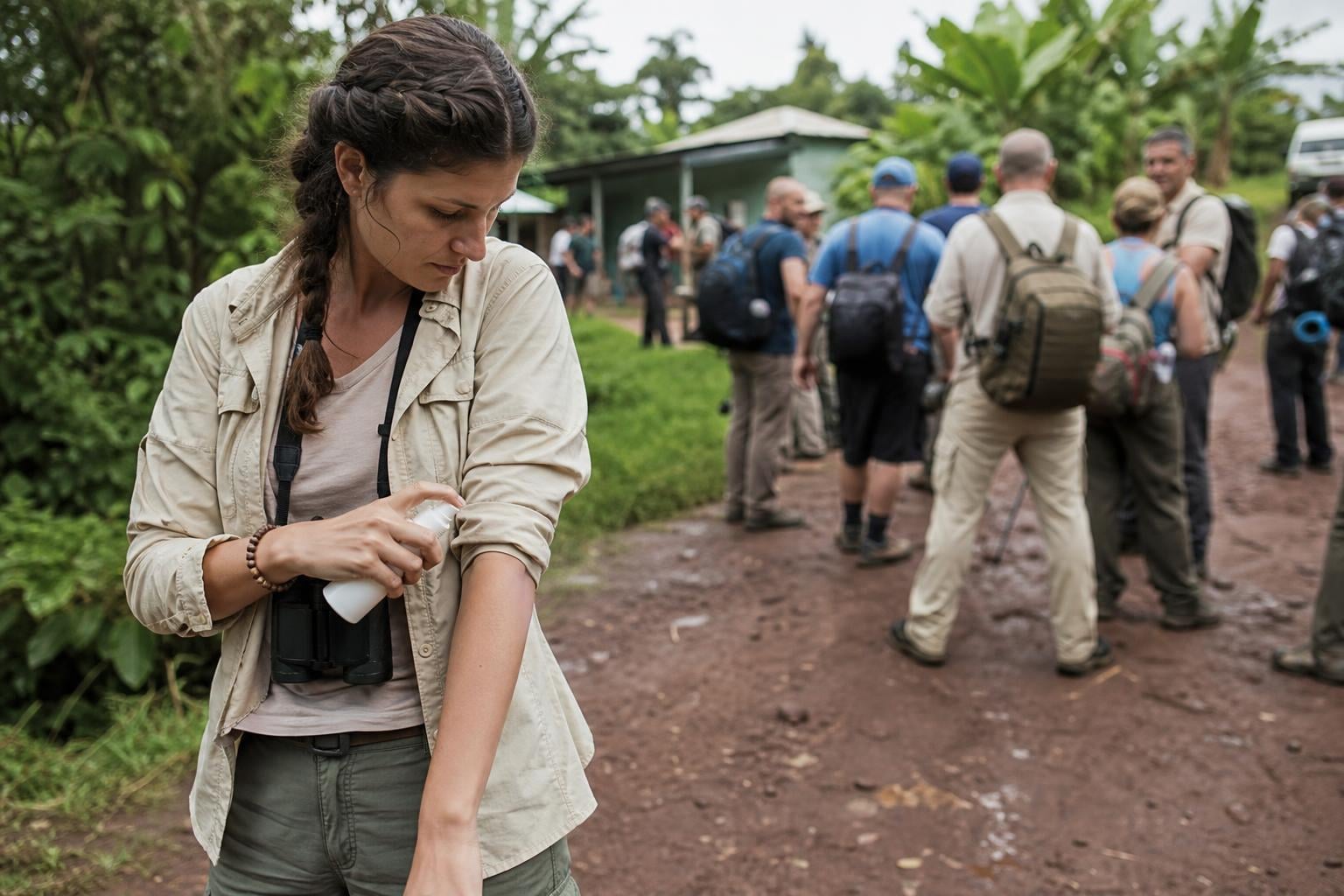
    – Applying 30–50% DEET insect repellent every evening

    – Wearing permethrin-treated clothing

    – Sleeping under insecticide-treated bed nets

    – Seeking medical advice 6–8 weeks before departure

    The actual gorilla trek is usually not the highest malaria risk. Overnight stays and road transfers through lower elevations account for most traveler exposure.

    Gorilla Trekking Malaria Risk at a Glance

    Question

    Short Answer

    Is malaria present in Uganda?

    Yes

    Is malaria present in Rwanda?

    Yes

    Is malaria common inside gorilla parks?

    Lower risk because of altitude

    Is malaria common during travel to the parks?

    Yes

    Should travelers take malaria medication?

    Yes, according to CDC guidance

    Is mosquito repellent still necessary?

    Yes

    Is dry season safer?

    Generally yes

    Can malaria affect your trekking permit?

    Yes, illness may prevent trekking

    Core Malaria Terms for Gorilla Trekkers

    Malaria

    An infectious disease caused by Plasmodium parasites, transmitted to humans through the bite of infected female Anopheles mosquitoes. It is not spread through casual contact, food, or water. Symptoms include fever, chills, headache, muscle aches, and fatigue.

    Why it matters for gorilla trekking: Malaria is endemic across both Uganda and Rwanda. As of 2023, Uganda had the third-highest global burden of malaria cases (4.8% of all cases worldwide). Rwanda has made dramatic progress, reducing its caseload by 85% between 2019 and 2023, from 4.9 million cases to 749,000. But the CDC still recommends prophylaxis for travelers to both countries.

    Plasmodium falciparum

    The most dangerous of the five Plasmodium species that infect humans. It causes the most severe form of malaria and is responsible for the vast majority of malaria deaths globally.

    Why it matters for gorilla trekking: P. falciparum accounts for roughly 97% of malaria infections in Uganda and dominates in Rwanda as well. It is chloroquine-resistant throughout sub-Saharan Africa, which means older, cheaper antimalarials won’t work. Travelers need one of the currently recommended alternatives (more on those below).

    Anopheles Mosquito

    The specific mosquito genus responsible for transmitting malaria parasites. Unlike the Aedes mosquitoes that carry dengue and Zika (which bite during the day), Anopheles mosquitoes are most active between dusk and dawn.

    Why it matters for gorilla trekking: This timing is critical. Multi-day gorilla trekking itineraries often require overnight stays at lodges near the forest edge. Practitioners in online travel forums note that exposure to mosquitoes at dusk and dawn around these lodges, particularly in lower-elevation areas surrounding the parks and in nearby towns like Buhoma and Ruhija, is where the real bite risk occurs. The trek itself, which happens during daylight hours in dense forest canopy, is actually the lowest-risk part of the day.

    Malaria Transmission

    The process by which Plasmodium parasites move from an infected mosquito to a human host through a bite. Transmission intensity depends on mosquito density, temperature, humidity, altitude, and season.

    Why it matters for gorilla trekking: Transmission in Uganda is year-round and perennial across roughly 90% of the country, including urban areas like Kampala. In Rwanda, transmission is more seasonal, peaking during the rainy months. The gorilla trekking malaria risk is not limited to the park itself. It follows the entire route of your itinerary.

    Malaria Symptoms

    The classic presentation includes fever, chills, sweating, headache, nausea, vomiting, body aches, and general fatigue. Symptoms typically appear 7 to 30 days after an infected bite, though they can emerge weeks or even months later with certain Plasmodium species.

    Why it matters for gorilla trekking: Here’s where gorilla trekking creates a unique financial risk beyond the health risk. If fever, chills, or respiratory symptoms develop before your scheduled trek, you will be flagged during the mandatory morning health briefing. Rangers can and do turn away visibly ill trekkers, because gorillas share approximately 98% of human DNA and are vulnerable to human diseases. Losing a permit that cost $700 or more because of preventable illness is a scenario worth avoiding. For a full breakdown of permit pricing and booking rules, see our gorilla trekking permits guide.


    Prevention and Prophylaxis Terms

    Chemoprophylaxis

    The practice of taking antimalarial medication before, during, and after travel to a malaria-endemic area. The drugs don’t prevent mosquito bites. They kill the malaria parasites at various stages of their life cycle inside your body, preventing infection from developing into disease.

    Why it matters for gorilla trekking: The CDC recommends chemoprophylaxis for all travelers to Uganda and Rwanda. No exceptions are made based on altitude, trip length, or time of year. As one experienced traveler put it on TripAdvisor’s Uganda forum: “Whether 1 night or 8, it only takes one bite from an infected mosquito.” That’s not fearmongering. It’s biology.

    Malarone (Atovaquone-Proguanil)

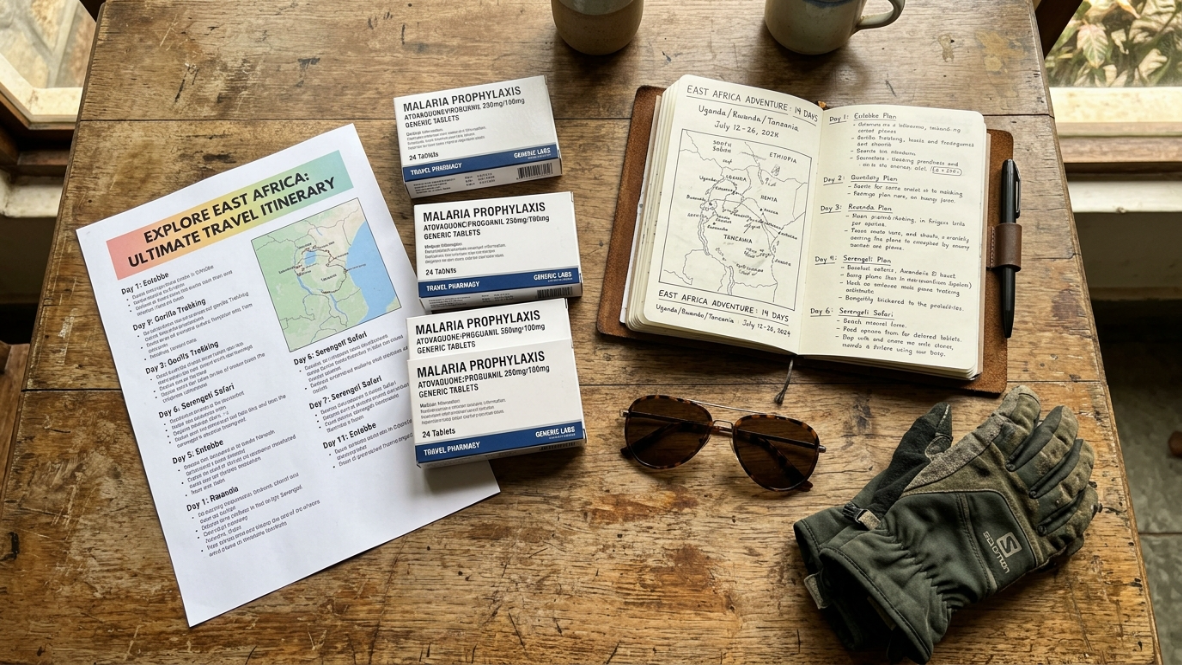
    A daily antimalarial pill that is started 1 to 2 days before entering a malaria zone and continued for only 7 days after leaving. It is generally the best-tolerated option, with the most common side effects being mild gastrointestinal upset and headache.

    Why it matters for gorilla trekking: Malarone is the preferred drug among many Africa travel professionals. One industry professional on TripAdvisor shared: “I personally take Malarone. For me it seems to have had the fewest side effects, and anecdotally this seems common with other people who are in the industry.” Its short post-trip tail (7 days versus 4 weeks for doxycycline) makes it especially practical for typical 7 to 14 day gorilla trekking trips. It also doesn’t cause photosensitivity, which matters if your itinerary combines gorilla trekking with a Zanzibar beach extension or open-vehicle safari days. The downside is cost: Malarone is the most expensive option.

    Doxycycline

    A daily antibiotic that doubles as an antimalarial. Taken 1 to 2 days before travel and continued for 4 weeks after leaving the malaria zone. It is the most affordable antimalarial option and also provides protection against some bacterial infections.

    Why it matters for gorilla trekking: The main drawback is photosensitivity, meaning your skin burns more easily in the sun. Inside the dense canopy of Bwindi Impenetrable Forest, this is less of a concern. But if your trip includes open savannah game drives in Queen Elizabeth National Park or beach time afterward, it becomes a real issue. The 4-week post-trip tail is also a nuisance, since many travelers forget to complete the course once they’re home.

    Mefloquine (Lariam)

    A weekly antimalarial pill started 2 weeks before travel and continued for 4 weeks after departure. The weekly dosing is convenient for longer trips.

    Why it matters for gorilla trekking: Mefloquine carries a risk of neuropsychiatric side effects, including anxiety, vivid dreams, and in rare cases, more serious reactions. Some travelers report that the vivid dream side effect is unsettling when combined with the excitement and physical exhaustion of a gorilla trek. This drug requires a conversation with your doctor well in advance, since you need to start it 2 weeks before departure to check for side effects. Those with age-related concerns about drug options should also review our guide to gorilla trekking age limits.

    Tafenoquine (Arakoda)

    A newer weekly antimalarial option started 3 days before travel and continued for only 1 week after return. It requires a G6PD blood test before prescribing, since people with G6PD deficiency (a genetic enzyme condition) cannot take it safely due to the risk of hemolytic anemia.

    Why it matters for gorilla trekking: Tafenoquine’s weekly dosing and short post-trip tail make it appealing for longer East Africa itineraries. However, it is not approved for travelers under 18 or for pregnant women, and the mandatory G6PD screening adds a step to pre-trip planning. Discuss it with your travel medicine specialist if the other options don’t suit you.

    Chloroquine Resistance

    Chloroquine was once the go-to antimalarial drug worldwide. Plasmodium falciparum has developed widespread resistance to it across sub-Saharan Africa, rendering it ineffective in Uganda and Rwanda.

    Why it matters for gorilla trekking: If anyone suggests chloroquine for a gorilla trekking trip, find a different doctor. It simply does not work against the dominant malaria parasite in East Africa.

    Drug Comparison at a Glance

    Drug

    Dosing

    Start Before Trip

    Continue After

    Key Concern

    Relative Cost

    Malarone

    Daily

    1-2 days

    7 days

    GI upset

    Higher

    Doxycycline

    Daily

    1-2 days

    4 weeks

    Sun sensitivity

    Lower

    Mefloquine

    Weekly

    2 weeks

    4 weeks

    Neuropsychiatric effects

    Mid

    Tafenoquine

    Weekly

    3 days

    1 week

    Requires G6PD test

    Mid-high

    Which Malaria Medication Is Best for Gorilla Trekking?
    Gorilla Trekking Malaria: Risks, Prevention & Tips 2026

    Choosing the right antimalarial depends on your health, itinerary, and personal preferences.

    Medication

    Best For

    Possible Drawback

    Malarone

    Most vacation travelers

    Higher cost

    Doxycycline

    Budget travelers

    Sun sensitivity

    Mefloquine

    Long trips

    Neuropsychiatric side effects

    Tafenoquine

    Weekly dosing

    Requires G6PD testing

    No medication is universally best. A travel medicine physician should recommend the option that fits your medical history.

    DEET

    The active ingredient in the most effective insect repellents. Look for concentrations between 30% and 50% for tropical use. Applied directly to exposed skin.

    Why it matters for gorilla trekking: Humid forest conditions mean you’ll sweat, which reduces DEET’s effectiveness. Reapply after heavy sweating. Use it on any exposed skin during the evening hours at your lodge, which is the highest-risk window for Anopheles bites. For a full list of what to bring, check our gorilla trekking packing list.

    Permethrin

    An insecticide applied to clothing, gear, and mosquito nets. It is not applied directly to skin. Permethrin-treated clothing repels and kills mosquitoes on contact.

    Why it matters for gorilla trekking: Treating your trekking pants, long-sleeved shirts, and socks with permethrin before departure adds a layer of protection. Many gorilla trekking lodges already provide permethrin-treated bed nets, but bringing your own treated clothing ensures coverage during the dusk hours when you’re outside.

    Insecticide-Treated Net (ITN)

    A bed net treated with insecticide (usually permethrin or a related compound) that kills or repels mosquitoes that land on it. The CDC Yellow Book specifically recommends sleeping under permethrin-impregnated netting for all safari and trekking travelers.

    Why it matters for gorilla trekking: Most reputable lodges near Bwindi and Volcanoes National Park provide ITNs. Use them every single night, even at altitude. Tuck the net under your mattress before dark, and check for holes. This is not optional.


    Geographic and Environmental Terms

    Altitude Effect

    The relationship between elevation and malaria transmission intensity. Anopheles mosquitoes breed less successfully at higher, cooler elevations. Research published in PubMed has documented a greater than 1,000-fold reduction in transmission intensity between lowland and highland areas in East Africa.

    Why it matters for gorilla trekking: This is the single most misunderstood aspect of gorilla trekking malaria risk. Volcanoes National Park in Rwanda sits at 2,400 to 4,500 meters above sea level. Bwindi Impenetrable National Park in Uganda ranges from 1,160 to 2,607 meters. At these elevations, mosquito density drops significantly. But every gorilla trekking itinerary transits through lowland areas where malaria is fully active. The CDC makes no altitude-based exceptions for Uganda. A blog post from Asilia Africa, a prominent East Africa operator, makes the critical point: “Most East Africa itineraries move between altitudes, and the benefits of anti-malarial medication apply to the entire trip rather than individual sections. Don’t assume that a night at high altitude means you can skip your meds.”

    Lower risk does not mean no risk.

    Bwindi Impenetrable National Park

    Uganda’s primary gorilla trekking destination, home to roughly half of the world’s remaining mountain gorillas. Located in southwestern Uganda, it spans altitudes from approximately 1,160 to 2,607 meters.

    Why it matters for gorilla trekking malaria planning: Bwindi’s risk level varies by sector. The lower sectors around Buhoma (roughly 1,500 meters) see more mosquito activity than the higher Ruhija sector (roughly 2,300 meters). Overnight stays at forest-edge lodges expose trekkers to bites at dusk and dawn. The risk is moderate rather than high, but it exists.

    Volcanoes National Park

    Rwanda’s gorilla trekking destination in the Virunga Mountains. Its altitude ranges from 2,400 to 4,500 meters, making it one of the highest gorilla trekking locations.

    Why it matters for gorilla trekking malaria planning: The park itself carries low malaria risk due to its high elevation. But travelers fly into Kigali (approximately 1,500 meters) and drive through lower-elevation areas to reach the park. Rwanda’s impressive 85% reduction in malaria cases since 2019 offers additional reassurance, but does not eliminate the need for prophylaxis. To compare the two countries’ gorilla trekking options in detail, read our Rwanda vs. Uganda comparison.

    Transit Risk

    The malaria exposure acquired not at the gorilla park itself, but during travel to and from it. This is the most underappreciated aspect of gorilla trekking malaria prevention.

    Why it matters for gorilla trekking: Flying into Entebbe, overnighting in Kampala, driving through lowland Uganda on the way to Bwindi, or combining gorilla trekking with a savannah safari in Queen Elizabeth National Park or Akagera creates exposure to high-transmission zones. Many travelers focus their malaria anxiety on the forest itself when the real risk points are the cities and lowland roads they pass through before and after the trek.

    Rainy Season

    March to May (long rains) and September to November (short rains) in both Uganda and Rwanda. Standing water from rainfall creates breeding grounds for mosquitoes, spiking transmission.

    Why it matters for gorilla trekking: Rainy season means more mosquitoes, muddier trails, and more physically demanding treks. The gorilla trekking malaria risk is highest during these months, making dry season travel doubly attractive.

    Dry Season

    June to September and mid-December to early February. Lower rainfall reduces mosquito breeding habitat and decreases transmission intensity.

    Why it matters for gorilla trekking: Dry season offers both the easiest hiking conditions and the lowest malaria risk. This double benefit makes it the recommended window for gorilla trekking. For month-by-month planning across the region, see our East Africa seasonal guide.

    Malaria Risk by Park: Quick Comparison

    Factor

    Bwindi (Uganda)

    Volcanoes NP (Rwanda)

    Transit Cities

    Altitude

    1,160–2,607m

    2,400–4,500m

    1,100–1,500m

    Malaria risk at park

    Moderate

    Low

    High

    CDC prophylaxis recommended

    Yes

    Yes

    Yes

    Peak mosquito season

    Mar–May, Sep–Nov

    Mar–May, Sep–Nov

    Year-round


    Health Screening and Permit Terms

    Morning Health Briefing

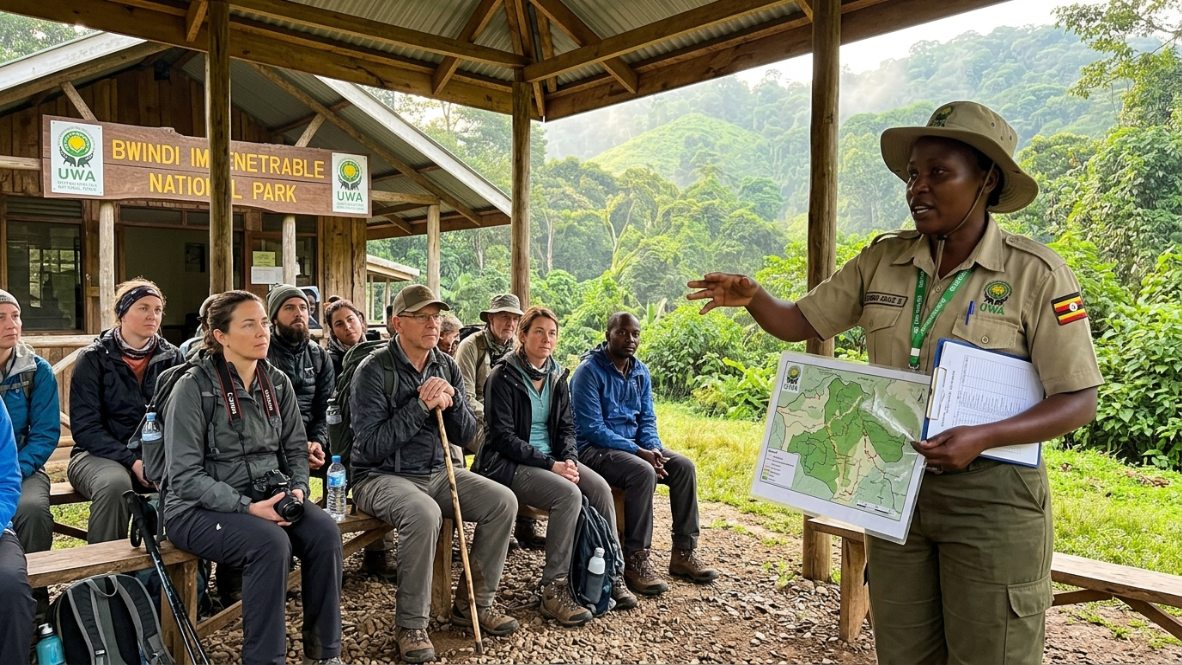
    A mandatory pre-trek assembly at park headquarters where rangers review trekking rules, assign groups, and screen participants for signs of illness. This happens every morning before gorilla trekking begins in both Uganda and Rwanda.

    Why it matters: Rangers look for fever, persistent coughing, sneezing, and other symptoms that could indicate a contagious illness. If you present with malaria-like symptoms (fever, chills, visible distress), you will be turned away. This screening exists to protect the gorillas, which are highly susceptible to human respiratory viruses and other pathogens.

    Illness Exclusion Policy

    Both the Uganda Wildlife Authority (UWA) and the Rwanda Development Board (RDB) enforce strict rules barring visibly ill trekkers from visiting habituated gorilla families. If you have a cold, flu, fever, or any contagious illness, you must not visit the gorillas.

    Why it matters: This policy creates a direct financial link between malaria prevention and your gorilla permit investment. Getting malaria during your trip doesn’t just make you sick. It can cost you the entire experience you traveled thousands of miles for. For full details on what rules apply during the trek, read our gorilla trekking safety rules guide.

    UWA “Safety Net” Refund

    In 2026, the Uganda Wildlife Authority clarified its refund policy for illness. If a Park Warden certifies that you are too ill to trek, you are eligible for a 50% permit refund. The policy is designed to encourage honest self-reporting rather than having sick trekkers attempt to hide symptoms.

    Why it matters: A 50% refund on a $700 Uganda permit means you lose $350. On a $1,500 Rwanda permit, you’d lose $750. That’s real money on top of the misery of being sick in a remote location.

    CFAR Travel Insurance

    “Cancel for Any Reason” insurance policies that provide coverage when standard travel insurance doesn’t apply. Standard policies typically cover illness but may not cover the specific scenario of being turned away at a gorilla trekking briefing.

    Why it matters: CFAR policies can help recover the remaining 50% of a forfeited permit that the UWA Safety Net doesn’t cover. Given that gorilla trekking malaria risk creates a real possibility of illness-related exclusion, CFAR insurance is worth investigating for any traveler who can’t afford to lose their permit fee. For a deeper look at insurance options, see our gorilla trekking insurance glossary.

    Disease Transmission to Gorillas

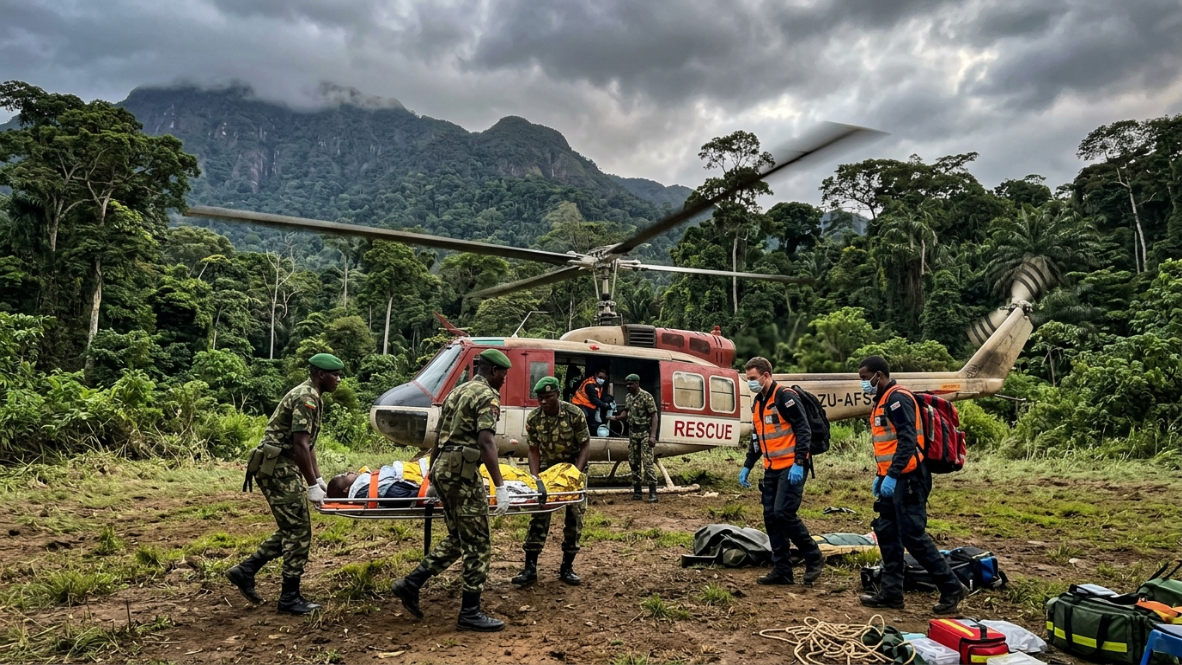
    Mountain gorillas are vulnerable to human diseases because of our close genetic relationship. Human respiratory viruses, gastrointestinal pathogens, and other infections can be fatal to gorilla families that have been habituated to human presence.

    Why it matters: This is why the health screening exists. Face masks (surgical type) are required during gorilla encounters. Minimum distance rules (7 meters in Rwanda, 10 meters in Uganda) add another layer of protection. The illness exclusion policy is not bureaucratic caution. It is conservation necessity.


    Emerging Concerns

    Artemisinin Partial Resistance

    The WHO has confirmed partial resistance to artemisinin, the frontline treatment drug for malaria, in four East African countries: Eritrea, Rwanda, Uganda, and the United Republic of Tanzania. This resistance affects treatment drugs (what doctors use after you’re infected), not the prophylactic drugs travelers take to prevent infection.

    Why it matters for gorilla trekking: If treatment drugs are becoming less reliable in the very countries where gorilla trekking happens, prevention becomes even more important. Taking prophylaxis seriously, using DEET, wearing treated clothing, and sleeping under nets is no longer just recommended practice. It is the primary defense when treatment certainty is eroding. The WHO has stated that vigorous measures are needed to protect drug efficacy in this region.


    Practical Quick Reference

    When to See a Travel Doctor

    Book your appointment 6 to 8 weeks before departure. This gives enough time to start mefloquine (which requires a 2-week lead), get a G6PD test if considering tafenoquine, and receive any needed vaccinations (yellow fever is required for Uganda entry).

    Seasonal Malaria Risk Calendar

    Month

    Risk Level

    Trekking Conditions

    January

    Lower

    Dry, good trails

    February

    Lower

    Dry, good trails

    March

    Rising

    Rains begin

    April

    High

    Heavy rain, muddy

    May

    High

    Heavy rain, muddy

    June

    Lower

    Dry season starts

    July

    Lower

    Peak dry season

    August

    Lower

    Peak dry season

    September

    Rising

    Short rains begin

    October

    Moderate-High

    Rainy, muddy

    November

    Moderate-High

    Rainy, muddy

    December

    Lower (mid-month on)

    Short dry season

    The Prevention Stack

    Gorilla trekking malaria prevention is not about choosing one measure. It’s about layering them:

    1. Chemoprophylaxis: Take antimalarial medication as prescribed, including the full post-trip course.

    2. DEET repellent: Apply 30-50% concentration to exposed skin, especially from late afternoon onward.

    3. Permethrin-treated clothing: Treat long sleeves, pants, and socks before departure.

    4. Insecticide-treated bed net: Use every night at your lodge, tucked under the mattress.

    5. Behavioral avoidance: Minimize exposed skin at dusk and dawn. Stay inside screened areas when possible during peak mosquito hours.

    No single measure is 100% effective. Together, they reduce risk to a very manageable level.

    📌 Ready to plan your gorilla trek? Explore our detailed gorilla trekking cost guide to understand what’s included and how to budget for permits, transport, and accommodation.

    Step-by-Step Malaria Prevention Timeline
    Gorilla Trekking Malaria: Risks, Prevention & Tips 2026

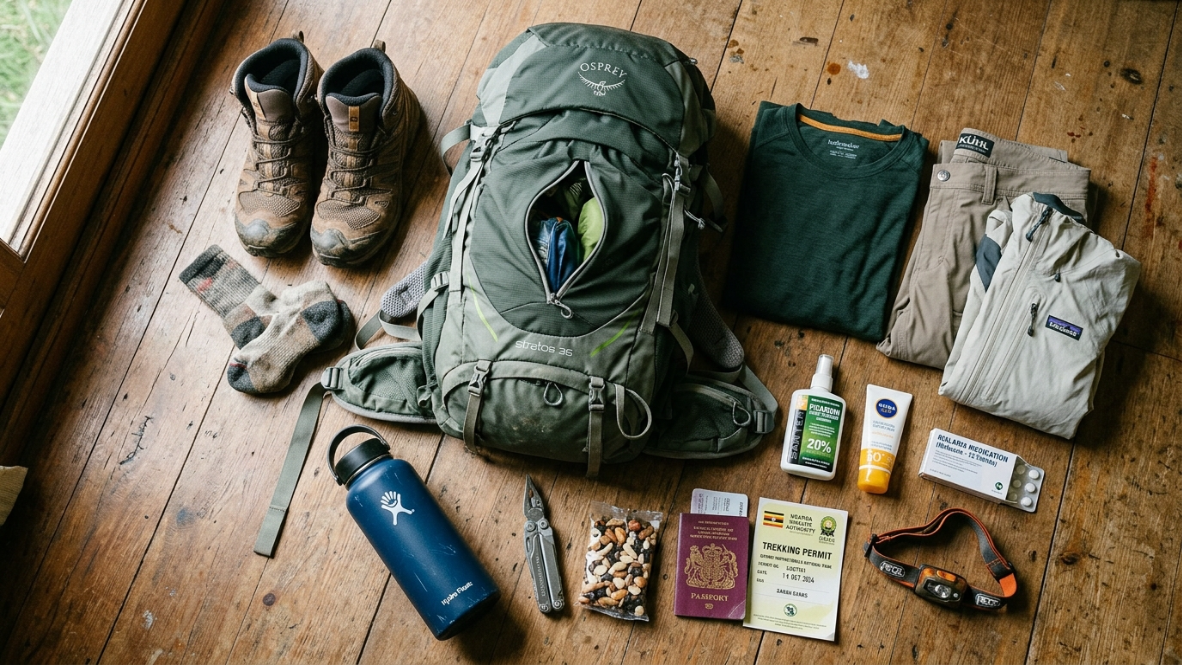
    One of the easiest ways to reduce malaria risk is to prepare before you leave home instead of waiting until you arrive in East Africa.

    6–8 Weeks Before Departure

    • Visit a travel medicine clinic

    • Discuss antimalarial medication options

    • Receive recommended vaccinations

    • Purchase travel insurance

    • Buy insect repellent and permethrin spray

    1 Week Before Departure

    • Begin medication if required

    • Treat clothing with permethrin

    • Pack long sleeves and lightweight pants

    During the Trip

    • Take medication every day (or weekly as prescribed)

    • Apply DEET every evening

    • Sleep under mosquito nets

    • Wear long sleeves after sunset

    After Returning Home

    Continue your medication for the prescribed period.

    If fever develops within several weeks after returning, tell your doctor that you recently traveled to Uganda or Rwanda.


    Frequently Asked Questions

    Do I need malaria pills for gorilla trekking in Bwindi or Volcanoes National Park?

    Yes. The CDC recommends antimalarial chemoprophylaxis for all travelers to both Uganda and Rwanda. While the parks themselves sit at high altitudes with reduced mosquito activity, your itinerary will include transit through lowland areas where malaria transmission is active year-round. No altitude-based exceptions exist in official guidance.

    Which antimalarial drug is best for gorilla trekking?

    There is no single “best” drug. It depends on your medical history, trip length, and itinerary. Malarone is the most commonly preferred by safari industry professionals due to its short post-trip course (7 days) and lack of photosensitivity. Doxycycline is the most affordable option. Mefloquine offers convenient weekly dosing. Discuss the options with a travel medicine specialist.

    Is the malaria risk lower in Rwanda than Uganda for gorilla trekking?

    Rwanda has made remarkable progress, cutting malaria cases by 85% since 2019, and Volcanoes National Park sits at higher elevation (2,400m+) than most of Bwindi. So yes, the on-the-ground risk at the Rwanda park is generally lower. But travelers still transit through Kigali and other areas where malaria is present, and the CDC recommends prophylaxis for both countries.

    Can malaria symptoms cause me to lose my gorilla trekking permit?

    Yes. If you develop fever, chills, or other malaria-like symptoms before your trek, rangers can turn you away during the mandatory morning health briefing. Uganda offers a 50% permit refund through its Safety Net policy if a Park Warden certifies your illness. The remaining cost is lost unless you carry CFAR travel insurance.

    When is gorilla trekking malaria risk lowest?

    During the dry seasons: June to September and mid-December to early February. Lower rainfall means fewer mosquito breeding sites, which translates to reduced transmission. These periods also offer the best trail conditions, making them ideal for gorilla trekking on every front.

    Should I still use a bed net at high-altitude lodges?

    Absolutely. Most lodges provide insecticide-treated nets, and you should use them every night regardless of altitude. Malaria-carrying mosquitoes can be present at elevations below 2,500 meters, and many Bwindi lodges sit in that range. It takes one bite from one infected mosquito.

    What about artemisinin resistance in Uganda and Rwanda?

    The WHO has confirmed partial artemisinin resistance in both countries. Artemisinin-based drugs are used for treatment (after infection), not prevention. This development doesn’t change which prophylactic drugs travelers should take, but it reinforces why preventing infection in the first place is critical. If treatment becomes less reliable, avoiding malaria altogether matters more than ever.

    How far in advance should I see a travel doctor before gorilla trekking?

    Six to eight weeks before departure. This allows time to start any antimalarial with a longer lead time (mefloquine needs 2 weeks), complete required blood tests (G6PD for tafenoquine), and receive vaccinations like yellow fever, which is required for Uganda entry and takes time to become effective.


    Gorilla trekking malaria risk is real, but it is thoroughly manageable. The combination of antimalarial medication, bite prevention measures, and smart trip timing makes gorilla trekking one of the safest high-end wildlife experiences in Africa. The key is taking preparation seriously rather than gambling on altitude or luck.

    📌 Planning a gorilla trek in Uganda or Rwanda? Our team designs custom gorilla trekking itineraries that account for health logistics, permits, and seasonal timing across both countries.
  • Safari Travel Insurance 2026: Coverage & Evacuation Guide

    Safari Travel Insurance 2026: Coverage & Evacuation Guide

    TL;DR

    Safari travel insurance is specialized travel coverage designed for the unique risks of African wildlife trips and high-altitude treks, including remote medical evacuations, activity exclusions, and high cancellation costs. Standard travel insurance often falls short because it may exclude safari activities, cap altitude coverage too low for Kilimanjaro, and carry inadequate evacuation limits. Most travelers need two layers of protection: a rapid-response air evacuation membership like AMREF Flying Doctors plus a comprehensive travel insurance policy. Buy your policy within 14 to 21 days of your first trip deposit to unlock time-sensitive benefits like Cancel for Any Reason and pre-existing condition waivers.


    A safari in East Africa is one of the most rewarding trips you can take. It’s also one of the most expensive. The average Africa trip costs around $11,000 per person, and Tanzania ranks among the world’s ten most expensive travel destinations, with average trip costs near $19,000 per person. When you’re investing that kind of money in non-refundable deposits, park fees, permits, and flights, the right insurance policy isn’t a nice-to-have. It’s essential.

    The problem is that “travel insurance” and “safari travel insurance” are not the same thing. Standard policies routinely exclude the activities, altitudes, and remote locations that define an East Africa trip. This glossary breaks down every term you’ll encounter when shopping for coverage, explains why each one matters, and gives you a practical framework for choosing the right policy.

    Duma Explorer does not sell insurance. But as an operator that designs private Tanzania safaris and Kilimanjaro climbs, we consider adequate insurance coverage a non-negotiable part of trip planning.

    Safari Travel Insurance at a Glance

    For most travelers visiting Tanzania, Kenya, Uganda, or Rwanda, the best safari travel insurance includes:

    Coverage

    Recommended Minimum

    Emergency Medical

    $100,000+

    Emergency Medical Evacuation

    $250,000–$500,000+

    Trip Cancellation

    100% of prepaid trip cost

    Trip Interruption

    150% of trip cost

    High-Altitude Trekking

    Required for Kilimanjaro (6,000 meters)

    Adventure Activity Coverage

    Walking safaris, game drives, gorilla trekking

    Pre-existing Condition Waiver

    Buy within 14–21 days

    Cancel For Any Reason (CFAR)

    Recommended for expensive safaris

    AMREF Flying Doctors Membership

    Strongly recommended

    Takeaway

    The safest approach for an African safari is combining comprehensive travel insurance with a regional air evacuation membership such as AMREF Flying Doctors. Buy coverage within 14–21 days of your first trip deposit to unlock valuable benefits such as CFAR and pre-existing condition waivers.

    Standard Travel Insurance vs Safari Travel Insurance

    Feature

    Standard Travel Insurance

    Safari Travel Insurance

    Medical Coverage Abroad

    Yes

    Yes

    Medical Evacuation

    Limited

    Higher Limits

    Remote Bush Evacuation

    Often Limited

    Yes

    Walking Safari Coverage

    Sometimes Excluded

    Included

    Gorilla Trekking

    May Require Upgrade

    Often Covered

    Kilimanjaro Coverage

    Usually Excluded Above 3,000m

    Available to 6,000m

    Adventure Activities

    Limited

    Designed for Safari Activities

    Emergency Assistance

    Basic

    Specialized Providers

    Who Needs Safari Travel Insurance?

    Safari travel insurance is recommended for:

    • Travelers visiting Tanzania, Kenya, Botswana, Namibia, South Africa, Uganda, Rwanda, or Zambia

    • Anyone climbing Kilimanjaro or Mount Kenya

    • Gorilla trekking visitors

    • Luxury safari travelers with high prepaid costs

    • Family safaris

    • Photography safaris carrying expensive equipment

    • Multi-country East Africa itineraries

    • Travelers flying on bush aircraft

    If your trip includes remote camps, charter flights, or trekking above 3,000 meters, specialized safari insurance becomes even more important.

    Core Coverage Types

    These are the building blocks of any safari travel insurance policy. Understanding them is the difference between being protected and being exposed.

    Safari Travel Insurance

    Safari travel insurance is a type of travel insurance that explicitly includes safari activities, game drives, walking safaris, and related adventures as covered activities. Many standard travel insurance policies treat these as exclusions or don’t mention them at all.

    Why it matters: if your policy doesn’t specifically list an activity like a walking safari or gorilla trek, it may be excluded from coverage. Practitioners on Reddit and travel forums frequently report discovering exclusions only after filing a claim. The fine print is everything.

    Safari-specific policies also tend to carry higher limits for medical costs and medical evacuations, reflecting the reality that safaris happen in places far from hospitals.

    Emergency Medical Coverage

    Emergency medical insurance reimburses you for medical costs incurred during your trip: doctor fees, ambulance transport, hospital stays, prescription medications, and treatment for conditions like malaria or injuries from a vehicle accident.

    This coverage is critical because U.S. health insurance typically does not apply abroad, and Medicare never covers foreign medical care. The CDC Yellow Book explicitly recommends that travelers to Africa carry dedicated medical coverage.

    Recommended minimums: At least $100,000 for medical expenses, though many operators and insurance experts recommend higher. Many safari destinations are hours from the nearest clinic, which means treatments that would be routine at home become expensive, logistically complex emergencies in the bush.

    Medical Evacuation Coverage

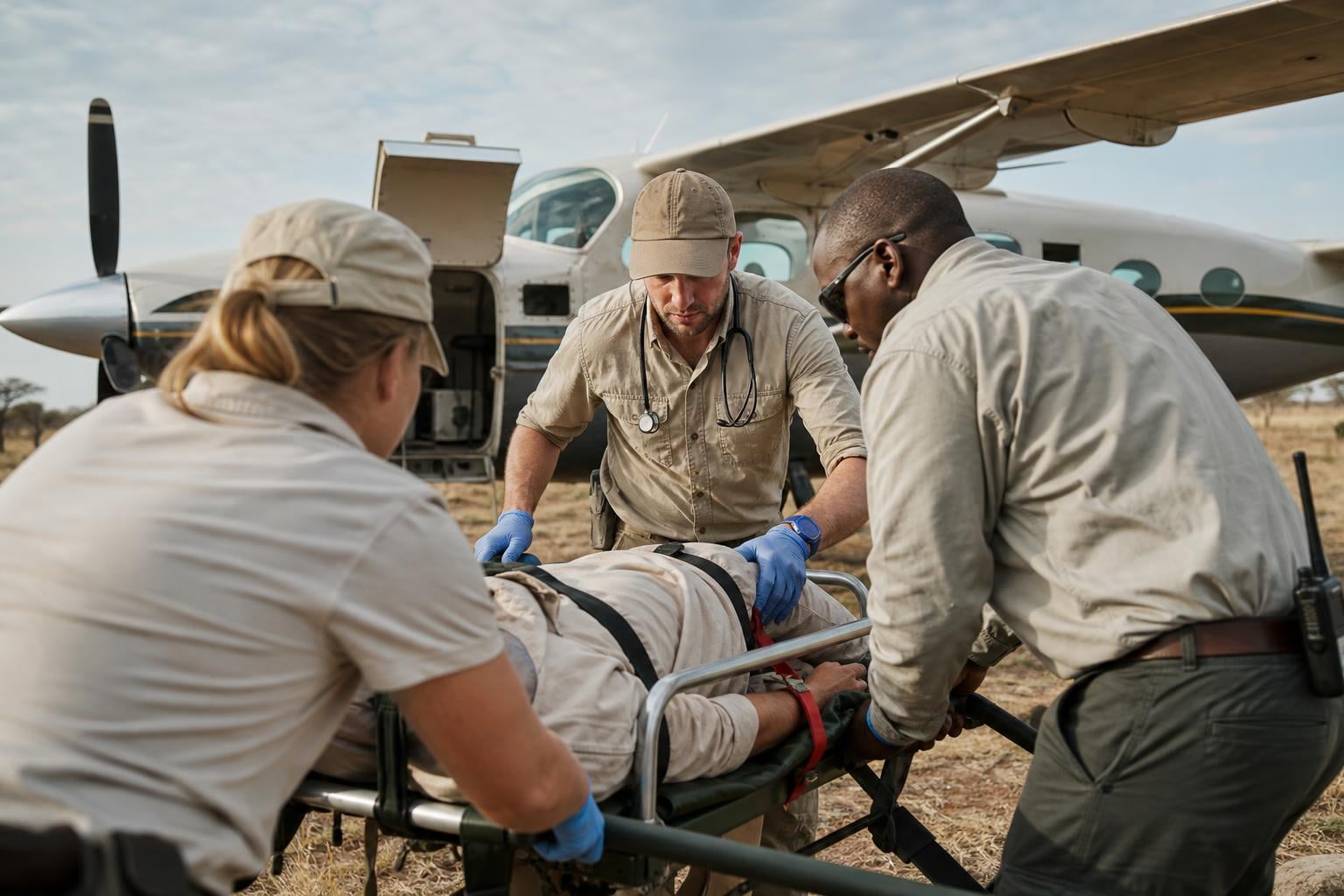
    If you need to be airlifted from a remote bush camp to a hospital in Nairobi or Dar es Salaam, medical evacuation coverage pays for it. This is arguably the most important coverage category for safari travelers.

    The real-world costs are staggering. An emergency air evacuation from a remote camp runs $10,000 to $50,000. Hospital treatment in Nairobi involving surgery and ICU can cost $15,000 to $80,000. Aeromedical repatriation back to your home country adds another $50,000 to $100,000. Total uninsured exposure for a serious medical emergency can reach $75,000 to $230,000.

    Recommended minimums: $250,000 to $500,000 in emergency medical evacuation coverage is standard for African safari travel. Some operators, including Yellow Zebra Safaris, recommend coverage between $350,000 and $1 million per person.

    Trip Cancellation Insurance

    Trip cancellation insurance reimburses up to 100% of your unused, non-refundable, prepaid trip costs if you need to cancel before departure for a covered reason. Covered reasons typically include illness or injury of the traveler, a travel companion, or a family member, as well as specific events like jury duty, job loss, or natural disasters at your destination.

    For safari travelers, the stakes are high. Between flights, lodge deposits, park fees, and permits, you could be looking at thousands of dollars in non-refundable costs. A broken leg six weeks before departure, without cancellation coverage, means losing all of it.

    Understanding the full breakdown of what goes into safari costs and fees helps you calculate exactly how much trip cancellation coverage you need.

    Trip Interruption Insurance

    If you need to cut your trip short and head home early for a covered reason, trip interruption insurance pays up to 150% of your prepaid, nonrefundable trip expenses. The extra 50% above your trip cost helps cover last-minute return flights, which are almost always more expensive than planned departures.

    This matters more than most people realize. Imagine you’re on day three of a ten-day safari when you get a call that a parent has been hospitalized. You need to fly home immediately. Without interruption coverage, you lose the remaining seven days of prepaid safari costs and eat the price of a walk-up international flight.

    Baggage and Personal Effects Coverage

    This reimburses you for lost, stolen, or damaged luggage and personal items. For safari travelers carrying expensive camera equipment, binoculars, or specialty gear, the standard coverage limits on basic policies (often $500 to $1,000) may not be enough. Check the per-item sublimits in any policy you’re considering, as some cap individual items at $250 regardless of their actual value.

    Travel Delay and Missed Connection Coverage

    Safaris often involve domestic flights on small regional carriers, bush transfers, and tight connections. If a delay causes you to miss a safari departure, a pre-booked domestic flight, or a lodge check-in, this coverage reimburses additional expenses like hotel stays, meals, and rebooking fees.


    Advanced and Optional Coverage

    Beyond the basics, several optional coverages address risks that are particularly relevant to East Africa travel.

    Cancel for Any Reason (CFAR)

    Safari Travel Insurance 2026: Coverage & Evacuation Guide

    CFAR is an optional upgrade that lets you cancel your trip for any reason not covered by standard trip cancellation, including personal concerns about safety, changes of heart, or a travel companion backing out.

    Key facts about CFAR:

    • You can typically recover 50% to 75% of your nonrefundable trip costs if you cancel at least 48 hours before departure.

    • CFAR adds roughly 40% to 50% to the cost of your base travel insurance policy.

    • To qualify, you must purchase CFAR within 14 to 21 days of your first trip payment and insure 100% of your prepaid, nonrefundable trip costs.

    • CFAR is not available in all states, including New York and Washington.

    For safari travelers, CFAR is almost always worth it. At an added cost of roughly $270 to $340 on a $678 base premium, you’re protecting an $11,000+ investment against any cancellation scenario, including political instability, elevated travel advisories, or simply changed plans. Given that several of Africa’s most popular safari destinations carry active U.S. State Department travel advisories, this kind of flexibility has real value.

    Non-Medical Evacuation

    Political unrest, civil disturbances, or natural disasters can necessitate evacuation even when no one is sick or injured. Non-medical evacuation coverage pays for relocation to safety in these situations. This is distinct from medical evacuation and carries its own coverage limits.

    For more context on destination-specific safety considerations, our East Africa safety guide covers what travelers should know about each country.

    Financial Default Coverage

    If your safari operator, airline, or lodge declares bankruptcy before your trip, financial default coverage reimburses your prepaid costs. These riders are generally time-sensitive and require purchasing the plan within a couple of weeks of your initial deposit.

    This coverage is worth considering for any trip booked far in advance, especially when working with operators you haven’t vetted thoroughly.

    Pre-Existing Condition Waiver

    Travel insurance typically excludes pre-existing medical conditions treated within a “lookback period” (usually 60 to 180 days before you purchased the policy). However, many policies offer pre-existing condition waivers if you purchase the policy within 14 to 21 days of your first trip deposit.

    This matters more than most travelers expect. According to the CDC Yellow Book, insurance companies fully pay only about two-thirds of international travel health insurance claims. The main reasons for denial are pre-existing illness and poor documentation. If you take blood pressure medication or have a history of any chronic condition, securing this waiver is critical.

    Interrupt for Any Reason (IFAR)

    The trip interruption equivalent of CFAR. If you need to leave your trip early for any reason (not just covered reasons), IFAR reimburses a portion of your remaining prepaid costs. Like CFAR, it’s an optional upgrade with time-sensitive purchase requirements.


    Safari-Specific and Kilimanjaro Terms

    These terms address risks unique to East Africa’s most popular activities. If you’re combining a safari with a Kilimanjaro climb or gorilla trek, this section is especially important.

    High-Altitude Trekking Coverage

    Most standard travel insurance policies quietly cap hiking or trekking coverage at around 2,500 to 3,000 meters. Kilimanjaro’s summit sits at 5,895 meters. Without explicit high-altitude trekking coverage up to at least 6,000 meters, your policy is useless on the mountain.

    This isn’t just about claims. Kili MedAir, the private company that provides helicopter search and rescue on Kilimanjaro, requires verified travel insurance with coverage up to 6,000 meters before initiating a rescue operation. Without it, they will not dispatch.

    If you’re planning a climb, understanding Kilimanjaro success rates by route helps you assess risk and choose the right coverage level.

    The Trekking vs. Mountaineering Classification Trap

    This distinction trips up Kilimanjaro climbers constantly. “Mountaineering” or “mountain climbing” implies technical climbing with ropes, ice axes, and fixed lines. Most insurance policies exclude it. Kilimanjaro, despite its altitude, is a non-technical trek. You walk up. No ropes, no technical gear, no ice climbing (on standard routes).

    When purchasing a policy or speaking with your insurer, specify that you are doing high-altitude trekking up to 6,000 meters, not technical mountaineering. One Kilimanjaro guide author on ClimbKilimanjaroGuide specifically warns: if a route includes anything technical, check how the insurer classifies it. For standard Kilimanjaro routes like the Lemosho or Machame, this classification should be straightforward, but you need to confirm it explicitly with your provider.

    Adventure Activities Coverage

    A basic travel insurance policy might not cover activities like game drives, walking safaris, gorilla trekking, or horseback safaris. If a plan doesn’t explicitly mention a specific activity, it may be excluded.

    Before purchasing, get a written list of covered activities from your insurer. Compare it against your actual itinerary. If you’re doing a walking safari in a remote area of Tanzania, a canoe safari, or a gorilla trek through dense forest, each of these needs to be specifically listed.

    AMREF Flying Doctors

    AMREF Flying Doctors is the air ambulance division of Amref Health Africa, founded in 1957 by three surgeons operating out of a Piper Tri-Pacer in Kenya. For over 65 years, AMREF has been the primary air evacuation service in East Africa, covering Tanzania, Kenya, Uganda, Burundi, and Rwanda.

    Their tourist membership (the Maisha plan) costs roughly $35 to $55 per person for 30 days and covers emergency air evacuation from remote areas to a hospital.

    Critical limitation: AMREF is not medical insurance. Their core product covers transport only, getting you from the bush to a hospital. The standard plan explicitly states that AMREF does not accept responsibility for hospital payments. At $40 to $100 per person, there’s no reason not to have it. But treat it as one layer of protection, not the whole thing.

    Kili MedAir

    Kili MedAir provides helicopter search and rescue operations specifically on Mount Kilimanjaro. Many climbing operators work directly with Kili MedAir for emergency evacuations during climbs.

    The critical point: Kili MedAir requires verified travel insurance covering altitude up to 6,000 meters before initiating a rescue. This is a hard requirement, not a suggestion. Evacuation costs on Kilimanjaro run $5,000 to $10,000 or more.

    Repatriation Coverage

    If you die abroad or are too seriously injured to travel commercially, repatriation coverage pays to transport you (or your remains) home. This is often bundled with medical evacuation but carries separate limits. Aeromedical repatriation from East Africa to the United States can cost $50,000 to $100,000. Verify that your policy covers this explicitly and at adequate limits.

    Insurance Considerations by Safari Destination

    Country

    Special Considerations

    Tanzania

    Kilimanjaro, remote parks, possible mandatory insurance

    Kenya

    AMREF network, flying safaris

    Uganda

    Gorilla trekking permits

    Rwanda

    Gorilla permits and luxury lodges

    Botswana

    Remote Okavango Delta camps

    Namibia

    Long driving distances

    South Africa

    Rental car coverage may be important

    Why We Recommend Buying Insurance Early

    As a safari operator planning private Tanzania safaris and Kilimanjaro climbs, we’ve seen travelers face canceled flights, medical emergencies, delayed baggage, and weather-related itinerary changes. While we don’t sell insurance, we’ve learned that travelers who purchase coverage immediately after making their first deposit generally have access to the widest range of protections and experience fewer financial surprises when plans change.

    Safari Insurance by the Numbers

    Statistic

    Value

    Average Safari Cost

    $11,000+

    Tanzania Average Trip

    ~$19,000

    Average Insurance Cost

    $45/day

    Typical Policy Cost

    $678

    Medical Evacuation

    $10,000–$50,000

    Repatriation

    $50,000–$100,000

    Hospital Treatment

    $15,000–$80,000

    Recommended Medical Coverage

    $100,000+

    Recommended Evacuation Coverage

    $250,000–$500,000+

    Buying and Timing Terms

    When you buy safari travel insurance matters almost as much as what you buy. Several of the most valuable benefits are only available during narrow purchase windows.

    Lookback Period

    The window (typically 60 to 180 days) during which insurers review your medical history for pre-existing conditions. Any condition treated, diagnosed, or adjusted within this period may be excluded from coverage unless you secure a waiver. The length of the lookback period varies by insurer and plan.

    Time-Sensitive Benefits Window

    Several of the most important safari insurance benefits, including CFAR, pre-existing condition waivers, and financial default coverage, are only available if you purchase your policy within 14 to 21 days of your first trip deposit.

    Here’s the real-world consequence: imagine you book your safari in January for August travel. You decide to wait until July to buy insurance. Then in July, you break your leg and your doctor says you can’t fly. Without insurance already in place, you lose your flights, safari deposits, permits, and accommodation payments. Buy early.

    If you’re still in the planning stage, reviewing common safari booking mistakes can help you avoid this and other costly errors.

    Insured Trip Cost

    Your insured trip cost must match your total non-refundable, prepaid expenses. Underinsuring (listing $5,000 when your actual costs are $11,000) means you’ll only be reimbursed proportionally if you file a claim. Include everything: flights, safari costs, lodge deposits, permits, internal transfers, and any pre-booked excursions.

    Covered vs. Non-Covered Reasons

    Standard trip cancellation policies only pay out for specific “covered reasons” listed in the policy. Common covered reasons include illness, injury, death of a family member, jury duty, job termination, and natural disasters at your destination. Anything not on the list, such as general anxiety about travel, a friend canceling, or vague safety concerns, is not covered unless you have CFAR.

    Primary vs. Secondary Coverage

    Primary coverage pays claims first, regardless of other insurance you carry. Secondary coverage only kicks in after your other insurance (health insurance, homeowner’s policy, credit card benefits) has paid its share. For safari travel, primary coverage is preferable because it simplifies claims and avoids delays from coordinating between multiple insurers.


    The Two-Layer Insurance Model for East Africa

    No single product covers every risk of an East Africa safari. The smartest approach is two layers of protection working together.

    Layer 1: AMREF Flying Doctors (or similar rapid-response evacuation)
    Cost: $35 to $55 per person for 30 days. This handles the immediate emergency, getting you from a remote bush camp or mountain slope to a hospital via air ambulance. AMREF has the aircraft, the landing strips, and 65+ years of operational history in East Africa.

    Layer 2: Comprehensive travel insurance
    Cost: $200 to $500+ per person for a two-week safari. This handles everything else: hospital bills, trip cancellation, trip interruption, baggage loss, repatriation, and liability.

    With both layers in place, your out-of-pocket exposure for a major medical emergency drops to near zero. Without them, you’re looking at potential costs of $75,000 to $230,000.

    This two-layer model is the approach most experienced safari travelers and operators recommend, yet it’s rarely explained clearly in insurance guides.


    What Coverage You Actually Need: A Decision Framework

    Coverage needs vary depending on your itinerary. Here’s how to think about it by trip type.

    Coverage Type

    Safari Only

    Safari + Kilimanjaro

    Multi-Country + Gorilla Trekking

    Emergency Medical

    $100,000+

    $100,000+

    $100,000+

    Medical Evacuation

    $250,000+

    $500,000+

    $500,000+

    High-Altitude Trekking (6,000m)

    Not needed

    Required

    Situational

    AMREF Flying Doctors

    Strongly recommended

    Strongly recommended

    Strongly recommended

    Trip Cancellation

    100% of trip cost

    100% of trip cost

    100% of trip cost

    CFAR

    Recommended

    Recommended

    Highly recommended

    Non-Medical Evacuation

    Recommended

    Recommended

    Highly recommended

    Adventure Activities

    Verify game drives, walking safaris

    Verify trekking classification

    Verify gorilla trekking, game drives

    For multi-country trips that include gorilla trekking permits in Uganda or Rwanda, the cancellation stakes rise further. A single gorilla permit costs $700 to $1,500 and is non-refundable. Losing that permit because of a last-minute illness, without cancellation coverage, is an expensive and avoidable loss.

    Cost Benchmarks

    According to 2026 sales data from Squaremouth, the average safari travel insurance premium runs about $45 per day, or roughly $678 total for a 15-day Africa trip. Tanzania-specific policies average $49 per day, or about $782 for a 16-day trip. Insurance typically runs 4% to 10% of your total trip cost.

    Planning a trip and want to understand the full cost picture? Our East Africa safari cost guide explains what drives pricing across destinations.


    Common Safari Insurance Pitfalls

    Safari Travel Insurance 2026: Coverage & Evacuation Guide

    These mistakes cost travelers thousands of dollars every year. Avoid all of them.

    Buying too late. Missing the 14-to-21-day purchase window after your first deposit locks you out of CFAR, pre-existing condition waivers, and financial default coverage. There’s no workaround once the window closes.

    Assuming credit card coverage is enough. The CDC explicitly warns that travelers should not consider credit card benefits as a substitute for travel health insurance, travel disruption insurance, or medical evacuation coverage. Credit card travel benefits are supplemental at best, with low limits and significant exclusions.

    Not verifying altitude limits. If you’re climbing Kilimanjaro and your policy caps trekking at 3,000 meters, you have no coverage above base camp. Kili MedAir won’t rescue you, and your insurer won’t pay your hospital bills. Confirm the 6,000-meter threshold in writing.

    Failing to declare pre-existing conditions. Undisclosed conditions are the leading cause of denied claims. If you take any regular medication or have been treated for anything within your policy’s lookback period, disclose it and secure the waiver.

    Confusing AMREF with comprehensive insurance. AMREF gets you to a hospital. It does not pay the hospital bill. This confusion is widespread and potentially devastating.

    Not carrying proof of insurance. Both digital and printed copies. Some operators require proof of coverage at check-in, and Kili MedAir needs verified insurance before dispatching a helicopter. Keep your policy number, emergency contact number, and coverage summary accessible at all times. When building your East Africa packing list, add printed insurance documents to the essentials.

    Overlooking Tanzania’s emerging mandatory insurance requirement. As of early 2026, U.S. travelers are not legally required to purchase travel insurance for Tanzania. However, Tanzania is currently rolling out legislation that would require all foreign visitors to purchase mandatory, government-approved travel insurance before entry. This is worth monitoring as you plan.

    Ignoring operator insurance requirements. Many safari operators and lodges now require proof of travel insurance with medical evacuation coverage before confirming your trip. This is an industry-wide trend, not an exception.


    Frequently Asked Questions

    Is safari travel insurance required for Tanzania?

    As of early 2026, it is not legally required. However, Tanzania is developing mandatory insurance legislation for foreign visitors, and many safari operators already require proof of coverage as a booking condition. Regardless of legal requirements, carrying adequate coverage for a trip of this cost and remoteness is strongly advisable.

    How much does safari travel insurance cost?

    Based on 2026 marketplace data, the average cost is about $45 per day, or roughly $678 for a typical 15-day Africa trip. Tanzania-specific policies average around $782 for 16 days. Adding CFAR increases the cost by 40% to 50%. Total insurance cost typically runs 4% to 10% of your trip investment.

    Do I need separate insurance for climbing Kilimanjaro?

    Not necessarily separate insurance, but you need a policy that explicitly covers high-altitude trekking up to 6,000 meters. Most standard travel insurance caps coverage at 2,500 to 3,000 meters, which leaves you uninsured above Kilimanjaro base camp. Kili MedAir will not initiate helicopter rescue without verified 6,000-meter coverage.

    Is AMREF Flying Doctors enough on its own?

    No. AMREF covers emergency air transport from remote locations to a hospital. It does not cover hospital bills, trip cancellation, baggage, or repatriation. Think of AMREF as the rapid-response layer and comprehensive travel insurance as the financial protection layer. You need both.

    What happens if I buy safari insurance too late?

    You lose access to time-sensitive benefits including CFAR eligibility, pre-existing condition waivers, and financial default protection. These benefits typically require purchasing within 14 to 21 days of your first trip deposit. You can still buy a basic policy later, but the most valuable protections will be unavailable.

    Does travel insurance cover gorilla trekking permits?

    Gorilla trekking permits ($700 to $1,500 per person in Uganda and Rwanda) are non-refundable prepaid trip costs. If you include them in your insured trip cost and cancel for a covered reason (or have CFAR), they should be reimbursable. Confirm that your policy covers adventure activities including gorilla trekking.

    Should I get Cancel for Any Reason coverage for a safari?

    For most safari travelers, yes. CFAR adds roughly $270 to $340 to a typical safari insurance premium, protecting an investment that averages $11,000 or more per person. Given the long planning horizons (often 6 to 12 months), the non-refundable nature of most safari costs, and the possibility of travel advisory changes in East Africa, CFAR provides meaningful financial protection that standard cancellation coverage cannot match.

    What documentation should I carry on safari?

    Carry both digital and printed copies of your insurance policy, including the policy number, coverage summary, emergency assistance phone number, and any relevant membership cards (such as AMREF). Store digital copies in your phone, in cloud storage, and as an email you can access offline. Include printed copies in your carry-on bag.


    Ready to start planning your East Africa trip with the right preparation? Explore our East Africa safari itineraries to see what’s possible, then lock in your insurance the moment you make your first deposit.

  • Safari Tipping Africa: 2026 Guide to Who, How Much, When

    Safari Tipping Africa: 2026 Guide to Who, How Much, When

    TL;DR

    Tipping on African safaris is customary but not mandatory. Expect to budget $10-20 per person per day for your safari guide, $5-15 per person per night for lodge staff via a communal tip box, and significantly more for Kilimanjaro climbs (roughly $180-300 per climber total). US dollars are preferred across East Africa, but bills must be Series 2009 or newer. This guide covers every role, amount, and term you need to know across safari game drives, Kilimanjaro climbs, and gorilla treks.


    Few things cause more pre-trip anxiety than figuring out safari tipping in Africa. How much is enough? Who exactly gets tipped? Do you hand cash directly to your guide or drop it in a box? What if you bring the wrong currency?

    The stress is real. The second-highest ranking Google result for this topic is a TripAdvisor thread titled “How much tip during Safari: quite different opinions,” which tells you everything about the confusion travelers face. Advice varies wildly depending on who you ask, which country you’re visiting, and whether your safari is shared or private.

    This glossary cuts through the noise. It defines every tipping-related term you’ll encounter across East African safaris, Kilimanjaro climbs, and gorilla treks, with specific amounts and practical mechanics for each. The goal is simple: tip fairly, with confidence.

    Planning a trip and want to understand total safari costs including tips? Start with a full fee breakdown.

    Quick Answer: How Much Should You Tip on an African Safari?

    If you only need the short answer, here are the recommended tipping amounts for most East African safaris in 2026.

    Person

    Recommended Tip

    Safari driver-guide (group safari)

    $10–20 per person per day

    Safari driver-guide (private safari)

    $40–50 per vehicle per day

    Lodge staff tip box

    $5–15 per guest per night

    Butler (luxury camps)

    $10–15 per day

    Transfer driver

    $2–10 per transfer

    Gorilla trekking guide

    $10–15 per person

    Gorilla trekking porter

    $5–10 plus porter hire fee

    Kilimanjaro lead guide

    Around $20 per day

    Kilimanjaro porter

    Around $5–7 per day

    Most travelers should budget around 5–10% of their total safari cost for gratuities.

    Safari Tipping at a Glance

    Trip Type

    Total Suggested Tip Budget

    3-day group safari

    $80–150 per person

    5-day private safari

    $150–300 per couple

    7-day Kilimanjaro climb

    $180–300 per climber

    Gorilla trekking day

    $20–35 per person

    Luxury safari (7 days)

    $400–700+ per couple

    How Much Cash Should You Bring for Safari Tips?

    Safari Tipping Africa: 2026 Guide to Who, How Much, When

    One of the most common mistakes first-time safari travelers make is bringing enough money for the safari itself but not enough cash for gratuities.

    A good rule is to separate your tipping money before leaving home and keep it in a different envelope or money pouch.

    For example:

    Trip

    Cash to Bring for Tips

    3-day safari

    Around $100–150

    5-day safari

    Around $250–350

    7-day Kilimanjaro

    Around $300–400

    Gorilla trek

    Around $30–40

    Bring mostly:

    • $5 bills

    • $10 bills

    • $20 bills

    Avoid carrying large numbers of $50 or $100 notes because many guides and camps cannot make change.

    Why Safari Tipping in Africa Matters

    Tipping in East Africa is not a bonus on top of a generous salary. For many roles in the tourism industry, tips represent a significant portion of total compensation. Base wages for safari guides, lodge staff, and especially Kilimanjaro porters are modest by international standards.

    Practitioners on travel forums report that some budget operators in Tanzania pay guides very little, with one noting that startup guides sometimes “work for free, relying solely on tips.” The Kilimanjaro Porters Assistance Project (KPAP) confirms that crew wages are a basic amount and tips complement these to provide a living wage.

    This doesn’t mean you should throw money around recklessly. Overtipping creates its own problems (covered below). But understanding that your gratuity is part of how these professionals earn their living reframes the entire conversation. You’re not being generous. You’re participating in the compensation system.


    A-to-Z Glossary of Safari Tipping Terms

    Askari (Night Watchman)

    The askari is the security guard who patrols your camp or lodge overnight. You’ll rarely see them working, which is exactly the point. They keep wildlife and unwanted visitors away while you sleep. Askaris are typically compensated through the communal tip box rather than individual tips. Knowing they exist, and that the tip box reaches them, is reason enough to contribute.

    Back-of-House Staff

    Kitchen teams, cleaners, laundry workers, maintenance crews. These are the people who make a safari lodge function but whom you may never meet face-to-face. The communal tip box exists primarily for them. Without it, the only staff receiving tips would be guides and front-of-house workers, leaving dozens of essential employees with nothing extra.

    Butler (Private/Luxury Camps)

    At high-end safari properties, you may be assigned a personal butler who manages your schedule, arranges meals, draws baths, and handles special requests. Because their service is individual and direct, butlers should be tipped separately from the general staff box. Roughly $10-15 per day is appropriate. If you’re staying at luxury lodges in Tanzania, ask at check-in whether your butler is included in the communal pool or tipped independently.

    Camp Staff Tip Box

    A physical box, usually at reception or the main lodge area, where guests deposit tips that are divided equally among all non-guide staff. This is the standard mechanism at most East African camps and lodges. The recommended contribution is $5-15 per guest per night. Some properties split the box weekly, others monthly. If you’re unsure whether your tip reaches everyone, ask the manager how distribution works. Reputable operations are transparent about this.

    Camping Safari Crew

    On mobile camping safaris, your crew typically includes a cook, a camp hand or two, and your driver-guide. Unlike lodge stays where staff are anonymous, you’ll eat meals prepared by a specific person and watch someone set up your tent each evening. Tip each crew member individually at the end of the trip. The cook usually receives $8-12 per day, and camp hands $5-8 per day, though amounts depend on group size and trip length.

    Cook (Kilimanjaro)

    The mountain cook prepares three meals a day plus snacks at altitude, often working over a small gas stove in freezing conditions. KPAP recommends tipping your Kilimanjaro cook approximately $12 per day. If you’ve ever tried to boil water at 15,000 feet, you’ll appreciate what this person does. For more on what meals look like on the mountain, see the Kilimanjaro food guide.

    Currency for Tips

    US dollars are the preferred tipping currency across Tanzania, Kenya, Uganda, Rwanda, Zimbabwe, and Botswana. In South Africa, use South African rand (ZAR); tipping in USD there is possible but not appreciated. The rand is also accepted in Eswatini, Lesotho, and Namibia, since their currencies are pegged to it.

    Tips can also be given in Tanzanian shillings, Kenyan shillings, euros, or British pounds, but USD remains the most universally useful.

    Driver-Guide (Safari)

    In East Africa, your safari guide and driver are usually the same person. This combined role means one individual handles wildlife spotting, route planning, vehicle maintenance, and guest experience for the entire trip. Tipping norms differ based on whether you’re on a shared or private safari:

    • Group/shared safari: $10-20 per person per day

    • Private safari: $40-50 per vehicle per day

    These are widely cited ranges across multiple East African operators. Tip at the end of your safari, not daily. Daily tipping can create an awkward performance dynamic where the guide feels pressure to “earn” each day’s tip rather than simply doing their job well.

    Choosing between private and group safaris affects your tipping math significantly, so factor that into your budget from the start.

    Envelope Method

    The practice of preparing labeled envelopes before your trip, each containing the correct amount for a specific person or role. This is especially useful on Kilimanjaro climbs where you might tip 10-15 individual crew members. Label each envelope with the recipient’s role (Lead Guide, Assistant Guide, Cook, Porter 1, Porter 2, etc.) and fill them with the right denominations. Many experienced travelers prepare envelopes at home as part of their packing checklist and pack them in a ziplock bag.

    Fly-In Safari

    When your safari involves small bush planes between camps, you might wonder about tipping the pilot. Don’t. Bush pilots are salaried professionals and tipping them is not expected or customary. Your guide and lodge staff at each destination are tipped normally.

    Gorilla Trekking Guide

    A park-employed ranger who leads your group through the forest to find a habituated gorilla family. These guides work for the national park authority (UWA in Uganda, RDB in Rwanda) rather than for a private tour company. Tip $10-15 per person per trek. In some cases, a single guide leads the entire group, while in others, multiple rangers and trackers work together. When comparing gorilla trekking in Rwanda vs Uganda, tipping norms are similar in both countries.
    Gorilla Trekking Porter

    This is the single most tip-dependent role in East African tourism. Gorilla trekking porters do not earn any salary; their entire income comes from the hire fee and your tip. They carry your daypack, help you navigate steep and muddy terrain, and sometimes physically pull you up hillsides. Hiring a porter costs about $20 in Uganda or $10 in Rwanda. Add $5-10 as a tip on top of that. Always hire a porter. It directly supports the local community surrounding the park, and you will be glad you did when the trail gets steep.

    Gratuity vs. Service Charge

    These terms are not interchangeable. A gratuity is a voluntary tip you choose to give. A service charge is an amount automatically added to your bill, typically 5-10% at upscale hotels and some restaurants. Always check your bill before adding an additional tip. If a service charge is included, you can still leave a small extra amount for exceptional service, but you’re not obligated to.

    Head Guide / Lead Guide (Kilimanjaro)

    The most experienced member of your mountain crew, responsible for pacing, route decisions, altitude sickness monitoring, and overall safety. KPAP recommends tipping the lead guide approximately $20 per day. On a 7-day Machame climb, that’s $140 for the lead guide alone. This person holds your summit chances in their hands, quite literally. Learn more about Kilimanjaro training and key terms to understand the full crew structure.

    Kirunje

    A Swahili term for “ghost porters,” people who appear at the tipping ceremony but did not actually work on your climb. KPAP warns about this practice and works to prevent it through crew registration and monitoring. Kirunje is one reason why tipping each crew member directly, rather than handing a lump sum to the head guide, is so important. If your operator is a KPAP partner, they’ll have systems to verify that every person at the ceremony actually carried loads on your climb.

    KPAP (Kilimanjaro Porters Assistance Project)

    A non-profit organization that monitors porter welfare on Kilimanjaro, setting minimum wage standards and tipping recommendations. KPAP-partner operators agree to transparency requirements including tip distribution reports. The project was founded because exploitation of porters, through underpayment, overloading, and inadequate gear, was widespread. Choosing a KPAP-partner operator is one of the most meaningful decisions you can make when booking a Kilimanjaro climb.

    Lodge Staff

    An umbrella term for housekeeping, dining room attendants, grounds crew, and other service staff at safari lodges. The general recommendation is $10-15 per guest per night contributed to the communal tip box. You don’t need to identify or tip individual lodge staff unless someone provides notably personal service (like arranging a surprise birthday setup or carrying heavy luggage a long distance).

    Massage Therapist / Spa Staff

    Many mid-range and luxury lodges offer spa treatments. Tip roughly $5 per treatment directly to the therapist. This is separate from the general staff tip box.

    Mokoro Poler

    In Botswana’s Okavango Delta, mokoro (dugout canoe) excursions are guided by polers who stand at the back and navigate through channels. Tip approximately $5 per person per activity. If your poler is also your walking safari guide, tip at the higher guide rate.

    Overtipping

    The idea that too much tipping can be harmful sounds counterintuitive, but it’s a real concern in East African tourism economies. Expert Africa notes that excessive tips can throw out the balance of the local economy. When a lodge porter earns more than a national park ranger, or when a Kilimanjaro porter can out-earn a local teacher, the incentive structures of entire communities shift. One commenter on TripAdvisor put it bluntly: “When a porter can earn more than a teacher due to tips, then the local economy is being badly skewed.”

    The solution isn’t to stop tipping. It’s to tip within recommended ranges and resist the urge to dramatically exceed them, even when service is outstanding. A heartfelt thank-you, a positive online review, or a letter to the operator praising a specific staff member can mean as much as extra cash.

    Per Diem

    Latin for “per day.” This is the standard unit for calculating safari and climb tips across Africa. When someone says “tip your guide $15 per diem,” they mean $15 per person, per day of service. On a 5-day safari, that’s $75 total per person for the guide. Simple math, but worth clarifying since some sources quote per-trip amounts without specifying the number of days.

    Porter (Kilimanjaro)

    The backbone of every Kilimanjaro expedition. Porters carry up to 20 kilograms of gear, food, water, and equipment up and down the mountain, often moving faster than climbers despite carrying more weight. KPAP recommends tipping porters approximately $5-7 per day. On a 7-day climb with 8 porters, that’s $280-392 just for porter tips. Some budget operators pay porters as little as $2-3 per day, making your tip the difference between a poverty wage and a reasonable one.

    Restaurant Tipping (East Africa)

    At sit-down restaurants in cities like Arusha, Nairobi, or Kigali, 10-15% of the bill is standard. At safari camp meals, tipping is already covered by the staff tip box, so no additional restaurant-style tip is needed. In Zanzibar, tipping practices follow similar patterns, though you can learn more about Zanzibar cultural etiquette for specific contexts.

    Specialty Porter (Kilimanjaro)

    Not all porters carry the same loads. Waiter porters serve meals at camp, toilet porters manage portable facilities, summit porters carry emergency equipment to the peak, and medical porters haul first-aid supplies. These specialized roles deserve tips at the higher end of the porter range, or slightly above.

    Tipping Ceremony (Kilimanjaro)

    A formal event, usually held at the last campsite or at your hotel in Moshi or Arusha after the climb. The group pools their tips, and the head guide introduces each crew member by name and role. Tips are announced publicly and distributed individually. This transparency is the point: it prevents managers from skimming and ensures each person receives their share.

    KPAP strongly recommends tipping each crew member directly rather than giving a lump sum to the head guide. In the past, tip money has not always been distributed fairly when given in bulk. If your operator provides a tip distribution report for each crew member to sign, that’s a strong sign of accountability.

    Tip Distribution Report

    A signed document confirming that each crew member received their individual share of the group’s tips. KPAP-partner operators use these reports as an accountability measure. After each climb, the operator reviews the reports to verify fair distribution. If your trekking company can’t tell you how they handle tip distribution, that’s a red flag.

    Tracker / Spotter

    More common in Southern Africa than East Africa, a tracker works alongside the main guide to locate wildlife. They often sit on a special seat at the front of the vehicle, reading animal tracks and signs. Tip $5-10 per person per day directly.

    Transfer Driver

    The person who drives you from the airport to your hotel or between camps. Transfers are brief interactions, and a tip of $2-10 per transfer is appropriate depending on distance and service.

    USD Bill-Year Rule

    This is the single most important practical detail that most tipping guides bury or skip entirely. US dollar bills in East Africa must be Series 2009 or newer (generally printed after 2013) to be accepted. Older bills may be refused by banks, currency exchanges, and the people you’re trying to tip. Local banks adopted this policy due to past counterfeiting issues with older series notes. Your guide literally cannot deposit or exchange an old $20 bill.

    Before your trip, visit your bank and specifically request newer bills in small denominations ($1, $5, $10, $20). Bringing the wrong bills is one of the most common safari booking mistakes travelers make.

    Walking Safari Guide

    A licensed, armed guide who leads on-foot game walks. Walking safari guides undergo additional training and certification beyond vehicle-based guiding. Tip at the same rate as your vehicle guide: $10-20 per person per day.


    Quick-Reference Tipping Tables

    Safari Game Drive Tipping

    Role

    Amount

    When

    How

    Driver-guide (group)

    $10-20/person/day

    End of safari

    Cash, directly or in envelope

    Driver-guide (private)

    $40-50/vehicle/day

    End of safari

    Cash, directly or in envelope

    Tracker/spotter

    $5-10/person/day

    End of safari

    Cash, directly

    Lodge staff (tip box)

    $5-15/person/night

    Each checkout

    Cash in communal box

    Butler

    $10-15/person/day

    End of stay

    Cash, directly

    Transfer driver

    $2-10/transfer

    End of transfer

    Cash, directly

    Spa therapist

    ~$5/treatment

    After treatment

    Cash, directly

    Kilimanjaro Climb Tipping (KPAP Recommendations)

    Role

    Daily Rate

    7-Day Climb Example

    Lead guide

    ~$20/day

    $140

    Assistant guide

    ~$12/day

    $84

    Cook

    ~$12/day

    $84

    Porter

    ~$5-7/day

    $35-49 each

    Total per climber estimate

    $180-300

    Note: Total depends on crew size, group size, and route length. Ask your operator for the exact crew count before your climb so you can prepare the right number of envelopes.

    Gorilla Trekking Tipping

    Role

    Amount

    Notes

    Trekking guide/ranger

    $10-15/person/trek

    Park-employed; tip directly

    Tracker/ranger assistant

    $5/person/trek

    Often 1-2 per group

    Porter

    $5-10 tip + hire fee

    No salary; tip is their income

    Driver (if separate)

    $5-10/day

    Same as transfer driver norms

    For details on gorilla trekking permits and costs, including how to budget the full experience beyond tips, see the dedicated guide.

    Safari Tipping Differences by Country

    Although tipping customs are similar across Africa, there are important regional differences.

    Country

    Typical Guide Tip

    Notes

    Tanzania

    $10–20/person/day

    USD preferred

    Kenya

    $10–20/person/day

    USD or KES accepted

    Uganda

    Similar to Tanzania

    Gorilla trekking tips common

    Rwanda

    Similar to Uganda

    Gorilla trekking focus

    Botswana

    Often higher for luxury safaris

    USD or BWP

    Namibia

    Usually lower than East Africa

    NAD or ZAR

    South Africa

    10–15% restaurants, ZAR preferred

    Different tipping culture

    Currency Cheat Sheet

    Country

    Preferred Tip Currency

    Bill Restrictions

    Tanzania

    USD

    Series 2009+, post-2013 print

    Kenya

    USD or KES

    Series 2009+ for USD

    Uganda

    USD

    Series 2009+

    Rwanda

    USD

    Series 2009+

    South Africa

    ZAR (strongly preferred)

    None for ZAR

    Botswana

    USD or BWP

    Series 2009+ for USD

    Namibia

    ZAR or NAD

    None

    Zimbabwe

    USD

    Series 2009+


    Worked Tipping Budget: 5-Day Safari + 7-Day Kilimanjaro Climb

    No other tipping guide provides a complete worked example, so here’s what a typical combined trip looks like. This assumes a couple traveling together on a private safari followed by a small-group Kilimanjaro climb.

    5-Day Private Northern Circuit Safari (2 travelers)

    Expense

    Calculation

    Total

    Driver-guide

    $45/vehicle/day x 5 days

    $225

    Lodge tip boxes

    $10/person/night x 2 people x 5 nights

    $100

    Transfer drivers (2 transfers)

    $5 x 2

    $10

    Safari tipping subtotal

    $335

    7-Day Lemosho Kilimanjaro Climb (per climber, assuming 4-person group)

    Expense

    Calculation

    Total

    Lead guide

    $20/day x 7 days

    $140

    Assistant guide

    $12/day x 7

    $84

    Cook

    $12/day x 7

    $84

    4 porters (shared across group)

    $6/day x 7 x 4 porters ÷ 4 climbers

    $42 per climber

    Climb tipping subtotal per climber

    ~$350

    Combined total per person: roughly $520-$550

    Bring this amount in clean, new, small-denomination USD bills. Having a few extra $5 and $10 bills provides a cushion for unexpected great service or roles you didn’t anticipate.

    For a comprehensive look at East Africa safari costs beyond tipping, including park fees, accommodation, and transport, the full pricing guide covers it all.


    The Ethics of Tipping on African Safaris

    Safari Tipping Africa: 2026 Guide to Who, How Much, When

    Tipping in Africa is more than etiquette. It’s embedded in how tourism wages work across the continent. But treating tips as a feel-good gesture without thinking about consequences misses the bigger picture.

    Why Your Tip Is the Real Wage

    Many operators, especially budget ones, keep prices low by paying crew members less. Some Kilimanjaro operators pay porters as little as $2-3 per day, well below the minimum wage set by Kilimanjaro National Park (KINAPA). Your tip doesn’t just supplement their income. In some cases, it is their income. This means the choice of operator you book with directly affects whether your tip is a thank-you bonus or a survival necessity. For thoughts on choosing responsible operators, see the cultural safari ethics and etiquette guide.

    The Overtipping Trap

    Generosity without context can backfire. When tourism-adjacent roles pay dramatically more than teaching, nursing, or park management, communities lose skilled workers to tip-heavy positions. This isn’t theoretical. Lodge porters in popular safari areas sometimes earn more than the park rangers who protect the very wildlife tourists come to see.

    Tip within the recommended ranges. If you want to do more, write a glowing review naming specific staff members, request the same guide on a future trip, or donate to organizations like KPAP.

    What Good Operators Do Differently

    Responsible operators pay fair base wages, provide proper gear for Kilimanjaro crews, and use transparent tip distribution systems. KPAP-partner companies have each crew member sign a tip distribution report confirming receipt. These reports are reviewed after every climb. That kind of accountability makes a real difference.


    Practical Tips for Safari Tipping in Africa

    Bring the right cash. Small USD bills ($1, $5, $10, $20), Series 2009 or newer. Visit your bank well before departure. Airport currency exchanges rarely stock the right denominations.

    Prepare envelopes at home. Label them by role, not by name (you won’t know names yet). Fill them once you confirm crew sizes with your operator.

    Ask for crew details before your trip. Any good operator will tell you how many porters, guides, and cooks will be on your Kilimanjaro climb or safari. This lets you budget precisely.

    Tip at the end of your stay, not daily. This avoids turning each game drive into a performance review. The exception: if you’re moving between multiple lodges, tip each lodge’s staff at checkout.

    Use your right hand. When handing tips in East Africa, use your right hand or both hands. The left hand is considered impolite in many East African cultures.

    Don’t tip the camp manager. This question comes up often. Camp and lodge managers are senior employees, similar to a restaurant owner. Tipping them is not expected.

    Don’t forget the unseen staff. The askari, the kitchen crew, the cleaner who arranged flowers in your tent. The tip box exists for them. Use it.


    Frequently Asked Questions

    Is tipping mandatory on African safaris?

    No. Tipping across East Africa is customary, not obligatory. Nobody will confront you if you don’t tip. But it is deeply embedded in the compensation structure for tourism workers, and skipping it entirely means these professionals receive only their modest base wage.

    What happens if I bring old US dollar bills?

    Bills printed before 2013 (pre-Series 2009) are frequently refused by banks and currency exchanges in Tanzania, Kenya, Uganda, and Rwanda. Your guide cannot deposit or spend them. You’ll need to bring newer bills or use local currency instead.

    Should I tip in US dollars or local currency?

    USD is preferred and most practical across East Africa. In South Africa, always tip in rand. If you’re doing a multi-country trip that includes Southern Africa, carry both USD and ZAR.

    How much should I budget for tipping on a Kilimanjaro climb?

    Plan for roughly $180-300 per climber, depending on crew size, group size, and route length. KPAP-recommended rates are approximately $20/day for the lead guide, $12/day for assistant guides and cooks, and $5-7/day for porters.

    What is the best way to distribute tips on Kilimanjaro?

    Tip each crew member individually during the tipping ceremony rather than giving a lump sum to the head guide. This prevents misallocation and aligns with KPAP recommendations for transparency.

    Do I tip a bush pilot on a fly-in safari?

    No. Bush pilots are salaried professionals and tipping them is not customary. Save your tips for guides, trackers, and lodge staff at each destination.

    Can I tip with a credit card?

    Almost never in a safari or climbing context. Tips are cash-only for guides, porters, and lodge staff in virtually all East African destinations. Some upscale hotel restaurants might allow adding a gratuity to a card payment, but don’t count on it.

    Why do tipping recommendations vary so much between sources?

    Because context matters. A shared budget safari in Tanzania has different economics than a private luxury safari in Botswana. Group size, trip style, lodge tier, and even the season can shift what’s appropriate. The ranges in this guide reflect the middle ground across reputable operators and destinations.

    Should I tip every day or only once?

    Generally, tip once at the end of the safari or climb. Daily tipping is uncommon unless different guides rotate throughout your trip.

    Should couples tip double?

    Usually yes. Most recommendations are per guest rather than per booking, although private safari vehicle tips are often given per vehicle.

    What if service was poor?

    Tips are voluntary. If service was genuinely poor because of avoidable issues, reducing the gratuity is acceptable. If problems were outside the guide’s control, such as weather or wildlife sightings, standard tipping is still appropriate.

    Should children tip?

    Children are not generally expected to tip separately. Families usually calculate gratuities based on paying adults unless the operator recommends otherwise.

    Should I tip if my safari is all-inclusive?

    Yes. “All-inclusive” almost always refers to accommodation, meals, and activities rather than gratuities.


    Ready to plan your trip with tipping already figured into the budget? Explore private Tanzania safari options to see what a well-organized, ethically run safari looks like from start to finish.

  • Safari Private vs Group: 2026 Costs & How to Choose

    Safari Private vs Group: 2026 Costs & How to Choose

    TL;DR

    A private safari gives your party exclusive use of a vehicle and guide with full itinerary flexibility, starting around $350 per person per day. A group joining safari puts you in a shared vehicle with strangers at fixed dates and routes, saving 30 to 50% on costs. The right choice depends on your budget, group size, travel style, and season. At four or more travelers, private safari costs approach group rates per person.


    The safari private vs group question is the most consequential decision in planning an East Africa trip. It affects your daily cost, how much wildlife you see, whether you can linger at a leopard sighting or must move on, and even how many bags you can bring.

    Most comparison articles recycle the same five bullet points without defining terms or showing real math. This guide takes a different approach. Every term below is defined with context, 2026 pricing data, and practitioner insights from operators, forums, and photographers who have lived the trade offs firsthand.

    Whether you’re a solo backpacker, a couple on a honeymoon, or a family of five, the safari private vs group framework here will help you book with confidence.

    → Already leaning toward a private trip? Explore private Tanzania safari options with route and cost details.

    Which is better: private safari or group safari?

    A private safari is better for travelers who want flexibility, exclusive use of a vehicle, and personalized guiding, typically costing $350 to $500 per person per day. A group joining safari is better for budget travelers who don’t mind sharing a vehicle with strangers on fixed itineraries, costing around $200 to $250 per person per day. If you are traveling as a group of four or more, a private safari often becomes cost competitive with group tours due to shared vehicle costs.


    Core Definitions: What “Private” and “Group” Actually Mean

    The terms “private safari” and “group safari” sound simple. In practice, they cover at least five distinct travel formats, and confusing them is one of the most common booking mistakes travelers make.

    Private Safari

    A private safari means your party, whether that’s two people or ten, has exclusive use of a dedicated 4×4 vehicle and professional driver guide. The itinerary is tailor made. You decide when to start each morning, how long to spend watching a cheetah hunt, and which parks to visit in what order.

    Typical inclusions: Accommodations, all meals, private vehicle, driver guide, park and conservation fees, and airport transfers. Mid range private safaris in Tanzania run $350 to $500 per person per day (PPPD) all inclusive, with budget options starting around $350 and luxury packages exceeding $600.

    A seven day mid range private safari typically costs $2,500 to $3,500 per person excluding international flights. For a full breakdown of what drives these numbers, see the Tanzania safari cost guide.

    Group Joining Safari (Shared Seat Safari)

    A group joining safari is a shared seat travel model. You buy one seat in a Land Cruiser alongside strangers, splitting fixed costs like fuel, guide fees, and per vehicle charges. Itineraries are locked. Daily timings are fixed. You cannot customize.

    Group sizes typically run four to seven passengers, depending on whether the format is budget camping (max six) or ensuite accommodations (max seven). Everyone gets a window seat in the standard configuration.

    Budget camping joining safaris of four to five days cost $800 to $1,200 total, or roughly $200 to $250 PPPD. That’s a 30 to 50% savings over private.

    Most passengers on joining safaris are young adults in their 20s and 30s, often backpackers or solo travelers on tight budgets.

    For a deeper breakdown of how these shared formats work, see this group Tanzania safari guide.

    Fixed Departure Escorted Tour

    Companies like G Adventures and Intrepid run branded group tours with pre set itineraries, confirmed departure dates, set group sizes, and international booking infrastructure. These are more structured and predictable than local joining safaris, with standardized accommodation quality and a tour leader in addition to the local driver guide.

    The key difference from a joining safari: you know exactly who is organizing the trip, what the refund policy looks like, and what accommodation standard to expect. The trade off is price. Escorted tours cost more than local joining safaris because of the overhead, typically running $300 to $450 PPPD depending on the brand and comfort level.

    Overland Truck Safari

    This format sits at the budget end of group travel and deserves its own mention because it often gets lumped in with small group safaris despite being a very different experience. Overland safaris use large converted trucks (sometimes seating 20 or more passengers) that travel long distances across multiple countries. Companies like Dragoman and Oasis Overland run these multi week itineraries.

    The wildlife viewing experience differs significantly from a small group Land Cruiser safari. Overland trucks are not permitted inside most national parks for game drives, so travelers transfer to smaller vehicles at park boundaries. The social element is huge, and the per day cost can drop below $100, but the pace is slow, the group dynamics are intense, and the wildlife time is more limited. For travelers primarily interested in East African wildlife rather than a cross continental adventure, a small group joining safari or escorted tour is a better fit.

    Private Small Group Safari (Semi Private)

    This is the format most couples and families actually book, and it causes the most confusion. A private small group safari means your own party (friends, family, travel companions) books a dedicated vehicle and guide. You share costs internally but have full flexibility over the itinerary.

    This is not a “group safari” in the industry sense. You are not joining strangers. The term “group” refers only to the size of your own party.

    Some operators now market a “semi private” option that falls between private and joining. In this model, the operator matches two or three small parties (say, two couples who don’t know each other) into a single vehicle at a reduced rate, but with slightly more flexibility than a standard joining safari. Practitioners on Reddit report mixed results: when the matched travelers have similar interests and pace, it works well. When they don’t, it creates the same friction as a joining safari at a higher price point. If considering a semi private arrangement, ask the operator how they match travelers and what happens if your preferences conflict.

    Understanding these five formats is the foundation of the safari private vs group decision. Everything that follows builds on these distinctions.

    Factor Private Safari Group Joining Safari
    Cost per person per day $350 to $500 $200 to $250
    Itinerary Fully flexible Fixed
    Vehicle use Exclusive Shared
    Guide attention Dedicated Shared
    Group size 2 to 10 (your party only) 4 to 7 strangers
    Luggage flexibility High Strict limits
    Photography access Ideal Limited
    Cancellation risk None (your trip runs regardless) Moderate (minimum pax required)
    Best for Families, couples, photographers Solo travelers, budget trips

    Cost and Pricing Terms

    PPPD (Per Person Per Day)

    The standard quoting unit for Tanzania safaris. When an operator quotes “$350 PPPD,” that means the total trip cost divided by the number of travelers divided by the number of safari days. This is how you compare operators on equal footing.

    Always confirm what a PPPD quote includes. Some operators exclude park fees, tips, or drinks. Others bundle everything. Without clarity on inclusions, a $300 quote can actually be more expensive than a $400 one.

    For a full breakdown of how safari pricing works, the budget safari cost glossary walks through every fee category.

    Conservation Fee / Park Entry Fee

    The adult conservation fee for most Northern Circuit parks (Serengeti, Tarangire, Lake Manyara) is $60 per person per day. This is fixed by the Tanzanian parks authority. It does not change whether you are on a private safari or a group joining trip.

    For a standard Northern Circuit itinerary, park fees alone account for 25 to 35% of your total spend. That’s a major chunk of your budget that is identical across formats.

    Crater Descent Fee: The Best Safari Private vs Group Math Example

    Ngorongoro Crater descent

    The Ngorongoro Crater descent fee is a per vehicle charge levied by the Ngorongoro Conservation Area Authority. The 2026 rate is approximately $295 per vehicle per trip down to the crater floor.

    Here’s where the safari private vs group cost difference becomes visceral:

    • Group joining safari with six passengers: $295 ÷ 6 = roughly $49 per person
    • Private safari for two: $295 ÷ 2 = $147.50 per person

    That single fee, for a single activity on a single day, costs a couple three times what it costs a group passenger. Multiply this dynamic across vehicle rental, fuel, and guide salary for an entire trip, and you see why joining safaris cost 30 to 50% less. For detailed planning around this specific park, see the Ngorongoro Crater safari guide.

    Solo Supplement

    Many lodges and tented camps charge a solo supplement when one traveler occupies a double room alone. This typically adds 30 to 50% to the accommodation cost. Solo travelers choosing private safaris face this on top of already paying 100% of the vehicle cost themselves. It’s a significant hidden expense.

    The Vehicle Cost Truth

    The safari vehicle is the single largest variable cost, and it’s almost identical whether two people or six people sit in it. A private Land Cruiser with driver guide costs $250 to $350 per day. For a couple, that’s $125 to $175 each. For a group of six, it’s $42 to $58 each.

    This math is the entire economic engine behind joining safaris. The wildlife is the same. The parks are the same. You’re splitting the vehicle.

    Real Cost Breakdown Example (7 Day Safari in 2026)

    Cost Component Private (2 people) Group (6 people)
    Vehicle and guide $150/day pp $50/day pp
    Park fees $60/day pp $60/day pp
    Accommodation $120 to $250 $100 to $180
    Total per day $350 to $500 $200 to $250

    What This Means in Practice

    A private safari is not “expensive for no reason.” You are paying for exclusivity of a fixed cost vehicle. Group safaris reduce price mainly by splitting transport costs, not by reducing wildlife access. Understanding this cost structure is essential to making the safari private vs group choice with clarity rather than guesswork.


    Accommodation Level and Type: How It Shapes the Safari Private vs Group Decision

    The type of accommodation you choose interacts directly with the safari private vs group equation, sometimes in ways that surprise first time planners.

    Budget camping uses basic dome tents at public campsites inside or near national parks. Shared toilet blocks, cold showers (sometimes), and a cook who prepares meals at the campsite. This is standard for group joining safaris and keeps costs at the $200 to $250 PPPD range.

    Mid range tented camps and lodges offer ensuite bathrooms, hot water, comfortable beds, and often a small pool or lounge area. This is where most private safari travelers land. Prices range from $150 to $350 per night per person, depending on location and season.

    Luxury and fly in camps run $500 to $1,500+ per person per night. These are almost exclusively booked through private safaris. Group joining safaris rarely use luxury accommodations because the economics don’t work: the savings from sharing a vehicle get wiped out by high room rates.

    One important nuance: some lodges and tented camps run their own shared game drives using open sided vehicles, separate from your safari operator’s Land Cruiser. This is common at mid range to luxury lodges in the Serengeti and Ngorongoro. Even if you booked a private safari, your lodge might offer morning and afternoon game drives in a shared lodge vehicle with other guests. These lodge drives can be excellent (experienced resident guides, open vehicles with great visibility), but they aren’t “private” in the way your dedicated operator vehicle is. If exclusive vehicle time matters to you, confirm with both your operator and the lodge how game drives are structured.

    For lodge recommendations that pair well with private itineraries, see the guide to romantic safari lodges or the family safari lodges guide.


    Vehicle and Logistics Terms

    Safari Vehicle

    Most safaris in Tanzania’s Northern Circuit use modified 4×4 Toyota Land Cruisers with pop up roofs for wildlife viewing. Standard configuration seats six passengers across three rows. Some operators squeeze a seventh passenger into the front seat. Customized stretch vehicles add an extra row and hold up to eight. For a complete overview of vehicle types and what to look for, read the safari vehicles glossary.

    Window Seat Guarantee

    Group size matters, but what matters more is whether every passenger gets a window seat during game drives. A window seat means unobstructed views and the ability to photograph without leaning across someone else. Reputable operators guarantee window seats for all passengers by capping vehicles at six.

    When a seventh passenger rides in front, or when vehicles are overloaded, the window seat guarantee breaks down. This is worth confirming before booking any group safari.

    Luggage Limits

    Group joining safaris almost universally restrict passengers to one duffel bag or backpack per person. As one Tanzanian operator notes, extra luggage causes “great inconvenience to fellow travelers” and congests the vehicle.

    Private safaris have no such constraint in practice. With a dedicated vehicle, your bags go in the back and nobody else is affected. For travelers who need camera gear, child supplies, or just prefer not to live out of a single bag, this is a meaningful difference. Check the safari packing list to plan what you actually need.

    Game Drive Flexibility and Timing

    On a private safari, your guide starts when you want, stays as long as you want at a sighting, and adjusts the route based on real time animal movement. If a pride of lions is hunting at 6:30 AM, you’re there.

    On a group joining safari, daily timings are fixed. Practitioners on travel forums describe a common frustration: passengers staying at different accommodations get picked up sequentially, adding 20 to 40 minutes of extra driving before and after every game drive. One operator explained that if a new passenger is starting their first day from Moshi or Arusha, the three hour drive can push an 8 AM start to 11 AM, effectively cutting the morning game drive in half. This timing rigidity is one of the clearest practical trade offs in the safari private vs group comparison.


    Cancellation Risk and Minimum Numbers

    This is one of the most underappreciated differences between private and group safaris, and it can wreck a trip if you’re not prepared.

    Private safaris have zero cancellation risk from the operator’s side. Your vehicle runs whether you’re two people or six. The trip happens on your dates, period.

    Group joining safaris require a minimum number of passengers to depart. Most operators need at least two to four confirmed seats before a departure is viable. If the minimum isn’t met, the operator may cancel the departure, merge you into a different date, or offer a private upgrade at extra cost.

    Practitioners on Reddit’s r/travel and TripAdvisor forums report this happening more often during shoulder season and green season months when traveler volume drops. One solo traveler described booking a joining safari for early November, only to receive a cancellation notice two weeks before departure because only one other person had signed up. The operator offered to run the trip as a private safari for an additional $400, which blew the budget.

    Before booking any joining safari, ask three questions:

    • What is the minimum number of passengers for this departure to run?
    • When will you confirm the departure (how many days before the start date)?
    • If the departure is cancelled, what are my options: refund, date change, or private upgrade?

    Operators who won’t answer these questions clearly are operators to avoid. For more on vetting, see common safari booking mistakes.


    Guide Quality: The Factor Most People Overlook in the Safari Private vs Group Debate

    The guide is the single biggest variable in safari quality, and this is where the safari private vs group decision carries consequences that go beyond cost and schedule.

    What Makes a Good Safari Guide

    A skilled driver guide does far more than drive and point at animals. They read animal behavior, predict movement, position the vehicle for optimal viewing and photography, interpret tracks and bird calls, and keep you safe. The difference between a guide with five years of experience and one with fifteen is enormous in terms of what you actually see and understand.

    In Tanzania, the minimum qualification is a TALA (Tanzania Association of Tour Operators) certification. More advanced guides pursue international certifications like FGASA (Field Guides Association of Southern Africa), which requires intensive training in ecology, tracking, and interpretation. Some operators also invest in Wilderness First Responder training for safety in remote areas.

    How Guide Quality Differs Between Formats

    Private safaris allow operators to assign their best guides to clients who request (and pay for) them. You can ask for a guide who specializes in birding, photography, or family safaris. Because the guide works exclusively with your party, they calibrate their approach to your interests over the course of the trip. By day three, a good private guide knows whether you want to chase predators or sit quietly watching elephants at a waterhole.

    Group joining safaris use competent guides, but the assignment is typically whoever is available for that departure date. You cannot request a specialist. The guide must balance the competing interests and energy levels of four to seven strangers, which limits how deeply they can focus on any one topic or sighting.

    Practitioners on YouTube safari channels note that guide quality on budget joining safaris varies more widely than on private trips. One wildlife photographer described the difference bluntly: “On my private safari, the guide positioned the vehicle so the light was behind us for every major sighting. On the group trip the year before, the guide parked where there was space, and half my shots were backlit.”

    If guide expertise matters to you, especially for birding, photography, or in depth wildlife interpretation, ask operators about guide certifications before booking.


    Photography and Birding Focus: Suitability by Format

    safari photography setup

    Photography Safaris

    For serious wildlife photographers, private vehicles are not a luxury. They are a tool. As one photography tour operator puts it: “If you’ve ever been crammed in next to six other people, elbow to elbow, while trying to swing a 500mm lens out the side window as a leopard disappears into the bush, you know exactly what I mean.”

    Private vehicle photographers on dedicated tours typically limit vehicles to three or four passengers, giving each person two window positions and room to maneuver long lenses.

    The specific advantages of private safaris for photography:

    • Vehicle positioning. Your guide can approach a subject from the angle that puts the light behind you, rather than parking wherever there’s room among other vehicles.
    • Time at sightings. No pressure from fellow passengers who’ve “gotten the shot” and want to move on. On group safaris, the guide typically allows five to ten minutes at a sighting before the majority vote to leave.
    • Early starts. The golden hour (first 30 to 45 minutes after sunrise) produces the best wildlife images. Private safaris can be at the gate the moment it opens. Group safaris often miss this window due to sequential pickups.
    • Bean bag and tripod use. With fewer passengers, there’s room to set up a bean bag on the vehicle’s window frame or roof hatch, something impractical when six people are jostling for position.

    For gear recommendations and camera settings, see the safari photography gear guide.

    Birding Safaris

    Birding shares many of the same format requirements as photography but adds another dimension: patience and silence. Serious birders need to stop frequently at sites that most wildlife tourists would drive past, including wetland edges, forest canopy viewpoints, and open grasslands where raptors hunt.

    On a group joining safari, a birder who wants to spend 15 minutes identifying a mixed flock in a fever tree stand will feel pressure from non birders who are waiting to find lions. On a private safari, the guide can plan a route that prioritizes key birding habitats without compromise.

    Tanzania’s Northern Circuit is home to over 500 recorded bird species. The best birding overlaps with green season (November through April), which is precisely when group departures are scarce, making private safaris the practical default for dedicated birding trips. For park by park birding highlights, see the Tanzania birding guide.


    Experience and Quality Terms

    Guide Attention: Dedicated vs. Shared

    On a private safari, your guide is working for you alone. That means personalized briefings, answers to every question, and the freedom to teach at your pace. If your kids want to learn about dung beetles for 20 minutes, the guide can oblige.

    On a group joining safari, the guide balances competing interests. As Safari Junkie observes, “group members have different expectations, interests that might not suit you. The group has to come to an agreement about everything, from stops along the game drives, what to focus on. Someone will want to see lions hunting, you might want to spend more time at the hippo pool.”

    Itinerary Customization

    Private safaris are fully flexible. Want to skip Lake Manyara and add an extra day in the Serengeti? Done. Want to arrive at Ngorongoro Crater at gate opening to beat crowds? Your call.

    Group joining safaris follow a fixed itinerary on fixed dates. The route is set before you book. You conform to the group, not the other way around.

    For ideas on how to structure a flexible route, browse safari itineraries and routes with real examples.

    Add On Activities

    Private safari travelers can add activities like Maasai village visits, trips to Olduvai Gorge, balloon safaris, or walking safaris at extra cost, built into the itinerary wherever it makes sense.

    Group joining safaris restrict this. Because the entire group must stick to the same schedule, optional add ons that don’t interest everyone simply don’t happen. If you’ve been dreaming about a specific experience, a cultural safari visit or a balloon flight at dawn, private is the only way to guarantee it.


    Safety and Risk Tolerance

    Both private and group safaris are equally safe in terms of the fundamental experience. They use similar vehicles, follow identical park rules, and employ licensed guides. The lions don’t care how many people are in your Land Cruiser.

    That said, there are practical safety differences worth noting.

    Medical situations. On a private safari, the guide can immediately drive to the nearest ranger station or airstrip if someone falls ill or is injured. On a group joining safari, an emergency involving one passenger affects the entire group’s schedule. Most guides will prioritize the emergency (as they should), but it means everyone’s game drive stops.

    Vehicle reliability. Private safari operators with a reputation to protect tend to maintain their vehicles more carefully. Budget joining safari operators, particularly those competing on price, sometimes run older vehicles. Breakdowns in remote parks are not dangerous per se (other vehicles pass regularly, and radio contact exists), but they are inconvenient and can cut into limited game drive time.

    Travel insurance. This applies equally to both formats, but travelers on joining safaris sometimes skip it to save money. That’s a mistake. Emergency evacuation from the Serengeti or Ngorongoro can cost $5,000 to $15,000 without insurance. Every traveler, regardless of format, should carry safari travel insurance with medical evacuation coverage.

    Comfort with strangers. This is less about physical safety and more about emotional comfort. Solo female travelers on forums sometimes express concern about sharing a vehicle with unknown companions for multiple days. Most joining safari experiences are perfectly fine in this regard, but it’s worth considering your own comfort level. If uncertainty about group dynamics would affect your enjoyment, that’s a legitimate reason to go private.


    Is a Private Safari Worth It?

    A private safari is worth it if:

    • You want to control your daily schedule
    • You are interested in photography or wildlife behavior
    • You are traveling with children or older family members
    • You want fewer time constraints at sightings
    • You have specific add on activities in mind

    A group safari is worth it if:

    • You are traveling solo on a budget
    • You want a social travel experience
    • You prefer fixed planning with no decision making
    • You are comfortable with the cancellation risk of minimum passenger requirements

    Decision Framework: Which Format Fits Your Trip?

    No single format is universally better. The right choice depends on who you are, what you want, and how much you can spend. Here is a clear framework.

    By Traveler Profile

    Traveler Profile Recommended Format Why
    Couples (honeymoon, anniversary) Private Full flexibility, romantic pace, exclusive guide. Pair with a honeymoon safari extension for the full experience.
    Families with children Private Kids need flexible stop schedules, bathroom breaks, nap friendly timing. Group safaris have rigid schedules. See the family safari planning guide for age specific tips.
    Solo travelers on a budget Group joining The shared seat model makes Tanzania accessible at prices rivaling almost any world class destination.
    Wildlife photographers Private (non negotiable) Vehicle positioning, patience at sightings, and lens space require a dedicated vehicle.
    Birding enthusiasts Private (strongly recommended) Frequent stops, silence, and green season timing all favor private format.
    Multi generational groups (4 to 6 people) Private At four or more travelers, private costs drop 20 to 30% per person. At this size, private becomes cost competitive with group joining.
    Social travelers Group joining or escorted tour Built in social environment, campfire bonding, and shared storytelling with fellow travelers.
    First timers with limited budget Group joining (verify the operator) Lowest entry point to the experience, but requires careful vetting.
    Travelers with mobility needs Private Flexible scheduling and a dedicated guide who can accommodate pace and comfort requirements.

    The 4 Person Break Even Rule

    Group size is one of the biggest cost levers in the safari private vs group equation. A party of four sharing a private vehicle pays 20 to 30% less per person than a couple on the same private itinerary, because the vehicle and guide fees spread across more people. At four travelers, a private safari often costs the same per person as a group joining seat with mid range accommodations.

    If you can assemble four people, go private. The cost difference evaporates and the experience difference does not.

    Seasonality of Group Departures

    Group joining safaris in Tanzania are generally available on select dates between June and October and December to February, the peak and shoulder seasons. If you plan to travel during the green season (March through May or November), group joining departures may not exist at all.

    This is a practical constraint many travelers overlook. Green season travelers effectively must book private, regardless of budget preference. Check when to visit East Africa to match your dates with available formats.

    The $200/Day Red Flag

    One experienced operator who stopped offering joining safaris shared this warning: “Anyone that offers solo travelers or couples safaris for under $200 a day is operating as a joining safari whether they indicate it or not. Most tour companies will tell you this if you ask but might omit this information if you don’t ask.”

    If a quote seems too low for a “private” safari, ask directly whether you will share a vehicle with other travelers.


    Decision Checklist: Private or Group?

    Before booking, run through these ten questions. Keep a tally of P (private) and G (group) answers.

    1. Are you traveling with four or more people? Yes = P (private costs drop to near group rates). No = continue.
    2. Is your budget under $250 per person per day all inclusive? Yes = G. No = P is viable.
    3. Do you need specific travel dates outside June to October or December to February? Yes = P (group departures likely unavailable). No = either works.
    4. Are you traveling with children under 12 or adults over 70? Yes = P (flexible timing is essential). No = either works.
    5. Is photography or birding a primary goal? Yes = P. No = either works.
    6. Do you have specific activities you want to include (balloon safari, cultural visit, walking safari)? Yes = P. No = either works.
    7. Are you a solo traveler comfortable meeting strangers? Yes = G offers savings and social benefits. No = P.
    8. Would a last minute cancellation or date change cause major problems (non refundable flights, limited vacation days)? Yes = P (no minimum pax risk). No = G is fine with a verified operator.
    9. Do you have more than one bag of luggage, camera gear, or child supplies? Yes = P. No = either works.
    10. Do you value having a guide who calibrates to your interests over multiple days? Yes = P. No = either works.

    Scoring: If you tallied four or more P answers, a private safari is the stronger fit. Three or more G answers point toward group joining. A near even split suggests a hybrid approach (group for part of the trip, private for key highlights) could be the best value.


    Common Confusion Points

    “Group Safari” Does Not Mean Traveling With Your Group

    This catches people constantly. In safari industry terminology, “group safari” means joining strangers. If you and five friends book a dedicated vehicle, that’s a private small group safari. The naming is counterintuitive, and operators don’t always clarify it.

    “Budget Safari” Often Means Joining Without Saying So

    Many operators market “budget safaris” without disclosing that the format is shared seat joining. The low price is the tell. Budget camping with a private vehicle cannot realistically cost $150 to $200 PPPD once you account for vehicle rental, fuel, guide salary, and park fees. If the math doesn’t add up, it’s because you’ll be sharing.

    Hybrid Approaches Exist

    Some operators offer combination packages where you start with a group tour and switch to private game drives later in the trip. This can work well for budget conscious travelers who want at least a few days of exclusive vehicle time, perhaps at a highlight destination like the Serengeti or Ngorongoro. It’s a genuine middle ground worth asking about.

    Same Parks, Same Animals

    The lions, elephants, and wildebeest do not care whether your vehicle is private or shared. The wildlife is identical. What changes is your ability to find it (flexible timing and a dedicated guide help), how long you can watch it, and how comfortably you experience it. That’s the core of the safari private vs group trade off: same destination, different experience.

    → Ready to plan a custom itinerary? See private Tanzania safari routes for a starting point.


    Quick Cost Comparison: Private vs Group Safari (2026)

    Factor Private Safari (2 travelers) Group Joining Safari (6 travelers)
    PPPD (mid range) $350 to $500 $200 to $250
    7 day trip total per person $2,500 to $3,500 $800 to $1,200 (budget camping, 4 to 5 days)
    Ngorongoro crater fee per person ~$148 ~$49
    Vehicle cost per person per day $125 to $175 $42 to $58
    Park fees per person per day $60 (same) $60 (same)
    Itinerary flexibility Full None
    Luggage limit Flexible One bag
    Guide exclusivity Dedicated Shared
    Cancellation risk None Moderate (minimum pax)
    Accommodation range Budget through luxury Budget through mid range

    The Joining Safari Experience: What Practitioners Actually Report

    TripAdvisor forums reveal a recurring pattern with joining safaris that deserves honest coverage. One solo traveler described the booking process: after emailing ten operators, they were quoted $550 for three days, only to have the itinerary change to four days at $1,400 upon replying. “I can only afford $650 max,” they wrote. This bait and switch dynamic is not universal, but it’s common enough that solo travelers should treat initial quotes as opening positions, not firm offers.

    Time management is another real issue. Because group joining safaris pick up passengers from different accommodations, the first game drive of the day often starts later than advertised. One operator explained that when a passenger joins from Moshi or Arusha, a three hour transfer can push the group’s start from 8 AM to 11 AM. The afternoon drive will still be solid, but “the long wait in the morning can absolutely ruin the day for some people.”

    Group dynamics also surface as a frequent concern. Practitioners on Reddit describe situations where one passenger’s strong preferences (wanting to skip a park, insisting on an unscheduled stop, or monopolizing the guide with constant questions) shifted the entire day’s experience for everyone else. The guide must mediate, which takes energy away from actually guiding.

    None of this means joining safaris are bad. For the right traveler, they’re excellent value. But going in with eyes open matters.

    → Want help choosing between formats for your specific trip? Get a custom safari quote based on your group size, dates, and priorities.


    Frequently Asked Questions

    Is a private safari worth the extra cost?

    For couples, families, photographers, and anyone who values flexibility, yes. The ability to control your schedule, linger at sightings, and have a dedicated guide transforms the quality of the experience. For solo budget travelers or social travelers in their 20s, a group joining safari delivers the core wildlife experience at a fraction of the price.

    How many people are on a group joining safari?

    Most group joining safaris in Tanzania cap at six passengers in a standard Land Cruiser (budget camping) or seven with ensuite accommodations. All passengers should have a window seat. If an operator puts more than seven people in a vehicle, that’s a red flag.

    Can I do a private safari on a budget?

    Yes. Budget private safaris start around $350 PPPD with basic but comfortable camping accommodations. If you travel with four or more people, the per person cost drops significantly because vehicle and guide fees are split.

    Are group joining safaris available year round?

    No. In Tanzania, joining safaris concentrate during peak season (June through October) and shoulder season (December through February). During the green season (March through May, November), departures are scarce or nonexistent because traveler volume drops too low to fill vehicles consistently.

    What if I’m a solo traveler who wants a private safari?

    It’s entirely possible, just more expensive. You’ll pay the full vehicle cost yourself plus any solo supplement at lodges. Expect to pay roughly double the per person rate of a couple on the same itinerary. Some travelers find a travel companion online to split costs, effectively creating a private small group safari for two.

    Can I combine a group safari with private days?

    Yes. Some operators offer hybrid packages where you join a group for part of the trip and switch to a private vehicle for key highlights. This is a smart approach if budget is tight but you want private time at, say, the Ngorongoro Crater or a specific section of the Serengeti.

    Do private and group safaris visit the same parks?

    Absolutely. The Northern Circuit (Tarangire, Lake Manyara, Serengeti, Ngorongoro) is standard for both formats. The difference is not where you go but how you experience it: your pace, your guide’s attention, your ability to detour, and how much time you spend at each location.

    How do I spot an undisclosed joining safari?

    Any quote under $200 per person per day for a solo traveler or couple should prompt the question: “Will I share a vehicle with other travelers?” Reputable operators will tell you honestly. If the answer is vague, assume it’s a joining safari regardless of how it’s marketed.

    Is a private safari safer than a group safari?

    Both private and group safaris are equally safe because they follow the same park rules and use similar vehicles and licensed guides. The practical differences involve speed of medical response (private vehicles can divert immediately) and vehicle maintenance standards (which vary by operator, not format).

    Do private safaris guarantee better wildlife sightings?

    No. Wildlife sightings depend on season and location, not safari type. However, private safaris allow more time at sightings, earlier starts during golden hour, and better vehicle positioning, all of which improve both the quality and quantity of what you observe.

    Why are group safaris cheaper?

    Group safaris are cheaper because travelers share the cost of the vehicle, fuel, and guide instead of paying for them individually.

    Can I switch from group to private safari mid trip?

    Yes, many operators allow hybrid itineraries where you upgrade to private game drives for specific parks or days. Confirm pricing and availability before your trip starts.

    What happens if a group joining safari doesn’t reach the minimum number of passengers?

    The operator will typically offer three options: a full refund, a transfer to a different departure date, or a private upgrade at additional cost. Always ask about minimum passenger requirements and cancellation deadlines before booking.

    Are lodge game drives the same as a private safari vehicle?

    No. Lodge game drives use the accommodation’s own vehicles and guides, shared with other lodge guests. They can be excellent, but they are not exclusive to your party. If a private vehicle experience is important, make sure your operator provides one rather than relying on lodge drives.

  • Tanzania Safari Packing List 2026: What to Bring & Skip

    Tanzania Safari Packing List 2026: What to Bring & Skip

    SEO Title: Tanzania Safari Packing List: What to Bring & Skip
    URL: /blog/tanzania-safari-packing-list/
    Meta Description: Pack smarter for Tanzania: soft-bag rules, safari clothing, health items, camera gear, Zanzibar add-ons, and what to leave at home.

    In short: Pack a soft-sided duffel (not a hard suitcase), neutral lightweight layers, one warm fleece for cold mornings, comfortable closed shoes, sun and insect protection, binoculars, and essential documents. Bush flights commonly allow only 15 to 20 kg total including carry-on, so plan a 4 to 5 day clothing rotation and use camp laundry. Your exact Tanzania safari packing list changes based on season, parks visited, and whether you are adding Zanzibar, Kilimanjaro, or gorilla trekking.

    For most Tanzania safaris, pack a soft-sided duffel, a small daypack, neutral lightweight clothing, one warm layer for early game drives, a light rain shell, comfortable closed shoes, sun protection, insect repellent, binoculars, essential medication, travel documents, and camera gear you know how to use. Do not pack a hard suitcase if your itinerary includes bush flights, and do not pack a new outfit for every day. Tanzania safari packing is about layers, dust, luggage limits, and long days in the vehicle, not dressing for a costume safari. Your exact list changes if you add Zanzibar, Kilimanjaro, gorilla trekking, a walking safari, or a balloon safari.

    Tanzania Safari Packing List at a Glance

    Category What to Pack Why It Matters
    Luggage Soft-sided duffel + daypack Bush flights and safari vehicles favor soft bags; many light aircraft enforce strict weight limits
    Clothing 3 to 4 neutral shirts, 2 to 3 trousers, fleece, rain shell Covers dust, sun, insects, cold dawns, and warm middays
    Footwear Comfortable closed shoes + sandals Closed shoes for game drives and walking; sandals for lodge time
    Health Prescription meds, malaria medication if prescribed, insect repellent, sunscreen, first aid Tanzania has malaria-risk areas and strong equatorial sun
    Safari gear Binoculars, camera or phone, lens cloth, power bank Wildlife may be distant; dust affects lenses and devices constantly
    Documents Passport, visa, insurance, copies, vaccine records if relevant Entry, emergency, and travel logistics
    Add-ons Swimsuit or Zanzibar cover-up, walking shoes, warm balloon layer Extensions change the list
    Leave behind Hard suitcase, excess outfits, unpermitted drone, plastic bags Avoid baggage, legal, and practical problems

    Before You Pack: Five Questions That Shape Your List

    Most packing lists hand you a generic checklist. That approach fails because a Serengeti fly-in safari packs differently from a road-based Northern Circuit trip with a Zanzibar beach week at the end. Before buying anything, answer five questions.

    1. Are you taking bush flights? If your itinerary includes small aircraft between parks, you need a soft-sided bag and a clear understanding of the weight limit. This is the single most important packing constraint.

    2. What month are you traveling? June through August means cold mornings and heavy dust. November through March tends to be warmer and wetter. Your warm-layer and rain-shell needs shift accordingly. Compare the best time for safari in Tanzania against your travel dates before packing.

    3. Which parks are on your itinerary? Ngorongoro Crater sits at high altitude and gets genuinely cold. Tarangire and parts of the Serengeti have tsetse flies that change what you should wear. Each location has its own conditions.

    4. Are you adding Zanzibar, Kilimanjaro, gorilla trekking, a walking safari, or a balloon ride? Each add-on requires specific gear. A Kilimanjaro climb needs a completely separate mountain kit.

    5. How often do you change camps or lodges? If you stay two or three nights per stop, camp laundry works. One-night stays mean laundry may not return in time, so you need a slightly larger clothing rotation.

    Your packing list should be built around your actual route. If you are still finalizing the itinerary, sort out the routing first.

    Plan your Tanzania safari itinerary before finalizing your packing list.

    Luggage: Soft Bags, Weight Limits, and the Three-Bag System

    Your Main Bag: The Soft-Sided Duffel

    A soft-sided duffel (50 to 70 liters for a 7 to 10 day trip) is the default choice for Tanzania safaris. Soft bags compress to fit in small aircraft cargo holds and stack easily in the back of safari vehicles. Hard-shell suitcases do not.

    If your itinerary includes any bush flights, a soft bag is not optional. Coastal Aviation’s baggage policy specifies cargo-pod door dimensions of just 76 cm x 48 cm x 29 cm. A rigid suitcase may physically not fit through the opening.

    Bush Flight Baggage Rules

    Do not assume your international airline allowance applies inside Tanzania. Domestic bush-flight carriers have strict limits that vary by airline:

    • Coastal Aviation: 15 kg (33 lb) per person including carry-on, soft bags strongly recommended
    • Regional Air: 15 kg (33 lb) per person in soft-sided bags
    • Auric Air: 20 kg (44 lb) total per passenger, inclusive of hand luggage, cameras, and personal items

    These are total weights, meaning your daypack, camera bag, and personal items count toward the allowance. The difference between 15 kg and 20 kg changes what you can bring, so confirm the exact carrier and route before you pack.

    Practitioners on Reddit report confusion about whether these limits are strictly enforced and whether extra weight can be purchased. The safest approach: pack to the published limit and confirm any excess-baggage policy with your operator in advance.

    Your Daypack: The Bag That Matters Most on Game Drives

    A small backpack or crossbody bag goes with you on every game drive. On a long day out in the bush (sometimes 7 to 10 hours), this bag matters more than extra clothes in the duffel.

    Pack in your daypack: sunglasses, sunscreen, insect repellent, refillable water bottle, camera or phone, binoculars, lens cloth, power bank and charging cable, lip balm with SPF, small pack of tissues or wipes, warm layer and rain shell (for mornings), any medication you need during the day, and a passport copy.

    Carry-On Essentials

    Keep these items with you at all times, never in checked luggage: passport and visa documents, prescription medication, camera gear and batteries, one change of safari clothing, glasses or contacts, chargers and power bank, travel insurance details, and valuables. If your main bag is delayed on a bush flight or international connection, you need enough in hand to start the safari comfortably.

    What to Wear on Safari in Tanzania

    You Do Not Need a Safari Costume

    The most common first-time mistake is buying an entire “safari wardrobe” of expensive technical clothing. Practitioners on Reddit report that comfortable normal clothes in neutral colors are usually enough. TripAdvisor travelers echo the same point. You need clothes that layer well, dry quickly, hide dust, and cover your arms and legs when needed. That is it.

    Neutral Colors: What Works and What to Avoid

    Good choices: Khaki, tan, olive, beige, brown, muted gray-green.

    Avoid or minimize: Bright white (shows every speck of dust within hours), black and dark blue (attract tsetse flies and absorb heat), neon or very bright colors.

    The CDC recommends neutral-colored, protective clothing for tsetse fly avoidance, noting that tsetse flies are attracted to both bright and very dark colors, particularly blue and black. That said, a single navy T-shirt will not ruin your trip. Focus on long-sleeved, neutral coverage rather than wardrobe perfection.

    The Clothing List for a 7 to 10 Day Safari

    Build your wardrobe around a 4 to 5 day rotation. You will rewear layers, and that is completely normal.

    • 3 to 4 lightweight shirts (at least 2 long-sleeved)
    • 2 to 3 pairs of lightweight long trousers
    • 1 pair of shorts for lodge time or warm afternoons
    • 1 fleece or packable light puffer
    • 1 lightweight rain and wind shell
    • 5 to 7 pairs of underwear
    • 3 to 5 pairs of socks
    • Warm sleepwear (nights can be cool, especially at altitude)
    • Wide-brim hat or cap
    • Sunglasses
    • Swimsuit if your lodges have pools or you are adding a beach extension
    • Optional: one casual dinner outfit, kept simple and wrinkle-resistant

    Fabrics: Lightweight cotton, linen blends, merino, or quick-dry synthetics all work. Avoid heavy denim and stiff fabrics that take forever to dry after hand washing.

    Laundry note: Many safari camps and lodges offer laundry service, but turnaround time and what they will wash vary. Some camps will not wash underwear due to local customs around hand-washed laundry. Pack enough undergarments to cover the gaps, and bring a few quick-dry items that you can sink-wash.

    [FACT CHECK REQUIRED: confirm whether Duma Explorer wants to state that most camps and lodges on its itineraries offer laundry, and whether underwear restrictions should be mentioned as a general caution.]

    Footwear

    For a vehicle-based safari, heavy hiking boots are unnecessary. Comfortable closed-toe shoes (trail shoes, sneakers, or light hikers) handle game drives, short walks, and camp paths. Bring sandals or slides for lodge evenings.

    Community discussions on Reddit warn against overpacking heavy boots for game-drive safaris. Save serious footwear for walking safaris, gorilla trekking, or Kilimanjaro.

    One important rule: never bring brand-new shoes. A LinkedIn practitioner post identifies unbroken hiking boots as one of the most common first-time mistakes. Break in any footwear weeks before departure.

    [FACT CHECK REQUIRED: confirm Duma’s preferred wording on camouflage or military-style clothing in Tanzania. If uncertain, say “avoid military-style camouflage to prevent unnecessary attention,” rather than making a broad legal claim.]

    Layering for Cold Mornings and Warm Middays

    Layering is the most useful packing skill for Tanzania. The temperature swing within a single day can be dramatic, especially June through August, when a safari logistics practitioner on LinkedIn notes that early mornings may be around 10 to 15°C while midday climbs to 25 to 30°C.

    Visit Tanzania recommends warm clothing for morning game drives in open vehicles during June, July, and August. The Tanzania Meteorological Authority describes a cool season from May to August and a hotter period from October through February.

    A practical layering system:

    1. T-shirt or light base layer
    2. Long-sleeve shirt
    3. Fleece or light puffer
    4. Wind and rain shell

    You put everything on for an early departure, then peel layers as the morning warms. By 10 a.m., you may be down to a single shirt.

    Travelers on Reddit and TripAdvisor consistently say cold mornings around Ngorongoro Crater surprised them more than any other packing issue. If you are visiting the crater rim (above 2,200 meters), pack warm socks and consider a beanie if you run cold.

    The Buff, Scarf, or Kikoi

    A lightweight scarf, buff, or kikoi (a traditional East African woven cloth) is one of the most versatile things you can bring. It works as a dust cover on Serengeti tracks, a sun shield, a warmth layer for your neck on cold mornings, and a modesty cover-up in villages or Stone Town. Reddit users and TripAdvisor posters mention this item more than almost any single piece of clothing. It weighs nothing and solves multiple problems.

    A Note for Women: Bumpy Roads

    One detail generic packing lists almost never mention: a traveler returning from an 8-day Tanzania safari on Reddit specifically recommended sports bras for women, citing hours of bumpy driving between Tarangire, Ngorongoro, and the Serengeti. Small thing, big comfort difference.

    Health, Sun, and Insect Protection

    Malaria and Insect Prevention

    The CDC recommends malaria prevention medication for travelers visiting certain areas of Tanzania. Malaria transmission occurs in all areas below 1,800 meters (5,900 feet), which includes every major safari park.

    Consult a travel medicine clinician several weeks before departure to discuss prophylaxis options. Do not wait until the last minute, because some antimalarials need to be started before arrival.

    For insect repellent, the CDC lists DEET, picaridin, oil of lemon eucalyptus (OLE/PMD), IR3535, and 2-undecanone as effective mosquito repellent ingredients. Products with 20% or more DEET provide protection against both ticks and mosquitoes. Permethrin-treated clothing and gear add another layer of protection. Treat shirts, trousers, and socks before departure. Permethrin goes on fabric, not skin.

    Tsetse Flies: What Actually Matters

    Tsetse flies live in some safari areas, particularly wooded habitats. TripAdvisor travelers often flag Tarangire, Lake Manyara woodlands, and parts of the western and northern Serengeti as areas with noticeable tsetse activity, though experience varies by season.

    Key points from CDC tsetse guidance:

    • Tsetse can bite through thin fabric, so wear medium-weight, neutral-colored clothing
    • They are attracted to bright and very dark colors, especially blue and black
    • Standard insect repellent and permethrin are not particularly effective against tsetse specifically
    • The best prevention is long sleeves, long trousers, avoiding dark colors in tsetse-prone areas, and closing vehicle windows when your guide advises

    Do not panic about tsetse. The risk varies by park, habitat, and season. But avoid making black or dark blue your main safari wardrobe, and wear long coverage when driving through wooded areas.

    Health Packing Checklist

    • Prescription medications in original packaging (bring enough for the trip plus extra for delays)
    • Malaria medication if prescribed by your clinician
    • Insect repellent (20%+ DEET or equivalent)
    • Sunscreen SPF 30 to 50+
    • Lip balm with SPF
    • Hand sanitizer
    • Oral rehydration salts
    • Basic first aid: blister plasters, bandages, antiseptic wipes, pain reliever, stomach remedies
    • Motion sickness medication if prone to nausea on rough roads
    • Backup glasses or contacts
    • Personal medical letter if carrying controlled prescriptions
    • Travel insurance and medical evacuation coverage details

    The CDC advises bringing all needed medicines from home, because medicines purchased abroad may be substandard or counterfeit.

    Camera, Binoculars, and Electronics

    Binoculars

    Binoculars may be the single highest-value item on your Tanzania safari packing list after your passport. Wildlife is not always close, and a decent pair transforms a distant speck into a leopard in a sausage tree.

    Recommended specs: 8×42 is a reliable default. 10×42 provides more reach if you can hold them steady. Bring one pair per person if budget allows, or at least one per couple.

    Reddit and forum discussions repeatedly rank binoculars among the top items travelers wish they had brought. A safari practitioner on LinkedIn frames binoculars alongside telephoto capability and power management as the items that most affect the quality of the experience.

    Camera Gear

    For casual photographers: Phone with enough storage (clear space before the trip), a small power bank, a lens cloth (dust is constant), and an extra memory card.

    For dedicated photographers: A telephoto lens in the 200 to 400mm range, a beanbag or support for vehicle-window shots, dust protection for gear, extra batteries, and backup storage. More detail on choosing the right setup is in the safari photography gear guide.

    Charging and Adapters

    Tanzania uses Type D and Type G plugs with 230V supply voltage. Most travelers need a Type G (British-style three-pin) adapter. Some older outlets accept Type D.

    Bring: Type G adapter (primary), power bank (essential for long game drives), multi-port USB charger, all charging cables, a small power strip if you have multiple devices, and a headlamp or small flashlight (many camps have limited lighting at night).

    Documents, Money, and Practical Restrictions

    Travel Documents

    • Passport valid for at least six months from entry date
    • At least one blank visa page, required by Tanzania eVisa terms
    • Printed and digital copy of eVisa grant notice if applying online
    • Return or onward ticket details
    • Travel insurance documentation
    • Yellow fever vaccination certificate if arriving from or transiting through a yellow-fever-risk country
    • Photocopies of passport and visa (keep separate from originals)
    • Emergency contacts, itinerary with lodge confirmations, and prescription list

    Money and Tipping

    Bring small, clean U.S. dollar bills for tipping and incidental purchases. Community discussions across Reddit consistently advise small, clean notes, reporting that old, torn, or very large bills can be refused. Carry some Tanzanian shillings for small local purchases at markets and villages.

    Plastic Bag Ban

    Mainland Tanzania banned single-use plastic bags effective June 1, 2019. Do not pack disposable plastic carrier bags. Use packing cubes, reusable fabric bags, silicone toiletry pouches, or dry bags instead.

    Drone Rules

    Do not pack a drone unless you have arranged permits well before your trip. The TCAA requires non-residents to apply for an import permit, register the drone, register the operator, and obtain an operations permit at least three weeks before arriving. National parks require additional authorization from park authorities. This is not something you can sort out at the airport.

    What Not to Pack for a Tanzania Safari

    A strong Tanzania safari packing list is defined as much by what stays home as by what goes in the bag.

    Leave Behind Why
    Hard suitcase Does not fit bush-flight cargo holds or compress into vehicle space
    Too many outfits Laundry and rewearing are normal; extra clothes waste weight
    Heavy hiking boots Unnecessary for vehicle-based safaris unless walking safari, gorilla trekking, or Kilimanjaro is included
    Brand-new shoes Blisters guaranteed; break in footwear before the trip
    Drone without permits Tanzania requires advance permits; national parks need additional authorization
    Disposable plastic bags Banned on mainland Tanzania
    Bright white clothing Shows dust within hours
    Black or dark blue as main wardrobe Attracts tsetse flies and absorbs heat
    Expensive jewelry or formalwear Impractical in the bush; safari camps are casual
    Hairdryer or high-power appliances Often incompatible with camp power; many lodges provide basics
    Large tripod Adds weight and bulk; check vehicle and flight compatibility first

    Adjust Your Tanzania Safari Packing List by Itinerary

    This is where generic packing guides fall short. What you pack changes depending on where you go and what activities you add.

    Northern Circuit: Serengeti, Ngorongoro, Tarangire, Lake Manyara

    The classic Northern Circuit covers diverse conditions. Add a warm layer for Ngorongoro rim (cold mornings at high altitude), a buff or scarf for Serengeti dust, neutral long trousers for tsetse-prone Tarangire and Lake Manyara woodlands, an extra lens cloth, and binoculars.

    Great Migration and Balloon Safari

    Migration safaris involve very early departures and long game drives. Extra batteries and memory cards are worth the weight. If a hot air balloon ride is included, the flight typically launches before dawn. Pack your fleece, wind layer, and closed shoes in your daypack the night before. A camera strap (not just handheld) keeps your gear secure during the flight and landing.

    [FACT CHECK REQUIRED: confirm what Duma Explorer advises for hot air balloon safari clothing, especially for Mara River and Northern Serengeti departures.]

    Safari + Zanzibar Extension

    Add a swimsuit, sandals or reef shoes, light beachwear, a modest cover-up for Stone Town and villages (Zanzibar is predominantly Muslim and respectful dress is appreciated), and lightweight clothing suited to tropical humidity. Use a separate packing cube for beach items so they do not take over the safari duffel.

    Review the Zanzibar malaria prevention guide for island-specific health considerations before departure.

    Duma Explorer designs bush-and-beach itineraries so travelers can pack efficiently for both without needing two heavy wardrobes. See how a safari and Zanzibar combination can be structured.

    Walking Safari

    For a guided walking safari (such as in Arusha National Park), add comfortable closed walking shoes or light hikers, neutral long trousers and a long-sleeved shirt, a hat, a small daypack with water, and insect protection. A casual walking safari does not require heavy trekking boots, but footwear should be more secure than sandals.

    Kilimanjaro + Safari

    A Kilimanjaro climb needs a completely separate technical packing list. Do not mix mountain gear into the safari duffel unless luggage storage or transfer is arranged with your operator. The two trips pack very differently, and trying to carry both kits in one bag guarantees you will exceed bush-flight weight limits. Duma Explorer offers both Kilimanjaro climbs and safaris and can help plan gear separation and storage logistics.

    [FACT CHECK REQUIRED: confirm whether Duma Explorer can arrange luggage storage in Arusha or at hotels for Kilimanjaro + safari or safari + Zanzibar combinations.]

    Gorilla Trekking Add-On

    If your Tanzania safari includes a gorilla trekking extension in Uganda or Rwanda, add waterproof hiking boots or trail shoes, long trousers thick enough for brush and nettles, a rain jacket, gardening-style gloves for steep trails, gaiters if conditions are muddy, and a waterproof bag for your camera. For health and fitness preparation, see the gorilla trekking health and safety guide.

    Family Safari

    Traveling with kids adds child-sized layers, hats, and sunglasses, kid-sized binoculars (a game-changer for engagement), a simple wildlife journal, extra underwear for everyone, familiar snacks where appropriate, children’s medications and sun protection, and one compact comfort item. Avoid encouraging a bag full of toys. Most children are captivated by the wildlife itself.

    Honeymoon Safari

    One nicer outfit for lodge dinners or sundowner photos is worth bringing. Keep it wrinkle-resistant and compact. If adding Zanzibar, one resort-appropriate outfit and beachwear cover the romance angle without overloading the bag.

    Sample Packing by Trip Length

    5-Day Northern Tanzania Safari

    1 soft duffel (40 to 50L), 1 daypack, 3 shirts (2 long-sleeved), 2 long trousers, 1 shorts or lodge outfit, 1 fleece, 1 rain shell, 4 to 5 underwear, 3 socks, closed shoes + sandals, hat, sunglasses, sunscreen, repellent, binoculars, camera or phone, power bank, lens cloth, documents, meds, and first aid.

    7 to 10 Day Safari

    Same structure plus 1 additional shirt, 1 to 2 extra underwear, and a plan to use camp laundry midway. Keep the same number of shoes.

    10 to 14 Day Safari + Zanzibar

    Keep safari clothing to a 5-day rotation. Add swimsuit, sandals, light beachwear, and a modest cover-up. Do not double the safari wardrobe.

    Safari + Kilimanjaro

    Separate the climb kit and safari kit entirely. Confirm luggage storage or transfer logistics with your operator. Keep the safari duffel light and within bush-flight limits.


    If your trip combines multiple destinations, seasons, or activities, the packing list should match the specific route, not a generic Africa checklist. Duma Explorer designs custom safaris across Tanzania (operating locally as Alika Africa), including Kilimanjaro climbs, Zanzibar extensions, and gorilla trekking add-ons, and can provide route-specific packing guidance once the itinerary is set.

    Request a custom Tanzania safari itinerary

    [FACT CHECK REQUIRED: confirm whether Duma Explorer provides clients with a formal pre-departure packing list and whether it differs for safari, Kilimanjaro, Zanzibar, and gorilla trekking itineraries.]

    Frequently Asked Questions

    Can I bring a suitcase on a Tanzania safari?

    For road-only safaris where all transfers are by vehicle, a suitcase can work, though a soft duffel is still easier to load. If your itinerary includes any bush flights, use a soft-sided bag and confirm the exact weight allowance with your carrier. Coastal Aviation, Regional Air, and Auric Air all require soft bags and enforce strict limits.

    What colors should I avoid on safari in Tanzania?

    Avoid black, dark blue, very bright colors, and bright white as your main safari clothing. Black and dark blue attract tsetse flies. Bright white shows dust immediately. Neutral earth tones are the most practical choice, but you do not need an entirely new wardrobe. Focus on long-sleeved, neutral coverage.

    How cold are mornings on a Tanzania safari?

    Cold enough to surprise most travelers, especially June through August and at higher elevations like the Ngorongoro Crater rim. Morning temperatures can drop to 10 to 15°C (50 to 59°F), and open vehicle windows make it feel colder. A fleece and a wind shell solve this completely. By mid-morning, you will likely be down to a single layer.

    Should I bring binoculars on safari?

    Yes. Binoculars consistently rank as one of the most valuable items travelers bring. Animals are not always close, and binoculars let you appreciate behavior and detail you would otherwise miss. An 8×42 pair is a good starting point.

    Can I bring a drone to Tanzania?

    Only with proper permits obtained in advance. The TCAA requires non-residents to complete import permit, registration, and operations permit steps at least three weeks before arrival. National parks require separate authorization. Showing up with an unpermitted drone risks confiscation.

    Can I do laundry on safari in Tanzania?

    Often yes. Many lodges and tented camps offer laundry, typically returned within a day. Availability varies by camp, one-night stays may not allow enough turnaround, and some camps will not wash underwear. Pack enough undergarments and a few quick-dry items to bridge the gaps.

    Do I need hiking boots for a Tanzania safari?

    Not for most vehicle-based safaris. Comfortable closed-toe trail shoes or sturdy sneakers handle game drives, short walks, and camp paths. Heavy boots are only necessary for walking safaris, gorilla trekking, or Kilimanjaro climbs. Whatever you bring, break it in before the trip.

  • Saadani National Park Guide 2026: Beach & Bush Safari

    Saadani National Park Guide 2026: Beach & Bush Safari

    TLDR

    Saadani National Park is East Africa’s only national park where wildlife roams alongside an Indian Ocean coastline. Covering 1,062 km² on Tanzania’s northern coast, it combines savanna game drives, river safaris, turtle nesting beaches, and a 200 km² coastal rainforest. It’s best understood as a complement to a Northern Circuit safari or a wildlife extension from Zanzibar, not a replacement for the Serengeti.


    Saadani National Park sits roughly 130 km northwest of Dar es Salaam on Tanzania’s Swahili Coast. It was gazetted in 2005 under the Tanzania National Parks Authority, absorbing the former Saadani Game Reserve, the Mkwaja Ranch area, the Wami River corridor, and the Zaraninge Forest into a single 1,062 km² protected area. The result is a park unlike anything else in East Africa: four distinct ecozones packed into a stretch of coast where elephants wander within earshot of the Indian Ocean.

    Most travel content repeats the “beach meets bush” tagline without explaining what that actually means in practice, or what it doesn’t mean. This glossary breaks down every key term, habitat, species, and logistical detail you need to decide whether Saadani belongs in your Tanzania itinerary.

    Planning a Swahili Coast trip that includes Saadani? Start with the practical details below.

    Is Saadani National Park Worth Visiting?

    Yes—if you’re looking for a quieter safari that combines wildlife with the Indian Ocean.

    Unlike the Serengeti or Ngorongoro, Saadani National Park is not about seeing huge concentrations of animals. Instead, it offers a unique combination of:

    – Game drives through coastal savanna

    – Boat safaris on the Wami River

    – Walking safaris

    – Turtle nesting beaches

    – Coastal rainforest hikes

    – Easy access from Zanzibar

    It is best suited as a 2–3 day extension to a Zanzibar holiday or Northern Circuit safari rather than as a standalone safari destination.

    Best for:

    – Zanzibar visitors

    – Repeat Tanzania travelers

    – Birdwatchers

    – Families

    – Honeymooners

    – Travelers wanting fewer crowds

    Not ideal for:

    – First-time safari visitors

    – Big Five seekers

    – Luxury beach vacations


    Saadani National Park at a Glance

    Feature

    Details

    Country

    Tanzania

    Established

    2005

    Size

    1,062 km²

    Famous For

    Beach and bush safari

    Best Time

    June–October

    Closest City

    Dar es Salaam

    Nearest Island

    Zanzibar

    Big Five

    Big Four (no rhinos)

    Main River

    Wami River

    Bird Species

    370+

    Main Activities

    Game drives, boat safari, walking safari, birding, turtle watching

    Typical Stay

    2–3 days

    Beach-and-Bush

    The phrase “beach-and-bush” describes Saadani’s core identity: a national park where terrestrial safari habitat meets the Indian Ocean shoreline. In practice, this means you can do a morning game drive through acacia woodland and spend the afternoon on the beach listening to waves.

    What it does not mean: animals parading along a pristine white-sand beach. As one candid TripAdvisor reviewer put it, “Don’t expect to see animals on the beach, this is very unfortunate and misleading campaign by TANAPA.” The beach itself has been described by safari experts as “scruffy and not the paradisiacal swathe of sand usually seen in East Africa.” That’s fine. Saadani’s value lies in the combination of experiences, not in delivering a Zanzibar-grade beach or a Serengeti-grade game drive simultaneously.


    Big Four (Not Big Five)

    Saadani National Park is home to four of Africa’s Big Five: lions, African bush elephants, Cape buffalo, and leopards. Rhinos are the missing fifth. While they once roamed this area, poaching has reduced their numbers to effectively zero.

    No travel page should sell Saadani as a Big Five destination. It isn’t one. But the four species present are genuinely here, and the park’s recovering populations tell a more interesting story than a simple checklist.


    Bimodal Rainfall

    Saadani’s eastern African coastal climate produces two rainy seasons each year. The long rains fall from March through June, the short rains from October through December. Total annual rainfall ranges between 800 and 1,200 mm.

    This bimodal pattern directly shapes when you should visit. The long rains (especially April and May) can make internal roads impassable. The dry intervals between rainy seasons concentrate wildlife near permanent water sources, improving sighting odds. For broader seasonal planning across all of East Africa, see our best time to visit guide.


    Boat Safari (Wami River)

    Saadani National Park Guide 2026: Beach & Bush Safari

    The Wami River boat safari is arguably Saadani’s single best activity. Multiple expert reviews and visitor accounts converge on this point. One TripAdvisor reviewer wrote: “The highlight of our stay was a boat trip on the Wami River. You’ll see plenty of crocodiles and hippos.”

    The Wami River forms the park’s southern boundary and flows through mangrove-lined banks before reaching its Indian Ocean estuary. A typical boat excursion lasts two to three hours and regularly produces sightings of hippo pods, Nile crocodiles, Angola colobus monkeys in the canopy, and mangrove kingfishers along the banks. For birders, this single activity can account for dozens of species in one outing.


    Dry Season

    The primary dry season runs from June through October. A shorter dry window falls in January and February. These are the best months for wildlife viewing because animals congregate around the Wami River, seasonal pans, and other permanent water sources. Vegetation thins out, improving visibility from game drive vehicles.

    Park guides with years of on-the-ground experience emphasize that game drives work best in the early morning (around 6 to 8 AM) and late afternoon (5 to 7 PM). Saadani’s coastal heat pushes animals into dense shade during midday, making those hours largely unproductive. One reviewer warned: “Animals in Saadani are adapted to coastal heat and they will stay put in the shade for most of the day.”


    Ecozones (The Four)

    Four ecozones make up Saadani National Park, and this layered biodiversity is what separates it from every other Tanzanian park:

    1. Marine environment of the Indian Ocean, including coral reefs and the Mafui Sandbank. Over 40 fish species breed here, alongside gastropods, echinoderms, and corals.

    2. Freshwater ecosystems of the Wami River and smaller watercourses, supporting hippos, crocodiles, and mangrove forests.

    3. Coastal forests, including the Zaraninge Forest, a globally significant biodiversity hotspot.

    4. Humid savanna, the dominant terrestrial habitat where most game drives take place, supporting elephants, lions, buffalo, and a range of antelope species.

    No other national park in East Africa contains all four. That’s the honest version of “beach meets bush.”


    Elephant Population

    Saadani’s elephant population is estimated at roughly 200 individuals. That number is growing slowly as anti-poaching efforts take hold, but it’s a far cry from the thousands you’d encounter in Tarangire or the Serengeti ecosystem.

    The odds of watching an elephant herd stroll along the beach are slim. Away from the coastline, though, especially near the Wami River during the dry season, elephant sightings are quite realistic. Manage your expectations and you’ll be pleasantly surprised rather than disappointed.


    Entry Fees

    Saadani falls in TANAPA’s lower fee tier, making it one of Tanzania’s more affordable parks. As of the most recent published rates:

    • Non-East African adults (16+): US$30 per person per 24 hours

    • East African Community citizens: TZS 5,000 per person per 24 hours

    • Expatriates and Tanzania residents: US$15 per person per 24 hours

    • Concession fee: Approximately US$29.50 per person per night

    TANAPA fees are subject to change, so confirm current rates with your operator or directly with TANAPA before traveling. For a full breakdown of how park fees compare across Tanzania’s circuits, our safari cost glossary puts these numbers in context.


    Game Drive

    Game drives in Saadani cover the park’s humid savanna zone, where most large mammals concentrate. The habitat is relatively flat with scattered woodland, giving it a different feel from the dramatic kopjes of the Serengeti or the Ngorongoro Crater walls.

    A park guide with nine years of experience summarized the appeal: “Our guests mainly like this park due to its proximity to the ocean. This unique combination of beach holiday and exciting safari game drives is what they enjoy most as they find all in one location.”

    The honest caveat: wildlife densities are low compared to Northern Circuit parks. SafariBookings’ expert panel rates Saadani just 2.6 out of 5 stars, noting it is “not suited to those seeking a full-on safari experience.” Visitor ratings average a notably higher 3.7 out of 5, suggesting the gap is about mismatched expectations rather than poor quality. Go in knowing what Saadani is, and the experience rewards you.

    A knowledgeable guide who understands animal movements makes an enormous difference here. As one TripAdvisor reviewer put it: “Most of negative reviews and criticism stem from people charging in on their own, without any knowledge of the roads, animal movements and usually at wrong time of the day.”


    Green Sea Turtle

    The beaches in and around Saadani National Park form one of the last major breeding sites in mainland Tanzania for green sea turtles. Nesting season runs from June through October, with roughly eight nests recorded during a typical season. After females bury their eggs in the sand, incubation takes 45 to 60 days before hatchlings emerge and make their scramble to the ocean.

    Madete Beach is the primary nesting area within the park. Witnessing a hatching event is rare and seasonal, but the park’s turtle conservation program adds a layer of purpose to any visit during those months.


    Green Season

    November through May is Saadani’s green season. The landscape transforms into lush coastal vegetation, migratory birds arrive, and tourist numbers drop to near zero. Birders will find this period exceptional, with many of the park’s 370-plus recorded species more active and visible.

    The trade-off: some internal roads become difficult or impassable during April and May’s heaviest rains, and large mammals disperse across the wider landscape, reducing sighting concentrations. Accommodations often offer lower rates during this period.

    Month-by-Month Guide

    Month

    Wildlife

    Birding

    Weather

    Recommended

    Jan

    Good

    Good

    Dry

    ✓

    Feb

    Good

    Good

    Dry

    ✓

    Mar

    Moderate

    Excellent

    Rain

    Depends

    Apr

    Poor

    Excellent

    Heavy Rain

    ✗

    May

    Fair

    Excellent

    Wet

    Depends

    Jun

    Excellent

    Good

    Dry

    ✓

    Jul

    Excellent

    Good

    Dry

    ✓

    Aug

    Excellent

    Good

    Dry

    ✓

    Sep

    Excellent

    Good

    Dry

    ✓

    Oct

    Very Good

    Good

    Dry

    ✓

    Nov

    Good

    Excellent

    Short Rains

    ✓

    Dec

    Good

    Excellent

    Rain

    ✓


    Lion Prides

    Saadani is home to approximately 50 lions organized into five resident prides, each occupying a defined territory within the park. These lions have distinctive physical traits: paler coats and noticeably smaller manes compared to their Serengeti or Ngorongoro counterparts, likely adaptations to the warmer, more humid coastal climate.

    Sightings are far from guaranteed. Lions in dense coastal bush behave differently from those in open grasslands, spending more time concealed in shade. A guide who knows their territories and movement patterns dramatically improves your chances.


    Mafui Sandbank

    The Mafui Sandbank lies within Saadani’s marine zone, offshore from the main coastline. Its colorful coral reefs serve as an important breeding ground for many fish species and offer the park’s best snorkeling and diving opportunities.

    This is one of the most consistently underexplained features of the park. Most guides and competitor pages mention it in passing, but for travelers who enjoy marine life, the Mafui Sandbank provides a genuinely different experience from the reefs around Zanzibar’s snorkeling spots, with far fewer boats and visitors.


    Mkwaja Ranch

    The Mkwaja Ranch area was a large-scale cattle operation that was absorbed into Saadani National Park during the 2005 expansion. Today, the former ranch lands have reverted to a mosaic of grassland and bush habitat, providing additional range for elephants, buffalo, and antelope.

    The ranch’s history matters because it partly explains why Saadani’s wildlife populations are still recovering. Decades of ranching activity displaced or reduced wild animal numbers. Recovery takes time, which is why current densities remain modest compared to parks that never had commercial agricultural use.


    Night Safari

    Several lodges within and adjacent to Saadani offer night game drives using thermal scopes and spotlights. This is a genuinely distinctive activity. Many Tanzanian parks restrict after-dark driving, but Saadani’s concession areas permit it.

    Night drives regularly produce sightings of civets, genets, bushbabies (including the globally rare Rondo dwarf galago in forested areas), and occasionally active predators. For travelers who have done standard daytime drives elsewhere, a Saadani night safari offers something they likely haven’t experienced before.


    Park Gates

    Saadani National Park has four entry gates:

    • Saadani Gate (south): The main entrance for visitors arriving from Dar es Salaam or Bagamoyo.

    • Mkwaja Gate (north): Primary access from Pangani or Tanga.

    • Madete Gate (north): Near the turtle nesting beaches, also accessed from the Pangani direction.

    • Gama Gate (southwest): A dry-season-only entrance. Impassable during heavy rains.

    TANAPA processes fees electronically, and credit card payment is accepted at the gates.


    Roosevelt’s Sable Antelope

    One of Saadani’s most significant but least publicized residents. Roosevelt’s sable (Hippotragus niger roosevelti) is an endangered subspecies found in only three locations in East Africa: Saadani National Park, Nyerere National Park (formerly the Selous), and Kenya’s Shimba Hills National Reserve.

    Sighting one is unusual and requires patience and luck, but for wildlife enthusiasts who understand what they’re looking at, a Roosevelt’s sable sighting in Saadani is genuinely special. This species alone justifies the park’s conservation importance. For other remote Tanzania safari destinations that protect rare species, Mkomazi and Ruaha share a similar profile.


    Saadani Safari Express

    A recent development that changes Saadani’s accessibility equation. The Saadani Safari Express is a fast boat connection between Zanzibar and Saadani National Park, taking just 60 to 90 minutes. This makes it possible to add a two or three day wildlife excursion to a Zanzibar beach holiday without backtracking through Dar es Salaam.

    Most competitor pages haven’t picked up on this connection yet. For travelers already based on Zanzibar who want a taste of mainland safari without a full Northern Circuit commitment, this is a significant new option. Zanzibar itself is only about 40 km from the park; flights take roughly 14 minutes.


    Saadani Village

    The park takes its name from Saadani, a small Swahili fishing village of about 800 inhabitants located within the park boundary. The name has roots in the Arab settlement of the area during the 19th century.

    Saadani was once an important harbor town and a center of the East African slave trade. Ruins from that period remain, and cultural visits to the village are available through park lodges. The broader Swahili Coast glossary covers the historical trade networks that made towns like Saadani, Pangani, and Bagamoyo pivotal along this coastline.

    It’s worth noting that the park’s creation and expansion involved land-rights tensions between TANAPA and several surrounding villages. At least six communities have documented disputes over boundaries and resource access. This context is absent from most travel marketing but important for understanding the park’s social dynamics.


    TANAPA

    The Tanzania National Parks Authority manages Saadani along with all other national parks in the country. TANAPA sets fee structures, maintains infrastructure, deploys rangers, and regulates concession operators within the park.

    For visitors, the practical implications are straightforward: carry a credit card for gate fees, follow ranger instructions, and respect the park rules regarding off-road driving and noise. Entry is based on 24-hour periods, not calendar days.


    Walking Safari

    Guided walking safaris in Saadani are led by armed TANAPA rangers and typically cover the mangrove forest edges, coastal woodland, or sections of the Zaraninge Forest. These walks focus on smaller details that game drives miss: primates, butterflies, medicinal plants, birdlife, and tracks.

    Morning and evening walks are available. The experience is quieter and more intimate than vehicle-based game viewing, and it’s particularly rewarding for birders and photographers who want ground-level perspectives.


    Wami River

    The Wami River forms Saadani’s southern boundary and is the park’s most important permanent water source. Its lower reaches flow through mangrove-lined banks before opening into an estuary at the Indian Ocean.

    During the dry season, the Wami becomes a magnet for wildlife. Hippo pods and Nile crocodiles are reliable residents. The river’s bird diversity is exceptional, with species like Pel’s fishing-owl, Goliath heron, lesser flamingos, and the striking mangrove kingfisher all recorded along its banks. The boat safari here (covered above) is the single activity most likely to produce consistent, high-quality wildlife encounters.


    Zaraninge Forest

    This is the entry that most travel content gets wrong by ignoring it almost entirely. The Zaraninge Forest is a 200 km² expanse of closed-canopy tropical forest within Saadani National Park. It is one of the larger coastal forests remaining in Tanzania and part of the globally recognized Eastern Arc and Coastal Forest Hotspot for Kenya and Tanzania.

    The biodiversity numbers are striking: two endemic plant species, 17 forest-dependent reptiles, and 10 amphibian species. The forest is also one of only eight known habitat patches for the Rondo dwarf galago, an uncommon primate found nowhere outside Tanzania’s coastal forests. For context on Tanzania’s birding hotspots, the Zaraninge Forest contributes substantially to Saadani’s total of over 370 recorded bird species, including East African endemics like the Sokoke pipit, Fischer’s greenbul, Kretschmer’s longbill, and the plain-backed sunbird.

    Walking safaris and guided forest hikes are the best ways to experience Zaraninge. You won’t see elephants here, but you might find a galago, a chameleon species found in only a handful of locations worldwide, or a bird that exists on no other continent.


    Birding at Saadani

    With over 370 recorded species, Saadani qualifies as an excellent birding destination by any standard. The park’s four ecozones create habitat diversity that concentrates species variety into a relatively compact area.

    Key species include the mangrove kingfisher (best seen on the Wami River), lesser flamingos, little bittern, Goliath heron, and the elusive Pel’s fishing-owl. The Zaraninge Forest adds endemics like the little yellow flycatcher and the Sokoke pipit. The green season (November through May) brings migratory species and generally better birding conditions, though the trade-off is reduced access to some roads.

    Wildlife You Can See in Saadani

    Mammals

    • Lion

    • Leopard

    • Elephant

    • Buffalo

    • Hippo

    • Crocodile

    • Giraffe

    • Zebra

    • Warthog

    • Bushbuck

    • Waterbuck

    • Wildebeest

    • Eland

    • Sable Antelope

    • Yellow Baboon

    • Vervet Monkey

    • Angola Colobus

    Birds

    • Pel’s Fishing Owl

    • Goliath Heron

    • Mangrove Kingfisher

    • Little Bittern

    • Flamingos

    • Fischer’s Greenbul

    • Sokoke Pipit


    Getting to Saadani

    Saadani National Park Guide 2026: Beach & Bush Safari

    Saadani National Park is accessible by road, air, and boat:

    • By road from Dar es Salaam: Approximately 130 km northwest, taking four to five hours depending on road conditions. The route passes through Chalinze and then follows a rougher track to the park.

    • By air from Dar es Salaam: Charter and scheduled flights take about 30 minutes to Saadani Airstrip.

    • By air from Zanzibar: A 14-minute flight.

    • By boat from Zanzibar: The Saadani Safari Express covers the crossing in 60 to 90 minutes.

    The boat connection is particularly useful for Zanzibar-based family travelers who want a short wildlife detour without the hassle of flying to the Northern Circuit. Check Tanzania visa requirements before arrival, as you’ll need your documents in order regardless of which route you take.

    Suggested 2-Day Saadani Itinerary

    Day 1

    • Morning arrival

    • Afternoon game drive

    • Sunset on the beach

    • Night safari

    Day 2

    • Sunrise boat safari on the Wami River

    • Walking safari

    • Visit Saadani Village

    • Return to Zanzibar or Dar es Salaam


    Who Should Visit Saadani National Park

    Saadani is a strong fit for:

    • Travelers already on Zanzibar who want a two or three day mainland safari without flying to Arusha

    • Honeymooners looking for a beach-and-bush combination in one location

    • Birders, especially those targeting East African coastal forest endemics

    • Families with children who enjoy beaches but also want some wildlife exposure

    • Photographers seeking solitude and uncrowded game drives

    • Repeat visitors to Tanzania who have already done the Northern Circuit and want something different

    Saadani is not ideal as:

    • Your only Tanzania safari. Wildlife densities are too low to satisfy travelers who haven’t experienced the Serengeti, Tarangire, or the Ngorongoro Crater

    • A Big Five destination. With rhinos effectively absent, that expectation will lead to disappointment

    • A luxury beach holiday. The coastline is natural and undeveloped, not manicured resort territory

    SafariBookings’ expert panel captured this positioning well: “Any wildlife-lover seeking a post-safari chill-out venue might want to consider it as an alternative to the more crowded and developed beaches around Zanzibar.”

    If you’re building a broader Tanzania itinerary that includes Saadani, our Pangani and Saadani travel guide covers the full Swahili Coast stretch and how to connect it with other destinations.

    Saadani vs Serengeti vs Nyerere

    Feature

    Saadani

    Serengeti

    Nyerere

    Beach Access

    ✓

    ✗

    ✗

    Big Five

    Big Four

    Yes

    Yes

    Boat Safari

    Excellent

    Limited

    Excellent

    Wildlife Density

    Moderate

    Very High

    High

    Crowds

    Low

    High

    Moderate

    Birding

    Excellent

    Excellent

    Excellent

    Walking Safari

    Yes

    Limited

    Yes

    Best For

    Beach + Safari

    Classic Safari

    Wilderness


    Sample Budget for a 2-Day Saadani Safari

    Expense

    Estimated Cost

    Park Entry

    US$30/day

    Concession Fee

    US$29.50/night

    Lodge

    US$100–350/night

    Boat Safari

    Usually included or US$30–60

    Guide

    Depends on operator

    Transportation

    Varies by route

    Pros and Cons of Visiting Saadani National Park

    Pros

    • Only beach-and-bush national park in East Africa

    • Easy from Zanzibar

    • Excellent birdwatching

    • Fantastic river safaris

    • Few crowds

    • Affordable park fees

    Cons

    • Lower wildlife density

    • No rhinos

    • Rough access roads

    • Limited accommodations

    • Beach is natural rather than resort-style

    Frequently Asked Questions

    Is Saadani National Park worth visiting?

    Yes, if your expectations match what the park actually delivers. Saadani is not a substitute for the Northern Circuit. It’s a distinctive add-on that works especially well as a two or three day extension from Zanzibar, combining coastal wildlife, river safaris, and genuine solitude. Visitor ratings on SafariBookings average 3.7 out of 5, notably higher than the expert panel’s 2.6, suggesting that travelers who arrive with calibrated expectations tend to enjoy it.

    What animals can you see in Saadani?

    Four of the Big Five (lion, elephant, buffalo, leopard) are present along with about 30 species of larger mammals. The elephant population is estimated at around 200, and roughly 50 lions are organized into five prides. Roosevelt’s sable antelope, an endangered subspecies found in only three locations in East Africa, is also here. Hippos and Nile crocodiles are reliable sightings on the Wami River. Over 370 bird species have been recorded.

    When is the best time to visit Saadani National Park?

    The dry season from June through October offers the best wildlife viewing, as animals concentrate near permanent water. January and February provide a secondary dry window with good conditions. The green season (November through May) is excellent for birding and offers lower prices, but some roads become impassable in April and May.

    How much does it cost to enter Saadani?

    Non-East African adults pay approximately US$30 per 24-hour period. East African Community citizens pay TZS 5,000. An overnight concession fee of roughly US$29.50 per person applies. These are among the lowest park fees in Tanzania. Always confirm current rates with TANAPA or your operator before traveling.

    Can you visit Saadani from Zanzibar?

    Yes. The Saadani Safari Express boat connection takes 60 to 90 minutes from Zanzibar. Charter flights cover the distance in about 14 minutes. This makes Saadani one of the easiest mainland wildlife experiences to access from Zanzibar, with ready-made two and three day packages available through operators.

    Are there turtles at Saadani?

    Green sea turtles nest on Madete Beach from June through October. Approximately eight nests are recorded per season, with eggs incubating for 45 to 60 days. Saadani’s beaches are among the last major mainland nesting sites in Tanzania for this species.

    What is the Zaraninge Forest?

    A 200 km² closed-canopy tropical rainforest within Saadani National Park. It’s part of the Eastern Arc and Coastal Forest Hotspot, home to endemic plants, 17 forest-dependent reptile species, and the critically rare Rondo dwarf galago. Most travel guides barely mention it, but for nature enthusiasts, Zaraninge is one of Saadani’s most compelling features.

    Is Saadani safe to visit?

    Yes. The park is managed by TANAPA with ranger patrols, and all walking safaris are accompanied by armed rangers. Standard East Africa travel safety practices apply: travel with a reputable operator, follow park rules, and stay in your vehicle during game drives unless accompanied by a guide.

  • Gorilla Trekking Bwindi Sectors: 2026 Guide to All 4

    Gorilla Trekking Bwindi Sectors: 2026 Guide to All 4

    TL;DR

    Bwindi Impenetrable National Park is divided into four trekking sectors: Buhoma, Ruhija, Rushaga, and Nkuringo. Each sector has different gorilla families, terrain difficulty, accommodation options, and access routes. Your permit locks you into one sector, so choosing the right one matters. This guide breaks down every sector, defines key terms, and covers the critical 2026 UWA rule changes that affect how you book.

    Quick Answer: Which Bwindi Sector Is Best?

    If you’re wondering which Bwindi gorilla trekking sector is best, the answer depends on your travel style rather than one “winner.”

    Traveler Type

    Best Sector

    Why

    First-time visitors

    Buhoma

    Easier terrain, excellent lodges, established infrastructure

    Best permit availability

    Rushaga

    Most habituated gorilla families and daily permits

    Birdwatchers

    Ruhija

    Highest concentration of Albertine Rift endemic birds

    Challenging hikes

    Nkuringo

    Steepest terrain and spectacular scenery

    Gorilla Habituation Experience

    Rushaga

    Only sector offering the four-hour habituation trek

    Luxury travelers

    Buhoma or Rushaga

    Largest selection of upscale lodges

    Shortest drive from Kigali

    Rushaga

    Approximately 4–5 hours via Cyanika Border

    Bottom line: There is no universally “best” Bwindi sector. The right choice depends on your fitness, preferred accommodation, permit availability, and overall Uganda itinerary.

    Why the Sector System Matters

    Bwindi Impenetrable National Park covers roughly 321 square kilometers of steep, tangled forest in southwestern Uganda. It sits between 1,160 and 2,607 metres in elevation and holds a UNESCO World Heritage designation. The 2018 Bwindi-Sarambwe census counted 459 gorillas in 36 social groups, and a new census is underway through 2025 to update those numbers. Combined with the Virunga Massif population of 604, the global mountain gorilla population stands at approximately 1,063.

    The park is split into four gorilla trekking Bwindi sectors, each functioning almost as its own mini-park with a separate briefing point, ranger team, gorilla families, and set of nearby lodges. The sectors are hours apart by road, and your permit assigns you to one specific sector and one specific gorilla family. You cannot show up at Buhoma with a Rushaga permit.

    This means sector choice is one of the most consequential decisions in your trip planning, affecting everything from how hard you hike to whether you can combine the trek with other parks.

    Planning a Uganda gorilla trek? See our gorilla safari pricing to understand what full trip packages look like.

    Bwindi Sector Map Explained

    Many first-time visitors assume the four Bwindi sectors are connected by short walking trails. They are not.

    Although all four sectors belong to the same national park, they function almost like separate parks with their own:

    • UWA briefing centers

    • ranger teams

    • gorilla families

    • lodge clusters

    • access roads

    Driving between sectors can take anywhere from one to four hours depending on the route, making it impractical to stay in one sector while trekking in another.

    This is why choosing the correct lodge after your permit is confirmed is just as important as selecting the correct trekking sector.

    The Four Bwindi Gorilla Trekking Sectors Defined

    Buhoma Sector (North)

    Gorilla Trekking Bwindi Sectors: 2026 Guide to All 4

    Buhoma is the original sector, opened to gorilla tourism in 1993, and it remains the most established. The Bwindi National Park headquarters sit here, which makes logistics straightforward. Check-in, briefing, and ranger coordination all happen at the same hub.

    Gorilla families: Mubare (the first family ever habituated in Bwindi), Habinyanja, Rushegura, Katwe, and others. The exact count fluctuates as groups split and merge, but expect roughly 3 to 5 trackable families at any given time.

    Terrain and difficulty: Varied but not punishing. Buhoma is widely considered the most forgiving sector for first-time trekkers. Several operators note that treks here sometimes finish by 11:00 AM, with total hiking time as short as 3 to 4 hours depending on where the gorillas slept the night before.

    Accommodation: The most developed lodging scene in Bwindi, skewing toward mid-range and luxury. Buhoma Lodge sits inside the park gate itself, a genuinely unusual arrangement.

    Access: About 8 to 10 hours by road from Entebbe, or roughly 2 hours by chartered flight to Kihihi Airstrip followed by a 1-hour drive. From Kigali, the Katuna (Gatuna) border crossing works best for reaching Buhoma.

    Best for: First-time trekkers, older travelers, families with teenagers meeting the age minimum, and anyone combining Bwindi with Queen Elizabeth National Park, Kibale Forest, or Murchison Falls.

    Ruhija Sector (East)

    Ruhija is Bwindi’s highest sector, perched at around 2,350 metres. The altitude makes it noticeably cooler than the other sectors, and the terrain is challenging partly because of the elevation itself. If you have concerns about fitness requirements for gorilla trekking, factor in the thin air.

    Gorilla families: Bitukura, Oruzogo, Mukiza, and Kyaguliro (roughly 4 families). Bitukura is considered one of the easiest families to trek to in Ruhija and a favorite among photographers because of the group’s relatively relaxed behavior around humans.

    Birding and wildlife: For birders, Ruhija is the standout sector, with numerous Albertine Rift endemics present. It is also the only Bwindi sector where elephants and antelopes are regularly spotted.

    Accommodation: Limited. Ruhija lacks the luxury lodge options found in Buhoma or Rushaga, and the access roads are rough, requiring a proper 4WD vehicle. One important logistics tip from practitioners: operators at Realm Africa Safaris recommend staying overnight in Ruhija itself rather than sleeping in Buhoma and waking up at 6:00 AM for the one-hour drive, or worse, staying in Kabale and waking at 5:00 AM for a two-hour drive in the dark. This is a common mistake.

    Unique feature: Ruhija is the only sector offering a hike to Rwamunyonyi Peak, which rises to 2,607 metres, the highest point in Bwindi.

    Access: Same border crossing as Buhoma (Katuna/Gatuna from Kigali), but add extra drive time from the border.

    Best for: Birders, photographers targeting the Bitukura family, and trekkers who want fewer crowds and don’t mind basic accommodation.

    Rushaga Sector (South)

    Rushaga has the largest number of habituated gorilla families of any Bwindi sector, which means more permits are released here daily. During peak season, this is often the easiest sector for securing availability. Most tour operators point to Rushaga as the default recommendation for exactly this reason.

    Gorilla families: Nshongi, Busingye, Kahungye, Mishaya, Bweza, Rwigi, Bikingi, Mucunguzi, and others. The count sits at roughly 7 to 9 families, though this shifts as groups split. Across all four Bwindi gorilla trekking sectors combined, the total is approximately 20 to 25 habituated families as of 2026.

    Why do published counts vary so much? Because gorilla groups are not static. A family led by a young silverback may split from a larger group, creating a new trackable unit. Less frequently, small groups merge. Any source claiming a fixed, precise number is oversimplifying.

    Habituation experience exclusivity: Rushaga is the only sector in Bwindi offering the Gorilla Habituation Experience (more on this below), where you spend up to four hours with a semi-habituated family instead of the standard one hour.

    Terrain: Variable. Some treks are moderate, others steep. The range of families means rangers can often match your fitness level to an appropriate group.

    Access: Approximately 4 to 5 hours by road from Kigali International Airport via the Cyanika border crossing, making Rushaga the most convenient sector for travelers coming from Rwanda.

    Best for: Travelers prioritizing permit availability, those wanting the habituation experience, and anyone routing through Kigali. For a full comparison of the Rwanda vs. Uganda gorilla trekking decision, that’s a separate but important planning step.

    Nkuringo Sector (South)

    Nkuringo is the least visited and most physically demanding of the four gorilla trekking Bwindi sectors. The trailhead sits high on a ridge, but the gorillas often range in the valleys below. Treks frequently begin with a steep descent through dense forest and end with a punishing climb back up. This is not a sector you pick lightly.

    Gorilla families: Nkuringo, Christmas, and Bushaho (roughly 3 families). Fewer families means fewer daily permits.

    Scenery: Nkuringo offers dramatic views of the Nyamuragira and Nyiragongo volcanic peaks across the border in the DRC. The ridge-top setting is genuinely stunning.

    Accommodation: Fewer options than Buhoma or Rushaga, though a handful of quality lodges exist on the ridge above the park.

    Access: Like Rushaga, the Cyanika border crossing from Kigali is the best route.

    Best for: Fit, experienced hikers seeking a challenging trek with fewer tourists. An expert guide summarized it well in a Horizon Guides interview: “I recommend Buhoma for easier-going treks and Nkuringo for longer and more challenging treks.”

    Quick-Reference Sector Comparison Table

    Buhoma

    Ruhija

    Rushaga

    Nkuringo

    Location

    North

    East

    South

    South

    Gorilla Families

    ~3–5

    ~4

    ~7–9

    ~3

    Difficulty

    Easy to moderate

    Moderate to hard (altitude)

    Variable

    Hard

    Habituation Experience?

    No

    No

    Yes

    No

    Accommodation Range

    Wide (budget to luxury)

    Limited

    Growing (mid to luxury)

    Limited

    Nearest Airstrip

    Kihihi (~1 hr drive)

    Kihihi (~2+ hrs)

    Kisoro (~1 hr)

    Kisoro (~1 hr)

    Best Border from Kigali

    Katuna/Gatuna

    Katuna/Gatuna

    Cyanika

    Cyanika

    Best For

    First-timers, multi-park trips

    Birders, photographers

    Permit availability, GHEX

    Fit hikers, solitude

    Which Sector Fits Your Priorities?

    If your priority is…

    Best Sector

    Shortest hikes

    Buhoma

    Highest success booking permits

    Rushaga

    Best photography

    Ruhija

    Luxury accommodation

    Buhoma

    Closest to Kigali

    Rushaga

    Fewest tourists

    Nkuringo

    Gorilla Habituation Experience

    Rushaga

    Multi-park safari

    Buhoma

    How UWA Assigns Gorilla Families

    Many travelers think they choose their gorilla family after buying a permit. In reality, your permit guarantees only your trekking sector.

    On the morning of your trek, Uganda Wildlife Authority (UWA) rangers assign each visitor to a specific habituated gorilla family based on several factors, including:

    • age

    • fitness level

    • medical considerations

    • group size

    • current gorilla locations

    This helps distribute visitors across multiple gorilla families while matching easier hikes to travelers who may need them.

    Gorilla Trekking Bwindi Sectors: 2026 Guide to All 4

    Permit and Booking Terms

    Gorilla Trekking Permit

    The standard gorilla trekking permit for Bwindi costs $800 USD per person for foreign non-residents as of 2026. This covers one trek with one habituated gorilla family, limited to one hour of viewing time once the group is found. Each family allows a maximum of eight visitors per day.

    The permit is sector-specific and family-specific. You don’t get to choose which family within a sector, but UWA rangers consider your fitness level during the morning briefing when making assignments. For a complete breakdown of booking procedures, read our Uganda gorilla permits guide.

    Gorilla Habituation Experience (GHEX)

    A unique alternative available only in the Rushaga sector. For $1,500 USD per person, you spend up to four hours with a gorilla family that is still being accustomed to human presence. Only four visitors are allowed per session, compared to eight for standard trekking.

    Here’s an important nuance that most guides skip: a traveler on TripAdvisor who did both the standard trek and the habituation experience reported that the semi-habituated group was far less relaxed, while the fully habituated families were more likely to behave naturally, giving a truer sense of gorilla life. The habituation experience offers more time, but the “always better” framing some operators use isn’t quite right. It depends on what you value more: duration or calm, close interaction.

    Note: some sources indicate the GHEX price may rise to $1,800 from mid-2026 or early 2027. Confirm current pricing with your operator.

    Low-Season Permit Discount

    Starting in February 2026, UWA introduced an official low-season discount. During April, May, and November, the standard permit drops to $600 USD per person for foreign non-residents. This represents a 25% savings. Those months overlap with Uganda’s rainy seasons, so trails are muddier and drives slower, but the gorillas are there year-round. For broader timing advice, see this best time to visit East Africa guide.

    Soft Hold (Abolished March 2026)

    Previously, tour operators could reserve a gorilla permit for up to seven days without payment, a “soft hold” that let them confirm client details before committing funds. As of March 1, 2026, this is gone. Full payment is now required immediately to secure a permit. This means booking decisions need to happen faster, and last-minute itinerary changes are harder to accommodate.

    Licensed Operator Requirement (2026)

    Also effective March 1, 2026: individual foreign travelers can no longer purchase gorilla trekking permits directly through UWA. All bookings must go through a licensed Ugandan tour operator. This is a significant change. If you’ve seen older blog posts advising you to email UWA directly, that advice is outdated.

    This rule change is one reason working with an established operator matters more now than it did even a year ago. The wrong operator can mean a lost booking window. The right one handles sector selection, permit procurement in the correct sector, and lodge matching near your assigned briefing point, all of which are tightly linked.

    Uganda Wildlife Authority (UWA)

    The government body that manages all national parks in Uganda, issues gorilla trekking permits, sets pricing, and enforces park rules. UWA rangers lead every gorilla trek.

    Peak Season and Dry Season

    Uganda’s dry seasons run roughly June through September and December through February. These are the peak months for gorilla trekking across all Bwindi sectors because trails are drier and road access is easier. Permits sell out faster. If you’re targeting peak season, book at least 3 to 6 months in advance.

    On-the-Ground Terms

    Morning Briefing

    Every gorilla trekking day begins with a briefing at your sector’s headquarters, typically between 7:00 and 7:30 AM. Rangers explain the rules, assign trekking groups to specific gorilla families based on fitness levels, and introduce your guides. This is mandatory. Being late is not an option.

    Gorilla Family / Group

    A social unit of mountain gorillas, typically ranging from 8 to 25 members, led by a dominant silverback. Each habituated family has a name and a known home range, though gorillas move daily. Tracker teams head out at 5:00 AM to locate the family before trekkers even arrive at the briefing point. This advance tracking is why the trek success rate exceeds 98% in 2026.

    Silverback

    The dominant adult male in a gorilla family, recognizable by the silver-grey hair across his back. The silverback makes all major decisions for the group: where to feed, when to move, and how to respond to threats. During your trek, the silverback is usually the most visually striking individual you’ll encounter, and the one whose body language the rangers watch most closely.

    Habituation Process

    The multi-year process of gradually accustoming a wild gorilla group to the presence of humans. It typically takes 2 to 3 years of daily visits by trained rangers before a family is calm enough to receive tourists. Groups in the habituation process are the ones visited during the GHEX in Rushaga.

    Porter

    A local community member you can hire to carry your daypack and help you navigate difficult terrain. The cost is $15 to $25 per day, and the money goes directly to the porter. As one travel blogger put it: “For just $20 to $25 USD it makes the trek easier and directly supports the local community.” In the steeper sectors like Nkuringo and Ruhija, a porter is not a luxury. It’s a practical decision.

    Need to know what to bring in that daypack? Here’s a gorilla trekking packing list.

    Sedan Chair (“African Helicopter”)

    For travelers with mobility limitations who still want to trek, four porters carry you through the forest in a specialized chair. This service costs between $300 and $500 and must be arranged in advance. It’s a real option, used regularly, and it opens gorilla trekking Bwindi sectors to people who might otherwise rule it out.

    7-Meter / 10-Meter Rule

    The minimum distance trekkers must maintain from gorillas. Historically set at 7 meters, UWA has tightened this to 10 meters in 2026 to reduce disease transmission risk. Rangers enforce this strictly. If a gorilla approaches you (which happens), you’re instructed to slowly back away. Flash photography is also prohibited. For the full breakdown of gorilla trekking safety rules, read our dedicated guide.

    Tracker / Ranger

    Two distinct roles. Trackers are the team that heads out before dawn to locate the gorilla family and radio back coordinates. Rangers are the armed UWA guides who accompany your trekking group, navigate the forest, and enforce park rules. You’ll typically have two rangers per group of eight trekkers.

    Trekking Certificate

    Issued after your trek as a souvenir. It names the gorilla family you visited, the date, and the sector. Not officially required for anything, but a nice memento.

    Logistics and Planning Terms

    Kihihi Airstrip

    The nearest airstrip to the Buhoma sector, about one hour’s drive away. Charter flights from Entebbe or Kajjansi take roughly two hours. This is the most common air route for travelers skipping the 8 to 10 hour road journey from Entebbe.

    Kisoro Airstrip

    The nearest airstrip to Rushaga and Nkuringo, about one hour’s drive from either sector. Flights here are less frequent and more weather-dependent than Kihihi, so build buffer time into your schedule.

    Cyanika Border

    The preferred Uganda-Rwanda border crossing for reaching Rushaga and Nkuringo from Kigali. The drive from Kigali to Rushaga via Cyanika takes approximately 4 to 5 hours.

    Katuna / Gatuna Border

    The busiest Uganda-Rwanda crossing, best for reaching Buhoma and Ruhija from Kigali. Processing is generally smooth but can back up during holidays.

    East Africa Tourist Visa (EATV)

    A single $100 visa covering Uganda, Rwanda, and Kenya for 90 days. Essential for travelers combining gorilla trekking in Bwindi with safari time in Kenya or beach time at a Rwandan lodge. The application process and current rules are covered in our East Africa visa guide.

    Time Zone Difference (Rwanda vs. Uganda)

    One of the most common mistakes on the Kigali-to-Bwindi route: forgetting the time difference. Rwanda runs on Central Africa Time (CAT). Uganda runs on East Africa Time (EAT). Uganda is one hour ahead. If your morning briefing is at 7:00 AM Uganda time and you’re crossing from Rwanda, your phone may still show Rwandan time. Set an alarm. Missing the briefing means missing your trek.

    Conservation Terms

    Revenue Sharing

    Twenty percent of gorilla permit fees go directly to communities surrounding Bwindi. This is not a vague promise. It’s a structured UWA program that funds schools, health clinics, and infrastructure in villages adjacent to the park. Revenue sharing is one of the core reasons local communities support conservation rather than resenting the park’s boundaries.

    Bwindi-Sarambwe Ecosystem

    Bwindi Impenetrable National Park in Uganda and the adjacent Sarambwe Nature Reserve in the DRC together form a contiguous gorilla habitat. Gorillas cross the border freely. Conservation management requires coordination between both countries.
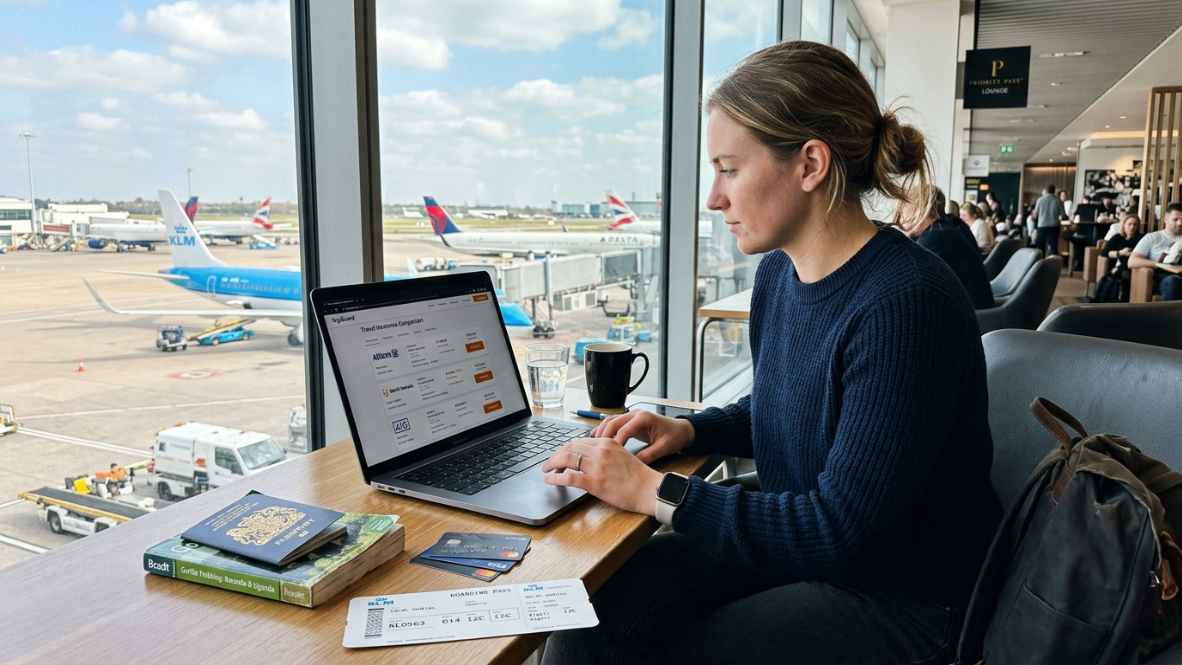
    Mountain Gorilla Census

    Conducted every 5 to 10 years across the Bwindi-Sarambwe ecosystem and the Virunga Massif. The most recent completed census (2018) counted 1,063 mountain gorillas globally. A new Bwindi-Sarambwe census began in 2025, using two sweeps to reduce the chance of missing any individuals. Results will update the population figures used for all four gorilla trekking Bwindi sectors.

    Batwa Community Experience

    The Batwa are the indigenous forest-dwelling people who were relocated when Bwindi became a national park. Cultural tourism programs in the Buhoma and Nkuringo sectors offer guided visits where Batwa community members share their history, traditional practices, and relationship with the forest. It’s a meaningful add-on, especially in sectors where you might have a free afternoon.

    Minimum Trekker Age

    You must be at least 15 years old to participate in gorilla trekking in Bwindi. No exceptions. This applies across all four sectors and to both standard treks and the habituation experience. For families with younger children, the age rule is the first thing to check. Full details are in our gorilla trekking age limits article.

    Choosing a Sector by Traveler Profile

    Rather than declaring one “best” sector (a question every competitor tries to answer with a single name), the smarter approach is matching the sector to your specific situation.

    You’re a first-time trekker over 50: Buhoma. The terrain is manageable, the infrastructure is proven, and treks often wrap up by late morning.

    You’re a serious birder or wildlife photographer: Ruhija. The Albertine Rift endemics and the Bitukura family’s photogenic calm are hard to beat. Pack warm layers for the altitude.

    You want the best odds of getting a permit in peak season: Rushaga. More families means more daily permits. It’s also the shortest drive from Kigali.

    You want the habituation experience: Rushaga. It’s the only option.

    You’re fit, experienced, and want solitude: Nkuringo. The ridge-to-valley treks are demanding, but you’ll share the forest with far fewer people.

    You’re combining Bwindi with other Uganda parks: Buhoma. Its proximity to Queen Elizabeth and Kibale makes multi-park itineraries practical without excessive driving.

    Ready to start building your itinerary? Explore Uganda gorilla safari trips with full pricing and sector-matched logistics.

    Common Mistakes When Choosing a Bwindi Sector

    Many first-time visitors accidentally choose the wrong sector because they focus only on gorilla numbers.

    Avoid these common mistakes:

    Booking accommodation before securing permits

    Always confirm your trekking sector first. Lodges are often several hours apart.

    Assuming every sector is equally easy

    Nkuringo and Ruhija generally require more climbing than Buhoma.

    Underestimating road travel

    Driving between northern and southern sectors can take several hours on mountain roads.

    Ignoring the Kigali route

    If flying into Kigali, Rushaga and Nkuringo usually offer the shortest transfers.

    Waiting too long during peak season

    Permits for popular travel months often sell out several months in advance.

    Frequently Asked Questions

    Can I choose which gorilla trekking Bwindi sector my permit is for?

    Yes, but availability varies by sector and season. Your operator requests a specific sector when booking your permit, and UWA confirms based on availability. Rushaga has the most daily permits, so it’s easiest to secure. Nkuringo, with only three families, is the tightest.

    How far apart are the Bwindi sectors from each other?

    Buhoma to Ruhija is roughly a one-hour drive. Buhoma to Rushaga or Nkuringo takes 3 to 4 hours by road. The southern sectors (Rushaga and Nkuringo) are close to each other but distant from the northern ones. You cannot realistically trek in one sector and sleep in another unless you’re prepared for a very early or very late drive.

    Is the gorilla habituation experience worth the extra cost?

    It depends on what matters to you. You get up to four hours instead of one, and the group is limited to four people instead of eight. But the semi-habituated gorillas may be more skittish. If calm, close encounters matter most, the standard trek with a fully habituated family can actually be more rewarding for some travelers.

    Can I still book a gorilla permit directly with UWA as a foreign traveler?

    No. As of March 1, 2026, all foreign travelers must book through a licensed Ugandan tour operator. Direct individual bookings with UWA are no longer accepted.

    What happens if I’m not fit enough for the sector I’m assigned?

    Rangers assess fitness during the morning briefing and assign gorilla families accordingly. Within a given sector, some families range closer to the trailhead than others. In Rushaga, for example, the wide selection of families gives rangers more flexibility. If you have serious mobility concerns, the sedan chair service ($300 to $500) is available with advance booking.

    Which Bwindi sector is closest to Kigali, Rwanda?

    Rushaga, at roughly 4 to 5 hours via the Cyanika border crossing. Remember the one-hour time zone difference when crossing from Rwanda into Uganda.

    When is the cheapest time to go gorilla trekking in Bwindi?

    April, May, and November, when the low-season permit discount drops the price from $800 to $600. Trails are wetter and drives take longer, but permit availability is better and lodges are less crowded.

    Do I need a specific visa to visit multiple countries on my gorilla trek?

    The East Africa Tourist Visa ($100) covers Uganda, Rwanda, and Kenya on a single 90-day permit. It’s the most practical option if you’re crossing borders.

  • Gorilla Trekking Etiquette 2026: Rules for Uganda & Rwanda

    Gorilla Trekking Etiquette 2026: Rules for Uganda & Rwanda

    TL;DR

    Gorilla trekking etiquette covers every behavioral rule and social expectation before, during, and after your encounter with mountain gorillas. Core rules include maintaining a minimum distance (10 meters in Uganda, 7 meters in Rwanda), observing a strict one-hour viewing limit, never using flash photography, and staying home if you’re sick. These aren’t suggestions. They exist because mountain gorillas share 98% of human DNA, making them dangerously vulnerable to our diseases, and every rule is a direct line of defense for a species that numbered just 254 individuals in 1981.


    The safety rules around gorilla trekking aren’t about protecting you from gorillas. They’re about protecting gorillas from you.

    That framing changes everything about how to approach gorilla trekking etiquette. This isn’t a theme park with guardrails designed for your comfort. It’s a conservation program that happens to allow visitors. The rules, both the enforceable ones and the softer behavioral expectations, exist because mountain gorillas are critically endangered, because human diseases can kill them, and because the tourism revenue that funds their protection only works if the gorillas remain wild and healthy.

    The most recent census from the Greater Virunga Transboundary Collaboration (late 2024) puts the global mountain gorilla population at approximately 1,063 individuals. That’s up from a catastrophic low of 254 in 1981. Mountain gorillas are the only great ape whose population is growing, and that growth is directly tied to tourism-funded conservation and the strict behavioral protocols that make it sustainable.

    This guide covers every piece of etiquette you need, organized as a glossary of terms and rules. Where Uganda and Rwanda differ, those differences are flagged. Where breaking a rule carries consequences, those consequences are spelled out.

    Planning your gorilla trek? Start with our breakdown of Uganda gorilla safari trips and prices.

    Gorilla Trekking Etiquette at a Glance

    If you’re going gorilla trekking in Uganda or Rwanda, follow these essential etiquette rules:

    – Stay at least 10 meters away in Uganda and 7 meters away in Rwanda

    – Never touch a gorilla, even if it approaches you

    – Keep voices quiet and avoid sudden movements

    – Turn off camera flash before entering the forest

    – Spend only one hour with the gorilla family (standard permits)

    – Stay home if you have a cold, flu, or other contagious illness

    – Follow ranger instructions immediately during the trek

    – Do not eat, smoke, or litter near gorillas

    – Respect the forest by leaving no trace

    – Hire a porter if you need assistance and tip guides respectfully

    These rules protect mountain gorillas from human disease, reduce stress on wildlife, and help ensure gorilla tourism continues to support conservation across Uganda and Rwanda.


    Gorilla Trekking Etiquette Checklist

    Before your trek, make sure you can answer “yes” to every item below.

    Checklist

    ✓

    Passport packed

    Permit confirmed

    Hiking boots cleaned

    Flash disabled

    Surgical mask packed

    Feeling healthy (no illness)

    Neutral clothing packed

    Water and snacks packed

    Cash for porter/tips

    Camera batteries charged

    Pre-Trek Etiquette

    These are the rules and protocols that apply before you ever set foot in the forest.

    Morning Briefing

    A mandatory orientation session held at park headquarters before each trek. In Rwanda, visitors gather at Volcanoes National Park headquarters in Kinigi at 7am. In Uganda, briefings happen at the respective park office (Bwindi or Mgahinga).

    During the briefing, rangers explain the core rules (distance, flash ban, time limit, behavior around gorillas), assign you to a specific gorilla family, and may check your camera settings to confirm flash is disabled. This is your last chance to ask questions, flag health concerns, or mention physical limitations.

    Show up on time. Late arrivals can delay the entire group, and rangers are not obligated to wait.

    Fitness Disclosure

    Gorilla families are assigned to trekking groups on the morning of the trek, not at booking. Some families live on steep slopes at high altitude, requiring hours of hard hiking. Others are closer to trailheads.

    If you have mobility challenges, knee problems, or any condition that limits your hiking ability, communicate this to your tour operator well before your trek date. The park officials can then assign you to a family that’s easier to reach. Hiding a fitness limitation doesn’t help anyone. It slows the group, puts pressure on rangers, and could mean you never reach the gorillas at all. Our detailed guide on gorilla trekking fitness requirements breaks this down further.

    Gorilla Permit

    Your gorilla permit is date-specific, park-specific, and matched to your passport. In Uganda, permits cost $800 during peak season and $600 during low season (2026 rates). In Rwanda, permits cost $1,500 year-round. Uganda also offers a Gorilla Habituation Experience permit at $1,800, available only in Bwindi.

    Permits are largely non-refundable. Rwanda does offer a partial exception: the Rwanda Development Board (RDB) will refund 50% of the gorilla tracking fee if a visitor is declared unfit due to illness by the Warden in Charge. Uganda has no comparable refund policy.

    For a full breakdown of costs and booking rules, see our guide on gorilla trekking permits in Uganda.

    Passport Requirement

    Bring your passport on trek day. Park officials check passports against permits before allowing entry. Forget your passport and you may not be allowed into the park. No exceptions, no workarounds. This catches people off guard surprisingly often, particularly those staying at lodges far from the park gate who pack light for the morning.

    Shoe Disinfection

    All visitors must disinfect their shoes at designated points before entering the forest. This prevents the introduction of soil-borne pathogens from other environments. Step into the disinfection mat fully and deliberately. It takes five seconds and protects an entire ecosystem.

    Gorilla Friendly Pledge

    The Gorilla Friendly Pledge is an online awareness campaign run by the International Gorilla Conservation Programme (IGCP), backed by Conservation International, Fauna & Flora International, and WWF. By taking the pledge, you commit to wearing a surgical mask near gorillas, maintaining at least 10 meters of distance, and following all park rules.

    Fewer than 2,000 people have taken it. Signing before your trek takes two minutes and serves as a useful mental rehearsal of the rules you’ll need to follow.

    Habituation

    Not every gorilla family in the forest is available for tourism. Gorilla habituation is a gradual process where wild gorillas become accustomed to human presence over two to three years (sometimes longer) under the guidance of researchers and conservationists. Only fully habituated families are opened to standard tourism visits.

    Uganda’s Gorilla Habituation Experience in Bwindi offers a unique alternative: trekkers spend up to four hours with a semi-habituated group, observing the habituation process in action. This comes with a higher permit cost ($1,800) and different behavioral expectations, since the gorillas are less predictable.


    During-Trek Behavioral Etiquette

    These rules apply from the moment you enter the forest until you leave. Most are strictly enforced by rangers, and violations can end your trek immediately.

    Minimum Distance Rule (7 Meters vs. 10 Meters)

    Gorilla Trekking Etiquette 2026: Rules for Uganda & Rwanda

    Uganda requires a minimum distance of 10 meters from gorillas. Rwanda requires 7 meters. According to IUCN best-practice guidelines for great ape tourism, 7 meters has historically been the standard minimum, with recommendations to increase it and add surgical masks when within 10 meters.

    The smart move: treat 10 meters as your personal standard regardless of which country you’re in. That extra three meters costs you nothing and gives the gorillas more space.

    Practitioners on Reddit who’ve done treks in both countries report that the distance rule is sometimes hard to maintain perfectly, especially when gorillas move toward the group. The key is never to approach closer yourself. If a gorilla closes the gap, hold still or move slowly backward. For a deeper look at all distance and safety protocols, read our full guide on gorilla trekking safety rules for Uganda and Rwanda.

    One-Hour Viewing Limit

    Standard gorilla treks allow exactly one hour of viewing time. Rangers track this precisely and will alert the group when the session ends. The timer starts when you first make visual contact with the gorilla family, not when you left the trailhead. So a four-hour hike to reach the gorillas doesn’t eat into your viewing time.

    This limit preserves the gorillas’ natural rhythms and ensures they associate human presence with minimal disruption. One hour sounds short. Every single trekker says it goes by in a flash. Knowing this in advance helps you prioritize the experience over fiddling with camera settings. For more context on trek timing, see how long gorilla trekking really takes.

    Group Size Cap (8 Visitors)

    Both Uganda and Rwanda limit groups to 8 visitors per gorilla family per day. Rwanda issues 96 gorilla permits per day total (12 habituated families multiplied by 8 visitors each). This cap is non-negotiable and is one of the reasons permits sell out months in advance.

    The small group size is central to gorilla trekking etiquette. Larger groups would create more noise, more disease risk, and more stress for the animals.

    No-Touch Rule

    Do not touch the gorillas. Even if a gorilla approaches you, brushes past you, or sits down right next to you. The temptation is real, especially with juveniles, who are curious and sometimes reach toward visitors. Resist it completely.

    Human contact can transmit diseases and cause gorillas unnecessary stress. Gorillas share 98% of their DNA with humans, which means our respiratory infections, skin conditions, and gastrointestinal bugs can jump species with alarming ease. A single touch could introduce a pathogen that spreads through an entire family.

    Health Screening and Illness Policy

    If you have a cold, flu, or any contagious illness, you must not visit the gorillas. This is enforced during the morning briefing, and rangers can turn you away on the spot.

    Losing a $700+ permit stings. But a respiratory virus transmitted to a gorilla family could be devastating. These animals have no immunity to human diseases. Entire family groups have been affected by outbreaks traced to human contact.

    Rwanda’s 50% refund for illness-related cancellations offers some financial cushion. Uganda offers none. Either way, reporting your illness honestly is not optional. It is the single most important piece of gorilla trekking etiquette.

    Mask Wearing

    The IGCP Gorilla Friendly Pledge asks trekkers to commit to wearing a surgical mask when within close proximity of gorillas. On the ground, enforcement varies. Some guides in both Uganda and Rwanda actively request masking when the group is close to the family. Others are more relaxed about it.

    Bring a surgical mask regardless. If the gorillas end up closer than expected (which happens regularly), you’ll want it.

    Flash Photography Ban

    Flash photography is completely banned during gorilla encounters in Uganda, Rwanda, and the DRC. Flash can startle gorillas, provoke defensive behavior from silverbacks, and disrupt the entire family dynamic. Rangers may check your camera settings before the trek, and using flash during the encounter can result in your visit being terminated immediately, without refund.

    Before you leave your lodge, switch your camera and phone to flash-off mode. Double-check it. Then check it again. One accidental flash pop can ruin the experience for your entire group. Our gorilla trekking photography guide covers camera prep, recommended lenses, and settings in detail.

    Drone Ban

    Drone usage is not permitted in any gorilla trekking park. The noise disturbs gorillas and other wildlife, and the visual presence of an unfamiliar flying object can provoke panic or aggressive responses. Leave the drone at your lodge. This applies to all drone sizes and types.

    Direct Eye Contact (Avoidance)

    Direct and prolonged eye contact can be perceived as a challenge or threat by gorillas. If a gorilla looks at you, avert your gaze. Don’t stare back. This feels counterintuitive when you’re face-to-face with one of the most magnificent animals on earth, but it matters. A brief glance is fine. A locked stare is not.

    Quiet Voices

    Speak in whispers. Better yet, stay silent. Loud voices or sudden noises can startle gorillas, particularly mothers with infants who are already on high alert. If you need to communicate with your guide or fellow trekkers, keep it barely above a murmur.

    No Eating, Drinking, or Smoking

    Visitors are prohibited from eating, drinking, smoking, or chewing gum during the gorilla encounter. Food smells attract insects and wildlife, create contamination risks, and are a general disturbance. Have your snack before or after the encounter, not during.

    No Mimicking Gorilla Sounds

    Even with the best intentions, mimicking gorilla vocalizations can send misleading signals and cause confusion or agitation within the family. The rumbling “contentment” sound you heard in a documentary? Don’t try to reproduce it. You don’t speak gorilla, and getting the tone wrong could be interpreted as aggression.

    Silverback Charge Response Protocol

    About 99% of gorilla charges are bluff charges. A silverback may beat his chest, vocalize loudly, and rush toward the group to give his family time to move to safety. It looks terrifying. It almost never results in contact.

    If a gorilla charges or comes close: crouch down slowly to make yourself appear smaller, avert your gaze, do not run, and follow your ranger guide’s lead exactly. Running triggers a chase instinct. Standing tall looks like a challenge. Crouching signals submission and defuses the situation.

    Submissive Posture / Crouching

    Beyond charge situations, crouching or sitting down is the default body language whenever gorillas are near. If a gorilla walks past you on the trail, crouch low, avoid eye contact, and wait for the animal to pass. Your ranger guide will model this behavior. Copy them.

    Toilet Protocol

    This is the etiquette rule no one wants to talk about, but everyone needs to know. If you need to relieve yourself while in the forest, ask the ranger guide to dig you a hole. The hole must be at least 30 centimeters deep. After you’re finished, fill the hole completely.

    This prevents human waste from contaminating the gorillas’ environment and reduces disease transmission risk. It’s not glamorous, but it’s straightforward and every experienced trekker will tell you to just ask without embarrassment. Rangers handle this request regularly.

    Leave No Trace

    Stay on designated trails to minimize habitat disruption and erosion. Do not litter. Fines for littering in Uganda can reach $150 USD. Do not remove plants, insects, or any natural objects from the forest. Pack out everything you bring in.

    This extends to small items people forget about: tissue wrappers, energy bar packaging, lens caps. If it entered the forest in your pocket, it leaves in your pocket.

    Gorilla Trekking Do’s and Don’ts

    Do

    Don’t

    Stay behind your ranger

    Approach gorillas

    Speak quietly

    Shout or clap

    Wear neutral colors

    Wear bright neon clothing

    Follow group instructions

    Wander away from the group

    Keep flash off

    Use flash photography

    Carry out your rubbish

    Leave litter behind

    Crouch if instructed

    Run from a gorilla

    Respect the one-hour limit

    Ask for extra viewing time


    Photography Etiquette

    Photography deserves its own section because it’s where etiquette violations happen most frequently.

    Pre-Trek Camera Check

    Rangers may inspect your camera and phone settings at the morning briefing to verify flash is disabled. Come prepared. If you’re using a DSLR or mirrorless camera, disable the pop-up flash and switch to manual or aperture-priority mode. On smartphones, go into camera settings and turn flash to “off” (not “auto,” which can fire in low light, which is exactly the condition you’ll be shooting in under the forest canopy).

    Telephoto Lens Selection

    A 70-200mm f/2.8 lens is the consensus pick among wildlife photographers for gorilla trekking. It gives you enough reach to fill the frame from a safe distance and enough light-gathering capability for the dim forest environment. Wider lenses (24-70mm) are useful for environmental shots, but don’t rely on them as your primary lens, because you’ll be tempted to move closer for frame-filling shots.

    No Rapid Repositioning

    Do not suddenly shift position to get a better angle if it means breaking the minimum distance rule. Professional photographers must balance creative ambition with compliance. No photograph is worth stressing a gorilla family or getting your trek terminated.

    Experience-First Mindset

    One of the most overlooked pieces of gorilla trekking etiquette has nothing to do with official rules. It’s about how you choose to spend your hour.

    Some tourists spend the entire session behind their phone screen, recording nonstop, posing with their backs turned to the gorillas for selfies, or snapping hundreds of nearly identical photos. They leave having documented the experience but barely having experienced it.

    Put the camera down for at least the first five to ten minutes. Watch the gorillas. Listen to them. Let the reality of what you’re seeing sink in. You can photograph for the remaining fifty minutes. That initial period of pure observation will be what you remember most vividly for the rest of your life.

    Social Media and Geotagging

    When you post your photos on social media (and you will), avoid geotagging exact locations. Specific GPS coordinates or trail markers can create over-tourism pressure on certain gorilla families and, in worst-case scenarios, provide intelligence for poaching operations. Tag the national park broadly if you want. Don’t tag the precise spot.

    The Biggest Gorilla Trekking Etiquette Mistakes Visitors Make

    Most etiquette violations happen because visitors become excited once they see gorillas. Common mistakes include:

    Getting Too Close

    Many visitors accidentally move forward while taking photos.

    Always let the gorillas control the distance.

    Forgetting Flash is Enabled

    Auto flash is one of the most common reasons rangers intervene.

    Turn flash completely OFF before leaving your lodge.

    Spending the Entire Hour Behind a Camera

    Many experienced trekkers recommend watching the gorillas for the first few minutes before taking photos.

    The memories are often more valuable than hundreds of nearly identical images.

    Talking Too Loudly

    Excited conversations disturb gorillas and other trekkers.

    Keep conversations short and quiet.

    Arriving While Sick

    Even a mild cold can threaten an entire gorilla family.

    If you’re unwell, inform park staff immediately.

    Porter and Tipping Etiquette

    This falls outside the formal park rules but is a critical part of gorilla trekking etiquette that directly affects local communities and your own trek experience.

    Hiring a Porter

    Hiring a porter is one of the smartest decisions you can make on a gorilla trek. Porters carry your daypack, camera bag, or water, freeing your hands for balance on steep, muddy terrain. For photographers carrying heavy camera equipment, a porter isn’t a luxury. It’s a necessity.

    Porter costs are modest: $10 to $25 for the day depending on the park and country. Critically, many gorilla trekking porters earn no regular salary. The daily hire fee is their income. Hiring a porter supports the local economy directly and gives community members a financial stake in gorilla conservation.

    For anyone with significant mobility concerns, sedan chairs carried by a team of porters are available in both Uganda and Rwanda. Using this service is not something to feel awkward about. It exists for a reason, it employs more porters, and it allows people who couldn’t otherwise trek to have the experience.

    Tipping Guidelines

    Tipping is expected and important. A common guideline: budget approximately $50 USD per couple per day, broken down roughly as $30 to the head ranger, $10 for backup guides or armed guards, and $10 for the tracking team. Porter tips are separate from the hiring fee. Since porters have no salary, their tip is functionally their bonus.

    In both Uganda and Rwanda, tips should be in US dollars. East African banks and exchange services can be particular about bill condition, so bring post-2009 bills in good condition. Some parks have communal tip boxes; others allow direct tipping. Your guide will clarify the local custom at the briefing.

    For a broader look at how costs break down across an East Africa trip, our East Africa packing list and gear guide covers what to bring and what to budget for essentials.


    Country-Specific Quick Reference

    Rules differ between Uganda and Rwanda in ways that matter. Here’s a clean comparison.

    Rule / Detail

    Uganda

    Rwanda

    Minimum distance

    10 meters

    7 meters

    Viewing time

    1 hour (standard), 4 hours (habituation)

    1 hour

    Group size

    8 visitors per family

    8 visitors per family

    Minimum age

    15 years

    15 years

    Permit cost (2026)

    $800 peak / $600 low season

    $1,500 year-round

    Habituation experience

    Yes (Bwindi only, $1,800)

    No

    Illness refund

    None

    50% refund via RDB

    Daily permits available

    Varies by park

    96 (12 families × 8)

    Porter cost

    ~$20 per trek

    ~$10 per trek

    Community revenue share

    Varies by park

    10% of permit revenue by law

    For a full country comparison beyond etiquette, read our detailed breakdown of gorilla trekking in Rwanda vs. Uganda.


    Consequences of Breaking the Rules

    Most competitor guides list rules without telling you what happens when someone breaks them. Here’s the reality.

    Trek terminated without refund. Visitors who use flash photography, attempt to touch gorillas, break distance rules, or otherwise violate regulations can have their viewing ended immediately. No second chances, no partial refund, no “I didn’t know.”

    Operators can lose permits. Tour operators or guides who encourage or allow rule violations risk having their permits suspended or revoked. This means reputable operators take enforcement seriously, and your guide will intervene if you’re breaking protocol.

    Littering fines. Uganda imposes fines of up to $150 USD for littering in national parks.

    Disease transmission. This isn’t a fine or a legal penalty. It’s the real consequence. A single instance of close contact or trekking while sick could introduce a pathogen to a gorilla family with no immunity. The population recovery from 254 to 1,063 animals happened because of the rules, not in spite of them.

    Gorilla Trekking Etiquette Myths

    Myth

    Fact

    Gorilla trekking is dangerous.

    Mountain gorillas are generally calm when visitors follow ranger instructions.

    Gorillas enjoy being touched.

    Human contact increases disease risk and is prohibited.

    Flash photography improves wildlife photos.

    Flash startles gorillas and is banned.

    Bigger groups mean better sightings.

    Small groups reduce stress on gorillas.

    You can stay longer if you pay extra.

    Standard permits allow only one hour with the gorillas.

    Conservation Context: Why Etiquette Is Conservation

    Gorilla Trekking Etiquette 2026: Rules for Uganda & Rwanda

    Every piece of gorilla trekking etiquette connects back to a conservation outcome. The distance rule limits disease transmission. The group size cap limits stress. The one-hour window preserves natural behavior. The no-touch rule prevents pathogen transfer at the most direct level possible.

    Rwanda’s 10% community revenue-sharing law means roughly €10 million from gorilla permit revenue has been invested in building schools, roads, and drinking water supplies in communities surrounding the parks. When local communities benefit financially from living gorillas, poaching pressure drops. This is the economic architecture that makes gorilla trekking sustainable, and it only works if trekkers follow the rules that keep gorillas healthy and wild.

    Rwanda’s annual Kwita Izina ceremony, where newborn gorillas are given names, celebrates this conservation success each year. It’s a reminder that behind every rule, there’s a gorilla with a name, a family, and a story worth protecting.

    Ready to plan your gorilla trekking trip? See our complete guide to gorilla trekking permits, costs, and booking rules in Uganda.

    Gorilla Trekking Etiquette Timeline

    Before Leaving Your Lodge

    • Eat breakfast

    • Pack passport

    • Disable flash

    • Bring water

    • Wear hiking gear


    During the Briefing

    • Listen carefully

    • Ask questions

    • Report illness

    • Mention mobility concerns


    During the Trek

    • Stay with your guide

    • Speak quietly

    • Respect wildlife


    During the Gorilla Encounter

    • Keep your distance

    • Avoid direct eye contact

    • Never touch gorillas

    • Follow ranger instructions


    After the Encounter

    • Leave no trace

    • Thank your guides

    • Tip respectfully

    • Share photos responsibly

    Frequently Asked Questions

    What happens if a gorilla approaches closer than the minimum distance?

    Hold still or move slowly backward. Never approach a gorilla yourself, but if one closes the gap on its own, stay calm, crouch low, and avert your gaze. Rangers will guide you. The distance rule governs your behavior, not the gorilla’s.

    Can I use my phone camera instead of a DSLR?

    Yes. Phones are allowed and many trekkers rely on them exclusively. The critical requirement is that flash must be disabled, not set to auto, but fully off. Forest canopy creates low-light conditions where auto-flash will fire, which is exactly the scenario you need to prevent.

    What if I get sick the day before my trek?

    Report it immediately to your operator and the park. In Rwanda, you may receive a 50% refund from the RDB. In Uganda, there is no refund policy for illness. Either way, trekking while sick is not a gray area. Rangers screen for symptoms at the briefing and can turn you away. Gorillas have no immunity to common human respiratory infections.

    Is the age limit enforced strictly?

    The minimum age is 15 years old in both countries, measured at the time of trekking, not at the time of booking. This is a strict Uganda Wildlife Authority and RDB rule with no exceptions. Families booking far in advance sometimes miscalculate, so verify your child’s age against the actual trek date. Read more about the gorilla trekking age limit and its implications for family travel.

    Do I really need to hire a porter?

    You don’t have to. But the terrain is steep, often muddy, and unpredictable. A porter costs $10 to $25 for the day, frees your hands for balance and photography, and directly supports a local community member who may have no other income source. Most experienced trekkers and operators describe hiring a porter as one of the best decisions you can make.

    How strictly is the one-hour limit enforced?

    Very strictly. Rangers time it from the moment you make visual contact with the gorilla family. When the hour is up, the group leaves. There is no negotiation, no extension, and no paying for extra time (outside of Uganda’s separate Gorilla Habituation Experience, which allows up to four hours).

    What should I wear on the trek?

    Long sleeves, long pants, sturdy waterproof hiking boots, and gardening-style gloves for grabbing vegetation on steep sections. Neutral earth tones are preferred over bright colors. For a complete checklist, see our gorilla trekking packing list.

    Is the Gorilla Friendly Pledge mandatory?

    No, it’s voluntary. But it takes two minutes online, reinforces every major etiquette rule, and signals your commitment to responsible tourism. Backed by IGCP (a partnership between Conservation International, Fauna & Flora International, and WWF), it’s a small gesture with real value as pre-trek mental preparation.

  • Gorilla Trekking Altitude 2026: Parks, Risks, What to Expect

    Gorilla Trekking Altitude 2026: Parks, Risks, What to Expect

    TLDR

    Gorilla trekking altitude ranges from about 1,500 meters at Bwindi’s lower sectors to over 3,500 meters on certain treks in Rwanda’s Volcanoes National Park. True altitude sickness is unlikely at these elevations for most people, but the combination of thinner air, steep terrain, and unpredictable trek lengths creates real fatigue. Your choice of park and sector matters more than most guides admit, and this article breaks down exactly what to expect at each location.


    Mountain gorillas live at elevations that most people never think about until the trip is booked. Then the questions start. How high will I actually be hiking? Will I feel the altitude? Should I take Diamox? Is Rwanda harder than Uganda?

    These are fair questions, and most online guides answer them poorly. They either dismiss altitude as irrelevant or lump all four gorilla parks together as if they’re interchangeable. They’re not. The elevation difference between Bwindi’s Buhoma sector and a high trek in Volcanoes National Park is roughly 1,500 meters, which is the difference between a pleasant forest walk and a genuinely breathless climb.

    This guide covers every gorilla trekking destination with specific altitude data, sector-level breakdowns, medical context, and practical advice for choosing the right park based on your comfort level.

    Planning a gorilla trekking trip? See our full breakdown of Uganda gorilla safari pricing to understand what’s included.

    Gorilla Trekking Altitude at a Glance

    The altitude for gorilla trekking depends on the park you visit.

    Park

    Typical Trekking Altitude

    Difficulty

    Bwindi (Uganda)

    1,500–2,600 m

    Easy to Moderate

    Volcanoes (Rwanda)

    2,500–3,500 m

    Moderate

    Mgahinga (Uganda)

    2,500–3,500 m

    Moderate

    Virunga (DRC)

    2,500–3,350 m

    Moderate

    Key Takeaways

    – Gorilla trekking occurs between 1,500 and 3,500 meters.

    – Most visitors do not develop altitude sickness.

    – The biggest challenge is steep hiking combined with thinner air.

    – Bwindi’s Buhoma sector is the easiest option.

    – Rwanda starts at a higher elevation than Uganda.

    What “Gorilla Trekking Altitude” Actually Means

    Gorilla trekking altitude refers to the elevation at which you’ll be hiking to find habituated mountain gorilla families. This is distinct from the overall elevation range of a national park, which can be misleading. Virunga National Park in the DRC, for example, spans from 680 meters at its lowest point to 5,109 meters at Mount Stanley. But gorilla trekking there happens in a narrow band around 2,500 to 3,350 meters.

    The same distinction matters everywhere. Park boundary elevations tell you very little about your actual trekking experience. What matters is the trailhead altitude (where you start walking), the trekking altitude (how high the gorillas are ranging that day), and the elevation gain (the vertical climb between those two points).

    Mountain gorillas as a species inhabit elevations between roughly 2,200 and 4,000 meters. The specific families you visit, the sector you’re assigned to, and even the season can shift your trekking altitude by hundreds of meters on any given day.

    Gorilla Trekking Parks Compared

    Best For

    Recommended Park

    Lowest altitude

    Bwindi (Buhoma)

    Beginners

    Bwindi

    Older travelers

    Buhoma

    Short hikes

    Volcanoes NP

    Best infrastructure

    Rwanda

    Biggest challenge

    Nkuringo

    Highest trekking elevations

    Volcanoes NP

    Best if worried about altitude

    Bwindi

    Altitude by Park: Side-by-Side Comparison

    No two gorilla parks offer the same altitude experience. Here’s what the numbers actually look like when you compare the four destinations where mountain gorilla trekking is possible.

    Park

    Country

    Park Elevation Range

    Typical Trekking Altitude

    AMS Risk

    Typical Trek Duration

    Bwindi Impenetrable NP

    Uganda

    1,160–2,607 m (3,806–8,553 ft)

    1,500–2,600 m

    Low

    2–8 hours

    Volcanoes NP

    Rwanda

    2,400–4,507 m (7,874–14,787 ft)

    2,500–3,500 m

    Low to Moderate

    1–6 hours

    Mgahinga Gorilla NP

    Uganda

    2,227–4,127 m (7,306–13,540 ft)

    2,500–3,500 m

    Low to Moderate

    1–6 hours

    Virunga NP

    DRC

    680–5,109 m (2,231–16,762 ft)

    ~2,500–3,350 m

    Low to Moderate

    2–5 hours

    A few things stand out immediately. Bwindi offers the widest range and the lowest possible trekking altitudes, which makes it the most forgiving option for altitude-sensitive travelers. Volcanoes NP in Rwanda starts higher (the entry point at Kinigi already sits at approximately 2,400 meters) and certain treks push past 3,000 meters. Mgahinga and Virunga fall in between but share the volcanic terrain of the Virunga Massif, meaning steeper gradients on open slopes.

    For more context on permits and logistics at each destination, see our guide to gorilla trekking permits in Uganda.

    Gateway Town Elevations

    Your acclimatization actually begins in the town where you sleep the night before your trek. These elevations matter:

    • Musanze, Rwanda (gateway to Volcanoes NP): ~1,850 m

    • Kabale, Uganda (gateway to southern Bwindi): ~1,900 m

    • Kisoro, Uganda (gateway to Mgahinga and Nkuringo): ~1,600 m

    • Kigali, Rwanda: ~1,500 m

    • Kampala, Uganda: ~1,190 m

    If you’re flying in from a coastal or low-altitude city, spending a night or two in one of these towns before your trek provides meaningful, if modest, acclimatization.

    Gorilla Trekking Altitude Compared to Familiar Places

    Location

    Elevation

    Sea Level

    0 m

    Denver

    1,609 m

    Kigali

    1,500 m

    Nairobi

    1,660 m

    Bwindi Trekking

    1,500–2,600 m

    Volcanoes NP Trekking

    2,500–3,500 m

    Machu Picchu

    2,430 m

    Everest Base Camp

    5,364 m

    Kilimanjaro Summit

    5,895 m

    Bwindi Sector Altitude Breakdown

    Bwindi Impenetrable National Park deserves its own section because it’s the most popular gorilla trekking destination and because its four sectors offer dramatically different altitude experiences. Most articles mention Bwindi’s overall range of 1,160 to 2,607 meters and leave it at that. That’s not helpful. The difference between sectors is the difference between an easy morning walk and a grueling all-day hike.

    Buhoma (Northern Bwindi): The Easiest Option

    Buhoma sits at the lowest elevations in the park and offers the gentlest terrain. The trails here are flatter compared to other sectors, and the gorilla families tend to range at accessible altitudes. This sector is widely recommended for beginners, older travelers, and anyone whose fitness levels are modest. If altitude is a concern at all, Buhoma effectively removes it from the equation.

    Rushaga (Southern Bwindi): Moderate

    Rushaga offers a middle ground. The terrain is hillier than Buhoma but less punishing than the higher sectors. Several habituated gorilla families range here, giving the park rangers more flexibility in matching groups to visitor fitness levels.

    Ruhija (Eastern Bwindi): High and Cold

    Ruhija is the highest sector in Bwindi, perched around 2,350 meters. It’s also the coolest and wettest, which compounds the altitude challenge. The elevation here adds a noticeable dimension of difficulty, and trekkers should expect to feel the thinner air during steep sections. Ruhija is a good choice for fit travelers who want a more immersive wilderness experience.

    Nkuringo (Southern Bwindi): The Steepest

    Nkuringo is consistently rated the most challenging sector in Bwindi. The difficulty comes less from absolute altitude and more from the extreme steepness of the terrain. The starting point sits high, and the descents and ascents through dense forest are relentless. This sector demands excellent physical fitness.

    Sector difficulty ranking, easiest to hardest: Buhoma → Rushaga → Ruhija → Nkuringo.

    For a detailed comparison of how Uganda and Rwanda differ beyond altitude, read our guide on gorilla trekking: Rwanda vs. Uganda.

    Is Altitude Sickness a Real Risk During Gorilla Trekking?

    Gorilla Trekking Altitude 2026: Parks, Risks, What to Expect

    This is the question that generates the most anxiety and the most misleading answers online. The short version: true altitude sickness (acute mountain sickness, or AMS) is unlikely during gorilla trekking, but altitude will absolutely affect how you feel.

    The Medical Threshold

    Acute mountain sickness generally becomes a risk at altitudes starting from 2,500 meters above sea level, though some individuals may develop symptoms slightly below that threshold. The medical literature notes that AMS is rare below 2,400 meters (8,000 feet), but there are isolated reports of symptoms in unacclimated individuals spending several hours at altitudes as low as 2,000 meters.

    Most gorilla treks in Bwindi stay well below the 2,500-meter threshold. In Volcanoes NP and Mgahinga, some treks do push past 3,000 meters, which puts them in the zone where mild symptoms (headache, nausea, light-headedness) become plausible for sensitive individuals.

    What Practitioners Say

    A medical contributor on TripAdvisor’s Bwindi forum put it plainly: “It would be most unlikely that a visitor hiking to see the gorillas at Bwindi would develop true high-altitude sickness, and there seems little indication for taking acetazolamide as prophylaxis.”

    Practitioners on Reddit and travel forums consistently echo a similar point: the altitude itself is not the problem. The problem is exertion at elevation. Dense forest, steep slopes, muddy trails, and the unpredictable duration of treks (anywhere from one to eight hours) combine with slightly thinner air to create genuine fatigue. You’re not going to get HACE or HAPE (the severe, life-threatening forms of altitude illness) on a gorilla trek. But you might get winded faster than you expected, especially if you flew in from sea level the day before.

    One important nuance: physical conditioning does not prevent altitude sickness. Being fit doesn’t make your body acclimatize faster. What fitness does provide is better breathing efficiency and cardiovascular capacity, meaning you’ll recover faster between steep sections and maintain a steadier pace overall. That distinction matters.

    For a thorough look at what fitness level you actually need, check out our guide on gorilla trekking fitness requirements.

    Should You Take Diamox?

    For Bwindi, the consensus among experienced guides and medical professionals is no. The altitudes involved are far too low to justify acetazolamide (Diamox), which is standard for Kilimanjaro-level climbs above 4,000 meters but overkill for a 2,000-meter forest trek.

    For Volcanoes NP or Mgahinga, where certain treks can reach 3,000 to 3,500 meters, the answer shifts to “maybe, if you have known altitude sensitivity.” Consulting a doctor before your trip is reasonable in those cases, particularly if you’ve experienced AMS symptoms at similar elevations before.

    How Altitude Affects Your Trek Day

    Even if altitude sickness isn’t a realistic concern, the gorilla trekking altitude still shapes your experience in practical ways.

    Thinner air means faster fatigue. At 2,500 to 3,000 meters, the air contains roughly 25% less oxygen than at sea level. You won’t notice it standing still, but you’ll feel it within minutes of hiking uphill through thick vegetation. Expect heavier breathing and the need for more frequent rest stops than you’d take on a similar hike at lower elevation.

    Guides pace to the slowest member. This is reassuring. Your park ranger and guide will set a sustainable pace, and there’s no pressure to rush. But it also means that if you’re the slowest member, the group moves at your speed, which can feel uncomfortable for some people.

    Trek duration is unpredictable. The gorillas move. Your guide will have radio intelligence about their general location, but “general” can still mean one hour of hiking or six. This variability is what makes altitude management tricky. You can’t budget your energy precisely when you don’t know how long the trek will last.

    Understanding how long gorilla trekking really takes will help you set realistic expectations.

    What Happens During Your Trek

    Stage

    Typical Elevation

    Park briefing

    1,500–2,400 m

    Trailhead

    1,500–2,600 m

    Forest hike

    2,000–3,200 m

    Gorilla encounter

    2,000–3,500 m

    Return hike

    Descending back to trailhead

    How Temperature Changes With Altitude

    Elevation

    Typical Temperature

    1,500 m

    18–25°C

    2,000 m

    15–22°C

    2,500 m

    12–20°C

    3,000 m

    8–18°C

    3,500 m

    5–15°C

    Higher elevations are not only harder because of thinner air. They’re also cooler and often wetter, which is why layered clothing is recommended regardless of season.

    Specific Gorilla Families and Altitude Difficulty

    This is something almost no online guide covers, but it’s critical information. Not all gorilla families range at the same altitude, and some are significantly harder to reach than others.

    In Volcanoes National Park (Rwanda):

    • Susa A is widely considered the most challenging group to trek due to the altitude range visitors must cover to reach them. Expect a longer, higher trek.

    • Sabyinyo, Hirwa, Kwitonda, and Agashya are generally more accessible and straightforward to reach.

    • Despite the higher base elevation, Volcanoes NP is regarded by many experts (including guidebook author Philip Briggs) as the easiest place overall to track mountain gorillas because the habituated groups are predictably territorial and often found close to the forest edge.

    In Bwindi (Uganda):

    • The Nkuringo group and other families in the Nkuringo sector require the most strenuous trekking.

    • Buhoma’s families are consistently the easiest to access, often found on relatively flat trails close to the park boundary.

    • Ruhija’s families add altitude to the challenge, with the sector’s characteristically cool, wet climate making conditions less comfortable.

    Your park will assign you a gorilla family on the morning of your trek based on group sizes, ranger intelligence, and sometimes visitor fitness levels. If you have strong preferences or concerns, communicate them clearly during the pre-trek briefing.

    Preparing for Gorilla Trekking at Altitude

    Gorilla Trekking Altitude 2026: Parks, Risks, What to Expect

    Preparation doesn’t need to be complicated, but it should be deliberate. Here’s what actually helps.

    Arrive Early

    Allow 24 to 48 hours at an intermediate elevation before your trek. If you’re flying from a coastal city, don’t schedule your gorilla trek for the day after arrival. Spend a night in Kigali, Musanze, Kisoro, or Kabale to let your body adjust. Even this modest acclimatization period makes a measurable difference in how you feel on trek day.

    Train Your Cardiovascular System

    Three to six weeks of regular cardio training before your trip is the single best investment you can make. Focus on hiking (ideally uphill), stair climbing, and sustained walking. You don’t need to be an athlete, but you do need to be comfortable walking for several hours at a steady pace on uneven ground.

    Hydrate and Avoid Alcohol

    Drink aggressively the day before and the morning of your trek. Dehydration amplifies altitude-related fatigue. Avoid alcohol the night before. This advice appears in virtually every gorilla trekking guide because it works.

    Hire a Porter

    At $15 to $20 in Uganda, a porter is the best money you’ll spend on your entire trip. They carry your daypack, provide a steadying hand on steep sections, and can push or pull you through difficult terrain when your legs give out. Every experienced gorilla trekker recommends this, and the money goes directly into the local community.

    Pack Light, Dress in Layers

    The temperature can swing significantly during a trek, especially at higher altitudes in Ruhija or Volcanoes NP. Start with a warm layer, carry rain gear, and be prepared to strip down as you warm up from exertion. Lighter camera gear also matters when every extra kilogram compounds fatigue at elevation. For a full equipment list, see our gorilla trekking packing list.

    How Gorilla Trekking Altitude Compares to Other East African Activities

    Gorilla trekking altitude sits firmly in the “moderate elevation” category when compared to other popular activities in the region. Putting it in context helps calibrate whether your concern level is appropriate.

    Activity

    Typical Altitude

    Zanzibar beach holiday

    Sea level

    Serengeti/Ngorongoro game drives

    1,000–2,300 m

    Nairobi

    ~1,660 m

    Kigali

    ~1,500 m

    Gorilla trekking (Bwindi)

    1,500–2,600 m

    Gorilla trekking (Volcanoes/Mgahinga)

    2,500–3,500 m

    Kilimanjaro summit (Uhuru Peak)

    5,895 m

    The key takeaway: gorilla trekking is nowhere near Kilimanjaro territory. Even the highest gorilla treks in Rwanda top out around 3,500 meters, which is lower than Kilimanjaro’s third-day camp on most routes. If you’ve completed a multi-day hike at moderate elevation anywhere in the world, gorilla trekking altitude should be well within your capacity.

    For travelers combining gorilla trekking with a Kilimanjaro climb, the trekking altitude serves as useful low-level acclimatization. For those pairing it with a safari, the transition from game-drive elevations (typically 1,000 to 2,000 meters) to gorilla trekking altitudes is gentle enough that most people don’t notice.

    Timing your trip well also reduces difficulty. Dry-season conditions make trails more stable underfoot, which matters when altitude is already taxing your system. Check our best time to visit East Africa guide for seasonal planning.

    Which Gorilla Trekking Destination Is Right for You?

    If You…

    Choose

    Are worried about altitude

    Bwindi Buhoma

    Are over 60

    Buhoma

    Want luxury lodges

    Rwanda

    Want the shortest hikes

    Rwanda

    Want lower permit prices

    Uganda

    Want a physical challenge

    Nkuringo

    Want volcanic scenery

    Rwanda or Mgahinga

    Choosing the Right Park for Your Altitude Comfort

    Your choice of destination should match your fitness level and altitude tolerance. Here’s a straightforward framework.

    If Altitude Worries You at All: Bwindi (Buhoma Sector)

    Bwindi’s Buhoma sector keeps you well below any altitude that could cause even mild symptoms. The terrain is the gentlest in the park, and the gorilla families here are reliably accessible. Multiple sources recommend Bwindi specifically for travelers who want to eliminate altitude as a variable. As one guide notes, “the hikes here tend to be a bit muddier, but you’re well below any elevation that could potentially make you feel iffy.”

    If You’re Moderately Fit: Volcanoes NP (Rwanda)

    Rwanda’s Volcanoes National Park starts at a higher base elevation (2,400 meters at Kinigi), but the trekking infrastructure is excellent and the gorilla groups are often found close to the forest edge. For most families, treks are shorter than Bwindi’s. The exception is Susa A, which involves a longer, higher ascent. If you request an easier family assignment during your briefing, Volcanoes NP is a very manageable option for people with average fitness.

    If You Want a Challenge: Mgahinga or Bwindi’s High Sectors

    Mgahinga Gorilla National Park shares the volcanic terrain of the Virungas and involves steeper ascents through open slopes. Bwindi’s Nkuringo and Ruhija sectors offer similarly demanding experiences within a dense forest setting. These options reward physically fit travelers with more remote, immersive encounters.

    Ready to start planning? Compare gorilla trekking in Rwanda vs. Uganda to find the destination that fits your trip.

    Key Altitude Terms for Gorilla Trekkers

    A quick glossary of terms you’ll encounter when researching gorilla trekking altitude:

    • AMS (Acute Mountain Sickness): The mildest form of altitude illness, characterized by headache, nausea, and fatigue. Generally onset at 2,500 meters or above.

    • Acclimatization: The body’s gradual adaptation to reduced oxygen at higher elevations. Even 24 to 48 hours at moderate altitude helps.

    • Elevation gain: The total vertical ascent during a trek, distinct from the absolute altitude. A trek that starts at 2,000 meters and reaches 2,800 meters has 800 meters of elevation gain.

    • Trailhead altitude: The elevation at the starting point of your hike, not the highest point you’ll reach.

    • HACE/HAPE: High Altitude Cerebral Edema and High Altitude Pulmonary Edema, the severe and potentially fatal forms of altitude illness. These occur at much higher elevations (typically above 4,000 meters) and are not relevant to gorilla trekking.

    Frequently Asked Questions

    What is the altitude for gorilla trekking in Uganda?

    In Uganda, gorilla trekking occurs at Bwindi Impenetrable National Park (typical trekking altitude of 1,500 to 2,600 meters) and Mgahinga Gorilla National Park (2,500 to 3,500 meters). Bwindi offers the lower-altitude option, particularly in its Buhoma sector, making it the better choice for altitude-sensitive travelers.

    Will I get altitude sickness on a gorilla trek?

    True altitude sickness is very unlikely during gorilla trekking, especially at Bwindi where most treks stay below 2,600 meters. The medical threshold for AMS onset is generally around 2,500 meters. What you will notice is faster fatigue and heavier breathing due to the combination of elevation and physical exertion on steep terrain.

    Is gorilla trekking altitude higher in Rwanda or Uganda?

    Rwanda’s Volcanoes National Park has a higher base elevation (starting at 2,400 meters) and treks can push past 3,000 meters. Uganda’s Bwindi is lower overall, with many treks staying between 1,500 and 2,200 meters. Mgahinga in Uganda matches Rwanda’s altitude range since both parks are on the Virunga volcanoes.

    Do I need Diamox for gorilla trekking?

    For Bwindi, no. Medical professionals and experienced practitioners agree there’s little indication for acetazolamide at these altitudes. For Volcanoes NP or Mgahinga, where treks can reach 3,000 to 3,500 meters, consult your doctor if you have known altitude sensitivity. Diamox is standard for climbs above 4,000 meters (like Kilimanjaro) but generally unnecessary for gorilla trekking.

    Which gorilla trekking sector is easiest?

    Buhoma sector in Bwindi is consistently rated the easiest for gorilla trekking, with the lowest altitude, gentlest terrain, and most accessible gorilla families. In Rwanda, families like Sabyinyo and Hirwa are considered easier treks compared to the Susa A group, which ranges at higher altitude.

    How should I prepare for gorilla trekking at altitude?

    Arrive one to two days early to acclimatize at your gateway town. Do three to six weeks of cardio training beforehand (hiking and stair climbing are ideal). Hydrate well, avoid alcohol the night before, hire a porter, and dress in layers. These steps collectively reduce altitude-related fatigue more than any single intervention.

    How does gorilla trekking altitude compare to Kilimanjaro?

    Gorilla trekking tops out around 3,500 meters on the most demanding treks. Kilimanjaro’s summit is 5,895 meters. Even the highest gorilla trek is lower than most Kilimanjaro camps from day three onward. The two experiences are in completely different altitude categories.

    Can older travelers handle gorilla trekking altitude?

    Yes, with the right preparation and park choice. Bwindi’s Buhoma sector is ideal for older travelers or anyone with limited fitness, as it stays at low altitude on relatively gentle terrain. Porters are available for additional support, and age requirements are straightforward (minimum age 15, no upper limit). Many travelers in their 60s and 70s complete gorilla treks successfully.

  • Gorilla Trekking Insurance 2026: Uganda & Rwanda Guide

    Gorilla Trekking Insurance 2026: Uganda & Rwanda Guide

    TL;DR

    Gorilla trekking insurance protects the $800 to $1,500 you spend on non-refundable permits, covers emergency medical evacuation that can cost $50,000 to $500,000 from remote forests, and fills the gap left by domestic health insurance that doesn’t work abroad. Buy it within 14 to 21 days of your first deposit to unlock critical benefits like pre-existing condition waivers and Cancel For Any Reason coverage.

    A gorilla permit in Rwanda costs $1,500. It is non-refundable. A permit in Uganda costs $800, and the refund schedule is so aggressive that canceling within eight days of your trek date gets you nothing back. Emergency medical evacuation from Bwindi Impenetrable Forest to a hospital with adequate facilities can run $50,000 or more, and the air ambulance flight to Nairobi alone takes four to five hours.

    These are not hypothetical risks. They are the financial realities of planning a gorilla trek in East Africa, where the average trip cost exceeds $9,150 according to Squaremouth data. Your standard health insurance almost certainly offers no coverage abroad (Medicare definitely doesn’t), and credit card travel benefits won’t cover a helicopter evacuation from a mountainside forest at 2,600 meters.

    This glossary breaks down every insurance term that matters for gorilla trekking, explains each one in the specific context of trekking in Uganda and Rwanda, and tells you exactly what to look for before you buy a policy. Whether you’re comparing Rwanda and Uganda for your trek or you’ve already booked permits, this is the reference guide to keep open while you shop.

    For a full breakdown of trip pricing and logistics, see our Uganda gorilla safari guide.

    Gorilla Trekking Insurance at a Glance

    Quick Answer

    Gorilla trekking insurance is strongly recommended for anyone visiting Uganda, Rwanda, or the Democratic Republic of the Congo because standard health insurance rarely covers overseas medical treatment or emergency evacuation. The best policies include:

    – Adventure activity coverage for gorilla trekking

    – At least $100,000 in emergency medical coverage

    – At least $250,000 in emergency medical evacuation

    – Trip cancellation covering gorilla permits

    – Cancel For Any Reason (CFAR) if you want maximum flexibility

    – Coverage for every country on your itinerary

    Buy your policy within 14–21 days of your first trip payment to qualify for pre-existing condition waivers and CFAR eligibility.

    Best Gorilla Trekking Insurance Coverage by Traveler Type

    Traveler Type

    Recommended Coverage

    Budget traveler

    Medical + evacuation + trip cancellation

    Luxury safari traveler

    Add CFAR and high baggage coverage

    Wildlife photographer

    Increase camera/equipment limits

    Travelers over 60

    Pre-existing condition waiver + higher medical limits

    Multi-country safari

    Multi-country coverage + evacuation

    Family traveling together

    Family policy with interruption coverage

    Minimum Insurance Requirements for Gorilla Trekking

    Coverage

    Recommended Minimum

    Emergency Medical

    $100,000

    Medical Evacuation

    $250,000

    Trip Cancellation

    100% of trip cost

    Trip Interruption

    150% of trip cost

    Personal Baggage

    $2,500+

    Camera Equipment

    Verify per-item limits

    Adventure Sports

    Included

    Altitude

    3,000m+

    Assistance Hotline

    24/7

    Coverage Types You Need to Understand

    Adventure Activity Rider

    What it is: An add-on or built-in clause in a travel insurance policy that specifically covers activities classified as higher-risk than standard tourism. Without it, any claim related to gorilla trekking could be denied.

    Why it matters for gorilla trekking: Most insurers classify gorilla trekking as a moderate-risk activity. That means a basic travel insurance policy may exclude it unless the policy explicitly names it as covered. The terminology varies by provider. Some list “gorilla trekking” directly, others use “guided hikes,” “wildlife encounters,” or “trekking above 2,000m.” If your policy doesn’t mention any of these, you are not covered.

    Standard policies routinely exclude what they call “extreme sports” without explicit add-ons. The problem is that gorilla trekking, white-water rafting, and even some guided hikes can fall into this excluded category depending on the insurer’s definitions.

    What to do: Call or email the insurer directly. Ask them to confirm in writing that gorilla trekking in Uganda or Rwanda is covered under the policy. Don’t assume. Each provider defines “adventure” differently, and the claim stage is the worst time to discover a gap. Understanding the safety rules for gorilla trekking also helps you understand the risk profile insurers are evaluating.

    Altitude Coverage Threshold

    What it is: The maximum elevation at which your insurance policy provides medical and evacuation coverage. Many policies set hard cutoffs at 2,000m, 3,000m, or 6,000m, and anything above the threshold is excluded.

    Why it matters for gorilla trekking: This is one of the most common policy traps for gorilla trekkers. Gorilla habitats in Bwindi, Mgahinga, and Volcanoes National Park sit at elevations between 2,200m and 3,000m. Trekkers regularly climb above 2,400m where oxygen levels begin to thin. A policy with a 2,000m altitude ceiling will not cover you where the gorillas actually live.

    World Nomads, for comparison, covers hikes up to 6,000m on their Standard Plan, which is more than enough. But cheaper policies from other providers often cap coverage at 2,000m or 3,000m without making it obvious.

    What to do: Search for “altitude,” “elevation,” or “trekking height” in the policy document. If the limit is 2,000m or lower, that policy won’t work for gorilla trekking. Period.

    Emergency Medical Coverage

    What it is: Coverage for hospital visits, doctor consultations, medications, surgery, and other medical expenses incurred during your trip abroad.

    Why it matters for gorilla trekking: Medical facilities in Uganda are extremely limited outside Kampala. If you become seriously ill or injured during a trek, local clinics near Bwindi or Mgahinga can provide only basic care. Anything serious requires transport to Kampala or across the border to Nairobi.

    Most U.S. health insurance plans offer no coverage for medical care abroad. Medicare covers nothing outside the United States. Even plans that do offer some international coverage typically have low caps and slow reimbursement processes that don’t help when you’re in a remote forest.

    What to look for: A minimum of $100,000 in medical expense coverage, ideally with no maximum limit. U.S. residents using World Nomads should note that their medical coverage limits range from $100,000 to $250,000, which is lower than what international residents receive on the same plan.

    Emergency Medical Evacuation

    Gorilla Trekking Insurance 2026: Uganda & Rwanda Guide

    What it is: Coverage for the cost of transporting you from a remote location to the nearest adequate medical facility via air ambulance, helicopter, or ground transport.

    Why it matters for gorilla trekking: This is the single most expensive risk you face. Emergency evacuation costs can easily exceed $50,000, and the CDC notes that evacuations from remote areas can surpass $100,000, with some cases exceeding $500,000. Squaremouth recommends at least $250,000 in medical evacuation coverage for travelers visiting Uganda.

    The logistics are sobering. An air ambulance from Nairobi to Bwindi Forest takes four to five hours. In a serious emergency, patients typically require transport to Kampala first, and sometimes onward to medical facilities in neighboring countries. If you want to understand why remoteness is such a factor, read about how long gorilla trekking really takes, including the hours spent deep in the forest far from any road.

    What to look for: At least $250,000 in evacuation coverage. Confirm whether the policy covers evacuation to the nearest adequate facility or to your home country (these are different things, covered below under Medical Repatriation).

    Medical Repatriation

    What it is: Coverage for transporting you back to your home country for continued medical treatment, or for returning your remains in the event of death abroad.

    Why it matters for gorilla trekking: Medical evacuation gets you to the nearest adequate hospital. Medical repatriation gets you home. These are two distinct coverages, and many travelers confuse them. A policy might evacuate you to Nairobi’s Aga Khan Hospital but leave you stranded there without repatriation coverage for the flight back to the U.S. or Europe.

    What to look for: Confirm that repatriation is included and covers the cost of a medically equipped flight to your home country if necessary.

    Trip Cancellation Coverage

    What it is: Reimbursement for non-refundable trip costs if you need to cancel your trip before departure for a “covered reason.”

    Why it matters for gorilla trekking: The non-refundable nature of gorilla permits is the primary reason trip cancellation coverage exists for this type of travel. If illness, a family emergency, or a natural disaster forces you to cancel, standard trip cancellation can reimburse the permit cost plus flights, lodging deposits, and other prepaid expenses.

    The catch is the phrase “covered reason.” Standard policies only pay out for specific, pre-approved causes: illness documented by a doctor, death in the family, natural disasters, airline bankruptcies, and similar events. “I changed my mind” or “work got busy” are not covered reasons. For those, you need CFAR (below).

    What to look for: Read the list of covered reasons carefully. Make sure illness, injury, and family emergency are included. Confirm that non-refundable permit costs are treated as insurable trip expenses. For a complete picture of Uganda permit costs and booking rules, see our dedicated permit guide.

    Trip Interruption Coverage

    What it is: Reimbursement for unused, non-refundable trip costs if your trip is cut short after it has already begun.

    Why it matters for gorilla trekking: Trip cancellation covers you before departure. Trip interruption covers you after. If you arrive in Uganda and fall ill on day two of a ten-day itinerary, trip interruption reimburses the unused portion. Some policies also cover the cost of a new one-way flight home.

    Cancel For Any Reason (CFAR)

    What it is: An upgrade to a standard trip cancellation policy that allows you to cancel your trip for literally any reason and receive a partial refund of your non-refundable costs. CFAR typically reimburses 50% to 75% of insured expenses.

    Why it matters for gorilla trekking: This is the most important upgrade for gorilla trekkers specifically because of Rwanda’s $1,500 fully non-refundable permit. Standard trip cancellation only pays for covered reasons. CFAR pays for anything: cold feet, schedule changes, political unrest, a pandemic, or simply deciding you’d rather go next year.

    Here’s the math. You book a Rwanda gorilla trek. The permit costs $1,500, and let’s say you’ve spent another $3,000 on flights and lodging deposits. That’s $4,500 at risk. With CFAR at 75% reimbursement, you’d recover $3,375 if you cancel for any reason at all. Without CFAR, and without a covered reason, you get nothing.

    The fine print: CFAR has strict eligibility requirements. You must purchase the upgrade within 10 to 21 days of your initial trip deposit (the exact window varies by provider). You must cancel at least 48 hours before departure. And you must insure all prepaid, non-refundable costs, not just some of them. CFAR adds 40% to 60% to the cost of a standard policy and is not available in all U.S. states.

    Pre-Existing Condition Waiver

    What it is: A policy feature that waives the standard exclusion for medical conditions that existed before you purchased insurance.

    Why it matters for gorilla trekking: The core gorilla trekking demographic skews older, with many trekkers in their 50s, 60s, and beyond. Pre-existing conditions like heart disease, diabetes, high blood pressure, and joint problems are common in this age group. Without a waiver, any claim related to a pre-existing condition will be denied, even if you had a heart episode during the trek itself.

    Practitioners on TripAdvisor forums note that many insurers also have age limits or require additional medical screening for older travelers engaged in adventure activities. For more on age-related considerations, see our guide to gorilla trekking age requirements.

    What to look for: Most insurers offer a pre-existing condition waiver if you purchase the policy within 14 to 21 days of your first trip deposit. Miss that window, and the waiver is gone. This is one of the strongest arguments for buying gorilla trekking insurance immediately after booking.

    Gear and Valuables Coverage

    What it is: Coverage for loss, theft, or damage to personal belongings, including expensive items like cameras, lenses, and electronics.

    Why it matters for gorilla trekking: Many trekkers carry thousands of dollars in photography equipment. A high-end DSLR body, a telephoto lens, and accessories can easily total $5,000 or more. Standard baggage coverage caps reimbursement at low per-item limits that won’t come close to replacing a professional lens.

    One important exclusion to know: a camera left on a vehicle seat during a bush walk is typically not covered if stolen. Insurers expect you to keep high-value items on your person or locked in a secure safe. For advice on what gear to bring and how to protect it, our gorilla trekking photography guide covers specific equipment recommendations.

    What to look for: Check per-item limits and total baggage coverage caps. If your gear exceeds those limits, consider a separate equipment rider or a standalone policy for high-value electronics.

    Personal Liability Coverage

    What it is: Coverage for legal costs and damages if you accidentally injure someone or damage property during your trip.

    Why it matters for gorilla trekking: This is less critical than medical or evacuation coverage, but worth having. If you accidentally injure another trekker on a steep trail or damage lodge property, personal liability coverage pays for the claim. Most comprehensive travel insurance policies include it automatically.

    Multi-Country Coverage

    What it is: A policy feature that covers you across all countries on your itinerary, not just the primary destination.

    Why it matters for gorilla trekking: Many gorilla trekkers combine Uganda with Rwanda, Tanzania, or Kenya on a single trip. A policy purchased for Uganda may not automatically extend to Kenya or Rwanda. If you cross a border without that country listed on your policy, you are uninsured in that country.

    Many policies require you to list every country you plan to visit. Forget to mention one, and the entire policy could be void for that leg of the journey. This is especially relevant for travelers using our East Africa visa guide to plan multi-country itineraries.

    What to do: List every country on your itinerary when purchasing the policy. If you add a destination later, contact the insurer to update your coverage.

    Travel Advisory Level

    What it is: A classification system used by the U.S. State Department (Levels 1 through 4) and similar agencies in other countries to indicate the safety risk of traveling to a specific destination.

    Why it matters for gorilla trekking insurance: Most standard travel insurance policies exclude coverage for travel to destinations under a Level 4 (“Do Not Travel”) advisory. This is critical because advisory levels can change rapidly. A country that was Level 2 when you booked might be Level 4 by your departure date due to disease outbreaks, civil unrest, or security threats.

    Note (June 2026): At the time of writing, Uganda’s U.S. travel advisory is Level 4 due to an Ebola disease outbreak, according to the U.S. Embassy in Kampala. Most standard policies will not cover travel against this advisory. CFAR may still reimburse partial costs. This situation is fluid. Always check the current advisory status before purchasing insurance or traveling.

    What to do: Check the State Department website for your destination’s current advisory level. If it’s Level 3 or 4, contact your insurer directly to understand what is and isn’t covered. CFAR becomes especially valuable during periods of advisory uncertainty.

    24/7 Emergency Assistance Line

    What it is: A phone number, staffed around the clock, that connects you with your insurer’s emergency coordination team for medical referrals, evacuation authorization, and claims guidance.

    Why it matters for gorilla trekking: When you’re in Bwindi with limited cell reception, response time matters enormously. A 24/7 line with experience coordinating in East Africa can mobilize local resources faster than a call center that has never heard of Kisoro or Kihihi. Ask the insurer whether their assistance team has experience with evacuations in East Africa specifically.


    Permit and Refund Terms

    Gorilla Permit

    What it is: A government-issued authorization that allows one person to spend one hour with a habituated gorilla family on a specific date. Permits are issued by the Uganda Wildlife Authority (UWA) for Bwindi and Mgahinga, by the Rwanda Development Board (RDB) for Volcanoes National Park, and by ICCN for Virunga National Park in the DRC.

    Current costs:

    • Uganda: $800 per person

    • Rwanda: $1,500 per person

    • DRC: $400 per person

    Uganda issues only 96 permits per day across all trekking sectors (88 in Bwindi, 8 in Mgahinga), which means availability is limited and cancellations are costly.

    Non-Refundable Permit

    What it is: A permit for which the issuing authority will not return your payment if you cancel. Both Rwanda and DRC permits are fully non-refundable under standard policy. Uganda permits follow a tiered schedule that still results in significant financial loss.

    This is the core financial risk that makes gorilla trekking insurance essential.

    Uganda vs. Rwanda Permit Refund Comparison

    Factor

    Uganda (UWA)

    Rwanda (RDB)

    Permit cost

    $800

    $1,500

    Cancel 0 to 8 days before

    No refund

    No refund

    Cancel 9 to 45 days before

    25% refund

    No refund

    Cancel 46 to 90 days before

    50% refund

    No refund

    Cancel 91+ days before

    75% refund

    No refund

    Illness at the park

    50% refund at warden’s discretion

    50% refund at RDB discretion

    Permit transfer (name change)

    Possible, subject to availability

    Possible

    Rescheduling to new date

    Allowed, subject to availability

    Case by case

    Sources: Bwindi National Park permit cancellation policy and Salt Holidays Rwanda permit guide

    The takeaway is stark. Rwanda’s $1,500 permit is the single largest non-refundable expense most travelers will ever book for a one-hour experience. Uganda’s refund structure looks better on paper, but canceling within 45 days still means losing 75% to 100% of the $800 fee.

    Total Financial Risk Without Insurance

    Expense

    Typical Cost

    Gorilla permit

    $800–$1,500

    Safari package

    $2,000–$6,000

    International flights

    $800–$2,000

    Hotels

    $500–$2,000

    Emergency evacuation

    $50,000–$500,000+

    Total exposure can exceed $60,000, making insurance one of the highest-value purchases for the trip.

    Permit Rescheduling

    What it is: Changing the date of your gorilla trek while keeping the same permit. Both UWA and RDB allow rescheduling under certain conditions, though availability is never guaranteed.

    Practical note: Rescheduling is easier in Uganda’s low season when permits are less scarce. In peak months (June through September, December through February), finding an open date can be nearly impossible.

    Permit Transfer

    What it is: Changing the name on a gorilla permit so a different person can use it. Rwanda allows permit transfers as an alternative to refunds. Uganda also permits transfers subject to availability.

    This matters for group trips where one member drops out. Instead of losing the full permit cost, the group can transfer the permit to a replacement trekker.


    Regional and Logistical Terms

    AMREF Flying Doctors / Maisha Plan

    What it is: AMREF Flying Doctors operates an emergency air evacuation service across East Africa. Their Maisha Tourist Plus plan is a short-term medical evacuation scheme designed for travelers exploring the region.

    Cost: $35 to $55 per person for 30 days of coverage.

    Coverage area: Tanzania, Kenya, Uganda, Rwanda, and Burundi.

    What it covers: Unlimited emergency air ambulance transfers within the covered region. If you or someone in your group becomes seriously ill in a remote area, AMREF can mobilize a fixed-wing air ambulance or helicopter to get you to a proper hospital.

    What it does not cover: Hospital treatment, medication, or any medical costs. AMREF covers transport only. It is not a substitute for travel medical insurance. Think of it as a supplemental evacuation layer.

    Why competitors miss this: No other ranking page for gorilla trekking insurance explains AMREF properly, yet it solves a real problem. Many international insurers are unfamiliar with local healthcare infrastructure in East Africa, which can delay evacuation approvals. AMREF operates locally and can act faster.

    One experienced traveler on TripAdvisor described the ideal layered approach as “AMREF to get out of the parks, plus Medjet to get home, plus some medical coverage for while you’re there,” noting it might be “a bit of overkill” but acknowledging the peace of mind.

    Bottom line: At $35 to $55 for 30 days, it’s one of the cheapest and most practical additions to any gorilla trekking insurance setup.


    What to Look for in a Gorilla Trekking Insurance Policy: Checklist

    Use this checklist when comparing policies. A good gorilla trekking insurance policy should meet all of these criteria:

    • Adventure activity coverage explicitly includes gorilla trekking, guided hikes, or wildlife encounters

    • Altitude coverage extends to at least 3,000m (gorilla trekking sites reach 2,200 to 3,000m)

    • Medical coverage of at least $100,000

    • Evacuation coverage of at least $250,000

    • Trip cancellation covers non-refundable permit costs as insurable expenses

    • Multi-country coverage lists every country on your itinerary

    • Pre-existing condition waiver included (if applicable to your health history)

    • 24/7 emergency assistance line with experience coordinating in Africa

    • Purchased within 14 to 21 days of your first trip deposit (required for CFAR eligibility, pre-existing condition waivers, and financial default coverage)

    Insurance Providers Worth Investigating

    Gorilla Trekking Insurance 2026: Uganda & Rwanda Guide

    Several providers are frequently mentioned in the context of gorilla trekking coverage:

    World Nomads covers adventure and active travel as a built-in feature across all plan tiers, with 250+ activities included. Their Standard Plan covers hikes up to 6,000m, well above gorilla trekking altitudes. U.S. residents should note that medical coverage limits ($100,000 to $250,000) are lower than what international residents receive.

    Allianz Travel is a reputable global provider. Verify that gorilla trekking appears under covered activities, as their adventure coverage varies by plan.

    IMG (International Medical Group) offers customizable travel medical insurance with evacuation and optional adventure sports coverage.

    SafetyWing provides medical coverage and travel protection geared toward long-term travelers. Basic plans may need adventure add-ons for gorilla trekking.

    Squaremouth is not an insurer but a comparison engine that lets you filter policies by activity type, coverage amount, and destination. It’s a practical starting point for comparing options side by side.

    How to Compare Gorilla Trekking Insurance Policies

    When comparing policies, don’t focus only on price. Compare the features that affect whether a claim will actually be paid.

    Feature

    Good

    Better

    Best

    Medical Coverage

    $100k

    $250k

    $500k+

    Evacuation

    $250k

    $500k

    $1M

    Adventure Activities

    Included

    Specifically lists gorilla trekking

    Includes high-altitude trekking

    Camera Coverage

    $500/item

    $1,500/item

    Scheduled equipment

    Cancellation

    Covered reasons

    CFAR optional

    CFAR included

    Assistance

    24/7

    Global

    East Africa experience


    Common Mistakes That Cost Gorilla Trekkers Money

    Relying on credit card travel benefits. Credit card perks cover basic trip delays and some baggage loss. They are not adequate for medical evacuation from a remote national park or wildlife-related incidents.

    Buying insurance too late. Many of the most valuable benefits, including CFAR, pre-existing condition waivers, and financial default coverage, are only available if you purchase within the first two to three weeks of your initial deposit. Squaremouth recommends buying within the first two weeks. Waiting until a month before your trip eliminates your access to these time-sensitive protections.

    Forgetting to list all countries. A combined East Africa itinerary that touches Uganda, Rwanda, and Tanzania requires all three countries on the policy. Miss one, and you have no coverage for that portion.

    Assuming “trekking” is automatically covered. It often isn’t. Gorilla trekking is classified as moderate-risk, and many standard policies exclude it without an explicit adventure rider.

    Not disclosing pre-existing conditions. For travelers over 50, this is the most common reason claims get denied. Always disclose every pre-existing condition to your insurer. The fitness requirements for gorilla trekking are real, and insurers will investigate medical history before paying out.

    Ignoring altitude thresholds. A policy that caps coverage at 2,000m is useless for gorilla trekking. Check the number. It’s that simple.


    When to Buy Gorilla Trekking Insurance

    The best time to purchase gorilla trekking insurance is immediately after booking your trip, ideally the same day you pay your first deposit. This isn’t just good advice. It’s a structural requirement for accessing the policy’s best features.

    Here’s why timing is critical:

    1. Pre-existing condition waivers require purchase within 14 to 21 days of the first deposit

    2. CFAR eligibility requires purchase within 10 to 21 days of the first deposit

    3. Financial default coverage (protection if a tour operator goes bankrupt) often has the same window

    4. Coverage begins immediately for events that occur between purchase and departure

    Waiting costs you options. Every day after your deposit that you don’t have a policy is a day when a sudden illness, a travel advisory change, or an airline bankruptcy could wipe out thousands of dollars in non-refundable bookings.


    Putting It All Together

    Gorilla trekking insurance is not a generic travel product. It’s a specific combination of coverage types calibrated to the unique financial and medical risks of trekking in remote East African forests at altitude. The permit economics alone (up to $1,500 with no refund) justify the cost of a comprehensive policy, and the evacuation risk makes it essential.

    A working operator handles permits, ground logistics, and safety planning so you can focus on the experience itself. But insurance is the one piece of trip preparation that no operator can do for you. It’s your responsibility, and it needs to be right.

    If you’re ready to start planning, explore our gorilla trekking trips and costs in Uganda or compare Rwanda and Uganda to decide which destination fits your trip.

    Gorilla Trekking Insurance Buying Timeline

    Time Before Trip

    Action

    Same day as first deposit

    Buy insurance

    14–21 days

    Last chance for many waivers

    2–6 months

    Book permits

    30 days

    Review policy

    1 week

    Save emergency numbers

    Who Can Skip Gorilla Trekking Insurance?

    Most travelers should purchase travel insurance, but there are a few situations where you may already have comparable protection.

    You may already be adequately covered if:

    • Your employer provides international medical insurance.

    • You have a premium global health insurance plan with evacuation benefits.

    • Your travel insurance is included through a comprehensive annual policy.

    • You have separate medical evacuation membership (such as AMREF) and independent travel medical coverage.

    Even in these cases, verify that gorilla trekking, altitude, and permit cancellation are covered before relying on existing protection.

    Frequently Asked Questions

    Is gorilla trekking insurance legally required?

    No park authority in Uganda, Rwanda, or the DRC currently requires proof of travel insurance to issue a gorilla permit. However, most reputable safari operators require it contractually before allowing you to participate, particularly coverage for medical emergencies and evacuation. TripAdvisor forum users report that their operators’ terms and conditions mandated proof of travel insurance.

    Does regular health insurance cover gorilla trekking?

    Almost never. Most U.S. health insurance plans provide no coverage for medical care abroad. Medicare offers zero international coverage. Even plans with some international provisions typically have low limits and slow claims processes that don’t help in a remote emergency. You need a dedicated travel insurance policy.

    How much does gorilla trekking insurance cost?

    A comprehensive travel insurance policy for a gorilla trek typically costs 5% to 10% of your total trip investment. For a $9,000 trip, expect to pay $450 to $900 for a standard policy. Adding CFAR increases the cost by another 40% to 60%.

    Can I get a refund on my gorilla permit if I have insurance?

    Insurance does not change the permit authority’s refund policy. UWA and RDB still apply their own rules. What insurance does is reimburse you for the financial loss. If you cancel for a covered reason (illness, emergency), trip cancellation coverage pays you back for the non-refundable permit cost. If you have CFAR, you can cancel for any reason and recover 50% to 75%.

    What is the minimum evacuation coverage I should get?

    Squaremouth recommends at least $250,000 in medical evacuation coverage for travelers to Uganda. Given that evacuation costs from remote areas can exceed $100,000 and sometimes reach $500,000 or more, this is a reasonable minimum, not an overestimate.

    Should I buy AMREF Flying Doctors coverage in addition to travel insurance?

    Yes, if you want the fastest possible emergency response. AMREF operates locally in East Africa and can mobilize evacuation faster than an international insurer unfamiliar with the region’s healthcare infrastructure. At $35 to $55 for 30 days, it’s an inexpensive supplemental layer. Just remember that AMREF covers transport only, not treatment.

    Does gorilla trekking insurance cover my camera equipment?

    Standard baggage coverage includes personal belongings, but per-item limits are often low ($250 to $500 per item). If you’re carrying a $3,000 camera body and a $2,000 lens, standard coverage won’t replace them. Look for a policy with higher per-item limits or add a separate equipment rider. Read our gorilla trekking packing list for gear recommendations.

    What happens if a travel advisory changes after I’ve booked?

    If your destination receives a Level 4 (“Do Not Travel”) advisory after you’ve booked, most standard policies will not cover you if you choose to travel anyway. CFAR gives you the option to cancel and recover a portion of your costs regardless of the reason, including advisory changes. Always check the current advisory status before departure and contact your insurer to understand how it affects your coverage.