Author: rankaiexpert

  • Gorilla Trek Cost 2026: Permits, Prices & What’s Included

    Gorilla Trek Cost 2026: Permits, Prices & What’s Included

    TLDR: A gorilla trek cost is the sum of a mandatory permit plus transport, lodging, meals, tips, and other logistics. Uganda’s standard foreign visitor permit is $800, Rwanda’s is $1,500, and total trip costs typically range from about $1,200 per person for a short budget Uganda trip to $5,000 or more for luxury itineraries. The permit is the headline number, but your country, route, accommodation tier, group size, and season determine the real price.

    The gorilla trek cost question sounds simple. It is not. The permit is the biggest fixed line item, and that is what most people fixate on: $800 for Uganda, $1,500 for Rwanda. But the real trip price depends on how you reach the park, where you sleep, whether you travel privately or in a group, and how much help you want with permits and logistics.

    This guide breaks down every layer of cost, from the permit itself to the expenses that catch travelers off guard.

    Exploring gorilla trekking options in Uganda or Rwanda? See Uganda gorilla safari prices for trip types, routes, and what to expect.

    Quick Answer: How Much Does Gorilla Trekking Cost in 2026?

    If you’re planning a gorilla trek in 2026, expect to spend:

    Trip Type

    Uganda

    Rwanda

    Permit Only

    $800

    $1,500

    Budget Trip

    $1,200–$2,000

    $1,700–$2,500

    Mid-range Trip

    $2,500–$4,000

    $2,500–$5,000

    Luxury Safari

    $4,000–$7,000+

    $5,000–$10,000+

    For most travelers, the permit accounts for roughly 40–65% of the total trip cost. Transport, accommodation, meals, porter fees, tips, and travel insurance make up the remaining expenses.

    Takeaway

    Uganda offers the lowest overall price for most travelers, while Rwanda offers the fastest and easiest access. The cheapest permit does not always result in the cheapest trip.

    Gorilla Trek Cost Calculator

    Expense

    Budget

    Mid-range

    Luxury

    Permit

    $800

    $800

    $800

    Accommodation

    $60

    $180

    $800

    Transport

    $150

    $350

    $800

    Meals

    $40

    $80

    Included

    Porter & Tips

    $50

    $80

    $120

    Insurance

    $80

    $120

    $200

    Miscellaneous

    $70

    $150

    $300

    Estimated Total

    $1,250

    $2,560

    $5,020+

    What “Gorilla Trek Cost” Actually Means

    In travel planning, gorilla trek cost means the total amount you should budget to see wild mountain gorillas, not just the park permit. The permit is mandatory and non-negotiable, but you still need to pay for transport, lodging, meals, tips, porter support, and sometimes visas or domestic flights.

    “Gorilla trekking” usually refers to visiting wild mountain gorillas in either Uganda (Bwindi Impenetrable National Park or Mgahinga Gorilla National Park) or Rwanda (Volcanoes National Park). DRC’s Virunga National Park historically offered trekking at a lower price, but the park’s official visitor site states that gorilla treks are closed until further notice, making it impractical for current planning.

    Here is the formula that governs every gorilla trekking cost:

    Gorilla trek cost = permit + transport + lodging + meals + guide/driver + porter and tips + visas/insurance + optional add-ons

    The permit is fixed. Everything else is a variable you can control.

    Quick Answer: How Much Does a Gorilla Trek Cost?

    Cost type

    Uganda

    Rwanda

    Standard foreign visitor permit

    $800

    $1,500

    Low-season permit (if available)

    Reported at $600 in Apr/May/Nov

    Standard $1,500 for foreign visitors

    Short budget trip (total)

    ~$1,200+ per person

    ~$1,700+ per person

    Mid-range private trip

    $2,500–$4,000+

    $2,500–$5,000+

    Luxury trip

    $4,000–$7,000+

    $5,000+

    These total-trip benchmarks come from Horizon Guides, written by Charlotte Beauvoisin, a Uganda-based travel journalist and Bradt Uganda contributor. Permit prices reflect Uganda Wildlife Authority’s published tariff and Visit Rwanda’s official gorilla tracking page.

    Permit Prices by Country

    The permit is the single largest fixed cost in any gorilla trekking budget. Here is what each country charges.

    Uganda

    Under the Uganda Wildlife Authority’s 2024–June 2026 conservation tariff, gorilla tracking permits cost:

    • Foreign Non-Residents: $800

    • Foreign Residents: $700

    • Rest of Africa: $500

    • East African Community citizens: UGX 300,000

    Uganda also offers the Gorilla Habituation Experience, which allows longer time with semi-habituated gorilla families. The habituation permit was $1,500 for Foreign Non-Residents under the same tariff, though practitioner reporting from Uganda-based Diary of a Muzungu indicates the rate rises to $1,800 from January 1, 2027.

    Both Bwindi Impenetrable National Park and Mgahinga Gorilla National Park offer gorilla tracking at the same permit rates. Source: UWA Conservation Tariff.

    For a deep dive on Uganda permit rules and booking, see the Uganda gorilla permits guide.

    Rwanda

    Rwanda’s official gorilla tracking permit is $1,500 for foreign visitors. The Rwanda Development Board booking portal lists additional categories: $500 for foreign residents in Rwanda, $200 for Rwandan citizens, and $200 for East African citizens, subject to promotional conditions.

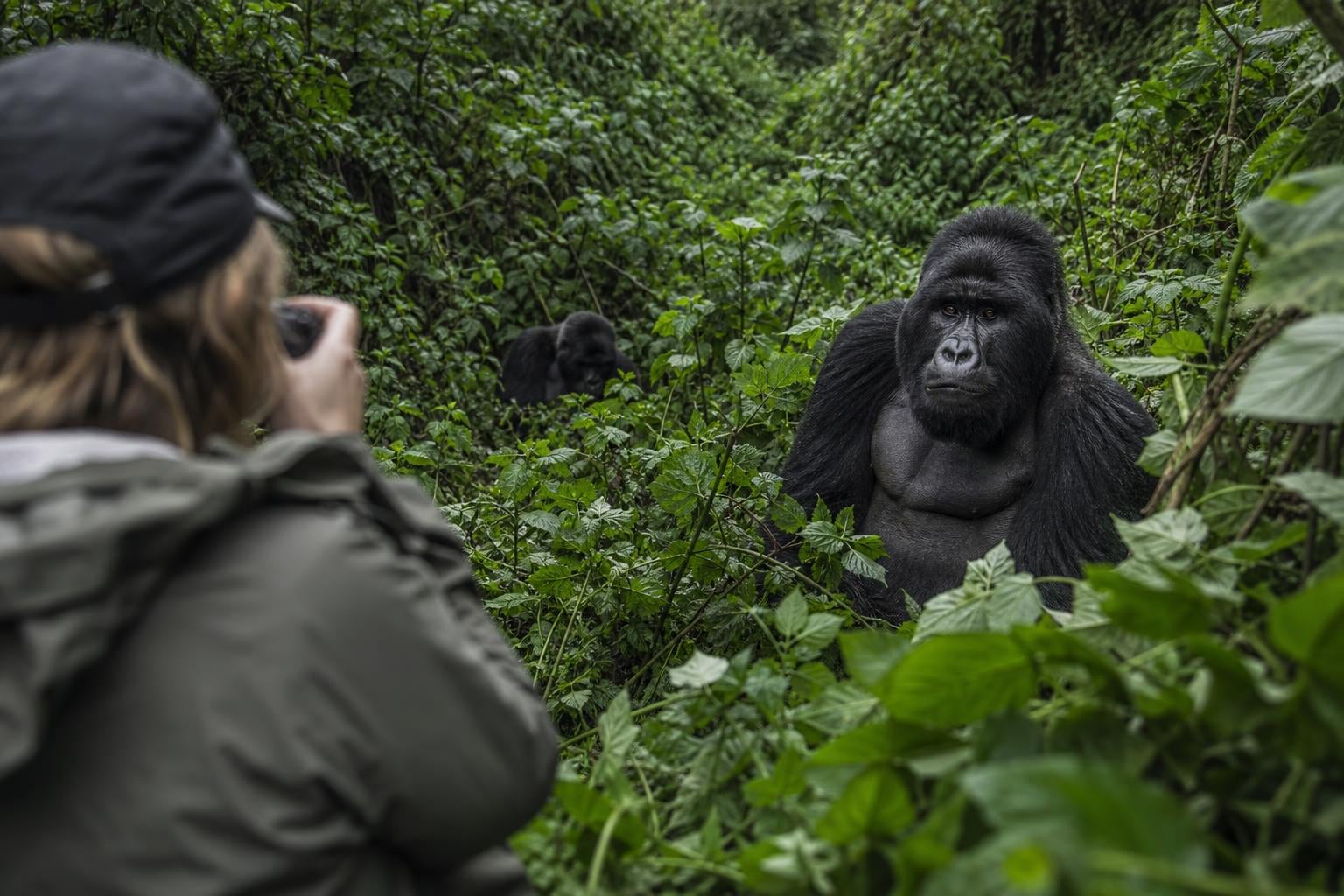
    Volcanoes National Park has 12 fully habituated gorilla families with eight permits issued per family per day, making 96 permits available daily. Visitors gather at park headquarters in Kinigi at 7:00 AM, get assigned a family group based partly on fitness level, and may hike from 30 minutes to four or more hours at altitudes between 2,500m and 4,000m. Source: Visit Rwanda.

    DRC (Virunga)

    DRC’s Virunga National Park was historically the cheapest mountain gorilla option, with permits often cited around $400. But SafariBookings notes the park closed to tourism in March 2020 and has not reopened due to security issues. Do not plan around DRC gorilla trekking unless official reopening and security conditions change.

    Country

    Park

    Foreign visitor permit

    Status

    Uganda

    Bwindi / Mgahinga

    $800

    Active; low-season discounts reported

    Rwanda

    Volcanoes National Park

    $1,500

    Active; 96 permits/day

    DRC

    Virunga

    ~$400 historical

    Closed until further notice

    Gorilla Trek Permit Prices by Nationality

    Visitor Category

    Uganda

    Rwanda

    Foreign Non-Resident

    $800

    $1,500

    Foreign Resident

    $700

    $500

    Rest of Africa

    $500

    —

    East African Citizen

    UGX 300,000

    $200 (eligible categories)

    What the Permit Includes (and What It Does Not)

    This is one of the biggest confusion points. Many travelers compare “$800 Uganda vs $1,500 Rwanda” and forget that neither permit covers getting to the park or sleeping near the trailhead.

    Usually included in the permit:

    • Park access for the trekking day

    • Ranger/guide support and trackers

    • Regulated access to one habituated gorilla family

    • Up to one hour of viewing time once gorillas are found

    • In Uganda, the tariff explicitly includes guide fee, park entrance for the day, and a community development contribution

    Not included in the permit:

    • International or domestic flights

    • Road transfers to the park

    • Accommodation

    • Meals outside a package

    • Porter

    • Tips for ranger, tracker, porter, and driver-guide

    • Visas

    • Travel insurance

    • Add-on activities (golden monkey trekking, chimpanzee tracking, etc.)

    Understanding these inclusions and exclusions matters because the cost of gorilla trekking extends well beyond the permit number you see quoted everywhere.

    What the Permit Does NOT Include

    Included

    Not Included

    Ranger Guide

    Flights

    Gorilla Tracking

    Hotels

    Park Entry

    Meals

    Conservation Fees

    Porter

    Community Contribution

    Tips

    One Hour Viewing

    Insurance

    Trackers

    Visa

    The Real Cost Drivers Beyond the Permit

    Country Choice

    Uganda lowers your permit cost. Rwanda lowers your logistical friction. These are not the same thing.

    Rwanda’s Volcanoes National Park sits about two hours from Kigali, making same-day or next-day trekking straightforward. Uganda’s Bwindi is harder to reach, requiring either a full day’s drive from Entebbe/Kampala, a domestic flight to a regional airstrip, or a cross-border shortcut from Kigali into southern Bwindi.

    Transport

    Transport is the cost variable people underestimate most. A private 4×4 with driver-guide from Entebbe to Bwindi can take 8 to 10 hours each way. Domestic charter flights cut the time but add several hundred dollars. The Kigali-to-southern-Bwindi route is a popular shortcut, but it introduces border crossings and visa considerations that add complexity.

    Should You Drive or Fly?

    Option

    Cost

    Time

    Best For

    Drive from Entebbe

    Lower

    8–10 hrs

    Budget travelers

    Domestic Flight

    Higher

    1–2 hrs

    Luxury & short itineraries

    Kigali to Bwindi

    Moderate

    3–4 hrs

    Time-conscious travelers

    Accommodation

    Lodge tier is the second-biggest swing after the permit. Horizon Guides gives typical per-person, per-night ranges for Uganda at roughly $50–$70 budget, $80–$120 mid-range, and $300–$3,000 luxury. Rwanda runs slightly higher overall, with a stronger concentration of high-end lodges near Volcanoes National Park.

    Group Size

    When two or four travelers share a private vehicle and driver-guide, the per-person transport cost drops substantially. Solo travelers absorb the full vehicle cost alone, which is one reason Rwanda can sometimes be cheaper for solo trips despite its higher permit price.

    Season

    Uganda’s low-season months (April, May, November) can reduce the permit cost by $200, bringing the Foreign Non-Resident rate to a reported $600. But the tradeoff is real: wetter trails, muddier conditions, and the Diary of a Muzungu notes that low-season permits cannot be rescheduled. If you are flexible, fit, and comfortable with rainier trekking conditions, these months offer the best-value Uganda windows, but only if you can commit to fixed dates.

    Uganda vs Rwanda: Which Is Better Value?
    Gorilla Trek Cost 2026: Permits, Prices & What’s Included

    This is the question almost every traveler asks, and the answer is not as simple as comparing permit prices.

    Choose Uganda if:

    • You want the lower permit price ($800 vs $1,500)

    • You are planning a longer East Africa safari that includes chimps, savanna wildlife, or multiple parks

    • You want the Gorilla Habituation Experience

    • You are traveling as a couple, family, or group and can share vehicle costs

    • You are flexible enough to travel during low-season discount months

    • You want more mid-range lodging options near the park

    Choose Rwanda if:

    • You have only one or two days for gorilla trekking

    • You are already in Kigali or arriving there

    • You are solo and want to avoid the cost of long private Uganda transfers

    • You want the simplest possible logistics

    • You prioritize luxury lodges and polished infrastructure

    • You are combining gorillas with other Rwanda parks

    For a full side-by-side breakdown, see Rwanda vs Uganda gorilla trekking.

    When the Cheaper Permit Is Not the Cheaper Trip

    On paper, Uganda saves a foreign traveler $700 on the permit alone. But TripAdvisor destination experts make a point that practitioners on forums consistently echo: the permit price is only one element. For a quick solo trip, Rwanda may be cheaper overall after logistics, while Uganda often makes more sense as part of a longer itinerary.

    Consider a solo traveler with two days in East Africa. In Rwanda, they fly into Kigali, transfer two hours to Volcanoes National Park, trek the next morning, and fly out the same evening. Total: permit plus one or two hotel nights, a short transfer, and meals. In Uganda, the same traveler needs a flight to Entebbe, a long drive or domestic flight to Bwindi, at least two extra nights, and a private vehicle. The $700 permit savings can vanish into transport and accommodation.

    The reverse is also true. A couple spending 10 days in Uganda, combining Bwindi with Queen Elizabeth National Park, Kibale Forest for chimps, and Lake Bunyonyi, will spread vehicle and guide costs across the full trip. The gorilla trekking cost becomes one line item in a longer, more cost-efficient itinerary.

    This is an important point that most gorilla trek cost guides skip over entirely.

    Hidden Costs to Budget For

    Porter ($10–$20 plus tip)

    Porters carry your daypack and physically help on steep, muddy, slippery sections. TripAdvisor users report porter costs around 50,000 UGX (about $13) in Uganda. Reddit travelers consistently emphasize that a porter does more than carry a bag: they help with balance on difficult terrain and provide direct local income. If you are debating one small add-on, choose the porter.

    Tips

    Tips are not included in the permit. Plan for tips to your porter, ranger/guide, trackers, and driver-guide if you are on a package. Read our guide on safari tipping etiquette for typical amounts.

    Travel Insurance

    Because permit refund rules are strict and gorilla trekking involves remote terrain, insurance is functionally mandatory. Rwanda’s RDB portal states there is no refund for late arrivals, flight delays, absence, or trip cancellation. Coverage for medical evacuation, trip interruption, and non-refundable permit costs is worth the premium. See gorilla trekking insurance for what to look for.

    Extra Night Near the Park

    Most itineraries require arriving the night before trekking to make the early morning briefing. This is not optional; it is a practical requirement that adds at least one hotel night to your budget.

    Gear

    Rain jacket, waterproof hiking boots, long pants, gardening gloves, and gaiters are standard recommendations. If you do not already own these, budget for them or plan to rent locally where available.

    Domestic Flights

    A charter or scheduled flight from Entebbe to an airstrip near Bwindi (like Kihihi or Kisoro) typically costs several hundred dollars per person. It saves a full day of driving each way but adds meaningfully to the total gorilla trekking cost.

    Habituation vs Standard Trekking

    Uganda’s Gorilla Habituation Experience lets visitors spend up to four hours with semi-habituated gorillas, compared to the standard one-hour viewing window. The habituation permit under UWA’s published tariff was $1,500 for Foreign Non-Residents, roughly matching Rwanda’s standard permit price.

    Fodor’s forum discussions reveal important nuance here. Some travelers find habituation compelling because it offers significantly more time for about the same price as a Rwanda standard permit. Others report that a standard trek with a fully habituated family can actually be more satisfying, because the gorillas are calmer, closer, and more predictable.

    Choose standard trekking for the classic experience, lower cost, and more sector flexibility. Choose habituation if your priority is extended time, a research-style experience, or gorilla photography. Avoid habituation if you expect a polished, easy, close-up encounter. Semi-habituated gorillas can be less predictable.

    For travelers who want better odds and more variety, booking two standard treks on consecutive days (two different gorilla families) is another option worth considering.

    Is Gorilla Trekking Worth the Cost?
    Gorilla Trek Cost 2026: Permits, Prices & What’s Included

    A high-signal Reddit thread asks directly whether Uganda gorilla trekking for roughly $900 is worth it. The responses are overwhelmingly positive, with many commenters describing it as a top travel experience. But several add important caveats: if you dislike hiking, group trekking, mud, or early mornings, the cost may not feel justified.

    Trek times vary widely. One Reddit user reported one trek took several hours while another day required only 20 minutes of walking, and they were actually disappointed it was not longer. This variability is part of the deal. You are visiting wild animals in their habitat, not buying a seat at a show.

    A better way to think about the price: you are not paying for one hour like a ticketed event. You are paying into a tightly controlled conservation system that allows a small number of people to visit wild gorillas without overwhelming them. Uganda’s tariff explicitly funds guide services, park entry, and community development. Rwanda channels 10% of permit revenue toward local communities for schools, health centers, roads, and farmer compensation when gorillas damage crops.

    The one-hour viewing window is only the final part of a regulated half-day or full-day experience. UWA says treks can last 2 to 7 hours in Uganda before you reach the gorillas.

    For a deeper look at this question, see our full guide on whether gorilla trekking is worth it.

    Booking and Risk Tips

    Reddit threads include cautionary stories about travelers trying to avoid “sketchy companies” and confusion around official Uganda permit purchasing. The anxiety is understandable: permits are expensive, non-refundable in many cases, and the booking process is not always intuitive.

    Here is a practical checklist:

    1. Secure the permit before final lodge booking. In Bwindi, the trekking sector affects where you should sleep. Booking the wrong lodge for the wrong Bwindi sector can add hours of rough driving.

    2. Ask for written permit confirmation with date, park, sector, and name details.

    3. Use official RDB/UWA channels or a vetted licensed operator. UWA has issued advisories on adherence to permit purchase guidelines.

    4. Avoid paying large sums to unverifiable WhatsApp-only operators. Use traceable payment methods.

    5. Budget for a porter. It is a small cost that improves both your experience and local livelihoods.

    6. Avoid tight flight connections after trekking. Trek length is unpredictable, and parks are remote.

    7. Do not trek sick. Rwanda’s rules state visitors may be denied access if they have a cold, flu, or contagious illness, with no refund.

    8. Buy travel insurance that covers non-refundable trip costs and medical evacuation.

    9. Confirm current rates at booking. Uganda’s tariff structure has been transitioning, and travelers booking for late 2026 or 2027 should verify directly with UWA or their operator.

    Planning Gorillas as Part of a Bigger Trip

    Gorilla trekking costs become more manageable when the trek is one component of a broader East Africa itinerary. Shared vehicle costs, combined logistics, and multi-stop routing spread the fixed expenses across more travel days and experiences.

    If you are combining Uganda or Rwanda gorilla trekking with a Tanzania safari, Kilimanjaro climb, Kenya extension, or Zanzibar beach stay, working with a single operator who can coordinate permits, border crossings, flights, lodges, and backup timing across multiple countries simplifies the process considerably.

    See Uganda gorilla trip options for trip types ranging from budget road treks to fly-in luxury itineraries, or explore how to fit multiple experiences into one East Africa trip.

    Frequently Asked Questions

    How much is a gorilla trekking permit?

    Uganda’s standard Foreign Non-Resident gorilla tracking permit is $800 under UWA’s published tariff. Rwanda’s foreign visitor permit is $1,500. Uganda has reported low-season discounts bringing the price to $600 for April, May, and November, but travelers should confirm current rates before booking.

    Is the permit the full gorilla trek cost?

    No. The permit covers the regulated trekking experience, but the total trip cost also includes transport, lodging, meals, tips, porter, visas, insurance, and optional add-ons. The permit is typically 40–65% of the total cost depending on lodge tier and transport choices.

    Is Uganda or Rwanda cheaper for gorilla trekking?

    Uganda is cheaper on permit price. But total gorilla trek costs depend on your itinerary. Rwanda can be more cost-efficient for a short solo trip because Volcanoes National Park is close to Kigali, while Uganda wins for longer trips, groups, and mid-range travelers combining gorillas with other wildlife areas.

    Why is gorilla trekking so expensive?

    Access is deliberately limited and conservation-managed. Rwanda allows only 96 visitors per day across 12 gorilla families. Uganda enforces similar group-size limits. The fees fund ranger guides, trackers, park operations, anti-poaching patrols, and community development programs.

    Can I trek gorillas in DRC for less?

    Not currently. Virunga National Park’s official site says gorilla treks are closed until further notice due to security issues. DRC is not a practical mountain gorilla option for mainstream travelers right now.

    Should I hire a porter?

    Yes. The cost is small (roughly $10–$20 plus tip), and porters help with bags and balance on steep, muddy trails. They also provide direct income to local communities near the parks.

    How long do I spend with the gorillas?

    The standard viewing time is one hour once the gorillas are found. But the trek to reach them can last 2 to 7 hours in Uganda, and 30 minutes to four or more hours in Rwanda, depending on where the gorilla family is that day.

    When is the cheapest time for gorilla trekking?

    Uganda’s reported low-season months (April, May, November) offer the lowest permit costs at $600 for Foreign Non-Residents. Trails are muddier, but crowds are thinner and lodge availability is often better. The tradeoff: these discounted permits reportedly cannot be rescheduled.
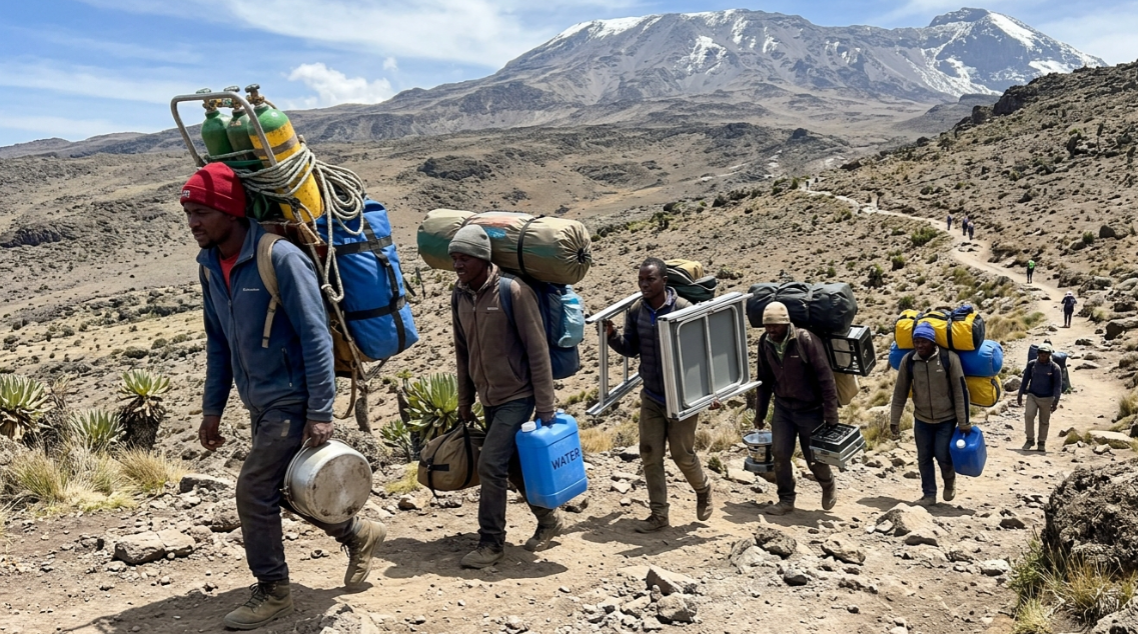
  • Kilimanjaro Porters: Glossary, Wages & Tipping (2026)

    Kilimanjaro Porters: Glossary, Wages & Tipping (2026)

    TL;DR

    Kilimanjaro porters are the local Tanzanian workers who carry gear, set up camps, and make summit attempts possible for more than 35,000 climbers each year. A typical climb requires 3 to 5 porters per climber, each carrying up to 20 kg of client gear under park regulations. Tipping runs $6 to $10 per porter per day, and choosing a KPAP partner operator is the single best way to ensure your crew is treated fairly.


    More than 35,000 people attempt to climb Kilimanjaro every year. Behind each of those climbers stands a team of porters, guides, and cooks, often outnumbering the trekkers four or five to one. This means the mountain supports a workforce of tens of thousands of porters cycling through each climbing season. Understanding who these people are, what they carry, what they earn, and how to treat them well is not optional knowledge for any serious trip planner.

    This glossary covers every term you will encounter about your Kilimanjaro mountain crew, from role definitions and weight regulations to tipping math and porter welfare organizations. If you are still choosing your best time to climb Kilimanjaro, bookmark this page and come back when you are ready to dig into crew logistics.

    Quick Answer: What Should You Know About Kilimanjaro Porters?

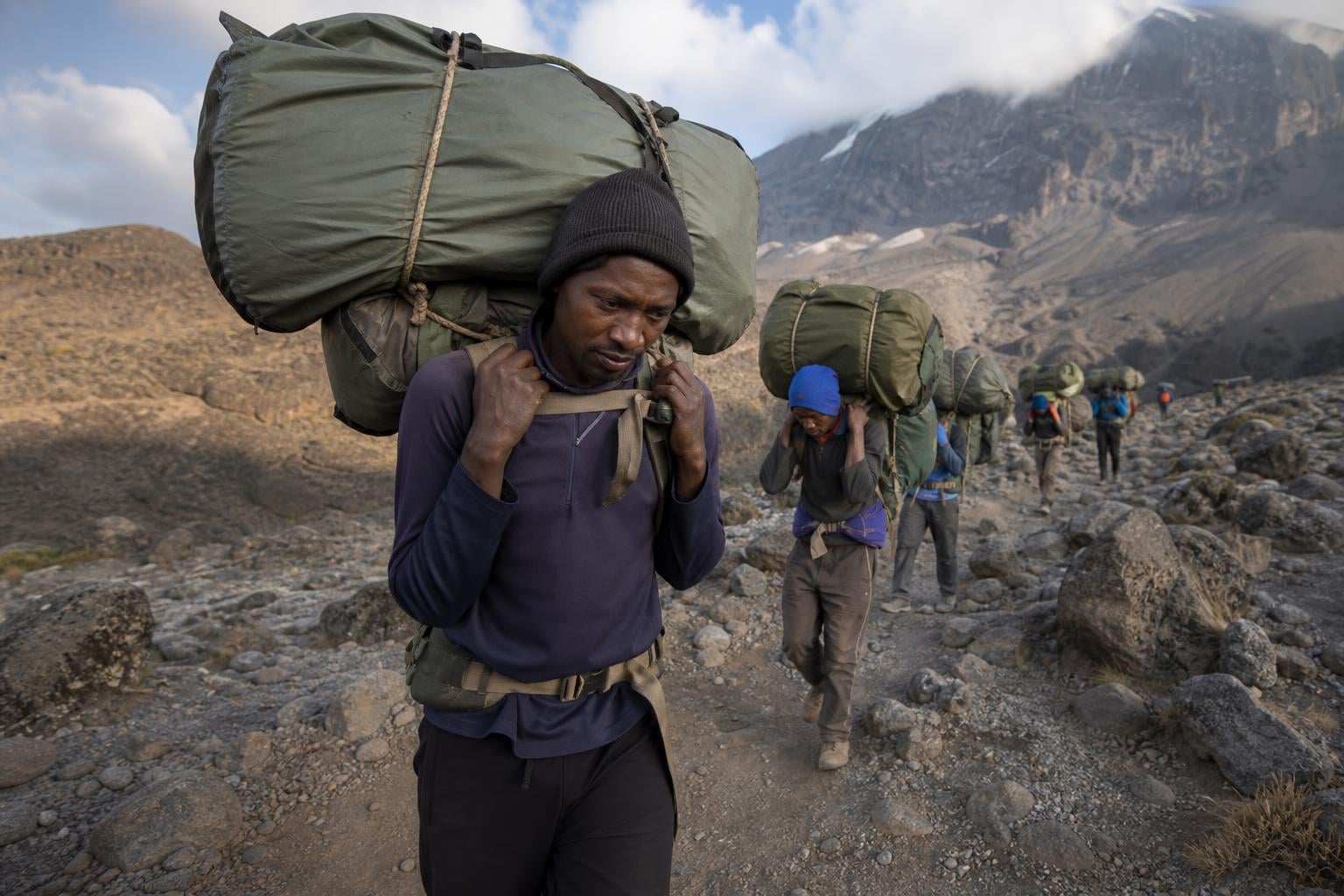
    If you’re climbing Mount Kilimanjaro, your porter team will carry your duffel bag, camping equipment, food, water, safety gear, and much of the shared expedition equipment. Most climbs require three to five porters per climber. Porters are legally limited to carrying 20 kg (44 lbs) of client gear, while recommended tips are $6–10 per porter per day. Choosing a KPAP-certified operator is the best way to ensure your crew receives fair wages, adequate food, proper equipment, and ethical working conditions.

    Key Takeaways

    • Expect 3–5 porters for every climber.

    • Porters carry far more than personal luggage.

    • The legal client load is 20 kg per porter.

    • Budget 10–15% of your trip cost for tips.

    • Always verify KPAP partnership before booking.

    • Cheap operators often cut porter wages.

    Why Kilimanjaro Needs So Many Porters

    Kilimanjaro Porters: Glossary, Wages & Tipping (2026)

    One of the biggest surprises for first-time climbers is the size of the mountain crew. Unlike many trekking destinations, Kilimanjaro requires support teams to transport nearly everything needed for several days at altitude.

    Porters typically carry:

    • Client duffel bags

    • Camping tents

    • Sleeping tents

    • Dining tent

    • Kitchen tent

    • Tables and chairs

    • Cooking equipment

    • Food supplies

    • Drinking water

    • Fuel

    • Oxygen cylinders

    • Medical kits

    • Portable toilets

    • Waste for removal

    Unlike pack animals, all supplies on Kilimanjaro are carried by people because animals are not permitted on most climbing routes.

    Typical Crew Size by Group

    Climbers

    Guides

    Cook

    Porters

    Total Crew

    1

    1

    1

    4–5

    6–7

    2

    1

    1

    6–7

    9–10

    4

    2

    1

    14–16

    17–19

    6

    2

    1

    20–24

    23–27

    10

    3

    2

    30–35

    35–40

    The Mountain Crew: Roles Defined

    The support team on a Kilimanjaro climb is collectively called the mountain crew. It includes everyone from the lead guide to the porter carrying your duffel bag. Most first-time climbers underestimate how many people are involved. A group of four climbers might have a mountain crew of around 21 people. A group of twelve could need 57.

    Here is who does what.

    Mountain Crew

    The umbrella term for your entire support team. This includes lead guides, assistant guides, cooks, and all categories of porters. When operators quote “crew size,” they mean this full headcount.

    Lead Guide

    The overall trek leader responsible for health, safety, route decisions, and pace management. There is one lead guide per group. Reputable operators staff this role with guides who have 15 or more years of mountain experience. Duma Explorer’s Kilimanjaro guides hold Wilderness First Responder (WFR) certification, and the company provides a 1:1 guide-to-climber ratio on summit day for maximum safety support.

    Assistant Guide

    Supports the lead guide by monitoring climber health, answering questions, and managing group logistics. The ratio is roughly one assistant guide for every two to three climbers on hut routes, and one for every four to five climbers on camping routes. On longer routes with more altitude gain, the assistant guide role becomes critical for spotting early symptoms of altitude sickness.

    Cook

    Prepares all meals: breakfast, lunch, dinner, and snacks. One cook per group is standard. The cook works closely with porters who help carry food supplies, purify water, and wash dishes. For a deeper look at what you will actually eat on the mountain, see this Kilimanjaro food guide.

    Porter (General)

    A Kilimanjaro porter is a local Tanzanian, typically between 18 and 40 years old, whose primary job is carrying equipment required for the climb. This includes not just your personal gear but also tents, sleeping bags, food supplies, oxygen bottles, medical kits, stretchers, hyperbaric chambers, portable toilets, and all garbage generated along the way. Porters also sanitize drinking and cooking water, help the cook with food preparation and service, and clean up afterward.

    Most Kilimanjaro porters are not employed permanently. They freelance for different companies climb by climb, and for many, this work is their primary income source.

    Summit Porter

    A specialized subset of Kilimanjaro porters who stay with the climbing group all the way to the peak, carrying safety and emergency equipment. While general porters travel ahead to set up the next camp, summit porters match the climbers’ pace through the final push, providing encouragement and carrying supplies through the coldest, windiest conditions near Uhuru Peak.

    Waiter Porter / Helper Porter

    Some porters pull double duty. A waiter porter carries loads like any other porter but also serves meals, sets the dining tent, and manages the eating area. These roles carry additional responsibilities beyond standard carrying duties and should receive additional tips accordingly.

    Toilet Porter

    Exactly what it sounds like. This porter is responsible for transporting, setting up, and servicing the portable toilet tent at each camp. It is not glamorous work, and it matters for hygiene at altitude. Practitioners on Reddit frequently mention that the toilet porter is the easiest crew member to forget when calculating tips, so make a point to include them.


    How Porters Work: Logistics Terms

    Porter-to-Climber Ratio

    The number of porters assigned per climber varies by route, trip length, group size, camping setup, and service level. Most sources cite a range of 3 to 5 porters per climber. A common standard is 4 porters per climber on camping routes. On the Marangu route, where climbers sleep in huts instead of tents, the ratio drops because there is less camping equipment to haul.

    Specific example: a climb for two people over seven days would typically require one lead guide, one assistant guide, one cook, and six to seven porters.

    For a breakdown of how routes affect crew size and summit outcomes, see Kilimanjaro success rates by route.

    Gate Weigh-In

    Before your trek begins, all porter loads are weighed at the park gate by Kilimanjaro National Park Authority (KINAPA) officials. This mandatory inspection verifies that no porter is carrying more than the regulated limit. Packs are checked again periodically during the journey. The gate weigh-in is your first real encounter with the park’s porter protection infrastructure, and a good operator welcomes it rather than trying to work around it.

    20 kg Weight Limit

    This is the single most confusing number in Kilimanjaro trip planning, because different sources cite different figures.

    Here is the real breakdown:

    • KINAPA/TANAPA regulation: Each porter may carry a maximum of 20 kg (44 lbs) of client gear.

    • Personal gear allowance: On top of the 20 kg client load, porters carry 5 to 10 kg of their own belongings (clothing, food, sleeping gear).

    • Female porter limit: Female porters are permitted to carry a maximum of 15 kg of client gear.

    • Voluntary operator limits: Some responsible operators cap client gear loads at 15 kg per porter as an extra safety margin. When you see “15 kg” cited online, this is usually the explanation.

    The problem is real. Unscrupulous employers routinely force porters to carry as much as 40 kg instead of the mandated 20 kg. This is one of the most common forms of porter exploitation.

    What Do Porters Actually Carry?

    Although climbers usually think porters only carry duffel bags, most loads consist of shared expedition equipment.

    Typical porter loads include:

    • Client luggage

    • Sleeping tents

    • Dining tents

    • Kitchen supplies

    • Food

    • Gas cylinders

    • Water

    • Tables

    • Chairs

    • Medical equipment

    • Portable toilets

    • Waste bags

    The exact load varies throughout the expedition because food weight decreases while waste must be carried off the mountain.

    Duffel Bag

    The standard container for gear that porters carry on your behalf. Most operators provide or require a specific type of duffel bag that can be sealed and weighed easily at gate check-ins. Packing efficiently is not just about your own comfort; it directly affects porter welfare. Check the East Africa packing list for practical guidance on keeping your load within limits.

    Total Luggage Weight Per Climber

    On average, it takes about 225 pounds (roughly 102 kg) of total luggage per trekker to get to Kilimanjaro’s peak and back. This figure includes all shared equipment: tents, cooking gear, food supplies, safety equipment, portable toilets, tables, chairs, and waste. It explains why even a two-person climb needs six or seven porters.

    Pole Pole

    Swahili for “slowly, slowly.” You will hear this phrase constantly from your guides, who use it to manage your pace and reduce altitude sickness risk. Here is the interesting contrast: porters do not go pole pole. After your tents are broken down and packed, a group of porters races ahead on the trail to secure the best campsite and finish setting up camp before trekkers arrive. They carry heavy loads at speed, often passing climbers on narrow trails. This mismatch between porter pace and climber pace is one reason porter fitness and proper load limits matter so much.

    Challenges Kilimanjaro Porters Face

    Although portering creates thousands of jobs, it is physically demanding work.

    Common challenges include:

    • Carrying heavy loads at high altitude

    • Freezing temperatures during summit pushes

    • Long walking days

    • Seasonal employment

    • Limited access to quality gear

    • Low wages from unethical operators

    • High competition for available work

    Choosing an ethical operator directly improves these conditions.

    Porter Welfare and Ethics Terms

    KPAP (Kilimanjaro Porters Assistance Project)

    Kilimanjaro Porters: Glossary, Wages & Tipping (2026)

    Established in 2003, KPAP is a legally registered project within a Tanzanian non-governmental organization. Its mission is to improve working conditions for porters by promoting socially responsible Kilimanjaro climbs. Through its monitoring programs, KPAP ensures that more than 7,000 porters each year receive fair wages and ethical treatment.

    KPAP has also provided free educational programs to over 16,000 mountain crew members, offering lessons in English, financial literacy, and HIV/AIDS prevention.

    Duma Explorer is a KPAP founding partner, a distinction that goes beyond standard partnership and reflects involvement in building the organization’s monitoring framework from the ground up.

    KPAP Partner vs Non-Partner Operators

    Feature

    KPAP Partner

    Non-Partner

    Weight Monitoring

    Yes

    Varies

    Wage Monitoring

    Yes

    Not guaranteed

    Tip Transparency

    Yes

    Varies

    Sleeping Conditions

    Audited

    Unknown

    Crew Meals

    Audited

    Varies

    Independent Inspections

    Yes

    No

    Partner for Responsible Travel Program

    KPAP’s formal monitoring system. After every climb, KPAP assesses the crew’s conditions and gives the operator a score based on wage payment, weight compliance, food provision, sleeping arrangements, and tipping transparency. To remain a partner, operators must maintain a score of 85% or higher for the entire season. Among partner companies, 95.2% of climbs had transparent tipping procedures, and porters slept in good quality tents with adequate space 97.4% of the time.

    KRTO (Kilimanjaro Responsible Trekking Organization)

    The parent NGO under which KPAP operates. KRTO is a registered non-governmental organization in Tanzania focused on sustainable trekking practices across the mountain.

    IMEC (International Mountain Explorers Connection)

    The nonprofit organization founded in 1996 to promote sustainable travel in the Himalayas. KPAP was created as an offshoot of IMEC, adapting lessons learned in the Himalayan porter welfare movement to Kilimanjaro’s specific context.

    TPA (Tanzania Porters Association) and KGA (Kilimanjaro Guides Association)

    Two organizations that set guidelines protecting porter welfare. The TPA focuses on porter rights and working conditions, while the KGA addresses guide standards and certification. Together, they create a regulatory layer beyond what the park authority enforces.

    KINAPA / TANAPA

    KINAPA (Kilimanjaro National Park Authority) manages Kilimanjaro National Park directly. TANAPA (Tanzania National Parks Authority) is the national-level body overseeing all Tanzanian national parks, including Kilimanjaro. TANAPA sets the 20 kg porter weight regulation, park entry fees, and permit requirements. You will see both acronyms on permits, gate signage, and official communications.

    Understanding Kilimanjaro weather by altitude zone helps explain why proper porter gear matters: temperatures on the mountain range from tropical heat at the base to well below freezing at the summit.

    Porter Lending Program

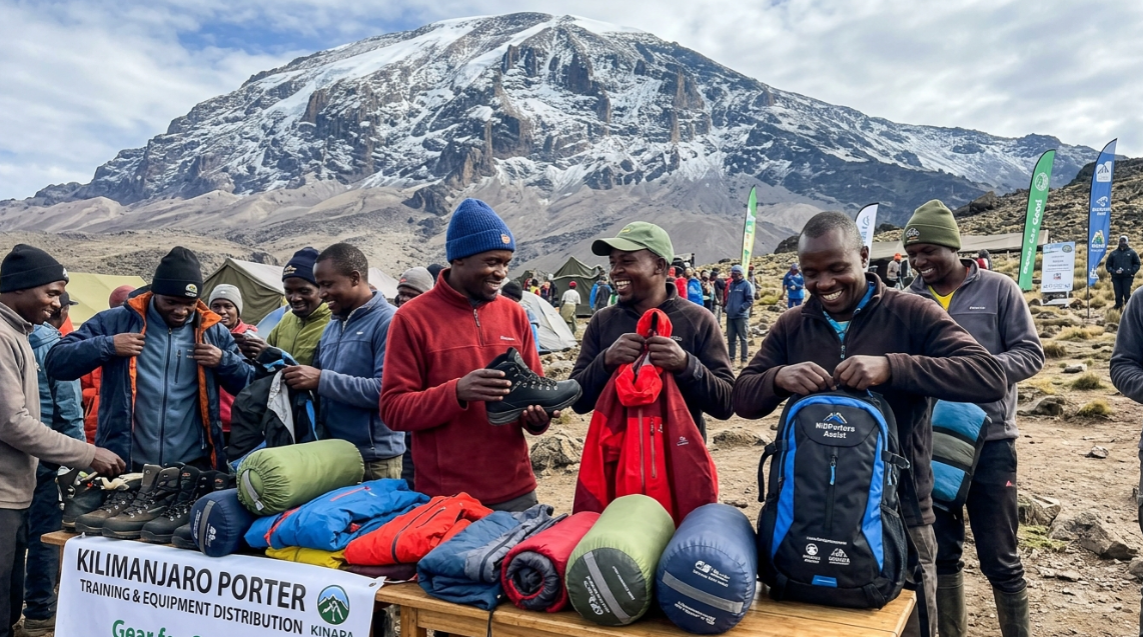
    A KPAP initiative that provides free gear and clothing to porters who cannot afford proper equipment. Without adequate jackets, boots, and sleeping bags, porters risk hypothermia and frostbite, especially on summit night when temperatures plummet. The lending program fills the gap for porters working with operators that do not supply crew gear.

    Kirunje

    A Swahili word meaning “shadow.” In the Kilimanjaro context, kirunje refers to a scam where operators or crew leaders add fictitious porters to the group headcount. These “shadow” porters do not exist, but their names appear on tip distribution lists, allowing someone in the chain to pocket the difference. This is one reason transparent tipping procedures (where each porter signs for their tips individually) matter. Only a handful of sources mention kirunje by name, but practitioners on climbing forums describe encountering it with budget operators.


    Tipping and Compensation Terms

    Porter Wage

    The Kilimanjaro National Park Authority mandates a minimum porter wage of 20,000 Tanzanian Shillings per day, roughly $8.50 at current exchange rates. This figure was agreed upon by porter unions in 2014, up from just 9,000 TZS previously. The increase was largely driven by KPAP advocacy.

    Context matters: many budget operators pay just half the minimum. If you book a climb that seems too cheap to be true, porter wages are almost always the first thing to suffer. For a broader understanding of what drives Kilimanjaro costs, the climb cost breakdown explains where your money actually goes.

    Porter Earnings Breakdown

    Income Source

    Typical Amount

    Daily Wage

    20,000 TZS minimum

    Tips

    $6–10/day

    Expedition Length

    6–8 days

    Total Earnings Per Climb

    varies by operator and tips

    Main Income Source

    Seasonal mountain work

    Tipping Ceremony

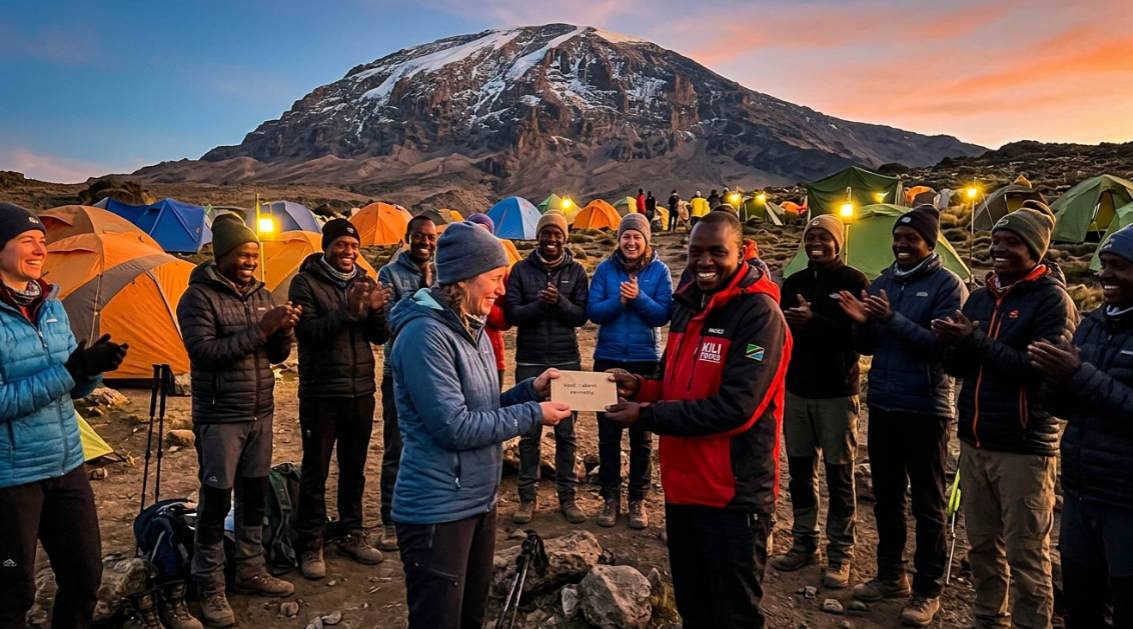
    The tipping ceremony marks the end of every Kilimanjaro climb. It is a tradition filled with singing and dancing, where the climbing group formally thanks the mountain crew and distributes tips. For many first-time climbers, this is an unexpectedly emotional moment. It is also practical: the ceremony creates a public, transparent setting for tip distribution, reducing the chance of tips being intercepted by middlemen. For broader context on tipping practices across East Africa, see this safari tipping guide.

    Per-Group vs. Per-Person Tip

    This is the number-one source of tipping confusion. Some operators quote tipping guidelines as a total per-group amount, others as per-person amounts. Always clarify which one your operator means. The standard practice is to calculate tips per climber, then pool the total for distribution across the crew.

    Tip Distribution Form

    A document used by ethical operators where each crew member signs individually upon receiving their tip. This paper trail prevents kirunje schemes and ensures every porter gets what they are owed. Ask your operator before the trek whether they use distribution forms.

    Tipping Quick Reference

    Here are the KPAP-recommended daily tipping amounts per climber:

    Role

    Tip Per Day (USD)

    Lead guide

    $20 to $25

    Assistant guide

    $12 to $20

    Cook

    $12 to $15

    Porter

    $6 to $10

    Budget rule: Plan to set aside 10 to 15% of your total trip cost for tips.

    Cash only. Credit cards are not accepted for tipping anywhere on the mountain. Bring enough cash in small USD denominations before your trek begins. Tanzanian shillings are also accepted, but USD is standard for tips.

    Practical math for a 7-day climb with 2 climbers:

    Assuming 1 lead guide ($20/day), 1 assistant guide ($15/day), 1 cook ($12/day), and 7 porters ($8/day each):

    • Lead guide: $20 x 7 = $140

    • Assistant guide: $15 x 7 = $105

    • Cook: $12 x 7 = $84

    • 7 porters: $8 x 7 x 7 = $392

    • Total: ~$721, split between two climbers = ~$360 per person

    This is a mid-range estimate. Adjust up or down based on service quality and group size.


    Choosing an Ethical Operator: What to Look For

    Being a Kilimanjaro porter is one of few job options available to many young Tanzanians who lack higher education or specialized training. But there are thousands of would-be porters and relatively few jobs, which makes it easy for companies to exploit them. Porters working for disreputable companies often have ragged clothes and worn-out shoes, do not receive enough food or proper shelter, and in extreme cases, risk death from hypothermia on cold nights.

    The best thing any climber can do is choose an operator that treats porters well. Price is the clearest signal. If a climb package seems impossibly cheap, the savings are coming from somewhere, and that somewhere is almost always crew welfare. See this guide on common safari booking mistakes for more on how bargain pricing creates hidden costs.

    Five Questions to Ask Any Operator About Porter Treatment

    1. Are you a KPAP partner? Verify their status directly on the KPAP website. Ask whether they are a standard partner or a founding partner, which indicates longer commitment to the program.

    2. What is your porter weight limit? The answer should be 20 kg maximum for client gear, with periodic checks during the trek. Better operators voluntarily limit loads to 15 kg.

    3. How many meals do porters receive per day? The standard is three full meals. Some budget operators cut this to two or provide inadequate portions.

    4. Do porters receive proper sleeping gear? KPAP partner companies provide good quality tents and adequate sleeping space 97.4% of the time. Non-partners often leave porters to fend for themselves.

    5. How are tips distributed? Look for operators who use individual tip distribution forms signed by each crew member. Transparent tipping should be the norm, not the exception.


    Key Numbers at a Glance

    Metric

    Figure

    Annual Kilimanjaro climbers

    35,000+

    Porters per climber

    3 to 5

    Client gear weight limit (KINAPA)

    20 kg (44 lbs)

    Female porter weight limit

    15 kg

    Total luggage per climber

    ~225 lbs (102 kg)

    Minimum porter daily wage

    20,000 TZS (~$8.50)

    Recommended porter tip/day

    $6 to $10

    Tip budget as % of trip cost

    10 to 15%

    KPAP partner score threshold

    85%+

    Crew members educated by KPAP

    16,000+

    Planning your climb and want to ensure your mountain crew is treated right from the start? Explore Kilimanjaro route options and costs to find the right fit for your trip.


    Frequently Asked Questions

    How many porters will I have on a Kilimanjaro climb?

    Most climbs require 3 to 5 porters per climber, depending on the route, number of days, and whether you are on a camping or hut route. A two-person, seven-day climb typically includes about 6 to 7 porters plus a lead guide, assistant guide, and cook.

    How much should I tip my Kilimanjaro porters?

    KPAP recommends $6 to $10 per porter per day. Tips must be in cash (USD or Tanzanian shillings). Budget 10 to 15% of your total trip cost for tipping the entire mountain crew.

    What is the weight limit for Kilimanjaro porters?

    KINAPA regulations cap client gear at 20 kg (44 lbs) per porter, with an additional 5 to 10 kg for the porter’s personal belongings. Female porters carry a maximum of 15 kg of client gear. Some operators voluntarily set lower limits for porter safety.

    What is KPAP and why does it matter?

    The Kilimanjaro Porters Assistance Project is a Tanzanian NGO established in 2003 that monitors operator compliance with fair wage, weight, food, and shelter standards for porters. Climbing with a KPAP partner operator is the most reliable way to ensure your crew is treated ethically.

    What is kirunje?

    Kirunje is Swahili for “shadow” and refers to the practice of adding fictitious porters to a crew list to siphon off tip money. Transparent tipping procedures with individual sign-off forms prevent this scheme.

    Do Kilimanjaro porters get paid enough to live on?

    The mandated minimum is 20,000 TZS per day (about $8.50), which is meaningful income in rural Tanzania when combined with tips of $6 to $10 per day. However, many budget operators pay well below the minimum. Choosing a KPAP partner operator is the single most effective way to ensure fair wages reach your crew.

    Can I donate gear to my porters?

    Yes, and many climbers do. Donate directly to individual porters rather than through guides or operators, which ensures items reach the intended person. Warm jackets, boots in good condition, and sleeping bags are the most needed items.

    How do I verify that an operator treats porters ethically?

    Check the operator’s KPAP partner status on the official KPAP website. Ask about weight limits, meals provided, sleeping arrangements, and tipping transparency before booking. Avoid operators whose pricing is significantly below market rates, as crew welfare is typically what gets cut first.

  • Kilimanjaro Tipping Guide 2026: How Much, When & How

    Kilimanjaro Tipping Guide 2026: How Much, When & How

    TL;DR

    Budget roughly $20/day for your lead guide, $12/day for assistant guides and cooks, and $6/day per porter, all per group, not per person. For a 7-day trek with two climbers, expect a total tip of about $1,000 ($500 each). Bring crisp US dollar bills dated 2009 or newer, and tip each crew member individually during the tipping ceremony on your final night on the mountain. Solo climbers pay more per person because the crew-to-climber ratio is higher.


    Tipping on Kilimanjaro is not optional in any practical sense. It is deeply expected, and for many crew members, tips represent the largest portion of their income. Yet the whole subject generates enormous confusion. Practitioners on Reddit’s r/Kilimanjaro forum regularly post conflicting numbers, misunderstand whether rates are per person or per group, and worry about the social dynamics of handing out cash at altitude after an exhausting summit push.

    This guide cuts through that confusion. It covers every role, every rate, every term you need to know, and the exact cash preparation steps that will save you stress on the mountain.

    Planning a Kilimanjaro climb? See how route choice affects success and crew size before budgeting your tips.

    Direct Answer

    If you’re climbing Kilimanjaro, budget around 10–15% of your trek cost for tips. Current KPAP recommendations are approximately $20–25 per day for the lead guide, $10–15 for assistant guides and cooks, $5–10 per porter, and $7–12 for specialty porters, with all amounts calculated per group rather than per climber. For most 7-day climbs, expect to budget roughly $450–550 per person in a two-person group, while solo climbers typically pay more because they require nearly the same support crew.

    Key Takeaways

    – Tips are expected on every Kilimanjaro climb.

    – Rates are per group, not per climber.

    – Bring clean US dollars printed in 2009 or later.

    – Tip crew members individually.

    – Budget about 10–15% of your total trip price.

    – KPAP-certified operators follow transparent tipping practices.

    Quick-Answer Kilimanjaro Tipping Table

    These daily rates align with recommendations from the Kilimanjaro Porters Assistance Project (KPAP), the independent organization that sets fair-treatment standards for mountain crews.

    Crew Role

    Daily Tip (Per Group)

    Lead Guide

    $20–$25

    Assistant Guide

    $10–$15

    Cook

    $10–$15

    Porter

    $5–$10

    Specialty Porter (waiter, toilet porter, summit porter)

    $7–$12

    The single most important thing to understand: these amounts are per group of climbers, not per climber. This distinction trips up almost everyone. If you’re climbing as a pair and your lead guide’s recommended tip is $20/day, you and your partner split that $20 between you, each contributing $10/day.

    A reasonable rule of thumb is to budget 10–15% of your total trek cost for Kilimanjaro tipping.

    If you’re also adding a safari to your trip, tipping norms differ. The Tanzania safari tipping guide covers those separately.

    Kilimanjaro Tipping Calculator (Quick Estimate)

    Many travelers simply want to know approximately how much cash they should bring. Use this quick guide before reading the detailed explanations.

    Group Size

    Trek Length

    Suggested Cash to Bring

    Solo

    6 days

    $350–450

    2 people

    7 days

    $900–1,100 total

    4 people

    7 days

    $1,250–1,500 total

    6+ people

    7–8 days

    $1,700–2,300 total

    Always bring around 10–15% extra in small bills in case your final crew is larger than expected.

    Kilimanjaro Tipping Guide 2026: How Much, When & How

    Total Per-Climber Budget by Group Size

    The number of people in your group changes your per-person tipping cost dramatically, because crew sizes don’t scale down proportionally.

    Scenario

    Trek Length

    Typical Crew Size

    Estimated Total Tips

    Per-Climber Cost

    Solo climber

    6 days

    1 guide, 1 assistant, 1 cook, 4 porters

    $330–$420

    $330–$420

    Pair

    7 days

    1 guide, 1 assistant, 1 cook, 6–7 porters

    $900–$1,100

    $450–$550

    Group of 4

    7 days

    1 guide, 2 assistants, 1 cook, 10–12 porters

    $1,200–$1,500

    $300–$375

    Group of 8

    7 days

    1 guide, 3–4 assistants, 1–2 cooks, 18–22 porters

    $2,000–$2,500

    $250–$315

    Solo climbers always pay the most per person. The crew-to-climber ratio is highest when you climb alone, since you still need a guide, cook, and several porters regardless. Understanding these private vs. group cost dynamics helps you budget realistically.


    How Total Tips Change by Route

    Different routes mean different trek lengths, and longer treks mean more days of tipping. Crew sizes also vary slightly based on the route’s logistical demands.

    Route

    Typical Days

    Typical Crew (for 2 climbers)

    Estimated Total Group Tip

    Marangu

    5–6

    1 guide, 1 assistant, 1 cook, 5–6 porters

    $650–$850

    Machame

    6–7

    1 guide, 1 assistant, 1 cook, 6–7 porters

    $850–$1,100

    Lemosho

    7–8

    1 guide, 1 assistant, 1 cook, 7–8 porters

    $1,000–$1,250

    Northern Circuit

    8–9

    1 guide, 1–2 assistants, 1 cook, 7–8 porters

    $1,100–$1,400

    The Northern Circuit, being the longest route, carries the highest tipping total. But it also has the highest success rates, so many climbers find the extra cost worthwhile.


    Glossary of Key Kilimanjaro Tipping Terms

    Assistant Guide

    The second-in-command on your climb. Assistant guides walk with slower climbers, help manage gear logistics, and provide backup safety coverage. Operators typically assign one assistant guide per every two climbers. Recommended tip: $10–$15 per day (per group).

    On summit night, having strong assistant guides matters enormously. Look for operators whose guides hold Wilderness First Responder certifications to ensure qualified support at high altitude.

    Cook (Mountain Cook)

    The person responsible for preparing all meals at camp, often producing surprisingly elaborate food under tough conditions at altitude. A good cook transforms your climb experience. Recommended tip: $10–$15 per day (per group).

    To get a sense of what mountain cooks actually prepare, the Kilimanjaro food guide breaks down typical menus from day one through summit day.

    Crew Manifest

    A document listing every crew member assigned to your climb by name and role. The manifest is your primary protection against kirunje (see below). Before the tipping ceremony, a reputable operator will share the manifest so you can verify that everyone present actually worked on your expedition.

    Helping Porter

    An informal term for any porter who takes on duties beyond carrying loads. This includes waiter porters, toilet porters, camp crew, and summit porters. Because they perform extra work, they should receive higher tips than standard porters. An additional $1–$3 per day above the base porter rate is appropriate.

    Kilimanjaro Porters Assistance Project (KPAP)

    The independent nonprofit that monitors porter treatment on Kilimanjaro. KPAP partner companies must meet strict standards: minimum daily wages (20,000 TZS for porters, 30,000 TZS for assistant guides and cooks, 40,000 TZS for lead guides), transparent tipping procedures, proper clothing and shelter, and load limits of 20 kg per porter.

    Partners must score at least 85% on KPAP’s Guidelines for Proper Porter Treatment Scorecard and are monitored every season. About 70% of Kilimanjaro expeditions don’t comply with KPAP standards, which makes choosing a certified partner one of the most impactful decisions you can make as a climber.

    Kirunje

    A Swahili term for the practice of unauthorized porters showing up at the tipping ceremony who did not actually work on your climb. They appear hoping to collect a share of the tips. This is one of the least discussed but most important Kilimanjaro tipping problems.

    Ethical operators prevent kirunje by maintaining crew manifests and requiring each crew member to sign a tip distribution report after receiving their share. If your operator cannot produce a manifest before the ceremony, that is a red flag.

    Lead Guide (Chief Guide)

    Your primary guide and expedition leader. The lead guide manages route decisions, monitors climbers for altitude sickness symptoms, coordinates with park rangers, and leads the summit push. On summit night, the lead guide typically walks with the main group and makes the critical call on whether to continue or turn back.

    Recommended tip: $20–$25 per day (per group). The lead guide receives the highest tip because they carry the greatest responsibility.

    Porter

    The backbone of every Kilimanjaro expedition. Porters carry food, camping equipment, personal bags, and everything else needed for days on the mountain. They hike ahead of climbers to set up camp, then break it down and carry it to the next site. A typical expedition uses three to four porters per climber.

    KPAP limits each porter’s load to 20 kg (about 44 lbs). Recommended tip: $5–$10 per day per porter (per group).

    Summit Porter

    A specialty porter who carries supplemental oxygen, medical supplies, or emergency equipment on summit night. This is physically demanding work at extreme altitude, done in darkness and bitter cold. Tip a summit porter at the higher end of the porter range, or add $2–$3 per day above the base porter rate.

    Tip Distribution Report

    A signed document confirming that each crew member received their individual share of the tips. After the tipping ceremony, every crew member signs this report. Responsible operators review these reports after every climb to verify fair distribution.

    This safeguard exists because of a real and documented problem: when tips are given as a lump sum to the lead guide, the money does not always reach every crew member. Practitioners on Reddit and Tripadvisor consistently warn against handing all tips to one person.

    Tipping Ceremony

    The formal event, usually held on the last evening on the mountain (after the summit attempt), where climbers present tips to each crew member. The ceremony typically involves the crew gathering together, singing, and clapping before each person steps forward.

    One travel blogger described the experience honestly: “The first time you see it, it can feel a bit awkward. Everyone stands around, you’re tired, and then the crew starts clapping and singing. But this moment means a lot to them.” That awkwardness is normal. The crew has spent days carrying your gear, cooking your food, and keeping you safe. The ceremony is their moment of recognition.

    Toilet Porter

    A porter specifically assigned to manage the portable toilet at camp, carrying it between sites, setting it up, and maintaining sanitation. This is one of the least glamorous jobs on the mountain and deserves recognition through a higher tip.

    Waiter Porter

    A porter who doubles as the camp server, setting up the dining tent, serving meals, and cleaning up afterward. Like other specialty roles, waiter porters should receive tips above the base porter rate.


    Why Tips Matter: Porter Wages in Context

    Understanding crew wages makes the importance of Kilimanjaro tipping impossible to ignore.

    As of 2024, KPAP partner companies pay porters a minimum of 20,000 Tanzanian Shillings per day, roughly $8.70. The Mount Kilimanjaro Porters Society negotiated increases effective January 2025, raising minimum daily wages to approximately $15 for porters. These are the rates at certified, ethical companies.

    Non-certified operators often pay far less. One self-identified porter shared on a Tripadvisor forum that “many companies pay porter salary of 10,000 TZS per day, equivalent to less than $4… porters depend on tip.”

    For many crew members, tips genuinely double or triple their take-home pay for a climb. This is why the tipping norms exist, and why following them matters.

    Why Does Kilimanjaro Require So Many Crew Members?

    One of the biggest surprises for first-time climbers is the size of the expedition team. Unlike many trekking destinations, Kilimanjaro climbs are fully supported expeditions.

    A typical climb includes:

    • Lead guide

    • Assistant guide(s)

    • Mountain cook

    • Camp crew

    • Waiter porter

    • Toilet porter (optional)

    • Equipment porters

    • Summit porter (sometimes)

    Several factors influence crew size:

    • Route length

    • Number of climbers

    • Camping versus hut routes

    • Total food and equipment

    • Safety requirements

    • National park regulations

    Because every expedition relies on a large support team, tipping represents an important part of responsible travel on Kilimanjaro.

    Does Route Choice Affect Tipping?

    Yes.

    Longer routes generally require:

    • More climbing days

    • More food

    • More fuel

    • Additional porter loads

    • Sometimes additional guides

    That increases the overall tip pool even though the daily recommended tip rates remain the same.

    Route

    Tipping Cost

    Marangu

    Lowest

    Machame

    Moderate

    Rongai

    Moderate

    Lemosho

    Higher

    Northern Circuit

    Highest

    Currency and Cash Preparation

    Getting cash wrong is one of the most common Kilimanjaro tipping mistakes. You cannot fix a currency problem once you’re on the mountain.

    US Dollar Requirements

    • Bills must be dated 2009 or later. Banks and recipients in Tanzania routinely reject older bills.

    • Bills must be crisp and undamaged. No tears, no ink marks, no heavy folds.

    • Tips can also be given in Euros, Swiss Francs, or Tanzanian Shillings, but US Dollars are the most universally accepted and preferred.

    Denomination Strategy

    Bring a mix of small and large bills:

    • $1, $5, and $10 bills work best for tipping individual crew members. You will need many of these.

    • $50 and $100 bills get better exchange rates if crew members convert to shillings, so including some larger denominations is thoughtful.

    • Plan your total, then add 10–15% extra for unexpected situations (an extra porter, a particularly helpful crew member, small purchases in Moshi or Arusha).

    Where to Get Cash

    Order new bills from your bank at least two weeks before departure. Airport exchange counters rarely stock the crisp, post-2009 bills you need. ATMs in Arusha and Moshi dispense Tanzanian Shillings, not dollars, so do not count on withdrawing tip money in Tanzania.

    For a full breakdown of what else to budget beyond tips, the Tanzania safari cost guide covers park fees, accommodations, and other expenses that shape your total trip spend.

    Kilimanjaro Tipping Guide 2026: How Much, When & How

    How Tipping Works on the Mountain

    The Timeline

    1. Pre-trek briefing: Your operator should provide a crew manifest listing every person assigned to your climb, along with their role.

    2. During the climb: Pay attention to who is working on your expedition. Note standout performers.

    3. After summit day: The tipping ceremony takes place on the last evening, usually at the final camp before descending to the gate.

    4. The ceremony itself: Crew members gather, often singing and clapping. You present tips individually, with each person stepping forward.

    5. Distribution report: Each crew member signs a document confirming receipt of their tip amount.

    The Envelope Method

    The most practical approach is to prepare individual envelopes before the ceremony. Label each one with the crew member’s name and role using the manifest. This keeps the ceremony organized and ensures every person receives their intended amount.

    KPAP strongly recommends tipping each crew member directly. Do not hand a lump sum to the lead guide for distribution. Multiple sources, from travel forums to operator blogs, report cases where guides kept a disproportionate share when given control of all tip money.

    The Emotional Reality

    Climbing Kilimanjaro is physically exhausting. By the time you reach the tipping ceremony, you have just completed (or attempted) a summit push that likely started around midnight, followed by a long descent. You are tired, possibly emotional, and standing in front of a group of people who made the whole thing possible.

    The singing, the clapping, the formality of it can feel overwhelming or awkward if you’re not prepared. That is completely normal. Experienced climbers on forums and YouTube walkthroughs consistently say the same thing: it feels strange for about thirty seconds, then it becomes one of the most meaningful moments of the entire trip.


    The “40% of Trek Cost” Problem

    A recurring anxiety on social media involves climbers whose operators quoted tipping expectations amounting to 30–40% of the trek price. One Facebook post that ranked in Google’s top results described a $510 tip demand on a budget trek, which sparked dozens of alarmed responses.

    Here is the context that post was missing: budget operators often set artificially low trek prices and then compensate by pressuring climbers to tip enormous amounts. The operator looks cheap on paper, but the real cost (trek price plus expected tips) is comparable to or higher than a reputable operator that pays fair wages from the start.

    When an operator pays KPAP-compliant wages, the tipping expectations remain reasonable, typically 10–15% of the total trek cost. When an operator pays porters $4/day and expects climbers to make up the difference, tipping can balloon to uncomfortable levels. This is one of many costly booking mistakes that travelers make when choosing the cheapest option.


    Gear Donations as Supplementary Tips

    Beyond cash, consider donating clothing and equipment to your crew. Mountain staff climb Kilimanjaro dozens of times per year and go through gear quickly. Warm jackets, fleece layers, gloves, hiking boots, and thermal underwear are all valuable.

    Two important rules for gear donations:

    1. Give directly to the intended person. Do not hand a pile of gear to the lead guide and assume it will be distributed fairly. The same transparency concerns that apply to cash tips apply here.

    2. Don’t substitute donations for tips. Gear is a welcome supplement, not a replacement. Your crew needs cash to pay rent, school fees, and daily expenses that a fleece jacket cannot cover.


    Common Mistakes

    Confusing “per group” with “per person.” This is the most widespread error. Forum threads on Reddit are full of climbers who budgeted $20/day per person for their lead guide instead of $20/day for the whole group. Read the KPAP guidelines carefully and do the math before you leave home.

    Handing a lump sum to the lead guide. It is faster and less awkward, which is exactly why people do it. But it removes transparency. Always tip individually.

    Bringing old or damaged bills. A $20 bill from 2006, no matter how crisp, will be rejected. This catches American travelers off guard more than anyone because US dollars “look the same” across decades. Check the date on every single bill.

    Tipping less because you didn’t summit. Whether you reach Uhuru Peak or turn back at Stella Point, the crew provided the same service. Tip for the quality of care you received, not for the outcome of the climb.

    Not accounting for specialty porters. Your total crew may include a waiter, a toilet porter, and a summit porter who all deserve slightly higher tips than base porters. If you budget only for generic “porter” rates, you will come up short.

    Biggest Myth About Kilimanjaro Tipping

    The biggest misconception is that operators are “asking for too much.”

    In reality, there are two very different situations:

    Ethical operators

    • Pay fair wages

    • Use KPAP standards

    • Tips reward excellent service

    Budget operators

    • Advertise unusually cheap climbs

    • Pay lower wages

    • Depend on climbers to make up the difference through larger tips

    Looking only at trek price can therefore be misleading. Always compare the total expected trip cost rather than the advertised package price.

    How Much Cash Should You Bring to Tanzania?

    Many travelers underestimate how much physical cash they need.

    Besides tips, you’ll likely use cash for:

    • Airport snacks

    • Drinks

    • Souvenirs

    • Hotel gratuities

    • Safari tipping

    • Visa fees (where applicable)

    • Emergency expenses

    A good rule is to carry your expected tip amount plus another $150–300 in small bills for incidental expenses.

    Frequently Asked Questions

    Is Kilimanjaro tipping mandatory?

    Tipping is not legally required, but it is a deeply entrenched custom and a critical part of crew compensation. Choosing not to tip would be a serious breach of mountain etiquette and would directly harm people who depend on that income.

    How do I find out my exact crew size before the climb?

    A responsible operator will provide a crew manifest during your pre-trek briefing. If your operator cannot or will not share this, ask directly. You need the number to calculate your total Kilimanjaro tipping budget.

    Can I tip in Tanzanian Shillings instead of US Dollars?

    Yes. Crew members accept Tanzanian Shillings, Euros, and Swiss Francs in addition to US Dollars. However, dollars are the most commonly expected currency and simplify the math since all published guidelines use dollar figures.

    What if I’m climbing during peak season? Should I tip more?

    Peak season (June through October and late December through February) does not change the standard tipping rates. However, during the best months to climb Kilimanjaro, crews work more frequently and may appreciate the recognition of particularly strong service with a modest bump above the minimum.

    Do tips differ between routes like Lemosho and Marangu?

    The daily per-role rates stay the same. What changes is the number of tipping days (Marangu is typically 5–6 days, Lemosho is 7–8) and sometimes the crew size. See the route-specific table above for estimated totals.

    What happens if extra people show up at the tipping ceremony?

    This is kirunje, the practice of unauthorized porters appearing to claim a share of tips. Use the crew manifest to verify who should be present. If you notice unfamiliar faces, raise the issue with your lead guide before distributing tips.

    Should I combine my Kilimanjaro and safari tips into one budget?

    No. Mountain tipping and safari tipping follow different conventions with different crew roles and rates. Budget them separately. For safari-specific guidance, the Africa-wide tipping etiquette guide covers drivers, lodge staff, and other roles.

    I’m still in the training phase. Is it too early to think about tipping?

    It is never too early to understand the financial picture. Knowing your tipping budget helps you choose the right route and group size. If you’re still building fitness, the Kilimanjaro training glossary covers the physical preparation side.


    Kilimanjaro tipping is not complicated once you understand the structure. Know your crew, know your rates, bring the right cash, and tip each person directly. The people who carry your gear, cook your food, and guide you to the roof of Africa deserve fair compensation, and now you know exactly how to provide it.

    Ready to start planning your climb with a KPAP founding partner? Compare routes, crew standards, and Kilimanjaro climb costs to find the right fit.

  • Kilimanjaro Safety Guide (2026): Every Term You Need

    Kilimanjaro Safety Guide (2026): Every Term You Need

    TL;DR

    Climbing Kilimanjaro carries a mortality rate of roughly 0.03%, making it statistically safe when proper protocols are followed. The biggest danger is altitude sickness, which affects over 75% of climbers to some degree. Your single most important safety decision is choosing an operator with Wilderness First Responder (WFR)- certified guides, proper health-monitoring equipment, and ethical porter practices. This glossary covers every safety term you’ll encounter during your research.

    Is Kilimanjaro Safe? (Quick Answer)

    Yes. Kilimanjaro is considered one of the safest high-altitude mountains when climbed with a reputable operator. The overall mortality rate is about 0.03%, but more than 75% of climbers experience mild altitude sickness. The biggest safety factors are choosing a longer itinerary (7–9 days), climbing with Wilderness First Responder (WFR) certified guides, monitoring oxygen levels twice daily, and descending immediately if serious altitude illness develops.

    In short:

    – Most climbers finish safely.

    – Altitude sickness—not technical climbing—is the biggest risk.

    – Guide quality matters more than fitness.

    – Proper acclimatization dramatically improves safety.

    Biggest Risks on Kilimanjaro

    Risk

    Likelihood

    Prevention

    Mild AMS

    Very High

    Slow ascent

    Severe AMS

    Low

    Early descent

    HAPE

    Rare

    Medical monitoring

    HACE

    Very Rare

    Immediate evacuation

    Falls

    Low

    Trekking poles and proper footwear

    Hypothermia

    Low

    Proper layering

    Dehydration

    Moderate

    Drink regularly

    Sunburn

    High

    Sunscreen and sunglasses

    Kilimanjaro vs Other Famous Mountains

    Mountain

    Technical Climbing

    Altitude

    Biggest Risk

    Kilimanjaro

    No

    5,895 m

    Altitude sickness

    Everest Base Camp

    No

    5,364 m

    Altitude sickness

    Everest Summit

    Yes

    8,849 m

    Extreme altitude

    Denali

    Yes

    6,190 m

    Weather

    Aconcagua

    No

    6,961 m

    Altitude sickness

    Why Kilimanjaro Safety Depends on What You Know

    Between 30,000 and 50,000 people attempt Kilimanjaro each year. Roughly 3 to 10 of them die, putting the mortality rate at approximately 0.03%. That’s far lower than Everest (around 6%) and comparable to Denali. But those numbers only tell part of the story.

    An estimated 1,000 climbers get evacuated from the mountain annually. And while official reports cite about 10 tourist deaths per year, the actual figure may be two to three times higher because not all fatalities are officially recorded. The difference between a safe climb and a dangerous one comes down to operator quality, route selection, and personal preparation, not raw fitness.

    If you’re researching how to choose the best Kilimanjaro guide, understanding the terminology below will help you ask the right questions and spot the operators who take safety seriously versus those who just say they do.

    This glossary covers every Kilimanjaro safety term you’ll encounter during your research, organized into five clusters: altitude and medical terms, certifications and standards, on-mountain safety systems, route safety concepts, and pre-climb preparation.

    Altitude and Medical Terms

    Kilimanjaro Safety Guide (2026): Every Term You Need

    Acute Mountain Sickness (AMS)

    The mildest form of altitude illness, characterized by headache combined with nausea, fatigue, dizziness, or difficulty sleeping. At elevations above 10,000 feet (3,000 m), more than 75% of climbers experience at least mild AMS symptoms. A 2022 study published in the Journal of Travel Medicine found that 8.6% of recreational hikers on Kilimanjaro experienced severe symptoms, compared to just 1.5% of porters and guides who are already acclimatized.

    Why it matters: AMS is the leading cause of death on Kilimanjaro. It does not correlate with fitness level, age, or sex. A marathon runner and a casual walker face the same biological risk. The variables that actually reduce AMS are route duration, acclimatization profile, and how quickly guides respond to early symptoms.

    High Altitude Pulmonary Edema (HAPE)

    Fluid accumulation in the lungs that can develop at high altitude, sometimes without prior AMS warning signs. Symptoms include extreme breathlessness at rest, a persistent cough (sometimes producing pink or frothy sputum), and chest tightness. HAPE can progress rapidly and become life-threatening within hours.

    Why it matters: Because HAPE can appear without the typical AMS warning signs, twice-daily health checks with pulse oximetry are critical for catching it early. Immediate descent is the primary treatment.

    High Altitude Cerebral Edema (HACE)

    Swelling of the brain caused by fluid leakage at extreme altitude. This is the most dangerous altitude illness. Symptoms include severe confusion, loss of coordination (ataxia), irrational behavior, and eventually loss of consciousness. HACE requires immediate descent, there is no “wait and see” option.

    Why it matters: HACE is rare but almost always fatal without rapid intervention. A guide trained only in basic first aid is not equipped to manage HACE during the hours it takes to evacuate a climber from high camp. This is precisely why WFR certification matters.

    Acclimatization

    The body’s gradual adaptation to reduced oxygen availability at altitude. At Kilimanjaro’s summit (5,895 m), there is approximately 49% less oxygen than at sea level. Acclimatization involves physiological changes including increased breathing rate, elevated heart rate, and higher red blood cell production.

    Why it matters: Proper acclimatization is the single most effective way to prevent altitude sickness. Routes that allow 7 to 9 days give the body significantly more time to adapt, which is why success rates jump from 65% to 85-95% on longer itineraries with experienced guides.

    “Climb High, Sleep Low”

    The core acclimatization technique used on routes like Machame, Lemosho, and Northern Circuit. Climbers ascend to a higher elevation during the day, then descend to a lower camp to sleep. For example, on the Machame or Lemosho routes, you might hike up to Lava Tower (4,600 m) during the day and then descend to Barranco Camp (3,950 m) to sleep.

    Why it matters: By sleeping at a lower altitude than the day’s highest point, the body gets a reprieve that improves rest and recovery. Routes designed around this principle have significantly higher summit success rates. Practitioners on Reddit frequently cite this acclimatization profile as the top factor in their successful summits, often more important than fitness.

    Extreme Altitude

    The altitude classification for elevations above 5,500 m. Kilimanjaro’s summit at 5,895 m falls squarely in this category, alongside peaks like Aconcagua and Denali. At extreme altitude, the body cannot fully acclimatize regardless of time spent. Performance degrades, and the risk of HAPE and HACE increases sharply.

    Why it matters: Many first-time climbers underestimate Kilimanjaro because it doesn’t require technical climbing gear. But from a pure altitude perspective, the summit puts you in the same physiological danger zone as some of the world’s most serious mountains.

    Pulse Oximeter (SpO2 Monitor)

    A small fingertip device that measures blood oxygen saturation (SpO2) and pulse rate. Normal blood oxygen at sea level is 95-100%. On Kilimanjaro, guides monitor readings twice daily and use specific thresholds to make descent decisions.

    Why it matters: The actionable numbers are critical to understand. When oxygen saturation drops below 80%, the climber enters a watch zone with readings taken every 30 minutes for two hours. If saturation does not rise to at least 75%, the climber must descend immediately. These aren’t arbitrary numbers. They represent the threshold where altitude illness can progress to HAPE or HACE.

    Lake Louise Scoring System (LLSS)

    A standardized diagnostic questionnaire developed in 1991 and last revised in 2018 to evaluate adults for acute mountain sickness. The system scores symptoms on a numerical scale: a total score of 3 to 5 indicates mild AMS, while 6 or more indicates severe AMS.

    Why it matters: The LLSS gives guides an objective framework for assessing climber health, removing guesswork from the equation. When paired with pulse oximetry data, it creates a two-factor assessment system that catches problems early. If your operator doesn’t mention LLSS or doesn’t explain their health monitoring protocol, that’s a red flag.

    Acetazolamide (Diamox)

    A prescription medication used as a prophylactic against AMS. It has been studied in over 200 high-altitude research trials over the past 50 years. Current Wilderness Medical Society practice guidelines recommend a 125 mg dose daily, started the day before ascent.

    Why it matters: Diamox can speed up acclimatization by stimulating deeper breathing, but it is not a substitute for proper pacing, route selection, or guide monitoring. Some climbers experience side effects including tingling in the fingers and increased urination. A pre-climb consultation with your doctor is essential before taking it. Proper nutrition and hydration on the mountain also play a supporting role in acclimatization.

    Pole Pole

    Swahili for “slowly, slowly” (pronounced po-lay po-lay). This isn’t just a charming local phrase. It’s the fundamental pacing philosophy on Kilimanjaro and arguably the most important two words you’ll hear during your climb. Experienced guides enforce a deliberately slow pace, especially on summit night, to minimize oxygen debt and reduce AMS risk.

    Why it matters: New climbers frequently feel frustrated by the slow pace early in the trek, especially when they feel strong. But altitude sickness doesn’t care how fit you are. The guides who insist on pole pole from day one, even when clients push back, are the ones whose climbers make it to the top.

    Safety Certifications and Standards

    Wilderness First Responder (WFR)

    An internationally recognized 80-hour wilderness medicine certification that prepares guides to manage medical emergencies in remote, high-altitude environments for 24 hours or longer in isolation. WFR certification is issued by organizations like NOLS (valid for two years) and WMA (valid for three years). It is voluntary for Kilimanjaro guides, not legally required.

    Why it matters: Here’s the critical distinction that most operator websites gloss over. Tanzania National Park regulations require lead guides to hold only a basic first aid certificate, which trains someone to manage an emergency for 10 to 20 minutes until professional help arrives. A WFR-trained guide can manage that same emergency for 24 hours or more. On a mountain where helicopter evacuation takes approximately 45 minutes just to reach the mountain from Arusha (and that’s in good weather, during daylight), the gap between basic first aid and WFR training is the gap between adequate and inadequate care. When evaluating operators, WFR certification is the single clearest indicator of a company’s commitment to Kilimanjaro safety.

    KPAP (Kilimanjaro Porters Assistance Project)

    A Tanzanian NGO established in 2003 to improve working conditions for porters on Kilimanjaro. KPAP conducts audits twice per year during each climbing season. Partner companies must achieve at least 85% on their performance scorecard in both audits to remain on the approved partner list.

    Why it matters: Approximately 70% of operators on Kilimanjaro do not meet KPAP’s ethical standards. But porter welfare isn’t just an ethics issue; it directly impacts climber safety. When porter teams are well paid, properly equipped, and not overloaded, camps get set up on time, meals are prepared properly, and guides can focus entirely on monitoring climbers instead of managing an exhausted, demoralized crew. A healthy support team creates a safer climb for everyone. KPAP partnership is a reliable proxy for overall operational quality.

    TANAPA (Tanzania National Parks Authority)

    The government body that manages regulations, fees, and rescue operations across all Tanzanian national parks, including Kilimanjaro. TANAPA sets the rules for guide certification minimums, park entry fees, and emergency rescue coordination.

    Why it matters: TANAPA’s regulations establish the baseline, but that baseline is minimal. The legal requirement is basic first aid certification for lead guides. Operators who exceed TANAPA minimums (with WFR training, emergency oxygen, and health monitoring protocols) are choosing to invest in safety beyond what the law demands.

    KINAPA (Kilimanjaro National Park Authority)

    The park-level arm of TANAPA that specifically manages Kilimanjaro. KINAPA handles route access (including closures like the Western Breach), campsite management, and on-mountain ranger presence. They also coordinate with Kilimanjaro SAR for rescue operations.

    Why it matters: KINAPA decisions directly affect route availability and safety conditions. When KINAPA closes a route, as they did with the Western Breach in May 2025, it’s typically in response to documented hazards like increased rockfall from glacial retreat.

    On-Mountain Safety Systems

    Daily Health Checks

    Twice-daily assessments combining pulse oximetry readings with Lake Louise Scoring System questionnaires. These are typically conducted at camp in the evening after arrival and again in the morning before departure. Some operators add a midday check during longer hiking days.

    Why it matters: Daily health checks are the early warning system that catches altitude illness before it becomes dangerous. The combination of objective data (SpO2 readings) and subjective symptom reporting (LLSS scores) gives guides a complete picture. Operators who skip this step, or who check only once daily, are cutting corners on the most fundamental Kilimanjaro safety protocol.

    Summit-Night Guide Ratio

    The ratio of guides to climbers during the summit-night push, which typically begins around midnight from high camp. This is the most physically demanding and medically dangerous phase of the entire climb, with temperatures dropping well below freezing and altitude effects at their peak.

    Why it matters: A 1:1 guide-to-climber ratio on summit night means each climber has a dedicated guide monitoring their condition, adjusting pace, and ready to turn back with them individually if needed. A ratio of 1:4 or 1:6 means one guide must split attention across multiple climbers in darkness, extreme cold, and thin air. The difference in responsiveness during a medical emergency is enormous. If you’re comparing operators, ask specifically about summit-night ratios, not just the overall trip ratio.

    For a deeper look at how route choice and itinerary length affect your odds, see Kilimanjaro success rates by route.

    Emergency Oxygen

    Supplemental oxygen carried by guides for acute altitude emergencies. This is not used for routine acclimatization support (as on commercial Everest expeditions) but reserved for climbers showing signs of severe AMS, HAPE, or HACE while being evacuated to lower altitude.

    Why it matters: Emergency oxygen buys time during descent. It is not a treatment for altitude sickness; the only real treatment is getting lower. But when a climber’s SpO2 drops into dangerous territory, supplemental oxygen can stabilize them enough to walk down or be carried. Not all operators carry emergency oxygen. Ask.

    Stretcher Evacuation

    Ground-based evacuation from high camps using a wheeled or carried stretcher. This is the first-line rescue response on Kilimanjaro because it can be deployed immediately without waiting for helicopter availability, daylight, or favorable weather.

    Why it matters: Stretcher evacuation requires a trained crew and enough porters to carry the stretcher safely down steep, rocky terrain (especially on routes like Machame with the Barranco Wall). The speed and competence of a stretcher evacuation depends entirely on the operator’s crew size and training.

    Helicopter Evacuation

    Air evacuation authorized by TANAPA, with helipads established at major camps including Horombo, Barranco, Barafu, Kosovo, Stella, Millennium, and Shira. Tropic Helicopters is the licensed Tanzanian air operator officially authorized to carry out aerial evacuations on Kilimanjaro. Response time from Arusha is approximately 45 minutes.

    Why it matters: Helicopter evacuation is the fastest way off the mountain in a life-threatening emergency, but it comes with significant limitations. Helicopters cannot fly at night or in poor visibility. Without proper travel insurance covering high-altitude evacuation, trekkers face costs of several thousand dollars out of pocket.

    On December 24, 2025, a helicopter crashed on Kilimanjaro during a medical evacuation, killing five people: two Czech tourists, a Tanzanian doctor, a mountain guide, and the pilot. This tragedy is a sober reminder that evacuation itself carries risk. It does not change the fundamental safety profile of trekking on Kilimanjaro (aviation and trekking are separate risk categories), but it underscores why prevention through proper acclimatization, health monitoring, and early descent decisions is always preferable to emergency extraction.

    Kilimanjaro SAR (Search and Rescue)

    The Moshi-based rescue coordination team responsible for organizing emergency response on Kilimanjaro. Kilimanjaro SAR coordinates between on-mountain crews, helicopter operators, and medical facilities in Moshi and Arusha.

    Why it matters: SAR provides the infrastructure that makes rescue possible, but response times depend on the location of the emergency, weather conditions, and time of day. SAR is a safety net, not a guarantee. The best safety strategy remains preventing emergencies through proper operator protocols.

    Route Safety Concepts

    Western Breach

    Kilimanjaro Safety Guide (2026): Every Term You Need

    The most dangerous route option on Kilimanjaro, approaching the summit from the west through a steep, rockfall-prone gully. In 2006, a rockfall killed three American climbers. In 2015, another rockfall killed one climber. Since then, glacial retreat has increased the frequency of rockfall events. The Western Breach features three documented “kill zones” where climbers are exposed to falling rock even during quick crossings.

    The route was closed again in May 2025 due to escalating rockfall risk from accelerating glacial melt.

    Why it matters: All standard routes (Machame, Lemosho, Northern Circuit, Rongai, Marangu) reach the summit via Barafu Camp or Stella Point and do not involve rockfall exposure. The Western Breach represents the only true “high-risk” route choice on Kilimanjaro. Understanding this distinction matters because some budget operators still advertise the Western Breach when it’s open, sometimes without clearly communicating the additional danger.

    Barafu Camp

    The primary high camp at 4,673 m, used as the summit-night launch point for most routes including Machame, Lemosho, and Northern Circuit. Climbers typically arrive in the afternoon, rest for a few hours, and begin the summit push around midnight.

    Why it matters: Barafu Camp is where the climb becomes genuinely hard. You’re at extreme altitude, trying to sleep in freezing temperatures, and about to embark on 6 to 8 hours of uphill hiking in the dark. The quality of your camp setup, your guide’s summit-night briefing, and your accumulated acclimatization from previous days all converge here. This is where the difference between a well-run operation and a cut-rate one becomes impossible to ignore. For a closer look at how weather affects conditions at Barafu and other camps, see the Kilimanjaro weather zone guide.

    Lava Tower

    An acclimatization waypoint at approximately 4,600 m on the Machame and Lemosho routes. Climbers ascend to Lava Tower during the day, then descend roughly 650 m to Barranco Camp (3,950 m) to sleep. This is the most prominent “climb high, sleep low” point on the mountain.

    Why it matters: The Lava Tower day is often when climbers first feel the real effects of altitude. Headaches, nausea, and fatigue are common. But that’s actually the point. By stressing the body at 4,600 m and then recovering at 3,950 m, the acclimatization benefit is substantial. Routes that skip this step (or rush through it) sacrifice a critical safety advantage.

    Acclimatization Day

    A rest day or short-hike day built into the itinerary specifically for altitude adaptation. On longer routes (8-9 days), acclimatization days are integrated at key elevation points. Some climbers use Kilimanjaro day hikes before their main climb as a pre-trek acclimatization strategy.

    Why it matters: Every additional day on the mountain improves acclimatization. The jump from a 5-day to a 7-day itinerary, or from 7 days to 9 days, produces measurable differences in summit success rates and altitude sickness incidence. Budget itineraries that compress the timeline are saving money at the direct expense of Kilimanjaro safety.

    Pre-Climb Safety Preparation

    Travel Insurance (High-Altitude Evacuation Coverage)

    Specialized travel insurance that explicitly covers helicopter rescue and medical evacuation above 5,000 m. Standard travel insurance policies often exclude high-altitude activities or cap evacuation coverage at amounts far below actual costs.

    Why it matters: Some popular travel insurance providers exclude the rescue dispatch cost itself, covering only medical treatment after you’ve been brought down. Helicopter evacuation from Kilimanjaro can cost several thousand dollars. Without coverage, that cost lands entirely on the climber. Before purchasing a policy, confirm three things: that it covers trekking above 5,000 m, that it includes helicopter evacuation, and that it covers search-and-rescue dispatch costs separately from medical treatment. Read the full travel insurance and evacuation coverage guide for a detailed breakdown.

    Pre-Climb Medical Screening

    A doctor consultation specifically addressing heart, lung, and altitude risk factors before committing to a Kilimanjaro climb. This should include discussion of any cardiac conditions, respiratory issues, blood pressure medication, and whether acetazolamide is appropriate.

    Why it matters: Certain pre-existing conditions significantly increase altitude risk. A history of HAPE or HACE, uncontrolled hypertension, or severe respiratory conditions may make the climb inadvisable. A pre-climb screening isn’t about getting “cleared” for Kilimanjaro. It’s about understanding your personal risk profile and making an informed decision. For guidance on physical preparation, see the Kilimanjaro training glossary.

    Kilimanjaro Safety Checklist

    Before Booking

    On the Mountain

    Choose a KPAP partner

    Follow “Pole Pole” pace

    Choose a 7–9 day route

    Drink plenty of water

    Verify WFR-certified guides

    Never hide symptoms

    Confirm emergency oxygen

    Complete every health check

    Buy evacuation insurance

    Descend if guides advise

    How to Use This Glossary When Choosing an Operator

    Knowing these terms transforms your ability to evaluate operators. When you’re comparing companies, use the glossary as a checklist. Does the operator mention WFR certification for their guides? Do they explain their pulse oximetry thresholds and LLSS protocols? Are they a KPAP partner? What’s their summit-night guide ratio?

    The operators who explain these systems clearly and in detail are typically the ones who actually implement them. The ones who say “we take safety seriously” without specifics are often the ones operating at KINAPA’s legal minimum.

    The average summit success rate across all operators is roughly 65%. With experienced guides on longer routes, that number reaches 85-95%. The difference isn’t luck. It’s the accumulation of every safety term defined in this glossary, applied consistently, by a crew that knows what they’re doing.

    For a detailed guide on evaluating operators based on these criteria, read how to choose the best Kilimanjaro guide.

    Frequently Asked Questions

    Is climbing Kilimanjaro safe?

    Statistically, yes. The mortality rate is approximately 0.03%, making it safer than driving in most countries. But that number assumes you’re climbing with a competent operator using proper safety protocols. With budget operators who lack WFR-trained guides, health monitoring equipment, and adequate crew, the risk profile is categorically different.

    What is the biggest danger on Kilimanjaro?

    Altitude sickness, specifically its severe forms: HAPE (fluid in the lungs) and HACE (brain swelling). Over 75% of climbers experience at least mild AMS symptoms. The key to safety is early detection through daily health checks and willingness to descend when symptoms escalate.

    Do I need to be extremely fit to climb Kilimanjaro safely?

    Physical fitness helps with endurance and comfort, but AMS does not correlate with fitness level. A highly trained athlete is just as susceptible to altitude sickness as a moderately fit hiker. The factors that actually predict safety are route duration, acclimatization profile, and guide quality.

    What is a pulse oximeter and why do guides use one?

    A pulse oximeter is a small fingertip device that measures blood oxygen saturation (SpO2). At sea level, normal readings are 95-100%. On Kilimanjaro, guides use specific thresholds: below 80% triggers close monitoring, and below 75% after two hours of observation requires mandatory descent. It’s the most objective tool guides have for assessing altitude stress.

    How long should my Kilimanjaro itinerary be for safety?

    Seven days is the minimum recommended duration for most routes. Eight to nine days is significantly safer and produces higher summit success rates. Every additional day allows more acclimatization. Five and six-day itineraries save money but increase AMS risk substantially.

    Is the Western Breach route safe?

    No. It is the most dangerous route on Kilimanjaro due to rockfall from retreating glaciers. Multiple fatalities have occurred, and the route was closed again in May 2025. All other standard routes summit via Barafu Camp or Stella Point without rockfall exposure.

    Do I need travel insurance for Kilimanjaro?

    Yes, and it must specifically cover high-altitude trekking above 5,000 m and helicopter evacuation. Standard policies often exclude these activities. Verify that your policy covers search-and-rescue dispatch costs, not just post-evacuation medical treatment.

    What does KPAP certification mean for my safety as a climber?

    KPAP audits verify that an operator treats porters ethically, including fair wages, proper equipment, and reasonable load limits. Well-supported porter teams set up camps on time, keep supplies organized, and allow guides to focus entirely on climber safety instead of crew management. Porter welfare and climber safety are directly connected.

  • Zanzibar Excursions 2026: 11 Best Tours & Day Trips

    Zanzibar Excursions 2026: 11 Best Tours & Day Trips

    TL;DR

    Most travelers overbook Zanzibar excursions and end up tired instead of rested. The best approach is to pick one cultural outing (Stone Town or a spice farm), one ocean day (Mnemba, Safari Blue, or Chumbe Island), and one nature or community experience (Jozani Forest or a seaweed farm), then protect the rest of your beach time. This guide ranks 11 excursions by price, base area, crowd level, and ethics so you can choose the right two or three for your trip.

    Planning a Zanzibar honeymoon or safari extension? Getting the excursion mix right matters even more when beach days follow a demanding safari or climb.

    Quick Answer: Which Zanzibar Excursions Are Worth It?

    If you only have time for a few Zanzibar excursions, prioritize experiences that match where you’re staying rather than trying to see everything.

    For most travelers:

    If you’re staying…

    Best Excursion

    Runner-up

    Stone Town

    Stone Town Walking Tour

    Prison Island + Nakupenda

    Nungwi/Kendwa

    Mnemba Snorkeling

    Sunset Dhow Cruise

    Paje/Jambiani

    Jozani Forest

    Seaweed Farm

    Matemwe

    Mnemba Reef

    Spice Farm

    Honeymoon

    Chumbe Island

    Sunset Dhow

    Families

    Jozani Forest

    Prison Island

    Budget Travelers

    Spice Farm

    Stone Town Walk

    For a typical 5-night Zanzibar trip, two excursions are enough:

    – one cultural experience

    – one ocean experience

    Leave the remaining days for beaches and relaxation.

    Bottom line: The best Zanzibar excursions are not necessarily the most expensive ones—they are the ones closest to your accommodation and suited to your travel style.

    Why Choosing the Right Zanzibar Excursions Matters More Than Ever

    Zanzibar is booming. International tourist arrivals rose 24.5% to 917,167 in 2025, and tourism contributes roughly 40% of the archipelago’s GDP (source). That growth has brought more operators, more copycat tours, and bigger crowds at popular stops like Nakupenda sandbank and Mnemba Atoll.

    The challenge is not finding excursions. It is choosing the few that match your location, budget, trip length, and tolerance for crowds. Most Zanzibar excursion lists dump ten options on you without telling you which ones make sense from Paje versus Nungwi, which tours are overcrowded at midday, or which ones carry hidden fees that double the advertised price.

    This guide fixes that. Every excursion below includes a realistic price range, the best base area to book from, honest crowd warnings, and a clear “book it if / skip it if” recommendation.

    At-a-Glance Comparison Table

    Excursion

    Best For

    Best Base

    Duration

    Starting Cost (pp)

    Watch Out For

    Stone Town walk

    Culture, first-timers

    Stone Town

    2-4 hrs

    ~$21-$45

    Guide quality, entrance fees

    Spice farm tour

    Food, families

    Stone Town / transfer day

    2-4 hrs

    ~$15-$35

    Tip pressure, staged walks

    Mnemba snorkeling

    Reef life, divers

    Nungwi, Kendwa, Matemwe

    Half day

    ~$70-$120+

    $25 marine fee, dolphin chasing

    Safari Blue

    Full-day boat trip

    Stone Town / Fumba

    Full day

    ~$60-$80+

    $10 marine fee, copycat operators

    Jozani Forest

    Families, nature

    Paje, Jambiani, transfer

    2-4 hrs

    ~$63-$98

    Long drive from north coast

    Prison Island + Nakupenda

    Easy boat day, sandbank

    Stone Town

    Half-full day

    ~$42-$75

    Crowds, variable lunch quality

    Chumbe Island

    Ethical reef, conservation

    Stone Town / Mbweni

    Full day

    ~$115-$135+

    Higher cost, limited spots

    Sunset dhow cruise

    Couples, easy evening

    Nungwi, Kendwa, Stone Town

    2-3 hrs

    ~$10-$20 shared

    Boat safety, weather

    Seaweed farm tour

    Slow travel, community

    Paje, Jambiani

    1.5-3 hrs

    ~$15-$25

    Tide-dependent, heat

    Kizimkazi dolphins

    Wildlife (with caveats)

    Kizimkazi / south

    Half day

    Varies widely

    Many unethical operators

    Mainland safari

    Wildlife add-on

    Zanzibar Airport

    1-3 days

    ~$400-$550+ (1 day)

    Flights, rushed viewing

    Prices are planning ranges, not guarantees. Always confirm current rates, included fees, and pickup costs before booking.

    How to Choose the Right Zanzibar Excursions

    By Base Area

    Where you stay on Zanzibar determines which excursions make sense. Drives across the island are slow, and a “half-day tour” from the wrong base can eat an entire beach day.

    Stone Town: Stone Town walking tour, spice farm, Prison Island and Nakupenda, Chumbe Island, Forodhani evening food stalls.

    Nungwi or Kendwa: Mnemba snorkeling or diving, sunset dhow cruise, north-coast beach time. Stone Town is worth a day trip if you have not been.

    Paje or Jambiani: Jozani Forest, seaweed farm, cave swimming (Kuza or Maalum style), The Rock viewpoint, Michamvi sunset.

    Matemwe or Kiwengwa: Mnemba snorkeling, spice farm or Jozani as a transfer-day stop.

    Practitioners on Reddit echo this logic: combine spice farm plus Stone Town in one day, Prison Island plus Nakupenda as a pair, or Jozani plus cave swimming if staying southeast. Several travelers note that Jozani and spice farms work well as transfer tours between Stone Town and the beaches, saving a dedicated beach day.

    By Trip Length

    For most visitors, fewer excursions means a better trip.

    • 3 nights: 1 excursion max. Stone Town or one reef day.

    • 5 nights: 2 excursions. One culture, one ocean.

    • 7 nights: 3 excursions. Culture, ocean, and nature or community.

    • 10+ nights: Add Chumbe, diving, seaweed tours, or a mainland safari.

    Best Zanzibar Excursions by Month

    This captures seasonal intent.

    Month

    Recommended Excursions

    Notes

    Jan-Feb

    Mnemba, Safari Blue

    Excellent visibility

    Mar-May

    Stone Town, Spice Farms

    Rain possible

    Jun-Oct

    All excursions

    Peak season

    Nov-Dec

    Snorkeling, Jozani

    Mixed weather

    By Ethics

    Not all Zanzibar excursions treat wildlife responsibly. Dolphin-chasing, starfish removal, and monkey feeding are real problems. This guide flags ethical concerns throughout, and there is a full responsible travel section near the end.

    The 11 Best Zanzibar Excursions, Ranked

    1. Stone Town Guided Walking Tour

    Stone Town Guided Walking Tour Screenshot

    Best for: First-time visitors, history lovers, travelers with only one day in Zanzibar

    Stone Town is Zanzibar’s strongest cultural excursion and the one most travelers should not skip. UNESCO describes it as an outstanding example of a Swahili coastal trading town shaped by African, Arab, Indian, and European influences over more than a millennium (UNESCO).

    A good guided walk covers the Old Fort, the former slave market and Anglican Cathedral area, Darajani Market, carved Zanzibari doors, Freddie Mercury’s childhood home, and the waterfront. Time it for late afternoon and you can finish at Forodhani Gardens for the evening food stalls.

    Typical cost: $21-$45 for guided walks, depending on duration and group size. One Reddit user reported paying $15 per person including an entrance fee, while another found a combo Stone Town/spice/prison tour around $50 through an online marketplace.

    Key details:

    • 2-4 hours

    • Best from Stone Town

    • Morning or late afternoon to avoid peak heat

    • Quality depends heavily on your guide’s storytelling

    For a deeper look at what to see, read our Stone Town travel guide.

    Book it if you want to understand Zanzibar beyond beaches. Skip it if you have already spent two or three days wandering Stone Town independently.

    Reddit travelers consistently say a guide helps when time is limited. One commenter noted that weekends can be nicer because there are fewer motorbikes in the narrow lanes.

    2. Spice Farm Tour (Ideally With Lunch or Cooking Class)

    Spice Farm Tour (Ideally With Lunch or Cooking Class) Screenshot

    Best for: Food travelers, families, anyone transferring between Stone Town and beach areas

    Zanzibar’s identity as the “Spice Island” comes from centuries of clove, cinnamon, and cardamom trade. A good spice tour is not just sniffing leaves. It should explain Omani influence, plantation economics, and why Stone Town was built on spice wealth.

    One knowledgeable Reddit poster argued that spice tours are often dismissed as “nice but not essential” because guides fail to explain the deeper history: the role of cloves in Omani rule, the non-native origins of many spices, and Indian Ocean trade routes. When guides cover that context, the tour transforms.

    Typical cost: $15-$35 for a basic farm walk. $23-$70+ if a cooking class, lunch, or Stone Town combo is included.

    Key details:

    • 2-4 hours

    • Works as a transfer-day stop between Stone Town and your beach hotel

    • Includes tasting fresh tropical fruits and Zanzibar spices

    • Expect some tip pressure from guides or farm staff

    Book it if you are changing bases or want a low-effort cultural half-day. Skip it if you would rather have an extra beach morning and your guide only says “smell this, guess what it is.”

    Understanding Zanzibar’s cultural traditions before visiting makes both Stone Town and spice farms more rewarding.

    3. Mnemba Atoll Snorkeling or Diving

    Mnemba Atoll Snorkeling or Diving Screenshot

    Best for: Snorkelers, divers, reef enthusiasts staying on the north or east coast

    Mnemba is Zanzibar’s most famous reef area, and for good reason. The coral is vibrant, turtle sightings are common, and on a calm day with a good operator, the snorkeling is genuinely excellent.

    The problem is that Mnemba can also be terrible. One Reddit traveler described seeing “maybe 50 boats” in rough conditions and called it their worst excursion. Another had a private tour and said it was fantastic and not too busy. The difference comes down to operator quality and timing.

    Typical cost: $70-$120+ for snorkeling tours, depending on group size and pickup. A $25 Mnemba Special Area fee applies per non-East African adult, with $10 per child (source). Confirm whether that fee is included in the quoted price.

    Key details:

    • Half day from Nungwi, Kendwa, or Matemwe

    • Mnemba Island itself is private; you access the surrounding reef

    • Some operators bundle this with dolphin-chasing, which is an ethical concern (see below)

    Book it if you want the best mainstream snorkeling and can find a reef-focused operator. Skip it if the tour advertises “guaranteed dolphin swimming” or you are based far south.

    For a full breakdown of reef options, see our Zanzibar snorkeling guide.

    4. Safari Blue / Menai Bay Dhow Excursion

    Safari Blue / Menai Bay Dhow Excursion Screenshot

    Best for: Groups, families, travelers who want one big boat day with sandbanks and a seafood BBQ

    Safari Blue is one of Zanzibar’s signature excursions. The classic itinerary includes dhow sailing through Menai Bay, reef snorkeling, a tidal sandbank stop, mangrove or lagoon swimming, a seafood BBQ, fresh fruit, and drinks. It is a full day on the water and, when done well, one of the island’s best social experiences.

    Typical cost: $60-$80+ per person. A $10 per person government marine conservation fee now applies for protected marine activities in areas like Menai Bay.

    Key details:

    • Full day, usually departing from Fumba or with Stone Town pickup

    • Snorkeling gear, lunch, and drinks typically included

    • Copycat “blue safari” tours exist and quality varies widely

    Reddit sentiment is polarized. Some travelers call it a highlight; others complain about crowded sandbanks and low-quality copycat versions. One critical post described the experience as “garbage,” while defenders said the key is booking early, choosing a reputable operator, and asking about group size.

    Book it if you want a full-day social boat trip and can confirm you are booking the original-style itinerary. Skip it if you mainly want quiet beach rest and do not enjoy group tour energy.

    5. Jozani Chwaka Bay National Park

    Jozani Chwaka Bay National Park Screenshot

    Best for: Families, nature lovers, travelers not doing a mainland safari

    Jozani is Zanzibar’s only national park, covering 50 km² of forest and mangroves. It is home to the rare, endemic Zanzibar red colobus monkey, which you will almost certainly see on a guided walk (Jozani National Park).

    Typical cost: $63-$98 for tour packages with pickup. A useful budget note from Reddit: visitors can pay transport and the park entrance independently, and the park provides a guide with entry. Independent visits can be cheaper if logistics are simple.

    Key details:

    • 2-4 hours, best from Paje, Jambiani, or as a transfer-day stop

    • Red colobus monkey viewing, forest walk, mangrove boardwalk

    • Do not touch, feed, or pose with monkeys

    • Can combine with cave swimming, The Rock viewpoint, or east-coast villages

    Book it if you want land wildlife without flying to the mainland. Skip it if you are already doing a multi-day Tanzania safari and would rather rest. For families considering Zanzibar with kids, our family travel guide covers age-appropriate activities beyond Jozani.

    6. Prison Island + Nakupenda Sandbank

    Prison Island + Nakupenda Sandbank Screenshot

    Best for: Easy boat day from Stone Town, families, sandbank photos

    This is one of Zanzibar’s most frequently booked excursions because it combines a short boat ride, Aldabra giant tortoises on Changuu (Prison Island), and a sandbank stop at Nakupenda. It is practical, photogenic, and does not require a full day.

    Typical cost: $42-$75 for combo tours. Reddit users report paying $50-$65 for comparable experiences and warn against overpaying much more for basic versions.

    Key details:

    • Half to full day from Stone Town

    • Tortoise welfare varies; avoid harassing or riding animals

    • Nakupenda can get crowded, especially midday

    • Lunch quality varies widely between operators

    • Sandbank access depends on tide

    Sentiment is mixed. One Reddit user worried it might be a tourist trap, but another said it was “100% worth it” if priced fairly and expectations are set. The snorkeling here is not Zanzibar’s best, but the overall experience is easy and enjoyable.

    Book it if you are based in Stone Town and want a simple water day. Skip it if you only have time for one ocean excursion and would rather snorkel at Mnemba or Chumbe.

    7. Chumbe Island Coral Park

    Chumbe Island Coral Park Screenshot

    Best for: Ethical snorkeling, conservation-minded travelers, honeymooners

    Chumbe is the premium alternative to crowded reef tours. It is a fully protected island with a Coral Reef Sanctuary and Forest Reserve, funded entirely through ecotourism revenue. Visitor numbers are capped (no more than 18 people on the island at a time, including overnight guests), which means the reef and forest feel genuinely unspoiled.

    Typical cost: Day trips commonly run $115-$135+ including boat transfer, guided snorkeling, forest walk, lunch, and equipment. A $25 Blue Economy Levy per foreign adult applies on top of Chumbe’s rates (Chumbe government charges).

    Key details:

    • Full day from Stone Town or Mbweni

    • Limited availability, book well in advance

    • Not a party boat; this is nature and conservation

    • Reef quality is among the best around Zanzibar

    Reddit users recommend Chumbe specifically for ethical snorkeling, noting the limited capacity. One Tripadvisor review says the price seems high but is justified because it directly supports protection and education.

    Book it if you value reef quality over price and want to avoid mass-tourism boat trips. Skip it if you are on a tight budget or prefer a social, group-energy excursion.

    8. Sunset Dhow Cruise

    Best for: Couples, honeymooners, travelers who do not want another full-day tour

    A sunset dhow cruise is the lowest-effort, highest-reward excursion on this list. Two to three hours of sailing, warm light, and the Indian Ocean. No museums, no hiking, no logistics.

    Typical cost: $10-$20 per person for shared boats in Nungwi. Online bookings start around $20. Private boats cost more.

    Key details:

    • Available from Nungwi, Kendwa, and Stone Town

    • Some boats have music and snacks; others are calm sailing

    • Safety standards vary; check for life jackets and boat condition

    Reddit users describe Nungwi sunset boats as a nice local experience but advise checking safety basics. One commenter compared three local boats and said the key is ensuring enough life jackets and a well-kept vessel.

    Book it if you want beauty without logistics, especially after arriving from a demanding safari or Kilimanjaro climb. Skip it if weather looks poor.

    9. Seaweed Farm or East-Coast Community Tour

    Best for: Slow travelers, culture seekers, east-coast stays in Paje or Jambiani

    Most Zanzibar excursion lists ignore this, which is a mistake. Zanzibar’s seaweed farming is economically important and visually fascinating on the tidal east coast. AP reported in 2025 that Zanzibar is seeing a seaweed boom, highlighting Mwani Zanzibar in Paje as a boutique seaweed farm and factory (AP News).

    Typical cost: $15-$25 per person. Some tours include village walks, local product demonstrations (soap, skincare), or Swahili cooking.

    Key details:

    • 1.5-3 hours, tide-dependent

    • Best from Paje or Jambiani

    • Often led by local women’s cooperatives

    • Can be very hot and exposed; bring sun protection

    Community and ethical travel threads on Reddit recommend seaweed farms and local cooking experiences as more meaningful alternatives to questionable animal tourism.

    Book it if you want something distinctive that supports local livelihoods. Skip it if you only want beaches and snorkeling.

    10. Kizimkazi Dolphin Watching (Only With Ethical Operators)

    Kizimkazi Dolphin Watching (Only With Ethical Operators) Screenshot

    Best for: Wildlife enthusiasts willing to observe from a distance, south-coast stays

    This is the most ethically sensitive excursion on the list. Dolphins are part of Zanzibar’s marine appeal, but the reality of many “dolphin tours” is ugly. Multiple Reddit threads describe 50+ boats racing toward dolphin pods, cutting across their paths, and dropping swimmers directly in front of them.

    Zanzibar Wildlife links to official Government of Zanzibar dolphin tourism guidelines and tells visitors to ensure captains and crews follow them. The same guidelines warn that starfish can be harmed by even brief exposure to air and should never be removed from the water.

    Typical cost: Varies widely by pickup distance, boat type, and inclusions.

    Key details:

    • Avoid any operator promising guaranteed dolphin swimming

    • Look for small boats, no-chase policies, and reef snorkeling alternatives

    • Several Reddit users recommend dive centers or reef-focused operators instead

    • Dolphin sightings should be treated as a rare, animal-led event, not a product

    Book it if you can find a genuinely responsible operator and are happy to observe from a distance with no guarantee. Skip it if the tour markets swimming with dolphins as the main attraction.

    11. Mainland Safari From Zanzibar

    Mainland Safari From Zanzibar Screenshot

    Best for: Travelers who came for the beach but now want wildlife, people with limited time

    A one-day fly-in safari to Mikumi or Nyerere (formerly Selous) from Zanzibar is possible. It is also expensive, tiring, and not comparable to a proper multi-day safari on Tanzania’s northern circuit.

    Typical cost: One-day Mikumi safaris from Zanzibar commonly start around $400-$550 per person, with flights as the main cost driver.

    Key details:

    • Hotel pickup, airport transfer, return domestic flights, park fees, game drive, and lunch

    • Wildlife sightings are never guaranteed

    • Flight delays can ruin a tight schedule

    • Not Serengeti-level viewing

    Reddit safari discussions are practical: yes, one-day Mikumi works if time is tight, but if you have three or more days, consider a deeper safari instead.

    The better approach: If safari matters to your trip, build it as the core itinerary and use Zanzibar as the beach finish. A rushed day trip from Zanzibar is rarely the best way to experience Tanzania’s wildlife.

    Curious about building a full Tanzania itinerary that pairs safari with Zanzibar properly? That is where sequencing makes all the difference.

    Zanzibar Excursions Map (Section)

    Even without an embedded map.

    Area

    Excursions

    Stone Town

    Stone Town, Prison Island, Nakupenda, Chumbe

    North Coast

    Mnemba, Dhow Cruise

    East Coast

    Seaweed Farm, Jozani

    South Coast

    Safari Blue, Dolphins

    Zanzibar Excursions After Safari or Kilimanjaro

    Many travelers reach Zanzibar after days of game drives, dusty roads, or high-altitude climbing. The last thing they need is another rigid schedule.

    A few principles:

    • Schedule at least one unstructured beach day immediately after arrival. You will be more tired than you expect.

    • Pick one culture day and one ocean day. That is enough.

    • Do not book a mainland safari day trip as an afterthought. If wildlife mattered, it should have been the first part of the itinerary, not a bolt-on.

    • Sunset dhow cruises and seaweed farms are ideal low-effort options for post-safari recovery days.

    If your trip involves both safari and beach, getting the sequence right saves time, money, and energy. See how private Tanzania safari options connect with Zanzibar beach extensions.

    What to Ask Before Booking Any Zanzibar Excursion

    A recent Reddit thread about Zanzibar tours gives the same advice experienced travelers share in person: ask for one full package price including transport and entry fees to avoid surprises.

    Use this checklist:

    1. Is transport from my hotel included?

    2. Are entrance fees included?

    3. Are marine conservation fees included?

    4. Is lunch included? What kind?

    5. Is snorkeling gear included?

    6. How many people are on the boat or in the vehicle?

    7. Is the guide or operator licensed?

    8. What happens if weather or tide conditions are poor?

    9. For wildlife tours: do you follow no-touch, no-feed, no-chase rules?

    10. Can I pay by card, cash, or mobile money? Any surcharge?

    Book Online, Locally, or Through a Trip Designer?

    Book online if you want cancellation protection, reviews, and last-minute availability.

    Book locally if you are price-sensitive, already on the island, and can verify inclusions and safety in person.

    Book through a trip designer if Zanzibar is part of a larger Tanzania safari, Kilimanjaro climb, honeymoon, or multi-country East Africa trip. Coordinating domestic flights, beach accommodations, transfers, and excursions together produces a smoother trip than patching pieces together from different vendors.

    Hidden Costs Most Zanzibar Excursion Lists Ignore

    The advertised price for Zanzibar excursions is almost never the total price. Budget for these extras:

    Zanzibar mandatory inbound insurance: Foreign visitors entering Zanzibar must purchase inbound travel insurance, effective since October 1, 2024 (source). The reported cost is $44 per entry, but verify the current fee on the official portal before travel. For broader trip coverage, review your safari and travel insurance options separately.

    Tanzania visa: U.S. nationals apply for a multiple-entry eVisa at a listed fee of $100. The visa covers Tanzania including Zanzibar, but Zanzibar’s inbound insurance is a separate requirement. Full details are in our East Africa visa guide.

    Marine conservation fees: Mnemba charges $25 per non-East African adult. Other protected marine areas like Menai Bay charge $10 per person. Chumbe adds a $25 Blue Economy Levy per foreign adult per day.

    Tips: Budget small cash for guides, boat crews, drivers, and farm staff.

    Tides: Many east-coast experiences depend on tide timing: seaweed farms, sandbank stops, reef walks, and cave swims. Always ask your operator about tide conditions for your booking date.

    Responsible Zanzibar Excursion Tips

    • Do not remove starfish from the sea. Zanzibar Wildlife warns that even brief exposure to air can cause terminal harm.

    • Avoid dolphin tours that chase, surround, or cut across pods. Official Government of Zanzibar guidelines exist, and visitors should ensure captains follow them.

    • Do not touch, feed, or pose with monkeys at Jozani or anywhere else.

    • Use reef-safe sunscreen or cover up with a rash guard.

    • Do not stand on coral.

    • Ask about life jackets and boat condition before boarding.

    • Choose smaller groups where possible.

    • Pay fair prices. Very cheap wildlife tours often cut corners on safety and conservation.

    • Photograph people only with permission.

    Planning Safari and Zanzibar Together

    If Zanzibar is part of a bigger East Africa trip, the best approach is to plan the whole sequence together rather than booking pieces separately. Domestic flights, lodge timing, park fees, beach accommodations, and excursion days all affect each other.

    Duma Explorer designs custom East Africa itineraries that pair Tanzania safaris, Kilimanjaro climbs, gorilla trekking, and Zanzibar beach time with the right level of excursions, not a rushed checklist of every available tour. The goal is to build the right days in the right order.

    Explore Tanzania safari costs per person to understand how budgets work when combining safari with Zanzibar beach extensions.

    FAQ

    How many excursions should I book in Zanzibar?

    For most trips: one cultural outing, one ocean day, and one nature or community experience. That means one excursion for a 3-night stay, two for 5 nights, and three for 7 nights. Leave room for actual beach time, especially if arriving after a safari or climb.

    Is Safari Blue worth it?

    Yes, if you book with a reputable operator and set expectations. It is a full-day social boat trip with snorkeling, sandbanks, and seafood. Copycat versions vary in quality. Ask about group size, confirm inclusions, and expect the $10 marine conservation fee in Menai Bay.

    Are Zanzibar dolphin tours ethical?

    Many are not. Travelers on Reddit and travel forums repeatedly report dozens of boats chasing dolphin pods. Avoid any operator guaranteeing dolphin swimming. If you want to see dolphins, choose reef-focused snorkeling or a dive center where sightings happen naturally rather than through pursuit.

    What is the best excursion from Stone Town?

    A guided walking tour of Stone Town itself is the best starting point. Combine it with a spice farm visit if you have a full day. Prison Island plus Nakupenda is the best easy boat day from Stone Town, and Chumbe Island is the premium reef option.

    What are the hidden costs of Zanzibar excursions?

    The main extras are marine conservation fees ($10-$25 depending on the area), Zanzibar’s mandatory inbound travel insurance ($44 reported), Tanzania visa fees ($100 for U.S. nationals), tips, and transport surcharges from distant hotels. Always ask for an all-in price before booking.

    Can you do a safari from Zanzibar?

    Yes. One-day fly-in safaris to Mikumi or Nyerere run from around $400-$550 per person. But they are expensive, tiring, and not comparable to a multi-day safari. If wildlife matters, design the safari as the main event and finish with Zanzibar rather than bolting it on as a rushed day trip.

    What is the best family-friendly Zanzibar excursion?

    Jozani Forest is the strongest family option: red colobus monkeys, a manageable walk, and a mangrove boardwalk. Prison Island plus Nakupenda also works well for families wanting a boat day with tortoises and a sandbank. Spice farms with fruit tasting are fun for kids who enjoy food.

    Should I book Zanzibar excursions in advance?

    For Chumbe Island, yes. Capacity is limited and it sells out. For popular tours like Safari Blue and Mnemba during peak season, advance booking helps secure your preferred date. For Stone Town walks, spice tours, and sunset dhow cruises, booking a day or two ahead is usually fine.

  • 2026 Tanzania Safari Trip Itinerary: Glossary & Costs

    2026 Tanzania Safari Trip Itinerary: Glossary & Costs

    TL;DR

    A Tanzania safari trip itinerary typically runs 7 to 10 days and follows the Northern Circuit through Serengeti, Ngorongoro Crater, and Tarangire. Park fees alone cost $70 to $83 per person per day at major parks, and a mid-range 7-day safari runs $2,800 to $4,900 per person. This glossary defines every term you’ll encounter when comparing operator proposals, from park fee structures to migration zones to accommodation types.


    When you receive your first Tanzania safari trip itinerary from an operator, the document reads like it was written in code. Ndutu plains, crater descent fees, NCAA, concession fees, mobile tented camps, GePG control numbers. None of it means anything yet.

    The internet is full of “Day 1, Day 2, Day 3” itinerary posts. What’s missing is a single reference that decodes the vocabulary of safari planning so you can actually evaluate those itineraries, compare quotes, and ask better questions.

    That’s what this guide does. It organizes every term you’ll encounter, thematically, building from geography to parks to timing to costs to logistics. By the end, you’ll be able to read any Tanzania safari trip itinerary and understand exactly what’s being offered, what’s missing, and what it should cost.

    For a broader look at stitching multiple East African countries into one trip, our safari itineraries and routes guide covers the big picture.

    Quick Answer: How Do You Plan a Tanzania Safari Itinerary?

    A typical Tanzania safari itinerary lasts 7 to 10 days and focuses on the Northern Circuit, including Tarangire National Park, Ngorongoro Crater, and Serengeti National Park. Most travelers arrive through Kilimanjaro International Airport (JRO), spend one night in Arusha, then gradually move west through the parks.

    A realistic mid-range budget is $2,800 to $4,900 per person, including accommodation, transportation, park fees, and game drives. Travelers should choose travel dates based on wildlife goals rather than weather alone—for example, January to March for calving season or July to October for Mara River crossings.

    Before booking, always verify:

    – Number of park days

    – Park fees included

    – Crater descent fee included

    – Private vs shared vehicle

    – Lodge location inside or outside the parks

    – Bush flight luggage restrictions

    – Total driving hours between parks

    Understanding these basics makes comparing safari quotes much easier.

    Safari Circuits and Geography

    Tanzania’s safari regions divide into distinct circuits, and understanding which circuit you’re on shapes everything: which parks you visit, how you travel between them, and how long you need.

    Northern Circuit

    The Northern Circuit is Tanzania’s most popular safari region and the foundation of nearly every first-timer’s itinerary. It includes four parks clustered within a few hours’ drive of Arusha: Serengeti, Ngorongoro, Tarangire, and Lake Manyara. Most experts recommend the Northern Circuit for a first Tanzania safari because the parks are relatively close together, wildlife density is extraordinary, and infrastructure is well developed.

    A solid Northern Circuit itinerary needs 7 to 10 days. The standard flow runs Arusha to Tarangire to Ngorongoro to Serengeti, then either driving back or flying out. This sequence works because it moves from lower to higher elevation gradually, positions you logically on the map, and saves the Serengeti (the longest stop) for last.

    For a detailed breakdown of each park on this route, see our Northern Circuit safari guide.

    Southern Circuit

    The Southern Circuit centers on Ruaha National Park and Nyerere National Park (formerly Selous Game Reserve). These are vast, remote wilderness areas with far fewer tourists. The trade-off: you need light aircraft transfers to reach them, which adds cost and requires 10 to 12 days for a meaningful experience. Domestic flights run $200 to $500 per person per sector.

    The Southern Circuit is best suited for return visitors or travelers who specifically want solitude and wild dog sightings. Our Southern Circuit safari guide explains the logistics.

    Western Circuit

    Rarely included in a first Tanzania safari trip itinerary, the Western Circuit covers Katavi National Park and Mahale Mountains National Park. Mahale is one of the best places in Africa to trek with wild chimpanzees. Access is by light aircraft only.

    Arusha

    The gateway city for Northern Circuit safaris. Nearly all itineraries begin and end here. Arusha sits at about 1,400 meters elevation, roughly 45 minutes from Kilimanjaro International Airport.

    Kilimanjaro International Airport (JRO)

    The primary arrival point for safari travelers. Located between Arusha and Moshi, JRO handles international flights from Nairobi, Addis Ababa, Amsterdam, Istanbul, and Doha. A separate, smaller airport (Arusha Airport / ARK) handles domestic and bush flights within Tanzania.

    Which Tanzania Safari Circuit Is Right for You?

    2026 Tanzania Safari Trip Itinerary: Glossary & Costs

    Many travelers only discover the different safari circuits after requesting quotes. Choosing the correct circuit first makes itinerary planning much easier.

    Circuit

    Best For

    Typical Length

    Budget

    Northern Circuit

    First-time visitors

    7–10 days

    $$

    Southern Circuit

    Repeat visitors

    10–12 days

    $$$

    Western Circuit

    Chimpanzee trekking

    10–14 days

    $$$$

    Coastal + Saadani

    Safari + beach

    6–9 days

    $$

    Key Takeaway

    If this is your first safari, the Northern Circuit delivers the best combination of wildlife density, logistics, and value.

    The Parks: What Each Name Means

    Every Tanzania safari trip itinerary references specific parks, and each one serves a different purpose. Here’s what matters about each.

    Serengeti National Park

    At roughly 30,000 square kilometers, the Serengeti is the anchor of any Northern Circuit safari. It hosts the Great Migration and has the highest concentration of large predators in Africa. Most operators recommend spending at least 2 to 3 nights here, and serious wildlife enthusiasts often stay 4 nights to explore different zones.

    The Serengeti is not one homogeneous place. It’s divided into distinct areas (Seronera, Western Corridor, Northern Serengeti, Ndutu), and where you stay determines what you see. More on these zones in the migration section below.

    Ngorongoro Conservation Area and Ngorongoro Crater

    The Ngorongoro Conservation Area (NCA) is managed separately from Tanzania’s national parks, by the NCAA rather than TANAPA. The crater itself is a collapsed volcanic caldera about 20 kilometers across, with a permanent population of roughly 25,000 large animals including black rhino, one of the Big Five species hardest to see elsewhere.

    Key detail: the NCA is a conservation area, not a national park. Maasai communities live and graze cattle here alongside wildlife. Descending into the crater for a game drive requires a separate $295 vehicle fee.

    Tarangire National Park

    Practitioners on Reddit and safari forums consistently call Tarangire the most underrated park on the Northern Circuit. The elephant herds here are larger than anywhere else in Tanzania, and the baobab-studded landscapes make for dramatic photography. Most first-timers skip it for an extra night at Ngorongoro, which experienced operators consider a mistake. One to two nights at Tarangire adds enormous variety to your itinerary without adding much distance.

    Lake Manyara National Park

    A small park known for tree-climbing lions and seasonal flamingo populations. Many itineraries include a half-day stop here as a transit between Tarangire and Ngorongoro. It’s worth visiting but not worth building an itinerary around.

    Nyerere National Park (formerly Selous Game Reserve)

    Africa’s largest game reserve, redesignated as a national park in 2019. Located on the Southern Circuit, Nyerere offers boat safaris on the Rufiji River alongside traditional game drives. Reaching it requires a bush flight from Dar es Salaam or Arusha.

    Ruaha National Park

    The second-largest national park in Tanzania and one of the best places to see wild dogs. Ruaha gets a fraction of the Serengeti’s visitors despite having comparable predator sightings. For travelers interested in remote Tanzania safaris, Ruaha is the crown jewel.

    Saadani National Park

    The only national park in East Africa that borders the Indian Ocean. Saadani combines beach time with bush game drives, making it an unusual extension option. See our Saadani guide for details on reaching it and what to expect.

    Which Parks Should You Prioritize?

    Park

    Minimum Time

    Best Known For

    Serengeti

    3 nights

    Great Migration, predators

    Ngorongoro

    1 day

    Big Five, crater ecosystem

    Tarangire

    1–2 nights

    Elephants, baobabs

    Lake Manyara

    Half day

    Tree-climbing lions

    Ruaha

    3+ nights

    Wild dogs, fewer tourists

    Nyerere

    3+ nights

    Boat safaris

    The Great Migration: Terms Decoded

    The Great Migration is the single most common reason travelers choose a Tanzania safari trip itinerary over other African destinations. Understanding the migration vocabulary is essential for timing your trip correctly.

    Great Migration

    Approximately 1.5 million wildebeest, along with hundreds of thousands of zebras and gazelles, move in a continuous clockwise loop through the Serengeti-Mara ecosystem. There is no start or end point. The herds follow the rains and fresh grass year-round.

    The common mistake: assuming “migration season” is a fixed window. In reality, the herds are always somewhere in the Serengeti. The question is where, and whether what’s happening there matches what you want to see.

    Calving Season (January to March)

    The herds congregate on the short-grass plains of the southern Serengeti and the northernmost regions of the Ngorongoro Conservation Area. An estimated 500,000 calves are born during a two- to three-week window in February. Predator activity is intense because newborns are easy targets. This is arguably the best time for raw wildlife drama, and it’s less crowded than the famous river crossings.

    Ndutu Plains

    The specific area where calving occurs, straddling the southern Serengeti and the NCA. When an itinerary mentions “Ndutu,” it means the calving grounds. Camps in this zone are typically mobile tented camps that set up from December through March.

    Seronera

    The central Serengeti, home to the park’s main airstrip and several permanent lodges. Seronera offers year-round game viewing because its mix of riverine forest, woodland, and grassland supports resident predators regardless of where the migration herds happen to be. Many itineraries default to Seronera as a safe bet.

    Western Corridor

    The band of Serengeti stretching west toward Lake Victoria. The migration passes through here from May to July, and the herds cross the Grumeti River during this period. The Grumeti crossings are smaller and less famous than the Mara River crossings but still dramatic.

    Kogatende and Northern Serengeti

    The northernmost section of the Serengeti, bordering Kenya’s Masai Mara. The herds arrive here from July through October, and the famous Mara River crossings happen in this zone. August is generally considered the best month for witnessing crossings, though timing varies year to year.

    Mobile Tented Camp

    A camp that physically relocates throughout the year to follow the migration herds. Operators recommend mobile camps for travelers whose primary goal is the migration, because a fixed lodge might be hundreds of kilometers from where the action is in any given month. Mobile camps typically offer comfortable beds, en-suite bathrooms, and full-board meals despite being temporary structures.

    For a deeper look at migration timing across the year, our Great Migration safari guide maps each month to specific zones.

    Great Migration Cheat Sheet

    Month

    Best Area

    Main Wildlife Event

    Jan

    Ndutu

    Calving

    Feb

    Ndutu

    Predator action

    Mar

    Southern Serengeti

    Calving ends

    Apr

    Central Serengeti

    Herd movement

    May

    Western Corridor

    Grumeti crossings begin

    Jun

    Western Serengeti

    Migration moving north

    Jul

    Northern Serengeti

    Mara River crossings begin

    Aug

    Northern Serengeti

    Peak crossings

    Sep

    Northern Serengeti

    River crossings

    Oct

    Northern Serengeti

    Return movement

    Nov

    Central Serengeti

    Southbound migration

    Dec

    Southern Serengeti

    Herds return to Ndutu

    Itinerary Building Blocks

    These are the activity terms you’ll see listed day by day in any Tanzania safari trip itinerary proposal.

    Game Drive

    The core safari activity. You ride in a 4×4 vehicle with a pop-up roof, driving through the park while your guide spots and identifies wildlife. Most itineraries include two game drives per day: an early morning drive (departing around 6:00 AM) and an afternoon drive (starting around 3:30 PM). Some days offer full-day game drives with a packed lunch eaten in the bush.

    Walking Safari

    2026 Tanzania Safari Trip Itinerary: Glossary & Costs

    A guided walk through the bush on foot, typically 2 to 3 hours, accompanied by an armed ranger. Walking safaris shift the experience from vehicle-based observation to ground-level immersion. They’re available in select parks, not in the Ngorongoro Crater or most of the Serengeti’s main areas.

    Night Game Drive

    A game drive conducted after dark using a spotlight to find nocturnal species like aardvarks, genets, bush babies, and hunting leopards. Night drives are not permitted inside national parks but are available in conservation areas and some private concessions.

    Balloon Safari

    A hot-air balloon flight over the Serengeti at dawn, followed by a bush champagne breakfast. The cost runs approximately $599 per person. It’s a splurge, but practitioners on forums consistently describe it as one of the most memorable experiences of their trip.

    Bush Lunch and Sundowner

    A bush lunch is a meal set up at a scenic spot in the park during a full-day game drive. A sundowner is an evening drink served at a viewpoint as the sun sets. Both are standard at mid-range and luxury properties.

    Cultural Visit

    Many itineraries include a visit to a Maasai village or a Hadzabe hunter-gatherer community. These visits are typically arranged through local cultural tourism programs. Our cultural safaris glossary covers what to expect and the etiquette involved.


    Accommodation Types

    The accommodation vocabulary in a Tanzania safari trip itinerary can be confusing because “tented camp” doesn’t mean what most people think it means.

    Lodge

    A permanent, built structure with solid walls, a roof, running water, and electricity. Safari lodges range from basic to five-star. They don’t move.

    Permanent Tented Camp

    A camp with canvas-walled tents built on raised platforms, typically with en-suite flush toilets, hot showers, and real beds. These are permanent structures that stay in one location year-round. Despite the word “tent,” the experience is closer to a boutique hotel than anything involving sleeping bags.

    Mobile Tented Camp

    A canvas camp that relocates seasonally, usually to follow the Great Migration. Comfort levels vary but generally include proper beds, bucket showers or portable flush toilets, and full-service dining. Mobile camps tend to be smaller (6 to 12 tents) and more intimate than permanent lodges.

    Public Campsite vs. Special Campsite

    Public campsites are shared, basic facilities inside national parks with communal bathrooms. Special campsites are private (reserved by one group at a time) with no permanent infrastructure, meaning you bring everything. Special campsites cost more but guarantee solitude.

    Fly-in Camp vs. Drive-in Camp

    A fly-in camp is accessed by bush flight, common in the Southern Circuit and remote Serengeti zones. Drive-in camps are accessed by road, typical on the Northern Circuit. The choice affects cost significantly: a 7-day mid-range drive-in safari runs roughly $3,500 to $5,000 per person, while a comparable fly-in trip costs $5,000 to $8,000.

    Per Person Sharing (pps)

    The standard pricing unit for safari accommodation. It means the price per person when two people share a room or tent. Solo travelers usually pay a single supplement of 20% to 50% more. If a quote says “$450 pps,” that’s $450 per person assuming double occupancy.

    Full-Board vs. All-Inclusive

    Full-board covers all meals (breakfast, lunch, dinner) but not drinks or activities beyond standard game drives. All-inclusive adds drinks (sometimes limited to house wines, beers, and soft drinks) and may include certain activities like walking safaris or cultural visits. Always clarify what “all-inclusive” actually includes, because it varies by property.


    Costs and Fees Vocabulary

    This is where most first-timers get tripped up. Park fees constitute a major portion of any Tanzania safari’s cost, and the fee structure involves multiple separate charges from different authorities. For a complete cost and fee breakdown, see our dedicated guide. Below are the terms you need to know.

    TANAPA (Tanzania National Parks Authority)

    The government body that sets entry fees for all national parks in Tanzania (Serengeti, Tarangire, Ruaha, etc.). TANAPA fees are standardized and publicly posted.

    NCAA (Ngorongoro Conservation Area Authority)

    A separate authority that manages the Ngorongoro Conservation Area independently from TANAPA. The NCA has its own fee schedule, which is why Ngorongoro costs are listed separately from other parks.

    Park Entry Fee

    The per-person charge to enter a national park or the NCA, calculated in 24-hour periods. At major parks like Serengeti and Ngorongoro, entry fees range from $70 to $83 per person per day (inclusive of 18% VAT) based on the 2026 TANAPA fee schedule. If you cross the 24-hour mark by even an hour, you pay for a full additional day.

    For a standard Northern Circuit itinerary, park fees alone can account for 25% to 35% of total trip spend.

    Crater Descent Fee (Crater Service Fee)

    A separate $295 charge per vehicle to drive down into Ngorongoro Crater for a game drive. This fee is per vehicle, not per person, so it’s split among all passengers. It’s a common source of sticker shock because it comes on top of the NCA entry fee.

    Concession Fee

    Every lodge, tented camp, and campsite inside a national park pays a concession fee to TANAPA, typically $50 to $71 per person per night plus 18% VAT. This fee is separate from the park entry fee and is often baked into accommodation rates rather than shown as a line item. Critically, it’s sometimes omitted from budget safari quotes. If a quote seems too good to be true, check whether concession fees are included.

    Transit Fee

    A reduced fee for passing through the NCA without descending into the crater. Travelers driving from Arusha to the Serengeti transit through the NCA, and this fee covers that passage.

    18% VAT

    Applied to all TANAPA and NCAA fees. When you see “$70.80 per person” for Serengeti entry, the 18% VAT is already included.

    GePG (Government Electronic Payment Gateway)

    Tanzania’s electronic payment system for park fees. All payments require a GePG control number, obtained through a registered tour operator or official TANAPA portals. You can pay by Visa, Mastercard, or local mobile money services like M-Pesa. This system replaced cash payments at park gates.

    What a 7-Day Safari Actually Costs

    Seven-day Tanzania safaris in 2026 cost roughly $1,800 to $3,500 per person for budget camping, $2,800 to $4,900 for mid-range lodge-based trips, and $5,500 to $10,500+ for luxury accommodations. Most travelers end up spending $350 to $500 per day for a quality mid-range experience with comfortable lodges, a private vehicle, and a professional guide.

    The single biggest cost lever is not the lodge. It’s whether you share a vehicle with other travelers or book a private safari with your own guide.

    For a complete safari cost breakdown, our pricing guide walks through every cost category.

    Estimated Tanzania Safari Costs at a Glance

    Expense

    Typical Cost (USD)

    Park Fees

    $70–83/day

    Ngorongoro Crater Fee

    $295 per vehicle

    Balloon Safari

    ~$599

    Bush Flight

    $200–500

    Mid-range Safari

    $2,800–4,900

    Luxury Safari

    $5,500–10,500+

    Driver Tip

    $15–25/day

    Seasons and Timing

    Seasonality determines everything about a Tanzania safari trip itinerary: which animals you see, where the migration herds are, how crowded the parks feel, and what you pay.

    Peak Season / Dry Season (June to October)

    The best wildlife viewing conditions. Vegetation thins out, animals congregate around water sources, and predator-prey action is concentrated. This is also the most expensive and crowded period. Prime camps in July and August should be booked 12 to 18 months in advance.

    Green Season / Wet Season (March to May)

    The long rains. Some roads become impassable, some camps close, and fewer travelers visit. But rates drop substantially, the scenery is lush, and migratory birds arrive. Budget-conscious travelers who don’t mind afternoon rain showers can find excellent deals.

    Shoulder Season (November, Early June)

    Peak-season months offer incredible action but come with more crowds and higher prices. Shoulder seasons can provide a great balance of strong sightings with fewer vehicles around. One operator perspective worth noting: early June may be the best-value window in Tanzania. You get peak-season weather and wildlife viewing with lower accommodation rates and easier availability than July through October.

    Short Rains (November to December)

    Brief, intermittent showers that green up the landscape without shutting down safari operations. November is technically low season in pricing but can offer superb game viewing, especially for calving season build-up.

    For month-by-month guidance on planning, check our best time to visit East Africa season guide.


    Logistics and Booking Terms

    These terms appear in every safari proposal. Understanding them is the difference between evaluating a quote intelligently and signing something you don’t fully understand.

    Driver-Guide

    A combined chauffeur and wildlife interpreter. Your driver-guide handles navigation, wildlife spotting, identification, and often the entire narrative of your safari experience. The quality of your guide matters more than the quality of your lodge.

    Private Safari vs. Group/Shared Safari

    A private safari means your own vehicle and guide, traveling on your own schedule. A shared or group safari means you join other travelers in a vehicle, following a fixed itinerary. Private safaris cost more but offer total flexibility. The private vs. shared safari comparison breaks down the pros, cons, and cost differences.

    Fly-in Safari vs. Drive-in Safari

    Drive-in safaris travel by road between parks. Fly-in safaris use light aircraft (bush flights) to hop between airstrips. Fly-in trips save time but cost significantly more ($200 to $500 per person per sector) and come with strict luggage limits.

    Bush Flight / Light Aircraft Transfer

    Small propeller planes (Cessna Caravans, typically) that operate from dirt or grass airstrips inside parks. These flights connect Arusha to the Serengeti in about an hour, versus 8+ hours by road. The luggage limit is 15 kg in a soft-sided bag. Hard-shell suitcases don’t fit and will be left behind.

    Pop-up Roof 4×4 / Safari Vehicle

    The standard game drive vehicle: a Toyota Land Cruiser with a roof that lifts up so passengers can stand, photograph, and observe wildlife from an elevated position. Most vehicles seat 4 to 6 passengers. Window seats matter because the middle seat has limited visibility.

    Inclusions vs. Exclusions

    The most important section of any safari quote. “Inclusions” lists what’s covered in the price: typically accommodation, meals, park fees, vehicle, guide, and airport transfers. “Exclusions” lists what you’ll pay separately: usually tips, drinks, visa fees, international flights, travel insurance, optional activities (balloon safari, walking safari), and sometimes the crater descent fee. Always read the exclusions first. That’s where surprises hide.

    Don’t miss our guide on costly booking errors to avoid, which covers the most common ways travelers misread quotes.

    Deposit, Final Payment, and Cancellation Terms

    Standard practice: a 25% to 30% deposit to secure your booking, with the balance due 60 to 90 days before departure. Cancellation policies become progressively stricter as the travel date approaches. During peak season, camps charge 100% cancellation fees within 30 days of arrival. Travel insurance is not optional.


    Extensions and Add-Ons

    Many travelers tack on extensions before or after their Northern Circuit safari. These terms show up frequently in multi-destination Tanzania safari trip itinerary proposals.

    Zanzibar Beach Extension

    The most common add-on. A 3- to 5-day stay on Zanzibar Island, reached by a short flight from the Serengeti or Arusha. Zanzibar offers beach relaxation, Stone Town cultural exploration, snorkeling, and spice tours. It’s the standard “safari and beach” combination.

    Swahili Coast / Pangani

    A less-visited alternative to Zanzibar for travelers who want a quieter coastal experience. Pangani is a historic port town on the mainland coast near Saadani National Park. See our Swahili Coast travel glossary for details.

    Gorilla Trekking Extension

    A 2- to 3-day add-on to visit mountain gorillas in Uganda’s Bwindi Impenetrable Forest or Rwanda’s Volcanoes National Park. This requires a separate flight from Tanzania and advance permit purchase. Permits cost $700 in Uganda and $1,500 in Rwanda.

    Maasai Mara Fly-in Extension

    A 3- to 4-day extension from northern Tanzania into Kenya’s Masai Mara, typically by light aircraft. This is popular during the July to October migration period when the herds cross into Kenya.

    Kilimanjaro Climb Add-On

    Some travelers combine a safari with a Mount Kilimanjaro climb, which adds 6 to 9 days depending on the route. The two experiences are typically booked back-to-back, starting or ending in Arusha.


    Tipping and Practical Terms

    These practical vocabulary items come up in the final stages of planning and trip preparation.

    Tipping Norms

    Tipping is expected and important in Tanzania’s tourism economy. Standard guidelines: $15 to $25 per person per day for your driver-guide, and $10 to $15 per person per day for lodge or camp staff (typically pooled into a shared tip box). Tips are usually given in US dollars at the end of your stay or at the end of the safari.

    For more detailed tipping guidance, our Tanzania safari tipping guide covers amounts by role and situation.

    Tanzania e-Visa

    Most nationalities need a visa to enter Tanzania, obtainable online before travel. The cost is $50 for single-entry or up to $100 depending on nationality and visa type. Apply at least two weeks before departure through the official Tanzanian immigration portal. For the full visa requirements walkthrough, see our East Africa visa guide.

    Soft-Sided Duffel Bag

    If your itinerary includes any bush flights, you must use a soft-sided duffel bag rather than a hard-shell suitcase. Maximum weight is 15 kg (33 lbs), including your camera gear and carry-on items. This is a firm limit, not a suggestion. Pack accordingly.

    Type G Plug Adapter

    Tanzania uses the UK three-pin plug (Type G). Most safari lodges have charging stations, but outlets can be limited. Bring at least one adapter and a multi-port USB charger.

    Malaria Prophylaxis Area

    All safari destinations in Tanzania fall within malaria-endemic zones. Consult a travel medicine specialist about prophylaxis options (atovaquone-proguanil, doxycycline, or melarquine) at least four weeks before departure. Lodges provide mosquito nets; bring DEET-based insect repellent as well.

    For a full rundown on what to bring, see our East Africa packing list.


    Common First-Timer Mistakes

    Understanding the vocabulary is one thing. Avoiding the planning traps is another. These are the mistakes that operators and experienced travelers flag most often.

    Cramming too many parks. Tanzania is enormous, and the Serengeti alone covers 30,000 square kilometers. Travelers who try to visit five parks in seven days spend most of their time in transit rather than watching wildlife. A focused 7-day Northern Circuit safari covering three parks (Tarangire, Ngorongoro, Serengeti) beats a rushed five-park marathon every time.

    Choosing dates for convenience, not wildlife goals. Booking around school breaks or cheap flights without checking what’s happening in the ecosystem. The fix is simple: match your goals to months. January through February for calving at Ndutu, July through August for Mara River crossings, November and early June for value with good conditions.

    Skipping Tarangire. Many first-timers allocate its days to the Serengeti or Ngorongoro instead. Tarangire is quieter, the elephant herds are bigger than anywhere else in Tanzania, and the baobab scenery is unlike anything on the rest of the circuit.

    Choosing the cheapest operator without scrutiny. Travelers attracted to extremely low rates on forums and booking platforms often end up disappointed by poor vehicle quality, inexperienced guides, hidden costs, or canceled bookings. Multiple practitioners on Reddit report that budget operators sometimes cancel trips weeks before departure when they can’t fill enough seats to break even.

    Ignoring the luggage limit. The 15 kg soft-sided bag rule for bush flights is absolute. Hard-shell suitcases physically do not fit in the cargo hold of a Cessna Caravan.


    Building Your Tanzania Safari Trip Itinerary: A Sample Framework

    While this guide is a glossary rather than a day-by-day plan, here’s a framework showing how the terms above fit together in a real 7-day itinerary structure.

    Day

    Location

    Key Terms in Play

    Day 1

    Arrive JRO, transfer to Arusha

    Transfer, JRO, Arusha

    Day 2

    Arusha to Tarangire

    Park entry fee (TANAPA), game drive, pop-up roof 4×4

    Day 3

    Tarangire to Ngorongoro

    Transit fee (NCA), lodge or tented camp

    Day 4

    Ngorongoro Crater

    Crater descent fee ($295/vehicle), NCAA, full-day game drive

    Day 5

    Ngorongoro to Serengeti

    Park entry fee, concession fee, Seronera or migration zone

    Day 6

    Full day Serengeti

    Morning and afternoon game drives, optional balloon safari

    Day 7

    Serengeti to Arusha (drive or fly-out)

    Bush flight or drive-in, 24-hour fee period, departure transfer

    This is the standard Northern Circuit loop. Extensions to Zanzibar, the Swahili Coast, or gorilla trekking add 2 to 5 days after Day 7.

    Ready to start designing your specific itinerary? Our team builds custom Tanzania safari itineraries around your dates, goals, and budget.


    Frequently Asked Questions

    How many days do you need for a Tanzania safari trip itinerary?

    Seven days is the most common length for a Northern Circuit safari and enough to cover Tarangire, Ngorongoro, and the Serengeti meaningfully. If you want to combine the safari with Zanzibar, plan for 10 to 12 days total. Southern Circuit itineraries need 10 to 12 days minimum because of the longer distances and remote access.

    What does a 7-day Tanzania safari cost in 2026?

    Budget camping safaris run $1,800 to $3,500 per person. Mid-range lodge-based trips cost $2,800 to $4,900 per person. Luxury experiences start at $5,500 and can exceed $10,500 per person. These ranges assume the Northern Circuit with a mix of game drives and standard inclusions.

    When is the best time to visit Tanzania for safari?

    June through October (dry season) offers the best all-around wildlife viewing. January through March is ideal for the calving season in the southern Serengeti. July through September targets the Mara River crossings. Early June and November provide shoulder-season value with good conditions.

    Are park fees included in most safari quotes?

    Usually yes, but not always. TANAPA and NCAA entry fees are typically listed under inclusions, while the $295 Ngorongoro Crater descent fee and concession fees are sometimes listed under exclusions. Always read the exclusions section of any quote carefully.

    What is the difference between a lodge and a tented camp?

    A lodge has permanent walls, a roof, and fixed infrastructure. A tented camp uses canvas structures on platforms but still offers en-suite bathrooms, real beds, and hot water. The experience level can be identical; the construction method differs. Mobile tented camps relocate seasonally to follow wildlife.

    Do I need a visa for Tanzania?

    Most nationalities require an e-Visa, obtainable online for $50 to $100 depending on nationality and visa type. Apply at least two weeks before your trip through the official Tanzanian immigration portal.

    Should I book a private safari or join a group?

    Private safaris cost more but give you control over pace, route, and schedule. Group safaris are cheaper per person but follow fixed itineraries and require flexibility with strangers. For families, couples, and photographers, private is almost always worth the premium.

    How far in advance should I book a Tanzania safari?

    For peak season (July through October), book 12 to 18 months ahead to secure preferred camps and lodges. Shoulder and green season trips can often be arranged 3 to 6 months out. Last-minute bookings are possible but limit your accommodation choices significantly.

  • What Is the Best Time for Safari in Tanzania? 2026 Guide

    What Is the Best Time for Safari in Tanzania? 2026 Guide

    TL;DR

    The best time for safari in Tanzania is during the dry season from June to October, when wildlife concentrates around water sources and visibility is excellent. But “best” depends on what you want. January and February deliver calving season drama in the Southern Serengeti. July through September bring the famous Mara River crossings. November and December offer lower prices, fewer crowds, and lush green scenery. The Serengeti alone covers nearly 15,000 square kilometers, so the right zone matters as much as the right month.


    Every Tanzania safari guide gives the same answer: June through October. That’s the safe recommendation, and it’s not wrong. But it’s incomplete. The best time for safari in Tanzania depends on whether you’re chasing river crossings or newborn wildebeest, whether you care more about empty parks or guaranteed big cat sightings, and how much you’re willing to spend.

    This glossary decodes every season, wildlife event, and planning term you’ll encounter while researching your trip. Instead of another narrative guide that buries the answer, each entry here gives you the definition, the dates, and what it actually means for your time on the ground.

    Before diving in, a quick cheat sheet:

    • Classic game viewing: June to October (dry season)

    • Calving season: January to February (Southern Serengeti)

    • River crossings: July to September (Northern Serengeti)

    • Best value + scenery: November to December (short rains)

    • Lowest prices: March to May (long rains)

    Exploring private safari options early in your planning process makes it easier to match timing with your priorities.

    Direct Answer: When Is the Best Time for a Tanzania Safari?

    If you’re wondering what is the best time for safari in Tanzania, here’s the short answer:

    Travel Goal

    Best Time

    Overall wildlife viewing

    June to October

    Great Migration river crossings

    July to September

    Wildebeest calving season

    January to February

    Best weather

    June to October

    Lowest prices

    March to May

    Best value

    November to December

    Bird watching

    November to April

    Photography (green landscapes)

    November to March

    Fewest crowds

    June, October and November

    For most first-time visitors, June through October offers the highest chance of seeing large concentrations of wildlife with excellent weather. However, photographers, repeat visitors, and travelers seeking lower prices may find January-February or November to be even better depending on their priorities.

    Tanzania’s Seasons Defined

    Tanzania doesn’t have a simple summer-and-winter split. It operates on a cycle of two rainy seasons and two dry seasons, all of which affect wildlife behavior, road conditions, park access, and pricing.

    Long Dry Season (June to October)

    The primary dry season and the period most safari operators consider the best time to visit Tanzania. Daytime temperatures hover in the mid-70s to low 80s°F, while mornings and evenings dip into the 50s and low 60s°F. Rainfall is minimal. Vegetation thins out, forcing animals to congregate around rivers and permanent water sources, which makes spotting them far easier.

    Less rain also means fewer mosquitoes, better road conditions, and clearer skies for photography. The trade-off is crowds (especially July and August) and dust. Practitioners on Reddit and safari forums frequently mention that Serengeti dust during peak dry season is genuinely awful, coating cameras, clothes, and everything in between.

    Short Dry Season (January to February)

    A brief window sandwiched between the two rainy seasons. This is technically still the wet period on paper, but rainfall tends to be light and intermittent. The real draw is calving season in the Southern Serengeti and Ndutu area. It’s warm, green, and alive with predator-prey action that many experienced safari-goers consider the single most exciting wildlife spectacle in Tanzania.

    Long Rains / Masika (March to May)

    Masika is the Swahili term for Tanzania’s long rains. This is the heaviest rainfall period, with April averaging roughly 280mm over 18 rainy days in some areas. Many lodges in southern and western Tanzania close during masika. Roads become difficult or impassable in remote areas. Tourist numbers plummet.

    That said, prices drop significantly. If you’re flexible and focused on the northern circuit (where infrastructure is stronger), March and early May can still deliver decent game viewing at a fraction of peak-season cost. Late April is the month most operators recommend avoiding entirely.

    Short Rains / Mvuli (November to mid-December)

    Mvuli refers to Tanzania’s shorter, lighter rainy season. These are brief afternoon showers, not all-day downpours. The landscape transforms from parched brown to vivid green almost overnight. Migratory birds arrive. Predator activity increases as prey species disperse across fresh grazing.

    This is one of the most underrated windows for a Tanzania safari. Experienced travelers on forums consistently describe November as a sweet spot: good wildlife, dramatic skies, and parks that feel almost private.

    Green Season

    Green season is the marketing-friendly term for the wet months, roughly November through March, sometimes extended to May. “Green” accurately describes what happens: the entire ecosystem renews. Grass grows tall, trees leaf out, and the savannah looks nothing like the dusty plains of August.

    For travelers who prioritize photography of landscapes (not just animals), green season delivers unmatched scenery. The challenge is that tall grass can make smaller animals harder to spot, and some parks in the southern and western circuits become inaccessible. Packing for variable weather is essential, and the safari packing list looks quite different for a wet-season trip.

    Shoulder Season

    Shoulder season falls at the edges of peak and low seasons: June, late October, November, and early December. These months often deliver 80% or more of the peak wildlife experience at significantly lower cost and with far fewer vehicles at sightings.

    June is technically part of the dry season but comes before the July-August crush. November offers green-season beauty with manageable rain. Smart budget travelers target these months specifically.

    High Season / Peak Season

    High season in Tanzania runs from July to October and again from late December through February. These months align with the best weather and the biggest wildlife events (Migration crossings and calving). Accommodation rates are at their highest, popular camps sell out months in advance, and you’ll share sightings with more vehicles.

    Low Season

    Low season covers March through May. It’s the cheapest time to visit Tanzania, and parks are uncrowded. But it comes with real trade-offs: heavier rain, closed camps, difficult roads in remote areas, and reduced wildlife visibility in some parks. It’s not “bad,” but it requires more flexibility and lower expectations for certain species.

    Understanding safari costs and fee structures helps you weigh these seasonal price differences in real terms.

    Tanzania Safari Month-by-Month Calendar

    Month

    Wildlife

    Weather

    Crowds

    Overall

    January

    Calving begins

    Warm

    Medium

    ★★★★★

    February

    Peak calving

    Warm

    Medium

    ★★★★★

    March

    Migration moving

    Rain begins

    Low

    ★★★☆☆

    April

    Heavy rain

    Wet

    Very Low

    ★★☆☆☆

    May

    Grumeti migration

    Rain easing

    Low

    ★★★☆☆

    June

    Dry season starts

    Excellent

    Medium

    ★★★★★

    July

    River crossings begin

    Excellent

    High

    ★★★★★

    August

    Peak migration

    Excellent

    Very High

    ★★★★★

    September

    Excellent wildlife

    Dry

    High

    ★★★★★

    October

    Great game viewing

    Warm

    Medium

    ★★★★★

    November

    Green season

    Light rain

    Low

    ★★★★☆

    December

    Migration returns south

    Warm

    Medium

    ★★★★☆

    Wildlife Events and What They Mean

    What Is the Best Time for Safari in Tanzania? 2026 Guide

    Knowing what is the best time for safari in Tanzania requires understanding the specific wildlife events that define each season. These aren’t abstract concepts. They’re the reason one month in the Serengeti looks completely different from another.

    Great Migration

    The Great Migration involves roughly 1.5 to 2 million wildebeest, along with hundreds of thousands of zebras and gazelles, moving in a roughly circular route through the Serengeti-Mara ecosystem. It’s the largest terrestrial animal migration on Earth.

    Here’s the critical nuance most guides gloss over: the Migration does not run on a calendar. Every timeline you see (including this one) is a general pattern based on what usually happens. A sudden dry spell can push herds earlier. Unexpected rain can hold them in place for weeks. Climate change is making these patterns less predictable year by year, with herds arriving a month earlier or later than expected in recent seasons.

    The general pattern looks like this:

    • December to March: Herds in the Southern Serengeti and Ndutu for calving

    • April to May: Moving northwest toward the Western Corridor

    • May to June: Grumeti River crossings

    • July to September: Mara River crossings in the Northern Serengeti

    • October to November: Herds begin moving south again

    Since the Migration straddles the Tanzania-Kenya border, travelers considering both countries should understand how the timing differs on each side.

    Calving Season

    Calving season occurs in January and February in the Southern Serengeti, primarily around the Ndutu area. An estimated 500,000 wildebeest calves are born within a two-to-three-week window, usually in February. This concentrated birth event attracts lions, cheetahs, hyenas, and wild dogs in exceptional numbers.

    Most “best time for Tanzania safari” guides undersell calving season. It happens during what’s technically the wet season, so it gets less attention than the dramatic river crossings. But many safari operators and repeat visitors consider it the single most rewarding wildlife spectacle in the country. The combination of newborn animals, frantic predators, and lush green plains creates extraordinary scenes.

    River Crossings

    Two river crossings define the Migration’s most dramatic moments:

    Grumeti River crossings happen in May and June as the herds move through the Western Corridor of the Serengeti. These crossings are less famous but can be spectacular, with large Nile crocodiles waiting in the murky water.

    Mara River crossings occur from July through September in the Northern Serengeti, near the Kenyan border. This is where the most iconic Great Migration photographs come from: thousands of wildebeest plunging into churning water, crocodiles striking, and the chaos of animals scrambling up steep banks. For many travelers, witnessing a Mara River crossing is the primary reason they choose July to September as the best time for their Tanzania safari.

    Predator Concentrations

    Dry season wins for big cat sightings, and it’s not subtle. One traveler who visited Tanzania in both wet and dry seasons reported seeing lion prides of maximum three during the wet season compared to prides as large as 13 lions of all ages in the dry months. The difference for cheetahs was even more striking: zero wet-season sightings versus seven in the dry season.

    The reason is straightforward. When water is scarce, prey animals must visit the remaining water sources, and predators know exactly where to wait. The short grass of dry season also makes cats far easier to spot. During green season, a pride of lions can disappear completely in waist-high grass.

    Big Five Viewing

    The Big Five (lion, leopard, elephant, buffalo, rhino) can be found year-round in Tanzania, but reliability varies by season and park:

    • Lions and leopards: Most reliably seen June to October across the Serengeti and Ngorongoro Crater

    • Elephants: Peak concentrations in Tarangire during dry season (hundreds gather along the Tarangire River)

    • Buffalo: Large herds visible year-round in Ngorongoro; exceptional dry-season herds in Katavi

    • Rhinos: Best seen in Ngorongoro Crater year-round (small but viewable population)

    Birding Season

    November through May is prime birding season in Tanzania. European and Asian migratory species arrive to overwinter, joining resident species for peak diversity. Flamingos gather at Lake Manyara during the wet months. For dedicated birders, the bird-watching parks and seasons guide covers specific species and locations in detail. Green season’s lush vegetation and insect abundance means more bird activity overall.


    Park-by-Park Best Timing

    The question of what is the best time for safari in Tanzania changes depending on which park you’re visiting. Tanzania’s parks span different ecosystems, altitudes, and rainfall patterns. The Serengeti in February and the Serengeti in August are almost different destinations.

    Serengeti National Park

    The Serengeti covers roughly 14,750 square kilometers. Saying “visit the Serengeti in July” without specifying the zone is like saying “visit California in spring” without mentioning whether you mean Death Valley or Mendocino.

    Southern Serengeti (Ndutu area): Best from January to March for calving season. The short-grass plains here are where the wildebeest give birth. This zone is relatively quiet from June onward when the herds have moved north.

    Central Serengeti (Seronera): Offers strong resident wildlife year-round. Big cats, hippos, and elephants live here permanently. This is the most accessible zone and works in any month.

    Western Corridor (Grumeti): Peaks in May and June during the Grumeti River crossings. The landscape is different here, with more woodland and riverine habitat.

    Northern Serengeti (Kogatende/Lamai): The place to be from July through September for Mara River crossings. Roads can be challenging, and this area is remote, but the payoff is extraordinary.

    Mobile tented camps relocate two to four times per year to follow the Migration’s path. Permanent lodges offer more comfort but may require longer game drives to reach the herds. If you’re timing your trip around the Migration, choosing a mobile camp that positions itself in the right zone can make or break the experience.

    For a deeper look at how Tanzania’s parks connect into safari routes, the safari locations and circuits guide maps out the Northern, Southern, and Western circuits.

    Ngorongoro Crater

    Wildlife viewing inside the Ngorongoro Crater is superb at all times of year. The crater floor is home to around 25,000 to 30,000 large mammals in a relatively small, enclosed area. Animals don’t need to migrate to find water, so the viewing remains consistent regardless of season.

    Dry season (June to October) offers shorter grass, making animals easier to spot. Wet season delivers lush, photogenic scenery and fewer tourists. Neither choice is wrong.

    One practical note: Ngorongoro is managed by the NCAA (Ngorongoro Conservation Area Authority), not TANAPA, so it has its own fee structure. Vehicle descent into the crater costs $295 per vehicle, on top of per-person entry fees.

    Tarangire National Park

    Tarangire is a dry-season standout. From June through October, elephants gather along the Tarangire River in some of the largest concentrations anywhere in East Africa. Hundreds of elephants in a single game drive is common during peak dry months. The park empties during wet season as animals disperse across the wider ecosystem, making it far less productive for visitors.

    Lake Manyara National Park

    A small but scenic park. Wet season brings flamingos to the lake’s alkaline waters. Dry season concentrates game along the lake’s western shore. It works as a half-day stop in any season but is most rewarding from June to October for terrestrial wildlife or November to March for water birds.

    Ruaha and Nyerere (Selous)

    Tanzania’s Southern Circuit parks are best visited from June to October. Both parks become difficult to access during the long rains, and many camps close entirely from March through May. During the dry season, wildlife viewing is exceptional, with less tourist traffic than the northern parks. The Southern Circuit safari guide covers logistics and camp options.

    Katavi and Mahale

    The Western Circuit is remote and seasonal. July through October is the only practical window. Katavi delivers massive buffalo herds and hippo concentrations in its shrinking pools. Mahale Mountains is one of the best places in Africa for chimpanzee tracking. Both parks require fly-in access and advance planning.

    Best Time by Safari Circuit

    Circuit

    Best Months

    Why

    Northern Circuit

    June-October

    Big Five, Migration, easiest logistics

    Southern Circuit

    June-October

    Remote parks, fewer vehicles

    Western Circuit

    July-October

    Chimpanzees and buffalo

    Coastal & Zanzibar extension

    June-October

    Best beach weather

    Practical Planning Terms

    TANAPA

    The Tanzania National Parks Authority manages most of Tanzania’s national parks, including the Serengeti, Tarangire, Lake Manyara, Ruaha, and Katavi. TANAPA sets entry fees, regulates visitor activities, and maintains park infrastructure. Fees can change on July 1 each year, so confirm current rates before booking.

    NCAA

    The Ngorongoro Conservation Area Authority operates separately from TANAPA. It manages the Ngorongoro Conservation Area, which includes the crater, Olduvai Gorge, and surrounding highlands. The NCAA has its own fee schedule, rules about vehicle access, and time limits for crater visits.

    Park Entry Fees

    For 2025-2026, the Serengeti National Park entry fee is $70 per adult foreign non-resident per day. Other parks have different rates. A critical detail that many travelers miss: an additional 18% VAT is applied on top of listed park fees in Tanzania. A $70 entry fee actually costs $82.60. This adds up quickly on multi-day, multi-park safaris.

    Understanding total costs in advance prevents sticker shock. The safari cost and pricing guide breaks down what you’ll actually pay across different trip structures.

    Concession Fees

    Some private concession areas within or adjacent to national parks charge their own fees on top of TANAPA or NCAA entry fees. These concessions often offer exclusive game-viewing experiences with fewer vehicles, walking safaris, and night drives that aren’t permitted in public park areas. The fees fund conservation and community programs in those zones.

    Mobile Tented Camp

    A mobile tented camp is a semi-permanent camp that relocates seasonally to follow wildlife movements, particularly the Great Migration. These camps set up in remote areas where permanent lodges don’t exist. They’re simpler than luxury lodges but put you closer to the action. For travelers whose primary goal is witnessing the Migration, mobile camps are often the better choice over fixed lodges that may be hours from the herds.

    Booking Lead Time

    For peak season travel (July to October, late December to February), booking 9 to 12 months before departure is recommended. Popular camps and lodges fill up quickly, and specific Migration camps with limited tent capacity sell out even earlier. Shoulder-season and low-season travel allows more flexibility, but planning ahead still gets you better camp placement and pricing. Rushing the booking process is one of the most costly safari booking mistakes travelers make.

    Tanzania Safari Weather by Month

    Month

    Day °C

    Night °C

    Rain

    January

    28

    17

    Low

    February

    28

    17

    Low

    March

    28

    18

    Moderate

    April

    26

    18

    High

    May

    25

    17

    High

    June

    24

    14

    Very Low

    July

    23

    13

    Very Low

    August

    24

    13

    Very Low

    September

    27

    15

    Very Low

    October

    29

    17

    Low

    November

    29

    18

    Moderate

    December

    28

    18

    Moderate

    Timing by Priority: A Decision Framework

    What Is the Best Time for Safari in Tanzania? 2026 Guide

    The best time for a safari in Tanzania ultimately depends on what you care about most. Here’s a quick-reference guide matched to common traveler priorities.

    “I Want the Great Migration River Crossings”

    When: July to September
    Where: Northern Serengeti (Kogatende, Lamai)
    Notes: This is peak season with peak pricing. Book mobile tented camps 9 to 12 months ahead. Accept that crossing timing is unpredictable: you might wait days at the river before herds attempt a crossing.

    “I Want Calving Season”

    When: January to February
    Where: Southern Serengeti, Ndutu area
    Notes: Half a million calves born in weeks. Predator activity is intense. Weather is warm with light rain. This is one of the best-kept secrets for wildlife photography.

    “I Want the Best Prices”

    When: March to May (long rains) or November to December (short rains)
    Where: Northern Circuit parks handle wet season best
    Notes: Expect 30-50% lower accommodation rates in March to May. November offers the better balance of price and experience. For a full breakdown, the Tanzania safari cost guide explains how seasons affect total trip pricing.

    “I Want Fewer Crowds”

    When: June, October, or November
    Where: Any park benefits, but particularly Serengeti and Ngorongoro
    Notes: June is early dry season before the European summer holiday rush. October is late dry season when many travelers have returned home. November’s short rains thin crowds further while still delivering good game viewing.

    “I Want the Best Photography”

    When: Depends on subject
    Where: Varies

    • February for calving drama (action shots, predator-prey)

    • July to September for river crossing chaos

    • November to December for dramatic storm-lit skies and green backgrounds

    • Dry season for big cat portraits with clean, uncluttered backgrounds

    “I’m Combining Safari with Kilimanjaro”

    When: January to February or September to October
    Where: Safari first (Northern Circuit), then Kilimanjaro or vice versa
    Notes: September and October offer the best Kilimanjaro climbing conditions: mild temperatures, less rain, and clearer skies. Pair with late dry season safari. January to February pairs calving season with Kilimanjaro’s other dry window. The Kilimanjaro month-by-month guide helps you align climbing dates with safari timing.

    “I’m Adding Zanzibar”

    When: Works year-round, but June to October offers the best beach weather
    Where: Safari first, then fly to Zanzibar for decompression
    Notes: Zanzibar is hot and humid in November and December with occasional showers. The driest, most comfortable beach months overlap with Tanzania’s safari high season, making a combined trip from June to October the most seamless option. Check the Zanzibar month-by-month guide for specific conditions.

    Tanzania Safari Timing at a Glance

    If your priority is…

    Go during…

    See lions

    June-October

    See elephants

    June-October

    River crossings

    July-September

    Baby animals

    January-February

    Save money

    March-May

    Avoid crowds

    November

    Birding

    November-April

    Photography

    February or November

    A Note on Climate Change and Migration Timing

    This deserves its own section because it affects everything above. Weather patterns across East Africa are becoming increasingly unpredictable. Unexpected rains during dry season and droughts during wet season have both occurred in recent years. Safari operators with ground teams in Tanzania report that herds have been reaching traditional locations a month earlier or later than the “standard” calendar suggests.

    What this means for planning: treat every month-by-month calendar (including this one) as a useful guide, not a guarantee. The Migration responds to rainfall, and rainfall is getting harder to predict. Working with an operator who has real-time information from guides on the ground, rather than relying solely on published calendars, gives you the best chance of being in the right place at the right time.


    Frequently Asked Questions

    Is the dry season always the best time for safari in Tanzania?

    For classic game viewing with reliable big cat sightings and easy wildlife spotting, yes. But calving season (January to February) and the short rains (November to December) both offer exceptional experiences that the dry season can’t match. “Best” truly depends on your priorities.

    Can I see the Great Migration year-round?

    The wildebeest are always somewhere in the Serengeti-Mara ecosystem, so technically yes. But the dramatic events people picture (river crossings, calving) happen in specific windows and locations. You won’t see a Mara River crossing in February, and you won’t find calving herds in August.

    What is the cheapest month for a Tanzania safari?

    April and May offer the lowest prices because they fall during the heaviest rains (masika). Tourist numbers are minimal, and many camps discount heavily or close entirely. November also brings lower rates with significantly better conditions than the long rains.

    How far in advance should I book a Tanzania safari?

    Nine to twelve months for peak season (July to October, late December to February). Six months is usually sufficient for shoulder and low season, though popular camps still fill up. Last-minute bookings in peak season often mean settling for second-choice accommodations.

    Is Tanzania safe to visit during the rainy season?

    Yes. Rain doesn’t create safety issues at well-established camps on the Northern Circuit. The main risks during wet season are logistical: impassable roads in remote parks, flight delays, and reduced wildlife visibility. The Tanzania safari safety guide covers both seasonal and general safety considerations.

    Should I choose a mobile camp or a permanent lodge?

    If your trip centers on the Great Migration, a mobile tented camp that repositions throughout the year puts you closer to the action. Permanent lodges offer more comfort, more amenities, and consistent quality, but you may need to drive an hour or more to reach the herds. Many travelers combine both: a permanent lodge for the start of their trip and a mobile camp for the Migration portion.

    What is the best time for safari in Tanzania with kids?

    June to October works well for families. Dry conditions mean fewer mosquitoes, more comfortable temperatures, and better road conditions. The long school holidays (July and August) align with peak season, making family-friendly camps more available (though pricier). January to February is another family-friendly window if your travel dates are flexible.


    The right timing transforms a good safari into an extraordinary one. Whether you’re drawn to the thundering chaos of a river crossing, the quiet miracle of half a million calves being born on the plains, or the simple beauty of a leopard silhouetted against a green-season sky, Tanzania delivers something remarkable in every season.

    Explore private Tanzania safari options to start matching your ideal timing with the right route, parks, and camps.

  • Is Gorilla Trekking Worth It in 2026? Costs, Odds, Impact

    Is Gorilla Trekking Worth It in 2026? Costs, Odds, Impact

    TL;DR

    Gorilla trekking costs $800 to $1,500 for a single permit, plus transport, lodging, and tips. The sighting success rate sits at 95-99%, the hour with wild mountain gorillas is consistently described as life-changing, and your money directly funds conservation that brought the species back from 254 individuals to over 1,063. For most travelers, it is absolutely worth it.


    The question comes up constantly on travel forums and in trip-planning conversations: is gorilla trekking worth it when a single permit costs as much as a round-trip international flight? It’s a fair question. Nobody should drop $800 to $1,500 without understanding exactly what they’re paying for.

    This guide breaks down every concept that shapes the “worth it” calculation. Not a sales pitch, not a travel diary. Just the terms, the numbers, and the context you need to make a clear-eyed decision.

    Planning a gorilla trekking trip? See our full Uganda gorilla safari guide with pricing, itineraries, and logistics.

    Direct Answer: Is Gorilla Trekking Worth It?

    If your budget allows it, yes—gorilla trekking is worth it for most travelers. Despite permit prices of $800 to $1,500, the experience offers a 95–99% chance of seeing wild mountain gorillas, supports one of the world’s greatest conservation success stories, and provides an encounter that cannot be replicated anywhere else. Travelers looking for unique wildlife experiences generally rate gorilla trekking among the best experiences in Africa because the permit fee directly funds gorilla protection, park management, and local communities.

    Gorilla Trekking at a Glance

    Factor

    Rating

    Chance of seeing gorillas

    95–99%

    Time with gorillas

    1 hour

    Permit price

    $800 (Uganda) / $1,500 (Rwanda)

    Physical difficulty

    Moderate to strenuous

    Conservation impact

    Extremely high

    Suitable for families

    Ages 15+ only

    Best for

    Wildlife lovers, photographers, bucket-list travelers

    Overall value

    Excellent despite high cost

    Who Should (and Shouldn’t) Go Gorilla Trekking?

    Gorilla trekking is worth it if you:

    • Want one of Africa’s most unique wildlife encounters

    • Value conservation travel

    • Are comfortable hiking several hours

    • Have room in your travel budget

    • Prefer intimate wildlife experiences over large safaris

    Gorilla trekking may not be worth it if you:

    • Prefer vehicle-based safaris

    • Have serious mobility limitations

    • Want to see many different animals in one day

    • Are traveling on a very tight budget

    • Dislike muddy hiking or humid rainforest conditions

    The Core Experience

    Gorilla Trekking

    Is Gorilla Trekking Worth It in 2026? Costs, Odds, Impact

    A guided hike through dense mountain forest to spend one hour with a habituated wild mountain gorilla family. This is not a zoo visit and not a game drive. You walk, sometimes for 30 minutes, sometimes for up to 8 hours, depending on where the gorillas moved overnight. The trek ends when rangers locate the family, and your group of eight gets exactly 60 minutes in their presence.

    The unpredictability is part of what makes it remarkable. Practitioners on Reddit’s r/travel forum frequently note that the jungle hiking itself, macheting through vegetation and scrambling up muddy slopes, is an adventure in its own right. One photographer on the Backcountry Gallery forum described the trek through Uganda’s forest as “cool on its own,” separate from the gorilla encounter.

    Learn more about how long trekking takes and what to realistically expect.

    Mountain Gorilla

    The mountain gorilla (Gorilla beringei beringei) is one of two subspecies of the eastern gorilla. They share approximately 98% of their DNA with humans. As of 2024, the global population has grown to roughly 1,063 individuals, up from fewer than 254 counted in 1981. They exist in the wild in only three countries: Uganda, Rwanda, and the Democratic Republic of Congo.

    In 2018, the IUCN upgraded their status from Critically Endangered to Endangered. That upgrade is a rare win in wildlife conservation, and it happened in large part because of the tourism revenue from gorilla trekking permits.

    Habituation

    Before any gorilla family can receive visitors, it goes through a multi-year habituation process. Researchers and rangers visit the group daily, gradually getting the gorillas accustomed to human presence. This is why the sighting success rate is so extraordinarily high: habituated families are tracked every single day.

    Uganda offers something unique, a four-hour “habituation experience” permit costing $1,500. This lets you accompany researchers and spend far longer with a gorilla family that’s still in the habituation process. It’s a rawer, more immersive version of the standard trek.


    Costs and Where the Money Goes

    Gorilla Trekking Permit

    The mandatory government-issued document that grants you access. In 2026, a Uganda gorilla permit costs $800 and a Rwanda permit costs $1,500. Each covers one hour with the gorillas, park entry fees, ranger guides, and trackers. Permits are non-transferable: your name and passport number are checked at the gate.

    During Uganda’s green season (April, May, and November), the permit drops to $600, though those dates cannot be rescheduled if conditions change.

    Rwanda Low-Season Discount

    Rwanda offers a reduced permit rate of $1,050 (instead of $1,500) for travelers who spend two or more nights visiting Rwanda’s other national parks, Akagera and Nyungwe, during the November through May period. It’s a meaningful savings, and those parks are genuinely worth visiting in their own right.

    Total Trip Cost

    The permit is the anchor expense, but it’s not the whole picture. Add transport to the park, accommodation, meals, tips for rangers and porters, and potentially a domestic flight. Budget travelers in Uganda should expect to spend around $1,200 to $1,500 total per person. Mid-range trips run $2,000 to $3,000. Luxury options with high-end lodges can push $4,000 to $6,000 or more.

    Travelers on Reddit’s r/travel consistently point out that budget calculations often ignore the 8 to 9 hour road trip from Kampala to Bwindi, or the cost of a domestic flight to cut that drive in half. These “hidden costs” beyond the permit catch people off guard.

    Hidden Costs to Budget For

    Expense

    Typical Cost

    Porter

    $10–20

    Ranger tips

    $10–20

    Driver tips

    $5–15

    Walking stick

    Usually free

    Gloves

    $5–20

    Travel insurance

    Varies

    Domestic flight

    $250–450

    Visa

    Depends on nationality

    Permit Revenue Allocation

    This is where the “worth it” question shifts from personal to collective. Permit fees fund anti-poaching patrols, ranger salaries, veterinary care for injured gorillas, habitat restoration, and community development. Volcanoes National Park in Rwanda generated $11 million from gorilla permits in the first half of 2022 alone.

    Under Rwandan law, 10% of all tourism revenue must go directly to communities surrounding the parks. That translates to roughly €10 million invested in schools, roads, and clean water infrastructure. The remaining funds support national conservation and park management.

    Conservation ROI

    Here’s the strongest case for whether gorilla trekking is worth the money: tourism permit revenue is directly responsible for the mountain gorilla population not just stabilizing but growing. From 254 individuals in 1981 to over 1,063 today, mountain gorillas are the only wild great ape population confirmed to be increasing. Every trekker’s permit is a measurable contribution to that outcome.

    For a deeper look at costs, read our gorilla trekking cost breakdown.

    Why Gorilla Trekking Costs So Much

    Many travelers initially experience sticker shock when they see permit prices. However, the fee is intentionally high because it limits visitor numbers while generating enough revenue to protect mountain gorillas.

    Permit revenue helps fund:

    • Anti-poaching patrols

    • Veterinary interventions

    • Ranger salaries

    • Forest protection

    • Scientific research

    • Community development projects

    • Visitor management

    Unlike many wildlife attractions, gorilla trekking is designed around conservation first and tourism second.

    Pros and Cons of Gorilla Trekking

    Pros

    Cons

    Nearly guaranteed gorilla sightings

    Expensive permits

    Supports conservation directly

    Physically demanding

    One-of-a-kind wildlife encounter

    Strict booking rules

    Small group experience

    Weather can affect trekking conditions

    Helps local communities

    Only one hour with gorillas

    Excellent for wildlife photography

    Long travel time to parks

    Gorilla Trekking by the Numbers

    Statistic

    Value

    Mountain gorillas remaining

    1,063+

    Countries where they live

    3

    Trekking success rate

    95–99%

    Visitors per gorilla family daily

    Maximum 8

    Viewing time

    60 minutes

    Minimum age

    15 years

    Typical hike

    30 minutes–8 hours

    Permit validity

    One day

    Success Rates and What to Expect

    Trekking Success Rate

    The chances of actually seeing gorillas sit between 95% and 99% across both Uganda and Rwanda. Multiple operators report success rates close to 100%. This is dramatically higher than most wildlife encounters in Africa, where sightings depend on luck and migration patterns.

    The near-certainty comes from the daily tracking system. Ranger teams locate each habituated family every morning before trekkers even arrive at park headquarters. In the rare event that gorillas aren’t found, Uganda offers a 75% refund on the permit.

    Gorilla Family (Group)

    A social unit led by a dominant silverback, typically containing 5 to 30 or more individuals including females, juveniles, and infants. On trek day, you’re assigned to a specific family at the morning briefing. Eight trekkers maximum are allowed per family per day. Rwanda’s daily limit is 112 permits total across 14 habituated families.

    Silverback

    The dominant adult male, aged 13 years or older, identifiable by the distinctive silver-gray saddle of hair across his back. He leads the group, determines daily movement, and makes all decisions about where the family feeds and sleeps. Encountering a silverback at close range is typically the most visceral moment of the trek.

    As one Fodor’s forum contributor put it: “After you have looked into the eye of a gorilla, you won’t regret any of the money you spent.”

    Why Book Multiple Treks

    Experienced trekkers on travel forums often recommend doing two treks instead of one. The reasoning is practical: weather varies day to day, gorilla families behave differently, and viewing conditions change based on vegetation and terrain. One poster on Fodor’s described doing four treks, saying the primary motivation was hedging against weather or limited viewing on any single day. If budget allows, a second trek significantly increases your chances of a truly exceptional encounter.


    Where to Go

    Bwindi Impenetrable National Park

    Uganda’s primary gorilla trekking destination, home to over 21 habituated gorilla families and approximately 459 individual gorillas. The park is divided into four trekking sectors: Buhoma, Ruhija, Rushaga, and Nkuringo. Each sector offers a different experience in terms of terrain, altitude, and gorilla family assignments.

    Our detailed guide covers all Bwindi trekking sectors to help you pick the right one.

    Volcanoes National Park

    Rwanda’s sole gorilla trekking location, set in the Virunga mountain range. It hosts 14 habituated families and sits roughly 2 to 3 hours by road from Kigali. The infrastructure is polished, with well-maintained roads and luxury lodge options nearby. Photographers on forums note that Rwanda’s more open terrain and farmland approaches offer better lighting conditions compared to Uganda’s dense canopy.

    Uganda vs. Rwanda

    This comparison shapes most travelers’ decisions. Uganda offers a lower permit cost ($800 vs. $1,500), more habituated gorilla families (22+ vs. 14), and a rawer jungle experience, but the drive from Kampala to Bwindi takes 8 to 9 hours. Rwanda’s permit costs more, but Volcanoes National Park is only a short drive from the capital, and the surrounding infrastructure caters to luxury travelers.

    Neither choice is wrong. Uganda gives you more gorilla access at a lower price point. Rwanda gives you convenience and a more streamlined experience. For a detailed side-by-side breakdown, read our Rwanda vs. Uganda comparison.

    Best Time to Go Gorilla Trekking

    Although gorilla trekking operates year-round, most visitors prefer the dry seasons because trails are easier to navigate.

    Season

    Conditions

    Recommendation

    June–September

    Dry trails, peak demand

    Best overall

    December–February

    Dry weather

    Excellent

    March–May

    Rainy, muddy, fewer visitors

    Budget-friendly

    October–November

    Mixed weather

    Good availability

    Fitness, Rules, and Preparation

    Is Gorilla Trekking Worth It in 2026? Costs, Odds, Impact

    Trek Difficulty

    Moderate to strenuous. Altitude ranges from 1,160 to 2,607 meters in Bwindi and roughly 2,500 to 3,500 meters in Volcanoes National Park. Expect steep inclines, thick mud, dense vegetation, and the possibility of rain at any time. Biting insects are common. Some trekkers experience mild altitude effects.

    That said, 98% of people successfully complete the activity. An Expert Africa reviewer described being assigned a gorilla family that had moved uphill overnight, turning what should have been a short hike into a two-hour moderately difficult climb each way. This kind of unpredictability is normal, not the exception. Check the fitness requirements before booking.

    Porter

    Locally hired assistants who carry your daypack and help you on steep, slippery terrain. They cost roughly $10 to $15 per day plus a tip. Hiring a porter is strongly recommended for two reasons: it makes the trek dramatically easier for you, and it directly supports livelihoods in communities surrounding the parks.

    For a full list of what to bring, see our gorilla trekking packing list.

    Pre-Trek Briefing

    A mandatory session held at park headquarters around 7:30 AM on trek day. Rangers cover safety protocols, gorilla behavior, the 7-meter distance rule, the ban on flash photography, and what to do if a gorilla approaches you. You’ll also learn which gorilla family you’ve been assigned to and get a general sense of where they were located that morning.

    7-Meter Rule

    The minimum distance you must maintain from the gorillas at all times. This rule exists primarily to protect gorillas from human respiratory diseases, to which they are highly susceptible. Rangers enforce it strictly. If a gorilla moves toward you, you’re instructed to slowly back away. Read the full gorilla trekking rules and etiquette guide.

    Minimum Age

    15 years old. No exceptions. This rule is enforced across all three gorilla trekking countries (Uganda, Rwanda, and DRC) by mutual agreement, primarily to protect the gorillas but also because the physical demands of the trek are significant.

    Permit Cancellation Policy

    Gorilla permits are generally non-refundable once booked. They are date-specific and person-specific. If you fall ill, miss your flight, or have any other disruption, you’re likely out the full permit cost. Travel insurance that covers trip cancellation is not optional for a trip like this. See our gorilla trekking insurance guide for specifics on what to look for in a policy.


    Photography Conditions

    Conditions vary significantly by country. Rwanda’s Volcanoes National Park, with its more open terrain and farmland approaches to the forest, generally provides better natural light. Uganda’s Bwindi, with its dense triple-canopy jungle, creates ISO challenges that frustrate photographers shooting in low light. One photographer described how Uganda’s thick vegetation required pushing ISO to extremes, but noted the atmosphere of macheting through the forest produced more dramatic, documentary-style images.

    For detailed camera settings and gear recommendations, check the gorilla trekking photography guide.

    What Makes Gorilla Trekking Different from a Safari?

    Unlike a traditional game drive where wildlife may remain hundreds of meters away, gorilla trekking places you within a few meters of a wild gorilla family under ranger supervision. Watching juveniles play, mothers care for infants, and a silverback quietly observe visitors creates a level of connection rarely experienced in wildlife tourism.

    Many travelers describe the encounter as less about photography and more about witnessing behavior that feels remarkably human.

    So Is Gorilla Trekking Worth It?

    The numbers make the case clearly. A 95-99% success rate means you will almost certainly see gorillas. Your $800 or $1,500 permit directly funds the conservation program that pulled this species from the edge of extinction. The mountain gorilla is the only great ape whose wild population is growing, and that growth is powered by tourism revenue.

    The experience itself is consistently described as transcendent. As one Expert Africa traveler wrote: “This hour felt like time stood still, pure magic.” Across years of forum discussions, travel reviews, and first-hand accounts, it is genuinely difficult to find someone who regretted going.

    The cost is real. For budget travelers, a gorilla trek represents a significant portion of an entire trip’s spending. But the encounter is singular. There are roughly 1,063 mountain gorillas on earth, living in a handful of forest patches across three countries. The window to see them in the wild exists because of a carefully managed system that balances tourism access with species survival. That system depends on people deciding, year after year, that the trek is worth the price.

    It is.

    Ready to start planning? Explore our Uganda gorilla safari packages with permit booking, transport logistics, and accommodation options handled for you.

    Gorilla Trekking Myths vs Reality

    Myth

    Reality

    You hike all day

    Many treks last only 2–4 hours

    Gorilla sightings aren’t guaranteed

    Success rates exceed 95%

    The permit only pays for tourism

    Much of it funds conservation

    You can get close whenever you want

    Rangers enforce a 7-meter rule

    Anyone can go

    Minimum age is 15

    Frequently Asked Questions

    Is gorilla trekking worth the cost compared to other African wildlife experiences?

    Yes. Unlike a game drive where sightings depend on luck, gorilla trekking has a 95-99% success rate. You’re virtually guaranteed an intimate encounter with one of the world’s rarest animals. No other wildlife experience in Africa combines that level of certainty with that degree of emotional intensity.

    What happens if I don’t see gorillas on my trek?

    It’s extremely rare, but if trackers cannot locate a gorilla family, Uganda offers a 75% refund on your permit. Rwanda’s policy varies. Booking two treks on consecutive days is a common strategy to hedge against weather, difficult terrain, or an unusually short sighting.

    Is gorilla trekking worth it if I’m not physically fit?

    Most people complete the trek successfully (98% completion rate), but fitness matters. Treks can last anywhere from 30 minutes to 8 hours. Hiring a porter makes a significant difference. If you have mobility concerns, discuss them with your operator beforehand so they can assign you to a closer gorilla family.

    Should I choose Uganda or Rwanda for gorilla trekking?

    Uganda costs less ($800 permit vs. $1,500) and has more habituated families, but requires a long drive or domestic flight to reach the park. Rwanda offers easier access from Kigali and polished infrastructure but at a higher price. Both deliver the same core experience.

    Is gorilla trekking worth it from a conservation perspective?

    Absolutely. Permit revenue funded the recovery of mountain gorillas from 254 individuals in 1981 to over 1,063 today. Ten percent of Rwanda’s permit revenue goes directly to surrounding communities. Your fee pays for anti-poaching patrols, veterinary care, and habitat protection.

    How far in advance should I book a gorilla trekking permit?

    At least 3 to 6 months in advance, and further out for peak season (June through September, December through February). Rwanda’s daily capacity is only 112 permits, and popular dates sell out quickly. Permits are person-specific and date-specific, so early planning is essential.

  • Tanzania Safari Cost Per Person 2026: Fees, Tiers, Tips

    Tanzania Safari Cost Per Person 2026: Fees, Tiers, Tips

    TL;DR

    A Tanzania safari costs between $250 and $1,500+ per person per day depending on accommodation tier, group size, and season. Most travelers on a mid-range private safari should budget $400 to $800 per person per day, which covers lodging, meals, park fees, a private vehicle, and a driver-guide. Government park fees alone run $500 to $600 per person on a typical 7-day Northern Circuit itinerary. Booking with a Tanzania-based operator instead of an international agency can cut costs by 25 to 40%.


    Planning a Tanzania safari means confronting a wall of numbers, abbreviations, and fine print. What does “per person sharing” actually mean? Why does one operator quote $4,000 and another $12,000 for nearly the same itinerary? And what on earth is a concession fee?

    This guide breaks down every cost component of a Tanzania safari cost per person, from government-mandated park fees to the tipping envelope you hand your guide on the last day. The goal is simple: after reading this, you should be able to pick up any safari quote and understand exactly what you’re paying for.

    Looking at private safari options? Start with private Tanzania safari routes and costs for a detailed breakdown of what custom itineraries look like in practice.

    Quick Answer: How Much Does a Tanzania Safari Cost Per Person in 2026?

    If you’re planning a Tanzania safari in 2026, here’s what most travelers actually spend.

    Safari Type

    Cost Per Person Per Day

    Typical 7-Day Cost

    Budget Group Safari

    $180–$400

    $1,260–$2,800

    Mid-Range Private Safari

    $400–$800

    $2,800–$5,600

    Luxury Safari

    $800–$1,500

    $5,600–$10,500

    Ultra Luxury Safari

    $1,500–$3,000+

    $10,500–$21,000+

    Most first-time visitors book a mid-range private safari and spend approximately $4,000–$6,000 per person after adding international flights, visa fees, travel insurance, and tips.

    The largest expenses are:

    – Park fees

    – Accommodation

    – Private safari vehicle

    – Guide

    – Flights

    – Tips

    Booking directly with a Tanzania-based safari operator instead of an overseas travel agency can reduce the total price by 25% to 40%.

    What Determines Tanzania Safari Prices?

    Many first-time visitors assume accommodation is the biggest expense.

    In reality, safari prices are influenced by several fixed government fees and logistical costs.

    The biggest factors include:

    • National park entrance fees

    • Serengeti concession fees

    • Accommodation category

    • Group size

    • Time of year

    • Number of safari days

    • Whether you fly or drive

    • Private vs shared vehicle

    • Operator markup

    Even two nearly identical itineraries can differ by several thousand dollars simply because one uses luxury camps inside the Serengeti while another stays just outside the park.

    Per-Person Daily Cost Ranges by Tier

    Tanzania Safari Cost Per Person 2026: Fees, Tiers, Tips

    The only honest way to compare Tanzania safari pricing is per person, per day. Total trip costs swing wildly depending on duration, so a daily rate (defined consistently to include accommodation, meals, park fees, game drives, and internal transfers) gives you a real apples-to-apples comparison.

    Here’s what the 2026 pricing consensus looks like:

    Tier

    Per Person Per Day

    7-Day Total (Per Person)

    Budget (group camping)

    $180–$400

    $1,260–$2,800

    Mid-range (private lodge)

    $400–$800

    $2,800–$5,600

    Luxury (fly-in, exclusive)

    $800–$1,500

    $5,600–$10,500

    Ultra-luxury

    $1,500–$3,000+

    $10,500–$21,000+

    These ranges cover everything on the ground. International flights are always extra. So are visa fees, travel insurance, and tips.

    A few important notes on these numbers. Budget safaris at the $180 to $250 range typically mean group-joining vehicles with six passengers and camping just outside park boundaries. The $400 to $800 mid-range band is where most private safaris fall, with comfortable lodges, a dedicated vehicle, and a professional guide. Once you cross $800 per day, you’re entering fly-in territory with exclusive concession camps and all-inclusive bar tabs.

    For readers focused on the lower end of the spectrum, the budget Tanzania safari cost glossary goes deeper into how to minimize costs without gutting the experience.

    Tanzania Safari Cost Calculator (Rule of Thumb)

    Total Safari Cost = Daily Rate × Number of Days + Flights + Visa + Insurance + Tips

    Example:

    7-day mid-range safari

    • $600/day

    • 7 days

    = $4,200

    Then add

    • Flights

    • Visa

    • Insurance

    • Tips

    Estimated trip total:

    Approximately $5,400 per person

    Park Fees: The Non-Negotiable Price Floor

    Park fees are set by TANAPA (Tanzania National Parks Authority) and NCAA (Ngorongoro Conservation Area Authority). Every operator pays the same rates. No one gets a discount. These fees are per person, per 24-hour period, and they represent the single largest fixed cost on any safari.

    2026 Park Entry Fees (Per Adult, Per 24 Hours)

    Park

    Entry Fee

    Serengeti National Park

    $82.60 (VAT inclusive)

    Ngorongoro Conservation Area

    $82.60

    Ngorongoro Crater descent

    $295 per vehicle

    Tarangire National Park

    $53–$59 (season-dependent)

    Lake Manyara National Park

    $53–$59

    Arusha National Park

    $53

    Tarangire and Lake Manyara charge $59 in peak season and $53 in low season, a small but real difference when multiplied across days and travelers.

    Why Park Fees Make $100/Day Safaris Impossible on the Northern Circuit

    Do the math on a standard 7-day Northern Circuit itinerary (Tarangire, Ngorongoro, Serengeti). Park entry fees alone come to roughly $500 to $600 per person. That’s before a single meal, a single night’s accommodation, or a drop of fuel. This is why truly cheap Serengeti safaris don’t exist; the government fees create a hard price floor.

    For a full guide to the parks and circuits that shape these costs, see Tanzania’s best safari parks and circuits.

    Which Costs Are Fixed vs Flexible?

    Fixed Costs

    Flexible Costs

    Park fees

    Accommodation

    Conservation fees

    Safari length

    Concession fees

    Vehicle type

    Crater fee

    Flights

    VAT

    Drinks

    Government taxes

    Balloon safari

    Entry permits

    Tips

    The Concession Fee: The Cost Most Quotes Hide

    This is the single most important pricing term most travelers have never heard of.

    Concession fee: A mandatory fee of $70.80 per person per 24-hour period, charged by TANAPA for every lodge and tented camp operating inside the Serengeti. This is in addition to the standard $82.60 park entry fee. It is not optional. Every property inside the park pays it.

    Here’s what that looks like in practice. If you stay inside the Serengeti for two nights at a lodge, your park fees alone are:

    • Park entry: $82.60 × 2 = $165.20

    • Concession fee: $70.80 × 2 = $141.60

    • Total: $306.80 per person, just for Serengeti park fees

    For a couple, that’s $613.60 in Serengeti park fees for a two-night stay. Add Ngorongoro and Tarangire and the total government fees for a 7-day Northern Circuit safari climb to $500 to $600 per person.

    Practitioners on travel forums consistently flag this as the biggest “gotcha” in safari pricing. One local operator put it bluntly: “The price on a safari quote is never the whole story.” The gap between what appears on a quote and what’s actually charged can be significant enough to change your perception of the deal entirely.

    The budget workaround: Sleeping outside the park eliminates the concession fee entirely. Budget camping safaris often use campsites just outside Serengeti boundaries for exactly this reason, saving $50 to $71 per person per night. It means driving in and out of the park each day, which costs time, but the savings are real.

    Hidden Costs Many Travelers Forget

    Most first-time safari budgets underestimate the final trip cost because they overlook several smaller expenses that add up quickly.

    Typical hidden costs include:

    • Airport transfers

    • Alcoholic beverages

    • Laundry

    • Souvenirs

    • Visa processing fees

    • Currency exchange fees

    • SIM card

    • Airport meals

    • Travel vaccinations

    • Emergency cash

    Budgeting an additional $500–$1,500 per traveler helps avoid unpleasant surprises.

    Glossary of Safari Cost Terms

    Fee and Tax Terms

    Conservation Fee / Park Entry Fee: The base admission charge to enter a national park or conservation area, set by TANAPA or NCAA. Paid per person, per 24-hour period. Not negotiable, not discountable.

    Concession Fee: The additional per-person fee for staying overnight inside a national park (most commonly the Serengeti). Charged on top of the park entry fee. Currently $70.80 per person per 24 hours in the Serengeti.

    Crater Service Fee: The $295 vehicle fee for descending into the Ngorongoro Crater floor. Charged per vehicle, not per person. On a group safari with six passengers, this splits to about $49 each. On a private safari for two, it’s $147.50 per person. This single fee is one of the biggest reasons group safaris cost so much less at Ngorongoro.

    VAT (18%): Tanzania applies 18% Value Added Tax to tourism services. Some quoted fees include VAT, others don’t. Always ask whether a quoted park fee is VAT-inclusive. This clarification alone can reveal $10 to $20 per day in costs that seemed included but weren’t.

    GePG (Government Electronic Payment Gateway): Tanzania’s parks operate on a strictly cashless system. All park fee payments require a government “Control Number” generated by the park authority. Self-drivers must pay via Visa or Mastercard at the gate. Cash is not accepted at any park entrance.

    Vehicle Entry Fee: A separate charge for bringing a vehicle into a park, distinct from the per-person entry fee. Usually included in package quotes but worth confirming.

    Accommodation Terms

    Full Board: Accommodation that includes breakfast, lunch, and dinner. Does not include drinks (except sometimes water, tea, and coffee). This is the standard for most mid-range lodges.

    All-Inclusive: Covers meals plus drinks (alcoholic and non-alcoholic), laundry, and sometimes activities like guided walks or night drives. Common at luxury camps. Worth noting: “all-inclusive” on a safari almost never includes park fees, tips, or international flights. The term is narrower than what you might expect from a Caribbean resort.

    Campsite (Public vs. Special): Public campsites are shared, basic, and cheap ($30 to $50 per person per night). Special campsites are private, exclusive to one group, and cost $50 to $75 per person per night. Neither includes any facilities beyond a cleared patch of ground and (sometimes) a pit latrine.

    Tented Camp: Not camping. Tented camps range from comfortable to wildly luxurious, with proper beds, en-suite bathrooms, and hot showers. The “tent” is a canvas structure on a permanent or semi-permanent platform. Prices range from $200 to $2,000+ per person per night.

    Lodge: A permanent structure, typically built of stone or wood, with hotel-style rooms. Lodges tend to be larger than tented camps and sometimes feel more like a hotel that happens to be in the bush.

    Single Supplement: The extra charge a solo traveler pays for occupying a room alone. Safari accommodations are priced for double occupancy (“per person sharing”). If you’re traveling solo, expect to pay 30 to 60% more per night. This is the solo traveler premium that few pricing guides discuss honestly.

    Trip Structure Terms

    Tanzania Safari Cost Per Person 2026: Fees, Tiers, Tips

    Northern Circuit: The most popular safari route, covering Arusha, Tarangire, Lake Manyara, Ngorongoro Crater, and the Serengeti. This is where the majority of first-time visitors go, and it’s also the most expensive circuit due to higher park fees and accommodation demand. For a detailed route breakdown, the Northern Circuit safari guide covers logistics and timing.

    Southern Circuit: Covers Ruaha, Mikumi, Selous/Nyerere, and sometimes Udzungwa. Fewer tourists, lower park fees, and generally 15 to 25% cheaper than the Northern Circuit for similar accommodation quality.

    Group-Joining Safari: You share a vehicle (typically a 4×4 Land Cruiser with pop-up roof) with other travelers, usually 4 to 6 passengers. The fixed vehicle cost ($200 to $300 per day) splits across the group, dramatically reducing per-person expenses. The trade-off: you don’t control the itinerary, pace, or stops. Read the group vs. private safari comparison for a full analysis of how this choice affects both cost and experience.

    Private Safari: A dedicated vehicle and guide for your party only. You control the schedule. But you also absorb the full vehicle cost. For two travelers, this means $100 to $150 per person per day just for the vehicle, compared to $33 to $50 per person in a group of six.

    Fly-In Safari: Instead of driving between parks (which can mean 4 to 8 hours on rough roads), you take bush flights. Faster, more comfortable, and significantly more expensive. A one-way bush flight within the Serengeti or between the Serengeti and Arusha typically runs $200 to $500 per person. The cost adds up quickly on multi-park itineraries.

    Game Drive: The core safari activity. You ride in an open-top 4×4 vehicle while a trained guide drives through the park looking for wildlife. Most safaris include two game drives per day (morning and afternoon). The vehicle, fuel, and guide are typically included in your package price.

    Seasonal Terms

    Peak Season (June to October): Dry season. Best game viewing because animals congregate around water sources. Also the most expensive period, with lodge rates 20 to 40% higher than shoulder season. July and August are the priciest months.

    Green Season (Late March to May): The “long rains.” Parks are lush and less crowded. Accommodation rates drop 30 to 40% below peak-season prices, and many lodges offer special promotions. Some roads become difficult, and a few camps close entirely. But for travelers flexible on timing, this is the best value window.

    For deeper detail on when to go, the best time to visit East Africa by season guide maps wildlife patterns to pricing across the entire region.

    Shoulder Season (November, January to February): A middle ground. Prices are moderate, crowds are manageable, and wildlife viewing is still strong. January and February coincide with calving season in the southern Serengeti (Ndutu), which is one of the most spectacular wildlife events on the continent.

    Festive Supplement (December 20 to January 5): A surcharge of $50 to $150 per person per night applied by most lodges and camps during the Christmas and New Year holiday period. This can add $700 to $2,100 to a week-long trip for a couple. It’s rarely mentioned in initial quotes.

    Booking and Pricing Terms

    DMC (Destination Management Company): A locally based operator that actually runs the safari on the ground, owning or contracting the vehicles, employing the guides, and handling park fee payments. When you book through an international agency in London or New York, they are almost always subcontracting a DMC in Arusha.

    Per Person Sharing (pps): The standard pricing unit for safari accommodation. It means the price per person when two people share a room or tent. Solo travelers pay the single supplement on top.

    Rack Rate: The published, non-discounted price for a room. Think of it as the sticker price at a car dealership. Operators and DMCs often negotiate below rack rate, especially in green season.

    International Agent Markup: The margin added by overseas tour operators who resell local itineraries. Multiple sources put this at 25 to 40% above what a Tanzania-based DMC charges. One travel blogger documented getting quotes of $10,000 to $25,000 for two people from international operators, then booking the same caliber trip through a Tanzanian operator for $6,114. The services were identical; the middleman markup was the difference.


    How to Read a Safari Quote (Line by Line)

    Most travelers receive a safari quote and see one big number. That’s a problem. Understanding the Tanzania safari cost per person requires knowing what’s behind that number.

    What’s Typically Included in a Package

    A standard safari package bundles:

    • Accommodation (lodge, tented camp, or campsite)

    • All meals (breakfast, lunch, dinner, plus water/tea/coffee)

    • Park entry fees

    • Concession fees (if staying inside a park)

    • A private or shared 4×4 vehicle with pop-up roof

    • Fuel

    • A professional English-speaking driver-guide

    • Airport or hotel transfers in Arusha

    What’s Typically Excluded

    This is where budgets go sideways. Beyond the package price, most travelers should set aside an additional $1,000 to $2,500 per person for:

    Item

    Typical Cost

    International flights

    $800–$1,800 (from US/Europe)

    Tanzania visa

    $100 (US citizens), $50 (most others)

    Travel insurance

    $100–$300

    Guide tips

    ~$50 per vehicle per day

    Lodge/camp staff tips

    $10–$15 per guest per day

    Serengeti balloon safari

    $599 per person

    Maasai village visit

    $30–$50 per person

    Drinks (alcoholic)

    $5–$15 per drink at most lodges

    Laundry

    $5–$15 per bag

    For visa specifics, the Tanzania visa and e-visa guide walks through the application process and fee structure by nationality.

    Five Questions to Ask Any Operator Before Booking

    1. Are concession fees included? If they say “park fees included” but don’t specifically mention concession fees, press them. This is the most commonly omitted line item.

    2. Is VAT included in all quoted fees? The difference between a VAT-inclusive and VAT-exclusive quote can be 18%.

    3. What happens if park fees increase before my trip? TANAPA can raise fees with relatively short notice. Ask who absorbs the difference.

    4. Is the crater descent fee included? The $295 Ngorongoro vehicle fee is sometimes listed as an “optional extra.”

    5. Are internal transfers included, or just game drives? Some quotes cover airport pickups; others charge separately.

    For a broader look at pricing pitfalls, see common safari booking mistakes to avoid.

    Average Tanzania Safari Cost by Group Size

    Travelers

    Typical Cost Per Person

    Solo

    Highest

    Couple

    Moderate

    Family of 4

    Lower

    Group of 6

    Lowest

    Real-World Tanzania Safari Cost Per Person: A Worked Example

    Abstract pricing ranges are useful. Concrete examples are better.

    Example: 7-Day Northern Circuit (Mid-Range, Private, Two Travelers, Peak Season)

    Park fees:

    • Tarangire (1 night): $59 entry

    • Ngorongoro Conservation Area (1 night): $82.60 entry

    • Ngorongoro Crater descent: $295 ÷ 2 = $147.50 per person

    • Serengeti (3 nights): ($82.60 entry + $70.80 concession) × 3 = $460.20

    • Lake Manyara (half-day): $59 entry

    • Total park fees: ~$808 per person

    Accommodation (mid-range lodges, peak season): ~$150–$250 per person per night × 6 nights = $900–$1,500

    Vehicle and guide: ~$250/day ÷ 2 people × 7 days = $875 per person

    Meals: Typically included in accommodation

    Rough total (on-ground package): $2,583–$3,183 per person

    Add extras: Visa ($100), tips ($350–$500), insurance ($150), international flight ($1,200)

    All-in total: ~$4,383–$5,133 per person

    This aligns closely with real-world reports. One couple documented paying $3,057 per person all-in for a 5-day, 4-night private safari in July 2025, including a hot air balloon ride, by booking directly with a Tanzanian operator. International operators quoted them $10,000 to $12,000 for two (compared to the $6,114 they actually paid).

    Average Tanzania Safari Budget by Travel Style

    Traveler Type

    Suggested Budget

    Backpacker

    $2,000–3,000

    Couple

    $8,000–12,000

    Honeymoon

    $10,000–18,000

    Luxury Traveler

    $15,000–30,000

    Photographer

    $5,000–10,000

    Six Ways to Reduce Your Tanzania Safari Cost Per Person

    1. Travel in Green Season (Save 30–40%)

    March through May offers the deepest discounts. Accommodation rates drop significantly, parks are emptier, and many lodges run promotions. The trade-off is rain, muddy roads, and some camp closures. But the Serengeti doesn’t stop being the Serengeti because it’s drizzling.

    2. Join a Group

    Splitting vehicle costs across more passengers is the most powerful cost lever after choosing your accommodation tier. A private vehicle costing $250 per day comes to $125 per person for two travelers, or $42 per person for six. On a 7-day safari, that’s a difference of $581 per person.

    3. Sleep Outside the Park

    Camping or lodging just outside Serengeti boundaries eliminates the $70.80 per person per night concession fee. For a couple staying three nights, that’s $424.80 saved. The downside: you spend time driving in and out instead of being in the park at first light.

    4. Book Directly with a Tanzania-Based Operator

    International agencies reselling local itineraries typically add 25 to 40% markup. One travel blogger described the dynamic perfectly: most early quotes came from foreign tour operators based in the UK or Netherlands who aren’t actually running the safari. They’re middlemen subcontracting local Tanzanian providers and passing the margin onto you.

    Ready to compare direct pricing? See what a custom Tanzania safari costs when you work with operators on the ground.

    5. Optimize Duration (The 7-to-10-Day Sweet Spot)

    Shorter 4 to 5-day “express safaris” reduce total costs but deliver higher per-day expenses because fixed costs (transfers, guide mobilization, one-time park entries) spread across fewer days. The sweet spot for value falls in the 7 to 10-day range, where you get enough time to visit multiple parks without redundant costs.

    6. Choose Shoulder Months Over Peak

    If green season feels too risky, consider June or November. These shoulder months offer moderate prices, solid weather, and fewer crowds than July, August, or the December festive period.


    Tanzania vs. Kenya: A Quick Cost Comparison

    Travelers often weigh Tanzania against Kenya, and price is a common deciding factor. Tanzania safaris generally run 10 to 20% more expensive than comparable Kenya trips, primarily because of higher park fees ($82.60 for the Serengeti vs. roughly $70 for the Masai Mara) and longer driving distances between parks.

    But Tanzania offers experiences Kenya can’t match: the Ngorongoro Crater, the full arc of the Great Migration across the Serengeti, and far less crowded parks outside the Northern Circuit. For a detailed side-by-side analysis, the Tanzania vs. Kenya safari comparison breaks down wildlife, cost, accessibility, and overall value.

    Tanzania Safari Cost Timeline

    Stage

    When You Pay

    Deposit

    Booking

    Final Balance

    30–90 days before

    Flights

    Anytime

    Visa

    Before departure

    Tips

    End of safari

    Balloon Safari

    Before or during trip

    Tipping: The Unwritten Cost Everyone Wonders About

    Tipping is expected on Tanzania safaris, and it’s not a trivial expense. Here’s the standard structure:

    Who

    How Much

    When

    Safari driver-guide

    $50 per vehicle per day

    End of safari, in an envelope

    Lodge/camp staff

    $10–$15 per guest per day

    In the staff tip box at checkout

    Kilimanjaro porters/crew

    Separate structure

    See Kili-specific guides

    Balloon pilot/crew

    $10–$20 per person

    After landing

    Transfer drivers

    $5–$10 per transfer

    At drop-off

    For a couple on a 7-day private safari, tips alone can reach $700 to $900. That’s a real budget item, not an afterthought. The Tanzania safari tipping guide provides detailed norms and practical advice on when and how to tip.


    Frequently Asked Questions

    How much does a 7-day Tanzania safari cost per person?

    For a mid-range private safari on the Northern Circuit, expect $2,800 to $5,600 per person for the on-ground package (accommodation, meals, park fees, vehicle, guide). Add $1,000 to $2,500 for flights, visa, tips, and insurance, bringing the all-in total to roughly $3,800 to $8,100 per person.

    Are park fees included in safari quotes?

    Usually, yes. But not always. The base park entry fee is almost always included. The concession fee (for staying overnight inside the Serengeti) and the Ngorongoro Crater descent fee are sometimes listed separately or omitted entirely. Always ask explicitly.

    Is it cheaper to book a Tanzania safari locally or through an international agent?

    Booking directly with a Tanzania-based operator is nearly always cheaper. International agents resell local itineraries at a 25 to 40% markup. The safari itself is run by the same local teams regardless of who sells it.

    What is the cheapest month for a Tanzania safari?

    Late March through May (green season) offers the lowest prices, with accommodation rates 30 to 40% below peak season. Park fees remain the same year-round, but everything else gets cheaper.

    How much should I tip on a Tanzania safari?

    The standard is approximately $50 per vehicle per day for your driver-guide, plus $10 to $15 per guest per day for lodge staff. For a couple on a 7-day safari, budget $700 to $900 total for tips.

    Do solo travelers pay more on safari?

    Yes, significantly. Solo travelers absorb the full vehicle cost (instead of splitting it) and pay a single supplement on accommodation, which typically adds 30 to 60% to the per-night lodging cost. Group-joining safaris are the best way to offset this premium.

    What’s the difference between a budget and mid-range Tanzania safari?

    Budget safaris ($180 to $400 per person per day) use group vehicles, basic lodges or camping, and often stay outside park boundaries. Mid-range safaris ($400 to $800 per person per day) offer a private vehicle, comfortable lodges inside or adjacent to parks, and a dedicated guide.

    How much does a Serengeti balloon safari cost?

    A Serengeti hot air balloon safari costs $599 per person as of 2026. It’s a sunrise experience lasting about an hour, followed by a champagne bush breakfast. It’s never included in standard safari packages.


    Planning your Tanzania safari budget and want real numbers instead of vague ranges? The complete Tanzania safari cost guide walks through budget, mid-range, and luxury options with detailed pricing for each tier.

  • 14-Day Tanzania Itinerary 2026: Safari + Zanzibar Guide

    14-Day Tanzania Itinerary 2026: Safari + Zanzibar Guide

    TLDR

    The best 14-day Tanzania itinerary for most first-time travelers follows the Northern Circuit safari route (Arusha, Tarangire, Ngorongoro, Serengeti) and finishes with Zanzibar. Plan 7 to 8 safari days, 4 to 5 beach and culture days, and build in buffer days for arrival and transfers. This guide explains the itinerary terms operators use, presents four ready-made two-week templates for different travel styles, and covers the seasonal, cost, and logistics decisions that determine whether a route actually works on the ground.

    Thinking about private safari options for your two weeks in Tanzania? Start with the route structure before requesting quotes.

    Quick Answer: Is 14 Days Enough for Tanzania?

    Yes. Fourteen days is enough to combine a world-class Northern Circuit safari with several relaxing days in Zanzibar, provided you avoid trying to visit every national park. Most first-time visitors should spend:

    Experience

    Recommended Days

    Arrival & Departure

    2

    Safari

    7–8

    Zanzibar

    4–5

    Transfers

    Included within safari/beach days

    Trying to add Kenya, Kilimanjaro, or Southern Tanzania usually creates long travel days and reduces actual wildlife viewing time. For most travelers, the classic Arusha → Tarangire → Ngorongoro → Serengeti → Zanzibar route provides the best balance of wildlife, scenery, culture, and relaxation.

    Why This 14-Day Tanzania Itinerary Works

    Most first-time visitors underestimate how large Tanzania is.

    The distance between major safari parks, domestic flight schedules, park gate procedures, and Zanzibar transfers all reduce usable sightseeing time.

    This itinerary was designed around three planning principles:

    • Spend more time inside the best wildlife parks.

    • Minimize unnecessary hotel changes.

    • End with Zanzibar after the safari instead of before it.

    Following these principles creates more game drives, fewer exhausting transfer days, and a smoother overall trip.

    The Best 14-Day Tanzania Itinerary at a Glance

    For most first-time travelers, this is the default. Change it only if you have a specific reason.

    Day

    Where

    What happens

    1

    Arusha

    Arrive at Kilimanjaro International Airport, recover from travel, meet your guide for a safari briefing.

    2

    Tarangire

    Drive to Tarangire National Park. Afternoon game drive among elephants and baobabs.

    3

    Tarangire or Karatu

    Full Tarangire day or morning drive followed by transfer toward Ngorongoro.

    4

    Karatu or crater rim

    Ngorongoro Crater descent. Dense wildlife, possible black rhino sighting.

    5

    Central Serengeti

    Transfer or fly to Serengeti. Partial game drive on arrival.

    6

    Central Serengeti

    Full game-drive day.

    7

    Seasonal Serengeti camp

    Move camp based on season: north for crossings, south for calving, central for year-round wildlife.

    8

    Serengeti

    Full game-drive day.

    9

    Stone Town

    Fly Serengeti to Zanzibar. This is a travel day, not a beach day.

    10

    Zanzibar beach

    Stone Town morning, optional spice tour or Jozani Forest visit, then transfer to beach hotel.

    11

    Zanzibar beach

    Rest, snorkel, dive, or dhow cruise.

    12

    Zanzibar beach

    Flexible day.

    13

    Zanzibar beach

    Final beach day or buffer.

    14

    Depart Zanzibar

    International departure or connection home.

    This safari-plus-Zanzibar structure is the most popular two-week Tanzania route for a reason. The 2025 Tanzania International Visitors’ Exit Survey found that the top activities and attractions for international visitors included wildlife safaris, beaches, Ngorongoro, Serengeti, Stone Town, and Tarangire, and that the average mainland stay was 9 nights with 6 nights in Zanzibar source. A 14-day Tanzania itinerary built on these two chapters simply follows what works.

    How to Choose Your Two-Week Tanzania Itinerary Type

    14-Day Tanzania Itinerary 2026: Safari + Zanzibar Guide

    Not everyone should follow the default. Your travel style determines how to split those 14 days.

    Traveler type

    Recommended split

    What to skip or reduce

    First-time safari traveler

    7 to 8 safari days, 5 Zanzibar days, plus buffers

    Skip Kenya and Kilimanjaro on this trip.

    Wildlife photographer

    9 to 10 safari days, 2 to 3 Zanzibar or Stone Town days

    Reduce beach time.

    Honeymooners

    5 to 7 safari days, 6 to 7 Zanzibar days

    Limit lodge changes.

    Families with children

    5 to 7 safari days, 5 to 6 beach days, slower transfers

    Avoid one-night stays.

    Kilimanjaro climbers

    7 to 8 climb days, 3 to 4 safari days, 2 beach days

    Accept shorter safari depth.

    Migration-focused travelers

    7 to 9 safari days with 4+ nights in Serengeti

    Cut weaker filler stops.

    Count experience days, not destination names

    This is the single most important planning concept for a Tanzania itinerary spanning 14 days: count usable experience time, not the number of parks or islands on the schedule.

    Here is how days actually work:

    • Arrival day is not a safari day. Jet lag, airport transfer, and check-in fill it.

    • Serengeti transfer day (if driving from Ngorongoro) is a partial safari day at best. The drive through the Ngorongoro highlands and across the plains eats most of the morning.

    • Serengeti to Zanzibar flight day is a travel day. Airstrip check-in, the flight itself, Zanzibar airport, and road transfer to your hotel will consume the day.

    • Ngorongoro Crater day is a genuine, high-value full safari day. Dense wildlife in a contained area makes every hour count.

    • Zanzibar beach days only feel restful if you arrived the day before, not after a late multi-leg transfer.

    Practitioners on Reddit warn that ambitious 14-day routes, especially those combining Tanzania and Kenya, can become “collecting parks” rather than getting good game-viewing time. Long, rough transfers and border logistics eat into the hours that should go to wildlife source.

    How Many Hours Will You Actually Spend Driving?

    Transfer

    Typical Time

    Arusha → Tarangire

    2–3 hours

    Tarangire → Karatu

    2–3 hours

    Karatu → Ngorongoro Gate

    1 hour

    Ngorongoro → Central Serengeti

    4–6 hours

    Central Serengeti → Airstrip

    30–90 minutes

    Zanzibar Airport → Nungwi

    1.5–2 hours

    14-Day Tanzania Itinerary Glossary: Key Terms Explained

    Tour operators use specific terminology when building itineraries. Understanding these terms helps you compare quotes and avoid surprises.

    Route and Location Terms

    Northern Circuit. The classic northern Tanzania safari route connecting Arusha, Tarangire, Lake Manyara, Ngorongoro, and Serengeti. Most first-time 14-day itineraries are built around it because it links major parks efficiently.

    For a deeper look at the Northern Circuit safari route, including park-by-park breakdowns, see the full guide.

    Arusha. The main safari staging city in northern Tanzania. Most travelers spend one night here after arrival before heading into the parks.

    JRO (Kilimanjaro International Airport). The main international airport for northern Tanzania. This is where safari and Kilimanjaro trips begin.

    ZNZ (Zanzibar Airport). Zanzibar’s main airport. The best departure point if your 14-day trip ends on the island, so you avoid backtracking to Arusha.

    Seronera (Central Serengeti). The central Serengeti hub with an airstrip and year-round resident wildlife. Best all-purpose base if you are not chasing a specific migration event.

    Northern Serengeti (Kogatende). The area near the Mara River where dramatic crossings happen. Strongest for July through October migration trips.

    Ndutu. Southern Serengeti and Ngorongoro Conservation Area plains where calving season takes place, usually January through March.

    Karatu. A town and lodge area outside the Ngorongoro Conservation Area. Often better value than crater rim lodges and a convenient staging point.

    Safari Style Terms

    Game drive. Wildlife viewing from a safari vehicle. When evaluating a Tanzania safari itinerary for 2 weeks, count the number of real game-drive hours, not just the number of nights listed.

    Private safari. Your vehicle and guide are dedicated to your party. More flexible, better for families and photographers, usually higher cost.

    Shared safari. Your vehicle is shared with other travelers. Lower cost but less flexibility and control over pacing.

    Fly-in safari. A safari that uses light aircraft to move between parks or from a park to Zanzibar. Saves road time but introduces baggage limits and schedule constraints.

    Mobile camp. A seasonal tented camp positioned to follow wildlife and migration patterns. Particularly useful for travelers chasing the Great Migration.

    Accommodation Terms

    Inside-the-park lodge. Accommodation within a national park boundary. Reduces daily driving but usually costs more due to park fees and concession structures.

    Outside-the-gate lodge. Accommodation outside the park. Can save money but may add one to two hours of driving each way. Practitioners on Reddit specifically warn that “Serengeti area” wording in a quote can mean outside-gate lodging near Ikoma, which changes the daily drive-time math significantly source.

    Crater rim. Lodges and viewpoints perched along the edge of Ngorongoro Crater. Ideal for early morning crater descents but expensive.

    Migration and Wildlife Terms

    Great Migration. The annual movement of over one million wildebeest plus hundreds of thousands of zebra, gazelles, and other ungulates on a roughly 1,000 km circular trek through the Serengeti-Mara ecosystem. UNESCO classifies it as the largest remaining unaltered animal migration in the world source.

    River crossing. Wildebeest and zebra fording the Mara River or other rivers during migration. Spectacular but unpredictable. Do not build an entire 14-day Tanzania itinerary around a guaranteed crossing, because no one can guarantee one.

    Calving season. The period (usually January through March) when many wildebeest give birth on the southern Serengeti plains. Excellent for predator-prey action near Ndutu.

    Big Five. Lion, leopard, elephant, buffalo, and rhino. Tanzania offers strong Big Five chances, but rhino sightings are most reliably associated with Ngorongoro Crater. UNESCO notes Ngorongoro’s global importance specifically includes the black rhino source.

    Zanzibar and Coast Terms

    Stone Town. The historic old city of Zanzibar, a UNESCO World Heritage Site with a cultural fabric shaped by African, Arab, Indian, and European influences over more than a millennium source. Worth at least one night or a full half-day, not just a drive-through on the way to the beach.

    Nungwi and Kendwa. North and northwest beach areas. Popular for swimming, sunsets, and resort stays with minimal tidal impact.

    Paje and Jambiani. East coast beach villages. Known for kiteboarding and reef-side atmosphere, but tidal swings here are more dramatic.

    Jozani Forest. A forest reserve home to Zanzibar red colobus monkeys. A good half-day break from the beach.

    For Zanzibar timing, check the month-by-month Zanzibar guide for tide, weather, and crowd patterns.

    Which 14-Day Tanzania Itinerary Is Best?

    If your priority is…

    Choose…

    First safari

    Classic Northern Circuit + Zanzibar

    Great Migration

    Wildlife Photographer itinerary

    Honeymoon

    Slow Safari + Zanzibar

    Climbing Africa’s highest mountain

    Kilimanjaro itinerary

    Maximum wildlife

    Photographer itinerary

    Family vacation

    Classic itinerary

    Four 14-Day Tanzania Itinerary Templates

    14-Day Tanzania Itinerary 2026: Safari + Zanzibar Guide

    Template A: Classic First-Timer (Safari + Zanzibar)

    This is the route shown in the quick-answer table above. It works for first-timers, couples, and families with older children. It gives enough Serengeti depth to justify the long-haul flight and enough Zanzibar time for real rest.

    The key insight: start with smaller parks and build toward the Serengeti. In a Reddit itinerary review, a traveler noted that their guide recommended starting with Tarangire because smaller parks feel less impressive if visited after the Serengeti. Start small, end big.

    Template B: Wildlife-First (Photographer / Migration Focus)

    Day

    Overnight

    Plan

    1

    Arusha

    Arrive and recover.

    2 to 3

    Tarangire

    Two full days for elephants, baobabs, dry-season concentrations.

    4

    Karatu

    Transfer toward Ngorongoro, optional Lake Manyara birding stop.

    5

    Ngorongoro

    Crater descent day.

    6 to 7

    Central Serengeti

    Core predator-rich zone.

    8 to 10

    Seasonal Serengeti

    Northern Serengeti for crossings or Ndutu for calving, depending on month.

    11

    Stone Town or Arusha

    Fly out of Serengeti, buffer night.

    12 to 13

    Zanzibar

    Short beach recovery.

    14

    Depart

    Fly home from Zanzibar.

    This pushes safari to 9 or 10 days. The Zanzibar portion is shorter, which is the right trade-off for photographers and repeat safari travelers who care more about golden-hour light in the Serengeti than a beach lounger.

    Template C: Kilimanjaro + Safari + Zanzibar

    Day

    Overnight

    Plan

    1

    Moshi or Arusha

    Arrive, gear check.

    2 to 8

    Kilimanjaro

    7-day climb (Lemosho or Machame route).

    9

    Arusha

    Recovery night.

    10 to 11

    Tarangire or Ngorongoro

    Short safari.

    12 to 13

    Zanzibar

    Beach recovery.

    14

    Depart

    Fly home.

    Be honest with yourself about this version. Kilimanjaro stands at 5,895 meters, and it demands enough time for proper acclimatization. If you include it in a Tanzania itinerary of 14 days, the safari and beach portions necessarily get shorter. This is the Kilimanjaro-first trip, not the maximum-wildlife trip.

    For climb timing, the Kilimanjaro month-by-month guide explains which months offer the best summit conditions.

    Template D: Honeymoon or Slower Safari + Zanzibar

    Day

    Overnight

    Plan

    1

    Arusha

    Arrive and recover.

    2 to 3

    Tarangire or Karatu

    Private guide, optional lodge spa time, slow start.

    4

    Ngorongoro

    Crater day.

    5 to 7

    Serengeti

    Three nights in one high-quality camp. Fewer moves, more atmosphere.

    8

    Stone Town

    Fly to Zanzibar, overnight in Stone Town.

    9 to 13

    Zanzibar beach

    Five beach nights.

    14

    Depart

    Fly home from Zanzibar.

    This works because it minimizes lodge changes, and that alone transforms the honeymoon experience. Nobody wants to repack every morning.

    Planning a bush-and-beach honeymoon? The Zanzibar honeymoon guide covers lodge choices, romantic add-ons, and beach area comparisons.

    What to Cut from a 14-Day Tanzania Itinerary

    Fourteen days is long enough for a great Tanzania trip. It is not long enough to treat every famous name as mandatory. Here is how to decide what stays and what goes.

    Lake Manyara

    Keep it if birding, tree-climbing lions, or a family-friendly shorter drive day matters to you. TANAPA describes Manyara as home to more than 400 recorded bird species, elephants, hippos, and flamingos on the soda lake. Cut it if the choice is between Manyara and an extra Serengeti or Tarangire day. For wildlife-first travelers, the Serengeti day wins.

    Kenya Add-On

    Keep it only if you are flying between countries and your budget supports it. Cut it from a 14-day Tanzania itinerary if the plan involves overland border crossings. Reddit operators warn that Serengeti-to-Masai Mara overland involves rough roads, border paperwork, vehicle swaps, and lost time that can consume an entire day.

    For a detailed comparison, see the Tanzania vs Kenya safari guide.

    Kilimanjaro

    Keep it if summiting is your primary trip goal. Cut it if you mainly want safari and beach. Adding a 7-day climb to a 14-day trip leaves you with only 5 or 6 days for everything else.

    Lake Eyasi and Cultural Visits

    Keep them if cultural experience is a top priority and the visit is arranged ethically. Cut them if they create a rushed wildlife route or feel like a staged performance squeezed into a transfer day.

    Too Many One-Night Stays

    If the itinerary has more than five lodge changes before Zanzibar, check whether you are buying a safari or a road trip. Every move costs time, and time in Tanzania is better spent watching wildlife than loading bags.

    Best Time for a 14-Day Tanzania Trip

    The right month changes where you should camp in the Serengeti and how you experience Zanzibar.

    Period

    Best for

    Watch out for

    January to February

    Southern Serengeti calving near Ndutu, predator action, warm Zanzibar

    Popular with migration travelers; book camps early.

    March to May

    Green-season value, fewer crowds, lush photography

    Long rains (masika) in north and east Tanzania can disrupt roads and beach weather.

    June to October

    Dry-season safari, Tarangire elephant concentrations, northern Serengeti crossings, prime Zanzibar beach weather

    Peak demand and pricing. The Tanzania Tourism Board says late June to October is best for wildlife viewing source.

    November to December

    Short rains (vuli), green landscapes, shoulder-season pricing

    Rain is less predictable; be flexible with road and boat plans.

    For a broader view covering Kilimanjaro, gorilla trekking, and coast timing, the East Africa season guide covers it all.

    Month-by-Month Snapshot

    Month

    Safari

    Zanzibar

    Overall

    January

    Excellent

    Excellent

    ⭐⭐⭐⭐⭐

    February

    Excellent

    Excellent

    ⭐⭐⭐⭐⭐

    March

    Good

    Fair

    ⭐⭐⭐

    April

    Fair

    Fair

    ⭐⭐

    May

    Fair

    Fair

    ⭐⭐

    June

    Excellent

    Excellent

    ⭐⭐⭐⭐⭐

    July

    Excellent

    Excellent

    ⭐⭐⭐⭐⭐

    August

    Excellent

    Excellent

    ⭐⭐⭐⭐⭐

    September

    Excellent

    Excellent

    ⭐⭐⭐⭐⭐

    October

    Excellent

    Excellent

    ⭐⭐⭐⭐⭐

    November

    Good

    Good

    ⭐⭐⭐⭐

    December

    Excellent

    Excellent

    ⭐⭐⭐⭐⭐

    How Seasonality Affects Your Serengeti Camp

    This is the part many tour pages oversimplify. The Serengeti is enormous, and “Serengeti” on an itinerary means different things depending on the month:

    • December to March: Southern plains and Ndutu for calving.

    • April to June: Central Serengeti (Seronera area) as herds move north.

    • July to October: Northern Serengeti (Kogatende) for river crossings.

    • November: Herds begin moving south again, though timing varies year to year.

    A good operator will adjust your camp placement by travel month, not drop you at Seronera year-round.

    Cost and Quote Terms You Need to Understand

    What Does a 14-Day Tanzania Trip Actually Cost?

    It depends on safari style, camp level, season, and whether you fly or drive between parks. Official 2025 data from the Tanzania International Visitors’ Exit Survey provides useful benchmarks source:

    Category

    Average per person per night

    Overall visitor spending

    USD 289

    Package visitor spending

    USD 479

    Wildlife safari visitor (overall)

    USD 452

    Wildlife safari package visitor

    USD 678

    Beach tourism (overall)

    USD 250

    These are averages across all comfort levels. A mid-range private safari will typically land above the overall average but below the high-end package number. A luxury fly-in safari with top camps will exceed it.

    For a detailed breakdown of where the money goes, the Tanzania safari cost guide explains park fees, vehicle costs, accommodation tiers, and tipping.

    Quote Terms to Know Before Comparing Prices

    Per person sharing. The price assumes two people sharing a room or tent. Solo travelers pay a single supplement on top.

    Park fees. Entry costs charged by TANAPA. Non-resident rates for Serengeti and Kilimanjaro are listed at USD 70.80 per day; Tarangire at USD 53.10 per day source. These are material costs. Make sure they are included in your quote.

    Crater service fee. A vehicle fee for descending into Ngorongoro Crater. This is expensive and affects whether one or two crater days make financial sense.

    Concession fee. A nightly fee tied to staying in certain protected areas or conservancies. It can appear in fine print and throw off quote comparisons.

    Domestic flights. Bush flights between Arusha, Serengeti airstrips, and Zanzibar. They save huge amounts of road time but add baggage limits and cost.

    “Serengeti area.” This is the term to watch most carefully. It may mean inside the park (good) or outside the gate near Ikoma (potentially adding 1 to 2 hours of driving each way, every day). Always ask exactly where the lodge is located.

    Questions to Ask Before Booking

    Before committing to any 14-day Tanzania safari quote, get clear answers to these:

    1. Are Serengeti nights inside the park, in a conservancy, or outside the gate?

    2. Are park fees, concession fees, and crater service fees included?

    3. Is the safari vehicle private or shared?

    4. Is the Serengeti-to-Zanzibar transfer a direct flight, via Arusha, or via another stop?

    5. What is the luggage limit for domestic flights?

    6. Which exact camps or lodges are used for your travel dates?

    7. Where is the Serengeti camp located for your specific month?

    8. Are meals, airport transfers, and internal flights included?

    For more on what can go wrong when these questions go unasked, the safari booking mistakes guide walks through the most costly errors.

    Logistics Most 14-Day Itineraries Hide

    Transfer Days Are the Biggest Planning Trap

    Tanzania itineraries look clean on paper. On the ground, transfer days consume more time than most operators admit. Arusha to central Serengeti by road is often 8 to 10 hours in real life when you account for gate formalities, Ngorongoro highland sections, and roadworks. Practitioners on Reddit flag this repeatedly: do not treat Serengeti arrival day or Serengeti-to-Zanzibar flight day as experience days.

    The practical fix: label every transfer day honestly in your schedule. If a day is mostly driving or flying, call it that. Then count what remains and make sure you still have enough genuine safari or beach time.

    Bush Flights Save Time But Create Baggage Constraints

    If your two-week Tanzania itinerary includes a Serengeti-to-Zanzibar flight, pack for the bush flight first, not your international airline allowance.

    Coastal Aviation allows 15 kg total including carry-on and strongly recommends soft bags. Auric Air lists 20 kg total including hand luggage and cameras source. Both require soft-sided duffel bags, not hard-shell suitcases.

    This means packing light for the entire trip, because you cannot easily split luggage between the safari and Zanzibar phases.

    For a full packing strategy, the East Africa packing guide covers bush flight rules, safari clothing, and mixed safari-beach packing.

    The Serengeti-to-Zanzibar Day Should Be Stone Town, Not Beach

    One piece of advice that shows up consistently in planning discussions: when you fly from the Serengeti to Zanzibar, plan to stay in Stone Town for the first night. The flight, airstrip logistics, Zanzibar airport, and road transfer eat the day. Trying to get to a north-coast beach resort on the same afternoon turns a travel day into an exhausting marathon.

    Stone Town solves this. It is close to the airport, rich with culture, and gives you a proper Zanzibar evening in the old city before transferring to the beach the next morning. UNESCO describes Stone Town’s urban fabric as reflecting a culture shaped by Africa, the Arab region, India, and Europe over more than a millennium. Skipping it to rush to a beach hotel is a missed opportunity.

    Visa Note

    American citizens need a multiple-entry visa for Tanzania tourism, currently USD 100. Check the official Tanzania Immigration site before travel, as requirements can change.

    Frequently Asked Questions

    Is 14 days enough for Tanzania?

    Yes. Fourteen days is enough for a strong Northern Circuit safari plus Zanzibar, or for Kilimanjaro plus a shorter safari and beach finish. It is not enough to comfortably see every major Tanzania and Kenya highlight unless you use domestic flights and accept trade-offs on safari depth.

    What is the best 14-day Tanzania itinerary for first-timers?

    Arusha to Tarangire to Ngorongoro to Serengeti to Zanzibar. This follows the classic Northern Circuit, builds from smaller parks to the Serengeti, and ends with beach recovery. It is the most validated structure for a two-week Tanzania itinerary.

    How many safari days should I plan?

    For most first-timers, aim for 7 to 8 safari days and 4 to 5 Zanzibar days, plus arrival, departure, and transfer buffers. Wildlife-focused travelers should push toward 9 or 10 safari days.

    Should I visit Serengeti or Ngorongoro if I only have time for one?

    Do both if at all possible. If forced to pick, Serengeti gives a broader, multi-day safari experience. Ngorongoro gives a dense, dramatic single-day crater experience with better rhino potential.

    Can I combine Kilimanjaro with safari and Zanzibar in 14 days?

    You can, but the trip becomes Kilimanjaro-first. A 7-day climb plus recovery day leaves only 5 or 6 days for safari and beach combined. That is enough for a taste of each, not a deep immersion in either.

    How much does a 14-day Tanzania trip cost per person?

    It varies significantly. Official 2025 survey data shows wildlife safari visitors averaged USD 452 per person per night overall, while package wildlife safari visitors averaged USD 678 per person per night. Private luxury fly-in safaris run higher. Budget and mid-range options exist below those numbers but involve trade-offs on lodge location, vehicle privacy, and camp quality.

    What is the best month to go?

    June to October is the safest all-purpose window for both safari and Zanzibar. January to February is excellent for southern Serengeti calving. March to May (long rains) requires the most flexibility but offers the best value.

    Should I fly or drive between Serengeti and Zanzibar?

    Fly if your budget allows. Driving back to Arusha and then flying to Zanzibar can waste an entire day or more. But even the flight day counts as a transfer day. Pack accordingly and plan for Stone Town on arrival night, not a long onward beach transfer.


    Two weeks in Tanzania is generous enough to do the country justice. The trick is choosing the right structure for your goals instead of cramming in every headline destination. Share your travel dates, priorities, and budget with the team at Duma Explorer, and they can translate this framework into a realistic route and cost plan built around what actually works on the ground.