Author: rankaiexpert

  • Tanzania Safari with Teenagers: 2026 Glossary & Guide

    Tanzania Safari with Teenagers: 2026 Glossary & Guide

    TL;DR

    A Tanzania safari with teenagers works best when the trip combines wildlife viewing with active experiences, flexibility and downtime. For most families, 7 to 10 days provides enough time to experience several parks without making every day a full-day game drive.

    The most important planning decisions are your teenager’s age, private versus shared vehicle, activity mix, accommodation setup and itinerary pace. Walking safaris and other activities have location-specific age restrictions, while gorilla trekking has a minimum age of 15 in the main destinations. A Zanzibar extension can add snorkeling, kayaking, paddleboarding and other water-based activities after the safari.

    This guide explains the key Tanzania safari terms parents need to know, including activities, destinations, accommodation, transportation, costs, age requirements and strategies for keeping teenagers engaged.


    A safari with teenagers succeeds or fails based on trip design. The wildlife is guaranteed to impress, but the itinerary structure, the activity mix, the accommodation choices, and even the vehicle arrangement determine whether your teen talks about the trip for years or spends it staring at a phone.

    The problem most parents face is jargon. Safari planning involves dozens of unfamiliar terms, from “conservancy” to “fly-in safari” to “bush breakfast,” and understanding what they mean (and which ones matter for teens specifically) is the difference between a well-paced trip and an expensive mistake.

    This glossary defines the terms you’ll actually encounter while planning, organized by category, with teen-specific context throughout. If you’re already thinking about itinerary structure, start with a private family safari in Tanzania to see how the pieces fit together.

    Tanzania Safari With Teenagers: What You Need to Know

    A Tanzania safari is an excellent trip for teenagers when the itinerary is designed around variety, flexibility and downtime rather than consecutive full days of game drives. For most families, 7 to 10 days is a practical length, with a private safari vehicle, a mix of game drives and active experiences, and optional downtime or a Zanzibar beach extension.

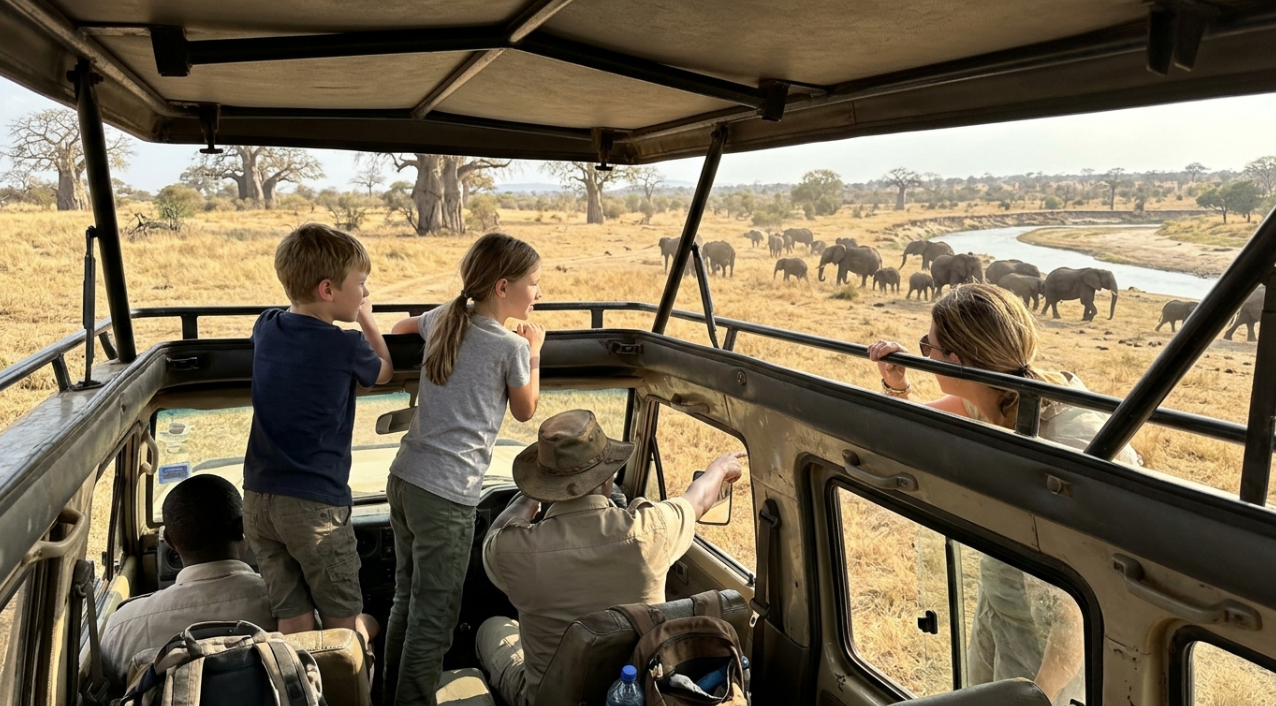
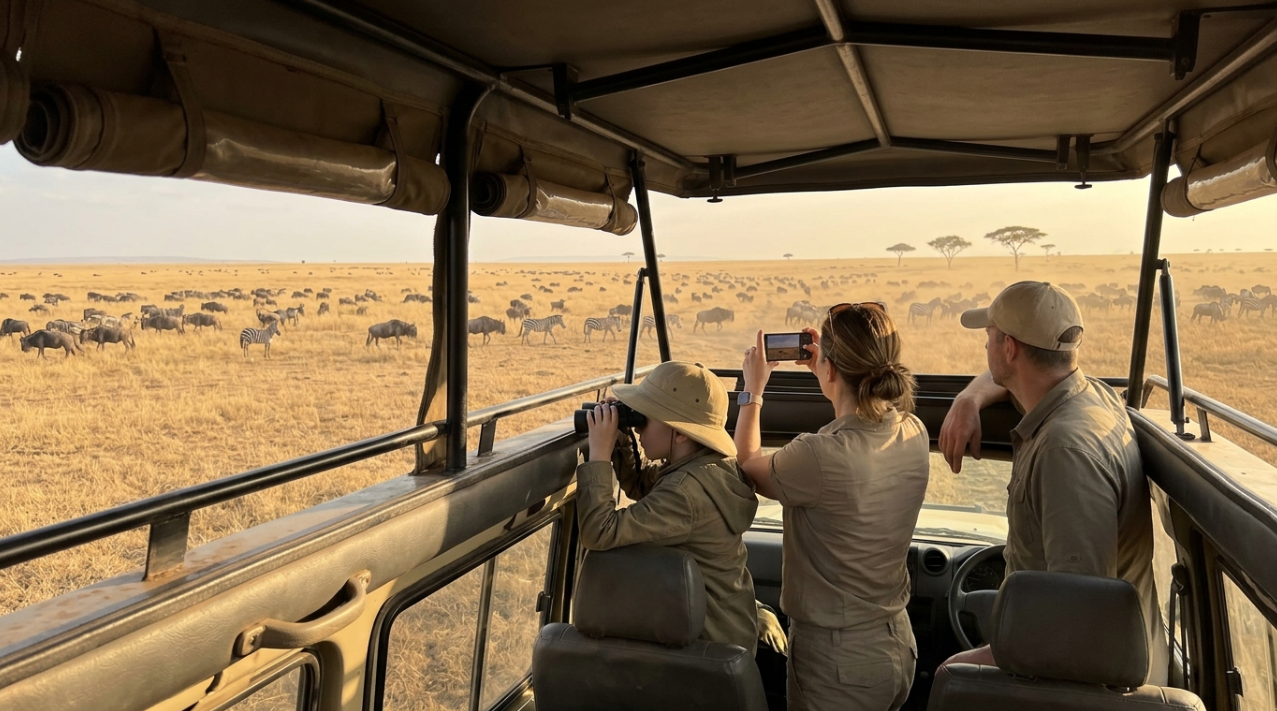
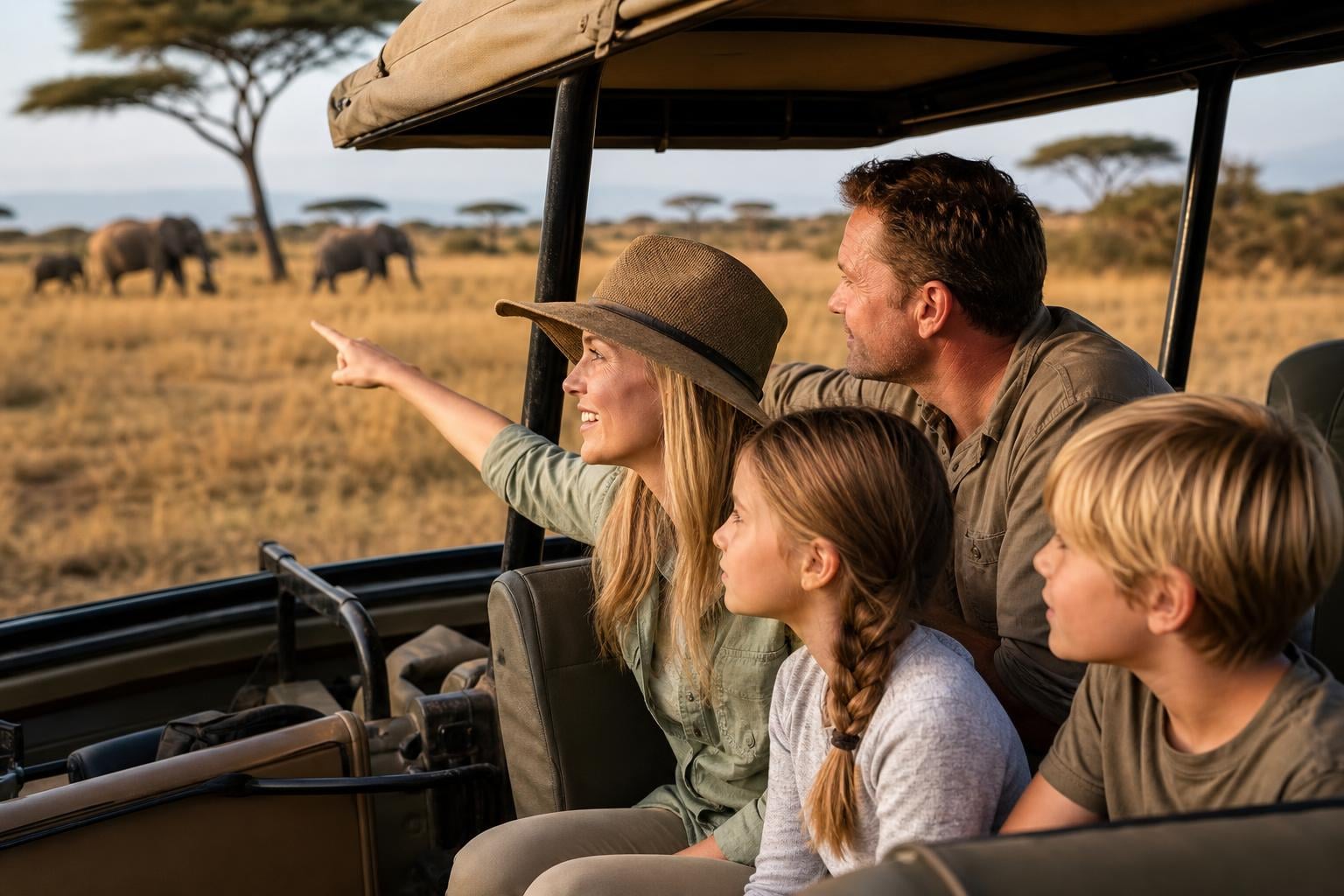
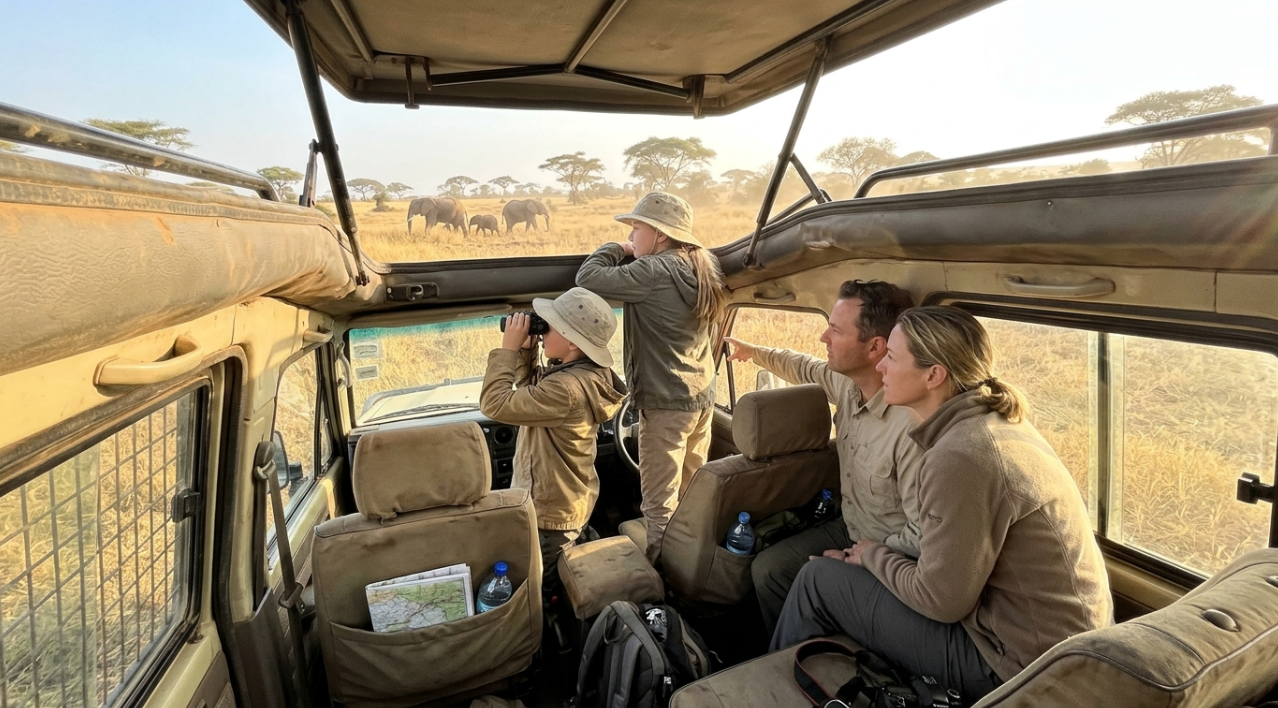
    Teenagers generally enjoy safaris most when they can participate rather than simply observe. Walking safaris, night drives where permitted, photography, cultural experiences, hot-air balloon flights and Zanzibar water sports can break up long periods in a vehicle.

    Before booking, check the minimum age for every activity and accommodation, because restrictions vary by park, concession, operator and activity. In particular, walking safaris, balloon flights and gorilla trekking have specific age requirements.

    Best formula for most families: 5–7 safari days + 2–4 days of beach time, with a private vehicle and at least one active experience every few days.

    Quick Reference: Tanzania Safari Activities for Teenagers

    Activity

    Typical age considerations

    Teen appeal

    Best use in an itinerary

    Game drive

    Generally suitable for families; operator rules apply

    High

    Core safari activity

    Walking safari

    Minimum age varies by location and operator

    Very high

    Break up vehicle-based days

    Hot-air balloon safari

    Minimum age varies by operator; commonly 7+

    Very high

    Special once-in-a-trip experience

    Night drive

    Usually available only in permitted private areas/concessions

    High

    Add variety after daytime drives

    Maasai cultural visit

    Usually family-friendly; experience varies

    Moderate–high

    Add cultural context

    Hadzabe experience

    Age and activity restrictions vary

    High

    Active cultural experience

    Zanzibar water sports

    Depends on activity and operator

    Very high

    Post-safari adventure

    Gorilla trekking

    Minimum age generally 15

    Exceptional

    Optional extension outside Tanzania

    Best Tanzania Safari Approach by Teenager’s Age

    There is no single itinerary that works equally well for every teenager. Age affects which activities are available, how much driving they can comfortably handle, and how much independence they want.

    Teen age

    What usually works best

    Activities to consider

    Planning priority

    12–13

    Shorter drives + active experiences

    Walking experiences where permitted, cultural visits, photography, pool time, Zanzibar

    Avoid overly long driving days

    14–15

    More adventurous itinerary

    Walking safari, balloon safari, cultural experiences, snorkeling, kayaking

    Check age restrictions carefully

    16–17

    More independence + challenging activities

    Walking safari, photography, night drives where permitted, water sports, adventure activities

    Give teens more control over activities

    18+

    Almost full adult itinerary

    Full range of age-appropriate safari activities

    Focus on interests and budget

    Important: Minimum ages are not universal. Each park, concession, camp and activity operator can have its own rules, so confirm the specific age requirement before booking.

    How Many Days Is Best for a Tanzania Safari With Teenagers?

    For most families, 7 to 10 days is a practical Tanzania safari length for teenagers. This provides enough time to experience several destinations while leaving room for rest, swimming, active experiences and shorter travel days.

    A useful structure is:

    Trip length

    Best for

    Example structure

    4–5 days

    First-time safari or limited vacation time

    Tarangire + Ngorongoro + Serengeti

    6–7 days

    Families wanting a focused safari

    Tarangire + Ngorongoro + Serengeti

    8–10 days

    Most families with teenagers

    Northern Circuit + active experiences + downtime

    10–14 days

    Families adding Zanzibar or another major experience

    Safari + Zanzibar

    14+ days

    Multi-country or highly customized trips

    Tanzania + Zanzibar + optional extension

    The key is not simply the number of days. Pacing matters more than duration. A 10-day itinerary with daily 8-hour drives can feel more exhausting than a 7-day itinerary with shorter drives, private vehicles and regular downtime.

    For teenagers, consider alternating high-energy safari days with shorter activities, pool time or a slower afternoon.

    Safari Types and Formats

    Game Drive

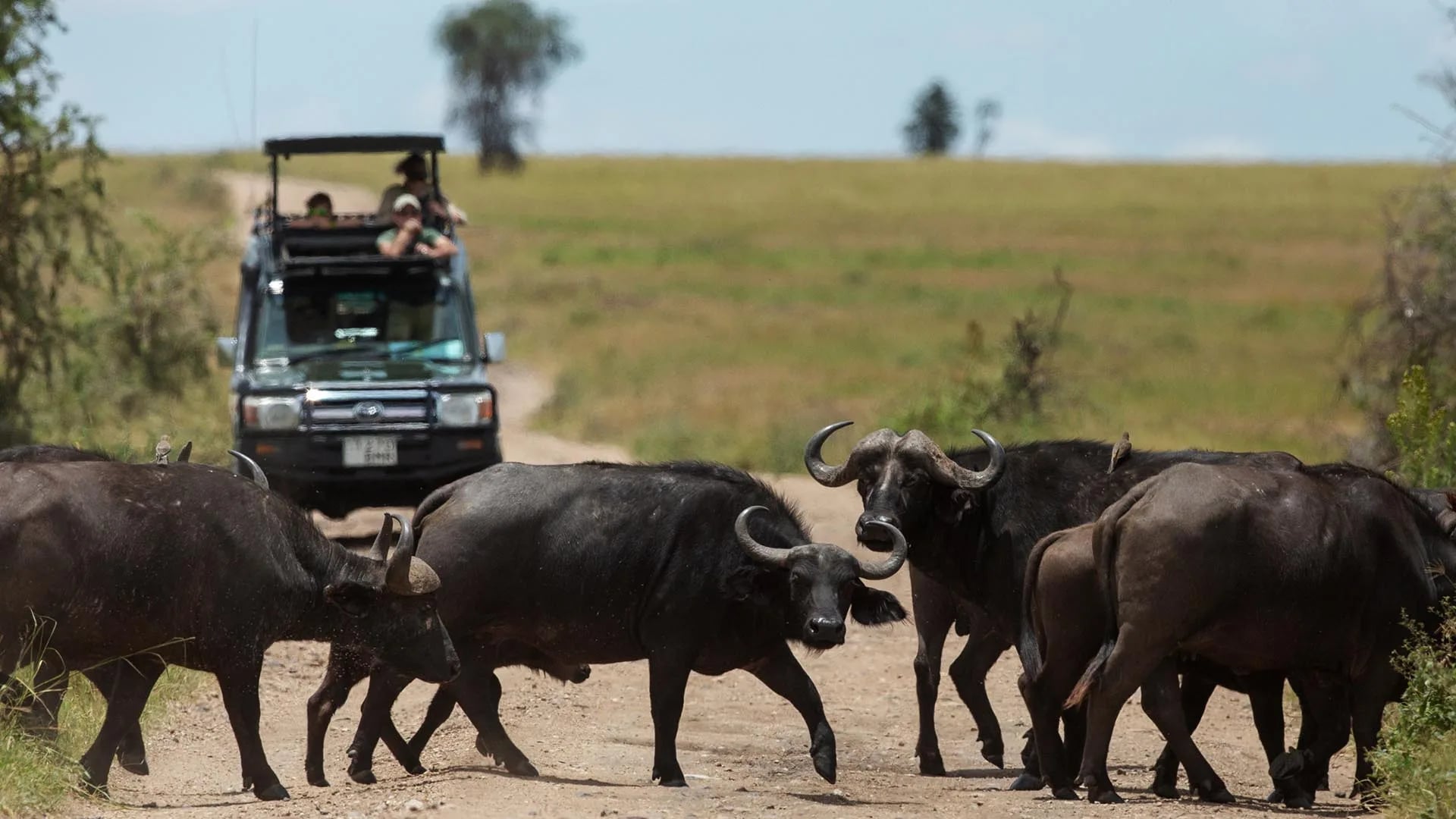
    A game drive is a wildlife-viewing excursion in a 4×4 vehicle, typically lasting 3 to 4 hours in the early morning or late afternoon when animals are most active. This is the core activity on any Tanzania safari. There is no legal minimum age for vehicle-based game drives under TANAPA (Tanzania National Parks Authority) rules.

    Why it matters for teens: Game drives are thrilling for the first few days, but teenagers have less patience than adults for long, slow drives across open plains. Practitioners on Reddit and travel forums consistently report that teens hit a wall around day 3 or 4 of all-day driving. The solution is mixing game drives with other activities rather than stacking them back to back for a full week.

    Walking Safari
    Tanzania Safari with Teenagers: 2026 Glossary & Guide

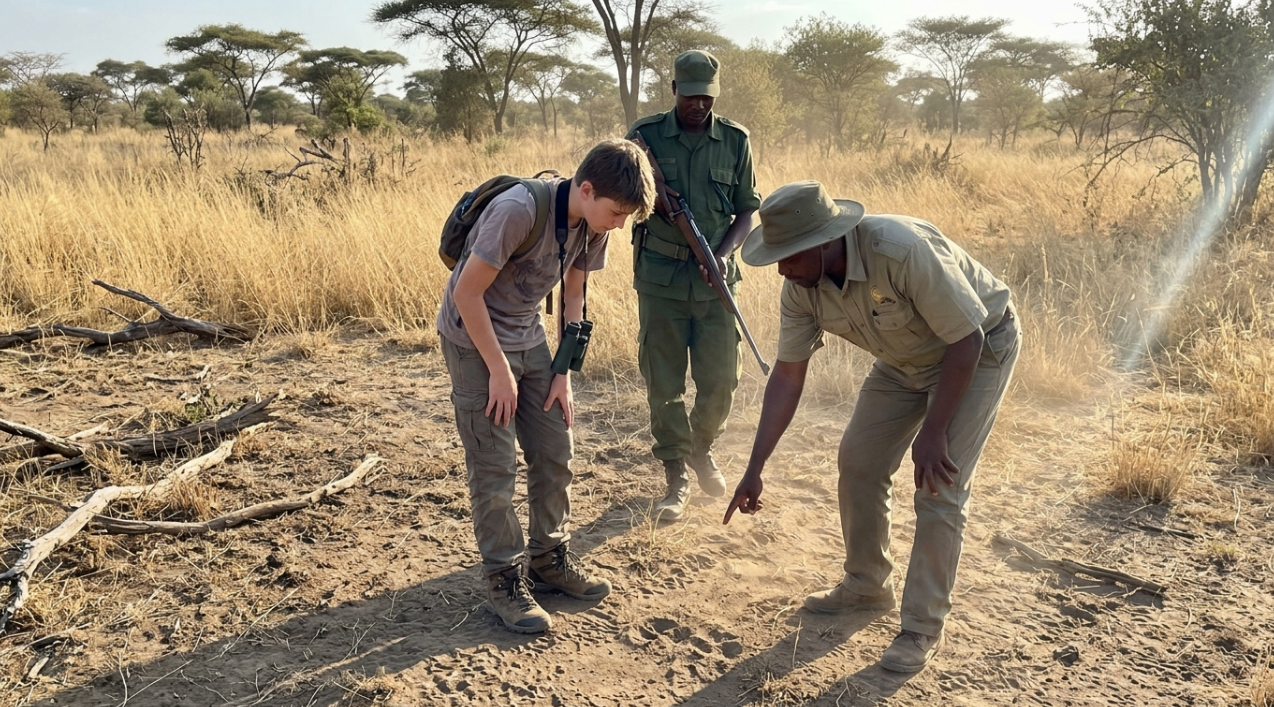
    A guided walk through the bush on foot, accompanied by an armed ranger and a qualified walking guide. Participants move slowly, tracking animals, identifying plants, and reading the landscape at ground level.

    The minimum age for walking safaris in Tanzania varies. TAWA (Tanzania Wildlife Management Authority) sets the minimum at 16 years in national parks, though some private conservancies and camps offer family-friendly walks for children as young as 12. In practice, most operators recommend walking safaris for ages 12 and above.

    Why it matters for teens: Walking safaris are often the highlight for teenagers. They’re physical, slightly adrenaline-producing, and completely different from sitting in a vehicle. Duma Explorer’s own experience confirms that walking safaris are excellent for tweens and teenagers who need to burn off energy.

    Night Drive

    A game drive conducted after dark using a spotlight to find nocturnal species like bush babies, aardvarks, genets, and hunting predators. Night drives are not permitted inside Tanzania’s national parks but are available in private conservancies and concession areas.

    Why it matters for teens: The novelty factor is high. Seeing a leopard hunting or a porcupine shuffling through camp feels completely different from daytime wildlife viewing.

    Fly-In Safari

    A safari itinerary that uses small bush planes to travel between parks or camps rather than driving. Flights typically use Cessna Caravans or similar aircraft, departing from bush airstrips. This dramatically reduces transit time (a 10-hour drive from Arusha to the central Serengeti becomes a 90-minute flight).

    Why it matters for teens: Less time in a car means more time on activities. For families combining multiple parks, fly-in segments prevent the road fatigue that makes teenagers miserable. Learn more about how types of safari vehicles and transport options affect the trip experience.

    Photography Safari

    A safari focused on wildlife photography, sometimes with a dedicated photography guide or specialized vehicle (lower sides, beanbag mounts, charging stations). Some camps offer structured photography workshops.

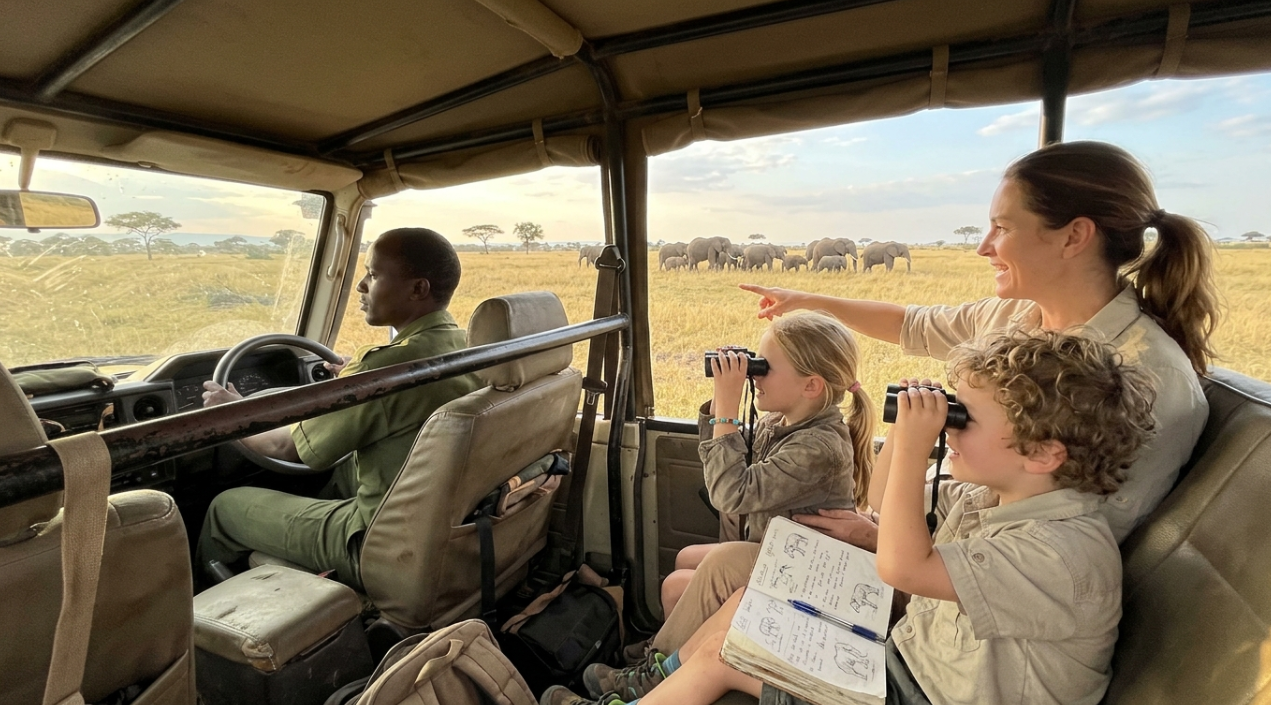
    Why it matters for teens: Teenagers who are active on social media or interested in photography respond extremely well to this format. Giving a teen a camera and a photography goal transforms passive observation into active engagement. Several family travel practitioners note that a daily photography project or short video diary turns the entire safari into a creative exercise. For gear considerations, see this safari photography gear guide.

    Bush-to-Beach

    An itinerary combining a wildlife safari with a beach extension, most commonly in Zanzibar. The typical structure is 6 to 7 days of safari followed by 3 to 4 days on the coast.

    Why it matters for teens: This is the single most effective pacing strategy for a safari with teenagers. Early morning wake-up calls are hard to sell to a 15-year-old. But the promise of snorkeling, kitesurfing, and beach time at the end of the trip makes those 5 AM alarms more tolerable. Multiple operators describe this as a “reward structure,” and parents on TripAdvisor forums confirm it works.


    Teen-Specific Activities and Experiences

    Hot Air Balloon Safari

    A sunrise flight over the Serengeti (or occasionally other parks), lasting approximately one hour, followed by a champagne bush breakfast upon landing. Children under 7 are not permitted. Children aged 7 to 16 may qualify for child rates at some operators, with prices for the 2026 Serengeti season ranging from $600 to $799 per person.

    Why it matters for teens: This is one of the most visually dramatic experiences available on safari, and teenagers universally love it. The views are extraordinary and the photos are exactly the kind of content teens want to share.

    Gorilla Trekking

    Hiking through montane forest in Uganda, Rwanda, or the Democratic Republic of Congo to spend one hour observing a habituated mountain gorilla family. The official minimum age is 15 years old, strictly enforced via passport checks on the morning of the trek. Rwanda maintains a zero-tolerance policy. Uganda Wildlife Authority may occasionally grant written exceptions for children who are 14 and turn 15 within the same calendar year, but this is not guaranteed.

    Why it matters for teens: Parents consistently describe gorilla trekking as the single most impactful wildlife experience their teenagers have ever had. The physical challenge (treks can last 2 to 8 hours through steep, muddy terrain) appeals to teens who want something demanding. The emotional impact of sitting meters from a silverback gorilla is profound. For permit details and planning logistics, see this guide to gorilla trekking permits and rules.

    Cultural Visit / Boma Visit

    A visit to a traditional Maasai homestead (boma) or other community, typically including demonstrations of daily life, traditional jumping dances, beadwork, fire-making, and conversation with community members. “Boma” refers to the circular enclosure of houses surrounded by a thorn fence.

    Why it matters for teens: The level of engagement depends entirely on how interactive the visit is. A lecture-style tour bores teenagers. A hands-on experience where they try fire-making, learn beadwork, or join in dancing holds their attention. Ask your operator how participatory the visit actually is before booking.

    Hadzabe Experience

    Time spent with the Hadzabe people, one of the last remaining hunter-gatherer communities in East Africa, near Lake Eyasi in northern Tanzania. Activities typically include an early morning hunt with bows and arrows, foraging for wild tubers and honey, and learning tracking skills.

    Why it matters for teens: This is consistently rated as one of the most engaging cultural experiences for teenagers. The hunting and tracking component is physical and genuinely interactive, not performative.

    Junior Ranger / Young Explorer Program

    Structured programs offered by some safari camps specifically for children and teenagers. These typically involve guided nature walks, animal tracking, bush skills, and sometimes conservation-focused activities. The quality varies enormously between camps.

    Why it matters for teens: Be careful here. Most “kids’ club” programs target younger children (ages 4 to 12), and teenagers find them patronizing. As one safari operator put it, teenagers don’t want a kids’ programme; they want agency, immersion, and a challenge. Look for camps with genuine teen programs that involve real bush skills rather than coloring sheets and bead games.

    Zanzibar Extension

    Adding 3 to 5 days on the Zanzibar archipelago after a mainland safari. Activities include snorkeling at Mnemba Atoll, kitesurfing at Paje Beach, stand-up paddleboarding, kayaking, Stone Town exploration, spice tours, and general beach relaxation. The east coast (Paje and Jambiani) is better for active teens, with shallow lagoons and kitesurfing focus. The north coast (Nungwi and Kendwa) offers calmer swimming with less tidal variation.

    Why it matters for teens: Zanzibar is where teenagers decompress after early mornings and long drives. The water activities provide the adrenaline hit that game drives eventually stop delivering. For excursion ideas, see this Zanzibar day trips guide.

    Best Tanzania Safari Parks for Teenagers

    Different parks create different experiences. For families traveling with teenagers, the best choice is not necessarily the park with the most wildlife. Variety, accessibility and the ability to combine different activities can be just as important.

    Destination

    Why teens may enjoy it

    Ideal stay

    Serengeti

    Big cats, dramatic landscapes and Great Migration viewing

    2–3 nights

    Ngorongoro Crater

    High wildlife density and relatively compact game drives

    1–2 nights

    Tarangire

    Elephants, baobabs and a different landscape from the Serengeti

    1–2 nights

    Arusha National Park

    Walking and active experiences close to Arusha

    1–2 nights

    Lake Manyara

    Forest, wildlife and a shorter stop between destinations

    1 night

    For many first-time family safaris, a combination of Tarangire, Ngorongoro and Serengeti provides a good balance of wildlife, landscapes and travel time. Families wanting more active experiences should also consider destinations where walking or other activities are permitted for their teenager’s age.

    Destinations and Geography

    Northern Circuit

    Tanzania’s most popular safari route, connecting Arusha, Tarangire National Park, Lake Manyara, Ngorongoro Crater, and the Serengeti. A typical Northern Circuit itinerary runs 7 to 10 days. Park fees range from $70 to $83 per person per day at major parks.

    Why it matters for teens: This is the standard route for a first family safari in Tanzania, and for good reason. The wildlife density is high, the parks are diverse, and the infrastructure supports a range of accommodation levels. For a detailed breakdown of routing and costs, see this Tanzania safari itinerary and costs guide.

    Serengeti

    Tanzania’s most famous national park, covering 14,763 square kilometers. Home to the Great Migration (over 1.5 million wildebeest plus hundreds of thousands of zebra and gazelle), the Serengeti offers year-round predator viewing and some of the most dramatic wildlife spectacles on earth.

    Why it matters for teens: The Serengeti delivers the “wow” moments that make safaris memorable: river crossings, lion hunts, cheetah chases. Two to three nights here is typical for families with teens.

    Ngorongoro Crater

    A collapsed volcanic caldera roughly 20 kilometers across, containing one of the densest concentrations of wildlife in Africa. Game drives in the crater are compact (typically a half-day) because the area is relatively small.

    Why it matters for teens: The crater is excellent for attention spans. Because the wildlife density is so high, you see animals quickly and consistently. A half-day descent works well as a “short” game drive day that leaves the afternoon free for the pool or a walk.

    Conservancy / Concession Area

    A privately managed wildlife area adjacent to or near a national park. Conservancies operate under different rules than national parks: they permit night drives, off-road driving, walking safaris, and bush meals that are prohibited inside park boundaries. They also have strict limits on the number of vehicles and visitors.

    Why it matters for teens: Conservancies unlock the activities that make safaris most engaging for teenagers. Walking safaris, night drives, off-road tracking, and bush dinners under the stars are all conservancy benefits. If your itinerary includes at least one conservancy stay, the variety of experiences increases dramatically.


    Accommodation and Comfort

    Tented Camp

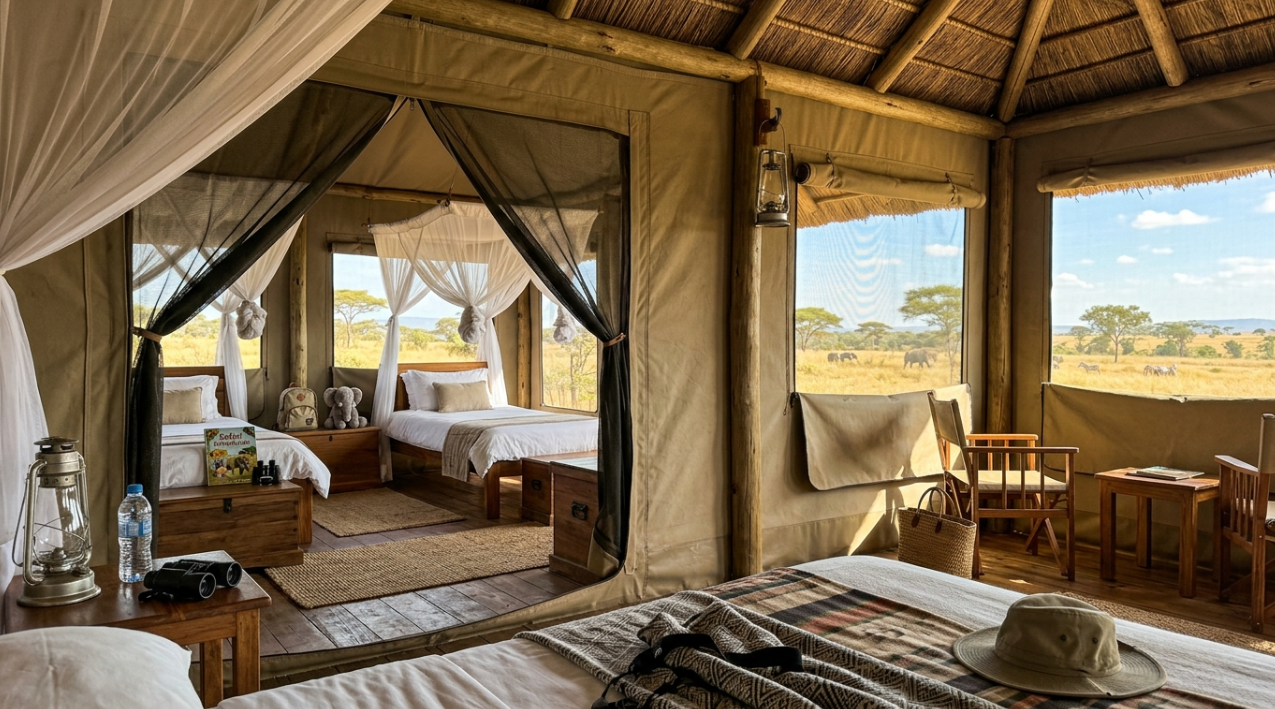
    Accommodation in large canvas tents, typically on raised platforms, with full beds, en-suite bathrooms, and sometimes verandas. “Tented camp” on safari does not mean camping in the backpacking sense. These are proper rooms that happen to be made of canvas.

    Why it matters for teens: The novelty of sleeping in a tent with wildlife sounds outside genuinely excites teenagers. But clarify the setup. Teens are happier when they have their own tent rather than sharing a family unit. Room configuration matters more than star rating for this age group.

    Lodge

    A permanent, built structure offering hotel-style accommodation in a safari setting. Lodges range from simple to ultra-luxurious and typically include restaurants, bars, swimming pools, and sometimes spa facilities.

    Why it matters for teens: Pools. TripAdvisor threads about safari with teenagers return to this point repeatedly: a swimming pool during midday downtime is not optional, it’s essential. When comparing lodges, check for a pool, some degree of Wi-Fi, and separate rooms for teens. One family safari planner summed it up well: the right accommodation is “not so high end that we didn’t feel like we were on a safari and not so basic that the kids wouldn’t want to return to Africa when they got older.”

    For families comparing camp and lodge options across Tanzania, this family safari lodges guide covers the specifics.

    Full Board (FB) vs. All-Inclusive

    Full board means breakfast, lunch, and dinner are included but drinks (especially alcohol) and some activities are extra. All-inclusive covers meals, house drinks, and often laundry and some activities. Understanding which meal plan your camp offers prevents unexpected charges.

    Why it matters for teens: Teenagers eat constantly. Full board covers the meals, but snacks and soft drinks between meals may not be included at every property. All-inclusive removes that friction entirely.

    Should You Book a Private Safari Vehicle for Teenagers?

    For families traveling with teenagers, a private safari vehicle is often worth considering because it gives the family greater control over the day.

    With a private vehicle, you can:

    • Start or finish a game drive around your teenager’s energy level.

    • Spend longer watching an animal when everyone is interested.

    • Return to camp when the family needs a break.

    • Stop for photography without coordinating with other travelers.

    • Adjust the schedule when weather or wildlife conditions change.

    • Combine shorter game drives with other activities.

    A shared vehicle can reduce the cost of a safari, but it also means your family must follow a schedule designed around other travelers. For teenagers with different energy levels or interests, that loss of flexibility can be frustrating.

    Planning rule: If your budget allows it, prioritize a private vehicle before upgrading to a more luxurious room category.


    Logistics and Planning

    Park Fees / Conservation Fees

    Daily fees charged by TANAPA for each visitor entering a national park. In Tanzania’s major parks (Serengeti, Ngorongoro, Tarangire), fees range from $70 to $83 per person per day for adults. Children typically receive discounted rates. These fees are usually included in your safari package price but represent a significant portion of total cost.

    TANAPA (Tanzania National Parks Authority)

    The government authority responsible for managing Tanzania’s 22 national parks, including the Serengeti, Tarangire, and Arusha National Park. TANAPA sets park regulations, entry fees, and activity rules within park boundaries.

    TAWA (Tanzania Wildlife Management Authority)

    The authority managing game reserves, wildlife management areas, and conservation areas outside the national park system. TAWA’s regulations differ from TANAPA’s, which is why activities like walking safaris may have different age restrictions depending on whether you’re inside a national park or a game reserve.

    Safari Fatigue

    The mental and physical exhaustion that sets in after consecutive days of early wake-ups (often 5:30 AM), long hours in a bouncing vehicle, and information overload. Safari fatigue is real, and teenagers are especially susceptible.

    Why it matters for teens: The typical recommendation is no more than 3 to 4 consecutive days of full game drives before mixing in a different activity, a rest day, or a beach extension. Spending 8 hours a day in a 4×4 on bumpy roads is exhausting for anyone, and teenagers will let you know it. A bush-to-beach approach (7 days safari, 3 to 4 days Zanzibar) is the most effective countermeasure.

    Fly-Out / Bush Flight

    A scheduled or charter flight departing from a bush airstrip, typically on a small prop plane. Bush flights connect remote safari areas to each other and to Arusha, Kilimanjaro International Airport, or Zanzibar. Luggage is usually limited to soft-sided bags weighing 15 to 20 kilograms.

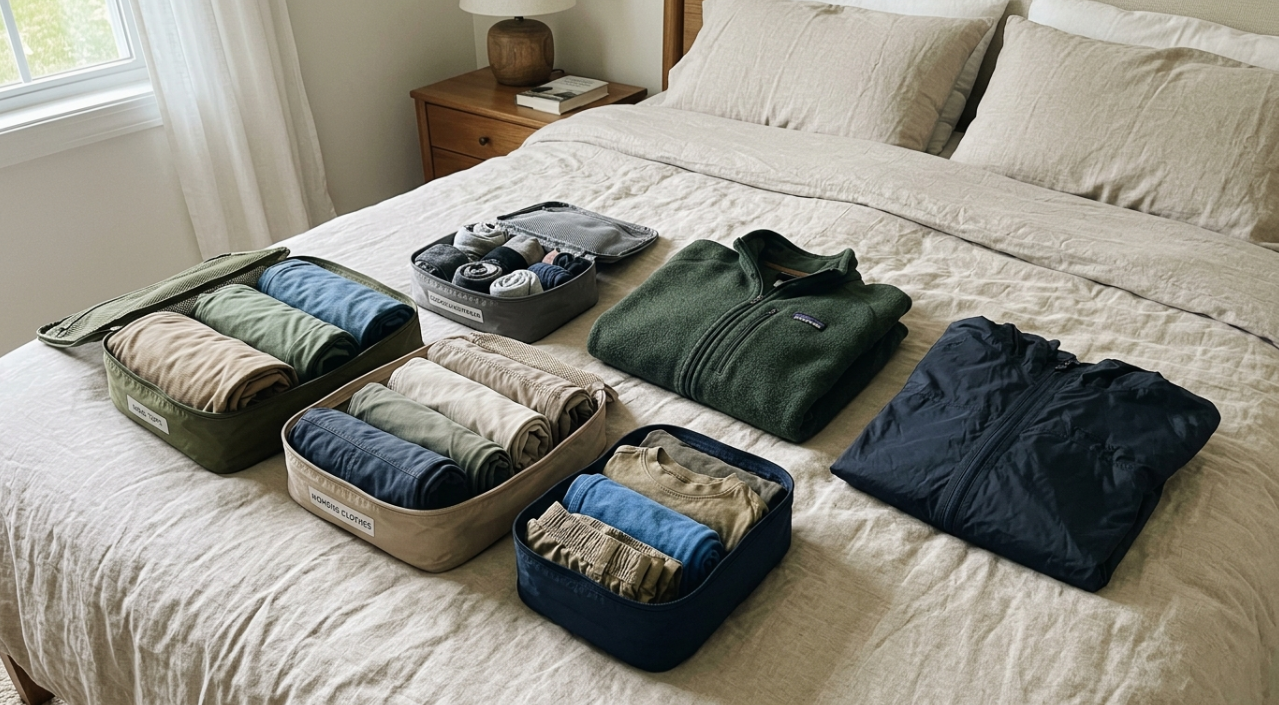
    Why it matters for teens: The weight restriction catches families off guard. Teens accustomed to packing large suitcases need to pare down to a soft duffel. Clarify luggage limits early to avoid arguments at the airstrip.

    Tipping (Guide and Camp Staff)

    Gratuities for your driver-guide, camp staff, and activity guides. Tipping is customary on safari and typically runs $15 to $25 per day for a driver-guide and $10 to $20 per day per family for camp staff, though amounts vary. Your operator should provide a tipping guide before departure.

    Malaria Prevention

    Malaria prevention is an important consideration for travel to Tanzania, including many safari areas and Zanzibar. Prevention may involve mosquito-bite precautions and, for some travelers, prescription medication.

    The appropriate medication depends on factors such as destination, travel dates, age, medical history and other medications. Families should speak with a qualified travel-health professional before departure rather than choosing a medication based solely on another traveler’s experience.

    For teenagers, also ask about potential side effects and practical considerations such as sun exposure during long days outdoors.

    Travel Insurance

    A policy covering trip cancellation, medical emergencies, evacuation, and baggage loss. Safari travel insurance should specifically include emergency medical evacuation by air ambulance, which can cost $50,000 or more without coverage. For detailed guidance, see this Tanzania travel insurance guide.

    Private vs. Shared Safari

    A private safari means your family has its own vehicle, guide, and itinerary. A shared (or group) safari means you join other travelers on a fixed schedule. Private safaris cost more but offer complete flexibility on pacing, stops, and daily schedule.

    Why it matters for teens: Shared safaris work fine for budget-minded adult travelers, but they’re a poor fit for families with teenagers. Your teen’s energy level, attention span, and bathroom needs don’t align with strangers’ preferences. The cost difference is real, but parents who’ve done both consistently say private is worth it for families.

    Families building a custom itinerary around teen ages and interests can plan a family safari that matches each activity to the right age and pace.

    7 Mistakes That Can Make a Tanzania Safari Boring for Teenagers

    Even an extraordinary wildlife destination can become tiring if the itinerary is poorly designed. The most common problems are:

    1. Scheduling too many consecutive full-day game drives.

    2. Choosing a shared vehicle when the family needs flexibility.

    3. Ignoring the teenager’s interests when choosing activities.

    4. Booking accommodation without checking room configuration.

    5. Leaving no time for swimming, relaxing or using the hotel facilities.

    6. Treating every cultural visit as a formal educational tour.

    7. Saving all the exciting activities for a single day instead of spreading them throughout the trip.

    The solution is not to eliminate game drives. Wildlife viewing is still the reason to visit Tanzania. Instead, build an itinerary where game drives are balanced with active experiences, cultural encounters, photography, downtime and, if desired, a Zanzibar beach extension.

    How to Keep Teenagers Engaged on Safari
    Tanzania Safari with Teenagers: 2026 Glossary & Guide

    Understanding the glossary terms above is half the battle. The other half is trip design. Here’s what actually works, based on operator experience and parent feedback from forums and reviews.

    Let them help plan the trip. Involve your teenager in researching camps, choosing activities, and shaping the itinerary. When they have ownership over the trip, they’re far more likely to be engaged from day one. Let them pick the Zanzibar water sport. Let them choose between a hot air balloon and an extra walking safari.

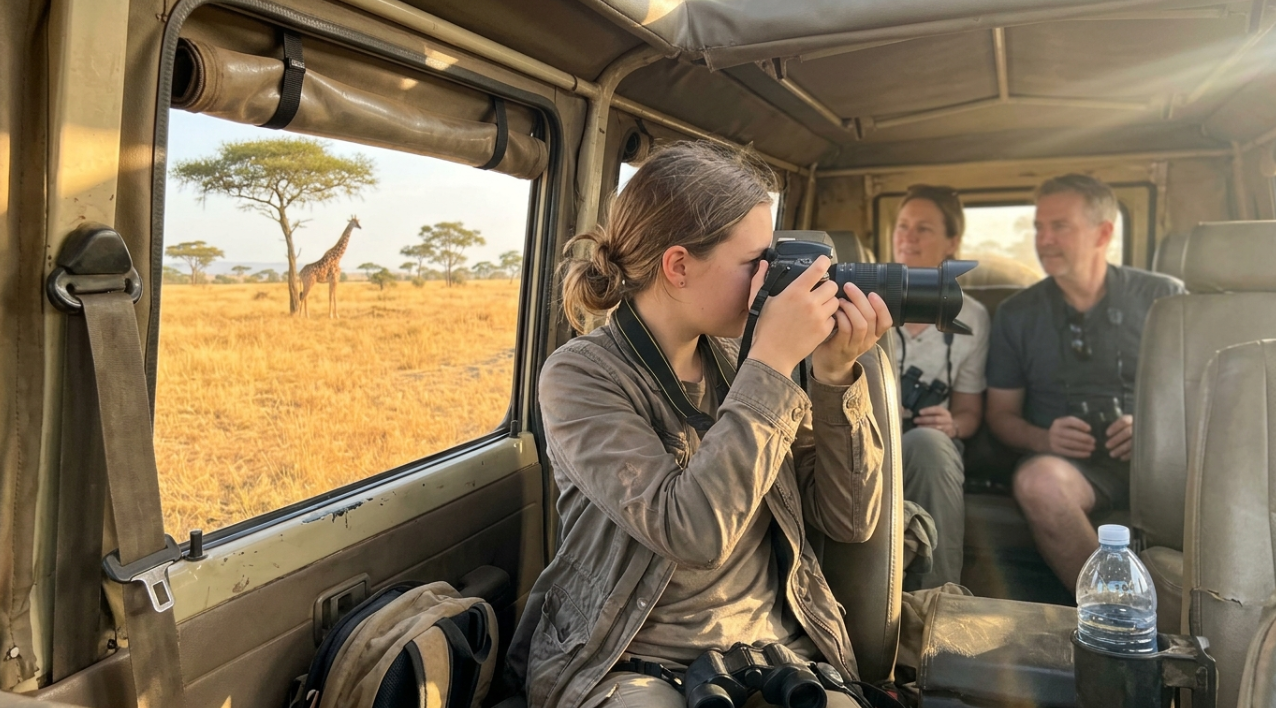
    Give them a creative project. A photography challenge, a daily journal, or a video diary transforms a teenager from a passive passenger into an active participant. Some families create a shared Instagram account for the trip. Others challenge their teen to photograph each member of the Big Five.

    Mix activities aggressively. The difference between a safari teenagers endure and one they rave about comes down to variety. Alternate game drives with walking safaris, cultural visits, balloon flights, and downtime. Never schedule more than two consecutive full-day game drives.

    Protect downtime. An overly packed trip quickly becomes tiring. Teenagers need space, a free afternoon, a pool at sunset, time to process what they’ve seen. Build at least one “slow” day into every three active days.

    End with the beach. The bush-to-beach structure works because it gives teenagers something to look forward to during the safari portion and something to unwind with afterward.

    Families trying to balance the right mix of activities can ask Duma Explorer to structure the itinerary pacing around their teens’ specific ages and interests, since the balance between game drives and active experiences matters as much as the destinations.

    Example 9-Day Tanzania Safari Itinerary With Teenagers

    A 9-day itinerary can provide a good balance between wildlife, active experiences and downtime without requiring every day to be a full-day game drive.

    Day

    Destination / activity

    Teen-friendly focus

    1

    Arusha

    Arrival, pool and recovery

    2

    Tarangire

    Game drive + shorter afternoon

    3

    Tarangire / Arusha area

    Walking or other active experience where permitted

    4

    Ngorongoro

    Crater game drive

    5

    Serengeti

    Transfer + afternoon wildlife viewing

    6

    Serengeti

    Full game-drive day

    7

    Serengeti

    Flexible wildlife/photography morning + downtime

    8

    Zanzibar

    Flight to the coast + beach

    9

    Zanzibar

    Snorkeling, kayaking, paddleboarding or free beach time

    The exact route should be adjusted according to the teenager’s age, interests, travel dates, wildlife priorities and available activities. Age restrictions and seasonal conditions should be confirmed with the safari operator before booking.

    What a Teen Safari Actually Looks Like: Real Examples

    Duma Explorer has organized family safaris with teenagers across Tanzania. One documented family of four (including two teenagers) completed a walking safari in Arusha National Park followed by 2 nights each in Western Serengeti, Central Serengeti, Ngorongoro, and Tarangire. The trip planner calibrated accommodations to strike the right balance between comfort and authenticity. The family witnessed a wildebeest crossing of the Mara River on their very first safari afternoon.

    A separate multigenerational group of 13 family members, spanning ages 11 to 62, completed a Tanzania safari described as a “trip of a lifetime.” Managing that age range requires careful itinerary design, pairing high-energy activities for the younger members with comfortable pacing for the older ones. For families bringing multiple generations, this multigenerational safari planning guide covers the logistics.

    How Much Does a Tanzania Safari With Teenagers Cost?

    The cost of a Tanzania safari varies substantially depending on accommodation level, travel season, number of travelers, private versus shared transportation, internal flights and optional experiences.

    For planning purposes, families should separate the budget into several categories:

    Cost category

    What affects the price

    Safari accommodation

    Lodge or tented camp, location and season

    Safari vehicle

    Private versus shared vehicle

    Park and conservation fees

    Destination, age and applicable fee category

    Internal flights

    Number of flights and route

    Activities

    Balloon safari, walking experiences and other excursions

    Meals and drinks

    Meal plan and camp policies

    Zanzibar extension

    Hotel, transfers and water activities

    Travel insurance

    Coverage level and travelers’ ages

    Tips

    Guide, camp and activity staff

    A private family safari generally costs more than a group safari because the family has exclusive use of the vehicle and guide. Premium camps, peak-season travel, internal flights and add-on experiences can increase the total significantly.

    Rather than choosing an itinerary based only on the headline price, compare what is included: accommodation, meals, park fees, vehicle, guide, transfers, flights and activities.

    Frequently Asked Questions

    How many days should a safari with teenagers be?

    Seven to ten days is the sweet spot for most families. This allows 5 to 7 days of actual game drives and activities after accounting for travel and rest days. Parents on the Fodors forum with teens aged 13 and 16 reported that 6 to 7 days of game drives was sufficient without boredom setting in. For ages 14 to 17, some operators recommend up to 14 days when the itinerary includes photography focus, a gorilla trekking extension, or a Zanzibar beach add-on.

    Will my teenager get bored on safari?

    Not if the trip is designed correctly. Boredom happens when the itinerary is nothing but game drives for a week straight. It does not happen when walking safaris, balloon flights, cultural visits, and beach time are woven in. A private vehicle is also critical because it lets you control pace. If your teen is fading, you head back to camp and the pool.

    Can a 14-year-old do gorilla trekking?

    The official minimum age is 15 in Uganda, Rwanda, and the DRC. Rwanda enforces this with zero exceptions. Uganda may occasionally grant written exceptions for a 14-year-old who turns 15 within the same calendar year, but this is not reliable. Plan around the rule, not the exception. Read the full gorilla trekking age limit breakdown for details.

    What is the minimum age for a walking safari in Tanzania?

    It depends on location. TAWA regulations set the minimum at 16 years old within national parks. Private conservancies and some camps accept participants as young as 12. Always confirm the specific age policy for each camp or conservancy on your itinerary.

    Is a Zanzibar extension worth adding for teens?

    Yes. Overwhelmingly yes. The beach extension serves a dual purpose: it rewards teens for those early mornings, and it provides the water-sport adrenaline (kitesurfing, snorkeling, paddleboarding) that game drives can’t deliver. Three to four days is enough. The east coast, particularly Paje, is the best choice for active teenagers.

    Do teenagers need their own tent or room on safari?

    They strongly prefer it, and most safari operators recommend it. Teens aged 13 and up generally want their own space, and sharing a family tent with parents can create friction that affects the whole trip. Most tented camps and lodges offer family configurations with connected or adjacent tents. Clarify room arrangements during the booking stage.

    How much does a safari with teenagers cost per person?

    A well-designed private family safari in Tanzania typically ranges from $5,000 to $15,000+ per person for a 7 to 14 day trip, depending on accommodation level, number of parks, internal flights, and optional activities like balloon safaris or gorilla trekking extensions. Park fees alone account for $70 to $83 per person per day at major parks. Children and teens sometimes receive discounted rates at certain camps.

    What is the best Tanzania safari itinerary for teenagers?

    For many families, a 7- to 10-day itinerary combining two or three wildlife destinations with active experiences and downtime works well. A private vehicle provides additional flexibility, while a Zanzibar extension can add water activities and relaxation.

    Is Tanzania safe for teenagers?

    Tanzania is a popular family safari destination, but families should follow their safari operator’s safety guidance and park rules. Teenagers should remain with their guide during wildlife activities and follow instructions around animals, vehicles and accommodation areas.

    What are the best safari activities for teenagers?

    Game drives are the foundation, but teenagers often enjoy the trip more when the itinerary also includes activities such as walking experiences where permitted, photography, cultural visits, balloon flights, swimming and Zanzibar water sports.

    Should teenagers have their own safari room or tent?

    Many teenagers appreciate having their own space, particularly on longer trips. Depending on the property, families may be able to book adjacent rooms, connected rooms or separate tents. Confirm the exact configuration before booking.

    Is Tanzania or Kenya better for a safari with teenagers?

    Both can work well for families. The better choice depends on wildlife priorities, travel dates, itinerary length, budget, accommodation preferences and the activities available to your teenager. Compare the specific itineraries rather than choosing a destination based only on the country name.
    Build My Family Safari

  • Best Age for Safari Tanzania 2026: Family Planning Guide

    Best Age for Safari Tanzania 2026: Family Planning Guide

    TLDR

    Most families find ages 8 to 12 the easiest window for a first Tanzania safari. Children aged 5 to 7 can have a great time with a private vehicle, shorter game drives, and family-friendly lodges. Kids under 5 can go, but the trip demands more logistical planning from parents. Teenagers are excellent safari travelers, especially when the itinerary includes photography, migration timing, or walking safaris.

    The best age for a safari in Tanzania is usually 8 to 12 years old. Children in this range can sit through longer game drives, follow wildlife safety instructions, ask good questions, and remember the trip decades later. Ages 5 to 7 can also work well if the safari is private, paced slowly, and built around shorter drives in parks like Tarangire, Ngorongoro, or the central Serengeti. Children under 5 can go, but naps, heat, malaria prevention, lodge policies, and long transfers require more careful planning. Teenagers are excellent safari travelers when the itinerary includes photography goals, migration timing, cultural context, or active elements like walking safaris.

    The answer is not just a number. It depends on matching your child’s age to the right vehicle type, parks, lodge style, game-drive rhythm, health preparation, and trip length.

    What Is the Best Age for a Tanzania Safari?

    For most families, 8 to 12 is the best age for a first Tanzania safari. Children in this age range can usually handle longer game drives, follow wildlife safety instructions, tolerate early mornings and travel days, and remember the experience. However, there is no universal minimum age for a Tanzania safari. Children aged 5 to 7 can have an excellent safari with a private vehicle, shorter game drives, family-friendly lodges, and fewer hotel changes. Toddlers can travel to Tanzania, but the trip requires more planning around naps, heat, road transfers, malaria prevention, and accommodation policies.

    The best age therefore depends less on a child’s birthday and more on their ability to handle vehicle time, follow safety instructions, manage the travel routine, and enjoy observing wildlife.

    Tanzania Safari by Child’s Age at a Glance

    Age

    Overall suitability

    Ideal safari style

    Typical game-drive approach

    Under 3

    Challenging

    Short, private, lodge-based

    Very short drives with flexibility

    3–4

    Possible

    Private family safari

    About 2–3 hours at a time

    5–7

    Good

    Private Northern Circuit safari

    Short morning drives plus downtime

    8–12

    Best overall

    Classic Tanzania family safari

    Longer drives with rest periods

    13–17

    Excellent

    Wildlife + adventure safari

    Full-day drives and specialized activities

    The key takeaway: There is no single age requirement for a Tanzania safari. For most first-time families, 8–12 is the easiest overall window, while children as young as 5 can have an excellent experience when the itinerary is designed around their needs.

    Quick Guide: Best Age for Safari in Tanzania by Age Band

    Child’s age

    Safari suitability

    What usually works

    Main consideration

    Under 3

    Possible, but challenging

    Private vehicle, short drives, lodge-based itinerary

    Naps, heat, transfers and health planning

    3–4

    Possible with careful planning

    2–3 hour drives, pools, flexible meals

    Limited attention span and activity restrictions

    5–7

    Good

    Private vehicle, shorter drives, family-friendly lodges

    Avoid overly ambitious itineraries

    8–12

    Best overall age

    Longer drives, classic Northern Circuit, cultural activities

    Build in downtime between full safari days

    13–17

    Excellent

    Photography, migration trips, walking activities where permitted

    Give teens autonomy and meaningful activities

    TANAPA’s official fee categories distinguish children under 5 (free entry) from children aged 5 to 15 (child rates), but these are fee categories, not readiness guidelines. Lodge policies, activity rules, and a child’s temperament matter more than the tariff structure when deciding the best time for a Tanzania safari with your family.

    Is There a Minimum Age for Safari in Tanzania?

    There is no single minimum age set by Tanzanian national parks. TANAPA’s official tariff page lists children under 5 as free and children 5 to 15 at reduced conservation fees. That means a two-year-old can technically enter Serengeti National Park.

    But park entry and safari readiness are different things. The practical minimum age for a family safari in Tanzania comes from several overlapping rules:

    Lodge age policies. Many safari camps set their own minimums. Asilia’s camps generally welcome children over age 5, but some properties like Usangu Expedition Camp and Kokoko Camp require guests to be at least 12. Nomad Tanzania recommends a private guide and exclusive vehicle for families with children.

    Activity restrictions. Walking safaris commonly require children to be 12 or older. Elewana does not permit children under 16 on its bush walks. Night drives, balloon flights, and certain cultural activities may also carry age minimums.

    Health considerations. Malaria prevention medications for children are age- and weight-dependent, which adds complexity for very young travelers (more on this below).

    Behavioral readiness. TANAPA park rules require visitors to follow guide instructions, stay on designated roads, and avoid disturbing wildlife. A child who cannot sit still or follow directions quickly creates real safety concerns in a vehicle near elephants or lions.

    The distinction between “minimum age” and “recommended age” matters. Minimum age is the youngest a park, camp, or activity allows. Recommended age is when a child is likely to enjoy the safari and the parents can enjoy it too. For Tanzania, the recommended age is almost always more important.

    Families weighing these factors can explore how a private family safari in Tanzania handles age-related logistics like vehicle exclusivity, pacing, and lodge selection.

    The Best Age for a Tanzania Safari, Stage by Stage

    Under 3: Usually Better to Wait

    Most families should wait unless they are experienced travelers with a compelling reason to go now, extra adult help, and the budget for a fully private arrangement.

    The trip becomes more about parent logistics than wildlife immersion. Long transfers, heat, nap schedules, feeding routines, car seats, and malaria prevention dominate every decision. Children this young are unlikely to understand or remember the wildlife experience. Shared vehicles are a poor fit because a fussing toddler affects every other guest in the car.

    This does not mean toddlers “cannot” go. It means the safari changes when they do.

    Ages 3 to 4: Possible, but Parent-Heavy

    A 3- or 4-year-old can enjoy watching elephants drink at a waterhole or hippos surfacing in a river. They will not, however, sit patiently for a two-hour search for a leopard in a tree.

    What works at this age:

    • Private vehicle (non-negotiable)

    • Drives limited to 2 to 3 hours

    • Lodges with pools, flexible meal times, and family rooms

    • Minimal lodge changes (ideally two or three bases, not five)

    • Parks close to Arusha to reduce transfer time

    • One or two parks rather than an ambitious checklist route

    “Possible” is not the same as “ideal.” A family with a 4-year-old and a 10-year-old should plan the itinerary around the 4-year-old’s limits, not the 10-year-old’s enthusiasm.

    Ages 5 to 7: Works Well with the Right Plan

    Best Age for Safari Tanzania 2026: Family Planning Guide

    This is where many families start having genuinely rewarding safaris. Five or six years old is the practical floor that most experienced operators and community travelers identify as workable, provided the itinerary is designed for it.

    Practitioners on Reddit report positive trips with children aged 5 and 6 when the family had their own guide and private vehicle. One user described a Tanzania trip with a 5- and 9-year-old that worked well because the pacing was realistic and the family could set its own schedule.

    Best parks and routing for ages 5 to 7:

    • Tarangire for elephants and baobabs, a high-impact first safari stop

    • Ngorongoro Crater for concentrated sightings in a compact area

    • Lake Manyara or Arusha National Park for shorter introductions

    • Central Serengeti only if the transfer plan is reasonable or fly-in logistics make sense

    Game-drive rhythm for younger children:

    • 2 to 3 hour morning drives

    • Midday pool and rest time

    • Optional short afternoon drive

    • Snacks, binoculars, and an animal checklist to keep them engaged

    Give each child a role: spotter, photographer, map reader, or animal checklist keeper. Put elephants early in the itinerary because they are high-impact and easy for young children to appreciate. Pool time is not wasted safari time. It is what makes the next morning’s drive possible.

    Ages 8 to 12: The Best Overall Age for a Tanzania Safari

    For most families, ages 8 to 12 are the best overall age for a first Tanzania safari. Children in this range are generally old enough to manage longer game drives, follow wildlife safety instructions, cope with early starts, and stay engaged during periods when animals are not immediately visible.

    They can also understand more of what makes a Tanzania safari special: predator and prey behavior, migration, conservation, local communities, and the differences between habitats.

    This age range also gives families more itinerary flexibility. Children can usually handle a classic Northern Circuit route that includes Tarangire, Ngorongoro Crater, and the Serengeti, provided the itinerary includes adequate rest and avoids unnecessary one-night stays.

    What works best for ages 8–12

    • 5–8 safari days for a well-paced trip

    • Two-night stays wherever practical

    • A private vehicle for maximum flexibility

    • A mixture of morning drives, afternoon activities, and downtime

    • Wildlife-focused activities such as photography, birdwatching, and animal tracking

    • Cultural or conservation experiences that add variety to game drives

    • Zanzibar after the safari if the family wants a slower finish

    What to avoid

    Avoid assuming that an 8-year-old can comfortably handle several consecutive full-day game drives simply because they are old enough for a longer safari. Safari fatigue can come from early mornings, long road transfers, heat, and repeated vehicle time—not just from the amount of wildlife viewing.

    For this age group, the best itinerary is usually one that balances wildlife intensity with enough time to rest and enjoy the lodge.

    Teens: More Options Open Up

    Teenagers are excellent safari travelers. They can handle longer drives, more remote camps, migration-focused routing, and physically demanding activities.

    What opens up for teens:

    • Walking safaris where camp rules allow (typically 12 or 16 and older)

    • Photography as a primary focus

    • Birding

    • More remote southern or western circuit parks

    • Migration river crossings that require patience

    • Conservation and cultural interpretation at a deeper level

    • Kilimanjaro or other active add-ons for fit, motivated teens

    Important nuance: Teens are not just “easier children.” They may need privacy, downtime, charging access, and a sense of autonomy. A teenager who feels dragged along will be less engaged than one who helped choose the itinerary or has a photography goal.

    Age Isn’t the Only Factor: Is Your Child Actually Ready?

    Two children of the same age can have very different safari experiences. A curious 6-year-old who enjoys animals and can sit quietly for two hours may cope better than an impatient 10-year-old who dislikes long drives.

    Before booking, consider five factors:

    Factor

    Why it matters

    Attention span

    Wildlife sightings can involve long periods of waiting

    Safety awareness

    Children must follow guide instructions around wild animals

    Vehicle tolerance

    Some transfers and game drives can be long and bumpy

    Early-morning tolerance

    Wildlife viewing often starts early

    Interest in nature

    Children who enjoy animals, photography, maps, or outdoor activities tend to engage more

    Age is a useful starting point, but readiness is the better test. If your child is young but comfortable with these demands, a carefully planned private safari can work. If your child is older but struggles with long vehicle journeys, the itinerary should still be adapted around their needs.

    Best Tanzania Parks by Child Age

    Park or area

    Best child age

    Why it works

    Planning note

    Tarangire

    5+

    Elephants, baobabs, strong first-safari feel

    Best wildlife concentration during dry season

    Ngorongoro Crater

    5+

    Compact area, frequent sightings, works for shorter attention spans

    Crater days can still be long; plan breaks

    Lake Manyara

    4 to 8

    Compact, varied habitats, good short introduction

    Wildlife density varies; do not oversell tree-climbing lions

    Central Serengeti

    8+

    Big-cat potential, classic plains, multiple-night stays work well

    Long drive access unless flying or routing carefully

    Northern Serengeti

    10+

    Dramatic migration crossings for older kids and teens

    Crossings are unpredictable and require patience

    Ndutu / calving area

    7+

    Baby animals and predator activity can captivate children

    Seasonal (late January to February); road logistics need planning

    Ruaha / Nyerere / remote south

    Teens or safari-experienced families

    Wilder, quieter, more adventurous

    Longer logistics, remote camps, advanced safari rhythm

    For families deciding between parks, the Serengeti safari guide explains how distances, seasons, and routing affect a family itinerary. The key insight for families: the best park for children is often the one that delivers rewarding sightings with the least road time, not necessarily the most famous park.

    According to Visit Tanzania, the best wildlife viewing months are the dry season from late June to October, with the wildebeest migration moving through the Serengeti in June and July and calving happening in late January to February. For first-time families with children 5 to 8, prioritize comfortable, high-density wildlife seasons rather than chasing a river crossing that may require hours of patient waiting.

    What Is the Best Time of Year for a Tanzania Safari With Children?

    The best time for a Tanzania safari with children depends on whether your priority is comfortable travel, general wildlife viewing, or a specific event such as the wildebeest migration.

    For many families with younger children, it is better to prioritize manageable road conditions, reliable wildlife viewing, and a comfortable itinerary rather than building the entire trip around a single unpredictable wildlife event.

    Travel period

    Best for families who want

    Family planning consideration

    June–October

    Dry weather and strong general wildlife viewing

    Peak periods can be busier and more expensive

    January–February

    Calving season and young animals

    Excellent for wildlife-focused older children

    March–May

    Lower-season travel and potentially lower prices

    Rain can make roads and transfers more challenging

    November–December

    Greener landscapes and fewer peak-season crowds

    Short rains can affect some travel days

    For younger children, a predictable itinerary with fewer long transfers may be more valuable than choosing a specific week solely to maximize the chance of seeing a migration event.

    If your children are 5–8, prioritize comfort and manageable travel days. If they are older and particularly interested in wildlife photography or migration, you can build the itinerary around a more specific seasonal goal.

    Why Private Vehicles Matter More When Children Are Young

    A private safari vehicle is a dedicated 4×4 and guide for one family. For families with children under about 10, it is often the difference between a safari that works and one that feels like endurance travel.

    Private vs. Shared Safari Vehicles for Families

    Feature

    Private vehicle

    Shared vehicle

    Departure time

    Family can usually set the schedule

    Set by group itinerary

    Breaks

    Easier to stop for snacks and bathrooms

    Must consider other guests

    Early return

    Easy to return to camp when children are tired

    May not be practical

    Child flexibility

    High

    Limited

    Cost

    Higher

    Lower

    Best for

    Families with young children or mixed ages

    Older children and budget-conscious families

    For families traveling with younger children, the main benefit of a private vehicle is flexibility rather than luxury. Parents can adapt the day when a child becomes tired, hungry, restless, or needs a break.

    In a Tripadvisor thread about taking a 6-year-old on safari in Tanzania, multiple experienced travelers and destination experts strongly recommended a private vehicle because the family could set the pace, take bathroom breaks, stop for snacks, and avoid disrupting other guests. A Reddit commenter who traveled with children aged 8 and 11 said a private vehicle and guide were “highly recommended” because the family could leave after breakfast, pack lunch, and adjust on the go.

    A shared or group vehicle costs less, but it locks the family into someone else’s schedule. An early morning start that excites a birder may exhaust a 6-year-old. A three-hour stakeout near a leopard sighting that thrills photographers may bore a child who has already seen enough.

    For families comparing vehicle options, the safari vehicle types guide explains pop-up roofs, seating configurations, and comfort features that matter when kids are aboard.

    The bottom line: If your youngest child is under about 10, a private vehicle is a planning tool, not a luxury add-on. It gives parents the ability to return to camp early, start later, or stretch a drive when the sightings are extraordinary.

    How Many Safari Days Should Families Plan?

    Youngest child’s age

    Safari-only duration

    Safari plus Zanzibar

    Notes

    Under 5

    3 to 5 safari days

    8 to 10 total days

    Keep the safari portion short and lodge-based

    5 to 7

    4 to 6 safari days

    9 to 12 total days

    Build in short drives and pool time

    8 to 12

    5 to 8 safari days

    10 to 14 total days

    Best range for a classic Northern Circuit route

    Teens

    7 to 10+ safari days

    12 to 16 total days

    Can handle remote areas, migration routing, or adventure add-ons

    Children often love wildlife but struggle with the logistics adults accidentally build around it: repeated dawn starts, long transfers, single-night stays, and too many consecutive full-day drives. Safari fatigue usually comes from repetition and transfers, not from boredom with animals.

    For most families with children 5 to 7, five safari nights plus Zanzibar is often stronger than eight safari nights. For ages 8 to 12, six to eight safari nights works well if not every day is a full-day drive. A Tanzania safari itinerary guide breaks down how to structure days, parks, and transfers for different trip lengths.

    Sample Tanzania Safari Itineraries by Child’s Age

    Best Age for Safari Tanzania 2026: Family Planning Guide

    The ideal Tanzania itinerary changes significantly depending on the youngest child’s age. These examples are starting points rather than fixed schedules.

    Ages 5–7: Shorter and Slower

    5–6 safari nights

    • Arrival and overnight near Arusha

    • Tarangire: 2 nights

    • Ngorongoro area: 2 nights

    • Serengeti or another wildlife area: 1–2 nights

    • Optional Zanzibar beach stay afterward

    Prioritize private vehicles, shorter drives, pools or family-friendly lodge facilities, and two-night stays.

    Ages 8–12: Classic First Safari

    6–8 safari nights

    • Arusha: 1 night

    • Tarangire: 2 nights

    • Ngorongoro: 1–2 nights

    • Central Serengeti: 2–3 nights

    • Optional Zanzibar: 3–5 nights

    This age group can usually handle a more complete Northern Circuit itinerary, but downtime should still be included.

    Teens: Longer or More Specialized

    7–10+ safari nights

    • Arusha

    • Tarangire or another introductory park

    • Ngorongoro

    • Serengeti

    • Optional Northern Serengeti, walking safari where permitted, photography activities, or other adventure experiences

    Older children can handle longer drives and more specialized wildlife experiences, allowing families to choose an itinerary based on specific interests rather than simply minimizing travel time.

    Health, Safety, and Travel Documents by Age

    Malaria Prevention

    Tanzania has malaria risk in all areas below 1,800 meters (5,900 feet), according to the CDC’s Tanzania traveler page. This includes every major safari park.

    Pediatric malaria prophylaxis is age- and weight-dependent. The CDC’s Yellow Book notes that atovaquone-proguanil can be used for children weighing 5 kg or more, doxycycline for children over age 8, and tafenoquine only for those over 18. This matters because families with very young or very small children may have fewer medication options.

    Talk to a pediatrician or travel-medicine clinic before booking. The consultation should cover your child’s age, weight, medication tolerance, and the specific itinerary elevation and duration.

    Minor Travel Documents

    The Embassy of Tanzania in Washington, D.C. states that visa applications for minors under 18 traveling alone or with only one parent should include a notarized consent letter jointly signed by both parents or legal guardians, plus a copy of their ID. This is relevant for divorced parents, one-parent trips, grandparents traveling with grandchildren, or blended families.

    For families where grandparents are taking grandchildren, the safari with grandkids guide covers additional documentation and planning considerations.

    Road Conditions and Transfer Planning

    The U.S. State Department notes that many roads in Tanzania are bumpy, potholed, or unpaved, and during rainy seasons many roads are passable only with 4WD vehicles. This is not just a comfort issue. Long, rough transfers are the single biggest source of complaints from families traveling with young children.

    The best age for a safari in Tanzania depends partly on how much road time the itinerary requires. A 6-year-old may do well on a 4- to 5-day private Northern Circuit safari, but struggle with long Serengeti transfer days unless the route is slowed down or supported by internal flights.

    Park Rules and Child Safety

    TANAPA park rules require visitors to follow designated roads, obey guide instructions, and avoid disturbing wildlife. Children must stay seated, keep hands inside the vehicle, and follow guide directions quickly. Before booking, honestly assess whether your child can do these things consistently.

    Families should also carry travel insurance for Tanzania that covers medical evacuation, trip cancellation, and emergency care for children.

    Family Tanzania Safari Health Checklist

    Before traveling, families should discuss the itinerary with a travel-health professional and check current entry and health guidance.

    Consider:

    • Recommended vaccinations and routine immunizations

    • Malaria prevention based on the child’s age and weight

    • Prescription medications and allergies

    • Sun protection and hydration

    • Motion sickness if long road transfers are planned

    • Travel insurance and emergency medical coverage

    • Medical evacuation coverage for remote safari areas

    • A supply of any regular medications

    • Appropriate clothing and insect-bite protection

    Health requirements can change, so check current official guidance before departure rather than relying on an old safari packing list or a previous family’s experience.

    Does Traveling Before Age 12 Save Money?

    Child rates exist, but they rarely make a private family safari inexpensive. TANAPA’s official tariff structure offers reduced conservation fees for children 5 to 15, and many lodges provide child-sharing discounts when children stay in a parent’s room.

    However, practitioners on Reddit note that child discounts do not always translate into big trip savings. Safari operators may quote blended per-person prices. Lodge child discounts can have blackout dates during peak season. And the fixed costs of a private vehicle, professional guide, domestic flights, and park fees remain regardless of your child’s age.

    Ask for a family quote that separates child rates, adult rates, vehicle costs, flights, and lodge sharing assumptions. Transparency at the quoting stage prevents surprises later.

    Common Mistakes When Choosing the Best Age for Safari in Tanzania

    Mistake 1: Planning Too Many Single-Night Stays

    Children do better with fewer moves and more predictable routines. Packing up every morning, driving to a new lodge, and settling into a new room is exhausting for kids and parents alike. Two-night minimums at each stop let children settle in, find the pool, and build a rhythm.

    Mistake 2: Booking a Camp Without Checking Age Rules

    A beautiful lodge may have a minimum age of 12, restrict children from shared game drives, or prohibit kids from walking safari activities. Always confirm camp age policies before falling in love with photos online.

    Mistake 3: Assuming a Private Vehicle Is Optional

    For younger children, a private vehicle is the control system that makes everything else work. It lets you start later, return early, take snack breaks, and adjust the day based on your child’s energy. Practitioners across Reddit and Tripadvisor consistently recommend private vehicles for families with children under 10.

    Mistake 4: Chasing the Hardest Wildlife Spectacle with Young Kids

    River crossings in the northern Serengeti can require hours of patience with no guarantee of action. Young children get more joy from elephants bathing, giraffes browsing, hippos surfacing, and lions resting near the road. Plan for the child’s memory, not the adult’s checklist.

    Mistake 5: Ignoring What Kids Actually Remember

    Adults focus on Big Five checklists. Children remember pools, vehicle routines, guides who taught them animal names, camp staff who played with them, and the smell of dust and acacia. A community member on Reddit argued that younger children may not recall every sighting, but they remember the warmth of staff, play, and the environment. Build the trip around experiences that resonate at their age.

    Is Your Child Ready? 7 Questions to Decide

    Use this as a practical self-assessment before booking:

    1. Can they sit in a vehicle for 2 to 3 hours without constant movement or distress?

    2. Can they follow instructions from a guide or parent immediately, without negotiation?

    3. Can they stay quiet briefly near wildlife when asked?

    4. Can they handle early mornings at least some days?

    5. Can they tolerate heat, dust, and bumpy roads without becoming inconsolable?

    6. Can they take travel medication or preventive health steps recommended by a clinician?

    7. Do they enjoy observing animals, nature, maps, photography, or outdoor experiences?

    If your child passes most of these, Tanzania is likely a good fit. If they struggle with two or more, the trip can still work, but only with a private vehicle, shorter routes, family-friendly lodges, and more downtime built into every day.

    Plan Around Your Youngest Traveler

    Real families often have one child ready and one not. A 4-year-old and a 10-year-old. A 6-year-old and a 13-year-old.

    The youngest traveler sets the itinerary. A 13-year-old can handle a route designed for a 6-year-old. A 6-year-old cannot handle a route designed for a 13-year-old. This is the most important principle for mixed-age sibling groups.

    For families with more than two children or three generations traveling together, planning a safari for a larger family covers vehicle capacity, room configurations, and how to keep different ages engaged on the same trip.

    You do not have to wait until high school, but you should not plan a 6-year-old’s trip like an adult’s trip.

    Glossary of Family Safari Terms

    Best age for safari: The age when a child can enjoy game drives, follow safety instructions, manage early mornings, and remember the experience. For Tanzania, this is often 8 to 12 for first-time families, with 5 to 7 workable on a private, well-paced itinerary.

    Minimum age: The youngest age allowed by a park, lodge, camp, or activity. This varies by property and is different from recommended age.

    Child rate: A reduced fee for children, tied to age and room-sharing rules. TANAPA uses under-5 and 5-to-15 categories for park tariffs. Lodges set their own child policies separately.

    Private safari vehicle: A dedicated 4×4 and guide for one family or group. The most important planning choice for families with children under about 10.

    Game drive: A guided wildlife-viewing drive in a safari vehicle. With younger children, shorter drives (2 to 3 hours) usually work better than all-day outings.

    Full-day game drive: A longer wildlife day with packed lunch and many hours away from camp. Better suited to children over 8 and teenagers.

    Camp age policy: A property’s specific rules about children, including minimum ages for lodging, shared drives, walking safaris, night drives, and room setups. Always confirm before booking.

    Unfenced camp: A safari camp without a hard barrier around the property. Wildlife may move through camp, so children need close supervision and must follow escort rules between tents at night.

    Walking safari: A guided bush walk. Age limits are often stricter than standard game drives, typically 12 or 16 depending on camp and operator.

    Fly-in safari: Using small aircraft between parks to reduce long road transfers. Useful for families with limited time or children who struggle with bumpy drives.

    Northern Circuit: Tanzania’s most common first-safari route, usually including Tarangire, Lake Manyara, Ngorongoro, and the Serengeti.

    Safari plus Zanzibar: A bush-and-beach trip pairing mainland wildlife viewing with Zanzibar beach time. Gives children a slower finish after early mornings and dusty drives.

    Malaria prophylaxis: Prescription medication to reduce malaria risk. Options for children depend on age, weight, and medical history. Consult a pediatrician or travel clinic before travel.

    Minor travel consent letter: A notarized letter sometimes required when a minor travels with only one parent, a grandparent, or a guardian. Tanzania’s embassy guidance mentions this for minors under 18.

    When Should You Wait?

    Waiting is sometimes the right answer. Consider postponing a Tanzania safari if:

    • Your child cannot sit in a vehicle for two hours without constant movement

    • Your child cannot follow safety instructions reliably

    • Your family budget only allows a shared group safari with a very young child

    • The itinerary requires multiple long transfer days without the budget for internal flights or private pacing

    • Your pediatrician or travel-medicine provider advises against the trip based on your child’s age, weight, or medical history

    Waiting a year or two can turn a stressful trip into a formative one. The right age for a family safari in Tanzania is not just when your child can go. It is when the whole family can enjoy the experience without every day revolving around fatigue management.

    When the timing is right, Duma Explorer can design a family route around your youngest traveler’s attention span, sleep rhythm, and comfort level rather than forcing your family into a fixed group schedule.

    Build My Family Safari

    FAQs

    What is the best age for a child’s first Tanzania safari?

    Ages 8 to 12 are the easiest window for a first family safari in Tanzania. Children this age can handle longer drives, follow safety rules, ask meaningful questions, and remember the trip. Ages 5 to 7 work well with a private vehicle, shorter drives, and family-friendly lodges. Teens can handle more ambitious routes and activities.

    Can toddlers go on safari in Tanzania?

    Yes, but it is not ideal for most first-time safari families. Toddlers need very short drives, predictable routines, a private vehicle, child-friendly lodges, and malaria prevention guidance from a clinician. The trip becomes more about parent logistics than wildlife immersion.

    Is a private safari vehicle worth the extra cost with kids?

    For children under about 10, a private vehicle is worth it. It lets the family start later, return early, take bathroom and snack breaks, and avoid disrupting other guests. Travelers on Tripadvisor and Reddit consistently recommend private vehicles as the single most important booking decision for families with young children.

    Which Tanzania parks are best for young children?

    Tarangire, Ngorongoro Crater, and Lake Manyara are strong choices for younger children because they deliver rewarding sightings without requiring very long drives. The Serengeti is excellent for children 8 and older but needs more careful routing or internal flights to manage transfer distances.

    How many safari days should a family plan?

    For children 5 to 7, four to six safari days often works best. For ages 8 to 12, five to eight days is a strong range. Teens can handle seven to ten or more. Many families add Zanzibar afterward to give children a relaxed beach finish.

    Do children get discounted park fees in Tanzania?

    TANAPA offers free entry for children under 5 and reduced rates for children aged 5 to 15. Many lodges also have child-sharing policies. However, fixed costs like private vehicles, guides, and domestic flights remain the same regardless of the child’s age, so total trip savings from child rates can be modest.

    What health preparation do children need for a Tanzania safari?

    Children traveling to malaria-risk areas in Tanzania should take prescription malaria prevention medication, which is age- and weight-dependent. Families should consult a pediatrician or travel-medicine clinic well before departure to discuss prophylaxis options, routine vaccinations, sun protection, and hydration planning.

  • Safari With Toddlers Tanzania: 2026 Rules, Parks & Safety

    Safari With Toddlers Tanzania: 2026 Rules, Parks & Safety

    TL;DR

    Yes, you can take a toddler to Tanzania for a vehicle-based safari. There is no universal government minimum age for a standard safari, but individual lodges, camps, operators, and activities can set their own age restrictions. TANAPA states that children under 5 enter its national parks free, while children aged 5–15 pay child rates.

    For toddlers, the best approach is usually a private safari vehicle, short and flexible game drives, fewer hotel changes, and family-friendly accommodation. Tarangire, Lake Manyara, and Ngorongoro are among the easiest Northern Circuit destinations to build into a shorter family itinerary, although the right choice depends on your child’s age, tolerance for driving, and the season.

    Health planning is particularly important. Tanzania has malaria transmission in areas below 1,800 metres, so parents should discuss malaria prevention and age- and weight-appropriate medication with a travel-health professional before departure.

    The key distinction is this: Tanzania does not have one universal “toddler safari rule.” Park regulations, lodge policies, activity restrictions, vehicle arrangements, and medical considerations all need to be checked separately.


    Can You Take a Toddler on Safari in Tanzania?

    Yes, toddlers can go on a vehicle-based safari in Tanzania. There is no single nationwide minimum age for a standard vehicle game drive, but individual lodges, camps, operators, and safari activities can impose their own restrictions. TANAPA states that children under 5 enter its national parks free of charge.

    For children under five, the most practical setup is a private vehicle, shorter game drives, a flexible itinerary, and accommodation that explicitly accepts young children. Parents should also plan malaria prevention, insect protection, appropriate travel insurance, and access to medical evacuation before travelling.

    In short: the question isn’t whether a toddler is legally allowed on safari; it’s whether the itinerary, accommodation, health preparation, and daily pace are appropriate for that child.

    Tanzania Safari With Toddlers: Quick Facts

    Factor

    What parents should know

    Minimum age for vehicle safari

    No single nationwide minimum age; park, operator and accommodation policies can differ

    Children under 5

    TANAPA national parks list children under 5 as free of charge

    Lodge minimum age

    Varies by property; some camps accept young children while others set minimum ages

    Best vehicle setup

    A private safari vehicle is strongly recommended for flexibility

    Game-drive length

    Plan shorter drives around your child’s age, energy and nap schedule rather than treating 2–3 hours as a legal limit

    Malaria prevention

    Tanzania has malaria transmission below 1,800 m; discuss medication and mosquito protection with a travel-health professional

    Best Northern Circuit options

    Tarangire, Lake Manyara and Ngorongoro can work well for shorter family itineraries

    Trip length

    A shorter itinerary with fewer hotel changes is usually easier for toddlers

    Key booking question

    Confirm the lodge’s minimum age policy before paying a deposit

    If you’re already confident a Tanzania safari with toddlers is right for your family, a private family safari is the starting point for building an itinerary around nap schedules, short drives, and the right lodges.

    Tanzania Safari Age Rules at a Glance

    There is no single age rule that applies to every Tanzania safari. Parents need to check four separate layers: national park rules, accommodation policies, safari activities, and the operator’s own requirements.

    Safari element

    Toddler-friendly?

    What to check

    Vehicle game drive

    Usually yes

    Operator and lodge policy

    Private safari vehicle

    Yes

    Vehicle configuration and child-restraint arrangements

    Shared game drive

    Less suitable

    Operator’s minimum age and schedule

    Walking safari

    Generally no for toddlers

    Minimum age varies by regulation, park and operator

    Hot-air balloon safari

    No

    Operator minimum age, height and safety requirements

    Night game drive

    Often restricted

    Lodge and operator age policy

    Lodge or tented camp

    Property-specific

    Minimum age before booking

    Cultural activities

    Often possible

    Activity-specific rules and child suitability

    Important: A child can be permitted to enter a national park but still be refused by a particular lodge or activity. Always confirm the specific property’s written child policy before booking.

    Age and Access Terms

    Understanding who sets the rules (and at which level) is the single most important step. Parents frequently assume “safari” has one set of age restrictions. It doesn’t. Parks, lodges, and specific activities each have their own policies, set by different authorities.

    TANAPA (Tanzania National Parks Authority)

    The government body that manages all Tanzanian national parks, including Serengeti, Tarangire, Lake Manyara, and Arusha National Park. TANAPA sets park entry fees, vehicle regulations, and activity rules. Critically for families: TANAPA imposes no minimum age for vehicle-based game drives. Your six-month-old can legally ride in a safari vehicle through any national park.

    Minimum Age Policy (Lodge or Camp)

    This is where most parents hit a wall. Individual lodges and tented camps set their own age restrictions, typically requiring children to be at least 8 to 12 years old. These policies exist because properties sharing common dining areas and game-viewing decks with other guests don’t want a screaming toddler disrupting the experience. The restriction is a hospitality decision, not a safety regulation.

    Some properties are more flexible. Lake Manyara lodges, for example, sometimes allow children as young as three, thanks to shorter drive distances and calmer surroundings. The key: always confirm the age policy before booking. Families traveling with toddlers alongside grandparents should also review our multigenerational safari planning guide, since mixed-age groups face layered restrictions.

    Exclusive-Use Booking

    Renting an entire camp or lodge so your family is the only group on the property. When you book exclusive use, age restrictions effectively disappear because the only guests affected are your own family. This is the most reliable workaround for parents with children under five who want access to premium tented camps. It costs more, sometimes significantly, but it removes the biggest accommodation obstacle for a safari with toddlers in Tanzania.

    Walking Safari Age Restriction

    Walking safaris have much stricter age requirements than vehicle game drives because guests are outside the vehicle in wildlife areas. Minimum ages vary by the specific park, walking activity, operator and applicable regulations.

    For toddlers, the practical answer is simple: do not plan a walking safari as part of the itinerary. If an older child wants to participate, confirm the minimum age directly with the operator and park authority before booking.

    Balloon Safari Age Restriction

    Hot-air balloon safaris are generally not suitable for toddlers. Operators commonly impose minimum-age and/or height requirements, with many using an age around seven as a starting point, but policies vary.

    For a toddler itinerary, treat a balloon safari as an older-child activity and check the specific operator’s current age, height and safety requirements before booking.

    Child (TANAPA Fee Definition)

    For park fee purposes, TANAPA defines a “child” as aged 5 to 15. Children in this bracket pay reduced rates (roughly 50% of the adult fee at most parks). This matters because it’s different from the infant/toddler category below.

    Infant or Toddler (Under 5)

    Children under five years old are exempt from all TANAPA park entry fees. They also enter the Ngorongoro Conservation Area free of charge, including concession fees. This exemption applies to every national park and the NCAA-governed Ngorongoro area. No ticket, no fee, no paperwork.


    Health and Safety Terms

    Health preparation is the section that causes the most anxiety for parents planning a safari with toddlers in Tanzania. Rightly so. But the risks are well understood and manageable with proper preparation.

    Malaria Prophylaxis

    Malaria prevention should be part of every family’s Tanzania trip planning. CDC lists malaria transmission in Tanzanian areas below 1,800 metres and recommends discussing an appropriate chemoprophylaxis option with a healthcare professional.

    Atovaquone-proguanil (Malarone) is one option and can be used for children weighing 5 kg or more, with dosing based on body weight. CDC notes that prophylactic use below 11 kg is considered off-label in the United States, so parents should not choose or dose the medication without medical advice.

    For a toddler safari, malaria prevention should combine any prescribed medication with mosquito-bite prevention: long sleeves and trousers, appropriate insect repellent, screened or air-conditioned sleeping areas, bed nets where necessary, and permethrin-treated clothing or gear where appropriate.

    Do not use the child’s weight alone to decide whether malaria medication is appropriate. A travel-health professional should consider the child’s age, weight, medical history, itinerary and destination before prescribing.

    DEET

    The gold-standard insect repellent recommended by the CDC. A concentration of 20-30% is effective and safe for children over 2 months old. The one precaution specific to toddlers: don’t apply it to their hands, since young children rub their eyes and put fingers in their mouths. Apply to clothing and exposed skin on arms and legs instead.

    Picaridin

    An odorless alternative to DEET that some parents prefer for toddlers. Effective against mosquitoes at 20% concentration. Less greasy, doesn’t damage plastics or fabrics. Either picaridin or DEET works; the important thing is using one of them consistently at dusk and dawn. For broader context on malaria prevention, our Zanzibar malaria guide covers the same prophylaxis framework.

    AMREF Flying Doctors

    An emergency air evacuation service that operates across East Africa. AMREF Flying Doctors maintain aircraft with medical staff on standby 24 hours a day. Coverage costs approximately $29 per person for up to 14 days (standard safari radius from Nairobi) or $45 per person for extended regional coverage up to 1,000 km. For families with toddlers, this is an essential safety layer. If your child develops a high fever or needs hospital care during a remote safari, AMREF can evacuate to a Nairobi hospital far faster than any ground transfer.

    That said, practitioners on travel forums emphasize treating AMREF as one layer of protection, not the whole plan. Pair it with comprehensive Tanzania travel insurance that covers medical evacuation, trip interruption, and pediatric care.

    Travel Clinic

    A specialized medical practice that provides destination-specific vaccinations and prescriptions. Visit one 4-6 weeks before departure. For a toddler safari in Tanzania, the travel clinic will prescribe malaria prophylaxis, review routine vaccinations (measles, polio boosters), and advise on any required certificates.

    Yellow Fever Certificate

    Required if you’re transiting through a yellow fever endemic country on the way to Tanzania (common with connections through Addis Ababa, Nairobi, or other hubs). The vaccine is not routinely given to children under 9 months. If your routing requires a transit that triggers this requirement, discuss alternatives with your travel clinic and airline.

    Rehydration Sachets

    Oral rehydration salts mixed with clean water. Essential for toddler bush travel. Stomach upsets, mild dehydration from heat, or changes in diet can all affect young children more quickly than adults. Pack at least one sachet per day of travel.

    Is Tanzania Safe With a Toddler?

    A Tanzania safari can be suitable for a toddler when the trip is designed around the child’s age and the realities of travelling in a wildlife environment. The biggest planning considerations are usually malaria and other mosquito-borne illnesses, heat and dehydration, vehicle safety, wildlife proximity, food and water hygiene, and access to medical care.

    The safest approach is to:

    • Use a private safari vehicle so you can stop, return to the lodge or change the schedule when your child needs it.

    • Follow your guide’s instructions about when it is safe to leave the vehicle.

    • Never allow a toddler to approach or feed wildlife.

    • Keep children away from unfenced areas unless a guide or lodge staff member has specifically confirmed that it is safe.

    • Use appropriate mosquito protection throughout the trip.

    • Carry sufficient drinking water, snacks and child-specific medication.

    • Confirm where the nearest clinic or hospital is at each stage of the itinerary.

    • Purchase travel insurance that explicitly covers medical treatment and evacuation.

    • Confirm the lodge’s child policy before booking.

    The goal is not to eliminate every risk. It is to remove avoidable risks and build enough flexibility into the itinerary that parents are not forced to choose between a child’s needs and a fixed safari schedule.


    Vehicle and Logistics Terms

    The vehicle situation on a Tanzania toddler safari is straightforward in principle but has practical nuances most guides skip.

    Private Safari Vehicle

    Safari With Toddlers Tanzania: 2026 Rules, Parks & Safety

    A dedicated Toyota Land Cruiser with a driver-guide assigned exclusively to your family. This is non-negotiable with a toddler. Shared vehicle game drives, where you’re grouped with 4-6 other guests, simply don’t work when a child needs a diaper change, a snack break, or a nap return to the lodge.

    A private vehicle means you set the pace, duration, and stops. One family travel blogger put it clearly: choosing an operator that offers private game drivers is key when traveling with a toddler, because flexibility is essential even though it costs more. For details on vehicle types and features, see the safari vehicles glossary.

    Pop-Up Roof (Roof Hatch)

    The raised section of a safari Land Cruiser that allows passengers to stand and view wildlife above the roofline. With a toddler, this requires active supervision. The opening is large enough for a small child to lean too far, and sudden vehicle movements on rough terrain can cause a fall. Some parents keep toddlers seated and use the windows instead. Others hold children while standing. Either way, never leave a toddler unsupervised at the roof hatch.

    Car Seat / Child Restraint

    Tanzania does not have mandatory car seat regulations. Safari vehicles are not designed with ISOFIX points or standard seatbelt configurations. Some operators can arrange booster seats or basic child restraints on request, and a few equip vehicles with fridges for milk storage. But the reality is that most families either bring a lightweight travel car seat from home or hold their toddler on their lap. Raising this with your operator before the trip is critical, not something to sort out on arrival day.

    Soft Bag

    A flexible duffel bag required for bush flights on light aircraft (Cessna Caravans and similar). Rigid suitcases do not fit in the cargo holds. If your Tanzania itinerary includes a fly-in segment (common for Serengeti transfers), pack everything in soft bags. Weight limits are typically 15-20 kg per person, including carry-on. With toddler gear (diapers, extra clothes, snacks), this requires disciplined packing.

    If you’re planning a family safari with a toddler and want an itinerary designed around nap schedules, short drives, and the right lodges, Duma Explorer builds custom private safaris around exactly these logistics.


    Park and Destination Terms

    Not every park in Tanzania works equally well with a toddler. The consensus across operators, travel bloggers, and parent communities is clear: three parks stand out, and a fourth works for families based near Arusha.

    Best Tanzania Parks for Toddlers

    Park

    Why it can work with toddlers

    Main drawback

    Best for

    Tarangire

    Relatively accessible from Arusha and strong wildlife viewing

    Can be hot during parts of the year

    A first short safari

    Lake Manyara

    Compact park that can work well for a shorter game drive

    Wildlife experience varies by season

    Half-day or short itineraries

    Ngorongoro Crater

    Very concentrated wildlife viewing

    Steep roads, early starts and a different elevation environment

    Families wanting high wildlife density

    Serengeti

    Exceptional wildlife and the option of longer stays

    Longer transfers depending on itinerary

    Families whose toddlers tolerate more travel

    Arusha National Park

    Close to Arusha and useful for a gentle introduction

    Lower large-game density than the headline safari parks

    A short add-on near Arusha

    The easiest combination for many toddler trips

    For a short Northern Circuit safari, Tarangire + Ngorongoro or Tarangire + Lake Manyara can create a simpler itinerary than trying to cover every major park.

    There is no single “best” park for every toddler. The right choice depends on the child’s age, tolerance for driving, travel season, accommodation availability and how much time the family has.

    Northern Circuit

    The standard Tanzania safari route connecting Tarangire, Lake Manyara, Ngorongoro, and Serengeti. Most adult safaris cover all four over 7-10 days. With a toddler, you’ll likely visit two or three of these parks over 3-5 days. The full circuit involves too much driving and too many lodge changes for children under five.

    Tarangire National Park

    The best starter park for a toddler safari. It’s a short drive from Arusha (about 2 hours), has enormous elephant herds that hold a toddler’s attention, and offers high wildlife density without requiring patience for long waits. The terrain is gentle, and game drives can be kept short while still seeing plenty of animals. Families who want deeper detail can explore the Tarangire safari glossary.

    Ngorongoro Crater

    A collapsed volcanic caldera with an incredibly concentrated animal population on its floor. The crater is ideal for toddlers because you see multiple species quickly, sometimes within the first 30 minutes of descending. There’s no need for the patience that Serengeti or remote parks demand. The drive down and back up takes time, but the game viewing itself can be condensed into 2-3 productive hours. For planning specifics, the Ngorongoro Crater safari guide covers access, fees, and timing.

    Ngorongoro Conservation Area Authority (NCAA)

    The separate governing body for the Ngorongoro Conservation Area, which is distinct from TANAPA-managed parks. This matters for fees: NCAA sets its own tariff structure. As of 2026, concession fees at Ngorongoro are $71 per person per night for foreign non-residents, while children aged 5-15 pay $12 per night. Children under five are exempt entirely.

    Lake Manyara National Park

    A small, easy park perfect for a half-day drive. Known for tree-climbing lions and large flocks of flamingos at the lake’s edge. The compact circuit means you can do a meaningful game drive in 2-3 hours and return to your lodge for lunch and nap time. Several Lake Manyara lodges accept children as young as three, making it one of the more accommodating destinations for families with toddlers.

    Arusha National Park

    The closest national park to Arusha town, with short circuits through forest and around lakes. Good for a gentle introduction to safari for very young children, though wildlife density is lower than Tarangire or Ngorongoro. The park offers canopy walkways and easy nature walks for older children, though walking safari age restrictions still apply.


    Accommodation Terms

    Lodge and camp selection can make or break a safari with toddlers in Tanzania. The wrong property turns a family adventure into a stressful negotiation with management about noise and meal times.

    Family Tent / Family Suite

    Larger accommodation units designed for families, typically featuring connected rooms or an extra bed in a spacious tent. Some properties offer two-bedroom suites with a shared living area. These are worth seeking out because they give parents a separate sleeping space from the toddler and a place to retreat during midday downtime. For families needing guidance on which specific lodges welcome young children, the family safari lodges guide is the most useful next step.

    Age Restriction (Lodge)

    The single most common surprise for parents planning a family safari. Many camps across Tanzania don’t allow children under five, and some set the minimum at eight or even twelve. This isn’t arbitrary cruelty. Open-sided tented camps near wildlife present genuine risks, and shared dining/lounge areas create friction between families and couples seeking a quiet bush experience. Always confirm the property’s specific policy before booking. Condé Nast Traveler has explicitly noted that “many camps don’t allow kids under five,” reinforcing the need to verify.

    Babysitting / Childcare

    Some family-focused lodges offer babysitting services, either through dedicated children’s programs or individual staff supervision. Quality varies significantly. At high-end properties, this might mean a trained guide takes older children on a nature walk while parents do a longer game drive. For toddlers, it typically means a staff member watches your child at the lodge. Ask specific questions: What’s the caregiver-to-child ratio? Is the person trained in first aid? Will your child be indoors or outdoors?

    Swimming Pool

    Often the deciding factor for toddler comfort between game drives. A pool gives children a way to burn energy, cool down in afternoon heat, and maintain some sense of routine. Properties without pools rely on the room and surrounding grounds for downtime, which can feel confining for active toddlers. When comparing lodges, pool access should be weighted heavily for any child under five.

    Kitchenette / Fridge

    Useful for bottle-feeding families, toddler meal preparation, and snack storage. Not all safari lodges offer in-room kitchen facilities, but many family-oriented properties provide a small fridge at minimum. If your toddler has specific dietary needs, confirm this before booking. Some operators can equip the safari vehicle with a portable fridge for milk and snacks during game drives.


    Itinerary and Pacing Terms

    Pacing is where most families get the planning wrong. An adult safari rewards long drives, dawn-to-dusk activity, and park-hopping. A toddler safari rewards the opposite.

    Short Game Drive

    A game drive lasting 2-3 hours, either in the early morning (roughly 6-9 AM) or late afternoon (4-6:30 PM). These windows align naturally with toddler wake schedules and avoid the peak midday heat when wildlife is least active anyway. Two short drives per day, with a long break at the lodge between them, is the rhythm that works.

    One family travel blogger with direct experience captured it well: for 2-3 year old kids, half-day game drives and wildlife viewing at waterholes work well, but don’t take a two-year-old on a three-day safari experience with nothing else on the program besides wildlife viewing.

    Nap-First Scheduling

    Structuring game drives around the child’s sleep schedule rather than forcing the child to adapt. This sounds obvious, but it requires an operator willing to build flexibility into the itinerary. A private vehicle makes nap-first scheduling possible because you’re not bound to a shared vehicle’s departure time.

    Rest Day

    A full day with no game drives, spent at the lodge with pool time, short walks, or cultural visits. For toddlers, rest days are productive, not wasted. They reset energy levels, reduce overstimulation, and give parents a break from vehicle logistics. A 5-day toddler safari should include at least one rest day.

    Single-Park Focus

    Staying two to three nights in one location rather than moving to a new park every day. This is the structural change that matters most for toddlers. Children in this age range don’t benefit from variety. They benefit from routine, familiar faces, and reduced transit time. A two-night stay at Tarangire followed by two nights at Ngorongoro is better than a four-park sprint, and it still covers excellent wildlife territory.

    For help choosing the right season for this kind of paced itinerary, the best time for Tanzania safari guide covers how weather affects comfort and wildlife viewing.

    Zanzibar Extension

    A beach stay added after the safari portion, typically 3-5 nights. For families with toddlers, a private villa with a pool on Zanzibar is the toddler-friendly format, not a shared resort beach. The combination of bush and beach gives the trip a natural arc: structured wildlife viewing followed by unstructured relaxation. It also breaks up long return flights with a decompression period.


    Cost and Fee Terms

    Understanding fees for a Tanzania safari with toddlers requires knowing which authority charges what, and where the under-five exemption applies.

    Conservation Fee

    The per-person, per-day park entry fee charged by TANAPA. Following the July 2025 increase, the headline rate for most Northern Circuit parks is $82.60 per adult per day. Children under five: free. Children aged 5-15 pay roughly half.

    Concession Fee

    A per-person, per-night charge for staying inside a national park or conservation area, separate from the daily entry fee. At Ngorongoro Conservation Area, concession fees are currently $71 per person per night for foreign non-residents, while children 5-15 pay $12 per night. Under fives are exempt.

    Vehicle Fee

    A per-vehicle, per-day charge ranging from $25 to $40 depending on the park. This is charged regardless of how many passengers are in the vehicle. With a private vehicle for your family, you pay this once per day.

    Child Rate

    The discounted park fee for children aged 5-15 at TANAPA parks, typically around 50% of the adult rate. Important to note: this only kicks in at age five. Below that, the child is free.

    Private Vehicle Supplement

    The additional cost for a dedicated vehicle and driver-guide versus a seat on a shared vehicle. This varies by operator and season but is typically $150-300 per day above the shared rate. For a toddler safari, this isn’t a luxury upgrade. It’s a necessity. If you’re weighing this decision more broadly, private vs. group safari costs breaks down the comparison in detail.


    Packing Terms for a Toddler Safari

    Safari With Toddlers Tanzania: 2026 Rules, Parks & Safety

    Standard safari packing lists don’t account for children under five. These are the toddler-specific items and concepts that matter.

    Pediatric Malarone

    Weight-dosed antimalarial tablets specifically for children. Your travel clinic will prescribe the correct dosage based on your child’s weight (minimum 11 kg). Tablets can be crushed and mixed into food for toddlers who can’t swallow pills. Start the course 1-2 days before entering a malaria zone and continue for 7 days after leaving.

    Insect-Repellent Clothing

    Long-sleeved shirts and pants treated with permethrin, worn particularly at dusk when mosquitoes are most active. Treating clothing is more effective and less messy than relying solely on skin-applied repellent for a squirming toddler. You can buy pre-treated clothing or apply permethrin spray to regular clothes before the trip.

    Portable Changing Kit

    A compact changing pad, wipes, diapers, and disposal bags for diaper changes at remote stops. Bush stops don’t have restrooms. Your guide will pull over in a safe, open area with good visibility (no tall grass, no predators in sight), and you’ll change the diaper on the vehicle seat or a mat on the ground.

    Bush Bathroom Stop

    When someone in the vehicle needs a restroom break in the bush, the guide stops in a flat, open area and checks for wildlife before anyone exits. With a diapered toddler, these stops are actually simpler than with older children. The guide handles safety; you handle the diaper.

    Entertainment Pack

    Audiobooks, sticker books, a few favorite small toys, and, for children aged three and up, a pair of real binoculars (not toy ones). Practitioners on family travel forums consistently recommend binoculars as the single best item for keeping kids engaged during drives. One experienced safari parent shared that binoculars are better than any toy because safari involves lots of driving and lots of patience, and having something to look through turns waiting into a game.

    A full family safari packing list covers both adult and child gear in one checklist.


    Frequently Asked Questions

    Can a 2-year-old go on safari in Tanzania?

    Yes. TANAPA sets no minimum age for vehicle-based game drives. A two-year-old can ride in a private safari vehicle through any national park. The constraints are practical, not legal: shorter drives, nap-based scheduling, private vehicle, and careful lodge selection. For children aged 0-2, a recommended safari duration is 3-4 days maximum, with key considerations being health precautions and limited activity options.

    Do toddlers need malaria tablets for Tanzania?

    Toddlers weighing at least 11 kg (about 24 lbs) can take Malarone (atovaquone/proguanil), which is the CDC-recommended option for pediatric use in Tanzania. For infants under 11 kg, malaria prophylaxis options are very limited. Consult a travel clinic 4-6 weeks before departure.

    Which Tanzania parks are best for toddlers?

    Tarangire (close to Arusha, high elephant density, short drives), Ngorongoro Crater (compact area, animals visible quickly), and Lake Manyara (small park, half-day circuit). These three parks offer high wildlife concentration without requiring the patience or long transit times that Serengeti demands.

    Do children under 5 pay park fees in Tanzania?

    No. Children under five enter all TANAPA national parks and the Ngorongoro Conservation Area free of charge. This includes entry fees, camping fees, and concession fees.

    Are car seats available in Tanzania safari vehicles?

    Not guaranteed. Tanzania has no mandatory car seat regulations, and standard safari Land Cruisers aren’t designed for them. Some operators can arrange booster seats on request, and some can equip vehicles with a fridge for milk. Bring a lightweight travel car seat if this is a priority, and confirm with your operator well before arrival.

    How long should game drives be with a toddler?

    Two to three hours maximum per drive, with two drives per day. Early morning (6-9 AM) and late afternoon (4-6:30 PM) are the best windows. They align with toddler energy levels and coincide with peak wildlife activity.

    What happens if my child needs medical attention on safari?

    AMREF Flying Doctors provides emergency air evacuation across Tanzania with medical staff on standby 24 hours a day. Coverage starts at about $29 per person for 14 days. Pair this with comprehensive travel insurance that covers pediatric medical care and evacuation. Your safari guide will also carry a first aid kit and have radio communication with the nearest clinic or hospital.


    Build Your Toddler Safari

    A Tanzania safari with toddlers takes more planning than a standard trip, but the reward is watching your child see an elephant for the first time from ten meters away. The planning complexity is exactly why families with young children benefit from an operator who understands the logistics at a granular level: which lodges actually welcome toddlers, which parks deliver wildlife without long drives, and how to structure days around a child’s rhythm rather than fighting it.

    Duma Explorer designs private family safaris in Tanzania built around your family’s specific ages, pace, and priorities.

    Build My Family Safari →

  • Family Safari Itinerary Tanzania 2026: Planning Glossary

    Family Safari Itinerary Tanzania 2026: Planning Glossary

    TL;DR

    A family safari itinerary in Tanzania typically follows the Northern Circuit (Tarangire, Ngorongoro Crater, Serengeti) over 7 to 10 days, using a private vehicle paced to your youngest child. This glossary defines 30+ terms parents encounter when reviewing safari proposals, from park fees and game drive durations to age restrictions, fly-in transfers, and seasonal timing. Use it as a decoder ring for any itinerary quote you receive.


    A family safari itinerary for Tanzania looks different from an adults-only trip in almost every detail. The parks may be the same, but the pacing, accommodation choices, transfer methods, activity restrictions, and daily schedule all shift when children are involved. And when you start reading proposals from operators, you hit a wall of unfamiliar terms: concession fees, crater service fees, fly-in transfers, private concessions, green season rates.

    This glossary covers the vocabulary of itinerary building, organized by planning category rather than alphabetically. Each term explains what it means and why it matters when you’re traveling with kids. If you’re trying to understand how a private family safari works in Tanzania, that guide covers what “private” actually means. This page focuses on the routing, pacing, scheduling, and fee language you’ll find in any proposal.

    What Is the Best Tanzania Family Safari Itinerary?

    A typical Tanzania family safari itinerary lasts 6 to 8 safari days and follows the Northern Circuit: Tarangire, Ngorongoro Crater and Serengeti. Families should use a private vehicle, limit long transfer days, stay at least two nights where possible, and choose camps based on their children’s ages and activity restrictions. Zanzibar can be added for 3 to 5 nights of beach time.

    Here’s a quick overview of what’s ahead:

    Category

    Example Terms

    Key Family Takeaway

    Route & Destination

    Northern Circuit, Tarangire, Ngorongoro, Serengeti

    The standard family routing framework

    Pacing & Structure

    Rest day, lodge move, game drive duration

    Pace to the youngest traveler

    Transport

    Fly-in, road safari, private vehicle

    Private vehicle is nearly essential for families

    Accommodation

    Family tent, minimum age, exclusive-use

    Check age restrictions before booking

    Fees & Costs

    Park entry, concession fee, crater service fee

    Children under 5 free; ages 5 to 15 roughly half-price

    Activities

    Walking safari, cultural visit, balloon

    Most have minimum age requirements

    Season & Timing

    Dry season, calving, Great Migration

    School holidays overlap with peak season pricing

    Tanzania Family Safari at a Glance

    Planning Decision

    Practical Starting Point

    Best overall route

    Tarangire → Ngorongoro → Serengeti

    Typical safari length

    6–8 days

    Longer family holiday

    7–10 safari days plus Zanzibar or other activities

    Best transport for flexibility

    Private safari vehicle

    Younger children

    Shorter drives, more lodge downtime and flexible schedules

    Older children/teens

    Longer game drives and a wider range of activities

    Lodge changes

    Aim for 2+ nights where practical

    Midday strategy

    Return to the lodge when possible

    Migration planning

    Choose the Serengeti area based on the month

    Zanzibar add-on

    Usually 3–5 nights

    Most important booking check

    Confirm each property’s minimum age before paying a deposit

    The key principle: build the itinerary around the youngest traveler rather than trying to fit children into an adult safari schedule.

    Tanzania Family Safari Itinerary: 7, 8, and 10-Day Options

    The best Tanzania family safari itinerary depends on your children’s ages, tolerance for long drives, travel season, and whether you want to include Zanzibar. For most first-time families, the Northern Circuit offers the simplest combination of Tarangire, Ngorongoro Crater, and Serengeti, with a private vehicle making it easier to adjust the pace.

    7-Day Tanzania Family Safari Itinerary

    Best for: Families who want the Northern Circuit highlights without spending too long on safari.

    Day

    Location

    Family-Friendly Plan

    Day 1

    Arusha → Tarangire

    Transfer and afternoon game drive

    Day 2

    Tarangire

    Morning game drive, lodge lunch and afternoon rest

    Day 3

    Tarangire → Ngorongoro

    Game drive or cultural stop en route

    Day 4

    Ngorongoro Crater

    Morning crater game drive and relaxed afternoon

    Day 5

    Ngorongoro → Serengeti

    Scenic transfer with wildlife viewing en route

    Day 6

    Serengeti

    Morning and optional afternoon game drives

    Day 7

    Serengeti → Arusha/Zanzibar

    Fly out of the Serengeti or continue by road depending on the itinerary

    Why it works for families: It covers Tanzania’s three headline safari areas without changing accommodation every night. Families with younger children can shorten individual game drives and use the lodge as a midday reset point.

    8-Day Tanzania Family Safari Itinerary

    Best for: Families who want more breathing room between major destinations.

    Day

    Location

    Family-Friendly Plan

    Day 1

    Arusha → Tarangire

    Arrival and short afternoon game drive

    Day 2

    Tarangire

    Morning game drive and relaxed afternoon

    Day 3

    Tarangire → Ngorongoro

    Transfer with optional cultural experience

    Day 4

    Ngorongoro

    Crater game drive and lodge downtime

    Day 5

    Ngorongoro → Serengeti

    Transfer to the Serengeti with wildlife viewing

    Day 6

    Serengeti

    Full or split game-drive day based on children’s energy

    Day 7

    Serengeti

    Second full day with a flexible morning and optional activity

    Day 8

    Serengeti → Arusha/Zanzibar

    Fly to the next destination or return toward Arusha

    Why it works for families: The additional Serengeti night reduces the pressure to see everything in one day. It also gives families more flexibility to stop a game drive early without feeling that they are missing the entire Serengeti experience.

    10-Day Tanzania Family Safari + Zanzibar Itinerary

    Best for: Families who want safari and beach time rather than 10 consecutive days of game drives.

    Day

    Location

    Family-Friendly Plan

    Day 1

    Arusha

    Arrival, pool time and relaxed evening

    Day 2

    Arusha → Tarangire

    Afternoon game drive

    Day 3

    Tarangire

    Morning game drive and afternoon rest

    Day 4

    Tarangire → Ngorongoro

    Transfer and optional cultural experience

    Day 5

    Ngorongoro

    Crater game drive

    Day 6

    Ngorongoro → Serengeti

    Transfer and wildlife viewing

    Day 7

    Serengeti

    Morning and optional afternoon game drives

    Day 8

    Serengeti

    Flexible safari day

    Day 9

    Serengeti → Zanzibar

    Fly to Zanzibar and settle in

    Day 10

    Zanzibar

    Beach and family activities

    Why it works for families: Adding Zanzibar creates a natural change of pace after several early mornings and vehicle-based days. Families can keep the safari portion focused on wildlife while using the beach portion for swimming, relaxation and lower-intensity activities.

    How Many Safari Days Should a Family Plan?

    For many families, 6 to 8 days of safari is a practical starting point, while a 10- to 14-day Tanzania holiday can work well when beach time or other non-safari experiences are added. The right length depends more on the youngest child’s age and the amount of driving than on a fixed number of days.

    A useful rule is:

    • 5–6 safari days: Good for younger children or first-time families who want a shorter trip.

    • 7–8 safari days: A strong balance for a classic Northern Circuit safari.

    • 9–10+ safari days: Better when combining regions, adding more Serengeti time, or including Zanzibar.

    • 10–14 total trip days: Often more comfortable for families when several non-safari days are included.

    The goal is not to visit the maximum number of parks. It is to create a route that gives children enough wildlife variety without turning every day into a long transfer.

    What Is the Minimum Age for a Tanzania Family Safari?

    There is no single minimum age that applies to every Tanzania safari. The practical age limit depends on the park, safari operator, accommodation, vehicle arrangement and activities included in the itinerary.

    A family with a toddler may be able to take a private game-drive safari, while a particular tented camp, walking safari or other activity may have a higher minimum age.

    As a general planning framework:

    Child’s Age

    What to Consider

    Under 5

    Possible with careful planning, but prioritize private transport, shorter drives and family-friendly accommodation

    5–7

    Good age for a flexible private-vehicle safari with shorter game drives and plenty of downtime

    8–12

    Often easier to combine longer drives, multiple parks and selected activities

    13–15

    More itinerary flexibility and a wider range of activities

    16+

    Most age-specific restrictions become less limiting, although individual properties and activities still set their own rules

    These are planning guidelines, not official age requirements. Always confirm the current minimum age directly with the operator and each accommodation before booking.

    Tanzania Safari Age Restrictions: What Families Should Check

    Age restrictions vary by activity and property, so parents should treat the following as a planning checklist rather than a universal set of Tanzanian rules.

    Experience

    Typical Family Consideration

    Confirm Before Booking

    Standard game drive

    Often possible for children of different ages

    Operator and vehicle policy

    Tented camp

    Some camps impose minimum ages

    Property’s current policy

    Walking safari

    Often has a higher minimum age than game drives

    Park, guide and operator

    Night game drive

    Rules vary by concession and operator

    Minimum age and concession rules

    Hot-air balloon

    Operator-specific age and safety requirements

    Current balloon operator policy

    Bush meals

    Usually easier for families

    Whether children are permitted and meal setup

    Cultural visit

    Generally flexible

    Community/activity arrangements

    Private vehicle

    Best option for adjusting pace

    Vehicle capacity and private-use terms

    Family room/tent

    Availability varies by property

    Exact room configuration and age policy

    Important: Do not rely on a generic “family-friendly” label. Ask the operator to confirm the minimum age for every lodge and every activity in your specific itinerary.

    Route and Destination Terms

    These are the places that appear in nearly every Tanzania family safari itinerary. Understanding what each one offers (and demands) helps you evaluate whether a proposed route makes sense for your children’s ages.

    Northern Circuit

    The Northern Circuit is a loop of parks and conservation areas within driving distance of Arusha, the gateway city for most Tanzania safaris. A classic Northern Circuit itinerary combines Tarangire National Park, the Ngorongoro Conservation Area, and the Serengeti, sometimes with Lake Manyara or Arusha National Park added. Most family itineraries span 7 to 10 days on this circuit.

    The Northern Circuit is well suited to families because it combines several high-value wildlife areas without requiring a separate domestic flight between every destination. However, driving times vary significantly depending on the exact route, lodge location and season. Families should evaluate the actual transfer time on each itinerary, rather than assuming that every park-to-park journey will be short.

    For younger children, the most important planning question is not simply how many parks the itinerary includes, but how many hours the family will spend in the vehicle on each transfer day.

    Tarangire National Park

    Family Safari Itinerary Tanzania 2026: Planning Glossary

    Operators typically place Tarangire at the start of a family safari itinerary, and for good reason. The park delivers immediate wildlife payoffs, particularly massive elephant herds that gather along the Tarangire River. Two nights here lets children settle into the rhythm of game drives before tackling longer days deeper in the circuit. Transfer time from Arusha is only about two hours, so kids aren’t exhausted before they even see their first animal.

    For families, Tarangire functions as a confidence builder. Your first game drive at Tarangire sets the tone for the entire trip.

    Ngorongoro Crater

    A collapsed volcanic caldera roughly 20 kilometers across, with one of the highest wildlife densities in Africa. Game drives within the crater floor are compact, typically 4 to 5 hours, which suits families well. You’re almost guaranteed to see lions, elephants, buffalo, hippos, and sometimes black rhino in a single morning.

    The key family detail: the Ngorongoro Crater has its own fee structure. A crater service fee of $295 per vehicle applies for the descent, regardless of how many passengers are inside. That means a family of five in a private vehicle pays the same vehicle fee as a couple. Per-person entry fees are separate (covered in the fees section below). For the full Ngorongoro Crater planning breakdown, that guide covers logistics, timing, and what to expect on the crater floor.

    Serengeti National Park

    The Serengeti is the centerpiece of most Tanzania safari itineraries and the stage for the Great Migration. It’s vast, which means longer transfer times to reach it, whether by road (roughly 4 to 5 hours from Ngorongoro) or by light aircraft. Operators generally recommend the Serengeti for families with children aged 9 and above because of those longer travel days, though families with younger kids can make it work with careful pacing and fly-in transfers.

    The Serengeti rewards patience. A two or three-night stay is the minimum to absorb what the park offers without rushing.

    Lake Manyara National Park

    A smaller park often used as a half-day stop between Tarangire and Ngorongoro. Lake Manyara is known for tree-climbing lions and huge flamingo flocks along the alkaline lake. Some operators include it as a brief game drive on a transfer day. It’s slightly more flexible on age than other parks, with some lodges allowing children as young as 3.

    Arusha National Park

    A small park on the outskirts of Arusha that most itineraries skip, but it offers something unusual: walking safaris. For families with children aged 9 and above, a walking safari in Arusha National Park can be transformative. Walking toward giraffe on foot at 20 to 30 meters produces some of the most intense child engagement of any activity on the Northern Circuit. It works well as a first-day or last-day activity.

    Zanzibar Extension

    Most proposals will offer the option to add Zanzibar after the safari. The reasoning is sound: safari first and beach second gives the best rhythm. Zanzibar becomes the reward, a few days to sleep later, swim, eat seafood, and process the safari experience. For families, this matters because children whose tolerance for back-to-back game drives is finite will be ready for sand and ocean by day six or seven.

    A typical extension runs 3 to 5 nights. You’ll see this listed as a separate line item in proposals, sometimes with a domestic flight from the Serengeti or Arusha to Zanzibar included.

    Great Migration

    The annual movement of roughly 1.5 million wildebeest and hundreds of thousands of zebra through the Serengeti ecosystem. Migration timing affects where you’ll be placed within the Serengeti:

    • January to March: Calving season on the southern plains near Ndutu. By mid-January, roughly 8,000 calves are born each day. More calves attract more predators. This is extraordinary to witness but can be intense for younger children.

    • June to July: Herds move through the Western Corridor in long columns.

    • July to September: River crossings in the northern Serengeti. These are dramatic but unpredictable. Practitioners on TripAdvisor frequently warn families: the migration crossing the Mara River is spectacular, but you sometimes have to sit for hours waiting for a crossing to happen. That calculus changes when kids are in the vehicle.

    Which Part of the Serengeti Should Families Visit?

    Family Safari Itinerary Tanzania 2026: Planning Glossary

    “Serengeti” is not a single wildlife-viewing area. The park is enormous, and the best location for a family itinerary depends on the month, migration movements and how much driving your children can tolerate.

    Serengeti Area

    Best For

    Family Consideration

    Central Serengeti

    Year-round wildlife and classic safari viewing

    Often a practical first choice because of strong resident wildlife

    Southern Serengeti / Ndutu

    Calving season

    Excellent for migration-focused trips from roughly January to March

    Western Corridor

    Seasonal migration viewing

    Can require longer transfers depending on the itinerary

    Northern Serengeti

    Migration and possible river-crossing viewing

    Spectacular but crossings are unpredictable and waiting can be lengthy

    The key lesson for families is simple: choose the Serengeti location based on your travel month, not simply because an itinerary says “Serengeti.”

    Private Concession

    A private concession is an area managed under an arrangement that can provide a more exclusive safari experience than a busy public-road setting. Depending on the location and property’s operating rules, guests may have access to experiences such as night drives, off-road driving or walking activities that are restricted or unavailable in national parks.

    For families, the attraction is flexibility and variety. However, these experiences are not automatically available at every concession, and each activity can have its own minimum-age and safety requirements. Confirm exactly what is included before booking.

    Ndutu / Southern Serengeti

    Ndutu is an area in the southern Serengeti/Ngorongoro Conservation Area that becomes the calving grounds from December through March. You’ll see “Ndutu” appear in family safari itineraries targeting calving season. Mobile tented camps in Ndutu follow the herds, so the accommodation is seasonal and the experience is raw. Best for families with older kids who can handle rustic conditions and early mornings.

    Which Tanzania Safari Route Works Best by Child’s Age?

    There is no single family safari route that works for every child. The younger the traveler, the more important short drives, flexible game-drive times and family-friendly accommodation become.

    Children’s Age

    Suggested Route Approach

    Priorities

    Under 5

    Tarangire + selected Northern Circuit highlights

    Private vehicle, short drives, flexible lodge time

    5–7

    Tarangire + Ngorongoro + limited Serengeti

    Wildlife variety without excessive transfer time

    8–12

    Tarangire + Ngorongoro + 2–3 Serengeti nights

    More game-drive flexibility and selected activities

    13–15

    Full Northern Circuit

    Longer drives and more activity options

    16+

    Northern Circuit or more adventurous route

    Walking and other age-dependent activities where permitted

    These are starting points rather than fixed rules. A child’s personality, travel experience and tolerance for long drives can matter as much as age.

    The best itinerary is the one that matches the youngest traveler’s stamina to the route—not simply the itinerary that visits the most famous parks.

    Itinerary Structure and Pacing Terms

    Pacing is where family safari itineraries diverge most from adult trips. These terms describe how days are structured and why it matters.

    Pacing

    The deliberate calibration of driving time, game drive duration, rest days, and transfer methods to suit everyone in the group. In practice, pacing means designing the itinerary around the person who needs the most accommodation, whether that’s a grandparent with limited mobility or a four-year-old who hits a wall after two hours in a vehicle.

    When reviewing a proposal, check the pacing by counting total driving hours per day. If you see a day with a 5-hour transfer followed by an afternoon game drive, that’s a 7 to 8 hour vehicle day. Fine for adults. Brutal for a six-year-old.

    Rest Day (Down Day)

    A day built into the itinerary with no scheduled transfers or obligations. A rest day at a Serengeti lodge lets grandparents sleep in and read on the veranda while teenagers swim and parents do an optional early morning game drive. Everyone recharges. The trip doesn’t become a forced march from park to park.

    Families traveling with three generations should consider a multigenerational safari planning approach that builds rest days into the framework from the start.

    Lodge Move / Transfer Day

    The day you pack up, leave one lodge, and drive (or fly) to the next. This is where family itineraries most often go wrong. Forum users and operators consistently advise: do not change lodges every night unless the route truly requires it. Constant packing makes the trip feel rushed, children lose their sense of place, and everyone arrives frazzled.

    A successful family safari itinerary embraces the “fewer lodge moves” principle. Staying at least two nights per location is far easier than packing up daily. Three nights at a Serengeti camp gives children time to learn the sounds, recognize the staff, and feel at home.

    Game Drive Duration by Age

    This is the single most actionable reference for parents building a Tanzania family safari itinerary. No two children are alike, but experienced operators and guides converge on consistent recommendations:

    Child Age

    Recommended Game Drive Length

    Notes

    3 to 4 years

    2 to 3 hours, morning only

    Short attention spans; bring activities for the vehicle

    5 to 7 years

    3 to 4 hours, morning preferred

    A breakfast stop in the bush helps break up the drive

    8 to 11 years

    4 to 5 hours with a bush breakfast stop

    Can handle split drives (morning + afternoon)

    12 to 16 years

    Standard full-day drives manageable

    Most teenagers match adult endurance by this age

    These are guidelines, not rules. Your child might surprise you. But when evaluating a proposed itinerary, check whether the scheduled game drive times align with your youngest traveler’s realistic attention span.

    Morning Game Drive

    Typically runs from 6:30 a.m. to around 10:00 a.m. This is the best window for wildlife activity: predators are still active from the night, herbivores are grazing, and the light is beautiful. Kids are usually fresh in the morning if they got to bed early the night before. Most family safaris prioritize this drive above all others.

    Afternoon Game Drive

    Usually 4:00 p.m. to 6:30 p.m. Shorter than the morning drive, often featuring the best lighting for photography and renewed predator activity as temperatures cool. Not every family itinerary day needs an afternoon drive. Some days, pool time wins.

    Midday Break / Lodge Lunch

    The hours between approximately 11:00 a.m. and 3:30 p.m. when most families return to the lodge. This is critical. Children need pool time, tree-climbing time, drawing time. Don’t skip this for a “we’re paying for this, let’s maximize game drives” mindset. Practitioners on safari forums warn that you’ll regret it by day three.

    A typical family safari day follows this structure:

    Time

    Activity

    6:00 to 6:30 a.m.

    Wake up, light breakfast

    6:30 to 10:00 a.m.

    Morning game drive (bush breakfast stop possible)

    10:30 a.m. to 3:30 p.m.

    Return to lodge, lunch, rest, pool, free time

    4:00 to 6:30 p.m.

    Afternoon game drive (optional)

    7:00 p.m.

    Dinner

    Packed Lunch vs. Hot Lunch

    Proposals may specify whether your midday meal is a packed lunch eaten in the vehicle during a full-day game drive or a hot lunch back at the lodge. Forum users consistently flag this for families: make sure some days include a hot lunch at the lodge instead of packed lunch every day. Kids tire of cold boxed meals quickly, and a hot lunch means real downtime at camp.

    Optimal Trip Length

    Operators recommend 6 to 8 days on safari for families with children under 12. After day six, kid-fatigue sets in fast. The vehicle that was thrilling on day one becomes confining. You can extend the total trip beyond 8 days by adding Zanzibar or other non-safari experiences, but the game-drive portion has a natural ceiling for younger travelers.

    If you’re building a full Tanzania safari itinerary with costs, that guide covers how trip length affects the total budget.


    Transport Terms

    How you move between parks shapes the entire family experience. These terms appear in every proposal.

    Fly-In Safari

    An itinerary that uses light aircraft to transfer between parks, landing at bush airstrips rather than driving for hours on unpaved roads. Fly-in safaris save enormous amounts of time and avoid exhausting transfer days. The trade-offs: higher cost, strict luggage limits (soft-sided bags only, typically 15 to 20 kg per person), and fixed flight schedules.

    Family consideration: light aircraft transfers are fast and practical for adults but significantly less comfortable for babies and young children. The planes are unpressurized and can experience noticeable turbulence. Most families with children under 5 find road transfers less stressful, even though they take longer.

    Road Safari (Drive-In)

    An itinerary using road transfers between parks in a safari vehicle. Lower cost, more scenery along the way, no luggage restrictions, and flexible scheduling. The downside: long, bumpy transfer days can drain young children. For families with kids under 8, limit driving days to 3 to 4 hours when possible.

    Fly-in vs. road for families:

    Factor

    Fly-In

    Road Transfer

    Travel time between parks

    30 to 90 minutes

    3 to 6 hours

    Cost

    Higher

    Lower

    Luggage

    15 to 20 kg soft bags only

    Flexible

    Comfort for young children

    Turbulence risk, noise

    Long but controllable with stops

    Scheduling flexibility

    Fixed departure times

    Leave when ready

    Best for ages

    7+

    All ages with proper pacing

    Pop-Top Safari Vehicle

    The standard game drive vehicle in Tanzania is a modified 4×4 Land Cruiser with a roof that pops up, allowing passengers to stand and view (and photograph) wildlife from an elevated position while remaining safely inside the vehicle. Children love it. The pop-top is one of the reasons kids engage so intensely on game drives. For more on safari vehicle types and features, that guide covers the differences in detail.

    Private Vehicle and Private Guide

    These terms cause real confusion. “Private vehicle” means your family rides alone in a 4×4 rather than sharing with strangers. “Private guide” means one guide is dedicated to your family. “Private itinerary” means the route is designed around your dates, ages, and pace.

    A family of four can sometimes make private vehicle costs more efficient per person than a couple, because the vehicle and guide cost is shared across more travelers. Private does not always mean more expensive per head, and it definitely does not mean “luxury.” The confusion between “private” and “luxury” leads many families to either overspend or assume private safaris are out of reach.

    For families, a private vehicle is almost essential. It lets you cut a game drive short if a child melts down, stop for unscheduled bathroom breaks, and go at your own pace. On a shared vehicle with other travelers, none of that flexibility exists.

    Duma Explorer designs custom family itineraries with private vehicles and guides across the Northern Circuit. If you’re comparing proposals and want to understand what “private” should include, explore private family safari planning for the full breakdown.

    Bush Airstrip

    A small, unpaved landing strip in or near a national park, used by light aircraft for fly-in transfers. There’s no terminal building, just a cleared strip of grass or dirt. Your guide meets you on the tarmac. It sounds adventurous because it is.


    Accommodation Terms

    Where you sleep matters more on a family safari than almost any other trip. These terms help you decode what’s being offered.

    Family Tent / Family Room

    Interconnecting or adjacent rooms configured for parents and children. In tented camps, this might mean two canvas tents joined by a short walkway. In lodges, it could be adjoining rooms with a shared door. Confirm the exact configuration before booking, especially in unfenced camps where children shouldn’t walk between rooms alone at night. For a detailed guide to family-friendly safari lodges in Tanzania, that resource covers what to look for by property type.

    Exclusive-Use Villa / Safari House

    A standalone property booked entirely for your group. Exclusive-use properties offer schedule flexibility that standard lodges can’t match: meal times shift to suit your family, game drives start when you want them to, and kids can make noise without worrying about other guests. These are typically the most expensive accommodation option but can be cost-effective for larger families or multi-family groups.

    Lodge Age Restrictions / Minimum Age

    This is the single most common surprise for families planning a Tanzania trip. Most tented camps and safari lodges enforce minimum age policies, typically requiring children to be at least 8 to 12 years old. The restrictions exist for safety reasons (unfenced camps, wild animals) and guest experience (other travelers may not want children at dinner).

    General ranges by property type:

    Property Type

    Typical Minimum Age

    Luxury tented camp (unfenced)

    8 to 12 years

    Mid-range tented camp

    6 to 8 years

    Permanent safari lodge

    4 to 6 years

    Family-specific lodge

    No minimum or 3+ years

    Private concession camp

    Often negotiable with private booking

    Exclusive-use villa

    No minimum

    Always confirm age policies before falling in love with a property.

    Child Rate (Accommodation)

    Many safari camps offer discounted or complimentary rates for children sharing their parents’ room. The age cutoffs vary wildly by property. Some extend child rates to age 16, others to age 21. A few offer free stays for children under 5. This is not standardized, so check each property individually. Proposals should specify which child rate applies.


    Fees and Cost Terms

    Tanzania’s park fee system is straightforward once you understand the layers. These terms appear on every invoice.

    Park Entry Fee (Conservation Fee)

    The per-person, per-day fee charged by TANAPA (Tanzania National Parks Authority) to enter a national park. Child rates apply to children aged 5 to 15. Children under 5 enter free.

    Current rates for the Northern Circuit parks families visit most:

    Park

    Adult (16+)

    Child (5-15)

    Under 5

    Serengeti

    $82.60

    $23.60

    Free

    Ngorongoro Conservation Area

    $82.60

    $23.60

    Free

    Tarangire

    $59.00

    $17.70

    Free

    Lake Manyara

    $59.00

    $17.70

    Free

    Arusha National Park

    $59.00

    $17.70

    Free

    These fees are charged per 24-hour period. A two-night stay means two days of park fees. They add up quickly for families. Good operators include all park fees in the quoted price so there are no surprises.

    Concession Fee

    An additional per-person fee for staying overnight inside a national park (as opposed to staying at a lodge outside park boundaries). Currently $70.80 per person per 24 hours in the Serengeti. This fee is on top of the park entry fee. Proposals should clearly state whether concession fees are included or extra.

    Crater Service Fee

    The specific fee for descending into the Ngorongoro Crater floor. This includes a $295 per-vehicle charge plus individual entry fees ($70.80 per adult, $23.60 per child). The vehicle fee is flat regardless of passenger count, so families sharing a private vehicle get better value per person than couples.

    Vehicle Fee

    Some parks charge a separate fee for the safari vehicle itself, independent of passenger fees. This appears as a line item in detailed invoices. Not all proposals break it out separately.


    Activity Terms with Age Restrictions

    Family safari itineraries in Tanzania typically include activities beyond standard game drives. Each one has its own age and logistics considerations.

    Walking Safari

    A guided walk through the bush on foot, accompanied by an armed ranger. The minimum age for walking safari in Tanzania is usually 12 to 16 years, depending on the park and operator. Arusha National Park is one of the few places where a walking safari is available for children as young as 9 (with parental consent and guide approval).

    Walking safaris are short (1 to 3 hours) and fundamentally different from a game drive. The sensory intensity of approaching wildlife on foot, hearing every twig snap, produces a reaction in children that vehicle-based viewing rarely matches.

    Cultural Visit / Maasai Village

    A visit to a local Maasai community, usually lasting 1 to 2 hours. Children of all ages can participate, and families consistently rate these visits as trip highlights. One Duma Explorer traveler described their experience at Mysigio Camp, where the family stayed “right next to a Maasai village and experience 1st hand their homes and unique culture.” Cultural visits provide a welcome change of pace between game drives and give children something to process beyond wildlife.

    Hot-Air Balloon Safari

    A sunrise balloon flight over the Serengeti, typically lasting about an hour, followed by a bush breakfast. The minimum age is 7 to 8 years (a government regulation, not an operator preference). The flight launches before dawn, so children need to be comfortable with a very early wake-up. The cost is significant, usually $500 to $600 per person.

    Night Game Drive

    Only available in private concessions, not in national parks. Night drives use spotlights to find nocturnal species (bush babies, aardvarks, leopards hunting) that are impossible to see during the day. Most concessions set their own minimum age, typically 6 to 10 years. If your proposal includes a private concession stay, ask whether night drives are included and what the age limit is.

    Bush Breakfast / Bush Lunch

    A meal set up outdoors during a game drive, often under an acacia tree with wildlife visible in the distance. Bush breakfasts are a common feature of morning game drives and give children a reason to look forward to the drive. The food is usually simple (eggs, sausages, toast, fruit, coffee, juice) but the setting is unforgettable.

    Sundowner

    An evening drink served at a scenic viewpoint as the sun sets, often during or after an afternoon game drive. Some lodges make this a formal affair with cocktails and canapes. With children, it’s more likely juice boxes and crackers with a view, but the experience of watching an African sunset together is the point.


    Season and Timing Terms

    When you travel determines which wildlife you see, how crowded the parks are, and how much you pay. These terms appear in every timing discussion.

    Dry Season / Peak Season

    June through October. Vegetation is sparse, making wildlife easier to spot. Water sources are limited, concentrating animals around rivers and waterholes. This is peak season: highest prices, most visitors, and the most competition for top lodges. It also overlaps with Northern Hemisphere summer school holidays, which is why so many families end up traveling during this window.

    Green Season / Shoulder Season

    November through March (with short rains typically in November and December). Fewer crowds, lower prices, and lusher landscapes. The southern Serengeti comes alive with the calving season from January through March. The trade-off: some roads can be muddy, and afternoon thunderstorms are common. For families willing to travel during winter or spring school breaks, the green season offers outstanding value.

    For a month-by-month breakdown of the best time to visit Tanzania, that guide covers how each season affects the safari experience.

    Calving Season

    January through March on the southern Serengeti plains. By mid-January, roughly 8,000 wildebeest calves are born each day. The concentration of newborns attracts predators, creating some of the most dramatic wildlife interactions of the year. Ndutu is the epicenter. For families, calving season offers incredible viewing without the crowds of peak dry season, but the predator action can be graphic. Parents of younger children should consider whether witnessing a lion kill is something their child is ready for.

    River Crossing Season

    July through September in the northern Serengeti, when migrating herds cross the Mara River. These crossings are the most photographed events in African wildlife, but they’re unpredictable. You might wait hours at a crossing point with nothing happening. Practitioners on safari forums consistently note that this waiting game is difficult with children in the vehicle. If river crossings are a priority, consider whether your children can handle long, uncertain waits.

    Short Rains and Long Rains

    The short rains (November to mid-December) bring brief afternoon showers that green up the landscape but rarely disrupt game drives. The long rains (late March through May) are heavier and more sustained. Most operators advise against family travel during the long rains due to muddy roads and reduced wildlife visibility. Some lodges close entirely during April.


    How to Read a Family Safari Proposal

    When you receive an itinerary proposal from an operator, here’s what to look for and what questions to ask.

    What Should Be Included

    A complete family safari proposal should specify:

    • Day-by-day routing with named parks and accommodation

    • Transfer method and estimated driving time for each move

    • Which meals are included at each stop

    • Park fees (stated as included or listed separately)

    • Whether the vehicle and guide are private

    • Age restrictions for each property

    • Child rates clearly broken out

    • Activity options with age minimums noted

    • Domestic flight details if fly-in segments are included

    • Zanzibar extension pricing if applicable

    Red Flags if Missing

    Missing Element

    Why It Matters

    No driving times listed

    You can’t evaluate pacing without knowing transit hours

    “Park fees extra” with no estimate

    Fees can add $100+ per person per day, budget impact is significant

    No mention of vehicle type (shared vs. private)

    You may be on a shared vehicle with non-family travelers

    No age restrictions noted

    You might book a camp that won’t accept your children

    Lodge names listed as “or similar”

    You can’t verify age policies or family room availability

    No child rate breakdown

    You’re guessing at the real cost

    Questions to Ask

    1. What is the maximum driving time on the longest transfer day?

    2. Are park fees, concession fees, and crater service fees included in the quoted price?

    3. What is the minimum age at each property?

    4. Is the vehicle private to our family?

    5. Can game drive times be adjusted for our children’s ages?

    6. What happens if our child gets sick or needs to return to the lodge early?

    7. Are there rest days built in, or is every day a transfer or full game drive day?


    Frequently Asked Questions

    What is the best age for a Tanzania family safari?

    Children aged 6 and above can handle the Northern Circuit comfortably with proper pacing. Ages 8 to 12 tend to be the sweet spot: old enough to appreciate wildlife, young enough to be genuinely amazed. Children under 6 can absolutely go on safari, but accommodation options narrow significantly due to age restrictions at many camps. For the best safari experiences for kids in Tanzania, that guide covers age-specific recommendations.

    How many days should a family safari in Tanzania be?

    Six to eight days on safari is the recommended range for families with children under 12. You can extend the total trip to 10 to 14 days by adding Zanzibar or other non-game-drive experiences. After about six days of game drives, most children are ready for something different.

    Do children pay park fees in Tanzania?

    Children under 5 enter all national parks free. Children aged 5 to 15 pay reduced rates (roughly 30% of the adult fee). Children 16 and older pay adult rates. These fees are charged per 24-hour period at each park.

    Is a private vehicle necessary for a family safari?

    Not technically required, but strongly recommended. A private vehicle lets you adjust game drive length on the fly, take bathroom breaks without inconveniencing other travelers, and move at your family’s pace. The cost is shared across all passengers, so a family of four often pays less per person than a couple would for the same vehicle.

    Can toddlers go on safari in Tanzania?

    Yes, but with significant constraints. Many camps have minimum ages of 6 to 12 years. Permanent lodges and exclusive-use properties are more flexible. Game drives should be limited to 2 to 3 hours. Fly-in transfers in unpressurized light aircraft are uncomfortable for very young children. It’s doable, but requires careful lodge selection and realistic expectations about daily schedules.

    Should families fly or drive between parks in Tanzania?

    It depends on your children’s ages and your budget. Flying saves hours and eliminates exhausting road transfers, but costs more and imposes strict luggage limits. Driving is cheaper and more flexible, but long bumpy roads wear children down. Many families use a hybrid approach: drive the shorter legs (Arusha to Tarangire, Tarangire to Ngorongoro) and fly the longer ones (Ngorongoro to Serengeti, Serengeti to Zanzibar).

    Is the Zanzibar extension worth adding after a family safari?

    Almost always yes. Children need decompression time after days of early mornings and vehicle-based activity. Zanzibar provides exactly that: beaches, swimming, snorkeling, and a completely different pace. Three to four nights is plenty. The domestic flight from the Serengeti to Zanzibar takes about 90 minutes, saving a full day of backtracking to Arusha.


    When you’re ready to turn these terms into an actual plan, Duma Explorer builds custom family safari itineraries around your children’s ages, your travel dates, and your priorities across the Northern Circuit.

    Build My Family Safari

    Share your travel dates, children’s ages, preferred trip length, accommodation style, and whether you’re interested in a Zanzibar extension. That’s enough to start designing a route that works for your whole family.

  • First Family Safari Africa: Parents’ 2026 Guide to 20 Terms

    First Family Safari Africa: Parents’ 2026 Guide to 20 Terms

    TL;DR

    A first family safari in Africa comes with unfamiliar vocabulary that directly affects your trip’s cost, safety, and enjoyment. This glossary covers every term parents encounter during planning, from game drives and Big Five to age restrictions, park fees, malaria zones, and pacing strategies. Knowing these terms before you start requesting quotes will save you money and help you ask the right questions.

    Planning your first family safari in Africa means stepping into a world of unfamiliar terms. Game drives, concession fees, Big Five, fly-in transfers, green season, private vehicles, PPPN pricing. Each one changes how a trip is planned, what it costs, and whether your children can participate. Most parents start their research overwhelmed, and the safari industry doesn’t always make it easy.

    This glossary defines the terms first-time safari families encounter most, with family-specific context for each. It covers the basics, then moves through vehicles, accommodations, age rules, destinations, wildlife seasons, health, costs, and trip pacing. Bookmark it and come back as your planning evolves.

    If your family is considering Tanzania specifically, our guide to private family safaris in Tanzania goes deeper into logistics and itineraries.

    What should first-time families know before going on safari in Africa?

    For a first family safari in Africa, the most important terms to understand are private vehicle, game drive, child policy, PPPN, park fees, concession fees, malaria prophylaxis, green season, and booking lead time. These terms directly affect whether children can participate in activities, how much the safari costs, when you should travel, and how flexible your itinerary will be. For most families, booking a private vehicle, choosing age-appropriate accommodation, limiting long transfer days, and confirming each lodge’s child policy before paying a deposit are the most important planning decisions.

    The 5 Safari Terms That Matter Most to Parents

    If you remember only five terms from this guide, make them these:

    Term

    Why parents should care

    Private vehicle

    Gives your family control over departure times, stops, drive length, and when to return to camp.

    Child policy

    Determines whether your children can join game drives and other activities at a specific lodge or camp.

    PPPN

    Explains how accommodation pricing works and prevents confusion when comparing safari quotes.

    Park and concession fees

    These can add significantly to the advertised safari price, particularly for families traveling across several parks.

    Malaria prophylaxis

    Determines part of your pre-trip health planning for destinations where malaria transmission occurs.

    The practical rule: Choose the destination and accommodation around the youngest traveler, then build the itinerary around realistic drive times and rest periods.

    Quick-Reference Table: 20 Terms Every First-Time Family Needs

    Term

    One-Line Definition

    Safari

    Swahili for “journey”; refers to your entire wildlife trip

    Game drive

    A guided wildlife-viewing excursion in a safari vehicle

    Big Five

    Lion, leopard, elephant, rhino, Cape buffalo

    Private vehicle

    A 4×4 reserved exclusively for your family

    Shared game drive

    A vehicle shared with other lodge guests

    Fly-in safari

    Traveling between parks by small bush plane

    Northern Circuit

    Tanzania’s most popular safari route (Tarangire, Ngorongoro, Serengeti)

    Pop-up roof

    Raised roof section on a Land Cruiser for 360-degree viewing

    Family suite

    Accommodation with connected rooms for parents and children

    Fenced camp

    A lodge with physical barriers against wildlife at night

    Junior ranger program

    Guided activities designed specifically for children

    PPPN

    Per Person Per Night, the standard safari pricing unit

    Park fee

    Daily entry charge for each national park

    Concession fee

    Additional conservation area charge (e.g., Ngorongoro Crater descent)

    Great Migration

    Annual movement of ~2 million wildebeest across the Serengeti ecosystem

    Calving season

    January to March, when ~8,000 wildebeest calves are born daily

    Malaria prophylaxis

    Preventive medication taken before, during, and after travel

    Green season

    The wet/rainy months, with lower prices and fewer tourists

    Beach extension

    Adding coastal days (typically Zanzibar) after the safari

    Booking lead time

    How far in advance you should reserve, ideally 9 to 12 months

    How to Use This Family Safari Glossary

    You do not need to memorize every safari term before booking your trip. Instead, use this guide at different stages of planning.

    Before choosing a destination: Start with the sections on destinations, seasons, malaria, and age restrictions.

    Before requesting quotes: Learn PPPN, park fees, concession fees, private vehicle, shared vehicle, and fly-in safari.

    Before choosing accommodation: Check the definitions of family suite, fenced camp, tented camp, mobile camp, and child policy.

    Before booking activities: Confirm the minimum age for walking safaris, night drives, balloon flights, canoe activities, and other excursions.

    Before paying a deposit: Ask the operator to confirm the child policy, vehicle type, park fees, accommodation configuration, transfers, and any additional conservation or activity fees in writing.

    The goal is not to become a safari expert. It is to know enough terminology to compare itineraries accurately and ask better questions before you book.

    Safari Basics: The Foundation Terms

    Safari

    A Swahili word meaning “journey.” In practice, it refers to your entire wildlife trip, not just one outing. When someone says “our safari was ten days,” they mean the whole itinerary. A common source of confusion for first-timers: the safari is the trip, while individual wildlife outings within it have their own names.

    Game Drive

    First Family Safari Africa: Parents’ 2026 Guide to 20 Terms

    The core safari activity. A game drive is a guided excursion through a national park or reserve in a specialized vehicle. Most camps run two drives per day: an early morning departure around 6:00 to 7:00 AM and a late afternoon drive starting around 3:30 to 4:00 PM. Each lasts roughly three to four hours.

    For families, the morning drive is usually the hardest adjustment. Young children who struggle with early wake-ups may do better with a late-morning departure on some days, which is one of several reasons a private vehicle matters (more on that below).

    Full-Day Game Drive

    Instead of returning to the lodge for lunch, the family stays out all day with a packed picnic. These work well for big parks like the Serengeti where distances between wildlife areas are long, but they’re tough on children under eight. Many families alternate full-day drives with half-day drives and rest time at camp.

    Night Game Drive

    A drive after dark using spotlights to find nocturnal animals like aardvarks, genets, and bush babies. Night drives are only permitted in certain areas (private concessions, some reserves) and are typically restricted to children aged six and older.

    Walking Safari

    A guided walk through the bush on foot, accompanied by an armed ranger. Walking safaris give older children a completely different perspective on wildlife. Age minimums range from 12 to 16 years depending on the reserve and operator. One Duma Explorer family of four with two teenagers did a walking safari in Arusha National Park as their trip opener before heading to the Serengeti, a common structure that gives teens an active start.

    Bush Walk

    A shorter, less intensive version of a walking safari. Some lodges offer guided nature walks focused on tracks, insects, and plants rather than large game. Age minimums are usually lower (sometimes eight or older), making these a better fit for younger families.

    Big Five

    Lion, leopard, elephant, rhinoceros, and Cape buffalo. The name has nothing to do with size. It comes from the old hunting era, when these five were considered the most difficult and dangerous animals to track on foot. Today the Big Five is a wildlife checklist, and most families will encounter at least three or four of them on a standard safari. Rhinos and leopards are the hardest to spot.

    You can see the Big Five across multiple countries, with the strongest concentrations in Tanzania’s Serengeti, Kenya’s Masai Mara, and South Africa’s Kruger ecosystem.

    Northern Circuit (Tanzania)

    Tanzania’s most visited safari route and the backbone of most first family safari Africa itineraries. It typically includes Tarangire National Park, the Ngorongoro Crater, and the Serengeti. These parks are connected by drivable roads from Arusha, the gateway city where most Tanzania safaris begin. The Northern Circuit offers the highest wildlife density in East Africa and is well set up for families, with a range of accommodation levels at every stop.

    Vehicle and Guide Terms

    Your vehicle choice is arguably the single most important family decision after choosing a destination. Practitioners on Reddit and travel forums consistently rate it as the number-one upgrade families should prioritize.

    Private Vehicle

    A 4×4 reserved exclusively for your family. This is the most frequently recommended upgrade for families planning their first safari in Africa, and for good reason. A private vehicle lets you control drive length, bathroom stops, return-to-camp timing, and how long to stay at each sighting. If a toddler melts down at hour two, you head back. If your teenager is fascinated by a leopard, you stay.

    Some lodges actually require a private vehicle when traveling with young children. Even where it’s not required, Go2Africa advises opting for one because it eliminates the social pressure of other guests wanting to move on.

    Private vehicles also lower effective age minimums at many properties. A lodge that restricts shared drives to guests aged 12 and up may welcome a six-year-old in a private vehicle.

    For a full breakdown of safari vehicle types and what to expect, see our dedicated guide.

    Shared Game Drive

    A drive where your family shares the vehicle with other lodge guests. The guide follows a set schedule, and the pace is determined by group consensus. Fine for couples and solo travelers, but often frustrating for families. A three-year-old who needs to return to camp at 8:30 AM will affect everyone’s experience.

    Pop-Up Roof (Hatch Roof)

    The signature feature of closed-body safari Land Cruisers. The roof section lifts up during game drives, allowing passengers to stand and get unobstructed 360-degree views. For families, closed vehicles with pop-up roofs are safer than fully open vehicles because children remain enclosed below the roofline while still getting an excellent vantage point.

    4×4 Land Cruiser

    The standard safari vehicle in East Africa. Toyota Land Cruisers dominate in Tanzania and Kenya because they handle rough park roads reliably. A typical safari Land Cruiser seats six to seven passengers, which works well for families of four to five with a driver-guide up front.

    Private Guide (Driver-Guide)

    Your dedicated guide for the duration of the safari. In East Africa, the driver and guide are usually the same person. A great guide transforms a first family safari in Africa from a zoo-on-wheels experience into genuine wildlife education. They know animal behavior, speak multiple languages, and keep children engaged with stories, tracking challenges, and scavenger hunts.

    Guide qualifications vary widely. Look for operators whose guides hold recognized certifications. Duma Explorer’s safari guides complete EcoTraining programs and are enrolled in the FGASA Level 1 certification, a 55-day field qualification that’s rare among East African operators.

    Tracker

    A second team member who sits on a seat mounted to the front of the vehicle (common in Southern Africa) or walks ahead during bush walks. Trackers read animal signs, footprints, and dung to locate wildlife. Not all safari operations use trackers, but children often find them the most fascinating person on the team.

    Accommodation Terms

    Lodge vs. Tented Camp vs. Mobile Camp

    These three terms describe different levels of permanence and comfort.

    A lodge is a permanent building, usually stone or wood, with solid walls, running water, and electricity. Best for families with young children who need familiar surroundings.

    A tented camp uses canvas-walled structures on raised platforms, often with en-suite bathrooms, real beds, and solar power. Despite the word “tent,” many tented camps are as comfortable as lodges. They feel more immersive.

    A mobile camp moves seasonally to follow wildlife (particularly the Great Migration). They’re simpler and more remote. Excellent for adventurous families with older children, but not ideal for first-timers with kids under eight.

    One family who traveled with Duma Explorer captured the accommodation sweet spot well: their planner “listened to what type of accommodations we needed, not so high-end that we didn’t feel like we were on a safari and not so basic that the kids wouldn’t want to return to Africa when they got older.” That mid-range approach is what most families should target.

    For families planning a Tanzania trip, our family safari lodges guide reviews specific properties by age suitability.

    Family Suite (Family Room)

    Accommodation designed for parents and children, with connected or adjacent sleeping areas. Family suites let you keep young children close at night while giving everyone breathing room during the day. These book up fast during peak season (July to October, December to January), which is why nine to twelve months of lead time matters.

    Fenced Camp

    A camp or lodge surrounded by a physical barrier, whether electric fence, stone wall, or thorn barrier, that prevents wildlife from wandering through the property at night. For families with young children, fenced lodges provide significant peace of mind. Children can walk between rooms without an escort, and parents don’t need to worry about a curious elephant at the tent flap.

    Unfenced camps are perfectly safe for adults (staff escorts are provided at night), but they add stress for families on their first safari.

    Exclusive-Use Lodge

    A small property booked entirely for one family or group. No other guests. Exclusive-use options are the ultimate in flexibility: meal times, drive schedules, and activity choices revolve entirely around your family. They’re expensive, but for multigenerational groups of eight or more, the per-person cost can actually be competitive with standard lodges.

    PPPN (Per Person Per Night)

    The standard pricing unit for safari accommodation. When a lodge quotes $450 PPPN, that means $450 per person, per night, not per room. A family of four at $450 PPPN is $1,800 per night before park fees or transfers. Understanding this prevents sticker shock.

    Age Rules and Child Policies

    This section matters more than any other for parents planning a first family safari in Africa. Age restrictions vary by lodge, activity, and country, and they’re rarely spelled out clearly until you ask.

    Minimum Age Restrictions by Activity

    Activity

    Typical Minimum Age

    Game drive (shared vehicle)

    6 to 12 years (varies by lodge)

    Game drive (private vehicle)

    Often no minimum, or 4+

    Walking safari

    12 to 16 years

    Bush walk (nature-focused)

    8 years

    Mokoro (canoe) ride

    8 to 12 years

    Hot air balloon

    8 years

    Junior ranger program

    4 to 12 years

    Gorilla trekking

    15 years (strict)

    Sources: SafariBookings family guide, multiple operator policies.

    The gorilla trekking age limit of 15 exists to protect the gorillas from childhood diseases like mumps, chickenpox, and measles, not because of physical difficulty.

    Child Policy

    Each lodge sets its own child policy, which may include minimum age limits, mandatory private vehicle requirements for young children, and restrictions on dining times. Always confirm the child policy before booking. A lodge that welcomes children of all ages in its marketing may still restrict under-sixes from the pool deck at certain hours or require children to eat dinner before the adult seating.

    The Private Vehicle Workaround

    Here’s the most practical tip in this glossary: a private vehicle often lowers or eliminates age restrictions. A lodge that won’t allow a five-year-old on a shared game drive may happily welcome that same child in a private vehicle, because the family absorbs any disruption themselves. This single upgrade opens up properties and activities that would otherwise be off-limits.

    If you’re navigating age restrictions and trying to figure out which parks and lodges will genuinely welcome your children, Duma Explorer designs private family safaris around the youngest traveler in your group.

    Junior Ranger Program

    Structured children’s activities led by trained guides. Programs typically include animal tracking lessons, bush craft, bird identification, and art projects. High-quality lodges build these into the daily schedule so children have their own “game drive” experience, and parents get an hour of quiet.

    The Golden Age for Safari: 8 to 12

    Go2Africa calls the 8-to-12 bracket “the golden age for safari,” and most experienced operators agree. Children in this range are old enough to handle three-to-four-hour game drives, genuinely appreciate what they’re seeing, follow safety rules without constant reminders, and remember the experience for life.

    That doesn’t mean younger or older children can’t go. Families with four-year-olds have wonderful safaris, they just need more accommodation flexibility, private vehicles, and shorter drive days. Teenagers, meanwhile, can handle walking safaris, cultural visits, and even hot-air balloon flights.

    What Age Is Best for a Family Safari in Africa?

    There is no single best age for an African safari. The right itinerary depends on your child’s ability to handle long vehicle rides, follow wildlife-safety instructions, adapt to unfamiliar surroundings, and participate in age-appropriate activities.

    Child’s age

    What usually works best

    What parents should plan for

    Under 5

    Short private game drives, fenced lodges, family-friendly camps

    Flexible schedules, frequent breaks, malaria planning, and accommodation with appropriate child policies

    5–7

    Private game drives, junior ranger activities, shorter walks where permitted

    Avoid overly long transfer days and confirm minimum ages for every activity

    8–12

    Longer game drives, wildlife walks, junior ranger programs, broader activity choices

    This is often an easy age range for combining wildlife viewing with educational activities

    13–15

    Longer drives, walking activities where permitted, cultural experiences

    Consider more adventurous activities and properties with fewer child restrictions

    16+

    Most adult-oriented safari activities, subject to operator and park rules

    Build the itinerary around interests such as photography, walking, conservation, or adventure

    The key planning rule

    Do not choose an itinerary based only on what adults want to see. Build the trip around the youngest traveler who has the greatest limitations, then add activities that keep older children and adults interested.

    Age limits are not universal across Africa. They can vary by country, park, lodge, activity, guide, and whether your family has a private vehicle. Always confirm the rules for your exact itinerary before booking.

    Destinations and Geography

    Tanzania (Northern Circuit)

    The most popular destination for a first family safari in Africa, and the one Google currently rewards most heavily in search results, for good reason. The Northern Circuit packs extraordinary wildlife density into a manageable geographic area. Most families visit Tarangire, Ngorongoro Crater, and the Serengeti over seven to twelve days, often adding a beach extension in Zanzibar.

    Tanzania charges children under five free entry to all national parks. Children aged 5 to 15 pay roughly 20 to 50 percent of the adult rate depending on the park. Premium parks like the Serengeti charge approximately $82.60 per adult and $23.60 per child (ages 5 to 15) including VAT, while parks like Tarangire charge around $59 per adult and $17.70 per child. Verify current rates with TANAPA before finalizing your budget.

    Kenya (Masai Mara, Amboseli)

    Kenya’s main advantage for families is convenience. Direct flights from Amsterdam and London arrive in Nairobi by early morning, and a 45-minute charter to the Masai Mara airstrip means no overnight road transfer. With tired children, that saves an entire day. The Masai Mara also delivers exceptional predator sightings and, during July through October, its share of the Great Migration’s river crossings.

    South Africa (Kruger, Madikwe, Private Reserves)

    South Africa’s standout advantage is malaria-free safari options. Madikwe Game Reserve is one of the country’s leading malaria-free Big Five reserves, combining strong wildlife viewing with convenient access from Johannesburg. For families with very young children or parents uncomfortable with antimalarial medication, South Africa removes that variable entirely.

    Private reserves around Kruger also tend to have no minimum age restrictions when you book a private vehicle.

    Which Country Suits Which Family?

    Family Type

    Best Starting Destination

    Young children (under 6)

    South Africa (malaria-free reserves)

    Children 8 to 15 who love animals

    Tanzania or Kenya (highest wildlife density)

    Adventurous teenagers (15+)

    Uganda or Rwanda (add gorilla trekking)

    Mixed ages (multigenerational)

    Tanzania (flexible Northern Circuit + Zanzibar)

    Zanzibar Extension

    Adding beach days to the end of a safari is a popular move, and for families it serves a real purpose beyond relaxation. After five or six days of early wake-ups and long drives, children need unstructured time. Zanzibar, a short flight from the Serengeti or Arusha, offers beaches, snorkeling, spice tours, and Stone Town exploration. A typical Safari and Zanzibar combination runs 10 to 14 days total.

    Wildlife and Seasonal Terms

    Great Migration (Wildebeest Migration)

    The annual circular movement of roughly two million wildebeest (plus hundreds of thousands of zebras and gazelles) through the Serengeti-Mara ecosystem. It’s not a single event but a year-round cycle. Where the herds are depends on the month. For a detailed month-by-month breakdown, see our Great Migration safari guide.

    Calving Season (January to March)

    The herds gather in the southern Serengeti, where roughly 8,000 calves are born each day. Calving season is particularly well suited to families. The “new life” narrative resonates with children, there’s less graphic predator-prey drama than during river crossings, and the southern Serengeti is wide-open grassland that’s easy to navigate.

    Mara River Crossing (July to October)

    The most dramatic event in the migration cycle: thousands of wildebeest plunging into the crocodile-filled Mara River. Crossings happen in the northern Serengeti and Kenya’s Masai Mara, primarily from late July through October. One family on a 10-day Duma Explorer safari saw a wildebeest crossing on their very first afternoon, proof that migration timing can deliver for families even without weeks of waiting.

    A word of caution from Go2Africa: if you have a sensitive teenager, discuss the possibility of witnessing dramatic predator-prey interactions beforehand. River crossings involve real death, and some children find it distressing.

    Dry Season vs. Green (Wet) Season

    Dry season (June to October in East Africa): Less vegetation means animals concentrate around water sources and are easier to spot. Roads are in better condition. This is peak safari season, with higher prices and more crowds.

    Green season (November to May, with variation): Rain brings lush landscapes, newborn animals, and excellent bird-watching. Prices drop 20 to 40 percent. Some roads become difficult. For families on a tighter budget, the green season shoulder months (November, early December, late March) offer a good balance. See our best time for Tanzania safari guide for month-by-month detail.

    Peak Season vs. Low Season

    Peak season (July to October, plus December to early January) means the best weather and highest animal visibility, but also the highest prices and fullest camps. Family suites during peak season can book out six to nine months ahead. Low season (April to May) brings the heaviest rains and the lowest prices, but some camps close entirely.

    Health and Safety Terms

    Malaria Prophylaxis

    Antimalarial tablets taken before, during, and after your safari. They don’t prevent mosquito bites. They stop the malaria parasite from establishing itself in your bloodstream if you are bitten. No child should travel to East Africa without a valid prophylaxis prescription from a travel medicine provider.

    The CDC recommends several options for children: atovaquone-proguanil is approved for infants weighing 5 kg or more, while chloroquine and mefloquine can be used for infants and children of all ages and weights depending on drug resistance at the destination. Consult your pediatrician or a travel medicine clinic at least six weeks before departure.

    In Tanzania, all Northern Circuit safari parks fall within the malaria transmission zone. In Kenya, the CDC’s malaria zone covers everywhere below 2,500 meters, including all game parks.

    DEET

    The gold standard insect repellent recommended by the CDC for preventing mosquito bites. DEET is safe for children over two months old. Concentrations of 20 to 30 percent provide several hours of protection. Apply it to exposed skin and over (not under) sunscreen. Some parents on the r/safaris Reddit community report bringing both DEET-based repellent and permethrin-treated clothing for double protection.

    Malaria-Free Safari

    A safari in a region where malaria transmission does not occur, eliminating the need for prophylaxis. South Africa’s Madikwe, Waterberg, and Eastern Cape reserves are the primary malaria-free Big Five options. This matters most for families with very young children, pregnant travelers, or anyone who wants to simplify the health preparation. The tradeoff: you won’t see the Great Migration or the Ngorongoro Crater.

    Yellow Fever Certificate

    Some African countries require proof of yellow fever vaccination for entry, particularly if you’re arriving from or transiting through another African country. Tanzania requires a yellow fever certificate if you’re entering from a country with yellow fever risk. Check requirements based on your specific routing.

    Travel Insurance

    Non-negotiable for a family safari. Policies should cover medical evacuation (safari camps can be hours from a hospital), trip cancellation, and baggage loss. Medical evacuation from a remote bush camp to Nairobi or Dar es Salaam can cost $50,000 or more without insurance. Our Tanzania travel insurance guide explains what to look for in a policy.

    Cost and Booking Terms

    Park Fees (Conservation Fees)

    The daily entry charge for each national park, paid per person per day. These fees are a significant portion of a family safari budget. In Tanzania, premium parks (Serengeti, Ngorongoro Conservation Area) charge around $82.60 per adult, while secondary parks (Tarangire, Lake Manyara, Arusha) charge around $59 per adult.

    The age bracket trap: Children under five enter free. Ages 5 to 15 pay reduced rates. At age 16, children pay full adult rates. If your child is about to turn 16, traveling a week earlier could save your family $2,000 or more in park fees across a multi-park itinerary. This is one of the most underappreciated planning details in family safari budgeting.

    Concession Fee

    An additional charge levied by specific conservation areas on top of standard entry fees. The most significant for families: the Ngorongoro Crater descent costs $295 per vehicle (not per person) as a one-time fee. This means it’s actually more economical for larger families since the cost is shared across the vehicle.

    Vehicle Fee

    A separate daily charge for bringing a vehicle into a national park. In Tanzania, this is included in most safari package quotes but can be a surprise if you’re comparing itemized costs between operators.

    Child Park Fee Rates (Tanzania)

    Park

    Adult (16+)

    Child (5-15)

    Under 5

    Serengeti

    ~$82.60

    ~$23.60

    Free

    Ngorongoro

    ~$82.60

    ~$23.60

    Free

    Tarangire

    ~$59.00

    ~$17.70

    Free

    Lake Manyara

    ~$59.00

    ~$17.70

    Free

    Arusha NP

    ~$59.00

    ~$17.70

    Free

    Rates include VAT. Verify with TANAPA for current figures.

    Private Vehicle Supplement

    The additional cost for reserving a vehicle exclusively for your family rather than sharing with other guests. This varies by operator and destination but typically adds $150 to $300 per day. For the reasons outlined above, it’s usually money well spent.

    Fly-In Safari

    Traveling between parks or camps by small bush plane rather than overland driving. Fly-in transfers dramatically reduce travel time (a six-hour drive between parks becomes a 45-minute flight) but increase cost significantly. For families with young children who struggle in vehicles, flying between the Serengeti and Arusha or between parks can preserve everyone’s energy. The tradeoff: you miss the scenery and roadside wildlife of the drive.

    What Does a First Family Safari in Africa Cost?

    A seven-day mid-range safari for a family of four typically costs between $9,000 and $13,500. Budget packages using basic tented camps and longer driving days can bring a five-day trip down to around $6,700 for four people ($400 to $500 per person per day). Premium lodge-based safaris run $800 to $1,500 per person per day.

    Duma Explorer’s private custom safaris start from approximately $2,000 per person for a five-day Northern Circuit itinerary. A comprehensive 13-day trip combining mountains, safari, and beach runs approximately $6,000 per person including accommodations, meals, and transport.

    Families trying to combine the Serengeti, Ngorongoro, and a Zanzibar beach stay without burning half the trip on transfers can ask Duma Explorer to map a realistic route and timeline.

    What Is Usually Included in a Family Safari Price?

    A safari quote can look expensive until you understand what is included. Unlike a standard hotel vacation, a safari package may combine accommodation, meals, transportation, guiding, park access, and domestic flights.

    Cost

    Often included?

    What to ask

    Accommodation

    Usually

    Is the price per person, per room, or PPPN?

    Meals

    Often

    Are all meals included or only breakfast?

    Private vehicle

    Sometimes

    Is the vehicle exclusive to your family?

    Driver-guide

    Usually

    Is the guide dedicated to your family?

    Park fees

    Often

    Which parks and how many days are included?

    Concession fees

    Varies

    Are conservation or concession charges included?

    Domestic flights

    Varies

    Are baggage limits and airport transfers included?

    Airport transfers

    Varies

    Are arrival and departure transfers included?

    Activities

    Varies

    Are walking safaris, balloon flights, or cultural activities extra?

    Drinks and tips

    Usually extra

    Which beverages and gratuities are excluded?

    Travel insurance

    Usually extra

    Does the policy include medical evacuation?

    Before comparing two safari quotes

    Do not compare the headline price alone. Ask both operators to provide the same information: accommodation, number of nights, vehicle type, guide, park fees, transfers, flights, meals, activities, taxes, and exclusions.

    A lower quote is not necessarily cheaper if it excludes park fees, private transportation, domestic flights, or activities that your family would otherwise need to purchase separately.

    Booking Lead Time

    How far in advance you should book. The standard recommendation is 9 to 12 months before travel, especially for peak season (July to October). Family suites and multi-room configurations are the first inventory to sell out because supply is limited. Booking early also secures private vehicles and preferred guides.

    Trip Pacing and Structure

    Pacing is where many first family safari Africa trips go wrong. Parents try to cram too many parks into too few days, and the result is exhausted children, rushed game drives, and more time in a vehicle than watching animals.

    The “Fewer Parks, More Nights” Rule

    The most common advice from experienced safari families: stay three to four nights in a single location rather than moving every two nights. This lets everyone unpack, settle into a rhythm, and actually enjoy each park rather than treating it as a checkbox. A family that spends three nights in the Serengeti and three in the Ngorongoro area will have a better experience than one that hits five parks in seven days.

    A 13-person multigenerational group (ages 11 to 62) that traveled with Duma Explorer described their trip as “truly a trip of a lifetime,” and their itinerary followed exactly this slower pacing approach.

    Drive Time vs. Game-Drive Time

    These are different things, and confusing them is a common planning mistake. Drive time is the transfer between parks or between your lodge and a game-viewing area. Game-drive time is the actual wildlife viewing. A budget itinerary might involve four hours of road transfer and three hours of game-drive time in a single day. A well-paced itinerary minimizes transfers so more time goes toward animals.

    Downtime Day (Rest Day)

    First Family Safari Africa: Parents’ 2026 Guide to 20 Terms

    A day with no scheduled game drive, usually spent at the lodge. Children swim, play, join junior ranger programs, or simply decompress. Building one rest day into every four or five safari days keeps energy levels sustainable, especially for children under ten.

    Beach Extension

    Adding Zanzibar, the Swahili Coast, or another coastal destination after the safari. For a first family safari in Africa that lasts ten days or more, a beach extension provides the transition from intense wildlife days to relaxed vacation mode. Most families do two to four nights.

    Multi-Country Safari

    An itinerary that spans two or more countries (for example, Tanzania safari plus Uganda gorilla trekking, or Kenya’s Masai Mara plus Tanzania’s Serengeti). Multi-country trips add complexity, flights, and border crossings but allow families to combine experiences that no single country offers alone. A good starting framework for a first trip: stick to one country and save multi-country planning for trip two.

    For families with many members across different age groups, our guide to planning safaris for large families covers the logistics of coordinating vehicles, rooms, and activities.

    How to Choose a Safari Operator for Your First Family Trip

    Private Safari Operator

    A company that designs and runs your safari rather than selling a fixed group departure. For families, working with a private operator who specializes in family travel is the strongest recommendation across every planning forum, Reddit thread, and expert guide. A good operator handles park permits, lodge bookings, vehicle assignments, guide selection, domestic flights, airport transfers, and dietary requirements.

    What to look for: an operator based in or deeply connected to your destination country, with specific experience handling families with children your kids’ ages. Ask how they handle the youngest-child rule. A qualified operator designs the entire itinerary around your youngest traveler’s needs, then layers in activities for older children and adults.

    Duma Explorer is led by Stacy Readal, who has spent 15 years based in Tanzania and speaks fluent Swahili. The company operates locally through Alika Africa, providing direct control over vehicles, guides, and logistics rather than subcontracting to third parties. That continuity matters when a two-year-old needs a schedule change on day three.


    Frequently Asked Questions

    What is the best age for a first family safari in Africa?

    Ages 8 to 12 are widely considered the sweet spot. Children in this range handle long game drives, follow safety instructions reliably, and form lasting memories. But families with younger children (even toddlers) have successful safaris every year, provided they book private vehicles, choose fenced lodges, and plan shorter drive days. Teenagers bring their own advantages: they can do walking safaris, cultural excursions, and (at 15+) gorilla trekking.

    How much does a family safari in Africa cost?

    A seven-day mid-range safari for a family of four runs $9,000 to $13,500 including accommodation, meals, park fees, vehicle, and guide. Budget options start around $6,700 for five days. Premium trips can exceed $20,000 for a week. The biggest variables are accommodation level, private vs. shared vehicle, number of parks, and whether you add a fly-in transfer or beach extension.

    Is Tanzania or Kenya better for a first family safari?

    Tanzania offers the highest wildlife density on the Northern Circuit and the option to add Zanzibar as a beach extension. Kenya offers easier international flight connections and shorter transfers to the Masai Mara. Both are excellent. Tanzania tends to edge out Kenya for families wanting a longer trip (10+ days) with varied parks. Kenya wins for families with limited time who want to minimize travel days. Our Tanzania vs. Kenya comparison covers this in depth.

    Do children need malaria medication for an Africa safari?

    Yes, for East Africa (Tanzania, Kenya, Uganda, Rwanda). All safari parks in these countries fall within malaria transmission zones. The CDC recommends specific antimalarials for children of various ages and weights. South Africa offers malaria-free safari alternatives at reserves like Madikwe and the Eastern Cape, where no prophylaxis is needed.

    How far in advance should we book a family safari?

    Nine to twelve months before travel for peak season dates (July to October, December to January). Family suites have limited inventory at most camps, and private vehicles must be reserved. Green season trips (November to May) can sometimes be booked four to six months out, but earlier is always safer for multi-room bookings.

    Can toddlers go on safari?

    Yes, with careful planning. Choose fenced lodges, book a private vehicle, plan short game drives (two hours maximum), and build in generous rest time. South Africa’s malaria-free reserves are the most popular choice for families with toddlers because they remove the prophylaxis concern and tend to have fewer age restrictions.

    What should we pack for a first family safari?

    Neutral-colored clothing (khaki, olive, brown), layers for cool mornings and warm afternoons, closed-toe shoes for walking, sun hats, high-SPF sunscreen, DEET-based insect repellent, binoculars, and a good camera. For children, bring familiar snacks, entertainment for transfer drives, and a headlamp for nighttime lodge navigation. Our family safari packing list has the complete checklist.


    Ready to start planning your family’s first safari?

    Build My Family Safari

  • Best Safari for Kids in Tanzania: 2026 Family Guide

    Best Safari for Kids in Tanzania: 2026 Family Guide

    Planning a Tanzania safari with kids is less about finding one “best” park and more about matching the destination, vehicle, accommodation, activities, and safari pace to your children’s ages. For most families, the Northern Circuit offers the strongest combination of wildlife, family-friendly lodges, flexible private safaris, and relatively easy access from Arusha.

    Answer Capsule: The best safari setup for kids in Tanzania usually combines a private 4×4, shorter game drives, family-friendly accommodation, and parks that minimize long transfer times. Tarangire and Ngorongoro are particularly practical for younger children, while Serengeti becomes more attractive for older children who can handle longer drives. The best timing depends on whether your priority is easier driving conditions, wildlife concentrations, lower prices, or the Great Migration.

    Quick takeaway: For a first family safari, focus on five decisions in this order:

    1. Your children’s ages — age affects activities, accommodation rules, and how much driving they can comfortably handle.

    2. Your safari vehicle — a private vehicle gives families much more control over stops, drive length, and daily timing.

    3. Your park combination — Tarangire, Ngorongoro, Serengeti, and Lake Manyara each suit different family priorities.

    4. Your itinerary pace — fewer parks with more time in each can be easier for children than constantly changing camps.

    5. Your accommodation — pools, family rooms, kids’ programs, and flexible meal arrangements can make a major difference.

    The guide below explains which Tanzania safari options work best for different ages, budgets, activity preferences, and trip lengths.

    Best Safari Parks in Tanzania for Kids

    There is no single best Tanzania national park for every family. The right choice depends on your children’s ages, tolerance for long drives, wildlife priorities, and how much time you have.

    Park

    Best For

    Why Families Like It

    Main Consideration

    Tarangire

    Younger children and first-time safari families

    Shorter drives, elephants, baobabs, strong wildlife viewing

    Usually visited for 1–2 days

    Ngorongoro Crater

    Families wanting concentrated wildlife

    High wildlife density in a compact area

    Crater descent and road conditions can make the day tiring

    Serengeti

    Older children and wildlife-focused families

    Predators, huge landscapes, Great Migration

    Longer transfers unless you fly

    Lake Manyara

    Shorter safari days

    Compact park, varied scenery, birdlife, short game drives

    Wildlife experience is less extensive than Serengeti

    Arusha National Park

    Active families and teenagers

    Walking opportunities, varied landscapes, close to Arusha

    Not a substitute for the major wildlife parks

    Which Tanzania park should you choose?

    For younger children: Tarangire is often easier to combine with a relaxed family itinerary because driving distances can be shorter.

    For concentrated wildlife viewing: Ngorongoro Crater can provide a high-density game-viewing experience without requiring a full day of searching across a huge landscape.

    For older children and teenagers: Serengeti is especially appealing when the family is comfortable with longer drives or bush flights.

    For a shorter safari: Tarangire and Lake Manyara can fit more easily into a compact itinerary.

    For active teenagers: Arusha National Park can add a walking component before or after a traditional game-drive safari.

    Quick-Reference: What’s Available by Age

    Age Bracket

    Game Drives

    Walking Safari

    Balloon Safari

    Gorilla Trekking

    Key Considerations

    Under 4

    Possible (private vehicle only)

    No

    No

    No

    Strongly discouraged by most operators; long drives and dust are hard on toddlers

    4 to 5

    Yes (private vehicle recommended)

    No

    No

    No

    Shorter drives, lodge with pool and childcare, flexible schedule needed

    6 to 9

    Yes

    No (minimum age 12+)

    Yes (age 7+)

    No

    Sweet spot for younger families; kids remember the trip and handle 3 to 4 hours in a vehicle

    10 to 12

    Yes

    Some operators allow 12+

    Yes

    No

    Can handle longer Serengeti distances; most camp age restrictions lift

    13 to 15

    Yes

    Yes

    Yes

    Yes (age 15+)

    Full access to nearly every activity; ideal for active, engaged teenagers

    16+

    Yes

    Yes

    Yes

    Yes

    Charged adult park fees; treated as adults by lodges

    For a broader overview of family safari planning across multiple African countries, the parent glossary covers terms that apply continent-wide.


    Age and Access Terms

    Child Rate

    How lodges, camps, and Tanzania’s park authorities define pricing for children. The term means different things depending on who’s charging:

    TANAPA (national parks): Children under 5 enter free. Ages 5 to 15 pay approximately 50% of the adult conservation fee. Children 16 and older pay the full adult rate. See the official TANAPA tariff page for current numbers.

    Lodges and camps: Children aged 0 to 2 are almost universally free. Ages 3 to 11 typically pay 50% to 75% of the adult rate. Children 12 and over are usually charged the full adult rate at most luxury properties.

    Why it matters for families: the gap between “child” definitions at park level versus lodge level catches many parents off guard. A 14-year-old pays reduced park fees but full price at most camps.

    Minimum Age

    Most Tanzania safari lodges and tented camps set their own minimum age for guests, typically somewhere between 8 and 12 years old. There is no government-mandated minimum age for game drives in Tanzania’s national parks.

    The distinction matters because most age restrictions apply to shared game drives, where a crying infant or restless toddler genuinely disrupts other guests. On a private vehicle, many properties will accommodate children below their standard minimum if the operator negotiates in advance.

    Parents on travel forums consistently report discovering camp age limits as a surprise during the booking process. Clarify this before you fall in love with a particular property.

    Age Restriction (Activity-Specific)

    Different activities carry different hard limits:

    Activity

    Minimum Age

    Notes

    Game drive (national parks)

    No official limit

    Lodge/camp policies apply; private vehicle recommended for under-6

    Walking safari

    12 to 16 years

    Varies by park and operator; most common minimum is 12

    Hot air balloon safari

    7 years

    Serengeti Balloon Safaris sets this limit; cost ranges from $600 to $799 per person in 2026

    Night drive

    Varies

    Only available in private conservancies, not national parks

    Gorilla trekking (Uganda/Rwanda)

    15 years

    Strict, non-negotiable; see the gorilla trekking age limit guide

    What Is the Best Tanzania Safari for Different Child Ages?

    Child’s Age

    Safari Style to Consider

    What to Prioritize

    What to Watch

    Under 4

    Short, flexible private safari

    Private vehicle, short drives, lodge facilities

    Long transfers, dust, early starts

    4–5

    Relaxed Northern Circuit

    Tarangire, Ngorongoro, pool, flexible schedule

    Camp age restrictions

    6–9

    Classic family safari

    Private vehicle, wildlife variety, manageable drives

    Too many long transfer days

    10–12

    Broader Northern Circuit

    Serengeti, selected activities, longer game drives

    Activity-specific minimum ages

    13–15

    More active safari

    Walking where permitted, Serengeti, cultural activities

    Operator-specific restrictions

    16+

    Nearly full adult itinerary

    Longer drives, broader activity choices

    Adult pricing at many properties

    Age is only one factor. A child’s patience with long drives, interest in wildlife, swimming ability, sleep schedule, and previous travel experience can be just as important when designing the itinerary.

    Junior Ranger Program / Kids’ Club

    On-site supervised activity programs designed for younger guests. Activities typically include animal track identification, bush craft, archery, stargazing, bird spotting, and cooking. Some properties, like those running the andBeyond WILDChild Programme, give every child a welcome bag with a logbook, crayons, age-appropriate toys, and a personalized note.

    Not every camp offers one. If your children are under 10, confirming the availability of a kids’ program or babysitting service should happen before you book, not after.

    Private Vehicle

    A dedicated 4×4 safari vehicle for your family only, with your own driver-guide. This is the single most important booking decision for families with kids under 10.

    A private vehicle means you control drive duration, bathroom stops, early returns to the lodge, and the pace of every sighting. One parent’s frustration, shared on a popular travel forum, captures the stakes perfectly: “If my kids cannot go on a game drive then either me or my husband are going to be stuck on the property.” With a private vehicle, that problem disappears.

    Families weighing accommodation styles and vehicle options against their children’s ages can explore Tanzania family safari options for a deeper look at how these decisions connect.

    Private vs. Shared Safari Vehicle for Families

    Best Safari for Kids in Tanzania: 2026 Family Guide

    For families traveling with children, the choice between a private and shared safari vehicle can affect the entire rhythm of the trip. A private vehicle costs more, but it gives the family control over when to start, stop, return to camp, and adjust the day’s schedule.

    Feature

    Private Vehicle

    Shared Vehicle

    Departure time

    Flexible

    Usually fixed

    Bathroom stops

    Flexible

    Depends on group

    Ending a game drive early

    Easy

    Must consider other guests

    Child naps

    Easier to accommodate

    Less predictable

    Family conversation

    Private

    Shared with other guests

    Cost

    Higher

    Lower

    Best for

    Families with young children or specific needs

    Older children and budget-conscious families

    When is a private safari vehicle worth the cost?

    A private vehicle is particularly useful when children are young, naps and bathroom breaks are unpredictable, or parents want the flexibility to shorten a game drive. It can also make it easier to customize the day around swimming, meals, and other activities.

    A shared vehicle can work well for older children who are comfortable following a fixed schedule and for families trying to reduce the overall safari budget.

    The key question is not simply whether a private vehicle is “better.” It is whether the additional flexibility is valuable enough for your family’s ages, schedule, and budget.

    Park and Route Terms

    Northern Circuit

    Tanzania’s most popular safari route, connecting four major wildlife areas: Tarangire, Lake Manyara, Ngorongoro Crater, and Serengeti. All are accessible from the gateway city of Arusha. This is the default family safari route because it offers the highest wildlife density, the widest range of family-friendly lodges, and well-maintained roads between parks.

    A detailed Northern Circuit guide breaks down distances, timing, and routing options.

    Tarangire National Park

    Often called the perfect first park for kids. Tarangire delivers large elephant herds, distinctive baobab trees, and compact driving circuits that keep vehicle time short. Several family-friendly lodges near or inside the park feature swimming pools, which, as any parent knows, can matter as much as the wildlife for keeping younger children happy.

    The short distance from Arusha (roughly two hours) means less time in transit and more time watching elephants. For families with children under six, Tarangire is the strongest starting point. A full breakdown of what to expect lives in the Tarangire safari glossary.

    Serengeti National Park

    Tanzania’s most famous park and the stage for the Great Migration. The Serengeti is bigger, wilder, and requires longer drives (or bush flights) to reach. That makes it best suited for children aged six and older who can handle three to four hours in a vehicle without melting down.

    The payoff is enormous. No park in Africa matches the Serengeti for predator sightings, open plains, and sheer drama. Families with teenagers often call it the highlight of their trip. For a comprehensive planning resource, see the Serengeti safari guide.

    Ngorongoro Crater

    A collapsed volcanic caldera roughly 20 kilometers across, home to an extraordinary concentration of wildlife in a compact space. The steep descent into the crater takes about 30 minutes, and once on the floor, game drives are relatively short because animals are everywhere.

    High wildlife density in a small area makes the Crater excellent for families. Children don’t need to endure hours of searching. The Ngorongoro Crater planning guide covers logistics and seasonal considerations.

    Lake Manyara National Park

    A smaller park about three hours from Arusha, known for tree-climbing lions, flamingos, and a canopy walkway. The driving circuit is short enough for a half-day visit, making it ideal for families with very young children who need an afternoon at the lodge.

    Lake Manyara works well as a first-day or last-day park, easing the family into or out of the safari experience.

    Arusha National Park

    A small park on the outskirts of Arusha that offers one thing most Northern Circuit parks don’t: walking safaris in a relatively low-risk environment. Families with older teenagers sometimes start here with a guided walk before heading into the bigger parks. One Duma Explorer client family of four with two teenagers did exactly this, beginning their nine-night private safari with a walking safari in Arusha National Park before moving through Western Serengeti, Central Serengeti, Ngorongoro, and Tarangire.

    Concession

    A private conservation area within or adjacent to a national park, managed by a lodge or camp operator. Concessions typically allow activities that national parks prohibit, including night drives, off-road driving, and walking safaris for younger ages. They also tend to limit visitor numbers, meaning fewer vehicles at sightings.

    For families, concessions offer more flexibility and a more exclusive feel, though they come at a higher price.

    Best Tanzania Safari Itineraries for Families

    The best family safari itinerary is usually the one that leaves enough time for wildlife viewing without turning every day into a long transfer. Children often enjoy the safari more when there are fewer accommodation changes and enough downtime between game drives.

    Trip Length

    Example Route

    Best For

    4–5 days

    Arusha → Tarangire → Ngorongoro → Arusha

    First safari with younger children

    6–7 days

    Arusha → Tarangire → Ngorongoro → Serengeti → Arusha

    Classic first Tanzania safari

    8–10 days

    Northern Circuit + Zanzibar

    Families wanting safari and beach time

    10–14 days

    Tarangire → Ngorongoro → Serengeti → additional park → Zanzibar

    Older children and teenagers

    4–5 Day Family Safari

    Keep the route compact. Tarangire and Ngorongoro can provide a strong introduction to Tanzania without requiring the family to spend several consecutive days on long road transfers.

    6–7 Day Family Safari

    Add the Serengeti if wildlife is a major priority and the children can comfortably handle longer travel days. Consider a bush flight if the budget allows and reducing road-transfer time is important.

    8–10 Day Safari and Zanzibar

    A safari followed by several days in Zanzibar gives children a change of pace. After several days of early starts and game drives, swimming, beaches, and less structured activities can provide useful downtime.

    10–14 Day Family Safari

    Longer trips allow families to slow down rather than simply add more destinations. Older children and teenagers can also handle a broader mix of activities, including selected walking experiences and cultural visits where permitted.


    Activity Terms

    Game Drive

    The core safari activity. You ride in a modified Land Cruiser (or similar 4×4) with a pop-up roof hatch that lets passengers stand for better wildlife viewing and photography.

    Game drives run in two sessions: an early morning departure before sunrise, returning mid-morning, and a late afternoon departure around 3:30 or 4 PM, returning after sunset. The midday break gives kids time to swim, rest, or do kids’ club activities. For a deeper look at safari vehicle types, including what a pop-up roof actually looks like, there’s a dedicated glossary.

    Walking Safari

    A guided walk through the bush on foot, led by an armed ranger and a certified walking guide. The minimum age in Tanzania is usually 12 to 16 years, depending on the park and operator. Walking safaris focus on tracking, smaller wildlife, and the sensory experience of being in the bush without a vehicle between you and the animals.

    Not for young children. Period.

    Night Drive

    A game drive conducted after dark using spotlights or infrared light to find nocturnal animals like aardvarks, bush babies, and hunting predators. Night drives are only permitted in private conservancies, not in Tanzania’s national parks. If your itinerary includes a concession stay, ask whether night drives are offered and whether children can participate.

    Bush Walk

    A shorter, less intensive version of a walking safari, typically conducted near the lodge boundary. Some properties allow children younger than 12 on bush walks because the environment is more controlled. These are more about teaching kids to read animal tracks and identify plants than about encountering large wildlife.

    Balloon Safari

    A one-hour hot air balloon flight over the Serengeti at dawn, followed by a champagne bush breakfast on landing. The minimum age is seven years old. Prices for the 2026 season range from $600 to $799 per person. Children are charged the same rate as adults.

    The experience is spectacular but expensive for a family. Some parents choose to send only the adults while kids do a morning game drive with the guide.

    Cultural Visit / Maasai Boma

    A guided visit to a Maasai village (boma) to learn about traditional housing, livestock herding, and daily life. Children consistently enjoy these visits because they’re interactive: jumping dances, fire-making demonstrations, and meeting Maasai children their own age.

    One Duma Explorer client family noted: “We especially enjoyed the Mysigio camp where we were able to stay right next to a Maasai village and experience 1st hand their homes and unique culture.” Cultural visits break up the rhythm of game drives and give kids a human connection to the places they’re visiting.

    Bush Breakfast / Bush Dinner

    A meal set up outdoors in the wilderness, often under a tree or overlooking a river. Bush breakfasts typically follow a morning game drive, while bush dinners happen at sunset. These are special-occasion meals arranged by the lodge, and kids tend to love the novelty of eating outside surrounded by nature.

    Spice Tour

    A Zanzibar-specific activity where a guide walks you through a spice farm, explaining the cultivation of cloves, vanilla, cinnamon, nutmeg, and other spices. Good for older kids (8+) who can engage with the smells and tastes. Younger children may lose interest quickly. A full overview lives in the Zanzibar spice tour glossary.


    Accommodation Terms

    Family Tent

    Best Safari for Kids in Tanzania: 2026 Family Guide

    Don’t let the word “tent” mislead you. A family tent on safari is typically a large canvas structure with proper beds, an en-suite bathroom (often with a flush toilet and hot shower), and sometimes a private plunge pool or deck. “Tent” refers to the canvas walls, not to camping gear you’d buy at a sporting goods store.

    Interconnecting Room

    Two separate rooms joined by an internal door. This is the standard family configuration at safari lodges. Parents get their own space; kids get theirs; everyone can check on each other without going outside. When booking, confirm whether the interconnecting door locks from both sides.

    Lodge

    A permanent structure built from brick, stone, or timber. Lodges are typically more child-friendly than tented camps because they offer more stability: solid walls, swimming pools, larger common areas, and often more staff on hand. For families with children under six, a lodge with a pool is close to non-negotiable. Practitioners on travel forums overwhelmingly identify pools as the single most important lodge amenity for kids on safari.

    Tented Camp

    Semi-permanent canvas structures that range from extremely basic to ultra-luxurious. A high-end tented camp can be as comfortable as any hotel, with king beds, freestanding bathtubs, and private butlers. The key variable for families is whether the camp is fenced.

    Mobile Camp

    A camp that physically moves two to three times per year to follow wildlife patterns, most notably the Great Migration. Mobile camps offer incredible wildlife access but typically have fewer family amenities (no pool, simpler structures). Best for families with older kids who are fully invested in the wildlife experience.

    Exclusive-Use Villa

    A private house within a camp or lodge property, booked exclusively by one group. Villas typically include multiple bedrooms, a private kitchen or chef, a plunge pool, and a dedicated safari vehicle. This is the ideal setup for multigenerational family safaris.

    One Duma Explorer client, Linda, traveled with 13 family members ranging in age from 11 to 62. She noted that the operator “planned the perfect safari with the right amount of days at each park and listened to what type of accommodations we needed.” Exclusive-use villas make trips like this possible without splitting the family across multiple rooms in different parts of a property. For multigenerational safari planning specifics, there’s a dedicated guide.

    Fenced vs. Unfenced Camp

    Fenced camps have a physical barrier (electric fence, thorn fence, or wall) between the accommodation and the surrounding bush. Unfenced camps sit directly in the wilderness, meaning animals can walk through the property.

    For families with young children, fenced camps or lodges provide peace of mind. Unfenced camps are perfectly safe when you follow rules (don’t walk alone at night, always use an escort), but they require a level of vigilance that can add stress when you’re also managing children.

    Kids’ Club

    A supervised on-site program offering age-appropriate activities during morning and afternoon game drive windows. Activities range from archery and animal-track identification to cooking lessons and stargazing. Not every camp has one, and quality varies widely. Ask for specifics before booking.


    Planning and Cost Terms

    PPPD (Per Person Per Day)

    The standard pricing unit for safari accommodation. A rate of “$600 PPPD” means each person pays $600 per day. For a family of four staying three nights, that’s $600 x 4 x 3 = $7,200 for accommodation alone.

    PPPD rates at safari camps usually include accommodation, all meals, some or all drinks, two game drives per day, laundry, and sometimes park fees. They typically exclude tips, balloon safaris, premium alcohol, and spa treatments. Always ask what’s included.

    Budget-level family safaris run roughly $400 to $500 PPPD. Mid-range (lodges with pools, reliable vehicles) runs $500 to $700 PPPD. Luxury and fly-in options start at $700 and can exceed $1,500 PPPD. A detailed Tanzania safari cost breakdown helps families understand what drives these numbers.

    Park Fee / Conservation Fee

    A daily fee charged by the government for entering a national park. This is separate from what you pay your safari operator for vehicles, guides, and accommodation. The adult conservation fee for most Northern Circuit parks is $60 per person per day. Children aged 5 to 15 pay approximately half the adult rate. Children under 5 are free.

    These fees add up fast for families. A family of four (two adults, one 8-year-old, one 3-year-old) visiting Serengeti for three days would pay approximately: (2 x $60 x 3) + (1 x $30 x 3) + $0 = $450 in park fees alone.

    TANAPA

    Tanzania National Parks Authority. The government body that manages all national parks in Tanzania, sets conservation fees, and establishes rules for activities inside parks (including walking safari age limits and night drive prohibitions).

    NCAA

    Ngorongoro Conservation Area Authority. A separate body from TANAPA that manages the Ngorongoro Conservation Area. The fee structure differs slightly: there’s a conservation fee per person plus a vehicle entry fee (currently $40 per vehicle for the crater descent).

    All-Inclusive

    A pricing structure where meals, drinks, activities, and sometimes park fees are bundled into one rate. “All-inclusive” sounds comprehensive but often excludes tips, balloon safaris, premium wines and spirits, spa treatments, and laundry at some properties. Read the fine print.

    Full Board

    All three meals (breakfast, lunch, dinner) are included in the rate. Drinks may or may not be. “Full board plus” or “full board with house drinks” means non-premium alcoholic and soft drinks are also covered. For families, full board is the norm on safari since there are no nearby restaurants.

    Soft Bag

    A flexible, collapsible duffel bag required for bush plane flights. Hard-sided suitcases cannot fit in the small luggage compartments of light aircraft. Weight limits are strict: usually 15 to 20 kg per person, including the bag itself. If your family itinerary includes any fly-in transfers, pack in soft bags from the start.


    Logistics Terms

    Fly-In Safari

    A safari that uses small bush planes (typically Cessna Caravans) to move between parks or camps. Fly-in safaris save hours of driving, which matters enormously for families with young kids. The trade-offs: higher cost, strict luggage limits (soft bags only, 15 to 20 kg), and fixed flight schedules that reduce flexibility.

    For families with children under eight, the time savings of a fly-in safari can be the difference between a smooth trip and daily meltdowns during long road transfers.

    Driving Safari

    A road-based safari where your guide drives you between parks in a 4×4. Lower cost, more scenic stops, easier luggage handling, and the flexibility to stop whenever a child needs a bathroom break. But transfer days between parks (especially from Arusha to Serengeti, roughly 8 hours) can drain young children.

    Families planning a first Tanzania safari can ask Duma Explorer to compare driving and fly-in routes for the same itinerary, so you see exact time and cost trade-offs.

    Bush Plane

    The small propeller aircraft used for fly-in safaris. Typically 12 to 14 seats, unpressurized, flying at lower altitudes. The views are fantastic. The luggage rules are not: soft bags only, 15 to 20 kg per person. Children count as full passengers for luggage limits.

    Transfer Day

    A day spent primarily driving between parks rather than game viewing. On a Northern Circuit driving safari, you’ll typically have one or two transfer days. These are the hardest days for kids. Experienced operators break them up with stops at viewpoints, picnic lunches, and brief village visits.

    Pop-Up Roof

    The hinged roof section of a safari vehicle that lifts up, allowing passengers to stand inside the vehicle for better wildlife viewing and photography. Children love this feature. Make sure your guide shows kids how the hinge works and establishes safety rules (no leaning out, sit down when the vehicle moves) before the first game drive.


    Season and Wildlife Terms

    Dry Season (June to October)

    The best overall period for a kids’ safari in Tanzania. Less mud, cooler temperatures, concentrated wildlife around water sources, and dramatically reduced mosquito activity. The dry season also aligns with Northern Hemisphere summer holidays, making it the most popular (and most expensive) time for family travel.

    For details on how timing affects every aspect of a trip, see the best time for a Tanzania safari.

    Green Season / Wet Season (November to May)

    Lower prices, lush scenery, and fewer tourists, but also rain, muddy roads, and higher malaria risk. The “short rains” (November to December) are manageable, while the “long rains” (March to May) can make some roads impassable. Not ideal for a first family safari unless budget is the primary driver.

    Calving Season (January to March)

    The period when roughly 500,000 wildebeest calves are born on the southern Serengeti plains near Ndutu. Baby animals everywhere. Predators hunting in broad daylight. For kids, this is arguably the most exciting time to visit the Serengeti because the action is constant and visible, not hidden in tall grass. The trade-off: January to March falls in the warmer, wetter part of the year.

    Great Migration

    The continuous, circular movement of approximately 1.5 million wildebeest, plus hundreds of thousands of zebra and gazelle, across the Serengeti-Mara ecosystem. The timing of the migration varies by month, and “seeing the migration” means different things at different times of year: calving in January to March, river crossings from July to October, and general herd movement year-round.

    Big Five

    Lion, leopard, elephant, buffalo, and rhinoceros. Originally a hunting term (the five most dangerous animals to hunt on foot), now the most famous wildlife checklist for safari visitors. Kids often keep a tally. The Northern Circuit offers realistic chances at all five, though rhino sightings depend on location and luck.


    Safety and Health Terms

    Malaria Prophylaxis

    Preventive medication taken before, during, and after travel to a malaria zone. Malaria is present across all Northern Circuit parks. Pediatric formulations are available for children, but dosages and drug choices depend on your child’s age and weight. Visit a travel clinic four to six weeks before departure to get the right prescription.

    For malaria prevention specifics in the broader region, the Zanzibar malaria guide covers prophylaxis options in detail.

    Travel Clinic

    A medical facility specializing in travel health. This is where you’ll get childhood vaccinations (yellow fever, hepatitis A, typhoid) and malaria prescriptions tailored to Tanzania. Four to six weeks of lead time is standard because some vaccines require multiple doses.

    AMREF Flying Doctors

    East Africa’s primary air ambulance service. Most reputable safari operators include AMREF coverage in their packages or offer it as an add-on. In the unlikely event of a medical emergency in a remote park, AMREF can evacuate patients to hospitals in Arusha or Nairobi. Confirm this coverage is included in your safari quote.


    Zanzibar Extension Terms

    Bush and Beach

    The classic Tanzania combination: a Northern Circuit safari followed by a beach stay on Zanzibar. For families, this isn’t a luxury add-on; it’s close to a necessity. By day five or six of back-to-back game drives, most children are ready for sand and water.

    Practitioners on travel forums consistently describe the beach days as “essential, not optional” for family trips. One experienced parent put it bluntly: the four days of beach decompression are “the difference between coming home rested and coming home shattered.” A recommended total trip length is 7 to 10 days.

    For itinerary ideas that combine both, the 14-day Tanzania and Zanzibar guide maps out pacing and logistics.

    Spice Island

    Zanzibar’s nickname, earned from its centuries-long role in the global spice trade. Cloves, nutmeg, cinnamon, black pepper, and vanilla are all grown here. A spice tour is one of the island’s signature family activities.

    Stone Town

    The historic old town of Zanzibar City, a UNESCO World Heritage Site. Narrow alleyways, carved wooden doors, rooftop restaurants, and a busy waterfront. Older kids find it fascinating. Toddlers find it hot and confusing. Best suited for families with children eight and up.

    Dhow Cruise

    A trip on a traditional Swahili sailing boat (dhow), typically at sunset or as part of a snorkeling excursion. Kid-friendly and photogenic. Ask about life jackets for children before booking. For a full list of activities on the island, see the Zanzibar excursions guide.


    What to Pack: Key Terms for Kids on Safari

    Junior binoculars: Lightweight, kid-sized binoculars with 8x magnification. Worth the investment. They keep children engaged during slow sighting moments.

    Wildlife bingo cards: Printable or laminated cards listing animals to spot. Many operators provide these, but bringing your own ensures you have them from day one.

    Soft bag: Required for any bush plane transfer. Even if your itinerary is driving-only, a soft duffel is easier to load into a safari vehicle than a hard suitcase.

    Neutral-colored clothing: Khaki, olive, tan, brown. Bright colors can disturb wildlife and attract insects. No camouflage patterns, which are restricted in some East African countries.

    Sun protection: High-SPF sunscreen, wide-brimmed hats, and UV-protective clothing. The equatorial sun at altitude is significantly stronger than most families expect.

    Closed-toe shoes: Required for any walking activity. Safari boots or sturdy sneakers work fine for kids.


    Park Fees for Children: Quick-Reference Table

    Park / Area

    Adult Fee (per day)

    Child Fee (ages 5-15, per day)

    Under 5

    Notes

    Serengeti

    $60

    ~$30

    Free

    Largest park; multi-day visits common

    Ngorongoro Crater

    $60 + $40 vehicle fee

    ~$30 + vehicle fee shared

    Free

    Vehicle fee is per vehicle, not per person

    Tarangire

    $60

    ~$30

    Free

    Usually 1-2 day visits

    Lake Manyara

    $60

    ~$30

    Free

    Half-day visits common

    Arusha National Park

    $60

    ~$30

    Free

    Walking safari option for teens

    Fees shown are approximate and based on published TANAPA rates. Confirm current rates with your operator or at tanzaniaparks.go.tz.


    Frequently Asked Questions

    What is the best age for a kids’ safari in Tanzania?

    Ages 6 to 9 are the sweet spot for younger families. Children in this range are old enough to be genuinely interested in wildlife, can handle three to four hours in a vehicle, and will remember the trip for the rest of their lives. Ages 10 to 15 open up even more activities, including walking safaris (12+) and balloon flights (7+). Children under 4 can technically go on safari, but most operators and experienced families discourage it.

    Do children pay full park fees in Tanzania?

    No. Children under 5 enter all TANAPA parks free of charge. Children aged 5 to 15 pay approximately half the adult conservation fee. At age 16, the full adult rate applies.

    Can toddlers go on safari in Tanzania?

    Technically yes, but it requires significant accommodation: a private vehicle, shorter game drives, a lodge with childcare, and realistic expectations. Long drives, extreme dust, strict timing, and the genuine risk of an unhappy child disrupting an entire lodge at 5 AM affect everyone’s experience. Most operators recommend waiting until at least age 4, preferably 6.

    Is a private vehicle necessary for a family safari in Tanzania?

    For families with children under 10, it is close to essential. A private vehicle lets you leave a sighting early, take unscheduled bathroom breaks, and return to the lodge when your kids hit their limit. On a shared vehicle, one restless child affects every other guest. The cost increase is meaningful, but the flexibility is worth it.

    How many days should a family safari in Tanzania be?

    Seven to ten days is the recommended range for a “bush and beach” trip combining a Northern Circuit safari (4 to 6 days) with a Zanzibar beach extension (3 to 4 days). A safari-only trip of 5 to 7 days works if beach time isn’t in the plan, though most families with children benefit from the decompression days.

    Is Zanzibar worth adding after a safari with kids?

    Yes. By the fifth or sixth day of game drives, most children are ready for swimming, snorkeling, and unstructured time. Zanzibar provides exactly that. The flight from Serengeti or Arusha to Zanzibar is short (60 to 90 minutes), and the island offers family-friendly beaches, spice tours, dolphin trips, and Stone Town exploration.

    What should kids pack for a Tanzania safari?

    Junior binoculars, a wildlife checklist or bingo cards, neutral-colored clothing (no bright colors or camouflage), a wide-brimmed hat, high-SPF sunscreen, closed-toe shoes for any walking activity, and a soft duffel bag if bush plane flights are part of the itinerary. Most lodges handle laundry daily, so you can pack lighter than you think.


    Start Planning Your Family Safari

    The best safari for kids in Tanzania isn’t a single lodge or park. It’s the right combination of parks, accommodation, vehicle type, and pacing matched to your children’s ages and your family’s travel style.

    Tell Duma Explorer your children’s ages, your travel dates, and how many days you have. The team will design the right route.

    Build My Family Safari

  • Best Family Safari Lodges Tanzania: 2026 Parents’ Guide

    Best Family Safari Lodges Tanzania: 2026 Parents’ Guide

    Planning a family safari in Tanzania is less about finding the most luxurious lodge and more about matching the property to your children’s ages, rooming needs, safety rules, vehicle setup, and tolerance for long drives. A lodge that works perfectly for teenagers may be a poor fit for a family with a four year old.

    The best family safari lodges Tanzania offers are those that match your children’s ages, room configuration, safety requirements, daily pace, and access to private game drives. For younger children, prioritize a private vehicle, family or interconnecting rooms, a pool or reliable downtime, flexible meals, and shorter transfers. For older children and teenagers, tented or mobile camps can offer more immersive wildlife experiences. Always confirm child policies, age restricted activities, fencing, night escorts, and room layouts before booking.

    Quick takeaway: For most families, the most important lodge features are the right room configuration, a private vehicle, manageable transfer times, appropriate camp safety procedures, and enough downtime for children. A higher room category does not automatically create a better family safari.

    If you want help comparing family safari packages across Tanzania’s parks, Duma Explorer designs private itineraries matched to children’s ages, rooming needs, and daily pace.

    Which Tanzania Safari Lodge Setup Is Best for Your Family?

    The right lodge setup depends heavily on your children’s ages, how much driving they can tolerate, and how much flexibility you want during game drives. When comparing family safari lodges Tanzania has available, start with these categories.

    Family situation Lodge setup to consider Vehicle What to prioritize
    Children under 5 Permanent lodge, farm lodge, or family friendly property with strong infrastructure Private vehicle Short drives, pool, flexible meals, easy room access
    Children 6 to 9 Permanent lodge or family tent with a pool Private vehicle strongly recommended Family room, downtime, shorter game drives
    Children 10 to 12 Lodge or tented camp with family accommodation Private vehicle still valuable Activity variety, comfortable rooming, flexible schedule
    Teenagers Tented or mobile camp, private villa, or more remote lodge Private or shared depending on family preference Walking, boating, photography, longer drives
    Family of 5+ Family tent, private house, villa, or multiple interconnecting rooms Private vehicle usually preferred Confirm exact bed and bathroom configuration
    Multigenerational family Private house, villa, or clustered rooms One or more private vehicles Flexible schedules, easy access, varied activities

    The key principle: Choose the lodge around the family’s constraints first, then choose the luxury level. A beautifully designed lodge cannot compensate for unsuitable rooming, excessive transfer time, or an activity policy that excludes your children.

    For families of five or more, room availability becomes a serious planning constraint. See this guide on safari for large families for specific strategies.

    Family Safari Lodge Terms at a Glance

    Term What it means Why it matters for families Best for
    Family tent A tent or unit with separate sleeping areas for parents and children Keeps everyone under one roof with bush immersion Families with children 6+
    Luxury tented camp A high end tented property combining canvas accommodation with premium service, fine dining, and often a pool or spa Offers the bush atmosphere of a tented camp with comfort levels that reduce friction for families used to hotel standards Families wanting immersive wildlife without sacrificing comfort
    Interconnecting rooms Two rooms with an internal connecting door Parents can check on younger children without going outside Families with children under 10
    Private vehicle A 4×4 used only by your family Control timing, snack stops, early returns All families, essential for younger kids
    Unfenced camp A camp where wildlife can walk through the property Requires supervision and maturity; magical for older kids Families with teens or children 10+
    Permanent lodge A fixed property with solid infrastructure Pools, reliable power, larger rooms, more predictable amenities First time safari families, younger children
    Mobile camp A camp that moves seasonally, often following the migration Atmospheric but fewer resort amenities Older children, wildlife focused families
    Farm lodge A lodge on or near a working farm, often around Karatu Space, gardens, food familiarity, non drive activities Younger children, multigenerational groups
    Fly in safari Using light aircraft between parks Reduces road time but comes with strict baggage limits Families with limited time or very young children
    Pool break Midday rest at camp, usually involving a swimming pool Prevents game drive fatigue in children All ages, especially under 12
    Child policy A lodge’s rules on minimum ages, pricing, and activity access Determines whether your children can stay and what they can do Every family; verify before booking
    Age restricted activity Activities like walking safaris with minimum age requirements Children may be excluded from certain experiences Families planning beyond game drives

    What Makes a Tanzania Safari Lodge Family Friendly?

    family friendly safari lodge Tanzania

    “Family friendly” on a safari property means something different than it does at a beach resort. It is not just about a kids’ menu or a crib in the room. A genuinely family friendly Tanzania safari lodge operates in a way that accounts for the unpredictability of traveling with children.

    The features that matter most:

    • Room layout that keeps parents and children in the same structure or connected units
    • Private vehicle availability so the family controls the pace of each day
    • Flexible meal times for early dinners, late breakfasts, and snacks between drives
    • Shorter game drives or the option to cut a drive short without disrupting other guests
    • A pool or garden space where children can decompress during the midday heat
    • Guides who engage children with tracking games, bird identification, or storytelling
    • Clear camp safety rules communicated during arrival briefings
    • Lodge location that minimizes transfer time between accommodation and wildlife areas
    • Food flexibility for picky eaters, allergies, or special diets
    • Medical and logistics support including distance to the nearest clinic and emergency procedures

    Practitioners on Reddit report that a pool can be a “lifesaver” because children may enjoy game drives but still need downtime after long hours in a vehicle. One parent noted that six or more hours per day in a 4×4 can be too much for young kids. The pool is not a luxury amenity. It is downtime infrastructure.

    How to Choose a Family Safari Lodge in Tanzania

    A practical way to compare family safari lodges Tanzania properties offer is to score each one against six family specific factors: rooming, safety, vehicle flexibility, location, downtime, and child activities.

    Factor What to check Why it matters
    Rooming Family tent, interconnecting rooms, number of beds and bathrooms Prevents rooming surprises and nighttime inconvenience
    Safety Fenced or unfenced, night escorts, pool supervision Determines how independently children can move around camp
    Vehicle Private or shared, vehicle capacity, flexible departure times Controls the pace of game drives
    Location Distance from park gates, airstrip, and wildlife areas Reduces transfer and commuting time
    Downtime Pool, gardens, activities, flexible meals Gives children a break from long game drives
    Activities Walking, boating, cultural activities, kids’ programs and age limits Adds variety and prevents an itinerary from becoming vehicle heavy

    A simple rule for comparing lodges

    Do not compare family lodges on star rating alone. First confirm that the property works for your children’s ages, rooming arrangement, safety requirements, activity interests, and daily pace. Then compare comfort, amenities, and price.

    A lodge that scores well on all six family factors may be a better fit than a more luxurious property that fails on one critical requirement, such as room configuration or location. For a deeper look at room options and what to confirm before booking, see this family safari room guide.

    Tanzania Safari Lodge Types for Families: Which Is Right for You?

    The range of family safari lodges Tanzania provides spans from permanent stone buildings to mobile canvas camps that follow the wildebeest migration. Each type suits different family situations.

    Permanent Safari Lodge

    A permanent lodge is a fixed property built from stone, timber, or concrete. These lodges tend to have more infrastructure than tented camps: swimming pools, larger bathrooms, stronger power systems, more reliable hot water, and sometimes Wi Fi.

    Properties like Serengeti Serena Safari Lodge and Ngorongoro Serena Safari Lodge fall into this category. Serengeti Serena is a well established permanent lodge in the central Serengeti’s Seronera area, offering a pool, family rooms, and relatively easy access to year round game driving. Ngorongoro Serena sits on the crater rim with views down into the caldera, though families should note that rim lodges can be cold at night (elevation around 2,300 meters) and that crater day trips require early starts.

    Best for: Younger children, first time safari families, multigenerational groups, and families who value predictability.

    Questions to ask: Does the lodge have a pool? Is the property fenced? How far is the nearest game drive area from the lodge? Are family rooms or suites available?

    Luxury Tented Camp

    A luxury tented camp sits between a permanent lodge and a basic tented camp. The accommodation is canvas, but the interiors rival fine hotels: hardwood floors, full bathrooms with running hot water, king beds, verandas overlooking the bush. Properties in this category typically include a pool, a bar, a dining tent, and experienced guides.

    Sanctuary Swala Camp in Tarangire is a good example. Set deep inside the park among ancient baobabs, Swala offers the kind of immersive wildlife experience that families with children 10 and older find thrilling. Elephant herds pass near camp regularly. The camp is unfenced, so families with younger children need to weigh that carefully.

    Chem Chem Lodge, located in a private concession between Tarangire and Lake Manyara, takes a different approach. The concession means exclusivity and the ability to do walking safaris and night drives that are not permitted inside national parks. For families with teenagers who want more than vehicle based game viewing, this kind of property adds variety. But the minimum age policies and the unfenced setting mean it is not suited to families with small children.

    Jabali Ridge in Ruaha National Park represents the far end of the spectrum: remote, architecturally striking, and positioned for serious wildlife watching. Ruaha itself is Tanzania’s largest national park and one of its least visited. Jabali Ridge works for families with older teens who are comfortable in remote settings and want a wilder, quieter experience than the northern circuit provides.

    Best for: Families with children mature enough to follow camp rules and appreciate the bush atmosphere. Parents who want a blend of comfort and immersion.

    Questions to ask: What is the minimum age? Is the camp fenced or unfenced? Does the family tent have one bathroom or two? Is there a pool?

    Tented Camp (Mid Range)

    Many family safaris use mid range tented camps that offer comfortable canvas accommodation without the premium pricing of luxury properties. These camps typically have proper beds, en suite bathrooms, and a central dining area, but the finishes are simpler.

    Kubu Kubu Tented Lodge in the central Serengeti is one such property. It sits on a hillside overlooking the Serengeti plains, has a swimming pool, and offers family tents. For families on a moderate budget who want to stay inside the Serengeti, Kubu Kubu provides a practical option. The pool, the central location, and the family tent configuration solve the three biggest challenges most families face.

    Best for: Budget conscious families who still want to stay inside the parks. Families with children 6 and up who are comfortable in canvas accommodation.

    Questions to ask: Is the camp fenced or unfenced? Are night escorts provided? Does the family tent have one bathroom or two? How far is the tent from the main dining area?

    Mobile Migration Camp

    A mobile camp packs up and moves seasonally, often to follow the Great Wildebeest Migration across the Serengeti. These camps offer a thrilling sense of being in the middle of the action, but they typically have fewer resort style amenities.

    Olakira Migration Camp is one of the better known mobile camps that follows the herds between the southern Serengeti (Ndutu area, December to March) and the northern Serengeti (Kogatende area, July to October). For families timing their trip around the migration, a mobile camp can put you within walking distance of the action. But these camps are unfenced, facilities are more basic than permanent lodges, and the experience requires a certain level of adaptability.

    Serengeti Safari Camp (Nomad Tanzania) is another mobile option. It operates in a similar pattern, moving seasonally to track the migration. Practitioners on travel forums note that mobile camps deliver an unmatched sense of wilderness but that families should be realistic about what “mobile” means: bucket showers on some nights, limited power, and canvas between you and the bush.

    Best for: Older children, wildlife obsessed families, and trips timed to the migration.

    Questions to ask: What is the minimum age? Is the camp unfenced? What bathroom facilities are available? How many nights does the camp stay in one location?

    For families considering a migration focused trip, understanding Serengeti safari regions before choosing a camp location is important.

    Farm Lodge

    A farm lodge sits on or near a working farm or garden property, most commonly around Karatu in the Ngorongoro highlands. Farm lodges can offer gardens, farm animals, coffee tours, and a softer daily rhythm than a full bush camp.

    Gibb’s Farm in Karatu, for example, publishes a family fact sheet noting that children of all ages are welcome, ages 0 to 6 stay free when sharing with parents, and the property offers cottages and family houses plus activities like garden walks, harvesting, egg collection, coffee roasting, and cow milking.

    The Manor at Ngorongoro takes the farm lodge concept in a more upscale direction. Set on a 1,500 acre coffee estate in the Ngorongoro highlands, The Manor offers colonial style suites, horseback riding, and estate tours. For families (particularly multigenerational groups), The Manor provides a comfortable, non bush base with enough activities to fill a rest day between game drives. The setting is gentler than a bush camp, which makes it appealing for families with children under six who need breaks from vehicle heavy days.

    Best for: Younger children who need non drive activities. Families who want a quieter base between Tarangire and Ngorongoro.

    Exclusive Use Lodge and Private House

    A self contained property reserved for one family or group, often with a private guide, vehicle, chef, and dedicated staff. Some Serengeti lodges offer villa configurations. Four Seasons Safari Lodge Serengeti, for instance, lists villas that can accommodate configurations such as two adults and three children in a two bedroom villa.

    Mkombe’s House in the Serengeti’s Grumeti area is purpose built for exclusive use. It sleeps up to ten guests in multiple bedrooms with a private pool, chef, guide, and vehicle. For multigenerational families or groups of families traveling together, this kind of property eliminates the constraints that come with shared camps: fixed meal times, shared vehicles, and the pressure to keep children quiet around other guests. The cost is high, but split across a large group, the per person rate can be comparable to high end lodge rooms.

    Best for: Multigenerational families, high budget trips, families who value privacy and fully flexible schedules. See this multigenerational safari planning guide for more on coordinating schedules across age groups.

    Remote Bush Camp (Southern Circuit)

    Properties like Sand Rivers Selous (now in Nyerere National Park) and Ikuka Lodge in Ruaha cater to families seeking something off the beaten path.

    Sand Rivers sits on the banks of the Rufiji River and offers boat safaris, walking safaris, and fly camping in addition to standard game drives. The activity variety is a genuine advantage for families with teenagers who get restless after several days of vehicle only safaris. Walking safaris here have minimum age requirements (typically 12 or 16), so confirm before booking.

    Ikuka Lodge, perched on a rocky outcrop in Ruaha, offers panoramic views and a remote, uncrowded park experience. Ruaha has strong populations of lion, leopard, elephant, and African wild dog. It is best suited to families with older children who have done the northern circuit before and want something wilder.

    Best for: Older children and teenagers. Repeat safari families looking for new territory.

    Northern Serengeti Camps

    The northern Serengeti around Kogatende and the Mara River is where the migration’s dramatic river crossings happen (roughly July through October). Camps here tend to be smaller and more remote.

    Nomad Lamai, set high on the Lamai Wedge overlooking the Mara River, is one of the more established options. It is a small camp (just a handful of rooms) with a pool and strong guiding. For families with older children timing a trip around the crossings, Lamai offers a front row seat. But the northern Serengeti requires either a long drive from Seronera or a bush flight, and the camp is unfenced.

    Elewana Tarangire Treetops, while not in the northern Serengeti, deserves mention here because families sometimes compare it when building a multi stop itinerary. Treetops is built around massive baobab trees in a private concession adjacent to Tarangire National Park. The treehouses are a hit with children old enough to appreciate the novelty, and the concession allows walking safaris and night drives. It works well as a first or last safari stop before flying to the Serengeti or heading to Karatu.

    Best for: Families timing trips around the migration (northern Serengeti camps). Adventure seeking families with children 8+ (Treetops).

    Beach Lodge (Zanzibar Extension)

    The beach component after safari. Families often add Zanzibar for swimming, snorkeling, slower mornings, and recovery from early safari wake ups.

    Best for: Families who want a balanced bush and beach trip.

    Watch out: Domestic flight timing and Zanzibar weather and tides matter for choosing the right beach area. For a complete planning breakdown, see this family safari Zanzibar guide.

    Tanzania Family Safari Room Options: Family Tents, Suites and Interconnecting Rooms

    Room configuration is one of the biggest stress points for families booking family safari lodges Tanzania properties offer. Getting this wrong means sleepless nights, safety concerns, or an unpleasant surprise on arrival.

    Family Tent

    A tent or unit designed for parents and children, typically with two bedrooms or a main bedroom plus a children’s sleeping area. Some family tents have two bathrooms; others share one. The difference matters at 5:30 a.m. when everyone is getting ready for a game drive.

    What to confirm: Number of bedrooms. Number of bathrooms. Whether rooms connect internally. Whether children sleep in the same canvas structure as parents.

    Interconnecting Rooms

    Two separate rooms with an internal connecting door. This layout lets parents check on younger children without walking outside, which is especially important at unfenced camps where night escorts are required.

    Adjacent Rooms

    Rooms near each other but not internally connected. This may work for families with teenagers but creates problems at unfenced camps where young children cannot walk between rooms alone after dark.

    Family Suite

    A larger suite with separate sleeping areas. Ask for the bed count, bathroom count, and whether children’s beds are real beds, sofa beds, or rollaways.

    Triple Room

    A room set up for three guests. Solves the problem of one child sharing with parents but usually does not work for a family of four or five.

    The Family of Five Problem

    Travelers on Tripadvisor have noted that few Tanzania lodges or tented camps accommodate five guests in one unit, and where family tents exist, a property may have only one. For families of five or larger multigenerational groups, this means booking early is not optional. It is the difference between staying together and being split across the camp.

    Practical advice: Book as early as possible for June through October and school holiday periods. Ask for a room map or written confirmation of bed layout, bathroom count, and whether children are in the same tent, an adjoining tent, or a separate tent nearby. For travel during school holidays, the competition for family units is even more intense.

    Cot or Extra Bed

    Do not assume availability. Confirm in writing before you arrive.

    Child Sharing Rate

    A child price based on sharing with adults. TANAPA states that children under 5 enter Tanzania national parks free and child rates apply for ages 5 to 15. Lodges may have their own separate child policies and pricing. Your operator should explain how children’s ages affect the total quote.

    Family Tent vs. Interconnecting Rooms

    Both options can work well for families, but they solve different problems.

    Option Main advantage Potential drawback Usually best for
    Family tent Keeps the family together in one accommodation unit Layouts vary significantly between properties Families wanting one shared base
    Interconnecting rooms Parents and children have separate rooms with internal access Not available at every lodge Families wanting more privacy
    Adjacent rooms More availability at some properties Children may need to go outside to reach parents Older children or teenagers
    Private villa/house Maximum privacy and flexibility Usually higher cost Multigenerational or larger families

    Before booking, ask for the exact room configuration in writing. Confirm the number of bedrooms, bathrooms, beds, internal doors, and whether children sleep in the same building as their parents. “Family room” does not necessarily mean the same thing at every safari lodge.

    Private vs. Shared Safari Vehicles for Families

    For families with younger children, a private vehicle is usually more important than upgrading to a more expensive lodge. This is true across all categories of family safari lodges Tanzania operators recommend.

    Private vs. Shared Safari Vehicle for Families

    Consideration Private vehicle Shared vehicle
    Departure time Family controls timing Follows group schedule
    Early return Easy to arrange Depends on other guests
    Snack and bathroom stops Flexible Must accommodate the group
    Child attention span Guide can adapt to the children Pace may suit the group rather than one family
    Cost Higher Usually lower
    Best for Younger children, multigenerational families, families wanting maximum flexibility Older children, budget conscious families, families comfortable with group schedules

    For families with young children, compare the cost of a private vehicle before paying for a higher room category. The flexibility can affect the entire daily safari experience, not just the accommodation.

    One parent on Reddit described booking a private safari car as the top tip for traveling with kids, because it lets the family set the pace and return to camp without disrupting others. Another family planning thread echoed that private vehicles prevent the friction that comes from sharing a vehicle with adults on a different schedule.

    Duma Explorer’s private safari model pairs families with a dedicated 4×4 and driver guide for the full trip. This setup naturally solves the pacing problem that shared vehicles create.

    For more detail on vehicle types and features, see this safari vehicle comparison guide.

    Fenced vs. Unfenced Safari Camps: What Parents Need to Know

    Unfenced Camp

    An unfenced camp is a safari property where no barrier separates the camp from the surrounding bush. Animals, including elephants, buffalo, and sometimes predators, can walk through or near the property.

    This does not automatically mean unsafe. Reputable unfenced camps have procedures: night escorts walk guests between tents and the main area after dark, arrival briefings explain rules, and staff monitor animal movement around camp.

    But unfenced camps require maturity and supervision. One Reddit discussion about Tanzania with kids warned that tented camps can be stressful after dark if children need escorts for every walk between tents or bathroom trips. For very young children, this creates logistical friction that compounds over several nights.

    Many of the properties mentioned in this guide (Sanctuary Swala, Nomad Lamai, Olakira Migration Camp, Sand Rivers) are unfenced. That is part of what makes them special. But parents need to match the camp to the child, not the other way around. Understanding fencing status is essential when shortlisting family safari lodges Tanzania camps include.

    Practical questions to ask:

    • Is the camp fenced or unfenced?
    • Are escorts required after dark?
    • Can children walk alone between their tent and the dining area?
    • Is the family tent close to the main area?
    • Is there a pool, and is it fenced or supervised?
    • What is the nearest medical support?

    For a deeper look at camp safety procedures and what to expect, read this Tanzania safari safety guide.

    Camp Briefing

    The arrival safety talk. For families, this is not a formality. Make sure children understand the rules, especially at unfenced properties. Ask the camp manager to explain rules directly to children in age appropriate language.

    Night Escort

    A staff member who walks guests between rooms and the main area after dark. At unfenced camps, this is standard. For families, it means every nighttime trip (bathroom, water, checking on children in a separate tent) involves calling for an escort and waiting.

    Best Tanzania Safari Regions for Families

    Each region offers different types of family safari lodges Tanzania visitors can choose from, and the right region depends on your children’s ages, your available time, and how much driving you want to do.

    Region Best family fit Lodge style to consider Watch outs
    Arusha First night after international flights; reset before safari Hotel, garden lodge, pool property Not a wildlife destination; use for recovery
    Tarangire Strong first real safari stop; elephants and baobabs Permanent lodge, tented camp with pool, treehouse lodge Some camps unfenced; check night drive/walking age rules
    Lake Manyara / Karatu Softer base between Tarangire and Ngorongoro Farm lodge, family friendly lodge with gardens Manyara is compact; Karatu is better for non drive activities
    Ngorongoro Dense wildlife in the crater; iconic day trip Crater rim lodge, farm estate, or Karatu base Crater days require early starts; rim lodges can be cold and expensive
    Serengeti Big wildlife, migration, multi day stays Permanent lodge, tented camp, mobile camp, private villa “Serengeti” is too vague; ask for exact location and airstrip
    Nyerere (southern) Activity variety: boats, walks, game drives Fly in lodge or tented camp Some activities have age restrictions; remote for toddlers
    Ruaha Quieter, wilder, less crowded Remote tented camp or hilltop lodge Best for older children and repeat safari families
    Zanzibar Beach recovery after safari Beach resort or family villa Choose beach area based on tides and children’s swimming ability

    Arusha: The Overlooked First Night

    The best family safari lodge decision might be the first night, not the Serengeti camp. A calm arrival lodge with a pool, flexible meals, and laundry service prevents the first game drive day from being ruined by jet lag and overtired children.

    Tarangire: Elephants and Big First Impressions

    TANAPA describes Tarangire as a year round wildlife destination famous for elephants and baobabs, with one of Africa’s highest concentrations of elephants. For families, Tarangire often works well as a first real safari stop because the wildlife is large, obvious, and impressive enough to hook children immediately.

    Properties like Sanctuary Swala (luxury, deep inside the park) and Elewana Tarangire Treetops (baobab treehouses, private concession with walking and night drives) represent different approaches to the same park. Swala puts you in the thick of elephant country. Treetops gives children the novelty of sleeping in a treehouse and the concession activities that national parks cannot offer.

    Families preparing for their first Tarangire game drive will benefit from understanding what to expect before arriving.

    Ngorongoro and Karatu: Dense Wildlife, Flexible Basing

    The Ngorongoro Conservation Area is a UNESCO World Heritage property known for the density of wildlife in and around the crater, including globally threatened species like black rhino. For families, a Ngorongoro crater day can deliver concentrated wildlife viewing in a compact timeframe.

    Ngorongoro Serena Safari Lodge sits on the crater rim and offers direct views into the caldera. It is a solid permanent lodge with family rooms and reliable infrastructure. The Manor at Ngorongoro, down in the highlands, trades crater rim views for space, gardens, horseback riding, and a less pressured atmosphere.

    Karatu, the agricultural town in the highlands between Tarangire and the crater, often serves as a more flexible and affordable base. Farm lodges here give children space, gardens, and farm activities that break up vehicle heavy days. For more on planning a crater visit with children, see this Ngorongoro Crater planning guide.

    Serengeti: Ask for the Exact Location

    UNESCO describes the Serengeti as 1.5 million hectares of savannah where two million wildebeest plus hundreds of thousands of gazelles and zebras migrate seasonally, followed by predators. It is the centerpiece of most Tanzania family safari itineraries, and the Serengeti contains many of the most popular family safari lodges Tanzania is known for.

    But “Serengeti” is not specific enough for lodge planning. Northern Serengeti, Central Serengeti, the Western Corridor, and the Ndutu area serve different seasons and offer different experiences. A Reddit planning comment warned travelers to ask for the exact camp location rather than accepting a vague description, and to understand how much of the itinerary is game drive time versus transfer time between camps.

    Central Serengeti (Seronera area) offers year round game viewing and the most lodge options. Serengeti Serena Safari Lodge and Kubu Kubu Tented Lodge are both located here. This is the most practical base for families who are not timing their trip specifically around the migration.

    Northern Serengeti (Kogatende/Lamai) is where the Mara River crossings happen. Nomad Lamai is a standout property here, but access requires either a long drive or a bush flight from Seronera.

    Mobile camps like Olakira and Serengeti Safari Camp follow the herds between seasons, offering front row seats to the migration wherever it happens to be.

    In Duma Explorer’s own traveler feedback, families have specifically praised Nyumbani Camp in Central Serengeti for its food and 24 hour hot water, and Lion’s Paw as a standout property. These are the kinds of operational details that matter to families: will the shower be warm at 5 a.m. when you are getting three children ready for a sunrise drive?

    For families considering kid friendly Serengeti camps, there is a separate guide that goes deeper into camp by camp comparisons.

    Southern Tanzania: Nyerere and Ruaha for Older Kids

    TANAPA describes Nyerere as protecting miombo woodlands, floodplains, and Rufiji River channels, with boat safaris, guided walking safaris, and African wild dog potential. For families with older children and teenagers, the activity variety here (boats, walks, game drives) can break up the monotony that younger kids sometimes feel after several days of vehicle only safaris.

    Sand Rivers is the benchmark property in Nyerere. Ikuka Lodge and Jabali Ridge serve Ruaha with different styles (Ikuka more intimate and elevated, Jabali Ridge more architecturally ambitious).

    Ruaha is quieter, more remote, and suited to families who want something wilder. It works best for teens, photographers, and families who have already done the northern circuit.

    If you are trying to balance Serengeti wildlife with Ngorongoro, Tarangire, and Zanzibar without exhausting children on transfers, Duma Explorer can help compare road based and fly in routes before lodges are confirmed.

    Which Family Safari Lodge Features Are Worth Paying For?

    family safari lodge features

    Not every upgrade matters equally for families. Across all categories of family safari lodges Tanzania has to offer, these are the features that consistently make or break the experience:

    1. Private vehicle. The single highest value upgrade for families with younger children.
    2. Correct room configuration. Family tent, interconnecting rooms, or adjacent units that match your family size.
    3. Location that reduces transfer time. Inside the park lodging or lodging near a park gate saves driving hours that children feel acutely.
    4. Pool or downtime space. Not optional for multi day safaris with children under 12.
    5. Good guide who engages children. A guide who can read children’s attention spans and turn a game drive into a treasure hunt.
    6. Flexible meals. Early dinners, packed snacks, food for picky eaters.
    7. Reliable power and hot water. At 5 a.m. with a cranky seven year old, hot water is not a luxury.
    8. Fly in option. If road transfers between parks exceed four hours, light aircraft can save the day.
    9. Laundry. Keeps luggage light, especially with bush flight baggage limits.
    10. Strong operator support. Lodge quality and management change. Duma Explorer’s team has proactively switched a camp after recent client feedback suggested it was no longer the right fit. An operator who monitors current conditions protects your trip in ways a booking platform cannot.

    Family Friendly Lodge vs. Luxury Lodge: What Is the Difference?

    A luxury safari lodge is not automatically a family friendly safari lodge. Luxury usually describes the level of accommodation, service, design, food, and amenities. Family friendly design describes how well the property works for children and parents.

    Consider a property like Jabali Ridge in Ruaha. By any measure, it is a luxury lodge: stunning architecture, excellent food, superb guiding. But Ruaha is remote, the park is wild, and the camp is best suited to older children. Meanwhile, a mid range tented camp like Kubu Kubu in the central Serengeti, with its pool and family tents, may deliver a better overall experience for a family with an eight year old.

    Feature Luxury lodge Family friendly lodge
    Accommodation High end finishes and service Appropriate room configuration for children
    Food Premium dining Flexible meal times and child friendly options
    Activities Wide range of experiences Activities appropriate for children’s ages
    Vehicle May be shared or private Private vehicle options are especially valuable
    Safety Professional camp procedures Clear procedures that work for families and children
    Downtime Pool or spa may be available Pool, garden, or activities that children can use
    Location May prioritize scenery or exclusivity Often prioritizes manageable transfers and access
    Rooming May focus on couples Family tents, villas, or interconnecting rooms

    Bottom line: When traveling with children, evaluate a lodge for family suitability first and luxury level second. A lower category property with the right room, location, vehicle, and downtime can fit a family better than a higher category lodge designed primarily for adults.

    Which Safari Lodge Features Do Families Often Overvalue?

    Some features sound important but do not always justify the cost or the tradeoffs.

    The highest star rating. A five star lodge in the wrong location means longer drives, which can ruin the day for young children. A well located mid range lodge with a pool and family tent often delivers a better experience.

    A kids’ club. Useful at beach resorts, but on safari, children are usually with their parents all day. A great guide and a private vehicle replace most of what a kids’ club offers.

    Visiting too many parks. Chasing a fourth or fifth park means more transfer time and less wildlife time. Families who spend three nights per camp and visit fewer parks consistently report better experiences. Moving lodges every night is exhausting for adults and worse for children.

    Migration proximity at the wrong time. The Great Migration is seasonal. If your travel dates do not align with the migration’s location, paying a premium for a “migration camp” produces disappointment, not wildebeest.

    Remote tented camps for young children. A remote, unfenced tented camp in Ruaha can be magical for teenagers. For a five year old, the same camp may mean stressful nights, limited food options, and no pool.

    Tanzania Safari Activities for Children: Age Limits and Options

    Walking Safari

    A guided on foot safari experience. TANAPA states that walking safaris must be on designated trails and accompanied by an armed ranger. Most parks and lodges set minimum ages, typically 12 or 16, for walking activities. Properties on private concessions (like Chem Chem Lodge or Elewana Tarangire Treetops) may have more flexibility on walking activities than national parks, but age minimums still apply.

    Age Restricted Activity

    Activities such as walking safaris, canoeing, hot air ballooning, chimp trekking, and horseback riding may have minimum ages set by parks, lodges, or operators. TANAPA states children under 15 are not permitted for chimp trekking. Always verify age rules before choosing a lodge based on its activity list.

    Junior Ranger or Kids’ Program

    Structured children’s activities offered by some lodges. Four Seasons Safari Lodge Serengeti, for example, runs a Kids For All Seasons program and notes guests must be age 2 or older. These programs vary widely in quality and scope. Some are full guided nature activities; others are basic childcare.

    Cultural Visit

    A visit to a Maasai, Hadzabe, Datoga, or local community. These should be handled respectfully and not treated as entertainment. They can be powerful experiences for older children who are ready to engage with different ways of life.

    Bush Meal or Picnic Lunch

    Meals served during a longer game drive day, usually in a scenic spot in the bush or beside a river. Important for children’s energy levels and for making full day drives feel like an adventure rather than an endurance test.

    Tanzania Family Safari Logistics: Flights, Luggage, Transfers and Park Fees

    Bush Flight

    A light aircraft flight between parks or between destinations like Serengeti, Arusha, and Zanzibar. Bush flights reduce road time dramatically, which matters for families with limited days or very young children.

    Soft Sided Luggage

    Duffel style bags that fit into small aircraft cargo holds and safari vehicle storage. Hard shell suitcases do not work on bush flights and take up too much space in 4x4s.

    Bush Flight Baggage Limit

    This is where family logistics get tricky. Coastal Aviation allows 15 kg (33 lb) per person including carry on and strongly recommends soft bags. Auric Air lists 20 kg (44 lb) per passenger inclusive of hand luggage, cameras, and personal items. For families carrying camera gear, medical kits, children’s comfort items, or car seats, these limits require advance planning. Raise luggage needs during itinerary design, not at the airstrip.

    Inside the Park vs. Outside the Park Lodge

    Lodges inside national parks or conservation areas usually offer better access to early and late game drives with less commuting. They tend to cost more and may be more remote. Outside the park lodges can offer better value, more space, and more non drive activities, but they add gate logistics and drive time.

    This distinction matters when comparing properties. Sanctuary Swala and Kubu Kubu are inside their respective parks. The Manor at Ngorongoro and farm lodges in Karatu are outside. Each setup has tradeoffs that affect the family’s daily rhythm.

    Park Fees and Child Rates

    TANAPA uses age bands for park entry: children under 5 enter free, and child rates apply for ages 5 to 15. Conservation fees are valid for 24 hours from entry. Your operator should explain how child ages affect the total quote and when additional day fees apply.

    For a full breakdown of how these fees affect your budget, see this Tanzania safari cost guide.

    Malaria Zone Planning

    The CDC states that malaria transmission occurs in Tanzania in all areas below 1,800 m (5,900 ft) and recommends prescription malaria medicine for travelers. The CDC’s child travel guidance says children going to malaria areas should take prevention medicine and that families should see a healthcare professional or travel medicine specialist at least one month before departure. Lodge choice does not eliminate the need for professional medical advice. Every family traveling to Tanzania should consult their doctor.

    Best Tanzania Safari Lodge Setup by Children’s Age

    The following table summarizes which family safari lodges Tanzania parents should consider based on children’s age groups.

    Children’s ages Best lodge style Vehicle advice Pacing advice Avoid
    Under 5 Permanent lodge, resort style base, farm lodge, or The Manor at Ngorongoro Private vehicle essential Very short drives, lots of downtime, pool Adult style itineraries, long transfers, unfenced remote camps
    6 to 9 Permanent lodge, farm lodge, family tent with pool (e.g. Kubu Kubu, Serengeti Serena) Private vehicle strongly recommended Split morning and afternoon drives, pool breaks Changing lodge every night, drives over 3 hours
    10 to 12 Tented camps or lodges with family units (e.g. Sanctuary Swala, Elewana Treetops) Private vehicle still valuable Longer drives possible, add non drive activities Too much transit between parks
    Teenagers Mobile camps, luxury tented camps, Nyerere or Ruaha options (Olakira, Nomad Lamai, Sand Rivers, Jabali Ridge) Depends on family style Add walking safaris, boat safaris, photography, cultural visits where age allowed Too little activity variety, too much downtime
    Multigenerational Private house (Mkombe’s House), villa, or clustered rooms Private vehicle(s) often best Flexible split activities, consider fly in to reduce road stress One size fits all schedule forced on all generations

    One parent planning with a six year old on Reddit wanted to keep the safari portion to seven days because of fatigue concerns. The right lodge cannot fix an itinerary built for adults. Pacing, camp count, and transfer distance matter as much as which property you choose.

    For families with teenagers specifically, the activity list becomes more important than the room configuration, and camps like Nomad Lamai or Sand Rivers start to make sense.

    Questions to Ask Before Booking a Tanzania Family Safari Lodge

    These questions apply across all types of family safari lodges Tanzania properties include, from permanent lodges to mobile camps.

    Rooming

    • Is there a true family unit with parents and children under one roof?
    • Are rooms interconnecting or just adjacent?
    • How many bathrooms does the family unit have?
    • Are cots or rollaways available? Confirm in writing.
    • How far is the family room from the main dining area?

    Safety

    • Is the camp fenced or unfenced?
    • Are escorts required after dark?
    • Are children allowed to walk alone between their room and the main area?
    • Is the pool fenced or supervised?
    • What is the nearest medical support, and how long does it take to reach?

    Activities

    • What is the minimum age for game drives at this property?
    • What is the minimum age for walking safaris, if offered?
    • Are ballooning, canoeing, or horseback riding available, and what are the age rules?
    • Can game drives be shortened without penalty?
    • Are private vehicles available, and what is the cost difference?

    Food

    • Can the kitchen accommodate picky eaters?
    • Are early dinners available for young children?
    • Are packed snacks provided for game drives?
    • Can the lodge handle food allergies or special diets?

    Logistics

    • What are the drive times between this lodge and the previous and next lodge?
    • Which airstrip does the lodge use for fly in guests?
    • What is the baggage limit on the flights used?
    • Is laundry available?
    • What happens if the lodge’s recent quality feedback is poor? Will the operator switch properties?

    Because lodge quality and management can change season to season, Duma Explorer treats lodge selection as part of ongoing trip design rather than a fixed list. The team has changed a camp proactively when recent client feedback suggested it was no longer the right fit.

    How Duma Explorer Helps Families Choose Safari Lodges

    Duma Explorer (operating locally as Alika Africa in Tanzania) designs private, custom safaris where lodge choice, guide fit, rooming, and pacing are matched to each family’s specifics. Owner led trip design by Stacy Readal, with extensive Tanzania experience and Swahili fluency, supports the kind of high touch lodge selection that families need.

    What this means in practice:

    • Lodge vetting based on current conditions, not just historical reputation. Properties are monitored through ongoing traveler feedback.
    • Private 4×4 and dedicated driver guide for the full trip, solving the pacing and flexibility problems shared vehicles create.
    • Route design around children’s ages, so a family with a six year old gets a different itinerary than a family with teenagers.
    • On the ground operations in Tanzania through Alika Africa for airport transfers, domestic flights, permits, and lodge troubleshooting if something goes wrong.
    • Guide quality investment. Duma’s safari guides have advanced training including EcoTraining and FGASA Level 1 certification, which translates to better wildlife interpretation and a better experience for curious children.

    Request a Custom Family Safari Itinerary

    Tanzania Family Safari Lodge FAQs

    What is the best age for a family safari in Tanzania?

    Many families find Tanzania works best once children can enjoy several hours in a vehicle, follow safety instructions, and handle early mornings. Ages 6 and up are generally easier than preschool ages, but the right answer depends on the child, the route, the lodge, and whether the family has a private vehicle. The CDC recommends families see a healthcare professional at least one month before travel to discuss malaria prevention and child specific health planning. For a detailed breakdown, see this guide on the best age for safari.

    Are tented camps safe for children?

    Many tented camps host families successfully, but parents should confirm whether the camp is fenced, whether night escorts are required, how far the family tent is from the main area, and whether children sleep in the same unit. Unfenced camps can be excellent for older children but may create stress for families with children under six.

    Do families need a private safari vehicle in Tanzania?

    A private vehicle is strongly recommended for families with younger children because it allows shorter drives, snack stops, flexible returns, and child paced wildlife viewing. For families with teenagers who are comfortable with group dynamics, shared vehicles can work. But for most family configurations, a private vehicle is the highest value upgrade available.

    Which Tanzania parks are best for a first family safari?

    A classic first family safari often combines Arusha (for jet lag recovery), Tarangire (for elephants and a strong first impression), Karatu or Ngorongoro (for crater wildlife and farm lodge downtime), and Serengeti (for the big wilderness experience). For help comparing routes and parks, see this Tanzania safari locations guide.

    Is Zanzibar worth adding after a family safari?

    Yes, for most families. After early mornings and dusty game drives, Zanzibar adds beach time, swimming, snorkeling, and slower days. Plan the route so domestic flights and baggage limits do not create stress. Choose beach areas based on tides, swimming conditions, and children’s ages.

    How early should families book family safari lodges Tanzania properties offer?

    Earlier than couples. Family tents and interconnecting rooms are limited at most properties, and some camps have only one family unit. Properties like Mkombe’s House (exclusive use) or Nomad Lamai (small camp, few rooms) book out fast. For travel during June through October or over Christmas and New Year, booking 9 to 12 months ahead is common. For school holiday dates with a family of five or more, even earlier is better.

    What should families pack for a fly in safari?

    Soft sided duffel bags are essential. Hard suitcases will not fit in light aircraft cargo holds. Bush flight baggage limits range from 15 to 20 kg per person depending on the airline, and that includes carry on items, cameras, and personal belongings. Pack light, use lodge laundry services, and raise any special luggage needs (car seats, medical equipment, heavy camera gear) during trip planning, not at the airstrip.

    How do luxury tented camps differ from standard tented camps for families?

    A luxury tented camp like Chem Chem Lodge or Sanctuary Swala offers the same canvas atmosphere as a standard camp but with significantly higher comfort: hardwood floors, full plumbing, premium linens, gourmet food, and often a pool. For families, the practical difference is that luxury tented camps tend to have better infrastructure for children (pools, flexible kitchens, more staff) while still delivering the bush immersion that makes a tented camp special. Standard tented camps like Kubu Kubu offer good comfort at a lower price point but may have simpler facilities. The choice depends on budget and on which features (pool, second bathroom, meal flexibility) matter most for your children’s ages.

  • Family Safari Packing List 2026: Tanzania Rules & Kids Gear

    Family Safari Packing List 2026: Tanzania Rules & Kids Gear

    A family safari packing list for Tanzania should prioritize lightweight, quick-dry clothing, soft-sided luggage, sun and insect protection, essential medicines, and age-appropriate gear for children. The most important rule is to plan around internal-flight luggage limits, because many safari flights restrict passengers to soft-sided bags and a limited weight allowance. Packing for laundry cycles instead of the full trip length keeps the family lighter and more flexible.

    A family safari packing list for Tanzania should include 3–4 days of lightweight layered clothing, a soft-sided duffel, day packs, sunscreen, insect repellent, essential medicines, binoculars, water bottles, and travel documents. Check the luggage allowance for every internal safari flight before packing, avoid camouflage clothing, and use lodge laundry to reduce the amount each family member needs to carry.

    Quick takeaway: Pack for weight, weather, health, and child engagement, not for the number of days on the itinerary. For most families, the core system is soft-sided duffel + 3–4 days of quick-dry layers + sun/insect protection + medical kit + kids’ activity gear + documents.

    If you’re still in the early stages of planning your family trip, family safari packages covers how to structure the itinerary itself.

    Family Safari Packing Checklist: What to Pack

    Use this as the core family safari packing checklist before you start organizing individual bags. The exact quantity depends on the itinerary, laundry availability, season, children’s ages, and the luggage allowance for each internal flight.

    Category

    What to Pack

    Recommended Approach

    Luggage

    Soft-sided duffel, day pack, packing cubes

    Check each airline/operator’s size and weight limits

    Clothing

    Quick-dry shirts, lightweight pants, convertible pants, fleece, rain shell

    Pack layers rather than bulky outfits

    Footwear

    Comfortable closed-toe shoes, sandals, trail shoes if needed

    Usually 1–2 pairs per person is enough

    Sun protection

    SPF 50+ sunscreen, hat, sunglasses

    Keep sunscreen and hats accessible during drives

    Insect protection

    DEET or Picaridin, long sleeves, long pants

    Follow current child-age and product instructions

    Health kit

    Regular medicines, thermometer, ORS, basic first aid

    Keep essential medicines in carry-on/day bags

    Kids’ gear

    Binoculars, journal, camera, water bottle

    Give older children their own small day pack

    Entertainment

    Cards, small games, favorite comfort item

    Choose lightweight, screen-free options where practical

    Documents

    Passport, visa documentation, insurance details, vaccination records if applicable

    Keep originals and secure digital copies

    Zanzibar add-ons

    Swimwear, rash guards, cover-ups, water shoes, waterproof bag

    Add these only if Zanzibar is part of the itinerary

    Do not pack

    Camouflage clothing/accessories, unnecessary heavy items

    Check current Tanzania rules and operator restrictions before departure

    How Much Should You Pack for a Family Safari?

    Family Safari Packing List 2026: Tanzania Rules & Kids Gear

    For a safari of one week or more, you usually do not need one complete outfit for every day. When laundry is available, planning around a small rotation of quick-dry clothing can reduce both luggage weight and the amount of time spent organizing clothes.

    Item

    Per Adult

    Per Child

    Packing Tip

    Quick-dry shirts

    4–5

    4–5

    Choose lightweight fabrics

    Long-sleeve shirts

    2–3

    2–3

    Useful for sun and insect protection

    Lightweight pants

    2–3

    2–3

    Prioritize quick-dry fabrics

    Shorts

    1–2

    1–2

    Useful for warmer afternoons and Zanzibar

    Fleece/light jacket

    1

    1

    Especially useful for early drives and higher elevations

    Rain/wind shell

    1

    1

    Choose a lightweight packable version

    Underwear

    4–6 sets

    4–6 sets

    Adjust according to laundry access

    Socks

    4–6 pairs

    4–6 pairs

    Bring more if walking is planned

    Sleepwear

    1–2 sets

    1–2 sets

    Lightweight is best

    Swimwear

    1–2

    1–2

    Mainly needed if the itinerary includes Zanzibar or a lodge pool

    Shoes

    1–2 pairs

    1–2 pairs

    Avoid packing multiple heavy pairs

    The principle: pack for the laundry cycle, not the number of nights. Before departure, confirm the laundry policy and luggage allowance for every safari camp, lodge, and internal flight on your itinerary.

    7-Day vs. 14-Day Tanzania Safari Packing

    The number of safari days does not necessarily mean doubling the amount of clothing. If laundry is available, a 14-day trip can use a similar clothing rotation to a 7-day trip.

    Item

    7-Day Safari

    14-Day Safari

    Quick-dry shirts

    4–5

    5–6

    Long-sleeve shirts

    2

    2–3

    Lightweight pants

    2

    3

    Shorts

    1–2

    2

    Fleece/light jacket

    1

    1

    Rain/wind shell

    1

    1

    Underwear

    5–7 sets

    6–8 sets with laundry

    Socks

    5–7 pairs

    6–8 pairs with laundry

    Main shoes

    1 pair

    1 pair

    Additional footwear

    1 pair if needed

    1 pair if needed

    Kids’ activity gear

    1 compact set

    1 compact set

    Medical/health kit

    1 family kit

    1 family kit, with sufficient medication

    Laundry planning

    Optional

    Highly useful

    Before using these quantities, check your safari operator’s luggage allowance and laundry policy. Internal-flight baggage limits and camp laundry arrangements can vary by itinerary.

    Bags and Luggage Terms Every Family Needs to Know

    Soft-Sided Duffel Bag

    A soft-sided duffel is a bag with no rigid frame, hard panels, or internal structure. Dimensions typically run about 34″ x 15″ x 13.5″. This is the only bag type accepted on Tanzania’s internal safari flights because small bush planes have narrow cargo holds with no space for rigid luggage. Hard-shell suitcases and standard wheeled bags simply won’t fit and will be refused at the airstrip.

    Wheeled duffels are acceptable only if they collapse completely flat when empty. A good test: if you can fold the bag in half and sit on it, it qualifies.

    Bush Plane Weight Limit (15 kg Rule)

    Most internal flights between safari parks in Tanzania enforce a 15 kg (33 lb) limit per person, including hand luggage. This is checked at the airstrip, and it is strictly enforced. Practitioners on TripAdvisor forums report that overweight bags may be left behind to follow on the next flight, or may not arrive at all. For a family of four, you have a collective 60 kg to work with. That sounds manageable until you realize it includes everything: toiletries, camera gear, medications, kids’ entertainment, and clothing for potentially two weeks.

    The strategy that works: weigh every bag at home before departure. Distribute heavier items (binoculars, chargers, medical kit) across family members so no single bag exceeds the limit. Children’s bags will naturally be lighter, giving you a small buffer.

    For more detail on how safari vehicles and bush planes shape your logistics, that guide explains what to expect from each type of transport.

    Day Pack

    A small backpack (15 to 25 liters) carried during game drives. It holds sunscreen, water, snacks, binoculars, camera, a light layer, and insect repellent. Each adult needs one. Each child old enough to carry their own (roughly age five and up) should have one too. Giving kids their own day bag builds independence and lets them control access to their own essentials, which reduces the “Mom, can you get my…” cycle during drives.

    One practical tip from The Safari Collection (an operator whose staff are parents themselves): make sure siblings’ day bags differ in color or design to avoid squabbles over whose is whose.

    Packing Cubes

    Lightweight fabric organizers that compress clothing inside a duffel. They serve two purposes on a family safari: keeping categories separated (one cube per family member, or one for tops, one for bottoms) and compressing air out of soft fabrics to save space. In a 15 kg world, packing cubes are not a luxury. They are how you fit a week’s worth of layered clothing into a collapsible bag.

    Clothing Terms and Concepts

    Neutral Palette and Earth Tones

    Khaki, tan, olive green, sage, and brown. These colors serve multiple practical functions beyond blending with the environment. They don’t startle wildlife the way bright colors can. They don’t attract biting insects the way dark colors do. And they don’t show the fine red dust that coats everything in the Serengeti and Tarangire after a few hours on dirt roads.

    A parent who traveled Kenya and Tanzania for 16 days with three kids (ages 6, 8, and 10) noted on the travel blog Travel Babbo that they “got carried away” buying all-neutral wardrobes and that most people at picnic sites were wearing regular clothes. The takeaway: you don’t need to look like a catalog model on safari. But avoiding the extremes (no bright red, no all-black, no all-white) is genuinely practical advice.

    Layering System

    A three-part clothing approach designed for Tanzania’s dramatic temperature swings. The Northern Circuit parks sit at varying elevations, and the difference between a 5:30 AM game drive and a midday return can be 20°C or more.

    Here’s the reality, broken down by numbers:

    Location

    Elevation

    Early Morning

    Midday

    Ngorongoro Crater Rim

    ~2,300 m (7,500 ft)

    6 to 10°C (43 to 50°F)

    20 to 25°C (68 to 77°F)

    Serengeti Central

    ~1,500 m (4,900 ft)

    15 to 18°C (59 to 64°F)

    28 to 32°C (82 to 90°F)

    Tarangire

    ~1,100 m (3,600 ft)

    16 to 20°C (61 to 68°F)

    30°C+ (86°F+)

    Wind chill in an open-sided safari vehicle at dawn makes those Ngorongoro temperatures feel considerably colder. Kids are less tolerant of cold than adults, and a shivering six-year-old will have zero interest in looking for leopards.

    The three layers:

    • Base layer: A lightweight, quick-dry long-sleeve shirt in a neutral color

    • Mid layer: A fleece or soft-shell jacket (this is the one most people underpack for kids)

    • Outer shell: A light, packable rain jacket that doubles as a windbreaker

    This system lets you strip down to one layer by 10 AM without needing a full wardrobe change. Understanding when you’re visiting Tanzania affects how heavily you weight each layer.

    Convertible Zip-Off Pants

    Pants with zippers at the knee that convert to shorts. For kids, these are close to perfect safari clothing: one garment handles cool mornings (full length) and hot afternoons (shorts), reducing the number of items you pack. Look for quick-dry synthetic or nylon blends in neutral colors.

    Quick-Dry Fabric

    Synthetic materials (nylon, polyester, merino wool blends) that wick moisture and dry within hours. Cotton absorbs sweat and stays damp, which matters when you’re wearing the same shirt for a morning and afternoon drive. Quick-dry fabrics also pack lighter and take up less space in your 15 kg duffel. For kids who spill water, drop food, and sweat through active days, quick-dry is especially practical.

    Closed-Toe Sandals vs. Hiking Boots

    For game drives where you stay in the vehicle, comfortable closed-toe sandals (like Keens or Tevas with toe protection) work well and dry quickly. For walking safaris, crater descents, or uneven camp terrain at night, a lightweight hiking shoe or boot provides ankle support and protection from thorns. Most families don’t need heavy hiking boots unless the itinerary includes significant walking components. Pack one pair of each for adults. For kids, sturdy closed-toe sandals and a single pair of trail shoes cover everything.

    Camouflage Clothing: Illegal in Tanzania

    This is the single most important packing rule that families get wrong. Camouflage-pattern clothing is illegal for civilians in Tanzania. It is strictly reserved for the Tanzania People’s Defence Force, and anyone found wearing it can be fined up to $2,000 and have the clothing confiscated. The restriction covers all camouflage patterns on clothing, bags, backpacks, hats, and accessories, regardless of where they were purchased.

    This matters enormously for families because kids’ camo gear is everywhere at home. Camo cargo pants, camo baseball caps from outdoor retailers, camo-print backpacks. Check every item before it goes in the bag. The same law applies in Uganda, so if your trip includes gorilla trekking, the rule follows you.

    Zanzibar Dress Code

    Many Tanzania family safaris include a Zanzibar beach extension. On the resort grounds and beaches, dress however you like. But in public areas (Stone Town markets, villages, mosques, restaurants outside hotels), conservative dress is legally required. Skimpy clothing outside hotels and beaches can result in fines up to $2,000. For families, this means packing light cover-ups, longer shorts or pants, and shirts that cover shoulders for any excursion into town.

    This is a distinct packing consideration from the safari portion of the trip. If you’re adding Zanzibar, check the Zanzibar family travel guide for more on what to expect with kids on the island.

    Sun and Insect Protection Terms

    DEET (N,N-Diethyl-meta-toluamide)

    The most effective and well-studied insect repellent for mosquitoes and ticks. For children, the CDC recommends concentrations of no more than 30% DEET. Children between 6 months and 12 years should use 10 to 30% concentrations. Do not use DEET on infants under two months old.

    Apply to exposed skin only (not under clothing). Avoid hands and faces on small children, as they touch their mouths frequently. Budget approximately one 100 ml bottle per person per week.

    Picaridin

    An effective alternative to DEET that is odorless, non-greasy, and doesn’t damage synthetic fabrics or plastics (DEET can dissolve certain materials). Available in 20% concentrations, which provides equivalent protection to 20% DEET. Some parents prefer Picaridin for kids simply because it feels less chemical on the skin. Both work. Pick one and use it consistently.

    Note: the CDC advises against using oil of lemon eucalyptus repellent on children under age 3.

    Permethrin Treatment

    Permethrin is an insecticide applied to clothing (not skin) that kills or repels mosquitoes, ticks, and tsetse flies on contact. You spray it onto evening safari clothes, socks, and shoes, let them dry for a few hours, and the treatment lasts through multiple washes. The combination of DEET or Picaridin on exposed skin plus permethrin-treated clothing dramatically reduces bite exposure. This is particularly important for children, who are often less diligent about reapplying repellent.

    Treat your family’s evening wear (long pants, long-sleeve shirts, socks) before leaving home. Bring an extra bottle for mid-trip treatment if your safari exceeds ten days.

    Tsetse Fly

    A biting fly found in many safari areas that transmits trypanosomiasis (sleeping sickness). The practical packing consideration: tsetse flies are strongly attracted to dark colors, especially blue and black. Wearing neutral, lighter shades significantly reduces your appeal to these insects. This is one of the concrete reasons your child’s favorite navy hoodie should stay home.

    Broad-Spectrum Sunscreen (SPF)

    Pack SPF 50 or higher for all family members. The equatorial sun in East Africa is intense even on overcast days, and open-topped safari vehicles offer zero shade for hours. Reapply every two hours, and after sweating. For kids, mineral (zinc oxide) sunscreens are gentler and provide immediate protection without the 20-minute absorption time of chemical sunscreens.

    Bed Net (LLIN: Long-Lasting Insecticidal Net)

    A mosquito net treated with insecticide that hangs over the bed. The good news: virtually all safari lodges and tented camps in Tanzania provide bed nets. Many camps also provide tissues, torches, hand sanitizer, mosquito repellent, moisturizer, and bird identification books, as practitioners from Wilderness Destinations confirm. You generally do not need to bring your own net. However, if your itinerary includes budget guesthouses in transit cities (Arusha, Dar es Salaam), packing a lightweight travel net as backup is reasonable.

    Health and Medical Kit Terms

    Antimalarial Prophylaxis

    Prescription medication taken before, during, and after travel to prevent malaria infection. For families with children, this is non-negotiable in Tanzania. Options include atovaquone-proguanil (Malarone), doxycycline (for older children), and mefloquine. Consult your pediatrician or a travel medicine clinic at least six weeks before departure. Pediatric dosing varies by weight.

    The “four pillars” for malaria prevention in children are: pediatric antimalarial tablets, 20 to 30% DEET or Picaridin repellent, treated bed nets, and protective clothing from dusk to dawn. For a deeper look at malaria prevention when traveling with family, the Tanzania safari safety guide covers broader health and safety planning.

    Oral Rehydration Salts (ORS)

    Powder sachets mixed with clean water to replace electrolytes lost through diarrhea, vomiting, or excessive sweating. Game drives can be surprisingly dehydrating for children: hours in the sun, excitement, irregular hydration breaks. Pack flavored varieties that kids will actually drink (unflavored ORS tastes like salty water, and no child will voluntarily finish it). Bring at least four to six sachets per child.

    Digital Thermometer

    The single most important diagnostic tool in your family medical kit. A fever in the bush could indicate anything from dehydration to malaria onset, and knowing the exact temperature determines whether you need lodge-level care or emergency evacuation. Pack a reliable digital thermometer with fresh batteries.

    Pediatric First-Aid Kit Contents

    A family-specific medical kit should include:

    • Pediatric paracetamol (acetaminophen) and ibuprofen in appropriate doses

    • Oral rehydration salts (flavored)

    • Digital thermometer

    • Hydrocortisone cream for insect bites

    • Antihistamine (liquid for younger kids, tablets for older)

    • Adhesive bandages and butterfly closures

    • Antiseptic wipes

    • Blister treatment (moleskin)

    • Tweezers for splinters or thorns

    • Motion sickness medication (for bumpy roads)

    • Any prescription medications your children take regularly

    Travel Insurance with Medical Evacuation

    Not a suggestion. A requirement. Standard travel insurance does not always cover emergency medical evacuation from remote safari areas, which can cost $50,000 or more if a helicopter or air ambulance is needed. Verify that your policy explicitly covers evacuation from bush airstrips in Tanzania, and that it covers all family members including children. Print the policy number and emergency contact number, and keep digital copies accessible offline.

    Kids’ Safari Gear Terms

    This section matters more than most parents expect. The difference between a child who is captivated by safari and one who is bored by the third game drive often comes down to engagement gear.

    Kid-Friendly Binoculars

    Binoculars sized for small hands with 8x magnification (8×22 or 8×21 are ideal). Higher magnification causes more image shake, and children’s hands shake more than adults’. Look for rubber-coated, waterproof, lightweight models in the $15 to $25 range so you’re not anxious about drops.

    One writer for Business Insider, packing for an 8-day Tanzania safari, initially considered ditching binoculars due to weight limits but removed shorts instead, and later called it the best trade she made. Binoculars “enhance the entire experience” for adults and children alike.

    Safari Journal and Wildlife Checklist

    Family Safari Packing List 2026: Tanzania Rules & Kids Gear

    A small notebook where kids record animals spotted, with space for sketches. Many operators and lodges provide printed wildlife checklists that kids can mark off. This transforms passive watching into active observation. A child who is “looking for the next animal to check off” stays engaged far longer than one who is simply told to look out the window.

    For families interested in photographing what they find, the safari photography gear guide explains camera options that work in bumpy vehicles.

    Kid-Friendly Camera

    An inexpensive point-and-shoot or action camera that children can operate independently. Looking through a viewfinder is a natural way to focus a child’s attention and engage their senses. The goal isn’t National Geographic shots. It’s giving the child agency in capturing their own experience. A waterproof model doubles as a Zanzibar snorkeling camera if your trip includes a beach extension.

    Comfort Items

    A favorite stuffed animal, a familiar snack from home, or a specific blanket. Safari lodges are wonderful, but they’re not home, and younger children (under seven, especially) may feel disoriented sleeping in a new place every two to three nights. One familiar object provides continuity. Don’t overthink this, just ask your child what they want to bring and negotiate it down to one item that fits in their day bag.

    Entertainment for Downtime

    A ball or frisbee takes up almost no space and transforms the hour between afternoon tea and the evening game drive. Card games like Uno, Dobble, or Top Trumps are tiny to pack and provide hours of entertainment. Avoid tablets and heavy electronics. Safari camps often have limited (or no) charging options, and screen time defeats the purpose of being in the bush.

    Kids’ Safari Day Pack Checklist

    Children do not need to carry much. The goal is to give them a few useful items that encourage observation and independence without adding unnecessary weight.

    Item

    Why Bring It

    Small binoculars

    Helps children actively search for wildlife

    Wildlife journal

    Gives them something to record or draw during drives

    Water bottle

    Keeps hydration within easy reach

    Hat

    Provides additional sun protection

    Sunscreen

    Useful for reapplication during long drives

    Light fleece or rain shell

    Handles changing temperatures

    Small snack

    Useful between meals or during long drives

    Camera

    Gives children ownership of their safari memories

    One small game or book

    Useful during lodge downtime

    Comfort item for younger children

    Helps maintain familiarity in unfamiliar surroundings

    For younger children, an adult should carry medicines, important documents, and other critical supplies rather than putting them in the child’s day pack.

    Documents and Admin Terms

    Passport Validity

    Tanzania requires passports to be valid for at least six months beyond your entry date, with at least two blank pages. Check every family member’s passport now, not three weeks before departure. Child passport renewals can take eight weeks or more during peak season.

    Tanzania E-Visa

    Tanzania uses an electronic visa system. Apply online before travel. Processing typically takes a few business days but can occasionally take longer. Each family member (including children) needs a separate application. The full process and current fees are covered in the Tanzania visa guide.

    Yellow Fever Certificate

    Required if you are arriving from or transiting through a yellow fever endemic country. If you’re flying direct from the US, UK, or Europe, you generally won’t need one for mainland Tanzania. However, Zanzibar sometimes enforces the requirement more strictly than the mainland. If your trip includes a Zanzibar extension, carry the certificate regardless. Children under one year are typically exempt from vaccination but check current WHO guidance.

    Copies Strategy

    Make two photocopies of every important document (passports, visas, insurance policy, vaccination certificates, flight itineraries, emergency contacts). Leave one set with a trusted person at home. Carry the second set separately from the originals. Also store digital scans in a cloud folder accessible from your phone. If a passport is lost in transit, having copies accelerates the replacement process at the nearest embassy.

    What NOT to Pack on a Family Safari

    Item

    Why to Leave It

    Camouflage anything

    Illegal in Tanzania. Fines up to $2,000. Clothes confiscated.

    Hard-shell suitcase

    Not accepted on bush flights. Won’t fit in vehicle cargo.

    Heavy jeans

    Slow to dry, absorb dust, take up excessive weight and space.

    Bright white clothing

    Gets filthy immediately, startles some wildlife, reflects harshly in photos.

    Dark blue or black clothing

    Attracts tsetse flies, absorbs heat, shows dust.

    Strong perfumes or fragrances

    Attract insects, especially mosquitoes.

    Excessive toys or electronics

    Heavy, breakable, and work against the experience.

    Multiple pairs of shoes

    One closed-toe sandal and one trail shoe per person is sufficient.

    Packing Differences: Safari-Only vs. Safari Plus Zanzibar

    If your family trip is safari-only, the list above covers everything. But a Zanzibar extension changes the packing equation.

    Additional items for Zanzibar:

    • Swimsuits and rash guards (reef protection for kids)

    • Reef-safe sunscreen

    • Lightweight cover-ups for town excursions (mandatory modesty in public areas)

    • Water shoes for coral beaches

    • A waterproof bag for boat excursions

    The tricky part is weight. You’re still limited to 15 kg per person on the bush flight from safari to Zanzibar (or the flight connects through Arusha/Dar). The strategy: plan your safari wardrobe to overlap with beach basics. Quick-dry neutral shirts work at the beach. Convertible pants become shorts. Your rain shell covers a boat trip.

    For families building a combined itinerary, the Tanzania safari trip itinerary and costs guide explains how routing between safari parks and Zanzibar affects timing, flights, and overall planning.

    Age-Specific Packing Considerations

    Toddlers (Under 4)

    Toddlers need routine and comfort above all. Pack familiar sleep items, sufficient diapers and wipes (availability outside Arusha is unreliable), child-safe sunscreen, a carrier or lightweight stroller for lodge grounds, and plenty of snacks. Note: some safari camps have minimum age requirements, and a few welcome young children only if you book a private vehicle. One parent on the Fodors travel forum discovered in the fine print of their booking that “children can go on game drives at the discretion of the lodge owner.” Confirm age policies during booking, well before you start packing.

    School-Age (5 to 12)

    This is the sweet spot for safari. These kids are curious, observant, and old enough to sit through a three-hour game drive if properly engaged. Their packing list adds binoculars, a journal, their own camera, and their own day bag. Pack a headlamp (more fun than a flashlight for the walk from dinner to the tent), and let them pick one or two card games. Fleece layers are critical for this age group as they feel cold faster than adults.

    Teenagers (13+)

    Teens can carry adult-sized loads and use adult-strength insect repellent. Their packing list is essentially the adult list with one addition: a better camera, if they’re interested. Many teens become serious safari photographers when given the right tool. The real packing challenge with teenagers is convincing them that they won’t need five outfit changes per day. They won’t.

    The Lodge Laundry Strategy

    Here’s the fact that changes everything about family safari packing: most safari lodges and tented camps in Tanzania offer laundry service, and it’s inexpensive. Travel Babbo, who traveled Kenya and Tanzania for 16 days with three kids, reported that most lodges charged just $1 to $2 per item. Other operators note that many properties offer laundry for free.

    This means a family of four does not need 14 days of clothing for a 14-day trip. Three to four days’ worth of safari clothing per person, laundered every two to three days, is sufficient. This is how you stay under the 15 kg limit without making painful trade-offs.

    Plan your packing around the laundry cycle, not the trip length.

    Duma Explorer designs custom family safari itineraries across Tanzania’s Northern Circuit, with lodges selected specifically for families. If you want help matching your family’s ages and interests to the right parks, camps, and routing, build your family safari with an operator who handles these details daily.

    Frequently Asked Questions

    How much luggage can each family member bring on a Tanzania safari?

    The standard limit on internal bush flights is 15 kg (33 lbs) per person, including hand luggage. Bags must be soft-sided duffel bags with no rigid frame. For a family of four, that’s 60 kg total. Distribute weight strategically, putting heavier shared items like binoculars and medical supplies in bags that have room to spare.

    Do safari lodges offer laundry service?

    Yes. The vast majority of safari lodges and tented camps in Tanzania provide laundry service, typically returned the same day. Costs range from free to $1 to $2 per item. This is the key to packing light: bring three to four days of clothing and use the laundry cycle.

    What colors should kids wear on safari?

    Neutral earth tones: khaki, tan, olive, sage, brown. Avoid dark blue and black (they attract tsetse flies and absorb heat), bright colors (they can startle wildlife), white (shows dust immediately), and any camouflage pattern (illegal in Tanzania, with fines up to $2,000).

    Is DEET safe for children?

    Yes, at appropriate concentrations. The CDC recommends 10 to 30% DEET for children aged 6 months to 12 years. Do not use DEET on infants under two months. Apply to exposed skin only, avoiding hands and face on young children. Picaridin at 20% concentration is an equally effective alternative that some parents prefer.

    Do I need to pack mosquito nets for a family safari?

    Almost certainly not. Safari lodges and tented camps in Tanzania provide bed nets as standard. The only exception: budget transit accommodation in cities like Arusha or Dar es Salaam, where net availability can be inconsistent. A lightweight travel net as backup weighs almost nothing.

    What should kids carry in their own day bag on safari?

    Binoculars, a wildlife journal or checklist, their own camera, a hat, sunscreen, a water bottle, a small snack, and one layer (fleece or rain shell). Letting children manage their own essentials builds independence and keeps them engaged during game drives.

    Can I bring a hard suitcase on a family safari in Tanzania?

    No. Hard-shell suitcases are not accepted on bush flights and take up too much space in safari vehicle cargo areas. Pack everything in collapsible soft-sided duffel bags.


    SEO Title: Family Safari Packing List: Every Term & Essential Explained

    Meta Description: What to pack for a family safari in Tanzania, from luggage rules and kids’ gear to clothing terms, insect protection, and legal rules parents need to know.

    Recommended URL: /blog/family-safari-packing-list-glossary

  • Safari for Large Families: Complete Planning Glossary [2026]

    Safari for Large Families: Complete Planning Glossary [2026]

    TL;DR

    A large family safari in Tanzania is easiest to plan around five decisions: how many travelers need each vehicle, the youngest traveler’s age, accommodation configuration, daily driving time, and total per-person cost. Families of up to six can usually plan around one private safari vehicle, while larger groups may need two vehicles. Age restrictions vary by lodge, activity, and whether the safari is private, so confirm each property’s rules before booking. Exclusive-use houses and family suites can simplify accommodation for multi-generational groups.

    What Is a Large Family Safari?

    A large family safari is a private or customized safari designed for a group whose size, age range, or accommodation needs require more planning than a typical couple or small family. In Tanzania, the key planning issues are vehicle capacity, child and activity age restrictions, family-room availability, pacing, park fees, and whether the group should use one or multiple vehicles.

    For most families, the planning process starts with group size and ages, not with choosing a lodge. Once you know how many adults and children are traveling, you can determine vehicle requirements, accommodation types, activity eligibility, and the likely cost structure.

    This guide explains the terminology used in large-family safari quotes and shows how the terms affect real planning decisions.

    Quick rule: build the safari around the youngest traveler and the total number of passengers, then choose vehicles, lodges, activities, and parks around those constraints.

    If you’re exploring family safari packages for the first time, start here and build your knowledge before you reach out to operators.

    Large Family Safari Glossary: Quick Reference

    Term

    Simple definition

    Why it matters

    Private safari vehicle

    A 4×4 reserved for your family or travel party

    Gives the group control over timing and stops

    Two-vehicle safari

    A large group divided between two safari vehicles

    Becomes relevant when one vehicle cannot comfortably accommodate everyone

    Exclusive-use lodge

    A lodge, house or camp booked only for your party

    Can provide greater privacy, flexible scheduling and family-friendly arrangements

    Family suite

    Accommodation designed for parents and children

    Keeps family members close while providing separate sleeping space

    Interconnecting rooms

    Two or more rooms connected internally

    Useful when a dedicated family suite is unavailable

    Minimum age

    Youngest age accepted by a lodge or activity

    Rules vary by property and experience

    PPPN

    Per-person-per-night pricing

    Helps compare accommodation quotes

    Single supplement

    Additional charge for single occupancy

    Relevant when the group creates an odd-numbered room arrangement

    Pop-top

    Raised roof section on a safari vehicle

    Allows passengers to stand for game viewing where permitted

    Split activities

    Different family members participate in different activities

    Useful when ages and interests vary

    Rest day

    A day without a major transfer or scheduled activity

    Gives children and older travelers time to recover

    Multi-generational safari

    A trip involving grandparents, parents and children

    Requires planning around different mobility, activity and pacing needs

    Concession fee

    Fee associated with access to certain private or protected areas

    Can appear separately or be incorporated into accommodation pricing

    Lead coordinator

    One person responsible for consolidating family requests

    Reduces conflicting instructions during planning

    5 Things to Decide Before Booking a Large Family Safari

    Before comparing safari lodges or requesting quotes, establish these five details:

    Planning decision

    What to determine

    Why it matters

    Group size

    Total adults, children and teenagers

    Determines vehicle requirements and accommodation capacity

    Youngest traveler

    Exact age at the time of travel

    Age rules can affect lodges and activities

    Vehicle plan

    One private vehicle or multiple vehicles

    Affects flexibility, guide requirements and vehicle-related costs

    Sleeping arrangement

    Family suite, interconnecting rooms, family tent or private house

    Large families may have limited room configurations

    Trip pace

    Number of parks, transfer days and game-drive length

    Helps prevent an itinerary that is too demanding for children or older travelers

    The most important rule

    Do not choose accommodation first and try to fit the family into it later. Start with the group’s ages, number of travelers and preferred pace, then identify properties that can accommodate those requirements.

    Safari Vehicle Planning for Large Families

    The number of people traveling together is one of the first decisions that affects a Tanzania family safari. Instead of assuming that every large family needs the same vehicle setup, ask the operator how many passengers the specific vehicle configuration is designed to carry comfortably.

    Large Family Vehicle Planning

    Group size

    Starting point for planning

    Main consideration

    2–4 travelers

    One private vehicle

    Plenty of flexibility and space

    5–6 travelers

    One private vehicle may work well

    Confirm seating, luggage space and guide configuration

    7–10 travelers

    Discuss multiple vehicles

    Compare the cost and flexibility of two vehicles

    11+ travelers

    Usually requires multiple vehicles

    Plan seating, luggage, guides and activities together

    These numbers are planning guidelines rather than universal vehicle regulations. Vehicle models and operator configurations differ, so confirm the exact passenger capacity before paying a deposit.

    Why Vehicle Capacity Matters

    A second vehicle does more than increase transportation capacity. It can allow family members to split activities, shorten game drives for younger children, accommodate different mobility needs, and give adults more flexibility without forcing the entire group to follow one schedule.

    For large families, compare quotes based on total vehicle cost, not just the advertised per-person safari rate.

    Accommodation Terms

    Where your family sleeps shapes the trip as much as where you drive. Large families face a specific set of accommodation challenges that couples and small groups never think about.

    Family Suite and Interconnecting Tents

    Safari for Large Families: Complete Planning Glossary [2026]

    Many safari camps offer interconnecting rooms: two tented suites joined by a shared doorway or a connecting lounge. Children sleep in one unit, parents in the other, with direct access between them. Some properties describe these as “family suites” with panoramic views and double or triple configurations.

    The critical point: interconnecting units are limited at most camps. A property might have 10 rooms but only two that connect. During peak migration season (July through October), these book out months in advance. If your family needs three or four connecting rooms, availability narrows further.

    Family Tent

    A dedicated family accommodation with two full-size en-suite bedrooms and an adjoining living area. Unlike interconnecting tents (which are standard rooms linked together), a family tent is purpose-built for families. These are more spacious, with a shared common area where children can play while parents keep watch.

    Not every camp offers them. When they do, there’s usually only one per property.

    Exclusive-Use Lodge and Private Safari House

    Instead of booking individual rooms within a shared lodge, your family rents the entire property. All staff, vehicles, dining, and scheduling revolve around your group. This is the single most powerful accommodation choice for a large family safari, and it solves multiple problems simultaneously.

    Why exclusive-use matters for large families:

    • Age restrictions disappear. Many lodges that enforce a minimum age of 6 or even 12 for shared guests waive that rule entirely when booked for exclusive use, because there are no other guests to disturb.

    • Scheduling flexibility. Breakfast at 8 instead of 6? A late game drive because the kids napped? No problem when you’re the only guests.

    • Shared communal space. Grandparents, parents, and children can gather in a living room, around a pool, or at a shared dining table, something impossible when spread across separate rooms at a busy lodge.

    • Cost efficiency. Dividing an exclusive-use villa’s total rate among 8 or 10 guests often works out cheaper per person than booking four or five individual luxury suites plus private vehicles at a shared property.

    Specific Tanzania examples include Mkombe’s House Lamai in the northern Serengeti (four en-suite bedrooms across two units, accommodating four adults and six children) and Jabali Private House in Ruaha National Park, surrounded by ancient baobab trees and designed for multi-generational groups.

    Triple Configuration and Extra Beds

    Some rooms can fit a third bed or a child’s cot. “Triple configuration” means a room set up for three occupants instead of the standard two. Availability varies by property, and many luxury camps won’t offer triples because it compromises the room’s aesthetics or comfort level. Always confirm whether the third bed is a proper mattress or a fold-out cot.

    Single Supplement

    An extra charge applied when one person occupies a room designed for two. For large families, this becomes relevant when you have an odd number of travelers and one family member ends up sleeping alone. A grandmother traveling with her daughter’s family of four, for example, will likely trigger a single supplement. Some exclusive-use properties fold this into the overall rate, eliminating the issue.

    Age Restrictions and Child Policies

    Age restrictions are the area where families get caught off guard most often, because there isn’t one rule. There are three separate layers, and they don’t always agree with each other.

    Minimum Age Restriction

    Safari camps and lodges set their own minimum age requirements, typically anywhere from 4 to 12 years old. Most camps in East Africa enforce a minimum of 6; many luxury lodges raise it to 12. These limits exist for real reasons: wildlife safety, the disruptive potential of crying infants on shared game drives, and national park regulations.

    Here’s the workaround that experienced families use: most age restrictions apply to shared game drives, where a fussing toddler genuinely ruins the experience for other guests. On a fully private vehicle with your family only, many properties will accommodate children below their stated minimum if the operator negotiates in advance.

    Exclusive-Use Age Override

    When a lodge is booked for exclusive use, there is typically no minimum age requirement. This policy exists because the only guests affected by a crying baby are your own family. For large families with toddlers or infants, exclusive-use bookings are often the only way to access high-end safari camps without leaving the youngest children behind.

    This override alone makes exclusive-use properties worth investigating for any multi-generational safari that includes children under six.

    Child Pricing at Safari Lodges

    Most safari camps consider anyone over 12 to be an adult and charge full rates. Children under 12 usually receive discounted rates, but only when sharing a room with an adult. Very few camps discount for children over 12, and some don’t discount at all. Teenagers are adults in the eyes of safari pricing.

    This means a family of two parents and three teenagers (ages 13, 15, and 17) pays five full adult rates. Budget accordingly.

    Activity Age Limits

    Individual activities carry their own age restrictions, independent of what the lodge allows:

    Activity

    Minimum Age

    Authority

    Game drives (shared vehicle)

    Varies by lodge, typically 6+

    Lodge policy

    Game drives (private vehicle)

    Often negotiable to younger

    Lodge + operator negotiation

    Walking safaris in Tanzania

    16 years

    TAWA regulation

    Hot air balloon (Serengeti)

    7 years

    TANAPA regulation

    Night drives

    Varies, typically 6+

    Conservancy rules

    Gorilla trekking (Uganda/Rwanda)

    15 years

    National park regulation

    The walking safari and balloon rules are hard regulatory caps, not operator preferences. Every balloon operator at every launch site in Serengeti verifies age at check-in. If your family includes teenagers hoping to add gorilla trekking, anyone under 15 cannot participate.

    Junior Ranger Program and Kids’ Activity Programs

    Many mid-range and luxury camps offer structured children’s programs: guided nature walks (within camp boundaries, not full bush walks), animal tracking, bug identification, or cultural activities with local staff. These programs let younger children stay engaged while adults head out on longer game drives. Availability and quality vary widely. Ask specifically what’s offered before booking, because “kid-friendly” on a website can mean anything from a dedicated children’s coordinator to a coloring book left on the bed.

    Safari Age Restrictions: The 3 Rules Families Need to Check

    There is no single Tanzania safari age rule that applies to every family, lodge and activity. Before booking, check three separate layers of restrictions:

    Rule layer

    Who sets it?

    What to check

    Accommodation age policy

    Lodge or camp

    Minimum age and child occupancy rules

    Activity age policy

    Lodge, operator or relevant authority

    Minimum age for walking, ballooning, boating or other activities

    Park or regulatory requirement

    Government or park authority

    Applicable official age, permit or activity restrictions

    This distinction matters because a child may be allowed to stay at a lodge but still be too young for a particular activity.

    Questions to Ask Before Booking

    If your family includes young children, ask the safari operator to confirm in writing:

    • Minimum age at every property

    • Minimum age for each planned activity

    • Whether a private vehicle changes the property’s policy

    • Whether exclusive use changes the property’s policy

    • Whether child pricing applies to the specific room category

    • Whether children can participate in the same game drives as adults

    Cost and Pricing Terms

    Safari pricing is built around per-person metrics that assume two adults sharing a room. Large families break those assumptions in several ways, some of which save money and some of which cost more than expected.

    Per Person Per Night (PPPN)

    The standard pricing unit across safari lodges. A Tanzania safari typically ranges from $1,100 to $3,300 PPPN depending on the property level, location, and season. This rate usually includes accommodation, all meals, some or all drinks, and two game drives per day. It assumes double occupancy, meaning two adults sharing one room.

    For large families, PPPN math gets complicated fast. A family of six needing three rooms pays six times the PPPN rate, not three times a “room rate.” Child discounts (when available) apply per child, not per room.

    For a full breakdown of what drives these numbers, see the safari cost breakdown guide.

    Large Family Vehicle Cost Example

    The effect of vehicle costs becomes easier to understand when the same fixed vehicle cost is divided among different numbers of travelers.

    Travelers sharing one vehicle

    Example vehicle cost

    Approx. vehicle cost per traveler

    2

    $600/day

    $300

    3

    $600/day

    $200

    4

    $600/day

    $150

    5

    $600/day

    $120

    6

    $600/day

    $100

    These figures are illustrative rather than a published Tanzania safari tariff. Actual vehicle costs vary by operator, itinerary, vehicle type, park, season and inclusions.

    The important planning principle is that a fixed vehicle cost becomes cheaper per traveler as more people share it, until the group requires another vehicle.

    Tanzania Park Fees for Children

    Tanzania’s national park fees use age categories that can make a noticeable difference to large-family budgets. TANAPA currently states that children under 5 enter national parks free of charge and that child rates apply to ages 5–15. Adult rates generally begin at age 16.

    Traveler age

    General TANAPA category

    Planning implication

    Under 5

    Child/free category

    May significantly reduce park-entry costs

    5–15

    Child rate

    Reduced rate may apply

    16+

    Adult rate

    Budget using the applicable adult tariff

    Exact fees vary by park, traveler category, and applicable tariff period, so use the current TANAPA tariff when calculating the final quotation. For example, TANAPA currently lists international visitor entry at $70 for adults and $20 for children at Tarangire National Park.

    For a large family, calculate park fees per traveler and per applicable park, rather than applying one Tanzania-wide daily number to the entire itinerary.

    Ngorongoro Crater Vehicle Fee

    The Ngorongoro Conservation Area charges a separate Crater Service Fee of $295 per vehicle for each descent into the crater. This is on top of individual entry fees. Large families needing two vehicles pay $590 in vehicle fees alone for a single crater visit.

    This fee makes the Ngorongoro Crater one of the most important line items in a large-family Tanzania safari budget. Some families choose to send only one vehicle into the crater (adults and older children) while younger kids enjoy a nature walk on the crater rim, saving $295.

    Concession Fee

    A fee charged by private wildlife conservancies (as opposed to national parks) for access to their land. Conservancies border many major parks and offer benefits like off-road driving, walking safaris, and night drives that aren’t permitted inside national parks. These fees are usually bundled into lodge rates, but for large groups requesting additional vehicles or activities, supplementary concession fees may apply.

    Shoulder Season and Green Season Pricing

    Shoulder season (the weeks bracketing peak season, typically late June and late October in Tanzania) offers lower rates with still-good wildlife viewing. Green season (November to mid-December and March to May) brings the lowest prices, lush scenery, and fewer tourists, but also rain and some muddy roads.

    For large families, green season pricing can make a transformative difference. A family of eight paying $1,500 PPPN in July might pay $900 PPPN in March, saving $4,800 per night across the group. Over a seven-night safari, that’s over $33,000 in savings. The tradeoff: afternoon rain showers and some camps close for maintenance.

    For guidance on timing, the best time for safari in Tanzania guide covers month-by-month conditions.

    How Much Does a Large Family Safari Cost?

    The total cost of a large family safari depends on the number of travelers, accommodation level, number of vehicles, season, parks visited, activities and whether the trip is fully private. A useful way to compare proposals is to separate the quote into five cost categories:

    Cost category

    Usually calculated by

    Why large families should watch it

    Accommodation

    Per person, per night or property

    Family rooms and exclusive-use properties use different pricing models

    Safari vehicles

    Per vehicle or incorporated into package price

    Multiple vehicles can materially change total cost

    Park and conservation fees

    Per traveler and/or vehicle

    Children may qualify for different rates

    Activities

    Per person or activity

    Age restrictions can affect who participates

    Flights/transfers

    Per traveler, route or aircraft

    Large groups can require more seats or different logistics

    The Large-Family Cost Equation

    For planning purposes:

    Total safari cost = accommodation + vehicles + park/conservation fees + activities + transfers/flights + applicable taxes and fees

    Then divide the total by the number of travelers to compare different proposals on a per-person basis.

    Do not compare two safari quotes solely by their advertised per-person rate. Check whether both quotes include the same vehicle arrangement, park fees, accommodation basis, transfers, activities and taxes.

    Itinerary and Pacing Terms

    Pacing is where many large-family safaris fall apart. What works for an adventurous couple, three parks in five days, constant movement, early starts, will exhaust children and frustrate grandparents.

    Multi-Generational Safari (3G Safari)

    Safari for Large Families: Complete Planning Glossary [2026]

    A safari spanning three generations: grandparents, parents, and children. Sometimes called a “3G vacation,” this is one of the fastest-growing segments in safari travel. The core challenge is designing one itinerary that works for a 70-year-old with a bad knee, a 40-year-old who wants to photograph leopards at dawn, and an 8-year-old who needs to run around after sitting in a car.

    For guidance on the grandparent-specific considerations, the safari with grandparents planning guide covers mobility, comfort, and pacing in detail.

    Family Pacing

    How fast or slow an itinerary moves, measured by drive length, number of camp changes, and rest time built in. Experienced safari planners on TripAdvisor forums are direct about this. One responded to a family’s packed itinerary: “I am exhausted just reading your itinerary… do you think your children will enjoy travelling for hours on end on 6 out of the 9 days of the safari?”

    Age-based guidelines for game drive duration:

    Age Range

    Recommended Max Drive

    Notes

    5 to 7 years

    3 to 4 hours (morning only)

    Include a bush breakfast stop to break it up

    8 to 11 years

    4 to 5 hours with a mid-drive break

    Binoculars and a wildlife checklist help maintain focus

    12+ years

    Full-day drives manageable

    Teenagers often become the most enthusiastic spotters

    Grandparents (65+)

    Varies by individual

    Cushioned seats, frequent stops, and avoiding rough roads matter more than drive length

    The best practice for families: fewer parks, more time in each. Two nights minimum per property, three is better. Moving camps every day with small children is exhausting for everyone, including the parents doing the packing.

    One Duma Explorer client family (two parents, two teenagers) followed this rhythm: one day and walking safari in Arusha National Park, then two nights each in the Western Serengeti, Central Serengeti, Ngorongoro, and Tarangire. That spacing gave them variety without constant movement.

    Split Activities

    Using two vehicles to send different age groups on different activities at the same time. Adults take an early morning drive to find predators while grandparents and young children sleep in, have a slow breakfast, and join a shorter mid-morning drive. Or teenagers go on a guided bush walk while younger siblings do a junior ranger activity at camp.

    Two vehicles are an expense, but they transform the experience for mixed-age groups. Instead of forcing a 6-year-old through a 10-hour game drive or making the adults skip the best wildlife hours, everyone gets an age-appropriate experience and regroups at camp for dinner.

    Another Duma Explorer client noted that their planner “listened to what type of accommodations we needed, not so high end and not so basic that the kids wouldn’t want to return.” That same calibration applies to activities: push-pull between adventure and comfort, adjusted by age.

    Rest Days and Pool Days

    Intentional days with no game drives, no transfers, and no agenda beyond the pool, a book, and lunch. Many safari planners skip these entirely, treating every day as a wildlife opportunity. For large families, rest days are essential. They prevent meltdowns (from children and adults alike), give grandparents recovery time, and let the family simply enjoy being together in an extraordinary setting.

    A rest day at a camp with a pool, a junior ranger program, and a sunset cocktail spot costs nothing extra, since you’re already paying for the accommodation, and it often becomes the day everyone remembers most fondly.

    Fewer Parks, More Nights

    A planning philosophy rather than a specific product. Instead of visiting five parks in seven days, visit two or three parks and spend two to three nights at each. Less time in transit means more time on game drives, at the pool, and together as a family.

    For a sample structure that balances park variety with comfortable pacing, the Tanzania safari itinerary glossary walks through route options and timing.

    Booking and Planning Terms

    Large family safaris involve more moving parts than any other type of safari booking. Clear terminology here prevents confusion during the planning process.

    Lead Coordinator

    One family member designated to handle all communication with the safari operator. When eight people are emailing separate requests, contradicting each other’s preferences, and forwarding conflicting date options, planning stalls. Assign one person to collect everyone’s input, synthesize it, and relay a single set of priorities to the operator.

    This sounds obvious. In practice, it’s the recommendation that experienced planners emphasize most.

    Private Group Safari

    A trip booked exclusively for your party, with your own vehicle(s), guide(s), and itinerary. This is not the same as a “group safari,” which means joining strangers on a pre-set route.

    For large families, private group safaris are almost always the right choice. You control the pace, the wake-up time, the lunch spot, and how long you stay at a sighting. When your 4-year-old needs to go back to camp, you go back to camp, without ruining six strangers’ afternoon.

    All-Inclusive

    Most safari lodges operate on an all-inclusive model: accommodation, all meals, house drinks, and two daily game drives are bundled into the nightly rate. This means no surprise bills at checkout, which is a genuine advantage for large families tracking a complex budget across multiple properties and multiple travelers.

    Confirm exactly what “all-inclusive” covers at each property. Some exclude premium wines, laundry, spa treatments, or specialty activities like balloon rides.

    Deposit Structure and Cancellation Terms

    Most safari operators require a deposit (commonly 25% to 30%) at booking, with the balance due 60 to 90 days before travel. Cancellation terms get stricter as the travel date approaches.

    For large families, the financial exposure is significant. A 13-person family at $2,000 PPPN over eight nights represents over $200,000 in total trip cost. Understanding cancellation terms and carrying appropriate travel insurance isn’t optional at that scale.

    Health, Safety, and Practical Terms

    Malaria Prophylaxis

    Anti-malarial medication recommended for all travelers to East Africa. The specific drug and dosage depends on age, weight, and medical history, which makes this particularly important for families with young children. Some prophylaxis options (like doxycycline) aren’t suitable for children under eight. Consult a travel health clinic well before departure, not your regular pediatrician’s office, because dosing for children in malaria zones requires specialist guidance.

    Fenced vs. Unfenced Camp

    Some safari camps have perimeter fences; others are completely open to wildlife. Neither is inherently unsafe (unfenced camps have 24-hour askari guards and strict walk-with-escort rules), but families with young children who might wander should understand the difference. A fenced camp with a swimming pool feels more relaxed for parents than an unfenced tented camp where a buffalo could walk through at dinner.

    For broader safety context, the Tanzania safari safety guide covers risks and precautions.

    Travel Insurance (Family Policy)

    A family travel insurance policy that covers medical evacuation, trip cancellation, and interruption for all travelers. In East Africa, medical evacuation by air ambulance can cost $50,000 or more. For large families, a single policy covering all members is usually cheaper than individual policies and avoids coverage gaps.

    Confirm that the policy covers safari-specific scenarios: evacuation from remote bush camps, altitude sickness (if combining with Kilimanjaro), and trip cancellation for any single family member that causes the whole group to cancel.

    Tipping

    Safari tipping is calculated per vehicle, per guide, and per camp staff team. For families with two vehicles, you’re tipping two driver-guides instead of one. Camp staff tips are sometimes pooled per group, but at other properties they’re per room.

    A family of eight with two vehicles, staying at four different properties over 10 nights, will budget significantly more for tips than a couple on the same itinerary. The Tanzania safari tipping guide provides current recommended amounts.

    Putting It All Together: How Large Families Should Approach Planning

    Understanding these terms is the first step. The second is knowing how they interact.

    A family of nine (grandparents, two sets of parents, three children ages 4, 8, and 14) might approach their planning like this:

    1. Vehicle math: Nine passengers means two vehicles. Budget for double vehicle costs including Ngorongoro Crater fees.

    2. Age restrictions: The 4-year-old triggers minimum age restrictions at most shared lodges. Solution: book exclusive-use properties or negotiate private-vehicle overrides.

    3. Activity planning: The 14-year-old is old enough for everything except walking safaris (16+) and gorilla trekking (15+). The 8-year-old can handle 4 to 5-hour drives. The 4-year-old needs half-day drives maximum and afternoon pool time.

    4. Accommodation: An exclusive-use lodge with four or five bedrooms solves age restrictions, gives everyone common space, and likely costs less per person than booking five separate suites.

    5. Pacing: Three parks maximum, two to three nights each, with one built-in rest day.

    6. Coordination: One lead coordinator collects everyone’s preferences and communicates a single vision to the operator.

    For multi-vehicle, multi-room family trips spanning multiple parks, working with an operator who handles both itinerary design and ground logistics makes a measurable difference.

    Explore Tanzania family safari options

    Frequently Asked Questions

    How many people fit in one safari vehicle?

    A standard extended Land Cruiser seats six passengers comfortably, excluding the driver-guide. Some vehicles technically seat seven by using the front bench seat, but that position offers poor visibility and cramped space. For game-viewing purposes, plan for a maximum of six per vehicle.

    At what age can children go on a game drive in Tanzania?

    It depends on the property and whether your vehicle is shared or private. Most camps set minimums between 6 and 12 years for shared drives. On a private vehicle, many camps will negotiate younger ages. Exclusive-use bookings typically remove minimum age restrictions entirely.

    Do children get discounted park fees in Tanzania?

    Yes. Children under 5 enter Tanzanian national parks for free. Children aged 5 to 15 pay reduced rates (around $20 per day at Serengeti compared to $60 to $70 for adults). At age 16, full adult rates apply.

    Is an exclusive-use lodge worth it for a large family?

    For families of six or more, almost always yes. The per-person cost often competes with booking multiple individual suites. You gain flexible scheduling, no age restrictions, shared living space, and privacy. The value proposition gets stronger as family size increases.

    How many days should a large-family safari be?

    Seven to ten days is the sweet spot for most large families visiting Tanzania. This allows two to three parks at a comfortable pace with rest days included. Shorter trips force too much driving between parks; longer trips test younger children’s patience. A family with teenagers can push toward 12 to 14 days and add extensions like Zanzibar.

    What’s the best time of year for a large family safari in Tanzania?

    Late June through October offers the driest weather and peak wildlife viewing, including Great Migration river crossings in the northern Serengeti. January through March brings the calving season in the southern Serengeti with fewer crowds and lower prices. For large families prioritizing budget, green season (March through May) cuts costs dramatically, though some camps close and afternoon rain is common.


    Duma Explorer designs private, multi-vehicle family safaris across Tanzania, with over 15 years of on-the-ground experience coordinating complex family logistics spanning all ages and group sizes.

    Build My Family Safari

  • Private Family Safari Tanzania: 2026 Glossary & Guide

    Private Family Safari Tanzania: 2026 Glossary & Guide

    TLDR

    A private family safari in Tanzania means your family gets its own vehicle, dedicated guide, and custom itinerary rather than joining a fixed group. The real value is control over pace, stops, route, and accommodation choices. For most families, spending first on a private guide and vehicle matters more than booking the fanciest lodge. This glossary covers every term you need to understand before requesting a quote, from vehicle types and child policies to crater permits and Zanzibar logistics.


    A private family safari in Tanzania usually means your family has its own safari vehicle, dedicated driver-guide, and custom itinerary rather than joining a fixed group departure. For families, that privacy matters less for status and more for comfort: you can start later, return early, adjust game drives around children’s energy, stop for breaks, and choose lodges with the right room setup. The main terms to understand are private vehicle, private guide, exclusive-use camp, family tent, fly-in safari, road safari, child rate, minimum age, and Northern Circuit. This glossary explains what each term means, why it matters for families, and how to use the terms when planning Tarangire, Ngorongoro, Serengeti, Arusha, Lake Manyara, or a Zanzibar extension.

    Private Family Safari Tanzania: Quick Answer

    A private family safari in Tanzania gives your family a dedicated safari vehicle and guide instead of sharing with other travelers. The main benefit is flexibility: you can adjust game-drive times, stops, meals, route, and daily pace around children’s ages and energy levels. A typical family itinerary may include Tarangire, Ngorongoro, and Serengeti, with Zanzibar added afterward for a beach stay. The most important planning factors are children’s ages, private vehicle and guide availability, accommodation room configuration, park routing, road versus fly-in transfers, activity age limits, and total safari cost.

    Private Family Safari Tanzania: Key Facts

    Planning factor

    What families should know

    Private vehicle

    Your family uses its own safari vehicle rather than sharing with another group

    Private guide

    A dedicated guide can adapt game drives and explanations to your family’s interests and pace

    Best-known route

    Tarangire, Ngorongoro, and Serengeti form the core of many Northern Circuit itineraries

    Young children

    Possible, but itineraries generally need shorter drives, flexible schedules, and carefully selected camps

    Older children

    Ages 8–12 can often engage strongly with wildlife, tracking, photography, and longer game drives

    Teens

    Longer drives and more active experiences may be easier to incorporate

    Road safari

    Usually provides more flexibility and can reduce flight costs, but involves longer transfers

    Fly-in safari

    Reduces long road journeys but adds flight costs and luggage restrictions

    Family accommodation

    Confirm whether you need a family room, connecting rooms, or multiple tents

    Zanzibar extension

    Commonly added after the safari for beach and recovery time

    Booking window

    Peak-season availability can require planning several months ahead, especially for large families

    Private Family Safari Terms at a Glance

    Term

    Plain-English Meaning

    Why It Matters for Families

    Private safari

    A safari built for your family rather than a mixed group

    Controls pace, stops, route, and lodge choices

    Private vehicle

    Your family has its own 4×4 safari vehicle

    Lets tired children return early without affecting strangers

    Private guide

    One guide stays focused on your family’s interests and pace

    Better for children’s questions, wildlife interpretation, and flexibility

    Custom itinerary

    A route designed around your dates, ages, budget, and priorities

    Avoids adult-style trips that are too intense for children

    Exclusive-use camp/villa

    A whole house, camp, or villa reserved for your group

    Useful for large or multigenerational families, but not required

    Family tent / family room

    Accommodation configured for parents and children

    Prevents rooming surprises and safety issues in unfenced camps

    Fly-in safari

    Domestic flights reduce long road transfers

    Saves time but raises cost and luggage planning complexity

    Road safari

    Overland travel between parks with game drives en route

    Often better value, but long days must be planned carefully

    Child policy

    Lodge or activity age rules

    Affects walking safaris, night drives, balloon safaris, and some camps

    Northern Circuit

    Tanzania’s classic family safari route: Tarangire, Ngorongoro, Serengeti, Lake Manyara, Arusha

    Most common first-time family safari region

    For a broader overview of family safari package terms across Africa, that glossary covers terminology beyond Tanzania specifically.

    What Does “Private Family Safari” Actually Mean in Tanzania?

    The word “private” gets used loosely in safari marketing. It can mean at least five different things, and most operators blend them together without explaining which ones you are getting.

    Private vehicle means your family rides alone in a 4×4 rather than sharing with strangers. Private guide means one guide is dedicated to your family, sometimes for the entire trip. Private itinerary means the route is designed around your dates, ages, and pace. Exclusive-use accommodation means you have an entire lodge, villa, or camp section to yourselves. Private concession means the wildlife area itself has restricted access, which is a separate concept from having a private vehicle.

    A family can book a private vehicle with mid-range tented camps and still have a genuinely private safari. They do not need an exclusive-use villa unless their group is large enough to need one. The confusion between “private” and “luxury” leads many families to either overspend or assume private safaris are out of reach.

    The practical distinction matters. A private Tanzania family safari is a different trip design model, not just a more expensive version of a group safari. The core value is control: pace, guide attention, children’s needs, vehicle space, camp selection, routing, and the ability to adapt each day.

    Duma Explorer (operating locally as Alika Africa in Tanzania) designs custom private safaris that typically include a private 4×4 vehicle, dedicated driver-guide, accommodations, meals, park fees, and in-country transfers. Owner-led trip design by Stacy Readal, who has spent 15 years based in Tanzania, means families work with someone who understands both the logistics and the on-the-ground realities.

    Private Vehicle: The Most Important Upgrade for Families

    A private vehicle is a safari 4×4 reserved for your family. No other travelers share it. Your family controls the day’s rhythm: leave later, return earlier, linger at a leopard sighting, stop for bathroom breaks, or cut a game drive short when a five-year-old melts down.

    This is not a vanity upgrade. It is the tool that makes the itinerary humane.

    Practitioners on Reddit report this consistently. In one thread about children ages 8 and 11 handling eight consecutive safari days, a traveler with repeated family safari experience called a private vehicle and guide “highly recommended” because the family could leave after breakfast, pack lunch, go deeper into the bush, and adjust everything on the go. Another discussion about traveling with toddlers drew strong advice to either wait until children are older or use a private vehicle, because very young children struggle with long, quiet drives and can disrupt other travelers in shared settings.

    For a deeper look at safari vehicle types including pop-up roofs, window seats, and seating configurations, that guide covers the mechanical details.

    A Tripadvisor thread asking whether age 7.5 is too young for safari drew similar advice: book a private car and plan shorter days, because a private setup lets the itinerary fit the child rather than the group. The private vehicle protects your family’s flexibility and protects other travelers’ experience.

    Private Guide: Why Guide Quality Shapes the Whole Trip

    Private Family Safari Tanzania: 2026 Glossary & Guide

    A private guide is a dedicated safari guide focused on your family’s route, wildlife interests, safety, and pace. On a private family safari in Tanzania, the guide often doubles as the driver and stays with your family throughout the itinerary.

    Guide quality affects how much your children engage. A good family guide explains animal behavior in age-appropriate ways, adjusts the commentary for teenagers versus six-year-olds, and knows when to let silence do the work. Guide ethics also matter, especially around high-drama wildlife events.

    TANAPA’s official Mara River crossing guidelines require vehicles to remain stationary in designated areas, not approach animals during crossings, and give wildlife adequate space. These rules exist because unethical tourism practices have been documented at crossing points. A respectful guide follows these rules without being asked. One family working with Duma Explorer specifically noted in their review that the guide was respectful of animals, something the family genuinely appreciated.

    Duma Explorer is rolling out FGASA Level 1 certification for safari guides through EcoTraining, building on existing guide training standards. For more about how guide qualifications work, that breakdown explains what FGASA, EcoTraining, and other credentials actually mean.

    Custom Itinerary: Route Design Built Around Your Family

    A custom itinerary is a route designed around your travel dates, children’s ages, preferred pace, interests, accommodation style, and budget. It is the opposite of a fixed group departure with pre-set dates and stops.

    Adult safari itineraries often try to cover too many parks in too few days. Families need fewer camp moves, realistic drive times, and genuine downtime. A custom family safari itinerary can sequence parks more thoughtfully:

    • Arusha arrival night for recovery

    • Tarangire as a gentle first wildlife stop (about 2.5 to 3 hours from Arusha by road)

    • Ngorongoro for a high-density wildlife day in the crater

    • Serengeti with enough nights or a fly-in strategy

    • Zanzibar after safari for beach rest

    One family of four with two teenagers, working with Duma Explorer, did a walking safari in Arusha National Park, then spent two nights each in Western Serengeti, Central Serengeti, Ngorongoro, and Tarangire. That itinerary illustrates thoughtful pacing: varied parks, enough time in each place, and enough movement to keep teenagers engaged without exhausting everyone.

    Explore the full scope of Tanzania safari itinerary and cost planning for a deeper breakdown of how days, parks, and costs relate to each other.

    How Many Days Do You Need for a Tanzania Family Safari?

    A Tanzania family safari can work in four to five safari days if the itinerary focuses on Tarangire and Ngorongoro. Families wanting to include the Serengeti should generally allow more time, particularly if traveling by road. Adding Zanzibar requires additional days for flights, accommodation, and beach time.

    Safari length

    What can fit

    3–4 days

    One or two nearby parks with limited transfers

    5 days

    Tarangire, Ngorongoro, and a carefully planned additional destination

    7 days

    Tarangire, Ngorongoro, and Serengeti with more realistic pacing

    8–10 days

    More Serengeti time, slower pacing, or additional activities

    10–14+ days

    Safari plus Zanzibar or a broader family itinerary

    For families with younger children, adding nights to fewer locations can be more comfortable than trying to maximize the number of parks visited.

    Which Ages Work Best for a Tanzania Family Safari?

    There is no universal “right age” for a family safari. The experience changes significantly by age group, and honesty matters more than cheerful marketing.

    Child Age

    Planning Implications

    0 to 4

    Possible, but difficult. Keep drives very short, choose fenced or highly supportive lodges, and expect disrupted plans.

    5 to 7

    Often workable with a private vehicle, flexible guide, snacks, and shorter game drives. Pool time helps.

    8 to 12

    Strong family safari age. Children can engage with animal behavior, tracking, and photography if the itinerary is not overloaded.

    13+

    Teens handle longer drives, migration-focused itineraries, and walking safaris where age-appropriate.

    Multigenerational

    Plan around the slowest traveler, not the most energetic. Consider two vehicles for large groups.

    The CDC recommends families consult a pediatrician or travel medicine specialist at least one month before departure. Children face many of the same travel health risks as adults, but consequences can be more serious, and not all vaccines can be given to very young children.

    Avoid the common operator mistake of saying “all ages are welcome” as if that solves the problem. The better answer: the right age depends on the child, the route, the guide, the vehicle setup, and the lodge choices.

    For families spanning three generations, Duma Explorer has designed trips including a multigenerational group of 13 travelers ranging in age from 11 to 62. That kind of trip requires careful room planning, possibly two vehicles, and a realistic pace that works for everyone.

    The Northern Circuit: Tanzania’s Core Family Safari Route

    The Northern Circuit is the classic Tanzania safari region most first-time families choose. It includes Arusha, Tarangire, Lake Manyara, Ngorongoro, and the Serengeti, and the Tanzania Tourist Board positions Tarangire, Ngorongoro, and Serengeti as the signature northern safari experience.

    Tarangire is a strong first stop for families. It is closer to Arusha than the Serengeti, famous for large elephant herds and baobab trees, and gentle enough to ease children into the safari rhythm without overwhelming them.

    Ngorongoro Crater concentrates wildlife in a dramatic volcanic caldera. The NCAA’s official guidelines note that crater tours are half-day and permits are valid for a single entry, which matters for setting expectations. You get one descent, and it needs to count.

    Serengeti is the emotional centerpiece. But the family planning challenge is distance and time. Do not casually add Serengeti to a three-night safari unless flying is part of the plan.

    Lake Manyara and Arusha National Park can fill useful roles depending on time, ages, and interests. Arusha National Park works well for a walking safari on arrival day.

    The best family route is not the route with the most parks. It is the route with the fewest exhausting transfers that still delivers varied wildlife. For a complete overview of where to go on safari in Tanzania, that guide covers all circuits.

    Sample 7-Day Private Family Safari Tanzania Itinerary

    A seven-day private family safari can cover the Northern Circuit without trying to visit every major park. The exact route should be adjusted for children’s ages, travel dates, accommodation availability, and whether the family prefers road travel or domestic flights.

    Day

    Example plan

    Family planning focus

    Day 1

    Arrive in Arusha

    Recover from international travel and keep the evening flexible

    Day 2

    Arusha to Tarangire

    Start with a manageable wildlife day

    Day 3

    Tarangire

    Full or shortened game drive based on children’s energy

    Day 4

    Tarangire to Ngorongoro

    Combine transfer with a relaxed afternoon

    Day 5

    Ngorongoro Crater

    Concentrated wildlife viewing with a realistic game-drive schedule

    Day 6

    Ngorongoro to Serengeti

    Consider flying if long road transfers are difficult for younger children

    Day 7

    Serengeti

    Full day or second Serengeti night depending on the total trip length

    Families with more time can add additional Serengeti nights rather than automatically adding another park. Families with very young children may also benefit from fewer camp changes and more downtime.

    Private Family Safari Tanzania Cost: What You Pay For

    The cost of a private family safari in Tanzania depends on the number and ages of travelers, safari length, vehicle and guide arrangement, accommodation category, park and conservation fees, domestic flights, season, and activities. There is no single reliable “family safari price” because a four-person mid-range road safari and a multigenerational fly-in safari can have very different costs.

    For families, compare quotes by looking at the total trip structure rather than only the advertised per-person price. Ask whether the quote includes the private vehicle, guide, park fees, accommodation, meals, airport transfers, domestic flights, and activities.

    Cost factor

    Why it changes the price

    Number of travelers

    Vehicle, guide, rooms, flights, and activities may be shared or multiplied across the group

    Children’s ages

    Some operators and lodges use child rates or age-specific pricing

    Safari length

    More nights increase accommodation, park, food, and guiding costs

    Accommodation

    Standard tented camps, lodges, and premium properties can have substantially different rates

    Private vehicle

    The vehicle and guide are dedicated to your group rather than shared

    Road vs. fly-in

    Flights can save transfer time but add per-person costs and luggage restrictions

    Season

    Demand and accommodation availability vary throughout the year

    Serengeti routing

    Long road transfers or domestic flights can materially affect the total

    Activities

    Walking safaris, balloon flights, cultural experiences, and other activities add separate costs

    Zanzibar

    Adds accommodation, flights or transfers, and additional activities to the overall trip

    Family Tents, Family Rooms, and the Rooming Problem

    Accommodation can make or break a family safari, and “family-friendly lodge” is too vague to be useful. Families need to ask specific questions before booking.

    Family room means one larger unit designed for parents and children. Family tent is the tented-camp version. Connecting rooms are separate units linked internally or side by side. Triple or quad means a room with three or four beds, though these are often limited by lodge policy.

    Fenced vs. unfenced camp is an important distinction. In unfenced camps, wildlife can move through camp, and children must be escorted by staff after dark. This is not a deal-breaker, but parents need to know in advance.

    Key questions to ask before confirming accommodation:

    • What exact room configuration will we have?

    • How far apart are the children’s and parents’ rooms?

    • Is the camp fenced?

    • What escort rules apply after dark?

    • Are meals flexible for early or late schedules?

    • Is there a pool, and is it supervised?

    One Duma Explorer review described Stacy planning the right number of days at each park and listening to the family’s accommodation needs: not so high-end that the trip stopped feeling like safari, and not so basic that the kids would not want to return to Africa when older. That calibration, matching comfort level to the family’s personality, is what good trip design looks like.

    Families of five face a recurring challenge. Many safari lodges and tented camps configure rooms for two or four. A five-person family often needs two rooms, which doubles the accommodation cost. This should be discussed during the planning stage, not discovered at check-in.

    Exclusive-Use Safari House or Villa

    Exclusive-use means your family reserves an entire house, villa, or camp section, usually with private staff, a private guide, and full schedule control. It is not the same as a private vehicle.

    Exclusive-use properties are best for:

    • Multigenerational families needing different rhythms (grandparents resting while teens do a walking safari)

    • Large groups needing four or more rooms

    • Families with very young children who need total flexibility

    • Milestone trips where privacy and shared space both matter

    They are not required for every private family safari. A family of four can have a wonderful private Tanzania safari with a dedicated vehicle, a good guide, and well-chosen tented camps. Exclusive-use adds a layer that makes most sense when the group is big enough to justify it.

    Practitioners on Reddit support this directly. In one discussion about private vs. non-private safari, a traveler said the extra cost of a private vehicle was worth it even at the expense of choosing a less luxurious camp, because flexibility mattered more than thread count. For most families, that hierarchy holds: private vehicle first, luxury extras second.

    The Private Family Safari Value Ladder

    This framework helps families decide where to spend first.

    Priority

    Spend Here First?

    Why

    Dedicated guide

    Yes

    Guide quality shapes safety, learning, wildlife sightings, and children’s engagement

    Private vehicle

    Yes

    Controls pace, bathroom breaks, starts, stops, and tired-child moments

    Realistic routing

    Yes

    Prevents the trip from becoming a transfer marathon

    Family room setup

    Yes

    Affects safety, sleep, and daily stress

    Camp location

    Yes

    Reduces wasted driving and improves wildlife time

    Fly-in transfers

    Sometimes

    Worth it when time is short or children cannot handle long drives

    Luxury lodge level

    Depends

    Comfort matters, but over-luxury can reduce the “safari” feel for some families

    Exclusive-use villa

    For large/multigen groups

    Excellent when privacy, shared space, and total schedule control matter

    Extra activities

    Selectively

    Good for teens; may not suit young children or tight itineraries

    Child Policies and Minimum Ages

    A child policy is a lodge or activity rule about whether children of specific ages are accepted, discounted, or allowed to participate. There is no single rule. These vary by property, operator, and activity type.

    Vehicle-based game drives are usually the most flexible, with no minimum age in most cases. Walking safaris commonly have minimum ages between 12 and 16. Night drives may restrict younger children. Balloon safaris typically require children to be at least 7 or 8. Some camps do not accept children under 5 or 6 at all, particularly unfenced camps in high-predator areas.

    Ask for rules before promising children a specific activity. A balloon safari sounds magical until you learn your seven-year-old is one month too young for the operator’s cutoff.

    Safari Pacing: The Term Most Parents Need to Understand

    Private Family Safari Tanzania: 2026 Glossary & Guide

    Safari pacing is the rhythm of wake-up times, game drives, meals, rest, transfers, and camp moves across the trip. It is one of the strongest reasons to book a private family safari.

    Families usually need:

    • Fewer one-night stops (two to three nights per location works better)

    • Later morning starts than a typical adult safari

    • Flexible lunch timing (packed lunches eaten in the bush work well with kids)

    • Genuine downtime between drives

    • Rest days or pool days between major transfers

    Reddit discussions show real parents worrying about exactly these issues. One parent asked whether kids ages 9 and 11 could handle eight consecutive game-drive days. The consensus: yes, with a private vehicle, later starts, and flexibility to call a drive early when attention fades.

    Long days on safari are real. A private safari does not eliminate them. What it does is give you tools to manage them, returning to camp early, splitting a full-day drive into two shorter sessions, or spending a midday hour at a hippo pool instead of pushing toward the next park.

    Great Migration, Calving, and Mara River Crossings

    The Great Migration is the seasonal movement of roughly 1.6 million wildebeest and zebra through the Serengeti-Mara ecosystem. It is the Serengeti’s defining feature, and many families plan their trip around it.

    A few terms to understand:

    Calving season occurs around mid-February in the southern Serengeti and Ndutu area, when an estimated 250,000 calves are born in a short window. Calving can be excellent for children interested in baby animals and predator-prey dynamics, though predator activity can be intense.

    Mara River crossings happen during the dry season in the northern Serengeti. These require patience, ethical viewing, and understanding that crossings are not scheduled entertainment. TANAPA’s guidelines explicitly require vehicles to stay stationary and give animals space.

    Migration camps are seasonal camps positioned for migration movement. Their location shifts with the herds, which is the whole point.

    For families, the Serengeti works best when you stay at least two to three nights in the relevant region, choose camp location carefully based on season, and do not promise children a river crossing as though it is a show. For help planning around the best time for a Tanzania safari, that guide breaks down seasonality month by month.

    Combining Safari and Zanzibar for Families

    A safari-and-Zanzibar trip pairs mainland wildlife viewing with Indian Ocean beach time. For families, this combination works well when Zanzibar comes after safari, giving children (and adults) recovery time after early mornings and long drives.

    Logistics to plan:

    • Flights: Domestic flights connect Serengeti or Arusha to Zanzibar, usually through Dar es Salaam or direct charters

    • Luggage: Domestic flights often have weight limits, so plan what stays in Arusha storage

    • Beach choice: Zanzibar’s east coast has big tides that can leave shallow flats at low tide; the north and west coasts often work better for children who want to swim

    • Insurance: The official Zanzibar inbound travel insurance portal states mandatory inbound insurance applies to Zanzibar visitors

    For families planning a longer trip, a Tanzania safari and Zanzibar itinerary of 14 days can combine the Northern Circuit parks with meaningful beach time. Zanzibar weather and wind patterns affect which coast suits your travel dates.

    Costs and What Drives Them

    Family safari pricing depends on many moving parts, and no single number captures it honestly. The main cost drivers are:

    • Number of travelers and children’s ages: Some parks and lodges offer child rates; others do not

    • Vehicle count: A family of four shares one vehicle; a family of seven may need two

    • Guide style: A dedicated private guide for the full trip costs more than a different driver at each camp

    • Number of safari nights: More nights means more park fees, accommodation costs, and meals

    • Park and conservation fees: Ngorongoro crater descent carries a separate service fee beyond general entry

    • Domestic flights: Multiply per-seat costs across every family member

    • Accommodation category: The gap between a good tented camp and a premium lodge can be $300 to $800 per person per night

    • Season: Peak season (July through October, December through February) drives prices higher and requires earlier booking

    Duma Explorer’s published starting points include a 5-day Northern Circuit safari from about $2,000 per person and a 13-day Mountains, Safari & Beach trip at about $6,000 per person including accommodations, food, and transport.

    [FACT CHECK REQUIRED: Confirm whether the 5-day Northern Circuit and 13-day Mountains/Safari/Beach price examples are still current and appropriate for this article.]

    For a detailed breakdown of how Tanzania safari costs are calculated, that guide covers per-person pricing mechanics.

    A useful thing for families to know: a family of four can sometimes make private vehicle costs more efficient per person than a couple, because the vehicle and guide cost is shared across more travelers. Private does not always mean more expensive per head.

    Health, Safety, and Documents

    Keep this section brief. Parents need to know what to prepare, not receive a medical education.

    Malaria: The CDC states that malaria risk in Tanzania applies to all areas below 1,800 meters and recommends prescription prophylaxis for travelers. Safari activities, including tented accommodation and dusk wildlife viewing, increase mosquito exposure. Consult a travel medicine specialist, bring insect repellent, and use bed nets.

    Yellow fever: Generally not required for direct travel from the United States. It is required for travelers arriving from or transiting for more than 12 hours through countries with yellow fever transmission risk.

    Travel insurance: Essential. Make sure the policy includes emergency evacuation coverage for all family members, including children. For more detail, the Tanzania safari safety guide covers park rules, vehicle safety, and camp protocols.

    Visa: U.S. passport holders traveling to Tanzania for tourism must apply for a Multiple Visa through the official eVisa portal. Requirements change, so verify before booking flights.

    Is a Private Family Safari the Right Fit?

    A private family safari in Tanzania is likely a good fit if:

    • Children can sit reasonably still for at least part of a game drive

    • The family values flexibility more than the lowest price

    • The trip includes multiple ages or generations

    • The family wants Serengeti, Ngorongoro, Tarangire, or Zanzibar arranged without DIY logistics

    • Parents want guide continuity and custom pacing

    • Room setup matters

    • The budget supports private guiding and quality accommodation

    Extra caution is needed if:

    • Children are toddlers or preschool age

    • The family wants the cheapest possible trip

    • The trip is only two to three safari nights and includes Serengeti by road

    • Travelers dislike long drives

    • Mobility needs have not been disclosed early

    • The family expects guaranteed sightings or scheduled migration crossings

    What to Share When Requesting a Quote

    A good safari planner will ask for specific details. Having these ready speeds up the process and leads to a better-designed trip:

    • Travel dates and total trip length

    • Number of adults and children’s exact ages

    • Safari-only or safari plus Zanzibar

    • Preferred accommodation style (comfortable tented camps, lodges, or premium)

    • Approximate per-person budget range

    • Must-see parks or wildlife priorities

    • Interest in Great Migration timing

    • Tolerance for long drives (or preference for flights)

    • Rooming needs (family of five, connecting rooms, etc.)

    • Mobility, dietary, or medical requirements

    • Interest in walking safaris, balloon safaris, cultural visits, or beach time

    If you are comparing a private vehicle with an exclusive-use lodge, or trying to decide between a road-based and fly-in route through the Serengeti, Duma Explorer can design both versions of the same Tanzania family safari for comparison.

    Request a Custom Family Safari Itinerary

    Frequently Asked Questions

    Is a private safari worth it for families in Tanzania?

    Almost always yes. A private vehicle and guide let the family control start times, drive length, breaks, lunch, sightings, and pace. This matters more with children or grandparents than with two flexible adults. The cost premium over a group safari is often smaller than expected when split across a family of four or five.

    What is the best age for children on a Tanzania safari?

    Ages 8 to 12 are often the sweet spot, with enough patience for game drives and enough curiosity to engage with wildlife. Teens can handle more ambitious routes. Younger children need shorter drives, flexible lodges, and private vehicles. Families with toddlers should plan very carefully or consider waiting.

    How many safari days does a private family trip need?

    For Tarangire and Ngorongoro, four to five safari days can work. For Serengeti plus Ngorongoro and Tarangire, plan about seven to ten safari days. Add more time if including Zanzibar or traveling with young children who need slower pacing.

    Is the Serengeti worth it for kids?

    Yes, if you give it enough time. The Serengeti can be the highlight of a family safari, but it is far from Arusha and should not be rushed by road in a very short itinerary. Two to three nights in the right Serengeti region, or flying at least one direction, makes it work.

    What is the difference between a private vehicle and an exclusive-use camp?

    A private vehicle means only your family shares the safari 4×4 and guide. Exclusive-use means your family has an entire house, villa, or camp section. Many families need the first. Fewer need the second. Exclusive-use is best for large or multigenerational groups.

    Can we combine a Tanzania family safari with Zanzibar?

    Yes. Zanzibar works best after safari because children and adults can rest after early mornings and long drives. Plan flights, beach location, tides, and mandatory Zanzibar inbound insurance requirements in advance.

    How far ahead should we book a private family safari?

    Six to twelve months is typical for peak season (July through October, or December through February). Multigenerational groups needing four or more rooms should plan even earlier, because many safari camps have only six to twelve rooms total. A large family can fill half a camp during high season.