Author: rankaiexpert

  • 9 Best Zanzibar Snorkeling Spots (2026): Honest Guide

    TL;DR

    Zanzibar’s waters hold over 600 fish species and 50 types of coral, but the snorkeling experience varies wildly depending on where you go, when you go, and who takes you there. Mnemba Atoll is the headline destination, though crowding has become a real problem. Chumbe Island offers the healthiest coral in East Africa but costs $145 per person when you factor in the Blue Economy Levy. For shore-access snorkeling without a boat, Nungwi is the only reliable option. This guide covers nine spots with honest tradeoffs, real costs (including hidden fees like the new $44 mandatory travel insurance), and practical advice on matching each spot to where you’re staying.

    Planning a trip that combines mainland safari with Zanzibar beach time? Check out our guide on safari or beach itineraries to see how the two fit together.

    Best Zanzibar Snorkeling Spots at a Glance

    If you only have time for one snorkeling trip in Zanzibar, choose based on your travel style:

    – Best overall reef: Chumbe Island

    – Best first-time experience: Mnemba Atoll

    – Best budget snorkeling: Tumbatu Island

    – Best shore snorkeling: Nungwi Beach

    – Best for families: Blue Lagoon

    – Best uncrowded reefs: Pemba Island

    – Best dolphin combo: Kizimkazi

    – Best Stone Town day trip: Prison Island

    – Best full-day adventure: Safari Blue

    Most travelers should plan snorkeling between June and October or December and February, when visibility is highest and seas are calmest.

    Budget travelers can snorkel Zanzibar for as little as $15–50 per trip, while premium eco-experiences like Chumbe Island cost $145+ per person including conservation fees.


    At-a-Glance Comparison Table

    Spot

    Best For

    Access

    Cost (per person)

    Crowd Level

    Skill Level

    Mnemba Atoll

    Iconic reef experience

    Boat only (20–60 min)

    $45–100

    High

    Beginner

    Chumbe Island

    Pristine coral, eco-tourism

    Boat (pre-booked)

    $120 + $25 levy

    Very Low

    Beginner–Intermediate

    Safari Blue / Menai Bay

    Full-day adventure

    Boat from Fumba

    $70–100

    High

    Beginner

    Nungwi Beach & Reef

    Shore-access, spontaneous snorkeling

    Walk-in from beach

    Free–$30

    Moderate

    Beginner

    Blue Lagoon (Michamvi)

    Families, starfish photography

    Shore entry

    $30–50 guided

    Low–Moderate

    Beginner

    Tumbatu Island

    Uncrowded Mnemba alternative

    Short boat from Nungwi

    Under $15

    Low

    Intermediate

    Kizimkazi

    Dolphins + snorkeling combo

    Boat from village

    $30–50

    Moderate

    Beginner

    Prison Island

    Stone Town day trip

    30-min boat

    $25–40

    Moderate

    Beginner

    Pemba Island

    Advanced, off-the-beaten-path

    Flight or ferry + boat

    $50–100+

    Very Low

    Intermediate–Advanced


    How to Use This Guide

    Before jumping into each spot, a quick note on how Zanzibar snorkeling actually works. Most of the best reefs require a boat trip. Shore snorkeling is limited to a handful of locations, and even those are affected by Zanzibar’s extreme tidal swings, especially on the east coast where you might need to walk hundreds of yards at low tide just to reach swimmable water.

    The north and northwest coasts (Nungwi, Kendwa) stay deeper throughout the day and are the exception. Everywhere else, check tide tables before heading out.

    For a complete breakdown of costs, fees, and how to budget your Zanzibar trip, see our Zanzibar cost and budget guide.


    1. Mnemba Atoll

    Best for: First-timers who want the classic Zanzibar snorkeling experience

    Mnemba Atoll sits off the northeast coast near Matemwe and is the spot most people picture when they think of snorkeling in Zanzibar. The protected reef is home to over 400 fish species, and fishing is strictly prohibited in the surrounding waters. Expect to see green turtles, Moorish idols, lionfish, snappers, and fields of starfish. The reef sits at a comfortable 6 to 16 feet deep, making it accessible for beginners and families.

    Logistics and cost:

    • Boat from Muyuni pier takes about 20 minutes; from Nungwi, roughly an hour

    • Half-day tours start from $45 per person; full-day tours run about $60 all-inclusive

    • Private boat charters push the price toward $100 per person

    What nobody tells you:

    Crowding is the real issue at Mnemba. Every morning, dozens of boats converge on the same stretch of reef. A long-time dive professional on ScubaBoard who worked nine years in Zanzibar put it bluntly: “Avoid Mnemba. While it has a good reputation, it has lost a lot of its charm over the years. It is incredibly crowded nowadays.”

    Multiple TripAdvisor reviewers also note that some operators will try to bring you to a dead reef nearby rather than the atoll itself. One reviewer warned: “Better go with a good company… and not with the beach boys.” The lesson here is that your operator choice matters more than the destination itself.

    Pro tip: If you still want to do Mnemba (and it’s worth doing once), book a morning trip during the week. Avoid weekends and holidays when boat traffic doubles.


    2. Chumbe Island Coral Park

    Best for: Eco-conscious travelers and underwater photographers willing to pay a premium

    Chumbe Island, about 8 km off the west coast, is arguably the best snorkeling in East Africa. The reef sanctuary hosts 200 species of hard corals (with at least 59 hard coral genera scientifically recorded) and over 440 identified fish species. A diver on ScubaBoard called it “a World class aquatic sanctuary,” and a TripAdvisor reviewer said it was “much more impressive than Blue Safari or Mnemba Island.”

    Logistics and cost:

    • Day trips cost $120 per person, including lunch and activities

    • Add the $25 Blue Economy Levy for adult foreigners (total: $145)

    • Maximum 14 day visitors allowed on the island at any time

    • Bookings can only be made a maximum of 3 days in advance, and only if lodge availability permits

    Tradeoffs to know:

    • The guided snorkeling session is only about one hour

    • Snorkeling is only permitted at low tide because waves and strong currents occur at high tide

    • Availability is genuinely limited, so you can’t count on getting a spot unless you’re flexible with dates

    Pro tip: If Chumbe is a priority, plan your Zanzibar itinerary around it rather than trying to squeeze it in at the last minute. Book the moment your dates are set.


    3. Safari Blue / Menai Bay Conservation Area

    9 Best Zanzibar Snorkeling Spots (2026): Honest Guide

    Best for: Budget travelers who want a full-day adventure blending snorkeling, sailing, and food

    Safari Blue is less a snorkeling trip and more a full-day ocean experience. Departing from Fumba Village on the southwest coast, it combines traditional dhow sailing, reef snorkeling in the Menai Bay Conservation Area, dolphin watching, a Swahili-style seafood barbecue on Kwale Island, and time on secluded sandbanks.

    If you’re curious about Zanzibar’s food scene beyond the boat BBQ, our Zanzibar food guide covers the best spots across the island.

    Logistics and cost:

    • Most packages range between $70 and $100 per person, including all meals, drinks, and equipment

    • Hotel transport is usually extra

    • Trips run from roughly 9 AM to 4:30 PM

    The operator problem:

    Safari Blue has a serious copycat issue. The original operator explicitly warns: “We are the original and ONLY genuine Safari Blue excursion operating from Fumba village.” Multiple TripAdvisor reviewers report showing up at sandbanks with 25 or more boats anchored together. What’s marketed as an intimate dhow experience can feel like a floating theme park on busy days.

    Pro tip: Ask your hotel or operator specifically whether they work with the original Safari Blue company. And if crowds bother you, this may not be your trip.


    4. Nungwi Beach and Reef

    Best for: Travelers who want casual, spontaneous snorkeling without booking a boat or tour

    Nungwi, at the northern tip of Zanzibar, is the island’s most reliable shore-access snorkeling spot. The reef is narrow and open to the sea, with a sandy drop-off punctuated by coral patches that allow for nice exploration right from the beach. Unlike the east coast, where tides can strand you on exposed flats, the north and northwest coasts stay deeper and swimmable most of the day.

    Logistics and cost:

    • Free if you have your own gear

    • Guided trips run $15 to $30

    • No boat required

    Unique draw: Nungwi offers night snorkeling excursions where you can see bioluminescent plankton glowing in the dark. It’s one of the only spots on the island where this is offered, and it’s a genuinely surreal experience.

    Tradeoffs:

    • The reef quality doesn’t compare to Mnemba or Chumbe

    • Beach vendors can be persistent

    • Coral coverage is patchy rather than continuous

    Pro tip: Bring your own mask and snorkel. Rental gear in Nungwi is often ill-fitting and poorly maintained. This single piece of advice appears repeatedly in forums and for good reason.


    5. Blue Lagoon (Michamvi/Pingwe)

    Best for: Families, beginners, and anyone who wants the classic starfish photo

    Situated near Michamvi and Pingwe on the east coast, Blue Lagoon is a calm, shallow snorkeling spot perfect for beginners. You can snorkel directly from the beach without a boat. The main draw is the population of colorful starfish scattered among the corals, creating what many visitors describe as one of Zanzibar’s most photogenic underwater scenes.

    Logistics and cost:

    • Guided tours run $30 to $50 per person

    • Many visitors combine it with lunch at The Rock Restaurant, Zanzibar’s iconic ocean-perched dining spot

    The tidal catch:

    This is where Zanzibar’s east coast tides become a real factor. At low tide, the lagoon becomes too shallow and fragile to snorkel. You need to time your visit around the tide tables, and that window can be narrow. Practitioners on TripAdvisor from nearby Matemwe consistently report tidal issues making beach snorkeling impossible during certain hours.

    Pro tip: Ask your accommodation for a printed tide chart and plan your Blue Lagoon visit for a rising or high tide window. Do not show up at low tide expecting to snorkel.

    For more detail on how Zanzibar’s seasons and tides affect planning, read our month-by-month Zanzibar timing guide.


    6. Tumbatu Island

    Best for: Intermediate snorkelers who want healthier coral and fewer boats than Mnemba

    Tumbatu sits about 2 km northwest of Nungwi and is one of the most underrated Zanzibar snorkeling spots. If you’re staying in Nungwi, it’s easy to find a boat to take you there for under $15. The coral gardens are reportedly healthier than what you’ll find at Mnemba, and the marine life is more interesting for experienced snorkelers: inquisitive batfish, rare ribbon eels, leaf fish, nudibranchs, pipefish, and juvenile sweetlips.

    Logistics and cost:

    • Under $15 for a boat from Nungwi

    • No formal tour structure; arrange directly with local boat operators

    • Bring your own gear for the best experience

    Important cultural note: Tumbatu Island residents are conservative and practice Islam. Be respectful of local traditions. Don’t wander onto the island in beachwear, and ask before photographing people.

    Tradeoffs:

    • No organized tour infrastructure means you need to be comfortable arranging things independently

    • Water can have more current than the sheltered Mnemba side

    • No facilities on or near the snorkeling area

    Pro tip: This is the spot to suggest to anyone who says “I did Mnemba and was disappointed by the crowds.” It delivers on the reef quality that Mnemba promises but increasingly can’t guarantee.


    7. Kizimkazi

    9 Best Zanzibar Snorkeling Spots (2026): Honest Guide

    Best for: Travelers who want dolphins and reef snorkeling in one trip

    Kizimkazi, a fishing village at the southern tip of Zanzibar, is the island’s go-to spot for dolphin encounters. Both bottlenose and humpback dolphins are frequently sighted here, and most tours combine dolphin watching with a reef snorkeling stop nearby.

    Logistics and cost:

    • Tours run $30 to $50 per person

    • The trip includes a boat ride to the dolphin areas, then a snorkeling stop

    • It’s a long drive from the north coast (90+ minutes), so this works best if you’re staying in the south or willing to make a day of it

    Tradeoffs:

    • The snorkeling is secondary to the dolphin experience; reef quality is decent but not exceptional

    • Dolphin encounters aren’t guaranteed (though sighting rates are high)

    • Some operators chase dolphins aggressively, which raises ethical concerns

    Pro tip: Choose an operator that follows responsible dolphin-watching guidelines: maintaining distance, not encircling pods, and limiting time near the animals.


    8. Prison Island (Changuu)

    Best for: Short-stay visitors based in Stone Town who want history and snorkeling in one outing

    Prison Island is about a 30-minute boat ride from Unguja Island and makes for an easy half-day trip from Stone Town. Besides snorkeling on the surrounding reef, you can explore the island’s historic architecture and meet its famous colony of Aldabra giant tortoises.

    Logistics and cost:

    • Boat transfers and basic tours run $25 to $40 per person

    • Often combined with a Stone Town walking tour for a full day

    If you’re spending time in Stone Town, our Stone Town travel guide covers the best things to do beyond the waterfront.

    Tradeoffs:

    • The reef around Prison Island is modest compared to Mnemba or Chumbe

    • It’s a popular stop for cruise ship passengers, so mornings can be crowded

    • The snorkeling is a side attraction rather than the main event

    Pro tip: Go in the afternoon when the cruise ship crowds have cleared. The tortoises are the real draw here, so treat the snorkeling as a bonus rather than the highlight.


    9. Pemba Island

    Best for: Serious snorkelers and divers willing to make the journey for uncrowded, world-class reefs

    Pemba Island, 50 km north of the main Zanzibar island (Unguja), is where experienced snorkelers go when they want the real thing. Every beach village in Pemba is blessed with coral reefs, and tourism infrastructure is minimal compared to Unguja. Misali Island and the Emerald Reef offer spectacular underwater landscapes with giant groupers, reef sharks, and colorful coral walls.

    Logistics and cost:

    • Requires a flight (about 30 minutes) or ferry from Unguja

    • Snorkeling trips from Pemba run $50 to $100+ depending on the operator and distance

    • Accommodation options are more limited and tend toward eco-lodges

    Tradeoffs:

    • Getting there adds a day and meaningful cost to your itinerary

    • Fewer operators means less competition and higher prices

    • Currents can be stronger, especially around Misali

    Pro tip: Pemba works best as a 2- to 3-night extension rather than a day trip. The travel time alone makes a day visit impractical, and the island rewards you with solitude that Unguja simply can’t match anymore.


    Match Your Base to Your Snorkeling

    One of the biggest planning mistakes is booking a hotel on the east coast and then realizing the best snorkeling spots require a long transfer to the opposite side of the island. Here’s how to match where you’re staying with what’s practical.

    Stone Town: Prison Island, Chumbe Island, Safari Blue (Fumba is close), and Nakupenda sandbank are all easily accessible. Best base for variety.

    Nungwi / Kendwa: Mnemba Atoll (about an hour by boat), Tumbatu Island (quick boat ride), and Nungwi’s own reef (walk-in). Best base for dedicated snorkelers.

    Matemwe: Closest access point to Mnemba Atoll (20 minutes from Muyuni pier). Limited other options without a long drive.

    Paje / Jambiani / Michamvi: Blue Lagoon is your go-to, but only at the right tide. East coast shore snorkeling is heavily tide-dependent. Consider a day trip to Mnemba or Safari Blue.

    South coast (near Kizimkazi): Dolphins and snorkeling combo. Less convenient for everything else.


    Best Time to Snorkel in Zanzibar

    The two prime windows are June through October (dry season, calm seas, best visibility) and December through February (warm, sunny, good conditions). Visibility during these months often reaches 20 to 30 meters, and water temperatures stay between 25°C and 29°C year-round, so you don’t need a thick wetsuit regardless of when you visit.

    Avoid April and May (long rainy season) and November (short rains). Reduced visibility, rougher seas, and some operators suspend trips entirely.

    Between July and November, humpback whales are sometimes spotted close to beaches. Whale sharks occasionally allow snorkelers to approach, though sightings are unpredictable.

    Zanzibar Snorkeling Conditions by Month

    Month

    Visibility

    Sea Conditions

    Crowds

    Recommendation

    January

    Excellent

    Calm

    Moderate

    Excellent

    February

    Excellent

    Calm

    Moderate

    Excellent

    March

    Good

    Increasing humidity

    Moderate

    Good

    April

    Poor

    Heavy rain

    Low

    Avoid

    May

    Poor

    Rough seas

    Low

    Avoid

    June

    Very good

    Calm

    Moderate

    Excellent

    July

    Excellent

    Calm

    High

    Excellent

    August

    Excellent

    Calm

    High

    Excellent

    September

    Excellent

    Calm

    Moderate

    Excellent

    October

    Very good

    Calm

    Moderate

    Excellent

    November

    Variable

    Short rains

    Moderate

    Mixed

    December

    Very good

    Calm

    High holidays

    Excellent


    What to Know Before You Go

    Mandatory Travel Insurance ($44)

    As of October 2024, Zanzibar requires all travelers to purchase a mandatory insurance policy through the Zanzibar Insurance Corporation. It costs $44, covers up to three months, and is required even if you already have your own travel insurance. This is separate from any park or conservation fees. No ranking snorkeling guide currently mentions this, but it’s a real cost you’ll encounter at entry.

    Blue Economy Levy

    Chumbe Island charges an additional $25 Blue Economy Levy per adult foreigner on top of the $120 day trip fee. This is a conservation charge, not a tip or optional add-on.

    Gear and Sunscreen

    Bring your own snorkel mask. Rental gear across Zanzibar ranges from mediocre to genuinely unpleasant, and a well-fitting mask makes or breaks the experience. Also bring reef-safe sunscreen from home. Practitioners on forums note that reef-friendly sunscreen is nearly impossible to find in Zanzibar’s supermarkets. For a full list of what to bring, see our Zanzibar packing list.

    Safety

    The waters around Zanzibar are warm, clear, and generally safe. There have been no reported shark attacks in the area. The main risks are strong currents (especially around Chumbe at high tide and certain channels near Pemba), sunburn, and dehydration. For broader safety tips, our Zanzibar safety guide covers what to watch for.

    Tipping

    Boat crews and guides on snorkeling trips typically expect a tip of $3 to $5 per person for half-day trips, and $5 to $10 for full-day excursions. This is not included in quoted prices.

    Reef Etiquette

    Don’t stand on coral, don’t touch marine life, and don’t chase turtles. It sounds obvious, but guides at Mnemba report having to remind visitors constantly. Coral that took decades to grow can be destroyed by a single careless kick.


    Combine Safari with Zanzibar Snorkeling

    Most travelers visiting Zanzibar are also considering (or have already booked) a mainland Tanzania safari. The safari-then-beach pattern is one of the most popular East Africa itineraries: a week in the Serengeti, Ngorongoro, and Tarangire followed by four to five days on Zanzibar’s coast.

    This combination works well logistically. Direct flights connect Arusha and the Serengeti to Zanzibar daily, and the transition from dusty game drives to turquoise water is one of the great contrasts in travel.

    If you’re considering this kind of trip, our guides on East Africa safari itineraries and combining multiple experiences into one East Africa trip walk through how to structure the timing, routing, and budget.

    Zanzibar Snorkeling Costs: Realistic Budget Breakdown

    One of the biggest surprises for travelers is how quickly snorkeling costs add up in Zanzibar once transfers, tips, conservation fees, and insurance are included.

    Typical Zanzibar Snorkeling Budget

    Expense

    Typical Cost

    Mnemba group tour

    $45–60

    Chumbe Island day trip

    $145

    Safari Blue tour

    $70–100

    Tumbatu local boat

    $10–15

    Gear rental

    $5–10

    Tips

    $3–10

    Mandatory Zanzibar insurance

    $44

    Realistic Weekly Snorkeling Budget

    Travel Style

    Budget

    Budget traveler

    $120–180

    Mid-range traveler

    $200–350

    Premium traveler

    $450+

    Zanzibar vs Maldives vs Red Sea for Snorkeling

    Destination

    Reef Quality

    Crowds

    Cost

    Best For

    Zanzibar

    Variable but excellent in places

    Moderate–High

    Moderate

    Safari + beach trips

    Maldives

    Extremely consistent

    Moderate

    High

    Luxury reef vacations

    Red Sea (Egypt)

    Exceptional

    Moderate

    Budget–Moderate

    Reef-focused travel

    Seychelles

    Good

    Low

    High

    Nature + beaches

    This is a major SEO opportunity because comparison keywords are high-intent.

    Frequently Asked Questions

    Is Zanzibar snorkeling as good as the Maldives or Red Sea?

    This is a common question on forums, and the honest answer is: it depends on the spot. Chumbe Island’s coral rivals anywhere in the Indian Ocean. Mnemba is beautiful but increasingly crowded, and some reef sections show damage. The Maldives and Red Sea generally have more consistent visibility and reef health across a wider area. Zanzibar’s advantage is that you can combine world-class snorkeling with culture, history, and safari in ways those destinations can’t match.

    Can I snorkel from the beach in Zanzibar or do I need a boat?

    Shore-access snorkeling is limited. Nungwi is the most reliable walk-in spot because tides don’t drain it as dramatically. Blue Lagoon works at the right tide. Everywhere else, boat access is required for quality reef snorkeling. Plan accordingly.

    How much does Zanzibar snorkeling cost in total?

    Budget roughly $45 to $60 per person for a standard Mnemba or Menai Bay trip, $120 to $145 for Chumbe, and as little as $15 for a boat to Tumbatu. Add the $44 mandatory insurance (paid once), tips for boat crews, and any gear rental ($5 to $10). A realistic per-person budget for three different snorkeling outings over a week is $150 to $250, excluding the insurance.

    When is the best time for Zanzibar snorkeling?

    June through October and December through February offer the best visibility (20 to 30 meters) and calmest seas. Avoid the long rains in April and May.

    Is Zanzibar snorkeling safe for beginners and children?

    Yes. Mnemba, Blue Lagoon, and Prison Island are all beginner-friendly with calm, shallow water. Chumbe’s guided snorkeling is also accessible for confident swimmers. The water temperature stays between 25°C and 29°C year-round, so cold is never a factor.

    What marine life will I see snorkeling in Zanzibar?

    Zanzibar’s waters are home to over 600 fish species and 50 types of coral. Common sightings include green sea turtles, starfish, Moorish idols, lionfish, snappers, octopus, and various ray species. At Kizimkazi, bottlenose and humpback dolphins are regularly encountered. Between July and November, humpback whales and whale sharks are occasionally spotted.

    Should I bring my own snorkel gear to Zanzibar?

    Bring at least your own mask. Rental gear quality is inconsistent, and a poor-fitting mask will ruin even the best reef. Fins are bulkier to pack but worth it if you plan multiple snorkeling days. Reef-safe sunscreen is essential and hard to find locally, so pack it from home.

    Is it worth going to Pemba Island just for snorkeling?

    If you’re a serious snorkeler or diver, absolutely. Pemba’s reefs around Misali Island are among the least visited and healthiest in East Africa. But it requires extra travel (a flight or ferry plus local boat arrangements), so it’s best treated as a multi-night extension rather than a day trip from Unguja.
  • Best Time Climb Kilimanjaro 2026: Month-by-Month Guide

    Best Time Climb Kilimanjaro 2026: Month-by-Month Guide

    TL;DR

    The best time to climb Kilimanjaro falls within two dry-season windows: January through early March and June through October. The long dry season (June to October) offers the most reliable weather, while the short dry season (January to March) brings fewer crowds and lush scenery. Your ideal month depends on whether you prioritize clear skies, solitude, photography, or combining your climb with a Tanzania safari.


    Kilimanjaro is open year-round, but conditions on the mountain shift dramatically from one month to the next. Picking the right window can mean the difference between a 90% summit success rate and a 60% one. It can determine whether you share a campsite with a hundred other trekkers or have the mountain almost to yourself.

    This guide breaks down every factor that affects your timing decision, from seasonal weather mechanics to crowd patterns, route selection, and safari combination planning.

    Comparing routes before choosing your dates? See our Kilimanjaro route comparison for success rates and itinerary details.

    Best Time to Climb Kilimanjaro: Quick Answer

    The best time to climb Mount Kilimanjaro is during the two dry seasons:

    January to early March → warmer temperatures, greener scenery, fewer crowds

    June to October → driest weather, clearest skies, highest summit success rates

    For most climbers, September and early October offer the best overall balance of weather, trail conditions, crowd levels, and safari opportunities.

    If your priority is:

    – Best weather: July to October

    – Fewer crowds: February or October

    – Best photography: January and February

    – Cheapest prices: November and May

    – Best safari combo: January–March or July–September

    Avoid April and May unless you intentionally want a rainy-season climb with minimal crowds.


    Kilimanjaro’s Four Seasons Explained

    Tanzania sits near the equator, so it doesn’t follow the spring/summer/fall/winter pattern most Western travelers expect. Instead, Kilimanjaro’s weather is governed by something called the Intertropical Convergence Zone (ITCZ), a band of low pressure that shifts north and south across Africa throughout the year. As it moves, it drags moisture with it, creating alternating wet and dry periods.

    The result is four distinct seasons.

    Short Dry Season (December to Early March)

    Mid-December through early March is one of the two best times to climb Kilimanjaro. Rainfall during this period is usually light and brief, skies clear quickly, and temperatures at higher elevations are warmer than during the June to October window. The lower slopes are green and lush, which makes for stunning photography on the approach days.

    Practitioners on travel forums often highlight this benefit. One climber on the Thorn Tree Forum wrote: “One thing I loved about climbing Kilimanjaro in February was seeing the lush greenery on the lower slopes. During the drier months, the landscape is more brown, but the skies are clearer.”

    This window is also less crowded than the long dry season, which appeals to climbers who want a quieter mountain experience.

    Long Rains, or Masika (Late March to May)

    The long rains typically begin in mid-March and last through May. April is the wettest month on Kilimanjaro. Trails become slippery, visibility drops to near zero at times, and the risk of hypothermia increases significantly. Most experienced operators discourage climbing during this period, and some reduce their schedules entirely.

    That said, the mountain doesn’t close. A few contrarian voices argue for rainy-season climbing. One account from a low-season climber noted: “Our porters were so happy to have work in low season, we didn’t get a lot of rain, and there were absolutely no climbers on the mountain besides us. Plus the top of the mountain was all covered in snow, a challenge, but soooo beautiful.”

    The takeaway: climbing in April or May is possible, but it carries real trade-offs in safety, comfort, and summit probability.

    Long Dry Season (June to October)

    This is the most popular window and, by most measures, the best time to climb Kilimanjaro. Rain probability is minimal, skies stay clear for days at a stretch, and visibility is unmatched. Sunrise and sunset views from camp are at their most dramatic.

    There’s a catch that few guides mention clearly: the summit is coldest during June and July. Temperatures at Uhuru Peak can drop to -20°C (-4°F) on summit night during these months. August through October is still cold, but slightly less brutal at altitude.

    July and August are also the busiest months on the mountain. If solitude matters to you, September and October offer similar weather with significantly fewer trekkers.

    Short Rains, or Vuli (November to Early December)

    November brings a second, lighter rainy period. It dumps far less water than the long rains, and some climbers find this shoulder season to be a worthwhile gamble. Trails are quieter, prices sometimes dip, and the mountain can be strikingly beautiful under fresh snow.

    A local guide on TripAdvisor offered a notable contrarian perspective: “You want snow, snow makes it easier and warmer in the evenings specially on your summit evening. July to end September is peak season so the mountain is very busy, this is also the dry season so it could be windy, dusty and extremely cold. So avoid peak season if you can.”

    Between the two rainy seasons, the short rains (November/December) are the safer bet for climbing compared to the long rains (March through May).

    Monthly Conditions Snapshot

    Best Time Climb Kilimanjaro 2026: Month-by-Month Guide

    Month

    Weather

    Crowds

    Difficulty

    Recommendation

    January

    Warm and dry

    Moderate

    Moderate

    Excellent

    February

    Warmest month

    Moderate

    Moderate

    Excellent

    March

    Rain increasing

    Low

    Moderate

    Good early month

    April

    Heavy rain

    Very low

    Hard

    Avoid if possible

    May

    Wet and muddy

    Very low

    Hard

    Not recommended

    June

    Dry but cold

    Moderate

    Moderate

    Excellent

    July

    Very dry and cold

    Very high

    Moderate

    Excellent

    August

    Dry and busy

    Very high

    Moderate

    Excellent

    September

    Dry with fewer crowds

    Moderate

    Moderate

    Best overall

    October

    Dry and warmer

    Low-moderate

    Moderate

    Excellent

    November

    Short rains

    Low

    Moderate

    Acceptable

    December

    Improving weather

    Moderate

    Moderate

    Good late month

    September is often considered the best all-around month because it combines dry weather, lower crowds, strong summit success rates, and excellent safari conditions.


    Understanding Kilimanjaro’s Climate Zones

    One reason timing matters so much is that Kilimanjaro packs five climate zones into a single ascent. Temperature drops roughly 0.6°C for every 100 meters of altitude gained. That means the summit can be 30°C colder than the base, even on the same day.

    Cultivation Zone (800m to 1,800m)

    Warm and humid. Average temperatures range from 21°C to 27°C. This is where you’ll start your trek, passing through banana plantations and small farms. During the rainy season, this zone gets drenched. During the dry months, it’s pleasant and easy walking.

    Rainforest Zone (1,800m to 2,800m)

    The wettest part of the mountain regardless of season. Expect mist, mud, and thick vegetation. Even during the dry season, afternoon showers are common here. Waterproof layers matter from day one.

    For a full breakdown of what to bring for each zone, check out the Kilimanjaro packing list.

    Heath and Moorland Zone (2,800m to 4,000m)

    Temperatures cool noticeably. Vegetation thins to heather and giant lobelias. This zone is drier than the rainforest below, and the change is sudden. During the dry season, views from this altitude can stretch hundreds of kilometers on clear mornings.

    Alpine Desert Zone (4,000m to 5,000m)

    Barren, rocky, and exposed. Daytime temperatures can feel warm in direct sun, but they plummet after sunset. This zone sees wide temperature swings, sometimes 30°C or more between midday and midnight. The air holds roughly 60% of the oxygen available at sea level.

    Arctic/Glacial Zone (5,000m to 5,895m)

    Summit territory. Temperatures on summit night range from -20°C to -10°C. Oxygen is roughly half of what you breathe at sea level. There’s no vegetation, just ice, volcanic rock, and the remnants of Kilimanjaro’s shrinking glaciers. Occasional snow flurries occur in any month, but sustained precipitation is rare at this altitude.

    Best Months by Travel Style

    Goal

    Best Time

    Best weather overall

    July to October

    Warmest temperatures

    January and February

    Fewest crowds

    April, May, November

    Best photography

    January and February

    Highest summit success

    July to September

    Best safari combination

    January–March and July–September

    Cheapest prices

    November and May

    Best for beginners

    January, February, September

    Snowiest summit views

    January, February, November


    Summit Success Rates by Season

    Season directly affects your odds of reaching Uhuru Peak, though perhaps not in the way you’d expect.

    During the dry season, summit success rates average 85% to 95% for climbers who take the recommended 7 to 9 day routes. During the wet months (April, May, and November), those rates can drop to 60% to 70%. The difference comes down to trail conditions, visibility, morale, and the cumulative effect of being cold and wet for days.

    But here’s the more important factor: the number of days you spend above 3,000 meters is the single biggest predictor of summit success, regardless of season. A 5-day Marangu climb in July will have a lower success rate than an 8-day Lemosho climb in November. Route duration matters more than month of year.

    The industry-wide average across all routes, seasons, and durations is around 65%. That number is dragged down by short itineraries and budget operators cutting corners on acclimatization.

    Planning your route and duration? The Lemosho route guide covers why this 8-day itinerary ranks among the highest for summit success.


    Crowd Levels and How to Avoid Them

    Best Time Climb Kilimanjaro 2026: Month-by-Month Guide

    Peak Season (July and August)

    These two months account for a disproportionate share of Kilimanjaro’s annual traffic. Popular routes like Machame and Marangu can feel packed, with crowded campsites and long queues at bottleneck sections like the Barranco Wall.

    High Season (January, February, September)

    Still busy, but noticeably less so than July/August. September in particular offers excellent weather with thinning crowds as Northern Hemisphere summer holidays end.

    Low Season (April, May, November)

    The quietest months. If solitude is your priority and you’re prepared for rain, these months deliver an experience that feels genuinely remote.

    Crowd-Avoidance Tactics That Actually Work

    Beyond choosing your month carefully, two lesser-known strategies can cut your crowd exposure dramatically.

    Start on a Wednesday or Thursday. Operator analytics from the past several years show these are the least busy start days, with roughly half the crowd compared to Monday or Saturday departures. Most group departures cluster around weekends, so a midweek start stacks the odds of quieter camps in your favor.

    Choose a less-trafficked route. The Rongai route attracts about eight times fewer climbers than Machame or Marangu. The Northern Circuit, a 9-day circumnavigation of the mountain, remains significantly quieter even in July.

    Worst Time to Climb Kilimanjaro

    Months to Avoid

    April and May are generally considered the worst months to climb Kilimanjaro because they fall during the long rainy season.

    During these months:

    • Trails become muddy and slippery

    • Visibility drops significantly

    • Camps are wetter and colder

    • Summit success rates decline

    • Gear dries slowly between trekking days

    That said, experienced climbers seeking solitude may still enjoy these months if they choose the Rongai route and travel with a strong guide team.


    Full Moon Summit Climbs

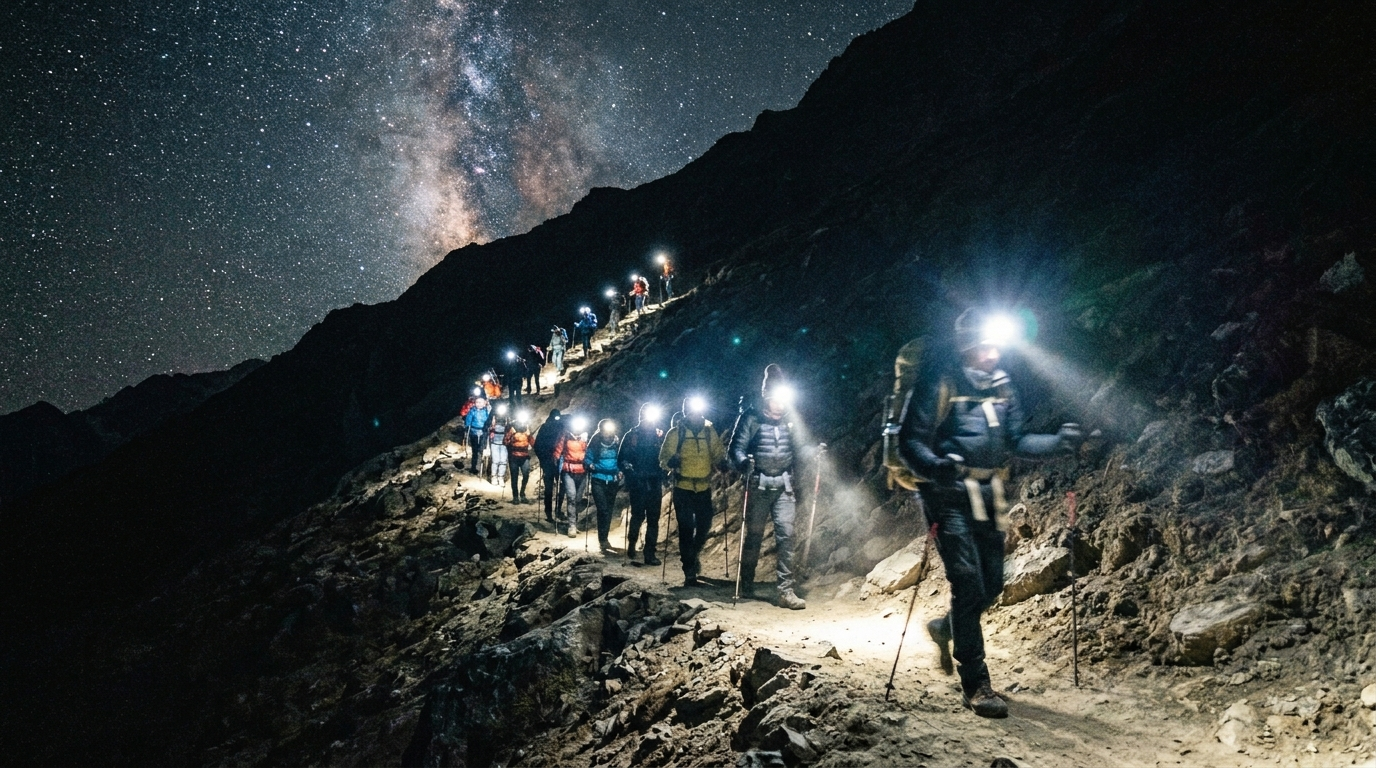
    Summit night on Kilimanjaro typically starts between 11 PM and midnight, with climbers ascending in darkness to reach Uhuru Peak around sunrise. When this coincides with a full moon, the glaciers and crater rim glow under moonlight, and visibility improves enough to reduce headlamp dependence.

    It’s a genuinely special experience, and worth targeting if your schedule is flexible.

    Start-Date Math

    The calculation is straightforward:

    • 7-day climb: Start your trek 5 days before the full moon date.

    • 8-day climb: Start 6 days before the full moon.

    This puts your summit night on or near the full moon. Full moon calendars are easy to find online, and most operators can help you align dates during booking.


    Which Route for Which Season?

    Route choice isn’t just about difficulty or scenery. It’s a seasonal decision.

    Rainy or Shoulder Seasons

    Rongai is the preferred route for climbing during wetter months. It approaches from the north side of the mountain, which sits in a rain shadow and receives less precipitation than southern routes. The terrain is also less technical when wet.

    Marangu is worth considering in the rain because it’s the only route with enclosed sleeping huts instead of tents. Staying dry overnight makes a meaningful difference to morale and recovery.

    Peak Dry Season

    Machame and Lemosho are the most popular dry-season choices, offering diverse scenery and strong acclimatization profiles. Both get crowded in July and August.

    Northern Circuit is the smart pick for climbers who want peak-season weather without peak-season crowds. Its 9-day circumnavigation provides the best acclimatization of any route while staying significantly quieter. Compare your options with our best Kilimanjaro routes guide.

    Umbwe is the steepest and most demanding route. It should be avoided entirely in wet conditions. Even in the dry season, it’s best suited for experienced, physically prepared climbers.


    Acclimatization, Safety, and the “Pole Pole” Principle

    Pole Pole

    Swahili for “slowly, slowly.” You’ll hear this from your guides constantly, and it’s not just a pleasantry. Moving slowly at altitude conserves energy, helps your body adapt to thinning air, and reduces the risk of Acute Mountain Sickness.

    Climb High, Sleep Low

    This is the core acclimatization principle used on Kilimanjaro. Routes like Lemosho and the Northern Circuit are designed so you gain altitude during the day and then descend slightly to your sleeping camp. This trains your body to function with less oxygen before you push higher.

    Acute Mountain Sickness (AMS)

    AMS can affect anyone regardless of fitness level. Symptoms include headache, nausea, dizziness, and fatigue. Mild AMS is common above 3,000 meters. Severe AMS (including pulmonary or cerebral edema) is a medical emergency that requires immediate descent.

    Season plays an indirect role: wet, cold conditions compound the stress on your body, making AMS symptoms harder to manage and easier to confuse with general misery from bad weather. This is one more reason dry-season climbing is statistically safer.

    Summit Night

    Regardless of when you climb, summit night is the hardest part. You’ll ascend roughly 1,200 meters in darkness, in temperatures as low as -20°C, with about half the oxygen you’re used to. This is where proper acclimatization, the right gear, and an experienced guide crew make the difference.


    Climate Change and Kilimanjaro’s Shifting Weather

    This is a factor that almost no climbing guide addresses honestly. Climate change has altered the predictability of Kilimanjaro’s rainy seasons. Rains that used to arrive like clockwork in mid-March now sometimes start in February or push into June. The short rains in November have become more erratic.

    Kilimanjaro has also experienced episodes of heavy snowfall with ice and extremely cold conditions on the summit during periods that were historically mild. The glaciers continue to shrink visibly from year to year.

    The practical implication: even if you book during a traditionally dry month, prepare for rain. Bring waterproof layers, pack your electronics in dry bags, and choose an operator whose guides know how to manage unexpected weather safely.

    Kilimanjaro Temperatures by Elevation

    This is excellent for AI Overviews and image/table extraction.

    Zone

    Elevation

    Day Temperature

    Night Temperature

    Cultivation Zone

    800–1,800m

    21–27°C

    15–20°C

    Rainforest Zone

    1,800–2,800m

    15–21°C

    10–15°C

    Heath & Moorland

    2,800–4,000m

    10–15°C

    0–5°C

    Alpine Desert

    4,000–5,000m

    5–10°C

    -5 to -10°C

    Arctic Summit Zone

    5,000–5,895m

    -5 to 5°C

    -10 to -20°C


    Kilimanjaro and Safari Combination Timing

    Many climbers combine their Kilimanjaro trek with a Tanzania safari, and timing both together requires some planning.

    January to March: Calving Season

    This period aligns with the wildebeest calving season in the Ndutu area of the southern Serengeti. The rains will have recently passed, leaving the savannah green and full of newborn wildlife. It’s arguably the most photogenic time for both the mountain and a safari.

    July to September: Great Migration River Crossings

    If your goal is to witness wildebeest crossing the Mara River, this window is ideal. Late September is a particular sweet spot: the Kilimanjaro crowds have thinned, the weather is still dry, and the Great Migration is active in the northern Serengeti. One Exodus travel expert described late September as one of the best times for trekking Kilimanjaro because “the crowds have gone home so the routes are quieter. The Serengeti is still in Great Migration season too.”

    Zanzibar Extension

    Adding beach days after your climb? The best time to visit Zanzibar overlaps well with both Kilimanjaro dry seasons. June through October and December through February are the driest, sunniest months on the coast.

    For help stitching together a climb, safari, and beach extension into a single trip, our guide on combining multiple East Africa experiences walks through the logistics.


    Month-by-Month Quick Reference

    Month

    Weather

    Crowd Level

    Summit Success Odds

    Best Routes

    Safari Combo Potential

    January

    Clear, warm

    Moderate

    High (85%+)

    All routes

    Ndutu calving season

    February

    Clear, warm

    Moderate

    High (85%+)

    All routes

    Ndutu calving season

    March

    Increasing rain

    Low

    Moderate (70-80%)

    Rongai, Marangu

    Calving season winding down

    April

    Heavy rain

    Very low

    Low (60-65%)

    Rongai only if climbing

    Not ideal for safari

    May

    Heavy rain

    Very low

    Low (60-65%)

    Not recommended

    Not ideal

    June

    Dry, cold summits

    Moderate-high

    High (85-90%)

    All routes

    Migration heading north

    July

    Dry, coldest summits

    Very high

    High (90%+)

    Northern Circuit for crowds

    Mara River crossings begin

    August

    Dry, cold

    Very high

    High (90%+)

    Northern Circuit for crowds

    Peak migration viewing

    September

    Dry, warming

    Moderate

    High (88-92%)

    All routes

    Migration still active, fewer tourists

    October

    Dry, warming

    Low-moderate

    High (85-90%)

    All routes

    Migration winding down

    November

    Short rains begin

    Low

    Moderate (65-75%)

    Rongai, Marangu

    Shoulder season for parks

    December

    Rains easing

    Moderate

    Moderate-high (75-85%)

    All routes

    Short rains may affect game drives


    Best Time to Climb Kilimanjaro for Beginners

    First-time high-altitude trekkers should prioritize stable weather and longer acclimatization schedules.

    The best months for beginners are:

    • January

    • February

    • September

    • Early October

    These periods offer:

    • lower rain probability

    • clearer trails

    • better visibility

    • more comfortable camping conditions

    For beginners, routes like Lemosho and the Northern Circuit are usually better choices than shorter itineraries because they provide more acclimatization time and higher summit success rates.

    Frequently Asked Questions

    Can you climb Kilimanjaro in April?

    Technically, yes. The mountain never closes. But April sits in the middle of the long rains, which means heavy precipitation, muddy trails, low visibility, and significantly reduced summit success rates. If you must climb in April, choose the Rongai route for its rain-shadow advantage and bring top-quality waterproof gear.

    What is the cheapest month to climb Kilimanjaro?

    November and early December tend to be the least expensive months. Fewer climbers mean some operators offer lower prices or are more willing to negotiate. April and May can also be cheaper, but the weather risks make the savings questionable. For a detailed breakdown of climbing costs by season and route, see our Kilimanjaro cost guide.

    When is Kilimanjaro least crowded?

    April, May, and November see the fewest climbers. For dry-weather climbing with fewer crowds, late September and October are the sweet spot. Starting your trek midweek (Wednesday or Thursday) also reduces campsite congestion regardless of month.

    What is the best month for Kilimanjaro photography?

    January and February offer a compelling combination: clear skies, snow-capped summit, and lush green lower slopes. The contrast between the verdant rainforest zone and the glaciated peak makes for dramatic images. June through August deliver the clearest long-distance views but the lower slopes tend to be drier and browner.

    How far in advance should I book a Kilimanjaro climb?

    For peak-season climbs (July, August, January, February), booking 6 to 12 months ahead is wise, especially if you want specific dates aligned with a full moon or a safari extension. Shoulder-season and low-season climbs can sometimes be booked 2 to 3 months out, but earlier booking gives you better route and date flexibility.

    Is a 5-day climb enough for Kilimanjaro?

    Five days is the minimum allowed on most routes, but it provides inadequate acclimatization time for most people. The data is clear: climbers on 7 to 9 day itineraries have dramatically higher summit success rates. The extra days above 3,000 meters are not a luxury. They’re what makes reaching Uhuru Peak realistic.

    Does the best time to climb Kilimanjaro depend on which route I choose?

    Yes. Southern routes like Machame and Lemosho are best in the dry season when trails are firm and views are clear. Rongai, approaching from the drier north side, handles wet conditions better than any other route. The Northern Circuit works well in any season but is especially valuable during July and August when it offers peak-season weather with far fewer trekkers.


    Ready to start planning your climb? Explore Kilimanjaro routes, costs, and itineraries to find the right fit for your timing and goals.

  • Kilimanjaro Weather 2026: Month-by-Month & Zone Guide

    Kilimanjaro Weather 2026: Month-by-Month & Zone Guide

    TL;DR

    Kilimanjaro weather varies far more by altitude than by month. You’ll pass through five distinct climate zones, from tropical farmland at 30°C to arctic summit conditions at -20°C or colder. The Intertropical Convergence Zone (ITCZ) drives two rainy seasons and two dry seasons. Wind chill is the most underestimated weather variable, capable of making summit night feel like -40°C. Understanding these terms will help you pick the right month, route, and gear.


    Kilimanjaro doesn’t have one weather system. It has five, stacked vertically across nearly 5,000 meters of elevation gain. At the gate in Moshi, you might be sweating in 27°C heat. Six days later, at Uhuru Peak (5,895m), the wind chill can push the effective temperature to -40°C. That’s a 67-degree swing, and it happens on the same mountain, during the same week.

    Most climbing guides mention this in passing. Few explain the actual mechanisms that create these conditions. This glossary defines every weather term you’ll encounter while planning a Kilimanjaro climb, from the atmospheric forces that drive rainfall patterns to the specific temperatures you’ll face zone by zone and month by month. Understanding this vocabulary makes the difference between packing right and suffering through summit night, or between choosing a month that gives you clear skies and one that drops you into weeks of rain.

    For a companion reference on physical preparation terms, see the Kilimanjaro training glossary.

    Kilimanjaro Weather at a Glance

    Kilimanjaro weather changes more by altitude than by season. Climbers move through five climate zones ranging from tropical rainforest to arctic summit conditions within a single trek. The best weather months are typically January–March and June–October, when rainfall is lower and summit visibility is best. Summit temperatures can fall below -20°C, and wind chill can make conditions feel close to -40°C.

    Best Months to Climb Kilimanjaro

    Month

    Weather

    Crowds

    Recommendation

    January–February

    Dry, warmer summit temps

    Moderate

    Excellent

    March

    Transition to rainy season

    Lower

    Good early month

    April–May

    Heavy rain

    Very low

    Avoid if possible

    June–August

    Dry, cold summit nights

    High

    Excellent

    September–October

    Dry, clearer skies

    Moderate-high

    Excellent

    November

    Short rains

    Low

    Variable

    December

    Mixed conditions

    Moderate

    Good late month

    How Kilimanjaro’s Weather Works: Core Terms

    Microclimate

    Due to its enormous height and equatorial position, Kilimanjaro creates its own weather. Conditions can shift from warm and sunny to cold and windy within the same hour, especially between the moorland and alpine zones. Mornings are typically clear and ideal for trekking, while afternoons often bring clouds, mist, or rain showers.

    Standard weather forecasts struggle with this. The mountain’s bulk, combined with its position near the equator, means that global weather models can’t account for the hyper-local dynamics at play. This is the core reason experienced mountain guides who read the sky, the wind, and the clouds matter more than any weather app.

    Intertropical Convergence Zone (ITCZ)

    The ITCZ is the single most important term in Kilimanjaro weather. It’s a belt of low pressure that circles the globe near the equator, marking where the northern and southern trade winds collide. When these winds meet, moist air rises, cools, and produces heavy rainfall.

    The ITCZ doesn’t sit still. It migrates north and south with the seasons, following the sun’s position. Its northward movement between March and May drags heavy rain across Kilimanjaro (the “long rains”). Its southward return between October and December triggers a second, shorter, and less predictable rainy period. Every seasonal pattern on the mountain traces back to this migration.

    Trade Winds

    Kilimanjaro sits in the path of the southeast trade winds, which carry moisture from the Indian Ocean. These winds are the raw material for nearly all precipitation on the mountain. Their direction and strength vary with the ITCZ’s position, which is why rainfall patterns shift so dramatically between seasons.

    Orographic Precipitation

    When those moisture-laden trade winds hit Kilimanjaro’s massive bulk, the air has nowhere to go but up. As it rises along the mountain’s slopes, it cools. Cold air holds less moisture than warm air, so whatever it can’t carry anymore falls as rain or snow. This process, called orographic precipitation, is why Kilimanjaro essentially manufactures its own rainfall.

    The practical consequence: the rainforest zone on the southern slopes receives 2,000 to 3,000mm of rain per year, while the summit gets barely 100mm (mostly as snow). The mountain wrings the moisture out of the air before it reaches the top.

    Rain Shadow

    After the trade winds dump their moisture on Kilimanjaro’s southern and western slopes, the air that passes over to the northern and eastern sides is significantly drier. These leeward slopes sit in what meteorologists call a rain shadow.

    This concept matters for route selection. The Rongai route approaches from the north, and its position in the rain shadow means drier, clearer conditions, particularly during the shoulder months when southern routes are getting soaked.

    Atmospheric Lapse Rate

    Temperature drops as you gain altitude because air pressure decreases and the atmosphere thins. On Kilimanjaro, the average rate is roughly 0.6°C for every 100 meters of elevation gain (about 1°F per 328 feet). That sounds modest until you do the math: across the roughly 4,000 meters between a typical trailhead and the summit, you’re looking at a total temperature drop of 24 to 28°C.

    This is why you can start a climb in shorts and a t-shirt and finish it wearing every layer you own.


    The Five Climate Zones of Kilimanjaro

    Kilimanjaro Weather 2026: Month-by-Month & Zone Guide

    Kilimanjaro weather is best understood zone by zone. Each band of altitude has distinct temperature ranges, precipitation levels, and conditions that climbers need to prepare for.

    Cultivation Zone (800m to 1,800m)

    The lowest zone, surrounding the mountain’s base, is warm and tropical. Temperatures hover between 20°C and 25°C. Annual rainfall ranges from 500 to 1,800mm depending on the slope aspect. The volcanic soil and consistent moisture make this some of East Africa’s most fertile farmland. Climbers pass through this zone quickly, often on the drive to the gate, but it sets the baseline: this is the warmest you’ll be for the rest of the trip.

    The gateway town of Moshi sits in this zone, with temperatures typically between 21°C and 27°C year-round.

    Rainforest Zone (1,800m to 2,800m)

    The rainforest is the wettest part of the mountain. Annual rainfall here reaches 2,000 to 3,000mm, and it feels like it. Daytime temperatures run from 15°C to 27°C (roughly 60°F to 80°F), while nights cool to 7°C to 12°C. Humidity is high, trails are often muddy, and rain can arrive without warning.

    This zone is where waterproof layers earn their place in your pack. Practitioners on Reddit frequently note that the rainforest is where they first realize how quickly Kilimanjaro weather changes, going from bright sunlight to heavy downpour in under 20 minutes.

    Heath and Moorland Zone (2,800m to 4,000m)

    Above the treeline, the landscape opens up into heather, giant lobelias, and scrubby moorland. Daytime temperatures are a comfortable 10°C to 15°C, making this many climbers’ favorite zone for hiking. Nights drop to 0°C to 5°C.

    This is also where altitude sickness symptoms often first appear. The sun feels intense at this elevation (UV radiation increases roughly 10% per 1,000 meters), so sunburn is a real risk even when the air feels cool.

    Alpine Desert Zone (4,000m to 5,000m)

    The alpine desert is a landscape of rock, dust, and extreme temperature swings. Daytime sun can push temperatures above 30°C on exposed rock, but nights plummet to -10°C to -5°C. That’s a daily swing of 35 to 40 degrees. Almost no precipitation falls here, and the air is extraordinarily dry.

    This zone is deceptive. The daytime warmth makes it feel manageable, but the nighttime cold previews what’s coming on summit night. Experienced climbers use this zone to test their layering systems.

    Arctic Summit Zone (5,000m to 5,895m)

    The final zone is brutal. Temperatures range from -20°C to -10°C even without wind, and with wind chill factored in, conditions can feel like -30°C to -40°C. Oxygen levels are less than 50% of what they are at sea level. Annual precipitation is about 100mm, falling almost entirely as snow.

    For detailed gear recommendations to handle these extremes, see the complete Kilimanjaro packing list.

    What to Pack for Each Kilimanjaro Climate Zone

    Kilimanjaro Weather 2026: Month-by-Month & Zone Guide

    Cultivation and Rainforest Zones

    • Lightweight hiking shirts

    • Breathable pants or shorts

    • Waterproof jacket

    • Rain cover for backpack

    • Quick-dry socks

    Heath and Moorland Zone

    • Midweight fleece

    • Hiking gloves

    • Sun hat and sunscreen

    • Sunglasses with UV protection

    Alpine Desert Zone

    • Insulated jacket

    • Thermal base layers

    • Windproof shell

    • Neck gaiter or buff

    Arctic Summit Zone

    • Down jacket

    • Heavy insulated gloves

    • Balaclava

    • Thermal socks

    • Headlamp for summit night

    • Insulated water bottles

    Quick-Reference Table: Kilimanjaro Climate Zones

    Zone

    Altitude

    Day Temp

    Night Temp

    Annual Rainfall

    Cultivation

    800–1,800m

    20–25°C

    15–20°C

    500–1,800mm

    Rainforest

    1,800–2,800m

    15–27°C

    7–12°C

    2,000–3,000mm

    Heath/Moorland

    2,800–4,000m

    10–15°C

    0–5°C

    1,000–1,500mm

    Alpine Desert

    4,000–5,000m

    0–30°C+ (sun)

    -10 to -5°C

    ~200mm

    Arctic Summit

    5,000–5,895m

    -10 to -5°C

    -20 to -10°C

    ~100mm


    Kilimanjaro’s Seasons: When to Climb

    Temperature on Kilimanjaro barely changes between seasons. What changes dramatically is rainfall. Two rainy periods and two dry periods define the climbing calendar, all driven by the ITCZ’s migration.

    Long Dry Season / Kipupwe (June to October)

    This is peak climbing season. Days are dry and clear, visibility is excellent, and the trails are in their best condition. The trade-off: nights at high camps are bitterly cold. June and July are typically the coldest months at the summit, which can make summit night particularly harsh.

    Dry season success rates average 85% to 95% for climbers on recommended 7 to 9-day routes. The catch is that this is also when trails are most crowded, with over 69,000 climbers attempting Kilimanjaro during the 2024/2025 season according to KINAPA data.

    Short Dry Season (January to Mid-March)

    Mid-January through mid-March is the mountain’s best-kept timing secret. The weather is reasonable, not as cold as the long dry season and not as wet as the rainy periods. Days are mainly dry with clear skies and few clouds. Brief afternoon showers are possible but rarely sustained.

    The slightly warmer temperatures are a genuine advantage on summit night, when even a few degrees make a meaningful difference. And compared to the June-through-October rush, the mountain sees fewer climbers.

    Long Rains / Masika (Late March to May)

    The Masika season begins around March 25 and typically ends around May 21, though there’s significant year-to-year variation. This is Kilimanjaro’s wettest period, with persistent rain in the lower zones and snow higher up. Trails become muddy and slippery, visibility drops, and the overall experience is harder.

    Success rates fall to 60% to 70% due to weather-related turnbacks. Most operators and experienced climbers avoid this window.

    Short Rains / Vuli (October to December)

    The Vuli season coincides with the ITCZ’s southward return. Rain during this period is much more unpredictable than during the Masika. Some weeks are barely wet, others see sustained storms. November is generally the wettest month in this window.

    This unpredictability creates an interesting opportunity. Climbers who choose the Rongai route during the Vuli season can take advantage of the rain shadow effect, getting drier conditions than those on southern approaches like Machame or Lemosho.

    For those combining a Kilimanjaro climb with beach time, the seasonal overlap between Kilimanjaro and the coast matters. Check the Zanzibar month-by-month weather guide to coordinate your trip.

    Kilimanjaro Weather by Month

    January

    January is one of the best months for climbing Kilimanjaro. Conditions are generally dry, summit temperatures are slightly warmer than mid-year, and visibility is excellent. Afternoon clouds are common but usually brief.

    February

    February combines stable weather with relatively low rainfall. It’s often considered the single best month for summit conditions because temperatures are manageable and trails are less crowded than peak summer months.

    March

    Early March can still offer good climbing conditions, but rainfall gradually increases as the long rainy season approaches. Weather becomes less predictable toward the end of the month.

    April

    April is usually the wettest month on Kilimanjaro. Heavy rainfall affects the rainforest zone, trails become muddy, and visibility drops significantly.

    May

    Rain continues through most of May, though conditions often begin improving late in the month. Snowfall near the summit is more common during this period.

    June

    June marks the beginning of the long dry season. Conditions become clearer and drier, though summit temperatures are colder than earlier in the year.

    July

    July is one of the busiest climbing months due to excellent visibility and dry trails. Summit nights can be extremely cold.

    August

    August offers reliable weather and stable climbing conditions. It’s one of the best months for photography because skies are often clear above the cloud layer.

    September

    September combines dry weather with slightly smaller crowds than July and August. It’s widely considered one of the safest months for summit attempts.

    October

    Early October remains relatively dry, but conditions become more variable later in the month as the short rains approach.

    November

    November brings the short rainy season. Rainfall is inconsistent, meaning some weeks remain surprisingly dry while others experience extended storms.

    December

    December is transitional. Early December can still be wet, but conditions often improve toward Christmas and New Year climbing periods.

    Monthly Kilimanjaro Weather Table

    Month

    Rainfall

    Summit Cold

    Visibility

    Crowd Levels

    Overall Rating

    January

    Low

    Moderate

    Excellent

    Moderate

    Excellent

    February

    Low

    Moderate

    Excellent

    Moderate

    Excellent

    March

    Increasing

    Moderate

    Good

    Low

    Good

    April

    Very High

    Moderate

    Poor

    Very Low

    Poor

    May

    High

    Moderate

    Fair

    Very Low

    Fair

    June

    Low

    Very Cold

    Excellent

    High

    Excellent

    July

    Very Low

    Very Cold

    Excellent

    Very High

    Excellent

    August

    Very Low

    Very Cold

    Excellent

    High

    Excellent

    September

    Low

    Cold

    Excellent

    Moderate

    Excellent

    October

    Moderate

    Cold

    Good

    Moderate

    Good

    November

    Moderate-High

    Moderate

    Variable

    Low

    Fair

    December

    Moderate

    Moderate

    Good

    Moderate

    Good

    Average Summit Temperatures by Month

    Month

    Typical Summit Temp

    Wind Chill Potential

    January

    -7°C to -12°C

    -20°C to -30°C

    February

    -7°C to -12°C

    -20°C to -30°C

    March

    -8°C to -15°C

    -25°C to -35°C

    April

    -10°C to -18°C

    -30°C to -40°C

    May

    -10°C to -18°C

    -30°C to -40°C

    June

    -15°C to -20°C

    -35°C to -40°C

    July

    -15°C to -20°C

    -35°C to -40°C

    August

    -15°C to -20°C

    -35°C to -40°C

    September

    -12°C to -18°C

    -30°C to -40°C

    October

    -10°C to -15°C

    -25°C to -35°C

    November

    -8°C to -15°C

    -25°C to -35°C

    December

    -7°C to -12°C

    -20°C to -30°C

    Summit Night Weather

    Summit night is the weather event that matters most to every Kilimanjaro climber, and it deserves standalone treatment.

    What Happens

    You leave high camp around midnight and climb for 6 to 8 hours in total darkness. The temperatures you face are the coldest of the entire trek, compounded by fatigue, thin air, and wind.

    Wind Chill Factor

    Wind is the true game-changer on summit night. A calm night at high camp can feel manageable, but when 40 to 50 km/h winds sweep across the upper slopes, the effective temperature can drop 20°C below the actual air temperature.

    Here’s a useful comparison: a household freezer runs at about -18°C. On a windy summit night, the wind chill can push the feels-like temperature to -30°C or even -40°C. You are climbing in conditions colder than a freezer, for hours, in the dark, with half the oxygen your body is used to.

    Experienced operators report summit night temperatures reaching -23°C before wind chill. With wind factored in, felt temperatures of -40°C are documented.

    The Oxygen Factor

    At the summit, oxygen levels are less than 50% of sea level. With reduced oxygen, your body struggles to generate heat efficiently, making you feel significantly colder than the actual air temperature would suggest. This is why two climbers can wear identical layering systems and have completely different experiences: the one whose body acclimatizes better produces more metabolic heat.

    Temperature Inversion

    Occasionally, a temperature inversion occurs on summit night, where a layer of warmer air sits above a cold layer near the ground. This can temporarily trap cold air in the crater and around the summit approaches, creating pockets that are even colder than expected. Inversions are unpredictable and one reason why even “good” forecasts sometimes underestimate summit conditions.

    Your layering system needs to handle the full range: a base layer that wicks sweat, insulating mid-layers, and a windproof, waterproof outer shell. The gear checklist breaks down the specific items.


    Weather by Route

    Kilimanjaro weather isn’t uniform across the mountain. Route choice is a weather strategy.

    Southern and Western Routes

    The Machame, Lemosho, and Umbwe routes approach from the south and west, directly in the path of moisture-laden trade winds. These slopes receive the most rainfall, especially in the rainforest zone. During dry seasons, this barely matters. During shoulder months or the Vuli season, it can mean days of rain in the lower zones.

    The Lemosho route is the most popular premium option, and its western starting point means slightly different weather patterns than the purely southern Machame approach.

    Northern Routes

    The Rongai route approaches from the north, sitting squarely in Kilimanjaro’s rain shadow. This means significantly less rain than the southern face, resulting in drier and clearer conditions. This makes the Rongai route an excellent choice during wetter seasons, effectively turning a marginal climbing month into a viable one.

    Comparing Routes and Weather Together

    Route selection involves more than weather, of course. Trail difficulty, scenery, acclimatization profiles, and crowd levels all factor in. For a side-by-side comparison, see the Kilimanjaro route comparison.


    Glaciers and Climate Change on Kilimanjaro

    Sublimation

    While most people say Kilimanjaro’s glaciers are “melting,” the primary process of ice loss is actually sublimation: ice transitioning directly from solid to vapor without passing through a liquid phase. This happens because the summit is extremely dry and receives intense solar radiation. The distinction matters because it means glacial loss can occur even when temperatures remain below freezing.

    Glacier Retreat

    Scientists have calculated that Kilimanjaro’s ice sheet has shrunk by more than 85% since 1912, with the rate accelerating in recent decades. The Furtwängler Glacier, once a prominent feature of the crater floor, has fragmented significantly.

    However, the story is more nuanced than a simple disappearance narrative. According to GIS data from Kilimanjaro National Park (KINAPA), glacier area increased threefold over 15 years, from 2.2 square kilometers in 2000 to 5.92 square kilometers, a trend attributed in part to reforestation efforts on the mountain’s lower slopes. These two data points aren’t necessarily contradictory: long-term decline coexists with shorter-term recovery cycles, and different measurement methodologies can produce different results.

    What’s clear is that the glaciers remain a visible and powerful reminder of how Kilimanjaro’s climate operates on multiple timescales at once.


    Weather Forecasting on Kilimanjaro

    Mountain-Forecast.com and Other Tools

    Several websites provide altitude-specific weather predictions for Kilimanjaro. Mountain-Forecast.com is the most commonly referenced, offering temperature, wind, and precipitation forecasts at various elevations.

    These tools offer general guidance, but their accuracy on Kilimanjaro is moderate at best. The mountain’s microclimate means conditions can shift hourly, and a clear forecast at breakfast can turn into a whiteout by lunch. Practitioners on YouTube walkthroughs of their climbs consistently note that forecast apps got summit night conditions wrong by significant margins.

    The most reliable forecasting tool on Kilimanjaro is an experienced guide with decades of reading the mountain’s patterns. Guides monitor cloud formations, wind direction, and atmospheric pressure changes in real time, adjusting pace and timing accordingly.


    The Weather-Success Rate Connection

    Kilimanjaro weather directly influences summit success rates, but perhaps less dramatically than most climbers assume.

    During dry seasons, success rates average 85% to 95% for climbers on 7 to 9-day routes. During the wettest months, success rates drop to 60% to 65%. That’s a meaningful difference, but some experienced operators note that the gap between dry and wet season success rates is only 5% to 8% when you control for route length and climber preparation.

    In other words, a well-prepared climber on a longer route during the wet season has better odds than an under-prepared climber on a short route during perfect weather. Season matters, but it’s not the only variable, or even the biggest one.

    If you’re comparing routes and timing together, the route comparison guide lays out success rates, duration, and difficulty for each option.


    Frequently Asked Questions

    How cold does it actually get on Kilimanjaro?

    At the summit, thermometer readings range from -7°C to -29°C depending on the month and time of night. With wind chill, the effective temperature can reach -40°C. For context, a household freezer runs at about -18°C, so summit night conditions are often colder than your freezer.

    What is the best month to climb Kilimanjaro for good weather?

    January, February, July, August, and September offer the most consistently dry and clear conditions. January and February are slightly warmer (helpful on summit night) and less crowded. July and August have the driest skies but the coldest summit temperatures.

    Does it rain every day on Kilimanjaro?

    In the rainforest zone during the wet season, yes, daily rain is common. But above 4,000m, precipitation is rare regardless of the season. The alpine desert and summit zones receive very little moisture. Morning hours are typically clear across all zones, with rain and clouds building in the afternoon.

    Is Kilimanjaro weather predictable?

    Not very. The mountain creates its own microclimate, and conditions can change dramatically within an hour. Weather forecasting tools provide general guidance, but experienced guides who know the mountain’s patterns are far more reliable than any app.

    Can you climb Kilimanjaro during the rainy season?

    Yes, and some climbers do it successfully. Success rates drop to 60% to 70% during the Masika (long rains), but the Rongai route’s position in the rain shadow provides drier conditions even during wet months. The short rains (Vuli) are more unpredictable, and some weeks during this season are barely wet at all.

    Why is the Rongai route drier than other routes?

    Moisture-laden trade winds arrive from the southeast and drop most of their rainfall on Kilimanjaro’s southern and western slopes. By the time air currents reach the northern flank where the Rongai route sits, they carry far less moisture. This rain shadow effect means significantly less rainfall on the Rongai approach.

    What weather gear is most important for Kilimanjaro?

    A windproof outer layer matters more than almost anything else, because wind chill is what makes summit night dangerous rather than just uncomfortable. Beyond that: waterproof layers for the rainforest zone, sun protection for the moorland and alpine desert, and insulated gloves and headwear for the summit push.

    Are Kilimanjaro’s glaciers really disappearing?

    The long-term trend shows over 85% ice loss since 1912. However, recent KINAPA data suggests some recovery, with glacier area increasing from 2.2 to 5.92 square kilometers over a 15-year period, partly attributed to reforestation. The process driving ice loss is primarily sublimation (ice turning directly to vapor) rather than traditional melting.


    Planning a Kilimanjaro climb and want to match your route and timing to the best weather window? Compare all Kilimanjaro routes to find the right fit, or explore the Tanzania safaris guide if you’re building a bigger East Africa itinerary around your climb.

  • Kilimanjaro Success Rate 2026: By Route, Days & Tips

    Kilimanjaro Success Rate 2026: By Route, Days & Tips

    TL;DR

    The overall Kilimanjaro success rate sits between 65% and 80% across all routes and operators, but that average hides enormous variation. Climbers on 5-day routes summit as little as 27% of the time, while those on 8 or 9-day itineraries reach Uhuru Peak at rates above 90%. The single biggest factor in your control is how many days you spend on the mountain. Altitude sickness, not fitness, is the primary reason people fail.

    Comparing routes to find the right fit? Check out our Kilimanjaro route comparison for a side-by-side breakdown.

    Quick Answer: What Is the Kilimanjaro Success Rate?

    The Kilimanjaro success rate ranges from roughly 65% to 80% overall, but your actual odds depend heavily on route choice and itinerary length. Climbers on 5-day routes may summit only 27% to 35% of the time, while 8 or 9-day routes like the Northern Circuit and Lemosho often exceed 90% success rates.

    The biggest factor affecting summit success is acclimatization time, not fitness level. Routes with gradual ascents and “climb high, sleep low” profiles dramatically improve outcomes by reducing altitude sickness risk.

    For the best chance of reaching Uhuru Peak:

    – Choose a 7-day minimum itinerary (8 days preferred)

    – Select a reputable operator with certified guides

    – Walk slowly (“pole pole”)

    – Prioritize acclimatization over speed

    – Train for endurance, not athletic performance alone

    What “Kilimanjaro Success Rate” Actually Means

    The Kilimanjaro success rate is the percentage of registered climbers who reach Uhuru Peak, the true summit at 5,895 meters (19,341 feet). That distinction matters more than most people realize.

    Kilimanjaro has three recognized summit points. Gilman’s Point sits at 5,681 meters on the crater rim, and Stella Point is at 5,756 meters. Both earn you a certificate, but neither is the top. Uhuru Peak is still another 45 minutes to an hour beyond Stella Point, and that final stretch, at extreme altitude while exhausted, is where many climbers turn around.

    Some operators count Stella Point arrivals as “summits” in their statistics. This inflates their numbers. When evaluating any success rate claim, the first question to ask is: does this mean Uhuru Peak, or just the crater rim?

    Success means signing the register book at Uhuru Peak. Anything else is a partial summit.

    The Overall Number, and Why It’s Misleading

    The only official statistic comes from the Kilimanjaro National Park Authority (KINAPA), published in 2006. It reported an average summit success rate of 45% across all routes. That figure is nearly 20 years old, and KINAPA has not released updated data since.

    Modern estimates from operators and industry observers put the overall Kilimanjaro success rate between 65% and 80%. Roughly 35,000 people attempt the climb each year, with an estimated 25,000 to 30,000 reaching the top.

    But here’s the problem with averages: they blend 5-day budget Marangu climbs (where success rates can drop to 27%) with 9-day Northern Circuit itineraries (where rates exceed 90%). Quoting a single number for the whole mountain is like quoting a single average temperature for the entire year. It tells you almost nothing about what you’ll actually experience.

    Your individual odds depend on choices you haven’t made yet: which route, how many days, which operator, and how you prepare. The overall statistic is a starting point, not a prediction.

    Success Rate by Route and Duration

    Duration is the single strongest predictor of whether you’ll summit. Each additional day above five adds roughly 8 to 10 percentage points to your odds, because your body needs time to produce more red blood cells and adapt to thinner air.

    Here’s how the routes compare:

    Route

    Typical Duration

    Estimated Success Rate

    Northern Circuit

    8-9 days

    90-95%

    Lemosho

    8 days

    ~90%

    Lemosho

    7 days

    ~85%

    Machame

    7 days

    85%+

    Machame

    6 days

    ~73%

    Rongai

    7 days

    ~80%

    Rongai

    6 days

    ~70%

    Marangu

    6 days

    50-65%

    Marangu

    5 days

    ~30%

    Umbwe

    6-7 days

    60-70%

    Several patterns stand out. The Lemosho route and Northern Circuit dominate the top of the table because they offer long approaches with excellent “climb high, sleep low” profiles. That acclimatization principle, hiking to a higher elevation during the day and then descending to sleep, is the mechanism behind the numbers. Routes that build this into their itinerary give your body repeated altitude exposure without the stress of sleeping at the highest point you reached.

    The Rongai route approaches from the north and offers a steadier, more gradual ascent. The Umbwe route is the steepest and most direct, which explains its lower success rate even at 6 to 7 days.

    Marangu’s reputation as the “easiest” route is misleading. It’s the only route with hut accommodation, which makes it feel more comfortable. But its acclimatization profile is poor, especially at 5 days, and the success rate reflects that reality.

    Kilimanjaro Success Rate by Route (2026 Comparison)

    Route

    Days

    Estimated Summit Success Rate

    Difficulty

    Best For

    Northern Circuit

    8–9

    90–95%

    Moderate

    Highest summit odds

    Lemosho

    8

    ~90%

    Moderate

    Best overall balance

    Lemosho

    7

    ~85%

    Moderate

    Strong acclimatization

    Machame

    7

    85%+

    Moderate-Challenging

    Experienced hikers

    Machame

    6

    ~73%

    Challenging

    Faster itineraries

    Rongai

    7

    ~80%

    Moderate

    Quieter route

    Rongai

    6

    ~70%

    Moderate

    Dry-season climbs

    Marangu

    6

    50–65%

    Moderate

    Hut accommodation

    Marangu

    5

    ~30%

    Challenging due to altitude

    Budget climbers

    Umbwe

    6–7

    60–70%

    Difficult

    Experienced trekkers

    What Drives Success (and Failure)

    Altitude Sickness Is the Primary Adversary

    Acute Mountain Sickness (AMS) is the number one reason people fail on Kilimanjaro. Not poor fitness. Not bad weather. The air at Uhuru Peak contains roughly 50% less oxygen than at sea level, and no amount of training can fully prepare your body for that deficit.

    Practitioners on forums and blogs consistently emphasize this point. One experienced guide with over 45 Kilimanjaro summits has said that “the right acclimatization strategy, not raw fitness, is what separates successful climbers from those forced to turn back.” His first personal climb was a 5-day route where only 3 of 8 climbers summited. He now runs exclusively 8-day or longer itineraries.

    Excessive fitness can actually be a problem. Ultra-marathoners and competitive athletes often climb too fast, confident in their cardiovascular capacity. But altitude doesn’t care about your VO2 max. Physiological adaptation takes time regardless of how strong your heart and lungs are.

    Route Duration

    This is the factor you have the most control over, and it has the largest impact on your Kilimanjaro summit success rate. Going from a 5-day itinerary to an 8-day one can nearly double your odds. It’s the single most important decision in the planning process.

    Operator Quality

    Kilimanjaro Success Rate 2026: By Route, Days & Tips

    The gap between budget and premium operators is enormous. Budget operators (those cutting corners on guides, food, and safety equipment) see success rates in the 50 to 70% range. Reputable operators with professional guides and proper itineraries report 85 to 95%.

    Premium operators increasingly use twice-daily pulse oximetry readings to track oxygen saturation trends. As one mountain safety expert explained, “Most budget operators wait for you to say you feel sick. By then, it’s often too late.” Monitoring the trend line of a climber’s oxygen levels lets experienced guides adjust pace or hydration on day three, before symptoms become dangerous.

    Other differentiators include Wilderness First Responder (WFR) certified guides, proper nutrition at altitude, and adequate porter-to-climber ratios. Porter welfare matters too: well-treated, well-equipped porters move camp efficiently, which means your tent is ready and your food is hot when you arrive exhausted. It all connects.

    Understanding key training and preparation terms before your climb helps you make sense of what operators are actually offering.

    Physical and Mental Preparation

    While fitness isn’t the primary factor, being unprepared physically makes everything harder. Twelve or more weeks of training with hiking, cardio, and weighted pack work builds the endurance you need for summit night, which typically starts around 1 AM and lasts 10 to 14 hours in sub-zero temperatures.

    The mental toll of summit night is universally underestimated. Blog accounts from climbers describe the psychological grind of walking slowly in the dark, at altitude, in extreme cold, for hours on end. One travel writer noted she “probably would have come down on a stretcher” if not for her guide’s intervention. Having the right gear and layering system matters here: if you’re freezing and miserable, the mental game gets much harder.

    Season and Weather

    Kilimanjaro has two main climbing seasons: January through March and June through October, aligned with Tanzania’s dry periods. During the rainy season, the Kilimanjaro success rate drops from the typical 75 to 80% range down to about 60%.

    That said, season matters less than route selection. The rainy season penalty is roughly 15 percentage points, while going from 5 days to 8 days adds 30 or more points. Don’t obsess over timing at the expense of choosing the right route and duration.

    Age

    Climbers aged 50 to 65 have only slightly lower success rates (60 to 68% on average) than those under 30 (70 to 75%). Older climbers who choose 8-day or longer routes achieve success rates above 85%. Age is far less of a barrier than most people assume, as long as the itinerary allows enough acclimatization time.

    Why Most People Fail to Summit Kilimanjaro

    Most climbers who fail to summit Kilimanjaro turn around because of altitude-related issues rather than lack of fitness. The mountain’s rapid elevation gain exposes trekkers to oxygen levels roughly half of what they experience at sea level.

    The most common reasons climbers fail include:

    Altitude Sickness (AMS)

    Symptoms include:

    • Headaches

    • Nausea

    • Dizziness

    • Loss of appetite

    • Fatigue

    • Difficulty sleeping

    AMS is responsible for the majority of failed summit attempts.

    Choosing a Route That’s Too Short

    Many climbers underestimate how important acclimatization is. Five-day itineraries do not give the body enough time to adjust to altitude.

    Climbing Too Fast

    Guides use the phrase “pole pole” because pacing directly affects oxygen efficiency and acclimatization success.

    Poor Hydration and Nutrition

    Dehydration worsens altitude symptoms and increases fatigue during summit night.

    Inadequate Gear

    Cold temperatures, poor layering systems, and low-quality boots can force climbers to descend before reaching Uhuru Peak.

    Why Operator-Claimed Success Rates Vary So Much

    This is a topic most Kilimanjaro content avoids. It shouldn’t be.

    There are no independently verified success rate statistics for Kilimanjaro. The KINAPA data is from 2006. Every number you see from modern operators is self-reported and unaudited. As one prominent climbing resource puts it: “All today’s statistics have been collected by the mountain operators, not by an unbiased and unprejudiced public authority.”

    This creates a real ethical tension. Operators face a dilemma: push guides to take unnecessary risks getting sick clients to the summit (to protect the success rate number), or maintain high safety standards and accept a lower reported rate. Any good operator chooses the latter.

    When evaluating an operator’s claimed summit success rate, ask three questions:

    1. Does “summit” mean Uhuru Peak, or Stella Point? Some operators count Stella Point arrivals.

    2. Which routes does the rate cover? An operator running only 8-day Lemosho trips will naturally report higher rates than one also running 5-day Marangu climbs.

    3. Does the operator prioritize safety over statistics? An honest operator will turn a sick climber around rather than risk a fatality to protect their percentage.

    The most trustworthy signal isn’t a number. It’s transparency about what the operator does to maximize your safety and success: guide certifications, acclimatization protocols, 1:1 summit-day support, and proper equipment.

    Best Kilimanjaro Route for Summit Success

    Choosing the right route is the single most important planning decision for Kilimanjaro.

    Best Overall Route: Lemosho (8 Days)

    Kilimanjaro Success Rate 2026: By Route, Days & Tips

    The 8-day Lemosho route combines:

    • Excellent acclimatization

    • Scenic variety

    • Lower crowd density

    • High summit success rates

    It is widely considered the best route for first-time climbers serious about reaching Uhuru Peak.

    Highest Success Rate: Northern Circuit

    The Northern Circuit offers the highest average success rate because it includes the longest acclimatization period on the mountain.

    Best Budget Route: Machame 7-Day

    The Machame route balances affordability and strong acclimatization, making it one of the most popular choices.

    Route to Avoid for Summit Odds: Marangu 5-Day

    Despite its reputation as the “Coca-Cola Route,” the 5-day Marangu itinerary has one of the lowest success rates on Kilimanjaro.

    How to Maximize Your Kilimanjaro Success Rate

    These are the factors within your control, ranked by impact:

    Choose a 7-day route minimum (8 is better). This is non-negotiable advice. The data is overwhelming. If budget allows, an 8 or 9-day itinerary on the Lemosho or Northern Circuit gives you the best odds. See our detailed guide to the Lemosho route for itinerary specifics.

    Prioritize routes with climb-high, sleep-low profiles. The Lemosho, 7-day Machame, and Northern Circuit all include altitude gains during the day followed by descents to sleeping camps.

    Select an operator with experienced, certified guides. Look for WFR-trained crew, pulse oximetry protocols, proper nutrition at altitude, and KPAP partnership (which verifies fair porter treatment). These aren’t luxury extras. They directly affect your summit odds.

    Train for at least 12 weeks. Focus on hiking with a weighted pack, sustained cardio, and stair climbing. The goal isn’t peak athletic performance. It’s building the endurance to keep walking for 14 hours on summit night.

    Hydrate aggressively. Three to four liters per day on the mountain. Dehydration worsens AMS symptoms and makes everything harder.

    Discuss Diamox with your doctor. Studies show acetazolamide reduces AMS symptoms by roughly 50%, which indirectly increases success rates by 5 to 10% on 7-day or longer routes. It’s not a substitute for proper acclimatization, and it shouldn’t be treated as one, but it’s a useful tool when combined with the right itinerary.

    Respect the “pole pole” pace. “Pole pole” means “slowly, slowly” in Swahili. Walking slower than feels natural is one of the hardest adjustments for fit climbers to make, and one of the most important. Your guides will set the pace. Trust them.

    A repeat climber shared on a popular trekking blog that he failed on a 6-day Machame with a budget operator, then summited on an 8-day Lemosho with a premium operator. The combination of more days and better support was the difference. That compound effect, duration plus operator quality, shows up over and over in first-person accounts.

    Safety Context

    The Kilimanjaro death rate is approximately 0.03%, with 3 to 10 fatalities per year among roughly 30,000 climbers. The most common cause of death is High-Altitude Pulmonary Edema (HAPE), accounting for 76% of fatalities in one study.

    These numbers are low, but they aren’t zero. Choosing an operator with proper safety protocols, experienced guides, and the willingness to turn clients around when necessary is the most effective way to mitigate risk. A good operator doesn’t just increase your chances of reaching the summit. They decrease your chances of a medical emergency.

    Planning a Kilimanjaro climb and want to compare all the route options? Or considering combining your climb with a safari or beach extension?

    Kilimanjaro Success Rate by Number of Days

    Duration

    Average Success Rate

    Recommendation

    5 Days

    27–35%

    Not recommended

    6 Days

    50–73%

    Acceptable minimum

    7 Days

    80–85%

    Recommended

    8 Days

    90%+

    Best balance

    9 Days

    90–95%

    Highest success rates

    Why Extra Days Matter

    Each additional acclimatization day allows the body to adapt to lower oxygen levels. Longer itineraries reduce AMS symptoms and dramatically improve summit odds.

    Frequently Asked Questions

    What is the current Kilimanjaro success rate?

    Modern estimates put the overall Kilimanjaro success rate between 65% and 80% across all routes. The only official KINAPA figure (45%) dates to 2006 and is considered outdated. The real range spans from about 27% on 5-day routes to over 90% on 8 or 9-day itineraries.

    Which Kilimanjaro route has the highest success rate?

    The Northern Circuit (8 to 9 days) has the highest estimated success rate at 90 to 95%, followed closely by the 8-day Lemosho route at approximately 90%. Both routes offer extended acclimatization and climb-high, sleep-low profiles.

    Does fitness level determine if you’ll summit Kilimanjaro?

    Fitness helps with endurance, especially on summit night, but it is not the primary determinant. Altitude sickness is the number one reason climbers fail, and it affects people regardless of fitness level. Highly fit athletes sometimes fare worse because they climb too fast.

    Is the 5-day Marangu route worth it?

    The 5-day Marangu has a success rate of roughly 30%, making it the least likely path to the summit. The 6-day option improves odds to 50 to 65%, but that’s still well below what 7 or 8-day routes on other paths offer. The hut accommodation is comfortable, but the acclimatization profile is poor.

    Does Diamox increase your chances of summiting?

    Studies indicate Diamox (acetazolamide) reduces AMS symptoms by about 50% and may improve success rates by 5 to 10% on longer routes. It should be discussed with your doctor beforehand and used as a supplement to, not a replacement for, proper acclimatization through route duration and pacing.

    How reliable are operator-claimed success rates?

    Not very. All modern Kilimanjaro success rate data is self-reported by operators with no independent verification. Some operators inflate numbers by counting Stella Point arrivals as summits or by only reporting rates for their longest routes. Ask specifically what “summit” means and which itineraries the rate covers.

    Does the rainy season affect the success rate?

    Yes, but less than you might think. Rainy season success rates drop to around 60%, compared to 75 to 80% in dry season. That’s a meaningful difference, but choosing a longer route has a much larger impact than choosing the perfect season.

    Are older climbers less likely to summit?

    Only slightly. Climbers aged 50 to 65 average 60 to 68% success rates compared to 70 to 75% for those under 30. Older climbers who choose 8-day or longer routes achieve success rates above 85%, essentially closing the gap entirely. The key is allowing enough acclimatization time.

    Is Kilimanjaro Harder Than Everest Base Camp?

    Kilimanjaro is physically shorter than the Everest Base Camp trek but often harder from an altitude perspective because climbers gain elevation much faster with less acclimatization time.


    Can Beginners Climb Kilimanjaro?

    Yes. Kilimanjaro is a non-technical climb that beginners can complete successfully with proper training, a longer itinerary, and a reputable guide company.


    What Percentage of Climbers Reach Uhuru Peak?

    On quality 7 to 9-day itineraries, roughly 80% to 95% of climbers reach Uhuru Peak, depending on the route and operator.


    Is Kilimanjaro Dangerous?

    Kilimanjaro is generally safe when climbed with experienced guides, but altitude sickness can become serious if ignored. Proper acclimatization and pacing are essential.

  • Zanzibar Honeymoon 2026: 12 Best Safari & Beach Ideas

    Zanzibar Honeymoon 2026: 12 Best Safari & Beach Ideas

    TL;DR

    Zanzibar is one of the best honeymoon destinations in East Africa, but coast choice, tides, and trip pacing matter more than most couples realize. The strongest Zanzibar honeymoon for most travelers pairs a private Tanzania safari (4 to 7 nights) with beach time on the right coast (4 to 6 nights), with safari first and beach last. This guide covers 12 honeymoon ideas, where to stay, real costs, hidden fees, best months, and the planning mistakes that turn a dream trip into a logistics headache.


    Zanzibar is not one beach experience. The north coast offers easy swimming and Indian Ocean sunsets. The east coast offers boutique charm and long barefoot walks, but the tide can pull the ocean hundreds of meters out. Stone Town is a UNESCO World Heritage maze of carved doors, spice markets, and rooftop dinners, not a place to plant a beach umbrella. Getting these details wrong is the difference between a honeymoon you talk about for decades and one that felt like a beautiful but frustrating series of transfers.

    For most couples coming from North America or Europe, the highest-value Zanzibar honeymoon is not Zanzibar alone. It is a short private Tanzania safari, where you watch lions at sunrise and over a million wildebeest crossing the Serengeti, followed by barefoot decompression on a Zanzibar beach. The wildlife creates the once-in-a-lifetime story. The island gives you the recovery your body needs after the wedding.

    This guide breaks down 12 ways to build that trip, with honest advice on costs, tides, timing, and what to skip.

    Planning a safari-and-Zanzibar honeymoon? Our Tanzania safari planning guide covers routes, costs, and itineraries.

    Is Zanzibar Good for a Honeymoon?

    Yes. Zanzibar is one of the best honeymoon destinations in Africa because it combines white-sand beaches, Indian Ocean sunsets, boutique resorts, and easy access to Tanzania safaris. For most couples, the ideal itinerary is 4 to 6 safari nights followed by 4 to 6 beach nights in Zanzibar.

    The best honeymoon areas depend on travel style:

    1. Kendwa or Nungwi: best for swimming and sunsets

    2. Jambiani or Pongwe: best for boutique quiet

    3. Paje: best for kitesurfing and beach cafés

    4. Stone Town: best for culture and rooftop dining

    5. Matemwe: best for snorkeling and diving access

    Couples should also plan around tides, domestic flights, and seasonal weather, especially during the long rains from March to May.


    Zanzibar Honeymoon at a Glance: Comparison Table

    Honeymoon idea

    Best for

    Suggested nights

    Cost level

    Best months

    Biggest tradeoff

    1. Private safari + Zanzibar

    Once-in-a-lifetime contrast

    9 to 14 total

    $$$ to $$$$

    Jun to Oct, Jan to Feb

    Safari is active; beach should come last

    2. Kendwa / Nungwi beach

    Swimming and sunsets

    4 to 6

    $$ to $$$$

    Jun to Oct, Dec to Feb

    Busier, more vendors

    3. Paje / Jambiani boutique

    Laid-back local rhythm

    4 to 6

    $$ to $$$

    Jun to Oct, Jan to Feb

    Low tide affects swimming

    4. Stone Town + beach

    Culture and food lovers

    1 to 2 + 4 to 6 beach

    $$ to $$$$

    Year-round (dry preferred)

    Not a beach base

    5. Matemwe / Mnemba snorkeling

    Marine life and quiet

    3 to 5

    $$ to $$$$

    Jun to Oct, Jan to Feb

    Boat conditions vary

    6. Sunset dhow + beach dinner

    Easy romantic evening

    1 evening

    $ to $$$

    Year-round

    Weather-dependent

    7. Spice tour + cooking class

    Food and culture

    Half-day

    $ to $$

    Year-round

    Can feel staged if poorly run

    8. Jozani Forest walk

    Light nature break

    Half-day

    $

    Year-round

    Not a full safari substitute

    9. Sandbank boat day

    Turquoise photos, snorkeling

    1 full day

    $ to $$

    Jun to Oct, Dec to Feb

    Crowded in peak season

    10. Pemba / private island

    Total seclusion

    3 to 5

    $$$$

    Jun to Oct, Jan to Feb

    Expensive, fewer options

    11. Kilimanjaro + Zanzibar

    Adventure couple recovery

    12 to 16 total

    $$$ to $$$$

    Jan to Mar, Jun to Oct

    Requires fitness and training

    12. Quieter Swahili Coast

    Crowd-averse couples

    4 to 6

    $$ to $$$

    Jun to Oct

    Less famous, fewer resorts

    Best Zanzibar Honeymoon Style by Couple Type

    Couple type

    Best honeymoon setup

    First-time Africa travelers

    4-night safari + 5-night Zanzibar

    Luxury honeymooners

    Serengeti luxury camp + private island/Pemba

    Budget-conscious couples

    Zanzibar-only with boutique east coast stay

    Adventure couples

    Kilimanjaro + safari + Zanzibar

    Food and culture lovers

    Stone Town + spice tour + beach

    Couples who hate crowds

    Pangani, Saadani, or Pemba

    Swimming-focused couples

    Kendwa or Nungwi

    Quiet barefoot-romance couples

    Jambiani, Pongwe, or Dongwe

    Diving/snorkeling couples

    Matemwe + Mnemba excursions

    Social/trendy travelers

    Paje


    1. Private Tanzania Safari + Zanzibar Beach Honeymoon

    Best for: Couples who want wildlife adventure and barefoot island recovery in one trip.

    This is the strongest Zanzibar honeymoon format for most couples, and it is the one that travelers describe as genuinely life-changing. A private safari through Tarangire, Ngorongoro Crater, and the Serengeti gives you mornings watching predators, afternoons on vast plains, and evenings by camp fires. Then a short domestic flight drops you on a white-sand coast where the biggest decision is whether to snorkel before or after lunch.

    The Serengeti alone hosts one of the world’s greatest wildlife spectacles: over a million wildebeest plus hundreds of thousands of zebras and gazelles moving in an annual circular migration. Pair that with 4 to 6 nights on the right Zanzibar beach and you have a honeymoon with two distinct emotional chapters.

    Recommended structure:

    • 1 night Arusha arrival buffer

    • 4 to 7 nights private safari (Tarangire, Ngorongoro, Serengeti)

    • Domestic flight to Zanzibar

    • 4 to 6 nights on the coast

    • Optional 1 night Stone Town

    Pricing notes:

    Published competitor benchmarks put budget private safaris around $350 per person per day, mid-range around $450 per person per day, and luxury from $650 and up. Full safari-plus-beach honeymoons range from roughly $3,500 per person (value) to $15,000 and above for ultra-luxury. Duma Explorer’s own starting guideposts include a 5-day Northern Circuit safari from about $2,000 per person and a 13-day Mountains, Safari & Beach itinerary around $6,000 per person including accommodations, food, and transport.

    What practitioners say:

    Practitioners on Reddit report that safari honeymoons are best structured with the active portion first and beach recovery last. “Do the adventure while the excitement is high; do the beach when your body finally realizes the wedding is over” is the consensus among experienced planners. One Zanzibar community thread directly recommends starting with safari and then relaxing on the island, rather than the reverse.

    Tradeoffs:

    • More expensive than Zanzibar-only

    • Safari mornings start early (often before 6 a.m.)

    • Requires coordinating domestic flights, transfers, and accommodations across two very different settings

    • Weather and wildlife sightings are never guaranteed

    If you want the safari and Zanzibar pieces designed together by one team, a private Tanzania safari planned alongside your beach extension eliminates the coordination headaches.


    2. Kendwa or Nungwi Beach Honeymoon

    Best for: Couples who want easy all-day swimming, sunset views, and a classic beach resort experience.

    The north coast is the safest choice for couples whose honeymoon fantasy involves stepping from the hotel pool into the Indian Ocean at any hour. Kendwa and Nungwi are less affected by tides than the east or south coasts, which means you will not walk out your resort door at low tide and find the ocean 200 meters away.

    Both areas face west, giving you sunsets directly over the water, and the area has more restaurants, dive operators, and excursion options than quieter parts of the island.

    Key features:

    • Swimmable beach most of the day

    • Sunset-facing coast

    • Wider selection of hotels, from mid-range to luxury

    • Easy access to dhow cruises, snorkeling trips, and north-coast dining

    Tradeoffs:

    • Nungwi can feel crowded and commercial. Practitioners on Reddit warn that Nungwi’s busier sections have persistent beach vendors and a more chaotic energy than couples expect from a honeymoon

    • Less of a “hidden gem” feeling

    • Kendwa is usually the better honeymoon compromise: easier swimming than the east coast, fewer hassles than central Nungwi

    The bottom line: If the couple’s dream is “wake up and swim whenever we want,” send them north. If their dream is “quiet barefoot romance away from crowds,” keep reading.


    3. Paje or Jambiani Boutique Honeymoon

    Best for: Couples who want boutique hotels, beach walks, kitesurfing, and a local, relaxed rhythm.

    The southeast coast is where Zanzibar feels less like a resort island and more like an actual place. Paje has a growing collection of restaurants, beach bars, and a world-class kitesurfing scene. Jambiani is quieter, with longer stretches of sand, seaweed farmers working at low tide, and a stronger sense of local life.

    Both deliver something Nungwi often does not: a boutique, unhurried atmosphere where the hotel might have 12 rooms instead of 120.

    Key features:

    • Long beaches ideal for morning and evening walks

    • Kitesurfing schools (especially Paje), with lessons often quoted around $70 to $100 per hour

    • Boutique hotels and more intimate dining

    • Nearby access to Jozani Forest, The Rock restaurant area (Michamvi/Pingwe), and southeast coast villages

    Tradeoffs:

    • Low tide on the east coast can make swimming inconvenient or impossible for several hours. Reddit users consistently flag this as the biggest surprise for east-coast visitors

    • Wind can be strong during kite seasons

    • Paje can attract a younger, more social crowd that may not match every couple’s idea of honeymoon quiet

    Paje and Jambiani are excellent when chosen on purpose. They disappoint couples who booked them expecting the north coast’s easy swimming. Check a tide chart for your travel dates before committing.


    4. Stone Town + Beach Honeymoon

    Zanzibar Honeymoon 2026: 12 Best Safari & Beach Ideas

    Best for: Couples who want culture, architecture, and rooftop dinners alongside their beach time.

    Stone Town is a UNESCO World Heritage Site and one of the most striking examples of a Swahili coastal trading town anywhere on the continent. African, Arab, Indian, and European influences have layered over more than a thousand years into a maze of narrow streets, hand-carved wooden doors, and spice-scented markets.

    For honeymooners, Stone Town works best as a 1 to 2 night stop, typically at the beginning or end of the Zanzibar portion. It is not a beach base. It is hot, busy, and maze-like. But a rooftop dinner overlooking the harbor, a morning food tour, or a guided walk through history adds a dimension that pure resort honeymooners miss entirely.

    For a deeper look at what to see and eat, our Stone Town travel guide covers the highlights.

    Key features:

    • Rooftop restaurants, seafood markets, and Zanzibar pizza at Forodhani Gardens

    • Historic architecture and museum stops

    • Easy access to spice tours, Prison Island, and Nakupenda sandbank

    • Close to the airport, which simplifies arrival and departure logistics

    Tradeoffs:

    • Not a beach setting

    • Modest dress is more important here, as Zanzibar has a Muslim cultural context and conservative attire is respectful in town and village areas

    • Best experienced with a local guide for history and context

    • Two nights is plenty for most honeymooners; forum users on TripAdvisor frequently question whether three nights in Stone Town is too many

    Stone Town is the seasoning, not the main course. Use it to make the trip feel like Zanzibar, not just “a beach resort somewhere.”


    5. Matemwe and Mnemba Snorkeling Honeymoon

    Best for: Couples who want marine life, diving or snorkeling access, and a quieter northeast-coast base.

    Matemwe sits on Zanzibar’s northeast coast, close to excursions out to Mnemba Atoll, one of the best snorkeling and diving sites in the western Indian Ocean. The beach is quieter than Nungwi, the resorts tend to be smaller, and the feel is more secluded.

    Key features:

    • Boat trips to Mnemba Atoll for coral reefs, tropical fish, and (seasonally) dolphins and sea turtles

    • Quieter hotels compared with the north-coast strip

    • Good pairing with a boutique honeymoon property

    • Works well after safari for couples who still want some activity beyond the sun lounger

    Tradeoffs:

    • Not every “Mnemba tour” includes the private island itself. The island is an ultra-exclusive lodge that costs thousands per person per night, as discussed in a FATTravel Reddit thread where travelers described it as uniquely private but extremely expensive

    • Boat comfort and snorkeling visibility depend on weather, wind, and tides

    • Shared boat tours can be crowded; prioritize small-group or private operators for a honeymoon

    Sell this to yourselves as “marine life and privacy,” not guaranteed dolphin encounters. Look for reef-conscious operators who limit group sizes.


    6. Sunset Dhow Cruise and Private Beach Dinner

    Best for: Couples who want an easy, photogenic romantic moment without a full-day excursion.

    A traditional wooden dhow gliding across the Indian Ocean at sunset is one of the most photographed Zanzibar honeymoon moments, and for good reason. It is short, low-effort, and genuinely beautiful.

    Key features:

    • Typically 1 to 2 hours

    • Available from the north coast or Stone Town, depending on the operator

    • Can be combined with a private beach dinner or sundowner setup

    • Strong honeymoon photo value

    Tradeoffs:

    • Weather-dependent; rough seas cancel trips

    • Shared cruises can feel generic or crowded

    • Private bookings cost more but are worth it if this is the “big romantic night”

    This is one of the lowest-risk honeymoon extras. Book it private if it matters to you.


    7. Spice Tour and Swahili Cooking Experience

    Best for: Couples who connect through food, markets, and hands-on cultural experiences.

    Zanzibar earned its “Spice Island” nickname through centuries of clove, cinnamon, vanilla, and nutmeg cultivation. A spice farm visit explains why, and a cooking class turns that context into something you take home in your memory (and your recipe notes).

    Key features:

    • Half-day experience, usually from Stone Town or en route to a beach hotel

    • Cloves, cinnamon, vanilla, nutmeg, tropical fruits

    • Can pair with a Stone Town food walk or market tour

    For restaurant recommendations across the island, the Zanzibar food guide goes deeper.

    Tradeoffs:

    • Some tours feel staged and push souvenir purchases

    • Better with a guide who explains trade history, cuisine, and cultural context, not just plant identification

    • Locally booked tours are usually cheaper, but luxury-agent versions can cost significantly more (one traveler reported a private spice tour quoted at $145 per person through a high-end operator)

    Use a spice or cooking experience to add depth. Do not stack it on a day when you both just want to lie on the beach.


    8. Jozani Forest and Mangrove Walk

    Best for: Couples who want a light nature excursion without flying back to the mainland.

    Jozani Chwaka Bay is Zanzibar’s only national park, covering about 50 square kilometers of swamp forest, mangroves, and coastal thickets. The main draw is the Zanzibar red colobus monkey, an endangered endemic species found nowhere else on earth.

    Key features:

    • Easy half-day trip, especially from Paje, Jambiani, Dongwe, or Pongwe

    • Mangrove boardwalk and forest trail

    • Good contrast to days of pure beach

    • Affordable compared with most Zanzibar excursions

    Tradeoffs:

    • Not a substitute for a mainland safari

    • Can get busy during peak hours

    • Do not feed, touch, or stage photos with the monkeys. Wildlife ethics matter here

    Jozani is worthwhile as a nature break, not a headline experience. Treat it as a morning detour, not a full-day commitment.


    9. Sandbank Boat Day (Safari Blue, Nakupenda, or Similar)

    Best for: Couples who want turquoise water photos, a seafood lunch on a sandbank, and a full day on the water.

    These full-day boat trips combine snorkeling, sandbank picnics, and grilled seafood, usually departing from near Stone Town or the southwest coast. The visuals are stunning. Instagram exists partly because of trips like this.

    Key features:

    • Snorkeling over coral reefs

    • Sandbank picnic with fresh seafood

    • Dhow or motorboat ride

    • Strong photo value for couples

    Tradeoffs:

    • Group trips can be crowded, especially in peak season

    • Weather-dependent: rough days mean cancellations or uncomfortable boats

    • Some trips feel more like a tourist conveyor belt than a private experience

    • Private charters cost significantly more but protect the honeymoon mood

    Skip the cheapest crowded version. For a honeymoon, smaller groups or private boats are worth the premium.


    10. Pemba or Private Island Escape

    Best for: Couples who value seclusion above all else and have the budget to match.

    If the idea of sharing a beach with other tourists makes you anxious, Pemba Island or one of the private-island lodge experiences is the answer. Pemba is Zanzibar’s quieter northern sister island, with better diving, fewer visitors, and a genuine feeling of remoteness.

    Key features:

    • Dramatically fewer crowds

    • Outstanding diving and snorkeling

    • Ultra-private lodge experiences

    • True “end of the earth” atmosphere

    Tradeoffs:

    • Expensive. Published luxury benchmarks show private-island stays reaching $1,700 per person per night and higher

    • Additional flights or boat transfers required

    • Fewer restaurant or nightlife options outside the lodge

    • Not ideal for couples who want to explore independently

    A Reddit commenter recommended Pemba specifically for travelers hesitant about busier areas of main Zanzibar, calling it a better match for those who want fewer people and more nature.

    Recommend this path only if privacy outweighs variety in your priorities.


    11. Kilimanjaro or Adventure Honeymoon Ending in Zanzibar

    Best for: Active couples who want a shared physical challenge before the beach.

    Some couples do not want to spend their honeymoon entirely horizontal. Climbing Kilimanjaro together, then recovering on a Zanzibar beach, creates a trip story that very few couples can match.

    Recommended structure:

    • 7 to 9 days Kilimanjaro climb (route dependent)

    • 1 to 2 nights Arusha recovery

    • Optional 2 to 4 nights safari

    • 4 to 5 nights Zanzibar recovery

    Duma Explorer offers private Kilimanjaro climbs across multiple routes, with starting guideposts including Machame from about $1,999 per person and Lemosho from about $2,999 per person. Small-group departures run on fixed dates with capped group sizes.

    Reddit post-climb advice often suggests 2 to 3 nights in Zanzibar for recovery, usually on the north coast where easy swimming and comfort are priorities after a week on the mountain.

    Tradeoffs:

    • Requires months of training and preparation

    • Not for couples who want a pure relaxation honeymoon

    • Recovery time is real: legs, appetite, and energy take days to normalize

    For route options and what to expect, the Kilimanjaro route comparison guide breaks down each path.


    12. Quieter Swahili Coast Alternative

    Best for: Couples who love the idea of beach-after-safari but worry Zanzibar will be too crowded or commercialized.

    Zanzibar gets over 900,000 international visitors a year now, up from about 737,000 in 2024. That growth is mostly concentrated on the north and southeast coasts. For couples who want a quiet mainland beach without the island logistics, Tanzania’s Swahili Coast (Pangani, Saadani) offers a different kind of post-safari ending.

    Duma Explorer includes Swahili Coast and Pangani/Saadani beach options, with a 5-day beach-and-bush extension starting from about $1,000 to $1,100 per person.

    Key features:

    • Fewer tourists by a significant margin

    • Easier bush-to-beach transitions (Saadani is a national park on the coast)

    • Lower-key atmosphere

    Tradeoffs:

    • Less famous and less “postcard” than Zanzibar

    • Fewer luxury resort options

    • No Stone Town, no spice island culture, no Mnemba snorkeling

    If a couple wants “quiet beach after safari” more than “Zanzibar specifically,” this may be the smarter match. See how Zanzibar compares with mainland options for more detail.


    Best Zanzibar Honeymoon Itineraries

    7-Night Zanzibar-Only Honeymoon

    • Night 1: Stone Town. Rooftop dinner, evening walk, settle in.

    • Nights 2 to 7: Beach base (Kendwa for swimming or Jambiani for boutique quiet).

    • Activities: Spice tour on transfer day, one snorkeling trip, sunset dhow, and at least two full do-nothing beach days.

    This works for couples who have limited time or are adding Zanzibar to a non-safari trip. Keep it simple: one beach base, one or two excursions, and protect your downtime.

    10-Day Tanzania Safari + Zanzibar Honeymoon

    • Day 1: Arrive Arusha. Rest.

    • Days 2 to 5: Private safari: Tarangire, Ngorongoro Crater, central or western Serengeti depending on migration timing.

    • Day 6: Fly to Zanzibar. Afternoon in Stone Town.

    • Days 7 to 10: Beach base on coast of choice.

    This is the format most couples should default to. Four nights safari, four nights beach, with the domestic flight as the natural transition. For couples timing around the Great Migration, our migration guide explains where the herds are month by month.

    14-Day Luxury Honeymoon

    • Day 1: Arrive Arusha.

    • Days 2 to 8: Extended safari: Tarangire, Ngorongoro, Serengeti (including possible balloon safari or Ndutu calving season camp).

    • Day 9: Fly to Zanzibar. Stone Town overnight.

    • Days 10 to 14: Luxury beach stay or Pemba/private island split.

    This gives enough time for a meaningful safari with varied landscapes and a genuinely restorative beach ending. Couples who want to combine multiple East Africa experiences in one trip, like adding gorilla trekking, can extend further.

    How Many Safari vs Beach Nights Should You Do?

    Total trip length

    Recommended split

    7 nights

    Zanzibar only

    10 nights

    4 safari + 5 beach

    12 nights

    5 safari + 6 beach

    14 nights

    6 safari + 7 beach

    16+ nights

    Safari + Zanzibar + extra destination


    Where to Stay in Zanzibar for a Honeymoon: Coast by Coast

    Your priority

    Best area

    Why it works

    Watch out for

    Swim anytime, sunset views

    Kendwa / Nungwi

    Minimal tide disruption, west-facing

    Busier, more vendors, resort-heavy

    Boutique quiet, local feel

    Jambiani / Pongwe / Dongwe

    Smaller properties, relaxed pace

    Low tide limits swimming

    Kitesurfing, social dining

    Paje

    Kite schools, restaurants, beach bars

    Wind, tide, younger crowd energy

    Culture, food, history

    Stone Town

    UNESCO site, easy airport access

    Not a beach base

    Snorkeling, diving access

    Matemwe / northeast coast

    Near Mnemba Atoll trips

    Still tide and wind dependent

    Ultra-private splurge

    Pemba / private island

    Maximum seclusion

    High cost, limited options

    The most common mistake forum users describe is trying to split a short stay across three or more areas. A TripAdvisor honeymoon planning thread showed one traveler proposing three hotel moves in eight nights, and the replies overwhelmingly suggested simplifying. If you have fewer than six beach nights, pick one base. If you have seven or more, splitting between two coasts can work if contrast matters to you.

    Best Zanzibar Honeymoon Hotels by Area

    Zanzibar Honeymoon 2026: 12 Best Safari & Beach Ideas

    Kendwa and Nungwi

    Best for swimming, sunsets, and classic resort honeymoons.

    • Zuri Zanzibar

    • Essque Zalu Zanzibar

    • Gold Zanzibar Beach House & Spa

    • Riu Palace Zanzibar

    Paje and Jambiani

    Best for boutique atmosphere, beach walks, and laid-back energy.

    • White Sand Luxury Villas & Spa

    • Bamboo Zanzibar

    • Alma Boutique Hotel

    • Kupaga Villas

    Matemwe and Northeast Coast

    Best for snorkeling, diving, and quieter beaches.

    • Matemwe Lodge

    • Zanzibar Retreat Hotel

    • Sunshine Marine Lodge

    Stone Town

    Best for culture, food, and architecture.

    • Park Hyatt Zanzibar

    • Emerson Spice

    • Zanzibar Serena Hotel

    Pemba and Private Island Escapes

    Best for ultra-luxury and privacy.

    • The Manta Resort

    • Fundu Lagoon

    • Mnemba Island Lodge

    Tip: For honeymoon travel, prioritize resorts with private plunge pools, included airport transfers, and flexible cancellation policies during rainy seasons.

    Zanzibar Honeymoon Travel Times

    Route

    Typical travel time

    Arusha to Zanzibar flight

    1 to 1.5 hours

    Serengeti to Zanzibar flight

    2 to 4 hours depending on stops

    Dar es Salaam ferry to Zanzibar

    About 2 hours

    Stone Town airport to Nungwi

    60 to 90 minutes

    Stone Town airport to Paje

    About 1 hour

    Europe to Zanzibar

    10 to 15 hours with connections

    U.S. to Zanzibar

    Usually 16 to 30+ hours with connections

    Travel fatigue matters on a honeymoon. Most couples enjoy the trip more when they minimize hotel changes and avoid same-day international-to-safari transfers.


    How Much Does a Zanzibar Honeymoon Cost?

    The honest answer depends on whether you are doing Zanzibar-only or combining it with a safari. Here are practical planning bands (excluding international flights):

    Trip style

    Typical structure

    Planning budget per person

    Zanzibar-only mid-range

    5 to 7 nights boutique or resort + tours

    $1,500 to $4,000

    Safari + Zanzibar (value-conscious private)

    4 to 5 nights safari + 4 to 5 nights beach

    $4,000 to $7,000

    Safari + Zanzibar (premium)

    5 to 7 nights safari + 4 to 6 nights luxury beach

    $7,000 to $10,000

    Ultra-luxury / private island

    Top safari camps + Pemba or private island

    $12,000 to $20,000+

    For a detailed breakdown of Zanzibar-specific expenses, our Zanzibar cost and budget guide covers accommodations, food, excursions, and transfers.

    Hidden Costs Most Couples Miss

    These line items add up and are rarely mentioned in honeymoon inspiration articles:

    • Tanzania visa: $50 ordinary, $100 for U.S. nationals

    • Zanzibar mandatory inbound insurance: $44 per visitor, purchased through Zanzibar Insurance Corporation’s official portal. This became required in October 2024. Save the QR-code certificate; you will need it on arrival. Reddit users report confusion and payment frustrations, so buy it early through the official channel only

    • Zanzibar infrastructure tax: $1 to $5 per person per day depending on hotel star rating

    • Domestic flights: Safari areas to Zanzibar, typically $150 to $350 per person one way

    • Transfers: Airport to north coast can be 60 to 90 minutes depending on traffic

    • Safari park and concession fees: Often included in operator pricing but worth confirming

    • Tips: For safari guides, lodge staff, Kilimanjaro crew, boat captains, and hotel staff

    • Spa, private dinners, premium drinks: Resort pricing applies


    Best Time for a Zanzibar Honeymoon

    Zanzibar’s weather is driven by two wet periods: short rains around October to December and long rains around March to May.

    June to October: The best overall window for a combined safari and Zanzibar honeymoon. Dry, warm, excellent wildlife viewing, and reliable beach weather. Book popular properties early, as this is peak season.

    December to February: Hot, sunny, and popular. Good beach weather. January to March overlaps with Ndutu calving season in the Serengeti, making it a strong pairing for safari-plus-beach honeymooners. December holidays need booking months ahead, as Zanzibar recorded over 100,000 international visitors in December 2025 alone.

    March to May: The long rains. Not ideal for a classic beach honeymoon. Some resorts offer lower rates, but expect overcast skies, heavy showers, and rough seas.

    November: Short rains begin. Can be a value month, but weather is unpredictable. Do not plan around “it might be fine.”

    For a month-by-month breakdown, our best time to visit Zanzibar guide covers weather, tides, and seasonal pricing.


    Honeymoon Planning Mistakes to Avoid

    1. Booking the east coast and expecting all-day swimming. The east and south coasts are tide-dependent. At low tide, the water can recede dramatically. Beautiful for walks, but not for the “roll out of bed and into the ocean” honeymoon.

    2. Moving hotels every two nights. Packing, checking out, transfers, checking in, and orienting yourself to a new property eats into the recovery time that makes a honeymoon feel like a honeymoon. If you have five beach nights, stay in one place.

    3. Spending too many nights in Stone Town. One or two is ideal. Three or more starts competing with your beach time and can feel hot and exhausting.

    4. Doing beach before safari. You will want the beach after the early mornings, long drives, and sensory overload of game viewing. Not before.

    5. Forgetting the mandatory Zanzibar insurance. Buy it through the official ZIC portal before flying in. Do not assume your international travel insurance replaces it.

    6. Booking the cheapest group boat trip. On a honeymoon, being packed onto a crowded dhow with 30 strangers is not worth saving $20. Go private or small-group.

    7. Ignoring dress expectations. Zanzibar has a Muslim cultural context. In Stone Town and villages, shoulders and knees should be covered. Resort beaches have more relaxed norms, but stepping off the property requires awareness.

    8. Not leaving buffer days. Domestic flights, transfers, and weather delays are real. Build at least one buffer day into the itinerary, especially between safari and beach.


    Practical Checklist Before You Go

    • Visa: Apply online or on arrival. Confirm current fees for your nationality

    • Zanzibar insurance: Purchase QR certificate from the official ZIC portal

    • Malaria prophylaxis: The CDC recommends prophylaxis for all Tanzania travel below 1,800 meters. Zanzibar qualifies. Consult a travel clinic well before departure

    • Yellow fever vaccine: Not required if arriving directly from the U.S. or Europe, but required if transiting through a country with yellow fever transmission risk

    • Travel advisory: The U.S. State Department rates Tanzania at Level 3 (Reconsider Travel) as of late 2025. Check current advisories before departure

    • Modest clothing for Stone Town and village visits

    • Reef shoes for tide flats and coral areas

    • Copies of passport, insurance, and itinerary (digital and physical)

    • Cash for tips and small vendors (U.S. dollars widely accepted; Tanzanian shillings for smaller purchases)

    For a full gear and clothing list, the Zanzibar packing guide covers everything from reef shoes to sun protection.


    Why Plan a Zanzibar Honeymoon with Duma Explorer

    The difference between a smooth Zanzibar honeymoon and a stressful one usually comes down to logistics: the right domestic flight connection, transfers that actually show up, a beach hotel that matches your expectations, and someone who knows which coast suits your travel style.

    Duma Explorer (operating locally in Tanzania as Alika Africa) is a dual U.S. and Tanzanian-owned operator focused on custom East Africa travel. Trip design is led by Stacy Readal, who has spent 15 years based in Tanzania and speaks Swahili. The team handles private safaris, domestic flights, airport transfers, lodge and camp selection, permits, guiding, and Zanzibar beach extensions as one coordinated package.

    Certifications include KPAP founding partner status (verified porter welfare), Travelife Certified sustainability practices, and a review footprint of over 600 five-star reviews across platforms including TripAdvisor Travelers’ Choice recognition from 2020 through 2025.

    For honeymooners, the value is not just booking rooms. It is avoiding bad pacing, wrong beach picks, poor flight connections, and the kind of planning friction that no couple wants to deal with after a wedding.

    Ready to start planning? Our East Africa itinerary guide shows how safari, beach, and cultural experiences fit together.

    Related Tanzania and Zanzibar Travel Guides

    Planning a larger East Africa honeymoon? These guides help you compare routes, seasons, and budgets:

    • Tanzania safari planning guide

    • Great Migration month-by-month guide

    • Best time to visit Zanzibar

    • Zanzibar cost and budget guide

    • Stone Town travel guide

    • Zanzibar packing guide

    • Kilimanjaro route comparison guide

    • Zanzibar food guide

    • Zanzibar vs mainland beach destinations

    • East Africa honeymoon itinerary ideas


    Frequently Asked Questions

    Is Zanzibar good for a honeymoon?

    Yes, especially as the final chapter of a Tanzania safari honeymoon. The island offers white-sand beaches, Indian Ocean sunsets, spice-island culture, and a pace that is ideal for post-wedding recovery. It works best when you choose the right coast and do not try to see everything in a few days.

    How many days do you need in Zanzibar for a honeymoon?

    Four to six nights is ideal after a safari. Seven to ten nights works well for a Zanzibar-only honeymoon or a two-coast split. Fewer than three nights feels rushed for most couples.

    Is Zanzibar better before or after a safari?

    After. Safari mornings are early and active. Zanzibar is best for recovery. The community consensus from Reddit honeymoon planning threads is clear: do the adventure first, then decompress on the beach.

    Which side of Zanzibar is best for honeymooners?

    Kendwa (north coast) is the safest all-around pick for easy swimming and sunsets. Jambiani, Pongwe, Dongwe, Matemwe, and Michamvi suit couples who want quieter boutique romance. Paje suits couples who want kitesurfing and a more social east-coast atmosphere but requires accepting tide-dependent swimming.

    Is Nungwi or Paje better for a honeymoon?

    Nungwi and nearby Kendwa are better for all-day swimming and sunsets. Paje is better for kitesurfing, restaurants, beach walks, and a laid-back local feel, but the ocean retreats significantly at low tide. Your priority determines the better choice.

    What hidden costs should Zanzibar honeymooners budget for?

    Tanzania visa ($50 to $100 depending on nationality), Zanzibar mandatory insurance ($44 per person), hotel infrastructure tax ($1 to $5 per person per day), domestic flights from safari, airport-to-hotel transfers, excursions, safari guide and lodge tips, and resort extras like spa and private dinners.

    What is the best month for a Zanzibar honeymoon?

    June through October offers the most reliable dry weather for both safari and beach. January and February are hot and sunny with good beach conditions. Avoid counting on April and May for a classic beach honeymoon due to long rains.

    Do you need travel insurance for Zanzibar?

    Yes. Zanzibar requires a mandatory inbound travel insurance policy ($44 per person), purchased through the official Zanzibar Insurance Corporation portal. This is separate from any personal travel or medical insurance you carry, which is also strongly recommended.

    Is Zanzibar safe for honeymooners?

    Yes, Zanzibar is generally considered safe for honeymoon travelers, especially in resort areas and established tourism zones. Couples should still use standard travel precautions, avoid isolated beaches at night, and arrange transfers through reputable operators or hotels.


    Which coast of Zanzibar has the best beaches?

    The north coast (Kendwa and Nungwi) has the best all-day swimming and sunset beaches because tides are less extreme. The east coast offers quieter boutique beaches but experiences dramatic tidal changes.


    Can you do Zanzibar without a safari?

    Yes. A Zanzibar-only honeymoon works well for couples with limited time or travelers focused on beaches, diving, food, and relaxation. However, many couples feel the best East Africa honeymoon combines safari and Zanzibar together.


    Is Zanzibar expensive for a honeymoon?

    Zanzibar can fit mid-range or luxury budgets. Boutique honeymoon trips often start around $1,500 to $4,000 per person for Zanzibar-only travel, while safari-plus-beach honeymoons typically cost more due to flights, park fees, and private safari logistics.

  • Tanzania Safari vs Kenya: 2026 Guide to Costs & Wildlife

    Tanzania Safari vs Kenya: 2026 Guide to Costs & Wildlife

    TLDR

    Tanzania and Kenya share the same wildlife ecosystem, but they deliver very different safari experiences. Kenya is usually the better pick for short first-time safaris, easier rhino sightings, and private conservancy options around the Maasai Mara. Tanzania is stronger for the full Great Migration story, the Serengeti’s scale, Ngorongoro Crater, Tarangire’s elephants, and a natural Zanzibar beach add-on. If you have fewer than eight safari days, do one country well rather than rushing both.


    The Serengeti and Maasai Mara are not separate wildlife worlds. They form one transboundary ecosystem where roughly two million wildebeest plus hundreds of thousands of gazelles and zebras migrate in a continuous loop. The animals cross the border freely. Travelers do not.

    That single fact is what makes the Tanzania safari vs Kenya decision so confusing. You are not choosing between different animals. You are choosing between different access points, park rules, trip lengths, crowd patterns, fee structures, and travel styles. This guide breaks down the terms you will encounter while planning, compares the two countries honestly, and gives you a practical framework for deciding.

    Quick Takeaway: Is Tanzania or Kenya Better for Your 2026 Safari?

    The primary difference between a Tanzania and Kenya safari comes down to time, budget, and specific wildlife goals:

    Choose Kenya if you have 5 to 7 days, want an easier and more affordable first-time safari setup, or have a primary goal of seeing rhinos up close (via Ol Pejeta or Lake Nakuru).

    Choose Tanzania if you have 8 or more days, want a comprehensive classic circuit (Serengeti, Ngorongoro Crater, Tarangire), or want to combine a world-class wildlife safari with a seamless beach holiday in Zanzibar.

    Expert Insight: The Serengeti and Maasai Mara form a single, continuous ecosystem. If your ultimate goal is witnessing the Great Migration, Tanzania holds the herds for 9 to 10 months of the year (including the January–March calving season), while Kenya provides optimal viewing during the dramatic Mara River crossings from August to October.


    Quick Verdict: Should You Choose Tanzania or Kenya?

    Choose Tanzania if you want:

    • The Serengeti, Ngorongoro Crater, and Tarangire in one classic northern circuit

    • The full Migration story, especially the January to March calving season

    • A Zanzibar beach add-on that connects naturally to your safari route

    • Eight or more safari days in vast, varied national park country

    • Kilimanjaro or broader Tanzania safari itineraries

    Choose Kenya if you want:

    • A shorter, simpler first safari with Nairobi as your hub

    • Easier and more reliable rhino sightings

    • Private conservancy experiences around the Maasai Mara

    • A family trip with fewer long transfers

    • A Kenya coast add-on like Diani or Lamu

    Combine both if:

    • You have 12 to 14 or more days and the budget for flights between key areas

    • You are not turning the trip into a transfer marathon


    Tanzania Safari vs Kenya at a Glance

    Decision factor

    Tanzania

    Kenya

    Practical verdict

    First-time ease

    Good, especially with a planner

    Excellent, Nairobi is a major hub

    Kenya wins for simplicity

    Wildlife volume

    Excellent

    Excellent

    Tie

    Big Five

    Strong, but rhino less reliable outside Ngorongoro

    Stronger rhino options

    Kenya wins for rhino-focused Big Five

    Great Migration overall

    Best for the full annual story

    Best known for peak Maasai Mara season

    Tanzania wins overall; both work for crossings

    Calving season

    Southern Serengeti and Ndutu

    Not applicable

    Tanzania wins

    Mara River crossings

    Northern Serengeti

    Maasai Mara

    Tie, season dependent

    Crowds

    More space, but hotspots get busy

    Mara Reserve can be crowded; conservancies quieter

    Depends on location and guide

    Private conservancies

    Fewer options on classic routes

    Strong Mara and Laikipia model

    Kenya wins

    Ngorongoro Crater

    Yes

    No

    Tanzania wins

    Safari plus beach

    Zanzibar is seamless

    Diani and Lamu are strong

    Tanzania wins for Zanzibar; Kenya for Diani and Lamu

    Short trips (under 7 days)

    Possible but can feel compressed

    Easier

    Kenya wins

    8 to 12 day safari

    Excellent northern circuit

    Excellent if combining Mara with Laikipia, Amboseli, or Samburu

    Tanzania often wins for classic circuit variety

    Cost

    Often higher route stack

    Often cheaper for short routes; Mara can be expensive

    Itinerary specific

    Combining both

    Possible with flights

    Possible with flights

    Best for 12 to 14 or more days


    Key Safari Terms, Defined

    One reason the Tanzania safari vs Kenya comparison feels overwhelming is the vocabulary. Here are the terms you will encounter while planning, explained in plain language.

    Tanzania Safari

    A safari based in Tanzania, usually centered on the northern circuit: Serengeti National Park, Ngorongoro Crater and Conservation Area, Tarangire National Park, and Lake Manyara National Park. Optional extensions include Zanzibar, Mount Kilimanjaro, and the less-visited southern and western parks like Nyerere (formerly Selous) and Ruaha.

    Why it matters: Tanzania’s classic northern circuit works best when you have enough time for a loop itinerary and want varied ecosystems, from open plains to volcanic craters to baobab-studded riverlands.

    Kenya Safari

    A safari based in Kenya, typically built around Nairobi, the Maasai Mara, Amboseli, Samburu, Laikipia, Lake Nakuru, or Tsavo. Kenya’s position as an established tourism hub with strong international air connections makes it particularly accessible for shorter itineraries.

    Why it matters: Kenya often works better for travelers with five to seven days because Nairobi is a major gateway and some safari areas connect well by short flights or manageable drives.

    Serengeti-Mara Ecosystem

    The shared transboundary wildlife ecosystem spanning northern Tanzania and southwestern Kenya. The Serengeti National Park covers approximately 14,763 square kilometers. The Maasai Mara protected area covers roughly 1,510 square kilometers. Together, with surrounding conservancies and conservation areas, the ecosystem stretches across roughly 30,000 square kilometers.

    Why it matters: The animals do not recognize borders, but travelers must. Vehicles, guides, permits, visas, border posts, and airstrips are all country-specific. Understanding this ecosystem as one unit helps you pick the right entry point rather than thinking of Kenya and Tanzania as competing destinations.

    Great Migration

    The annual circular movement of wildebeest, zebras, gazelles, and other grazers through the Serengeti-Mara system, driven by rainfall and the search for fresh pasture. UNESCO notes that well over one million wildebeest, 72,000 zebras, and about 350,000 Thomson’s and Grant’s gazelles participate in the cycle.

    Why it matters: Tanzania is better for seeing different Migration stages across more months, since the herds spend the majority of the year on the Tanzanian side. Kenya is excellent for a focused peak-season Maasai Mara experience from roughly August through October. For a deeper look at the seasonal movements, read this guide to when and where to see the wildebeest migration.

    Mara River Crossing

    The dramatic moments when herds plunge into the Mara River, facing steep banks, crocodiles, strong currents, and the pressure of thousands of animals behind them. Crossings happen in both northern Serengeti and Maasai Mara, typically between July and October, though timing shifts with the rains.

    Why it matters: Crossings are never guaranteed on a specific day. A good trip plan uses the right location, enough nights in the area, and realistic expectations rather than banking on one dramatic morning.

    Calving Season

    The period when wildebeest give birth on the southern Serengeti and Ndutu short-grass plains, usually around January through March depending on rains. Hundreds of thousands of calves are born within a few weeks, attracting heavy predator activity.

    Why it matters: This is a Tanzania-only advantage. The calving grounds are nowhere near Kenya, making it one of the clearest reasons to choose Tanzania for a specific time of year.

    Big Five

    Lion, leopard, elephant, buffalo, and rhino. The term originated from colonial-era hunting, but today it refers to the five species most safari travelers hope to see.

    Why it matters: Both countries can deliver the Big Five. The key difference is rhino. Kenya offers more reliable rhino routing through places like Ol Pejeta Conservancy, Lake Nakuru, or even Nairobi National Park. Tanzania’s primary rhino opportunity on the classic circuit is Ngorongoro Crater, where sightings are possible but can be distant and are not guaranteed.

    National Park

    A government-managed protected area with formal rules, fee structures, and access controls. Game drives are the standard activity. Walking, night drives, and off-road driving are typically restricted.

    Why it matters: Most of Tanzania’s northern circuit safari takes place inside national parks or conservation areas. This means the experience is strongly game-drive focused, with defined entry and exit times.

    National Reserve

    A protected area similar to a national park but often managed by county or local authorities rather than national wildlife services. The Maasai Mara is technically a national reserve, not a national park, which affects its governance structure.

    Why it matters: The distinction matters because Kenya’s reserve-and-conservancy model creates a different visitor experience than Tanzania’s national park model, particularly around vehicle limits, activity options, and fee structures.

    Private Conservancy

    A wildlife area, often community-owned or privately managed, where tourism revenue supports landowners and conservation. In Kenya’s Greater Mara region, conservancies surround the national reserve and often allow activities that national parks generally do not: guided walks, off-road game drives, night drives, strict vehicle limits at sightings, and fly-camping.

    Why it matters: This is one of the most important but under-discussed factors. The real comparison is often not just Kenya vs Tanzania but public reserve vs private conservancy vs national park vs private concession. Kenya has a much more developed conservancy network around the Mara, which is a genuine advantage for travelers who want flexibility beyond standard game drives.

    Concession

    A designated area where a specific lodge or operator has exclusive or semi-exclusive tourism rights, typically with extra fees. Tanzania has some concession areas within the Serengeti and elsewhere.

    Why it matters: Concessions can improve privacy and reduce vehicle density, but they usually increase the per-night cost of a safari.

    Park Fees and Conservation Fees

    Per-person, per-day fees charged to enter or stay in protected areas. These fees are a major hidden driver of safari cost differences.

    Current published rates: Tanzania’s TANAPA tariff lists non-East African adult conservation fees at USD 70 peak / USD 60 low season for Serengeti, and USD 50 peak / USD 45 low season for Tarangire, Lake Manyara, and Arusha national parks. Kenya’s KWS fee regulations list non-resident adult fees at USD 90 for Amboseli and Lake Nakuru, USD 80 for Nairobi National Park and Tsavo.

    Why it matters: Fees change. Always confirm current park, reserve, conservancy, concession, and crater fees before booking. When comparing safari quotes, the difference often comes down to whether all these fees are included or hidden.

    Crater Descent Fee

    A per-vehicle fee charged to drive down into Ngorongoro Crater for a game drive. This is separate from the Ngorongoro Conservation Area entry fee.

    Why it matters: This is one of the line items that makes Tanzania quotes look higher than Kenya quotes at first glance. It is a real cost, but it pays for access to one of the most extraordinary wildlife viewing areas on the planet.

    Fly-In Safari

    A safari using light aircraft (bush planes) to travel between hubs, parks, and remote airstrips rather than driving between destinations.

    Why it matters: Flying saves hours of transfer time, reduces fatigue, and opens up remote areas. But it adds cost and comes with strict baggage limits, typically 15 kilograms in a soft-sided bag for most bush flights.

    Green Season

    The rainier, greener months when prices drop, crowds thin, skies become dramatic, and newborn wildlife appears in some regions. In Tanzania and Kenya, the long rains typically fall from March through May.

    Why it matters: Green season is not automatically bad. It can offer excellent value if the route is chosen well and expectations are set properly.

    Safari Fatigue

    The tiredness that comes from too many long drives, one-night stops, early wake-ups, and constant packing.

    Why it matters: Practitioners on Reddit report this consistently. One traveler discussing a Kenya-Tanzania itinerary said they skipped a game drive just to rest after several consecutive days in a vehicle. Two or three nights in fewer places almost always beats one night in many parks.


    Wildlife: Which Country Has Better Animal Sightings?

    Tanzania Safari vs Kenya: 2026 Guide to Costs & Wildlife

    Both countries are excellent for wildlife. That is not a hedge; it is the truth. The question is what kind of wildlife experience you want.

    Big Cats

    The Serengeti and Maasai Mara are both outstanding destinations for lions, leopards, and cheetahs. The Mara’s smaller size concentrates predators into a more viewable area. The Serengeti’s vast plains offer different dynamics: large lion prides controlling territory, cheetahs hunting on open grasslands, and leopards in the Seronera Valley. Sightings depend on guide skill, season, location, and time spent. Neither country has a permanent lock on better big cat viewing.

    Rhinos

    Kenya wins for rhino sightings. Adding Ol Pejeta Conservancy, Lake Nakuru, or even a half-day at Nairobi National Park gives a strong chance at both black and white rhino. Tanzania’s primary classic-circuit rhino opportunity is Ngorongoro Crater, where black rhinos live but sightings can be at a distance. For travelers whose Big Five checklist hinges on a close rhino encounter, Kenya is the safer bet.

    Elephants

    Kenya’s Amboseli is iconic for large-tusked elephants framed against Mount Kilimanjaro. Tanzania’s Tarangire National Park is famous for dry-season elephant concentrations among ancient baobab trees, with some of the highest elephant densities of any park in Tanzania. Both are world-class. If you care about elephants specifically, either country can deliver.

    Special Species

    Kenya’s Samburu region offers the “Samburu Special Five,” species you will not easily find on a standard Tanzania safari: Grevy’s zebra, Somali ostrich, reticulated giraffe, gerenuk, and beisa oryx. Tanzania counters with chimpanzee trekking in Gombe and Mahale, plus the vast southern and western parks (Ruaha, Nyerere, Katavi) that feel genuinely remote and carry different species mixes.

    Birds

    Both countries are outstanding for birding. Tanzania’s diversity of habitats, from alkaline lakes to highland forests to coastal mangroves, gives it a slight edge for dedicated birders on longer trips.

    2026 Wildlife Density & Sighting Predictor

    Target Wildlife

    Tanzania Safari Experience

    Kenya Safari Experience

    Tactical Advantage

    Big Cats (Lions, Leopards, Cheetahs)

    Mass concentrations across the massive Serengeti plains and high density inside Ngorongoro Crater.

    High concentration in a compact area within the Maasai Mara Reserve and surrounding conservancies.

    Tie. Both offer elite predatory action.

    Rhinos (Black & White Rhinos)

    Limited to distant sightings inside Ngorongoro Crater; numbers are heavily protected and scarce.

    Exceptionally reliable tracking in Ol Pejeta Conservancy, Lake Nakuru, and Nairobi National Park.

    Kenya Wins. Essential for checklist-focused travelers.

    Elephants

    Mega-herds framed by massive baobab trees in Tarangire National Park.

    Classic, iconic views of massive tuskers moving against Mount Kilimanjaro in Amboseli.

    Tie. Highly dependent on your preferred scenic backdrop.

    Unique Species

    Chimpanzee trekking opportunities in the remote western zones of Mahale and Gombe.

    The “Samburu Special Five”: Reticulated giraffe, Grevy’s zebra, Somali ostrich, beisa oryx, and gerenuk.

    Kenya Wins for unique regional dry-country variants.


    Great Migration: Kenya vs Tanzania

    The Migration is not “in Kenya” or “in Tanzania.” It is a continuous ecological event that moves through both countries. But Tanzania owns more of the calendar.

    Migration Calendar

    Months

    Usually better side

    What is happening

    January to March

    Tanzania

    Calving on the southern Serengeti and Ndutu plains; peak predator activity

    April to May

    Tanzania

    Green season; herds begin moving north; some roads and camps affected by rain

    June to July

    Tanzania

    Western and central Serengeti movement; herds begin approaching the Grumeti and northern areas

    August to October

    Kenya or Tanzania

    Mara River crossing attempts on both sides of the border

    November to December

    Tanzania

    Herds generally return south following the short rains

    Calving in Tanzania

    The southern Serengeti and Ndutu area is where hundreds of thousands of wildebeest calves are born within a condensed window. The calving grounds lie within the Ngorongoro Conservation Area boundary, and UNESCO notes that well over one million wildebeest pass through the area as part of this cycle. This is a Tanzania-only experience and one of the strongest reasons to visit between January and March.

    Crossings in Both Countries

    Mara River crossings happen in the northern Serengeti and in the Maasai Mara, depending on exactly where the herds are and where they need to go. Kenya’s Maasai Mara is easier to access during crossing season. Tanzania’s northern Serengeti can feel more remote and less crowded, though the infrastructure is growing.

    Why Crossings Are Never Guaranteed

    Crossings depend on herd movement, rain, river levels, and timing. A good Great Migration safari uses the right positioning, enough nights in a crossing area (three nights minimum, ideally more), and guides who understand herd behavior. No operator can guarantee a crossing on a specific day.

    A practitioner post from Cottar’s Safaris on LinkedIn warned that chaotic crowding at crossing points is a growing concern, recommending that travelers support community-owned conservancies and choose guides committed to ethical viewing practices rather than rushing to the most photographed riverbanks.


    Costs: Why Kenya Can Be Cheaper, but Not Always

    Tanzania Safari vs Kenya: 2026 Guide to Costs & Wildlife

    The blanket claim that “Kenya is cheaper” needs updating. Kenya can still be cheaper for short, Nairobi-based routes because of easier access, larger accommodation supply, and shorter logistics. But the gap narrows or disappears depending on the specific itinerary.

    The Safari Cost Stack

    The final price of a safari is not one number. It is a stack of components:

    1. International flights to Nairobi or Kilimanjaro

    2. Domestic or bush flights within the country

    3. Private vehicle and guide (or shared vehicle)

    4. Park, reserve, and conservancy fees per person per day

    5. Concession fees (if staying in a concession camp)

    6. Ngorongoro crater descent fee (Tanzania only)

    7. Accommodation level (budget camping to luxury tented camps)

    8. Season (peak vs. green)

    9. Group size

    10. Transfer distances and road quality

    11. Visa or eTA fees

    12. Tips, drinks, laundry, and extras

    For a detailed breakdown, the East Africa safari cost guide explains each layer.

    Where Tanzania Costs More

    Tanzania’s price pressure usually comes from the route stack. A classic northern circuit includes Serengeti conservation fees (USD 70 per person per day in peak season), Ngorongoro Conservation Area fees plus the crater descent charge, Tarangire or Lake Manyara fees, longer driving distances between parks, and sometimes bush flights to cut travel time. These add up.

    Where Kenya Costs More Than Expected

    Premium Maasai Mara conservancy stays can run USD 600 to over USD 1,500 per person per night. Conservancy fees are layered on top of the nightly rate. Amboseli’s entry fee is now USD 90 per non-resident adult per day. A Kenya trip that combines the Mara with Samburu and Amboseli, especially using internal flights and high-end camps, can match or exceed a Tanzania northern circuit in total cost.

    The Honest Answer

    Cost depends on itinerary, not country. Short Nairobi-based Kenya safaris tend to be cheaper. Long Tanzania circuits tend to cost more because they include more parks, more fees, and more distance. But a seven-night luxury Mara conservancy trip can cost as much as a ten-day Tanzania safari at midrange lodges.

    Fees change. Confirm current park, reserve, conservancy, concession, and crater fees before booking.


    Crowds and Safari Quality

    “Tanzania has fewer crowds” is a common claim, and it is only partly true.

    The Serengeti Has More Space, but Hotspots Get Busy

    The Serengeti is nearly ten times the size of the Maasai Mara. That scale means you can find emptier zones, especially in the western corridor and southern plains outside peak months. But the central Seronera area (where many lodges sit) and popular crossing points in the north can get congested with vehicles during high season.

    Tanzania recorded 357,807 international visitor arrivals at Serengeti National Park in 2024, and Ngorongoro saw 611,139 international visitor arrivals that same year. These are not small numbers.

    The Maasai Mara Can Be Very Busy

    During peak Migration months (August through October), the Maasai Mara National Reserve can have significant vehicle density at popular sighting areas. This is well-documented by travelers and operators alike.

    The Conservancy Advantage

    Kenya’s private conservancies around the Mara offer a meaningful solution to crowding. Vehicle limits, off-road permissions, and exclusive access areas create a quieter, more flexible experience. If the choice is between a mid-budget Mara Reserve safari and a conservancy-based Kenya trip, the conservancy option often delivers a better quality of wildlife viewing, not just fewer vehicles.

    Guide Quality Matters More Than Country

    The quality of your guide, how they position the vehicle, whether they rush to every radio call, whether they respect distance and time limits at sightings, affects your experience more than which country you pick. A good guide in either country will find you better wildlife moments than an average guide in the “right” park.


    Itineraries: How Many Days Do You Need?

    This is the section where the Tanzania safari vs Kenya decision becomes most practical.

    5 to 6 Safari Days

    Kenya recommended: Nairobi to Maasai Mara, possibly adding Lake Nakuru or Amboseli. This is the simplest way to get a strong first safari without excessive driving.

    Tanzania possible: Tarangire to Ngorongoro to Central Serengeti, using a tight schedule and ideally a bush flight for the return leg. Doable but compressed.

    Verdict: Kenya is usually easier for trips this short.

    7 to 9 Safari Days

    Tanzania recommended: Tarangire to Ngorongoro to Serengeti (location adjusted by season), with the option to add Zanzibar if the total trip is ten or more days. This is the sweet spot for the Tanzania Northern Circuit.

    Kenya recommended: Nairobi to Samburu or Laikipia, then Maasai Mara. Add Diani Beach if a coastal finish appeals.

    Verdict: Both countries work well. Tanzania’s northern circuit shines at this length.

    10 to 12 Safari Days

    Best options: Tanzania’s northern circuit done at a comfortable pace (two to three nights per location), or Kenya combining the Mara with Laikipia, Samburu, and Amboseli. Some travelers start thinking about combining both countries at this length.

    Warning: Practitioners on Reddit consistently report that 10 to 12 days across both Kenya and Tanzania often feels rushed. One traveler with a USD 6,000 per-person budget worried that advertised packages looked like “constant packing and one-night stops.” That worry is justified. If you combine both countries in this window, you need flights, not overland transfers, and you need to accept that you will see less of each country than doing one properly.

    12 to 14 or More Days

    Combined option: Tanzania northern circuit, then fly to a Maasai Mara conservancy, then Nairobi. Or Kenya first, then northern Serengeti and Ngorongoro, then Zanzibar.

    The key rule: Fly between countries. A Reddit thread about a 14-day Kenya-Tanzania itinerary warned that the plan involved punishing transfer days, border paperwork, vehicle changes (you cannot use the same safari vehicle across the border), and dead travel time between Serengeti and Maasai Mara. The commenter recommended flying between the two areas rather than driving, and noted that bush plane schedules and baggage limits matter.

    For multi-country trip design, this guide to fitting multiple experiences into one East Africa trip walks through the logistics.

    The “Don’t Duplicate” Warning

    Another traveler on Reddit reported hearing from fellow safari-goers that the Maasai Mara and Serengeti can feel similar enough that you may not need both in the same trip. They said they were glad they used bush flights and consistently wished their two-night stays had been three nights.

    The lesson: if you are adding Kenya to a Tanzania trip or vice versa, give it a specific reason. A Mara conservancy experience, a crossing opportunity, a particular lodge, or a flight routing advantage. Not just “because it is next door.”


    Safari Style by Traveler Type

    Families

    Kenya often wins for families on shorter trips because the Nairobi to Mara route is straightforward and well-served by family-friendly lodges. A Reddit discussion about family safaris in Kenya advised keeping things simple: Maasai Mara and maybe one other area, with a private vehicle for flexible game drives and breaks.

    Tanzania can also work well for families, especially if the itinerary slows down and avoids overpacking. Two or three nights per location, private vehicle, and a guide who understands children’s attention spans are more important than which country you pick. For Tanzania-specific family advice, the Tanzania family safari guide covers the best parks, lodges, and pacing tips.

    Honeymooners

    Tanzania wins if the plan is to combine Serengeti and Ngorongoro with Zanzibar. The safari-to-beach arc is natural and romantic. Kenya wins if using boutique Mara conservancy camps with exclusive access and intimate settings. Both countries have world-class luxury options.

    Photographers

    Tanzania offers vast plains, calving drama, Ngorongoro’s contained crater, and the Serengeti’s big-sky compositions. Kenya offers Mara predator action, conservancy flexibility (off-road permissions help enormously for photography), Amboseli’s elephants against Kilimanjaro, and Samburu’s unique species. Off-road permission and vehicle density matter more for photographers than which country name is on the map.

    Budget Travelers

    Kenya generally has more budget and midrange group safari options, particularly for Nairobi-based trips. Tanzania budget safaris exist, but park and crater fees make it harder to reduce costs without cutting into guide quality, vehicle condition, or accommodation standards. With either country, the cheapest option is not always the best value.


    Safari and Beach: Zanzibar vs Diani and Lamu

    Tanzania pairs naturally with Zanzibar. A short flight from Serengeti or Arusha lands you on an island with Stone Town’s history, white-sand beaches, and spice culture. This is the most seamless safari-to-beach combination in East Africa. For help deciding between coast and bush, the Zanzibar vs mainland Tanzania guide lays out the options.

    Kenya pairs naturally with Diani Beach (south coast), Lamu (north coast), or Watamu. If you are already routing through Nairobi or Mombasa, a Kenya beach finish makes logistical sense.

    Neither is objectively better. Match the beach to your route.


    Practical Entry, Health, and Safety Notes

    Entry Requirements

    Kenya: All visitors, including infants, need an approved Electronic Travel Authorization (eTA) before travel. Processing guidance says three working days.

    Tanzania: U.S. nationals visiting for tourism are required to apply for a multiple-entry visa at a fee of USD 100. Other nationalities have different requirements. Apply before travel.

    Health Preparation

    Both countries require malaria and travel health planning. The CDC recommends prescription antimalarial medication for travelers visiting Tanzania below 1,800 meters and for travelers visiting Kenya game parks below 2,500 meters. Options include atovaquone-proguanil, doxycycline, mefloquine, or tafenoquine depending on medical suitability. Consult a travel medicine provider at least four to six weeks before departure.

    Health should not be a major Kenya vs Tanzania differentiator. Preparation is essentially the same.

    Safety

    As of recent U.S. State Department advisories, Tanzania was listed at Level 3 (Reconsider Travel) and Kenya at Level 2 (Exercise Increased Caution). These are broad national assessments that reflect country-wide conditions, not safari-specific risks. They can change at any time.

    The practical advice: check your home country’s current advisories before travel. Use a reputable local operator. Avoid political demonstrations. Follow your guide’s instructions. Travel during daylight where possible. Understand that risk varies by region, not just by country name.

    2026 Entry, Health, and Logistics Quick-Reference

    Administrative Factor

    Tanzania Travel Protocols

    Kenya Travel Protocols

    Entry Authorization

    eVisa Required. Standard tourist visas should be secured online prior to travel to avoid arrival queues.

    eTA Required. Universal Electronic Travel Authorization required for all international visitors (including infants).

    Standard Entry Cost

    USD 100 for U.S. citizens (Multiple-entry tourist visa); USD 50 for most other nationalities.

    Approximately USD 30–50 processing fee depending on the system tier used during the application.

    Yellow Fever Requirement

    Strictly Mandatory if entering from an endemic zone or if transiting through Kenya for more than 12 hours.

    Mandatory only if arriving from a country with known active yellow fever transmission risk.

    Malaria Prophylaxis

    Highly Recommended year-round for all primary safari parks below 1,800 meters (Serengeti, Tarangire, Zanzibar).

    Highly Recommended for all major game reserves situated under 2,500 meters in elevation.


    Questions to Ask Before Comparing Safari Quotes

    Before choosing between a Tanzania safari vs Kenya based on price alone, ask any operator these questions:

    1. Are all park, reserve, conservancy, concession, and crater fees included?

    2. Is the vehicle private or shared, and how many people will be in it?

    3. Are airport transfers and domestic flights included?

    4. What are the luggage limits for bush flights?

    5. Are there any one-night stops that should be two or three nights?

    6. How many hours are transfer days, realistically?

    7. Does the guide stay with you throughout, or do you change guides between countries?

    8. Is the camp inside the park, outside the gate, or in a conservancy?

    9. What happens if the Migration is not where expected?

    10. What is the emergency and medical evacuation plan?

    11. What cancellation and payment terms apply?

    A good East Africa planner should tell you when Kenya is the better fit and when Tanzania is. If your dates revolve around calving season, northern Serengeti crossings, or Zanzibar, a Tanzania-first route usually makes sense. If you want Maasai Mara plus Serengeti without wasting days in transfers, ask a planner to design the route around flights and realistic connection times.


    Final Recommendation

    If this is your first safari and you have less than a week, Kenya is usually the easier choice. If you have eight to twelve days and want the most complete classic East Africa safari, Tanzania is usually stronger because Serengeti, Ngorongoro, Tarangire, and Zanzibar combine naturally. If the Great Migration is your priority, Tanzania gives you more of the year-round story, while Kenya is excellent for a peak Maasai Mara season trip.

    If you want both countries, slow down and fly between key areas rather than turning the safari into a transfer marathon.

    The best safari is usually the one with better pacing and guiding, not the longest park list.

    For help designing a custom East Africa safari itinerary that matches your timeline, season, and priorities, working with a planner who knows both countries, and who will honestly tell you which one fits your trip, saves more than money. It saves wildlife time.


    Frequently Asked Questions

    Is Tanzania or Kenya better for a first safari?

    Kenya is usually easier for a first safari, especially with fewer than seven days. Nairobi is a major international hub, the Maasai Mara is well-connected, and the logistics are simpler. Tanzania is also excellent for first-timers, particularly with eight or more days, a private guide, and a well-designed northern circuit itinerary.

    Is Tanzania or Kenya cheaper for safari?

    Neither country is automatically cheaper. Kenya tends to cost less for short, Nairobi-based trips because of easier access and shorter distances. Tanzania’s northern circuit often costs more because the route includes multiple parks with daily conservation fees, the Ngorongoro crater descent charge, longer drives, and sometimes bush flights. But premium Kenya conservancy stays can match or exceed Tanzania prices.

    Which is better for the Great Migration?

    Tanzania is better for the full Migration calendar because the herds spend roughly nine to ten months on the Tanzanian side, including the calving season in the southern Serengeti. Kenya’s Maasai Mara is excellent during peak crossing season, roughly August through October. Both countries can deliver Mara River crossings, depending on exactly where the herds are.

    Can you see the Big Five in both Kenya and Tanzania?

    Yes. Both countries have lion, leopard, elephant, buffalo, and rhino. The main difference is rhino. Kenya offers easier and more reliable rhino sightings through places like Ol Pejeta Conservancy and Lake Nakuru. Tanzania’s key rhino area on the classic route is Ngorongoro Crater, where sightings are possible but less certain.

    Can I combine Kenya and Tanzania in 10 days?

    You can, but it will feel rushed. Most travelers and planners recommend picking one country for 10 days rather than splitting time, dealing with border logistics, changing vehicles and guides, and spending full days on transfers. If you insist on both, use flights to connect the Serengeti and Maasai Mara, and accept that you will see less of each country than if you focused on one.

    Which is better for families?

    Kenya is often simpler for families because the Nairobi to Maasai Mara route involves less driving and many family-friendly lodges exist in the Mara area. Tanzania works well for families too, but the itinerary needs slower pacing, two to three night stays, and a private vehicle with a guide who is good with children.

    Which is better for a safari and Zanzibar combination?

    Tanzania, by a significant margin. Zanzibar is a short flight from Serengeti or Arusha, making the safari-to-beach transition seamless. Kenya offers beach options like Diani and Lamu, which are strong in their own right but are not Zanzibar.

    Are Kenya and Tanzania safe for safari?

    Safari areas in both countries have strong safety records when using reputable operators. Travel advisories from the U.S. State Department and other governments cover broad national conditions, not safari-specific risks. Always check current advisories, use experienced local guides, avoid demonstrations, and confirm your operator’s emergency and evacuation protocols before travel.

  • Private Tanzania Safari 2026: 9 Best Options & Costs

    Private Tanzania Safari 2026: 9 Best Options & Costs

    Uploading Your Image…

    TL;DR

    A private Tanzania safari gives you your own vehicle, your own guide, and an itinerary built around your pace. It does not automatically mean ultra-luxury. Prices typically range from $250 to $2,500+ per person per day depending on accommodation, season, and group size. The best value for most travelers is not the cheapest operator or the biggest brand name, but a custom trip run by a vetted operator with local ground control, excellent guides, and transparent pricing. This guide breaks down nine ways to approach a private safari in Tanzania, with real cost data, operator types, route ideas, and the vetting questions that actually matter.

    What is the Cost of a Private Tanzania Safari?

    In 2026, a private Tanzania safari costs between $250 and $2,500+ per person, per day. The extreme price variation is driven by four primary levers: accommodation tier (budget tented camps vs. ultra-luxury permanent lodges), seasonal demand (peak dry season vs. green season), group size (sharing fixed vehicle and guide costs), and logistical routing (drive-in routes vs. internal fly-in safaris).

    A classic mid-range private safari featuring comfortable, en-suite lodging, a dedicated 4×4 vehicle, and an expert driver-guide typically ranges from $350 to $500 per person, per day.

    2026 Cost Breakdown: Budget vs. Luxury Safari Tiers

    Safari Tier

    Typical Cost (USD per person/day)

    Accommodation Style

    Vehicle & Guide Status

    Ideal For

    Budget Private

    $250 – $350

    Basic adventure camping or budget lodges outside park gates

    Dedicated private 4×4, local guide

    Budget-conscious small groups & solo travelers

    Mid-Range Private

    $350 – $600

    Mid-scale tented camps & lodges with en-suite bathrooms

    Dedicated private 4×4, experienced naturalist guide

    Couples and families seeking comfort and high value

    Luxury Private

    $700 – $1,200

    Prime-location permanent luxury lodges & mobile camps

    Fully customized 4×4, elite certified guide

    Honeymooners, photographers, & multi-generational families

    Ultra-Luxury

    $1,200 – $2,500+

    Exclusive concessions, world-class luxury villas (Singita, &Beyond)

    Private customized 4×4, master guide, fly-in logistics

    The Real Problem With Booking a Private Tanzania Safari

    You will find hundreds of operators offering private Tanzania safaris. Some charge $200 per person per day. Others charge $2,000. The quotes often look similar on paper: Serengeti, Ngorongoro, Tarangire, private vehicle, meals included.

    So what explains the tenfold price difference?

    Usually it comes down to four things: lodging tier, guide quality, vehicle condition, and how honestly the operator lists inclusions. The animals are in the same parks regardless of price. What changes is the comfort, the guiding depth, the logistics, and whether you spend your days fighting for window seats or watching a leopard hunt at your own pace.

    Tanzania drew over 2.14 million international visitors in 2024, up from 1.8 million the year before, with tourism earnings rising 15.7% to $3.9 billion source. That demand means good guides, prime camps, and migration-season accommodations sell out well in advance. Treat a private safari like the serious purchase it is, not a last-minute hotel booking.

    This guide covers nine distinct private safari approaches, from custom-designed trips to migration-focused itineraries to safari-and-beach combos. It also explains costs in plain terms, lays out the vetting questions most buyers skip, and flags the mistakes that waste the most money.

    For a deeper look at Tanzania safari itineraries, costs, and planning logistics, the complete Tanzania safaris guide covers the full picture.

    What “Private Tanzania Safari” Actually Means

    Private does not mean luxury. It means three things:

    1. Your own vehicle. No strangers. No compromises on sightings, timing, or bathroom breaks.

    2. Your own driver-guide. One person focused on your group’s interests, pace, and wildlife priorities.

    3. Your own itinerary. You choose the parks, the lodging level, the daily rhythm, and how long you sit with a pride of lions.

    A private safari can be budget, mid-range, luxury, or ultra-luxury. The “private” part refers to exclusivity of the vehicle and guide, not the thread count of your sheets.

    Practitioners on Reddit repeatedly frame this distinction in practical terms. One traveler in an Africa travel discussion noted that private vehicles give more flexible timing, more space, and the ability to tailor game-drive pace, especially on long days in the Serengeti or Ngorongoro source. Another warned that some operators pack 8 to 10 people into a single jeep and that vehicle setup “makes a big difference” when you are on game drives all day source.

    The point is simple: private is worth it if you care about photography, children’s pacing, special interests like birding, longer sightings, or avoiding the friction of group compromises. Whether private fits your trip also depends on when you go—peak season pricing, migration zones, and lodge availability shift the math significantly. See our best time for a Tanzania safari guide for the seasonal context behind these pricing tiers.

    At-a-Glance Comparison: 9 Private Tanzania Safari Approaches

    Option

    Best For

    Typical Cost Signal (pp/day)

    Key Differentiator

    Main Tradeoff

    Duma Explorer / Alika Africa

    Custom private safari with local ops + high-touch planning

    5-day Northern Circuit from ~$2,000 pp total

    Owner-led design, Tanzania ground team, trained guides

    Not the cheapest option

    High-review local operators

    Travelers wanting marketplace validation

    $175–$1,115

    Large review footprint, daily departures

    Guide quality varies by assignment

    Budget/mid-range private operators

    Value-focused travelers

    $100–$600

    Good value if carefully vetted

    Older vehicles, vague inclusions possible

    Luxury camp/lodge operators

    Honeymooners, high-end travelers

    $700–$2,500+

    Prime locations, top camps

    May steer toward owned properties

    Overseas safari planners

    Complex multi-country trips

    Quote-based

    One point of contact, payment convenience

    May subcontract ground operations

    Global luxury brands

    Brand reassurance over value

    Premium/quote-based

    Familiar name, polished service

    Often expensive; may subcontract locally

    Private migration safari

    Photographers, wildlife enthusiasts

    Higher in peak zones

    Better chance of right Serengeti zone

    Crossings never guaranteed

    Safari + Zanzibar/Swahili Coast

    Honeymoons, first-timers wanting balance

    Adds flight/transfer costs

    Bush + beach in one trip

    Beach days reduce wildlife days if trip is short

    Tanzania + gorilla trekking

    Bucket-list East Africa trip

    Adds permits, flights, logistics

    Combines savannah with mountain gorillas

    More expensive and complex

    9 Best Private Tanzania Safari Options

    1. Duma Explorer / Alika Africa

    Duma Explorer / Alika Africa Screenshot

    Best for: Couples, families, honeymooners, and wildlife-focused travelers who want a custom private itinerary designed around their season, budget, and interests, with one team handling both planning and ground operations.

    Duma Explorer operates locally in Tanzania as Alika Africa. The two names refer to the same team: Duma Explorer is the U.S.-facing planning side, and Alika Africa is the Tanzanian ground operation that runs the vehicles, employs the guides, and manages logistics in-country. This dual setup means travelers get U.S.-side communication and Tanzania-based execution under the same ownership.

    Key features:

    • Owner-led trip design by Stacy Readal, who has spent 15 years based in Tanzania and speaks fluent Swahili

    • Private 4×4 vehicle with a dedicated driver-guide

    • Safari guides with advanced training through EcoTraining, with a FGASA Level 1 certification rollout underway

    • Offices in Tanzania (Arusha), the United States, and South Africa

    • Ability to coordinate Tanzania safari plus Kilimanjaro climbs, gorilla trekking in Uganda or Rwanda, Kenya extensions, and Zanzibar or Swahili Coast beach add-ons

    • KPAP founding partner and Travelife Certified for sustainability and porter welfare

    • TripAdvisor Travelers’ Choice from 2020 through 2025, with 600+ five-star reviews claimed across platforms

    Pricing:

    • 5-day Northern Circuit safari from approximately $2,000 per person

    • 13-day Mountains, Safari & Beach itinerary around $6,000 per person, including accommodations, food, and transport

    • Swahili Coast beach-and-bush extensions from approximately $1,000 to $1,100 per person

    • Private/custom safaris typically include accommodations, meals, private 4×4, driver-guide, park fees, and in-country transfers

    What travelers say:

    Reddit users who booked through Duma repeatedly highlight guide quality. Multiple commenters mention guides by name (Isack, Sifuni, Justin), praising animal-spotting ability, behavior reading, respectful park-rule compliance, and professionalism. One user said their guide helped them see three river crossings in Northern Serengeti. Another said they chose Duma based on Reddit recommendations and had the “best trip” of their life source. On SafariBookings, Alika Africa holds a 5.0 out of 5 rating from 86 reviews source.

    Tradeoffs:

    • Not positioned as the cheapest option on the market

    • Best fit for travelers who value planning quality and guide caliber over rock-bottom pricing

    • The dual brand naming (Duma Explorer / Alika Africa) can create momentary confusion for first-time researchers

    • Not ideal for travelers who only want the cheapest possible group safari

    Choose Duma Explorer if you want a private Tanzania safari designed around your dates, interests, and comfort level by a team with local ground operations and the ability to stitch together safari, mountain, gorilla, and coast experiences under one roof.

    2. High-Review Local Operators

    Best for: Travelers who prioritize large marketplace review volume as their main comfort factor when choosing an operator.

    Several Tanzania-based operators have built enormous review footprints on SafariBookings, which functions as the largest safari comparison marketplace. These companies offer custom private safaris with daily departure flexibility and mid-range to luxury lodging options.

    Representative operators and data:

    • Lion King Adventures: $200–$1,115 pp/day, 1,409 reviews

    • Gosheni Safaris: $175–$500 pp/day, 1,060 reviews

    • Serengeti Smile: $160–$1,200 pp/day, 1,041 reviews

    • African Big Cats Safaris: $200–$1,100 pp/day, 657 reviews

    source

    Key features:

    • Custom tours that can start on almost any date

    • Broad price ranges covering budget through luxury

    • Strong marketplace visibility with searchable, filterable profiles

    • Multiple vehicle types and lodging partnerships

    What travelers say:

    One Reddit user noted they “always refer people to Lion King Adventures” after positive personal experiences and good feedback from people they sent source. Another commenter in the same thread said smaller groups and private vehicles made a huge difference on their Serengeti and Ngorongoro trip.

    Tradeoffs:

    • A high review count does not guarantee the specific guide assigned to your trip will be excellent

    • Larger operators may feel less boutique or personalized than owner-led planners

    • Ask about vehicle ownership, maximum passengers per vehicle, and whether your itinerary is truly custom or template-based

    • Wide price ranges can mean wildly different experiences at the low and high ends

    3. Budget-to-Mid-Range Private Operators

    Best for: Value-focused travelers who want a private vehicle and guide without paying luxury-lodge prices.

    Private safaris at this tier prove that “private” and “budget” are not mutually exclusive. Several well-reviewed Tanzania operators deliver solid Northern Circuit experiences with private 4x4s, clean mid-range lodges, and competent guides at prices well below luxury benchmarks.

    Representative operators and data:

    • Suricata Safaris: $190–$600 pp/day, 3,153 reviews

    • Soul of Tanzania: $150–$400 pp/day, 543 reviews

    • Mountain Warriors: $150–$500 pp/day, 496 reviews

    source

    Key features:

    • Strong on classic Northern Circuit routing (Tarangire, Serengeti, Ngorongoro)

    • Good fit for small groups of friends splitting vehicle costs

    • Often excellent for wildlife access without luxury frills

    • Some offer both set-departure and custom private options

    What travelers say:

    Practitioners on Reddit’s r/safaris forum emphasize that price differences between operators are usually about lodging level, vehicle sharing, and operator involvement, not about seeing different animals. One traveler reported a 10-day private Tanzania/Kenya safari for two guests with a private guide at $3,750 per person in January 2025, illustrating that private does not have to mean ultra-luxury source.

    Tradeoffs:

    • Very low quotes may exclude park fees, use older vehicles, or rely on shared departures

    • Budget operators may have less flexibility for complex multi-country logistics or premium lodge selection

    • Ask specifically whether the vehicle is actually private and whether park, concession, and crater fees are included in the quoted price

    • Cancellation terms and payment protections may be less formal

    4. Luxury Camp and Lodge Operators

    Luxury Camp and Lodge Operators Screenshot

    Best for: High-end travelers and honeymooners who care as much about where they sleep as what they see on game drives.

    Luxury camp and lodge operators in Tanzania (think Asilia Africa, Nomad Tanzania, &Beyond, and Singita-style properties) sell an experience that combines wildlife with hospitality. Prime locations, exceptional food, walking safaris, and sometimes private concessions with limited vehicle traffic.

    Pricing:

    Industry benchmarks place luxury private safaris at $700 to $2,500+ per person per day depending on lodging, exclusivity, and season source. Most are quote-based.

    Key features:

    • Prime camp locations, often inside or bordering key wildlife corridors

    • Strong hospitality: food, service, camp design

    • May offer walking safaris, night drives, fly-in logistics, or mobile migration camps

    • In-camp guiding teams in addition to your driver-guide

    What travelers say:

    TripAdvisor forum discussions offer a balanced view. One user noted that &Beyond operates outstanding camps but may steer travelers toward its own properties. Another said Go2Africa subcontracted part of a Tanzania trip to Asilia and that Asilia provided an excellent guide and service source.

    Tradeoffs:

    • Companies that own camps may design itineraries to fill their own beds rather than match the best options for the season

    • Luxury does not always mean better wildlife viewing if the camp location is poorly matched to migration timing

    • High cost often reflects room and camp standards more than guide exclusivity

    • Less neutral itinerary design compared to independent planners who can book across all lodge brands

    5. Overseas Safari Planners

    Overseas Safari Planners Screenshot

    Best for: Travelers planning complex multi-country trips who value concierge-style coordination and payment convenience from a single point of contact.

    Overseas safari planners (Go2Africa, Expert Africa, and similar specialist agencies) design and coordinate trips across multiple countries and lodge networks. They handle the logistics and typically subcontract the ground operations to local partners in Tanzania.

    Key features:

    • Broad lodge networks across East and Southern Africa

    • Useful for Kenya + Tanzania + Uganda/Rwanda + beach combinations

    • Concierge-style communication and payment processing

    • Strong for travelers who do not want to manage multiple operator relationships

    What travelers say:

    TripAdvisor users report positive experiences with Go2Africa for private Kenya/Tanzania family safaris, though some note that Go2Africa is South Africa-based and relies on local partners like Asilia for Tanzania ground operations source. African Safari Mag explains the distinction clearly: safari planners design and coordinate, but the traveler may never deal directly with the ground operator source.

    Tradeoffs:

    • Planning margin is typically built into the price

    • Travelers should ask who actually owns the vehicle, employs the guide, and handles emergencies in Tanzania

    • Less direct local accountability than a Tanzania-based operator

    • If something goes wrong on the ground, the planner is a phone call away but not physically present

    This is where the hybrid model matters. An operator like Duma Explorer/Alika Africa combines U.S.-side communication with Tanzania-based ground execution, which gives travelers the convenience of an overseas planner with the accountability of a local operator. For those planning multi-experience East Africa trips, that combination simplifies complex logistics considerably.

    6. Global Luxury Tour Brands

    Global Luxury Tour Brands Screenshot

    Best for: Travelers who prioritize brand recognition and reassurance over value optimization.

    Names like Abercrombie & Kent, Tauck, Globus, and National Geographic Expeditions carry weight. They have polished pre-trip materials, familiar booking infrastructure, and strong reputations. For some travelers, that brand comfort is worth the premium.

    Key features:

    • Strong name recognition and marketing

    • Set itineraries or customized luxury programs

    • Familiar booking, support, and cancellation infrastructure

    • Professional pre-trip communication and materials

    What travelers say:

    TripAdvisor forum users are often skeptical. One destination expert noted that Globus and Tauck are reputable but subcontract Tanzania operations to local companies, that A&K has expertise but is very expensive, and that &Beyond may push travelers toward its own properties. Another user said overseas operators can deliver fantastic private safaris but travelers should confirm camp suitability for their specific travel dates source.

    Tradeoffs:

    • Potentially significant markup for the brand layer

    • May not give access to anything a strong local or specialist operator cannot also book

    • Less flexibility to adjust itineraries once booked

    • Forum users repeatedly note that no large brand has access to properties or services unavailable to a good independent operator

    The question to ask yourself: “Am I paying extra for a better guide, better camp, and better experience, or just for a familiar brand name and a middle layer?”

    7. Private Great Migration Safari

    Private Great Migration Safari Screenshot

    Best for: Wildlife enthusiasts and photographers who want to time their private Tanzania safari around wildebeest herds, predator action, or river crossings.

    The Great Migration is Tanzania’s most famous wildlife spectacle, and it plays out across different zones of the Serengeti throughout the year. A private vehicle makes a real difference here because you can wait at crossings, adjust routes based on herd movement, and spend time at sightings without a group vote.

    Key features:

    • Seasonally matched routing: Ndutu and Southern Serengeti during calving season (roughly January through March), Central and Western Serengeti as herds move north, Northern Serengeti for river crossings (roughly July through October)

    • Private vehicle flexibility to adjust around unpredictable wildlife

    • Can combine with Tarangire and Ngorongoro for a fuller Northern Circuit experience

    • Premium camps in migration zones, including mobile camps that follow the herds

    What travelers say:

    A Duma Explorer client on Reddit said Stacy timed their trip so they caught the Great Migration “in full swing.” Another said they saw three river crossings in Northern Serengeti with their guide Justin source. These outcomes depend heavily on guide judgment and seasonal knowledge, not just camp location.

    For detailed month-by-month migration timing, the Great Migration safari guide breaks down where the herds tend to be and when.

    Tradeoffs:

    • River crossings are inherently unpredictable; no operator can guarantee them

    • Peak migration areas and camps can be crowded and expensive

    • Some travelers overpay for “migration” branding while under-building the rest of the itinerary

    • The guide’s judgment and seasonal knowledge matter as much as, or more than, the camp location

    8. Private Safari + Zanzibar or Swahili Coast

    Private Safari + Zanzibar or Swahili Coast Screenshot

    Best for: Honeymooners and first-timers who want the intensity of a wildlife safari balanced with beach recovery time.

    Combining a Northern Circuit safari with a Zanzibar or Swahili Coast extension is one of the most popular private Tanzania safari structures. A few days of game drives followed by white-sand beaches, Stone Town exploration, and snorkeling creates a trip with real variety.

    Pricing:

    Duma Explorer’s 13-day Mountains, Safari & Beach itinerary runs approximately $6,000 per person including accommodations, food, and transport. Swahili Coast beach-and-bush extensions start from roughly $1,000 to $1,100 per person.

    Key features:

    • Classic safari plus Zanzibar, Pangani, or Saadani beach add-on

    • Good post-safari recovery for families and couples

    • Works well with domestic flights and private transfers

    • Zanzibar adds cultural depth: Stone Town, spice tours, marine life

    Reddit users in Tanzania travel discussions frequently mention this combination. One traveler said they combined safari with Zanzibar and “also highly recommended” it source. For those weighing the options, the Zanzibar vs. mainland Tanzania guide helps frame that decision clearly.

    Tradeoffs:

    • If the total trip is only 7 days, beach time cuts significantly into wildlife time

    • Adds flight and transfer logistics

    • Zanzibar lodging conditions and beach quality vary by coast and season

    • Not ideal for travelers who want to maximize every day in the bush

    9. Tanzania Safari + Uganda/Rwanda Gorilla Trekking

    Tanzania Safari + Uganda/Rwanda Gorilla Trekking Screenshot

    Best for: Travelers building a true East Africa bucket-list trip who want savannah wildlife and mountain gorillas in one journey.

    Adding gorilla trekking to a Tanzania safari creates one of the most extraordinary wildlife combinations on earth. But it also adds significant complexity: gorilla permits, regional flights, border logistics, luggage limits, trekking fitness, and weather considerations.

    Key features:

    • Tanzania Northern Circuit or Serengeti safari plus Bwindi (Uganda) or Volcanoes National Park (Rwanda) gorilla trekking

    • Requires advance permit booking (permits are limited and seasonal)

    • Duma Explorer coordinates multi-country trips including gorilla permits and logistics across Tanzania, Uganda, and Rwanda

    What travelers say:

    Reddit discussions around East Africa planning emphasize that multi-country logistics are difficult to stitch together independently. One user said they contacted about five companies for cost estimates, itinerary advice, and internal logistics before choosing an operator source. This is exactly the kind of trip where having one team manage everything matters most.

    For permit details, costs, and trekking logistics, the Uganda gorilla safari guide covers what to expect.

    Tradeoffs:

    • Substantially more expensive than Tanzania-only trips

    • Requires permit planning months in advance

    • Less room for last-minute itinerary changes

    • Trekking fitness and altitude considerations add another planning layer

    How Much Does a Private Tanzania Safari Cost?

    Private safari pricing in Tanzania is not a single number. It is a formula with several variables, and understanding those variables is the difference between comparing quotes intelligently and comparing apples to oranges.

    Market Benchmarks

    A 2026 cost guide estimates private Tanzania safaris at $250 to $2,500+ per person per day. Many mid-range private safaris land around $350 to $500 per person per day for comfortable lodges, a private vehicle, and a professional guide source.

    For Duma Explorer’s pricing, a 5-day Northern Circuit safari starts from approximately $2,000 per person, and a 13-day Mountains, Safari & Beach itinerary runs around $6,000 per person.

    Fixed and Semi-Fixed Costs

    These costs exist regardless of lodging tier:

    • Park fees: Serengeti and Nyerere charge $70 per adult in peak season and $60 in low season per 24-hour period source. Ngorongoro’s entry permit is $70.80 per adult source.

    • Ngorongoro Crater descent fee: $295 per vehicle per trip for non-East African visitors source. This is per vehicle, not per person, so it is more cost-effective with a full vehicle.

    • Concession fees: Ngorongoro charges $59 per adult for lodge/permanent tented camp concession fees source.

    • Vehicle and guide cost: A private 4×4 with a driver-guide is a daily fixed cost shared across passengers.

    • Fuel and driving distances: Northern Circuit routes cover substantial ground between parks.

    • Domestic flights: If flying between parks or to Zanzibar.

    These official tariffs are subject to change without prior notice source, which is why quotes can shift between inquiry and booking.

    Variable Costs

    • Accommodation tier: This is the single biggest variable. Budget lodges, mid-range tented camps, and luxury camps can differ by hundreds of dollars per night.

    • Season: Peak season (June through October, plus December through February) costs more.

    • Group size: Four travelers sharing a vehicle pay significantly less per person than two travelers, because the vehicle and guide cost is fixed.

    • Fly-in vs. drive-in routing: Internal flights save time but add cost.

    • Premium locations: Crater rim lodges, Northern Serengeti camps during crossings, and exclusive concessions all command premiums.

    • Add-ons: Balloon safaris, walking safaris, cultural visits, Zanzibar, gorilla trekking.

    The Ngorongoro Rim vs. Karatu Decision

    This is a classic value question. Reddit users discuss it regularly. Crater-rim lodges charge a premium for views and shorter descent logistics. Nearby Karatu offers more lodge options at much lower prices but adds drive time to the crater floor. Photographers or luxury travelers may value the rim. Value-focused travelers often do very well in Karatu source.

    Why Quotes Vary So Much

    A quote of $2,500 per person and a quote of $7,000 per person for similar routes can both be legitimate. The difference is usually accommodation, vehicle/guide exclusivity, season, routing efficiency, flights, and operator service level. As one Reddit commenter put it, the animals do not know whether you paid $200 or $800 to sleep source.

    For a deeper breakdown of safari pricing across East Africa, the East Africa safari cost guide explains the math behind the numbers.

    What Is Typically Excluded

    Even in all-inclusive quotes, these are usually extra: international flights, visa fees, travel insurance, tips for guides and camp staff, premium alcoholic beverages, optional activities (balloon safari, spa treatments), and personal purchases.

    Mandatory 2026 Tanzania National Park & Statutory Fees

    Fee Category

    Cost Type

    Peak Season Rate (June–Oct, Dec–Feb)

    Low Season Rate (Mar–May, Nov)

    Serengeti & Nyerere Park Entry

    Per Adult (per 24 hours)

    $70.00

    $60.00

    Ngorongoro Conservation Area Entry

    Per Adult (per 24 hours)

    $70.80

    $70.80

    Ngorongoro Crater Descent Fee

    Per Vehicle (per turn)

    $295.00

    $295.00

    Ngorongoro Concession Fee

    Per Adult (per night)

    $59.00

    $59.00

    Note on Statutory Costs: These official tariffs are fixed by the Tanzanian government and are subject to change without prior notice. A reputable operator will explicitly state whether these fees are included in your upfront quote.

    Best Private Tanzania Safari Itinerary by Trip Length

    5 Days: Fast Northern Circuit

    Tarangire, Serengeti, Ngorongoro. Best for tight schedules. The risk is long drives and limited flexibility. You will see wildlife, but you will also spend real time on roads.

    7 Days: Best First-Timer Balance

    Tarangire, two to three nights in the Serengeti, Ngorongoro or Karatu. Reddit users often call seven days a solid sweet spot for a Northern Circuit private safari source. Enough time to absorb each park without exhausting yourself.

    The Northern Circuit safari guide maps out this route in detail, including park highlights and logistics.

    8 to 9 Days: Migration or Photography Upgrade

    Add more Serengeti nights. This matters for unpredictable wildlife events like river crossings and for photographers who want multiple game drives in the same area. More nights in one park means less driving and more actual wildlife time.

    10 to 14 Days: Safari + Coast or Multi-Country

    Best for honeymoons, families, and bucket-list trips. This length accommodates a full Northern Circuit safari plus Zanzibar, a Swahili Coast extension, a Kenya add-on, or gorilla trekking in Uganda or Rwanda. For most first-timers with 10 or more days, safari plus coast is one of the best private Tanzania safari structures.

    Best Time for a Private Tanzania Safari

    Timing shapes everything: wildlife density, lodge prices, road conditions, and crowd levels.

    • Dry season (June through October): Wildlife concentrates around water sources, making sightings easier. This is peak season with higher demand and pricing.

    • Calving season (January through March): Southern Serengeti and Ndutu. Huge herds, predator action, and newborn wildebeest. Incredible for photography.

    • Migration crossings (July through October): Northern Serengeti. The most dramatic spectacle, but also the most unpredictable. You might see five crossings in a day or none in a week.

    • Green season (March through May, November): Lower prices, fewer crowds, lush scenery, but some road challenges and lighter wildlife concentrations in certain parks.

    For month-by-month detail, the best time for a Tanzania safari guide covers seasonal tradeoffs more thoroughly.

    Private vs. Shared Safari: When Private Is Worth the Premium

    Private is worth it if:

    • You are a couple, family, or group of four or more

    • You want photography time without group pressure to move on

    • You have children or older travelers who need flexible pacing

    • You want migration flexibility to follow sightings

    • You have special interests: birding, culture, walking safaris

    • You dislike group compromises about meals, departure times, and sightings

    Shared can work if:

    • You are a solo traveler on a tight budget

    • You are flexible about routes and timing

    • You do not mind fixed itineraries and other travelers’ preferences

    • You want to keep costs down and social interaction is a plus

    The economics are straightforward. A private vehicle might cost $200 to $350 per day. Split between four travelers, that is $50 to $90 each. Split between two, it doubles. Solo, you absorb it all. Group size is the single most powerful lever for controlling private safari cost.

    How to Vet a Private Tanzania Safari Operator

    The Checklist Most Buyers Skip

    Before you send a deposit, get clear answers to these questions:

    1. Are you the actual ground operator, or a planner/agent? Know who employs the guide and owns the vehicle.

    2. Who owns and maintains the vehicle? Third-party fleet hire means less quality control.

    3. What type of vehicle will be used? Toyota Land Cruiser with a pop-up roof is the Northern Circuit standard.

    4. What is the maximum number of passengers? Private means private. Confirm it.

    5. Which guide will be assigned? Ask about experience, training, and languages.

    6. Are all park fees, concession fees, and the Ngorongoro Crater fee included? These are large costs. If excluded, the quote is misleading.

    7. What happens if the vehicle breaks down? Ask about backup plans.

    8. What payment methods are accepted? Get documentation for every payment.

    9. What are the cancellation and refund terms? Get them in writing.

    10. Are you registered and licensed in Tanzania? A Reddit practitioner response advises checking the government tourism ministry database and TATO membership before trusting review volume alone, since reviews can be fabricated source.

    Red Flags

    • Quote excludes park fees

    • “Safari vehicle” not specified by type

    • No written cancellation terms

    • Operator cannot name the lodge or camp until after the deposit

    • Overpromises river crossings or specific animal sightings

    • Pushes only one camp or lodge brand

    • Requires unusual payment methods with no documentation

    • Reviews look generic, templated, or suspiciously recent

    Where to Save vs. Where Not to Save

    Save on:

    • Crater rim vs. Karatu lodging if budget matters

    • Ultra-luxury room categories when mid-range is comfortable enough

    • Extra internal flights when the driving route is reasonable

    • Traveling shoulder or green season

    Do not save on:

    • Guide quality

    • Vehicle condition

    • Park time (more nights in the bush almost always pays off)

    • Clear, written inclusions

    • Ground support and emergency preparedness

    • Travel insurance

    The Hidden Quote Checklist: What Must Be Included

    When evaluating safari proposals, ensure the operator has explicitly itemized the following lines. If these are missing, your out-of-pocket costs on arrival will skyrocket:

    • Vehicle Fees: Fuel, unlimited mileage game drives, and driver-guide allowances.

    • Crater Fees: The mandatory $295 vehicle descent fee for the Ngorongoro Crater floor.

    • Concession/Camping Fees: Daily surcharges required for staying at lodges or camps located inside national park boundaries.

    • Flying Doctors Insurance: In-country emergency medical evacuation insurance to AMREF facilities in Nairobi or Dar es Salaam.

    • Inbound Airport Transfers: Pickups and drop-offs at Kilimanjaro International Airport (JRO) or Arusha Airport (ARK).

    10 Common Private Tanzania Safari Mistakes

    1. Booking by cheapest quote. A cheap quote is only cheap if it includes the same fees, vehicle, route, and lodge level.

    2. Comparing itineraries without comparing lodging locations. Two “Serengeti” lodges can be hours apart.

    3. Not confirming private vehicle. Some “private” tours put you in a vehicle with strangers.

    4. Over-prioritizing migration crossings. Crossings are unpredictable. Build a trip that is excellent regardless.

    5. Too few nights in the Serengeti. One night is not enough. Three or more makes a real difference.

    6. Assuming “tented camp” means rough camping. Many tented camps have en-suite bathrooms, real beds, and hot showers.

    7. Skipping guide questions. Your guide matters more than your thread count. On a private safari, your guide decides where you spend your time, how you approach sightings, and whether the day feels rushed or rich.

    8. Ignoring park and crater fees. These can represent a large fixed portion of any private Tanzania safari quote.

    9. Booking too late for peak season. Good guides, prime camps, and migration-zone rooms sell out months in advance.

    10. Not planning extensions early. Zanzibar flights, gorilla permits, and Kenya add-ons all require lead time.

    Final Recommendation

    For most first-time travelers spending real money on a private Tanzania safari, the best value is not the cheapest operator or the biggest luxury brand. It is a custom safari run by a vetted operator with local ground control, excellent guides, transparent inclusions, and the planning expertise to match the itinerary to the season.

    Duma Explorer / Alika Africa fits that description. Owner-led trip design, Tanzania-based ground operations, trained guides, clear inclusions, and the ability to coordinate safari, Kilimanjaro, gorilla trekking, and coast extensions through a single team. If you want a private safari that balances wildlife, comfort, timing, and logistics, start with a custom Duma Explorer itinerary and build from there.

    Frequently Asked Questions

    What exactly makes a Tanzania safari “private”?

    A private safari means you have your own vehicle, your own driver-guide, and a custom itinerary. You do not share the vehicle with strangers, and your daily schedule is built around your group’s pace and interests. Private does not automatically mean luxury; it refers to exclusivity of transport and guiding.

    How much should I budget for a private Tanzania safari?

    Plan for $250 to $2,500+ per person per day depending on accommodation tier, season, route, and group size. Most mid-range private safaris with comfortable lodges, a private 4×4, and a professional guide fall around $350 to $500 per person per day source. Fixed costs like park fees ($70 per person per day in Serengeti peak season) and the Ngorongoro Crater descent fee ($295 per vehicle) are significant regardless of lodging choice.

    Should I book with a local Tanzania operator or an overseas planner?

    Both can deliver excellent trips. Local operators offer direct ground control, often better value, and immediate guide/vehicle accountability. Overseas planners offer payment convenience and single-point-of-contact coordination, but may subcontract ground operations. The strongest option for many travelers is a hybrid: an operator with international-facing communication and local Tanzanian operations, which gives you both convenience and ground-level accountability.

    How far in advance should I book a private Tanzania safari?

    For peak season (June through October) and migration-focused itineraries, six to twelve months ahead is advisable. Good guides and prime camp rooms sell out. Green-season trips offer more last-minute flexibility, but popular lodges still fill. Gorilla trekking permits should be secured even earlier if combining with a Tanzania safari.

    Is the Great Migration worth building a private safari around?

    It can be extraordinary, but it should not be the only thing your trip depends on. River crossings are unpredictable. Build an itinerary that would be excellent even without a crossing, and treat the migration as a spectacular bonus. A knowledgeable guide who reads herd movement and seasonal patterns is more valuable than an expensive camp in the “right” zone with a generic guide.

    What vehicle should I expect on a private Tanzania safari?

    The standard for Northern Circuit safaris is a Toyota Land Cruiser with a pop-up roof. Ask your operator to confirm the vehicle type, maximum passenger capacity, whether the vehicle is owned or hired, and whether it has charging ports and a cooler. A safari vehicle checklist shared by practitioners recommends confirming these details and asking about the backup plan for breakdowns source.

    What is the difference between a tented camp and a lodge?

    A lodge is a permanent structure, often concrete or stone, with standard hotel-style rooms. A tented camp uses canvas structures that range from basic to ultra-luxury, many with en-suite bathrooms, real beds, hot water, and electricity. “Tented” does not mean roughing it. Some of Tanzania’s finest accommodations are tented camps. Mobile tented camps move with the migration herds and offer a more immersive experience.

    Can I combine a Tanzania safari with Zanzibar and gorilla trekking in one trip?

    Yes, though it requires careful logistics. A 14-day or longer trip can accommodate a Northern Circuit safari, a Zanzibar beach extension, and gorilla trekking in Uganda or Rwanda. This kind of multi-experience trip is where working with a single operator who handles all the pieces (permits, flights, ground transfers, timing) provides the most value and the least stress.

  • Group Tanzania Safari 2026: 6 Ways to Join Strangers and Split Costs

    Group Tanzania Safari 2026: 6 Ways to Join Strangers and Split Costs

    TL;DR

    A group Tanzania safari means traveling with people you don’t know — whether that’s a joining safari in a shared 4×4, a fixed-departure escorted tour with a global brand like G Adventures or Intrepid, or a premium small-group program. The cheapest option starts around $100 per person per day; the most comfortable can exceed $7,000 for an 8-day trip. The right choice depends on your budget, social preferences, and how much itinerary flexibility you’re willing to trade for lower prices. Solo travelers, backpackers, and social-first travelers benefit most from group formats. Travelers who want their own vehicle and pacing should look at private safaris instead.

    What is a Group Joining Safari in Tanzania? A group Tanzania safari is a “shared-seat” travel model where solo travelers or couples join strangers in a 4×4 vehicle to split fixed costs like fuel, guide fees, and crater entry permits. In 2026, costs typically range from $200 to $350 per day for budget camping and $400 to $700 per day for mid-range lodges. This format reduces costs by up to 40% compared to private tours but requires a fixed itinerary with no flexibility on pacing or route.

    Which type of group Tanzania safari do you actually mean?

    Most safari websites blur these categories together, which makes comparison almost impossible. Before looking at operators or prices, figure out which model you want.

    Joining (shared) group safari. You buy a single seat in a shared 4×4 with other travelers you have never met. The itinerary is fixed. The operator decides when to leave each sighting, where to eat lunch, and how long to spend in each park. This is the cheapest option by far, and it works well for solo travelers and backpackers who prioritize seeing the parks over controlling the pace.

    Premium small-group fixed departure. A higher-tier scheduled tour using comfortable lodges instead of camping. Same group dynamic as G Adventures or Intrepid, but with better accommodations, fewer travelers per departure, and more handled logistics. Best for travelers who want the convenience of a set itinerary without the rough comfort level of budget camping.

    Fixed-departure escorted tour. A global brand like G Adventures or Intrepid runs a scheduled departure with a set itinerary, set group size, and set dates. You book online, show up, and travel with whoever else signed up. Good for social travelers who want structure and predictable logistics.

    African Safari Mag’s operator framework makes a similar distinction, noting that group safaris lower costs but limit flexibility, while private options offer more control at a higher price point source. Practitioners on Reddit echo this consistently: shared group tours are cheaper and fixed, while private vehicles provide flexibility, space, and more control over game-drive timing source.

    Quick decision guide

    Choose a shared joining safari if you are solo, price-sensitive, comfortable with fixed routes, and care more about seeing the major parks than customizing every hour.

    Choose a fixed-departure escorted tour if you want set dates, a social group dynamic, a known international brand, and do not want to compare multiple local quotes.

    Choose a premium small-group tour if you want comfort, strong pre-trip documentation, and handled logistics in a fixed itinerary.

    If you want your own vehicle and custom pacing instead, see our private Tanzania safari guide.

    At-a-glance comparison table

    Option

    Best for

    Typical price signal

    Flexibility

    Main strength

    Main risk

    Duma Explorer / Alika Africa private safari

    Families, couples, friend groups

    5-day Northern Circuit from ~$2,000 pp

    High

    Custom design, local operations, guide quality

    Not the cheapest shared-seat option

    Local joining safari

    Solo travelers, backpackers

    ~$100–$600 pp/day depending on operator

    Low

    Lowest per-person cost

    Full vehicle, fixed route, hidden exclusions

    Local budget/mid-range operator

    Budget-to-midrange travelers

    ~$175–$600 pp/day

    Medium

    Local pricing, review-backed

    Quality varies widely

    G Adventures camping safari

    Social travelers, first-timers

    From ~$2,212 pp (6 days)

    Low

    Known brand, social group, set route

    Camping comfort, fixed itinerary

    Intrepid overland/small group

    Younger travelers, East Africa routes

    From ~$1,886 pp (8 days)

    Low to medium

    Many route styles and departures

    Overland pace, group composition

    Premium escorted small group

    Comfort-focused travelers

    ~$7,000+ pp (8 days, ex flights)

    Low

    Comfort, handled logistics

    Expensive, fixed schedule

    Safari + Zanzibar package

    Honeymooners, families wanting beach

    From ~$2,152 pp (combined routes)

    Low to medium

    One booking for wildlife + coast

    Transfer days eat into beach time

    Best group Tanzania safari options

    1. Local joining safari

    Best for: Solo travelers and budget travelers who want Tanzania’s core Northern Circuit without paying for a private vehicle.

    A joining safari is the most affordable way to see Tarangire, Serengeti, and Ngorongoro. You show up in Arusha (or sometimes Moshi), get matched with other travelers in a shared 4×4, and follow a fixed itinerary for 4 to 7 days.

    Pricing:

    • SafariBookings lists budget and fixed operators with day rates ranging from roughly $100 to $600 per person per day depending on operator, season, and accommodation level source

    • African Safari Mag estimates budget camping safaris at $200–$350 per person per day source

    Key features:

    • Shared 4×4 vehicle with other travelers

    • Fixed itinerary, usually Tarangire, Serengeti, Ngorongoro, sometimes Lake Manyara

    • Camping or basic lodge options

    • Lowest per-person cost because guide, vehicle, fuel, and park fees are split

    Tradeoffs:

    • You do not control how long the group stays at a sighting

    • Vehicle seating matters: confirm maximum passengers and whether everyone gets a window seat

    • Fixed routes may rush certain parks

    • Cheap quotes sometimes exclude fees or use accommodation far from the wildlife areas

    • “Group safari” in this context means joining strangers, not traveling with a curated small group

    Real user perspective: In a Reddit discussion about shared safaris, one commenter noted that shared options “drop the cost a lot” but cautioned that solo private safaris are expensive in Tanzania, making joining groups the budget-friendly default source. Another AfricaTravel thread summarized the tradeoff bluntly: group tours are better value but can feel rushed with fixed schedules source.

    2. G Adventures camping safari

    G Adventures camping safari Screenshot

    Best for: Social travelers and first-timers who want a known global brand with fixed departure dates.

    G Adventures runs scheduled small-group camping safaris in Tanzania with set itineraries, group sizes of 10–14, and straightforward online booking. If your idea of a group Tanzania safari is meeting new people and sharing the experience with fellow travelers, this format delivers.

    Pricing:

    • The Tanzania Camping Adventure is listed from approximately $2,212 per person on sale (regular ~$2,949), covering a 6-day itinerary including Arusha, Lake Manyara, Serengeti, Ngorongoro, a Maasai village visit, and a Clean Cookstove Project visit

    • Flights, insurance, and optional activities are not included

    Key features:

    • Fixed itinerary and departure dates

    • Group size 10–14, ages 12+

    • Camping-focused accommodations

    • Includes guide, meals, transport, and listed activities

    • Stronger social component than a private safari

    Tradeoffs:

    • Less flexible than a private safari at every decision point

    • Camping comfort is not for everyone (especially with kids or older travelers)

    • Fixed group size means less space and less control over game-drive decisions

    • Not ideal for photographers who need long waits at sightings

    • Group composition can make or break the social experience

    Real user perspective: Reviews on TourRadar give the G Adventures Tanzania Camping Adventure 4.9 out of 5 based on 23 reviews, with 5.0 ratings for itinerary, guide, and food. One reviewer emphasized that the guides and crew were central to the experience and praised the food quality compared with other groups they encountered in camp.

    3. Intrepid overland and small-group safari

    Intrepid overland and small-group safari Screenshot

    Best for: Younger and social travelers, especially those combining Tanzania with Kenya, Zanzibar, or a broader East Africa route.

    Intrepid offers multiple Tanzania trip styles (Basix, Original, Comfort, Premium) across a wide range of routes and budgets. Some trips focus on Tanzania only, while others link Nairobi to Stone Town or combine a Serengeti safari with Kilimanjaro.

    Pricing:

    • Serengeti Trail from approximately $1,886 (8 days)

    • Tanzania Family Safari from approximately $2,455

    • East Africa Safari & Coast from approximately $4,940

    • Road to Zanzibar from approximately $2,152

    Key features:

    • Many route styles across budget levels

    • Good for multi-country East Africa itineraries

    • Age ranges vary by trip: some 15–99, some 18–35, family trips from age 5

    • Published itineraries and set departure dates reduce planning work

    Tradeoffs:

    • Overland routes can be fast-paced with long road days

    • Less flexibility at wildlife sightings

    • Group demographics vary widely and affect the social experience

    • The “group vibe” depends entirely on who else books

    • Less suitable for travelers with specific migration timing goals

    Real user perspective: Reddit discussion around Intrepid-style group tours shows a common caution: group composition matters. One traveler in their 30s noted that age mismatch among group members significantly changed the social dynamic source.

    4. Local budget and mid-range Tanzania operator

    Local budget and mid-range Tanzania operator Screenshot

    Best for: Value-conscious travelers comfortable comparing multiple quotes and doing their own vetting.

    Tanzania has hundreds of local safari operators, many based in Arusha or Moshi, offering everything from budget camping to solid mid-range lodge safaris. SafariBookings lists over 100 top-rated Tanzania operators with review counts, price ranges, and location data source.

    Pricing:

    • Suricata Safaris: $190–$600 pp/day (3,153 reviews on SafariBookings)

    • Gosheni Safaris Africa: $175–$500 pp/day

    • Soul of Tanzania: $150–$400 pp/day

    • Go Serengeti African Tours: $100–$600 pp/day (set-date, fixed-itinerary model)

    Key features:

    • Tanzania-based operations with local knowledge

    • Some offer custom tours starting any day, others run fixed departures

    • Can be budget, mid-range, or luxury depending on lodge selection

    • Usually strong for Northern Circuit routes

    • May offer better local pricing than global planners

    Tradeoffs:

    • Quality varies enormously, and review volume alone is not a reliable quality signal

    • Some low quotes omit park fees, crater fees, or concession fees

    • Payment methods and cancellation policies need careful reading

    • Very new operators may have few reviews and limited track records

    • Camp or lodge location can matter more than headline company ranking

    Real user perspective: Practitioners on Reddit advise that lower price is not automatically a scam. Smaller operators can have lower overhead, but travelers should verify business registration, tourism licenses (TALA/TATO), company-bank-account payments, exact accommodation names, and past-client references source. African Safari Mag similarly recommends checking longevity, valid licenses, clear communication, and local presence source.

    5. Premium escorted small-group safari

    Premium escorted small-group safari Screenshot

    Best for: Travelers who want comfort, strong pre-trip documentation, and handled logistics without needing a fully custom private route.

    Premium escorted small-group tours sit between budget camping safaris and bespoke luxury. They typically use comfortable lodges, have well-documented trip notes, and run on fixed schedules managed by established adventure-travel brands.

    Pricing:

    • Premium fixed-departure Tanzania safaris can reach $7,000+ per person excluding flights for an 8-day itinerary, based on 2026/2027 pricing snapshots

    Key features:

    • More comfortable than budget camping

    • Fixed departures with clear booking terms

    • Guided group structure with experienced leaders

    • Better pre-trip documentation than many small local operators

    • Good for travelers who want handled logistics but do not need a custom route

    Tradeoffs:

    • Significantly more expensive than budget joining safaris

    • Fixed schedule with limited customization

    • Group composition still affects the experience

    • For a family or friend group that could fill a private vehicle, this format rarely offers better value than a private small-group safari

    Real user perspective: One February 2026 reviewer on a premium escorted safari praised the wildlife viewing and noted that the guide’s knowledge of animal behavior helped keep their vehicle positioned ahead of crowded vans at sightings, a tangible benefit of experienced guiding.

    6. Safari plus Zanzibar group package

    Safari plus Zanzibar group package Screenshot

    Best for: Honeymooners, families, and travelers with 10–14 days who want wildlife intensity followed by beach rest in a single booking.

    Combining a Tanzania group safari with Zanzibar is one of the most popular trip structures in East Africa. Multiple operators offer combined packages that handle the safari, domestic flights or road transfers, and beach accommodations in one itinerary.

    Pricing:

    • Combined safari-and-coast routes range from approximately $2,152 to $4,632+ per person depending on duration, comfort level, and route

    • Budget for the domestic flight between Serengeti (or Arusha) and Zanzibar separately if it is not included

    Key features:

    • Combines Northern Circuit safari with Stone Town and Zanzibar beaches

    • Reduces planning friction by putting everything under one booking

    • Works well for honeymooners, families, and first-time East Africa travelers

    • Can include cultural stops in Stone Town

    For a deeper comparison of when to add beach time and what to expect on the coast, see this guide to Zanzibar vs. mainland Tanzania.

    Tradeoffs:

    • Domestic flights have strict luggage limits (usually 15–20 kg in soft bags)

    • Serengeti-to-Zanzibar same-day movement should be treated as a travel day, not a beach day

    • Cheap packages may use awkward transfer times or poor beach hotels

    • If the safari is shortened to fit the beach, wildlife time suffers

    • Zanzibar adds cost and logistical complexity

    Real user perspective: Practitioners on Reddit warn that safari-to-Zanzibar logistics are often underestimated. One planning thread notes that airstrip schedules, check-in timing, luggage limits, and road transfers eat more time than travelers expect source. A LinkedIn traveler who combined Kilimanjaro, Serengeti, and Zanzibar in February 2026 emphasized that planning longer in the northern Serengeti was critical for migration-focused goals source.

    Duma Explorer’s product mix is well suited for safari-plus-beach planning, with extensions to Zanzibar, Pangani, and Saadani. If combining multiple experiences into one East Africa trip is what you are after, this guide to fitting multiple experiences into one trip walks through the logistics.

    How much does a group Tanzania safari cost?

    Tanzania is not a cheap safari destination. Understanding why helps you compare quotes honestly instead of chasing the lowest number.

    Budget shared or camping group safari

    Market estimate: $200–$350 per person per day for budget camping safaris source. SafariBookings shows fixed and budget operators ranging from roughly $100 to $600 per person per day depending on operator, season, and accommodation tier source.

    Mid-range lodge safari

    Market estimate: $400–$600 per person per day source. A private small-group safari through Duma Explorer starts at approximately $2,000 per person for a 5-day Northern Circuit route, which lands solidly in the mid-range lodge category while including a private vehicle and guide.

    Luxury and premium safari

    Market estimate: $700–$1,500+ per person per day for luxury, and $2,000+ per person per day for ultra-luxury source. Premium fixed-departure group tours can reach $7,000+ per person excluding flights for an 8-day itinerary.

    What makes Tanzania expensive?

    A “cheap” safari quote cannot magically erase fixed official fees. If one operator is dramatically cheaper than comparable quotes, the difference is usually accommodation level, vehicle sharing, routing, guide cost, company margin, or missing inclusions.

    Here is what those fixed fees look like:

    • TANAPA park conservation fees: Serengeti non-East African adult fees are $70 per day in peak season and $60 in low season. Tarangire and Lake Manyara are $50 peak and $45 low season source.

    • Ngorongoro Conservation Area entry: $70.80 per non-East African adult. Children ages 5 to below 16 pay $23.60 source.

    • Ngorongoro crater service fee: $295 per vehicle per trip for non-East African citizens source.

    • Concession fees: Lodges and permanent tented camps inside Ngorongoro charge $59 per non-East African adult source.

    On a typical 6-day Northern Circuit safari visiting Tarangire, Serengeti (2 nights), and Ngorongoro, park and crater fees alone can add up to $300–$400+ per person before a single night of accommodation.

    For a full breakdown of what drives East Africa safari pricing, the safari cost guide with prices explained covers each cost layer in detail.

    Mandatory 2026 Fees: Why “Cheap” Safaris Have a Floor

    If a quote looks too good to be true, check it against these non-negotiable daily fees. Many budget operators exclude these to make their headline price look lower.

    Fee Type

    2026 Peak Season Cost (USD)

    Applied Per

    Serengeti Conservation Fee

    $70.80

    Per Adult / Per Day

    Ngorongoro Crater Service Fee

    $295.00

    Per Vehicle / Per Entry

    Ngorongoro Entry Fee

    $70.80

    Per Adult / Per Day

    Tarangire / Manyara Fee

    $59.00

    Per Adult / Per Day

    Lodge Concession Fee

    $59.00

    Per Person / Per Night

    What you trade for the lower price

    Group safaris save real money, but the savings come with tradeoffs. Understanding them in advance prevents disappointment.

    Limited pacing control. The driver decides when to leave a sighting, even if a leopard is still active. On a fixed itinerary, you cannot ask to spend an extra night somewhere because the wildlife is unusually good.

    Vehicle crowding. A 4×4 with 6-7 passengers means everyone competes for window angles and roof-pop-up space. On long game drives, this matters.

    No customization. You cannot easily add Zanzibar, swap parks based on migration timing, or change the route based on conditions. The itinerary is what it is.

    Group composition risk. The social experience depends entirely on who else books your departure. Reddit discussions consistently flag this as a make-or-break factor for fixed-departure tours.

    No control over guide assignment. You get whoever is leading the departure. On joining safaris, the guide may also be juggling other travelers’ priorities.

    If these tradeoffs matter to your group, the alternative is a private Tanzania safari — same parks, your own vehicle, custom pacing.

    Which Social Vibe Fits You?

    The “group” in group safari varies wildly depending on the operator style:

    • The Backpacker Joiner: Best for those aged 18–30. Expect basic camping, shared chores, and high social energy.

    • The Global Adventure Brand (Intrepid/G): Mixed demographics (25–55). Professional “Chief Experience Officers” handle the social friction.

    • The Premium Small Group: Best for travelers 50+. Focuses on quiet wildlife observation and shared dinners at luxury lodges.

    Best Tanzania group safari routes

    4–5 days: short Northern Circuit

    Route: Tarangire or Lake Manyara, Serengeti, Ngorongoro.

    Best for travelers with limited time. This is the most common group safari route and hits the three flagship parks. The risk is that it can feel rushed, especially with one-night stays in each location.

    6–8 days: classic Northern Circuit

    Route: Tarangire, Serengeti (2–3 nights), Ngorongoro, optional Lake Manyara.

    Best for first-timers. Two or three nights in the Serengeti makes a noticeable difference in wildlife encounters. For a more detailed look at park selection and routing, the Northern Circuit safari guide breaks down each park.

    8–10 days: migration-focused safari

    Route depends on month: Ndutu and southern Serengeti for calving season (January–March), Western Serengeti as herds move north (May–June), Northern Serengeti and Mara River area for crossings (July–October).

    Camp location matters more than saying “Serengeti.” Two camps can both be described as “Northern Serengeti” while one is far closer to the Mara River than the other. Practitioners on Reddit warn that “Serengeti area” can even mean outside the park near Ikoma, adding long daily drives and gate queues source. For detailed month-by-month migration positioning, this Great Migration safari guide covers where the herds are throughout the year.

    UNESCO describes the Serengeti’s annual migration as involving roughly two million wildebeests plus hundreds of thousands of gazelles and zebras across 1.5 million hectares of savannah, the largest remaining unaltered animal migration on Earth source. Getting this right is worth the planning effort.

    10–14 days: safari plus Zanzibar

    Best for honeymooners, families, and anyone who wants wildlife intensity followed by beach time. Treat the Serengeti-to-Zanzibar transfer as a travel day. Do not shortchange the safari to squeeze in extra beach days.

    Best time for a group Tanzania safari

    January–March: Southern Serengeti and Ndutu calving season. Predator concentrations are high. Newborn wildebeest everywhere. Fewer crowds than peak dry season.

    June–October: Dry season. Peak safari demand and highest prices. Migration moves through the Western and then Northern Serengeti depending on exact timing. The best wildlife viewing conditions overall because vegetation is thinner and animals congregate around water.

    July–October: Northern Serengeti and Mara River crossing attempts. Popular but expensive. Crossings are not guaranteed on any single day.

    November–December: Short rains. Migration moves south again. Green landscapes, fewer tourists, and lower prices.

    April–May: Long rains. Greenest, quietest, cheapest. Rain can affect some roads and game-drive timing, but the parks are beautiful and nearly empty.

    Tanzania’s tourism demand is strong and growing. The Bank of Tanzania reported international arrivals rising from 1,808,205 in 2023 to 2,141,895 in 2024, with tourism earnings reaching $3.903 billion source. Good camps and strong guides book early, especially for migration season. Plan accordingly.

    For a complete month-by-month breakdown, the best time for a Tanzania safari guide covers weather, wildlife, crowds, and pricing by season.

    What to ask before booking a Tanzania group safari

    This checklist is more valuable than any operator ranking. Most travelers compare headline prices without asking the questions that actually determine whether the trip is good.

    1. What is the exact legal company name? Some operators use a marketing name that differs from their registered business name.

    2. Is the operator registered and licensed? Ask for TALA (Tourism Agent License) or TATO membership.

    3. Is the deposit paid to a company bank account? If you are asked to wire money to a personal account, stop.

    4. What is the exact vehicle type and maximum group size? A Land Cruiser with a pop-up roof and six seats is a different experience from a minivan with eight.

    5. Is everyone guaranteed a window seat? This matters more than you think on a 6-hour game drive.

    6. Are park conservation fees included? Serengeti fees alone are $60–$70 per person per day.

    7. Is the Ngorongoro crater service fee ($295 per vehicle) included?

    8. Are concession fees included? Ngorongoro lodge concession fees are $59 per person.

    9. What are the exact lodge or camp names? “Serengeti lodge” is not a name. Get the specific property.

    10. Is the accommodation inside or outside the park? Outside-gate lodges add long daily drives.

    11. What is the cancellation policy?

    12. Who is the guide, and what is their experience?

    13. Is the safari private or shared? If shared, how many people are already booked?

    14. What happens if the group departure does not fill?

    A LinkedIn practitioner post argues that generic advice like “the migration is in the Serengeti in July” is not enough. Local and indigenous knowledge determines where to avoid crowds and how to position for better sightings source. This is exactly why guide quality and ground knowledge matter more than a company’s marketing page.

    Red flags when comparing group safari quotes

    Be cautious if you see any of these:

    • Price is 40–50% lower than comparable quotes. Fixed park and crater fees mean there is a floor. Something is missing.

    • Operator cannot name the exact camps or lodges.

    • “Serengeti area” is used instead of a specific location. This may mean outside the park.

    • “Northern Serengeti” is vague during migration season. Ask for the camp name and its distance from the Mara River.

    • Park fees or crater fees are not clearly marked as included.

    • Payment goes to a personal bank account.

    • No recent reviews, or only generic reviews.

    • No clear cancellation terms.

    • Vehicle group size is vague or unlisted.

    • Itinerary has too many one-night stops. A Reddit commenter criticized itineraries packed with one-night stays, arguing they waste game-viewing time on transfers and miss prime morning and evening drives source.

    • Long transfer days are described as “easy” or “casual.”

    • Operator pressures you to book immediately.

    African Safari Mag flags dramatically cheaper prices, cash-only or Western Union payments, excluded park fees, pressure tactics, and confusion over who actually runs the safari as warning signs source.

    Final recommendation

    If you are a solo traveler on a strict budget, a vetted joining safari with a reputable local operator can work. Confirm exact inclusions, fees, group size, vehicle type, and lodge names before paying anything.

    If you are a solo traveler or part of a couple comfortable with shared travel, a joining safari or fixed-departure tour can be an excellent introduction to Tanzania at a fraction of the bespoke-trip price. Vet the operator carefully — fees, vehicle type, exact lodges, and cancellation terms — and the result can rival much pricier alternatives.

    For travelers who want guaranteed structure, branded service, and an easy international booking experience, G Adventures, Intrepid, and premium escorted operators deliver predictable, well-documented trips.

    For travelers who want their own vehicle, custom pacing, and the ability to layer in Zanzibar, Kilimanjaro, or gorilla trekking, the better fit is a private Tanzania safari rather than a group format.

    Duma Explorer, operating locally as Alika Africa, is built for exactly this type of trip. Owner-led planning, local ground operations in Tanzania, experienced guides with advanced training, and the ability to extend into Zanzibar, Kilimanjaro, gorilla trekking, or Kenya make it a strong fit for travelers who want more than a checkbox safari. If that sounds right for your group, start with the Tanzania safari planning guide to compare itineraries, costs, and next steps.

    Frequently asked questions

    How much does a group Tanzania safari cost per person?

    Budget shared or camping safaris typically run $200–$350 per person per day. Mid-range lodge safaris fall in the $400–$600 range. Luxury and premium group safaris start at $700+ per person per day. A private small-group safari through Duma Explorer starts at approximately $2,000 per person for a 5-day Northern Circuit itinerary, including accommodation, meals, a private vehicle, guide, and park fees.

    Can I join a group safari in Tanzania as a solo traveler?

    Yes. Many local operators run joining (shared) safaris where solo travelers buy a seat in a shared 4×4 with other travelers. Fixed itineraries depart regularly from Arusha, especially during peak season. The tradeoff is less flexibility and control over pacing.

    What is the best group size for a Tanzania safari?

    For joining safaris, 4-6 travelers in a single 4×4 is the sweet spot. Everyone gets a window seat, the vehicle isn’t overcrowded, and the per-person cost stays reasonable. Above 6 passengers, comfort declines on long game drives. Below 4, some operators may cancel the departure or charge a small-group supplement.

    When should I book a group Tanzania safari?

    For migration-season trips (June–October) and family travel during school holidays, book 6–12 months in advance. Popular camps and strong guides fill early. For green season (April–May, November) or budget joining safaris, 2–4 months is often enough.

    What parks are included in a typical Tanzania group safari?

    Most group safaris follow the Northern Circuit: Tarangire, Serengeti, and Ngorongoro Crater, sometimes with Lake Manyara added. Longer itineraries may include the southern Serengeti (for calving), the Northern Serengeti (for river crossings), or extensions to the Southern Circuit parks like Ruaha and Nyerere.

    Are Tanzania park fees included in group safari prices?

    Not always. Serengeti conservation fees are $60–$70 per person per day, the Ngorongoro crater service fee is $295 per vehicle, and concession fees at Ngorongoro lodges add $59 per person. Always confirm whether these are included before comparing quotes.

    Can I combine a group Tanzania safari with Zanzibar?

    Yes, and it is one of the most popular trip combinations in East Africa. Budget 10–14 days total and treat the safari-to-Zanzibar transfer day as exactly that, a travel day. Domestic flights have strict luggage limits (typically 15–20 kg in soft bags), so plan accordingly.

  • Cultural Safaris Tanzania: How to Avoid the $50, 10-Minute Maasai Stop

    Cultural Safaris Tanzania: How to Avoid the $50, 10-Minute Maasai Stop

    TL;DR

    A cultural safari in Tanzania is a guided experience focused on living cultures, heritage sites, food, music, crafts, and community encounters rather than wildlife alone. Tanzania has over 120 ethnic groups, so “cultural safari” means far more than a Maasai village stop. The best experiences are locally guided, transparently paid, and community-controlled. This glossary explains the key terms, places, etiquette rules, and red flags that help travelers tell the difference between a respectful cultural encounter and a rushed tourist trap.


    Wildlife draws most travelers to Tanzania. But the country’s human landscapes, the pastoralists grazing cattle alongside wildebeest, the farmers growing coffee on volcanic slopes, the Swahili traders who shaped a coastline for a millennium, deserve more than a footnote on a game-drive itinerary.

    A cultural safari in Tanzania is a guided travel experience centered on people, heritage, livelihoods, food, music, crafts, and community-led encounters. According to Tanzania’s official tourism portal, the country is home to over 120 ethnic groups, each with distinct customs, languages, music, dance, and art. That means “cultural safari” should never be reduced to a single village visit.

    Yet most online guides treat it that way. They focus almost entirely on Maasai boma stops and leave out Hadzabe hunter-gatherers, Datoga blacksmiths, Chagga coffee farmers, Swahili coastal communities, Makonde carvers, Sukuma drummers, and the archaeological sites that stretch human history back millions of years.

    This glossary covers the terms, places, ethical frameworks, and practical details that actually help you plan a respectful cultural experience in Tanzania, whether you have two hours or two days.

    Quick Takeaway: How to Book an Ethical Tanzania Cultural Safari

    To avoid superficial tourist traps and ensure fair community compensation, look for these key indicators when selecting a Tanzanian cultural experience:

    The “Green Flags”: Clear community control over the tour structure, upfront disclosure of village development fees, direct payments to local artisans, and explicit consent guidelines for photography.

    The “Red Flags”: Last-minute roadside stops tacked onto wildlife itineraries, lack of transparency regarding fee distribution, and the commercial exploitation of children or schools.

    Why Cultural Safaris Matter Beyond Wildlife

    Tanzania recorded 2,141,895 international tourist arrivals in 2024, with tourism earnings reaching USD 3.9 billion. Most visitors head straight for Ngorongoro, Serengeti, and the beaches. The same survey found that 68.8% of tourism earnings came from package tour arrangements. That statistic matters because it means itinerary design shapes where money flows. When a tour operator includes a properly structured cultural stop, revenue reaches communities. When they skip it or tack on a five-minute roadside pause, it doesn’t.

    Cultural safaris show that the safari landscape has always been shared by people, livestock, crops, trade, art, language, and wildlife. A Maasai herder near Tarangire, a Chagga farmer on Kilimanjaro’s slopes, a Swahili fisherman off Zanzibar: these are not distractions from the “real” safari. They are the context that makes it meaningful.

    If you’re building a Tanzania safari itinerary, cultural add-ons are one of the best ways to ensure your trip supports more than park fees and lodge revenue.

    The 2026 Impact Gap in Tanzanian Tourism

    The financial division within package tours highlights a major structural challenge in East African travel: the unequal distribution of wealth between high-end safari lodges and neighboring communities. While park fees and luxury accommodations command premium rates, local host communities often receive less than 5% of the total itinerary spend if cultural elements are treated as an afterthought.

    By demanding transparent, community-led cultural additions, travelers can bridge this economic gap, shifting tourism from an extractive model to a sustainable mechanism that directly funds local healthcare, schools, and infrastructure.

    Cultural Safari Glossary: Key Terms to Know

    Cultural Safari

    A safari itinerary component focused on people, heritage, food, music, crafts, livelihoods, architecture, archaeology, and community-guided interpretation. It may be a 90-minute village walk or a multi-day immersion. UN Tourism defines cultural tourism as travel where the essential motivation is to learn, discover, experience, and consume tangible and intangible cultural attractions at a destination. In Tanzania, that can mean everything from beadwork demonstrations to archaeological sites with three-million-year-old footprints. Cultural experiences are a specific thematic layer within the broader Northern Circuit safari framework—same parks and route, but interpreted through people and heritage rather than wildlife alone.

    Community-Based Tourism (CBT)

    A model where local communities host, guide, manage, or directly benefit from tourism. Mto wa Mbu, near Lake Manyara, is one of the strongest examples. Its cultural tourism programme employs around 200 people, involves 40 tour guides, six women’s groups, and 60 youth artisans making handicrafts. A USD 4 village development fee per tourist goes to schools, health centers, and irrigation projects. This is what structured community benefit looks like.

    Cultural Tourism Enterprise (CTE)

    A local organization offering structured cultural experiences: village walks, craft demonstrations, farm visits, meals, or heritage interpretation. Tanzania has approximately 128 cultural tourism enterprises, far more than the handful that show up in standard safari brochures. CTEs range from small village cooperatives to well-organized programmes with guides, fees, and development goals.

    Maasai

    A Nilotic pastoralist people of northern Tanzania and southern Kenya, probably the most recognized cultural group in East African tourism. Tanzania’s tourism board highlights Maasai storytelling, dance, colorful shukas, beadwork, and village experiences near Ngorongoro and Serengeti. But “Maasai cultural visit” covers a huge range of experiences, from a 10-minute roadside stop to an overnight community stay. The quality depends entirely on who designed the encounter and who benefits from it.

    Boma

    In cultural safari language, a boma usually means a Maasai homestead or enclosed family compound with livestock areas. “Maasai boma visit” is one of the most common cultural add-ons along the Northern Circuit safari route. Expert Africa describes visits where travelers learn about fire-making, beadwork, homes, and customary practices in Ngorongoro Highlands bomas, typically lasting 2 to 3 hours with small groups.

    Manyatta

    A traditional Maasai home or settlement structure, often built from mud, sticks, and cow dung. Tourism descriptions frequently mention manyattas, but the glossary note here is important: not all Maasai live in traditional manyattas today. Modern livelihoods include schooling, trade, conservation work, and wage employment. A Maasai person using a phone is not “less authentic.”

    Adumu

    The well-known Maasai jumping dance, typically performed by young warriors (morani). You’ll see it at most tourist-facing Maasai village visits. It’s a real cultural expression, but it is one part of Maasai life, not the whole story. Good guides put it in context rather than treating it as the main event.

    Shuka

    The colorful cloth strongly associated with Maasai dress. The red-checked shuka is probably the single most photographed element of East African cultural tourism. It carries social meaning (age, status, occasion) that most brief visits don’t explain.

    Beadwork

    Maasai beadwork is both craft and cultural expression, with colors and patterns indicating age, marital status, and social position. Many village visits include beadwork demonstrations and a craft market. If purchases are expected, you should know that in advance so you can bring small bills. Ask whether artisans sell directly or through an intermediary.

    Hadza / Hadzabe / Hadzapi

    A culturally, linguistically, and genetically distinct hunter-gatherer community around Lake Eyasi in northern Tanzania. The Hadza Fund estimates the population at approximately 1,000 to 1,500 people and notes they are the only population in East Africa that continues to rely extensively on hunting and gathering. Visiting the Hadzabe is not the same as visiting a Maasai boma. It requires a different ethical lens and a guide who can mediate the encounter carefully.

    Hadzane

    The Hadza language, which features click consonants and is often considered a language isolate, not related to any neighboring language family. Hearing Hadzane spoken is one of the most distinctive elements of a Lake Eyasi cultural visit.

    Datoga / Datooga

    A pastoralist people often visited alongside the Hadzabe near Lake Eyasi. Carbon Tanzania describes the Yaeda-Eyasi landscape as home to Hadza hunter-gatherers and Datooga pastoralists, connected by a wildlife corridor to the Ngorongoro Conservation Area. Datoga cultural visits often feature blacksmithing demonstrations where traditional tools and jewelry are forged from scrap metal.

    Mto wa Mbu

    A town near Lake Manyara that has become one of Tanzania’s best models for community-based cultural tourism. The programme, which started in 1996 as a pilot supported by SNV and the Tanzania Tourist Board, offers village walks, bike tours, farm visits, banana beer tasting, local meals, and craft workshops. It also donates about 10,000 tree seedlings annually and helps fund 50 game scouts protecting the Jangwani wildlife corridor. Because Mto wa Mbu sits on the road between Lake Manyara and Ngorongoro, it fits naturally into most Northern Circuit itineraries without adding travel time.

    Chagga Coffee Tour

    A cultural and agricultural experience on the slopes of Mount Kilimanjaro, usually involving coffee growing, roasting, local food, waterfalls, caves, or Chagga heritage. Tanzania’s tourism board highlights Chagga traditions, agriculture, and banana beer brewing on Kilimanjaro’s slopes. For climbers looking for a recovery day before or after Kilimanjaro, a Chagga coffee tour near Moshi is one of the most accessible cultural add-ons. If you’re comparing Kilimanjaro routes, build in a rest day for this. There’s also a deeper look at how coffee breaks on safari work in practice.

    Village Development Fee

    A local contribution paid as part of some cultural tourism experiences. In Mto wa Mbu, tourists pay a USD 4 village development fee for each village visited, directed by village councils toward social services. This kind of transparent fee structure is a green flag. If your operator can’t explain where fees go, that’s worth questioning.

    Swahili Coast

    The coastal cultural region shaped by over a thousand years of African, Arab, Persian, Indian, and European trade and contact. Tanzania’s tourism board describes Swahili coastal culture as a blend of African, Arab, and Persian influences with distinctive architecture, food, music, and fabrics.

    Stone Town

    The historic center of Zanzibar City and a UNESCO World Heritage Site. UNESCO describes it as an outstanding example of a Swahili trading town whose architecture reflects African, Arab, Indian, and European influences over more than a millennium. A Stone Town heritage walk covers carved doors, spice markets, narrow alleys, the old slave market, and living Swahili urban culture. If you’re weighing whether to add Zanzibar, the Stone Town travel guide covers what to see and do in detail.

    Taarab

    A coastal music tradition associated especially with Zanzibar. Tanzania’s tourism board describes it as a blend of Swahili poetry, Arab melodies, and Indian influences, often performed at weddings, festivals, and cultural ceremonies. If you visit Zanzibar and only see the beach, you miss this entirely.

    Kanga and Kitenge

    Traditional fabrics widely worn across Tanzania. Kanga cloths typically carry Swahili proverbs and cultural messages. Kitenge fabrics are used for clothing, head wraps, and decoration. Both make meaningful souvenirs when purchased from local vendors.

    Makonde Carving

    A carving tradition associated with the Makonde people of southern Tanzania, known for ebony wood sculptures with flowing, layered human forms. Tanzania’s tourism board describes Makonde carving as internationally recognized. Most travelers encounter Makonde carvings in Dar es Salaam or curio shops, but the tradition is rooted in southern Tanzania.

    Tingatinga Art

    A colorful painting style originating in Dar es Salaam in the late 1960s, often depicting wildlife, daily life, and bold patterns. Named after its founder, Edward Said Tingatinga. The paintings you see in markets across Tanzania are part of this tradition.

    Sukuma Dance and Ngoma

    The Sukuma are Tanzania’s largest ethnic group, known for energetic dance and drumming traditions. Ngoma, more broadly, refers to traditional drumming and dance ceremonies practiced across multiple Tanzanian communities. Tanzania’s tourism board highlights ngoma as rooted in ceremonies, storytelling, and community gatherings.

    Kondoa Rock-Art Sites

    A UNESCO World Heritage Site in central Tanzania with rock paintings across more than 150 shelters along the Masai escarpment. The paintings document a transition from hunter-gatherer to agro-pastoral societies over at least two millennia, and some shelters still hold ritual associations for nearby communities. Kondoa requires dedicated route planning and rarely appears in standard safari itineraries, which is exactly why it belongs in a cultural safari glossary.

    Olduvai / Oldupai Gorge

    A major paleoanthropological site in northern Tanzania, often visited as a stop between Ngorongoro and Serengeti. The on-site museum covers early hominin discoveries, including the nearby Laetoli footprints (approximately 3.5 million years old). Expert Africa describes it as a 1 to 2 hour stop with an engaging museum. It’s the kind of cultural add-on that costs almost no extra time when it’s already on your route.

    Staged Authenticity

    A tourism concept where a performance is presented as everyday life when it is actually designed for visitors. This is the core tension travelers feel when they ask, “Is this real?” Expert Africa directly notes that genuine cultural experiences can be hard to find because many tribal villages are now commercial setups. A staged element is not automatically unethical. A dance performed for tourists can still carry real cultural meaning. The problem arises when a 10-minute show is sold as deep immersion, or when the community has no control over what happens.

    Photo Consent

    Permission before photographing people, homes, ceremonies, children, or sacred objects. Every ranking guide on Maasai village visits stresses this point. Ask before taking photos. Do not photograph children without a parent’s or guardian’s clear agreement. And recognize that consent extends to social media posting and any further use of images. PINGO’s Forum, a Tanzanian Indigenous rights organization, has raised concerns about AI-manipulated content using Hadzabe images circulating online without the community’s recognition, benefit, or control.

    Orphanage Tourism

    Visiting orphanages or child-care institutions as a tourist activity. Do not do this. Experienced travelers on Tripadvisor’s Tanzania forum explicitly warn against orphanage visits, describing them as potentially corrupt or exploitative when used for tourist entertainment. School visits can have similar problems if they treat children as props rather than prioritizing learning and privacy.

    Best Places for Cultural Safaris in Tanzania

    Cultural Safaris Tanzania: How to Avoid the $50, 10-Minute Maasai Stop

    Northern Circuit Cultural Stops

    Most cultural safari add-ons cluster around the Northern Circuit: Arusha, Tarangire, Lake Manyara, Mto wa Mbu, Ngorongoro, Serengeti, Lake Eyasi, and the Kilimanjaro/Moshi area.

    Arusha serves as the gateway city for nearly every Northern Circuit safari and most Kilimanjaro climbs. Cultural tourism enterprises operate in and around Arusha, making it a natural starting point for a village walk, market visit, or farm tour before heading into the parks.

    Mto wa Mbu is best for travelers who want a low-pressure, community-run experience with markets, farms, food, and crafts. Because it sits on the road toward Ngorongoro, it rarely requires a detour.

    Ngorongoro Highlands offers Maasai-guided walks and boma visits when arranged through an operator with genuine community relationships. Expert Africa describes walks that take about 1.5 hours at a gentle pace with small groups of six.

    Lake Eyasi and Yaeda Valley are the primary areas for Hadzabe and Datoga cultural visits. The Hadzabe secured Tanzania’s first Certificate of Customary Right of Occupancy in 2011 over more than 20,000 hectares of traditional land in Yaeda Valley and later partnered with Carbon Tanzania to sell carbon credits. Cultural visits here require careful operator selection.

    Kilimanjaro / Moshi is best for Chagga coffee tours, waterfall hikes, and agricultural heritage. It’s an obvious fit for anyone doing a Kilimanjaro climb.

    Olduvai / Oldupai Gorge works as a short archaeological stop between Ngorongoro and Serengeti, usually 1 to 2 hours.

    Zanzibar and the Swahili Coast

    Stone Town is the cultural heart of Zanzibar and a natural add-on for any traveler extending their trip to the coast. A heritage walk covers Swahili architecture, the old slave market, spice history, carved doors, food markets, and living urban culture. For travelers weighing mainland versus coast options, the Zanzibar vs mainland Tanzania guide breaks down the tradeoffs.

    Spice tours are a popular Zanzibar add-on focused on food and agriculture. Best when locally guided and not treated as a substitute for engaging with Stone Town’s deeper history.

    Central Tanzania

    Kondoa Rock-Art Sites are best for archaeology and history travelers willing to go off the standard circuit. UNESCO describes the landscape as spanning more than 150 painted shelters with connections to both ancient and living communities.

    Maasai vs Hadzabe vs Datoga vs Chagga vs Swahili Coast

    Travelers often struggle to choose between cultural experiences, especially when time is limited. Here’s a practical comparison.

    Copy and paste this section:

    Culture & Experience

    Primary Focus & Highlights

    Target Itinerary Time

    Core Ethical Consideration

    Best Structural Alignment

    Maasai Boma / Village

    Pastoralist history, beadwork, traditional dance.

    1 to 3 Hours (or Overnight)

    Ensure the village is community-run and not a roadside stop.

    Ngorongoro, Tarangire, Lake Manyara Transit

    Mto wa Mbu Community

    Multi-ethnic village life, local markets, farming.

    2 to 4 Hours (Half Day)

    Confirm village development fees are paid transparently.

    Lake Manyara or Ngorongoro Transit

    Hadzabe (Lake Eyasi)

    Hunter-gatherer traditions, foraging, click language.

    Full Day or Overnight

    Maintain strict photo consent; avoid treating foraging as a show.

    Karatu or Lake Eyasi Dedicated Day

    Datoga / Datooga

    Traditional blacksmithing, pastoralist livelihoods.

    Half to Full Day

    Verify that artisans are directly compensated for metalwork.

    Pair with a Lake Eyasi Hadzabe itinerary

    Chagga Coffee Tour

    Volcanic farming, roasting, Kilimanjaro history.

    Half to Full Day

    Ensure local guides are from the immediate mountain community.

    Kilimanjaro Climb rest days (Moshi/Arusha)

    Stone Town (Zanzibar)

    Swahili trade history, architecture, spice spice markets.

    Half to Full Day

    Engage with authentic, complex local trade histories.

    Pre- or post-safari Zanzibar beach extension

    Kondoa Rock Art

    Deep-time archeology, ancient rock-art shelters.

    1 to 2 Days

    Requires dedicated route planning and specialized guides.

    Central Tanzania standalone heritage tri

    Practitioners on Reddit echo this decision difficulty. One user in r/tanzania asked whether an overnight Hadzabe stay near Lake Eyasi was worth it, noting conflicting information about authenticity and wondering whether a Maasai or Hadzabe overnight would be the better choice. There’s no universal answer. It depends on your time, comfort level, and what kind of encounter you’re seeking.

    What to Expect on a Cultural Safari

    Typical Activities

    Guided village walk. Market visit. Local meal or cooking demonstration. Coffee farming and roasting. Beadwork, weaving, carving, painting, or blacksmithing. Storytelling with elders or local guides. Livestock and herding discussion. Dance or music demonstration. Heritage site or museum interpretation. Archaeological stop at Olduvai/Oldupai or Kondoa.

    How Long to Allow

    A quick boma stop runs 30 to 60 minutes. A standard village walk takes 2 to 3 hours. A Mto wa Mbu community tour fills a half day. Lake Eyasi Hadzabe/Datoga visits usually take a full day or overnight. A Chagga coffee tour near Kilimanjaro is a half or full day. A Stone Town heritage walk needs at least half a day to do properly. Kondoa requires dedicated route planning and at least a full day.

    What Does It Cost?

    Prices vary widely by operator, format, and what’s included. One common reference point: a basic Maasai village visit is often quoted between $25 and $50 per person, but some guided experiences reach $100 to $150 or more when transport, local guides, village fees, and meals are bundled. The more important question is not the total price but what it includes. Ask whether the quoted rate covers guide fees, transport, community development contributions, translation, and whether craft purchases or tips are expected on top. A Tripadvisor reviewer of Mto wa Mbu praised their village tour through banana plantations, a woodworking shop, and an art studio but wished they had known to bring cash for the community-support purchase stops included along the way.

    If you’re budgeting for a broader trip, the best time to visit Tanzania guide covers how seasonality affects pricing and route planning, including cultural stops that work year-round.

    How to Choose an Ethical Cultural Experience: The 5 Cs

    IMG_9321.jpg

    Not every Maasai village visit is meaningful, and not every staged performance is unethical. The difference comes down to five things.

    Consent. People know what is happening and choose to participate. Photography and video require permission. Children are not used as props.

    Control. The community or local host decides what is shown, when visits happen, group sizes, and how their stories are told.

    Compensation. Fees, tips, craft purchases, or development contributions are clear, fair, and explained before the visit.

    Context. The guide explains history, modern life, livelihoods, land pressures, and cultural change instead of presenting people as frozen in the past.

    Continuity. Tourism supports cultural skills, local livelihoods, and community goals rather than turning culture into a one-time show.

    This framework aligns with UNESCO’s definition of sustainable tourism, which emphasizes respecting the socio-cultural authenticity of host communities and contributing to intercultural understanding.

    One Reddit user in r/kilimanjaro captured the tension well: they wanted to visit the Maasai in the “least commercial way” and understood that payment was fair, but did not want to feel like part of an industry. A reply recommended a Maasai-run lodge experience as “somewhat commercial but not in an exploitative way” because it was controlled by Maasai for Maasai. Commercial is not automatically bad. Lack of consent, context, control, and fair benefit is the problem.

    Red Flags: When to Skip a Cultural Visit

    Green Flags

    The operator names the community enterprise or local host. Fees and village development contributions are explained before arrival. Photography rules are covered at the start. Children are not pushed to perform, hug, or pose. The guide interprets language and explains context. Travelers are told in advance whether craft purchases are optional or expected. The visit includes ordinary livelihoods: farming, herding, cooking, craftwork, markets, or local history. Modern life is acknowledged, including schooling, phones, land pressures, and changing livelihoods.

    Red Flags

    A surprise “village stop” added on the road with no advance explanation. No information about where fees go. “Take photos with the tribe” is the primary selling point. Children are encouraged to hug tourists or ask for gifts. An orphanage or school visit is offered as a tourist activity. Travelers are pressured to buy crafts without prior warning. The community is described as “primitive,” “untouched,” or “living museum.” A short dance and sales session is presented as deep immersion.

    Experienced travelers on Tripadvisor warn in strong terms. Multiple contributors in the Tanzania destination forum describe some organized village visits as creating a “carnival zoo-like atmosphere” and recommend rural accommodation, local restaurants, markets, or properly designed community stays as alternatives. Another traveler described a roadside Maasai stop on the Ngorongoro-to-Serengeti route as a “$50, 10-minute ritual” followed by sales pressure, calling it not what they had hoped for.

    In a r/tanzania discussion about tourism more broadly, one commenter argued that tourist-facing culture in Zanzibar, Arusha, and national park areas can become a “Disney version of Africa”, complete with overused greetings and Lion King clichés that prevent visitors from actually learning Tanzanian culture. That criticism is worth sitting with.

    A Note on Culture, Conservation, and Land Rights

    Cultural safaris happen in real communities shaped by tourism, conservation policy, land use disputes, climate, and changing livelihoods. The glossary would be incomplete without acknowledging this.

    Maasai communities in northern Tanzania have faced well-documented pressures around relocation, grazing access, and conservation priorities. Human Rights Watch reported in 2024 that a government program aimed to relocate over 82,000 people from the Ngorongoro Conservation Area to Msomera village, roughly 600 km away. The World Bank suspended disbursements for the REGROW project in April 2024 because resettlement-related requirements had not been followed.

    A respectful cultural safari should not romanticize communities while ignoring the pressures they face. Good guides and good operators provide context, not just choreography.

    Sample Tanzania Itineraries With Cultural Add-Ons

    Northern Circuit With Mto wa Mbu or Maasai Visit

    Best for: First-time safari travelers with limited time.
    Route: Arusha, Tarangire, Mto wa Mbu or Lake Manyara, Ngorongoro, Serengeti.
    Cultural element: Mto wa Mbu village walk with local lunch and craft stops, or a Maasai boma visit near Ngorongoro.
    Why it works: Mto wa Mbu sits right on the Northern Circuit route, so no detour is needed. The community programme specifically offers half-day tours with guides, meals, and farm visits.

    Lake Eyasi Cultural Day

    Best for: Travelers who want a deeper cultural experience and can handle early starts.
    Route: Karatu or Ngorongoro area to Lake Eyasi for Hadzabe and Datoga visits, then return or overnight.
    Cultural element: Guided Hadzabe visit with foraging and language context, Datoga blacksmithing.
    Caution: Choose a guide and operator who can explain consent, payment, photography rules, and why these communities should not be treated as living exhibits.

    Kilimanjaro Climb Plus Chagga Coffee Tour

    Best for: Climbers who want a recovery day with cultural content.
    Route: Moshi or Arusha to a Chagga village on Kilimanjaro’s slopes.
    Cultural element: Coffee growing and roasting, banana beer, local food, waterfalls, Chagga caves.

    Safari Plus Zanzibar Cultural Extension

    Best for: Travelers adding beach time who want more than a resort stay.
    Route: Serengeti or Arusha, then fly to Zanzibar, then Stone Town, then beach.
    Cultural element: Stone Town heritage walk, spice market, Swahili architecture, food, and difficult histories of trade and slavery.

    Special-Interest Heritage Route

    Best for: Archaeology, art, and history travelers.
    Route: Northern or central Tanzania with Olduvai/Oldupai and Kondoa.
    Cultural element: Olduvai museum and Laetoli footprint context, Kondoa rock art.

    If you’re trying to combine safari, culture, Kilimanjaro, gorillas, and Zanzibar in a single trip, the itinerary design matters more than adding more days. Cultural stops need enough time to work. A rushed stop on the way to the next game drive is rarely the best version of Tanzania’s living heritage.

    Etiquette Quick Reference

    Ask before photos. Every time. For adults, children, homes, ceremonies, and close-ups of jewelry or craftwork. Consent applies to social media posting too.

    Dress modestly. Cover shoulders and knees for village visits. This is basic respect in most Tanzanian communities.

    Bring small bills. Useful for craft purchases and tips. Don’t hand out candy, money, or supplies directly to children. It creates unhealthy expectations.

    Ask about purchase expectations. Will the tour include stops where buying crafts is expected? Knowing in advance lets you prepare rather than feeling ambushed.

    Skip orphanage visits. Full stop.

    Don’t confuse modernity with inauthenticity. A Maasai herder with a mobile phone, a Chagga farmer selling coffee online, a Swahili guide with a university degree: these are not contradictions. They are contemporary life.

    Ask where the money goes. The best question is not “Is this authentic?” It’s “Who designed this experience, who guides it, and how does the host community benefit?”

    Planning a Cultural Safari That Actually Works

    The best cultural experiences need time, the right local guide, clear community benefit, and space for real conversation. If you want culture built into a Tanzania wildlife itinerary, plan it deliberately rather than accepting a last-minute add-on.

    Duma Explorer, which operates on the ground in Tanzania as Alika Africa, can fold cultural experiences into a Tanzania safari without turning them into rushed roadside stops. With Tanzanian ground operations, Swahili-speaking staff, and over 15 years of local relationships, the team designs itineraries where cultural stops are built into the route, not bolted on as afterthoughts. For travelers considering family safaris, cultural visits need extra care around children’s interactions and ethical framing.

    FAQ

    Are cultural safaris in Tanzania worth it?

    Yes, when they are locally guided, transparent about fees, and respectful of the community. A well-structured cultural stop adds context to wildlife landscapes and helps tourism revenue reach people beyond park gates. Expert Africa directly notes that genuine experiences can be hard to find because many tribal villages are commercial setups, so operator choice matters.

    Is a Maasai village visit a tourist trap?

    It depends on the specific visit. A Maasai community-run experience where the village controls the encounter and benefits from it can be genuinely worthwhile. A quick roadside stop designed mainly to sell crafts, with no explanation of context or fees, can feel hollow. Practitioners on Reddit describe wanting the “least commercial” version and recommend looking for community-run options rather than random roadside stops.

    What is the difference between Maasai, Hadzabe, and Datoga cultural visits?

    A Maasai visit typically focuses on pastoralist life, cattle, beadwork, dance, and homestead architecture near the major safari parks. A Hadzabe visit near Lake Eyasi centers on hunter-gatherer traditions, Hadzane language, foraging, and tracking. A Datoga visit usually involves pastoralist and blacksmithing traditions, often combined with the Hadzabe day. Each requires different time commitments and different ethical considerations.

    Should I bring gifts for children?

    No direct candy, toys, or cash. This conditions children to approach tourists, which creates longer-term problems. Instead, bring small bills for craft purchases from adult artisans, or ask your guide how to contribute to a community project. Experienced Tanzania travelers on Tripadvisor strongly advise against child-focused gift-giving.

    Can I take photos during a cultural visit?

    Only with permission. Ask before photographing individuals, children, homes, ceremonies, and craftwork. Some communities welcome photos; others restrict them in certain contexts. Your guide should cover photography rules before the visit begins.

    How much time should I allow for a cultural safari?

    Allow 2 to 3 hours for a good village walk or boma visit. A half day works for Mto wa Mbu or Chagga coffee tours. Lake Eyasi Hadzabe and Datoga visits usually need a full day or overnight. Stone Town heritage walks benefit from at least half a day. The more time you give, the less rushed and transactional it feels.

    What is the most ethical cultural safari in Tanzania?

    There is no single answer, but strong indicators include community-based tourism structures, named local guides, transparent fees, optional craft purchases, clear photography rules, and community control over the experience. Mto wa Mbu is a useful benchmark because its model includes local guides, women’s groups, youth artisans, village development fees, and conservation funding, all publicly described.

    Where does a cultural safari fit in a Tanzania itinerary?

    Most cultural add-ons fit naturally into the Northern Circuit between Arusha and Serengeti. Mto wa Mbu and Maasai visits require no detour. Lake Eyasi needs a planned day. Chagga coffee tours work before or after a Kilimanjaro climb. Stone Town fits a Zanzibar beach extension. For broader itinerary planning across multiple experiences and countries, the East Africa safari itinerary guide covers how to sequence these decisions.

    What makes a Tanzanian cultural safari ethical?

    An ethical cultural safari is defined by community control, explicit photo consent, and fair financial compensation. The host community must dictate the terms of the tour, and a clear portion of the fee must go directly to local development or the artisans themselves.

    How do you avoid tourist traps during a Maasai village visit?

    Avoid unscheduled roadside stops offered spontaneously by drivers. Instead, book pre-arranged visits through operators that partner directly with established Cultural Tourism Enterprises (CTEs) or community-owned bomas where fees are settled transparently in advance.

    Can you take photos of people during cultural tours in Tanzania?

    Yes, but only with explicit verbal or implied permission. Never take photos of children without parental consent, and respect local guidelines regarding sacred ceremonies, internal homestead environments, or specific heritage landmarks.

  • Kilimanjaro Training: Why Marathon Fitness Won’t Save You at 19,341 Feet

    Kilimanjaro Training: Why Marathon Fitness Won’t Save You at 19,341 Feet

    TLDR

    Kilimanjaro training is about becoming durable enough to hike uphill and downhill for hours over consecutive days while your body adjusts to altitude. Fitness helps you enjoy the climb and recover each night, but it does not prevent altitude sickness. Most active people need 8 to 12 weeks of specific preparation, while beginners and older travelers should plan for 3 to 6 months. This glossary explains every term you keep seeing in Kilimanjaro training advice, tells you what actually matters, and helps you separate smart preparation from overhyped shortcuts.


    Search “how to train for Kilimanjaro” and you will drown in contradictions. One page says eight weeks is enough. Another says six months. One recommends altitude masks. Another calls them useless. Someone says running is the best preparation. An expedition company says running is exactly the wrong approach.

    The problem is not that the advice is wrong. It is that nobody explains the vocabulary. Terms like “Zone 2,” “vertical gain,” “eccentric strength,” “acclimatization,” and “pole pole” get thrown around as if everyone already knows what they mean and why they matter for a 5,895-meter mountain.

    This glossary fixes that. Each entry gives a plain definition, explains why the term matters specifically on Kilimanjaro, and tells you what to do with it. No generic workout plan. No hype. Just the decoder you need to build a training approach that actually matches the mountain.

    The core truth, before anything else: train for endurance and durability, but respect altitude. They are different problems, and confusing them is the most common mistake climbers make.

    Does Fitness Prevent Altitude Sickness on Kilimanjaro?

    No. Physical fitness does not prevent altitude sickness, Acute Mountain Sickness (AMS), HAPE, or HACE. Altitude sickness is determined by genetics, your rate of ascent, and how well your body acclimatizes to low oxygen levels. Kilimanjaro training improves your endurance to hike 4 to 8 hours daily for consecutive days and helps your muscles recover each night, but even elite marathon runners can experience severe altitude sickness if they ascend too quickly.


    The 4-Part Kilimanjaro Training Stack

    Before the glossary entries, here is a framework that organizes everything. Think of Kilimanjaro preparation as four layers, each doing a different job.

    1. The Engine: Aerobic Endurance

    Your ability to move slowly for hours without burning out. This is built through steady hiking, incline walking, stairs, cycling, running, or swimming. Most Kilimanjaro training plans recommend 3 to 5 or more days per week of aerobic work, with longer hikes added as the trip approaches.

    2. The Chassis: Legs, Core, Hips, and Joints

    Kilimanjaro Training: Why Marathon Fitness Won't Save You at 19,341 Feet

    What keeps your knees, hips, ankles, lower back, and shoulders functioning after multiple days on the mountain. The descent deserves special attention. Going downhill loads your quads and knee stabilizers harder than most people expect.

    3. The Rehearsal: Pack-Loaded Uphill and Downhill Time

    The most Kilimanjaro-specific layer. Stairmaster, hills, stadium stairs, parking ramps, and incline treadmills all help if local terrain is flat. The key is not speed. It is time on feet, vertical gain, pack comfort, and controlled descending.

    4. The Mountain Variable: Acclimatization and Safety Response

    The part training cannot fully control. The CDC states plainly that training and physical fitness do not affect altitude-illness risk. Risk depends on individual susceptibility, altitude, and ascent rate. This is why route length, gradual ascent, pacing, hydration, symptom honesty, and guide monitoring matter as much as your squat numbers.

    Understanding these four layers makes every glossary term below click into place.


    What Training Can and Cannot Do

    This distinction is worth a table, because it prevents the single most dangerous misconception in Kilimanjaro preparation.

    Training can improve

    Training cannot guarantee

    Endurance for long trekking days

    Freedom from altitude sickness

    Leg strength for steep ascents

    A safe outcome on a too-fast itinerary

    Knee durability for descents

    Immunity from AMS, HACE, or HAPE

    Confidence with boots, poles, and pack

    Summit success

    Recovery between consecutive hiking days

    Permission to ignore symptoms

    The International Society of Travel Medicine shared expert commentary on LinkedIn emphasizing that fitness does not protect people from altitude illness and may actually lead some fit climbers to move too fast or push through warning signs. Being strong helps you handle the workload. It does not give you permission to ignore headache, nausea, dizziness, breathlessness at rest, or guide instructions.


    Fitness and Workout Terms

    Aerobic Base

    What it means: Your ability to keep moving at an easy-to-moderate effort for a long time without redlining.

    Why it matters on Kilimanjaro: The mountain involves repeated long trekking days, typically 4 to 8 hours of walking. A better aerobic base means you recover faster overnight and actually enjoy the scenery instead of staring at your boots. Kilimanjaro training plans typically build from 30 to 45 minute cardio sessions up to longer 75 to 90 minute sessions and eventually full-day hikes.

    Common mistake: Training only with high-intensity intervals. Kilimanjaro is mostly slow, steady work. Sprinting does not transfer well to 7 hours of uphill plodding.

    Zone 2 Training

    What it means: Easy aerobic work where your breathing stays controlled and you can hold a conversation. In heart-rate terms, roughly 60 to 70 percent of your maximum, though the exact number varies by individual.

    Why it matters on Kilimanjaro: Experienced trekking coaches argue that building training around Zone 2 (moving gradually into Zone 3 over time) produces the endurance foundation that summit day demands. Speed is irrelevant. Duration is everything.

    Common mistake: Turning every workout into a hard effort and arriving overtrained or injured.

    Time on Feet

    What it means: The total duration your body spends walking, hiking, or climbing stairs, measured in hours rather than miles or kilometers.

    Why it matters on Kilimanjaro: Fatigue accumulates over days. Alpine Ascents recommends climbers be comfortable walking 4 to 8 hours per day on successive days. A 5-mile flat walk that takes 90 minutes does not prepare you for a 5-mile rocky ascent that takes 5 hours.

    Common mistake: Counting only mileage. On steep, slow Kilimanjaro terrain, hours and elevation gain matter far more than pace.

    Vertical Gain (Elevation Gain)

    What it means: The total amount of uphill climbing you accumulate, measured in feet or meters.

    Why it matters on Kilimanjaro: A flat 10-mile walk and a hilly 6-mile hike with 2,000 feet of climbing are completely different efforts. Distance matters less on Kilimanjaro than daily elevation gain and hours spent ascending.

    Common mistake: Walking flat routes and assuming the mileage alone will transfer. Practitioners on Reddit report that climbers who trained mostly on flat ground struggled significantly more than those who incorporated regular hill or stair work.

    Pack-Loaded Hiking

    What it means: Training while carrying a daypack similar to what you will carry on the mountain.

    Why it matters on Kilimanjaro: Expedition companies reference a 15 to 25 pound daypack as a realistic training target, though actual loads vary depending on water, layers, snacks, and personal gear. Your shoulders, hips, and back need to be used to the weight before day one.

    How to train it: Start with a light pack (8 to 10 pounds) and add weight gradually over weeks. Practice on uphills and downhills.

    Common mistake: Starting too heavy too soon, especially on descents, which is a fast path to knee pain.

    Progressive Overload

    What it means: Gradually increasing the duration, elevation, distance, or pack weight of your training sessions over time.

    Why it matters on Kilimanjaro: Bodies adapt to stress, but only when the increase is gradual. A widely cited guideline is increasing training load by roughly 10 percent per week: a little more elevation, a few more minutes, a slightly heavier pack.

    Common mistake: Cramming. Jumping from 2-hour flat walks to 6-hour loaded hill hikes in a single week invites injury.

    Stairmaster Training

    What it means: Using a stair-climbing machine to simulate sustained uphill movement.

    Why it matters on Kilimanjaro: The Stairmaster is one of the best substitutes for hills if you live somewhere flat. Coaches recommend Stairmaster and incline treadmill work with a backpack when real hills are not available.

    Common mistake: Going too fast. The goal is slow, sustained climbing for 30 to 60 or more minutes, not crushing a quick HIIT session.

    Incline Treadmill

    What it means: A treadmill set to a steep uphill grade.

    Why it matters on Kilimanjaro: Practical for flat-city training. Set the incline to 10 to 15 percent and walk at a comfortable pace to build hiking-specific strength.

    Common mistake: Thinking incline treadmill perfectly replicates Kilimanjaro terrain. Real trails involve uneven ground, loose scree, rock steps, dust, and descents. The treadmill is a useful tool, not a complete simulation.

    Downhill Conditioning

    What it means: Training your quads, knees, hips, ankles, and core to handle controlled descending.

    Why it matters on Kilimanjaro: The descent is where many climbers break down. Tusker Trail notes that going downhill is especially taxing on knees, hips, and thighs. After summit night, you descend thousands of vertical feet on tired legs. If you have not trained for this, it will hurt.

    How to train it: Walk downhill with a loaded pack. Do slow step-downs off a bench. Use eccentric squats and lunges. If terrain allows, find trails with real descents and practice controlled, knee-friendly technique.

    Common mistake: Training uphill only and treating the descent as an afterthought.

    Eccentric Strength

    What it means: Muscle control while the muscle is lengthening, the opposite of a contraction. Think of the lowering phase of a squat or the controlled braking action of walking downhill.

    Why it matters on Kilimanjaro: Every downhill step loads your quads and knees eccentrically. Weak eccentric control equals sore, wobbly legs and potential knee flare-ups on descent days. If you have ever stumbled down a mountain with quads that feel like jelly, you have felt eccentric failure.

    How to train it: Slow step-downs, walking lunges with deliberate lowering, and trail descents. Take 3 to 4 seconds on each lowering phase.

    Core Stability

    What it means: Trunk control that keeps you balanced on uneven terrain, helps support a daypack, and protects the lower back.

    Why it matters on Kilimanjaro: Wobbly footing over roots, rocks, and scree is constant. A strong core keeps your upper body centered over your feet and reduces the strain of carrying a loaded pack for hours.

    How to train it: Planks, dead bugs, farmer’s carries, single-leg balance work, and hiking on uneven terrain.

    Step-Ups

    What it means: Repeatedly stepping onto a bench, box, or stair with a controlled, full range of motion.

    Why it matters on Kilimanjaro: Step-ups closely mimic the motion of uphill hiking and are one of the best exercises for flat-land Kilimanjaro training. Add a daypack for specificity.

    Back-to-Back Hikes

    What it means: Training on consecutive days to simulate the cumulative fatigue of a multi-day trek.

    Why it matters on Kilimanjaro: The mountain does not give rest days on most routes. Hiking Saturday and Sunday with a loaded pack teaches your body to recover overnight and perform again the next morning.

    Common mistake: Doing back-to-back hikes every weekend from the start. Build into them gradually to avoid overuse injuries.

    Taper

    What it means: Reducing training volume in the days before your climb so your body arrives rested and recovered.

    Why it matters on Kilimanjaro: Training programs recommend ending hard training at least 4 to 7 days before the summit attempt. Your last week before flying should involve light movement, stretching, and gear organization, not desperate last-minute training.

    Common mistake: Cramming hard workouts in the final week. You cannot build meaningful fitness in the last few days, but you can absolutely arrive tired or injured.

    Gear Shakedown

    What it means: Practicing with the exact boots, socks, daypack, rain gear, layers, hydration system, gloves, trekking poles, and headlamp you plan to use on the mountain.

    Why it matters on Kilimanjaro: Gear problems become training problems if they cause blisters, chafing, cold hands, or dehydration. Break in boots over weeks, not days. Test your hydration setup while walking. Adjust your pack straps until the weight sits on your hips, not your shoulders. For a full breakdown of what to bring, check this Kilimanjaro packing list and gear checklist.

    Common mistake: Buying new boots two weeks before departure and assuming they will be fine.

    Mobility

    What it means: The range of motion in your ankles, hips, calves, hamstrings, and thoracic spine.

    Why it matters on Kilimanjaro: Tight ankles limit your ability to navigate uneven terrain. Stiff hips make long uphill stretches painful. Restricted hamstrings affect stride on descents. Even 10 minutes of daily mobility work, ankle circles, hip openers, calf stretches, hamstring slides, pays real dividends on a multi-day trek.


    Altitude and Safety Terms

    A note: this section is educational, not medical advice. Anyone with a medical condition, concerns about altitude, or questions about medication should consult a travel-medicine clinician before climbing.

    Acclimatization

    What it means: The body’s gradual process of adapting to lower oxygen availability at higher altitude. Your breathing rate, heart rate, and blood chemistry shift over hours and days to compensate.

    Why it matters on Kilimanjaro: Acclimatization is the single biggest factor in Kilimanjaro safety and comfort. The Wilderness Medical Society recommends gradual ascent and emphasizes that sleeping altitude is more important than the highest point reached during the day. Training cannot replace acclimatization. It buys your body time.

    Common mistake: Thinking that being fit means you acclimatize faster. You don’t. This is worth understanding deeply, because it changes how you approach route choice. Longer routes with gradual altitude profiles give your body more time to adjust, which is why many experienced operators recommend 7 to 9 day itineraries. A Kilimanjaro route comparison can help you see the difference.

    AMS (Acute Mountain Sickness)

    What it means: The most common altitude illness, typically causing headache plus some combination of nausea, dizziness, fatigue, appetite loss, or disturbed sleep. Symptoms often appear 2 to 12 hours after arriving at a higher altitude.

    Why it matters on Kilimanjaro: AMS is extremely common on the mountain. CDC guidance reports that AMS prevalence reached 75 to 77 percent in studies of 4- and 5-day Kilimanjaro ascents, and even among climbers using acetazolamide on 5-day ascents, 40 percent or more still reported symptoms. A 2022 prospective study found severe altitude illness in 8.6 percent of recreational hikers, with 1.1 percent requiring hospitalization.

    Common mistake: Hiding symptoms because you do not want to be “the weak one.” This is dangerous. Mild AMS that goes unreported can escalate.

    HACE (High-Altitude Cerebral Edema)

    What it means: A severe altitude illness involving swelling in the brain. Symptoms include confusion, loss of coordination, altered mental state, and inability to walk straight.

    Why it matters on Kilimanjaro: HACE is a medical emergency. It requires immediate descent and medical intervention. This is not something you push through.

    HAPE (High-Altitude Pulmonary Edema)

    What it means: A severe altitude illness involving fluid in the lungs. Symptoms include breathlessness at rest, persistent cough, gurgling breathing, and extreme fatigue.

    Why it matters on Kilimanjaro: HAPE can occur with or without AMS and requires urgent treatment and descent. The Wilderness Medical Society states that HAPE treatment should include oxygen and descent when possible.

    Sleeping Altitude

    What it means: The altitude at which you sleep each night, as opposed to the highest point you touch during the day.

    Why it matters on Kilimanjaro: This is the altitude number that matters most for acclimatization. CDC recommends limiting sleeping-altitude gain to roughly 500 meters (about 1,600 feet) per day once above 3,000 meters and adding an acclimatization day for each additional 1,000 meters of sleeping-altitude gain.

    Climb High, Sleep Low

    What it means: A trekking pattern where you hike to a higher altitude during the day, then descend to a lower camp to sleep.

    Why it matters on Kilimanjaro: Some routes build this into the itinerary. It exposes your body to higher altitude during the day while letting you sleep at a more comfortable elevation. This supports acclimatization because sleeping altitude matters more than the high point touched while awake.

    Pole Pole

    What it means: Swahili for “slowly, slowly.” You will hear this constantly from guides and porters.

    Why it matters on Kilimanjaro: It is not a cute phrase or cultural decoration. It is a safety principle. Rushing uphill burns energy, raises your heart rate unnecessarily at altitude, and can accelerate AMS symptoms. Guides say “pole pole” because they know that the slowest sustainable pace is usually the right pace. The ego-killing truth of Kilimanjaro: the person shuffling along at the back of the group is often doing it right.

    Diamox (Acetazolamide)

    What it means: A prescription medication used to help prevent or treat AMS. A common adult prevention dose cited in the Wilderness Medical Society guidelines is 125 mg every 12 hours.

    Why it matters on Kilimanjaro: The guidelines say acetazolamide should be strongly considered for moderate- or high-risk travelers ascending to high altitude. However, it is a medical decision, not a training shortcut. Side effects can include tingling in hands and feet, increased urination, and altered taste of carbonated drinks.

    What to do: Talk to a travel-medicine clinician before your trip. Do not self-prescribe, borrow from a friend, or rely on it as a guarantee.

    Hypoxic Tent

    What it means: A tent or sleeping system that reduces oxygen concentration to simulate sleeping at altitude.

    Why it matters on Kilimanjaro: Many climbers ask about these, but the evidence is thin. The Wilderness Medical Society notes that hypoxic tents may help only when sufficiently long exposures are done regularly over weeks, but there are no data showing increased summit success or improved physical performance. Short or infrequent exposures are likely of no benefit.

    The blunt version: For most travelers, the money is better spent on a longer route, good gear, medical consultation, and consistent hiking-specific Kilimanjaro training.

    Altitude Mask

    What it means: A mask marketed to make breathing harder during exercise, sometimes confused with real altitude simulation.

    Why it matters on Kilimanjaro: These masks restrict airflow; they do not meaningfully reduce oxygen concentration the way actual altitude does. They should not be confused with acclimatization. Short exercise exposures to restricted breathing are likely of no benefit for altitude adaptation.

    Practitioners on Reddit reflect the same skepticism. Threads about altitude gyms and masks show mixed expectations: some users see psychological value, but others point out that plenty of normally fit people summit without simulated altitude. The consensus leans toward spending money on training time, gear, and itinerary length instead.

    Symptom Honesty

    What it means: Telling your guide, immediately and truthfully, when you have a headache, nausea, dizziness, unusual fatigue, breathlessness at rest, confusion, or any other concerning symptom.

    Why it matters on Kilimanjaro: CDC prevention advice includes knowing early symptoms, not ascending to sleep higher when symptoms are present, and descending if symptoms worsen. Your guide cannot help you if you hide what you are feeling. This is not weakness. It is how safe climbs work.

    Pulse Oximeter

    What it means: A small clip-on device that measures blood oxygen saturation (SpO2) and heart rate from your fingertip.

    Why it matters on Kilimanjaro: Guides often use pulse oximeters to monitor climbers during morning and evening health checks. Lower readings at altitude are expected, but significant drops or readings paired with symptoms can inform descent decisions.

    Descent Decision

    What it means: The choice, made by you and your guide, to turn around and go down if altitude symptoms are worsening.

    Why it matters on Kilimanjaro: This is one of the hardest decisions on the mountain, and it can save your life. A good guide will make the call even when you do not want to hear it. The right response is to listen.

    How Route Choice Impacts Your Acclimatization Success

    Because physical fitness cannot prevent altitude sickness, your choice of itinerary is the most critical safety factor. Shorter routes force a rapid ascent, drastically increasing the risk of AMS.

    Kilimanjaro Route

    Standard Duration

    Acclimatization Profile

    Estimated Success Rate

    Lemosho Route

    7 to 8 Days

    Excellent (Excellent “Climb High, Sleep Low” options)

    High (85%+)

    Machame Route

    6 to 7 Days

    Good (Steep, but allows decent acclimatization)

    Moderate to High (75%+)

    Rongai Route

    6 to 7 Days

    Moderate (Gradual ascent, lower peak-and-valley variation)

    Moderate (70%+)

    Marangu Route

    5 to 6 Days

    Poor (Fastest route, hut accommodation but rapid ascent)

    Low (Under 50%)


    Route and Mountain Terms

    Kilimanjaro Training: Why Marathon Fitness Won't Save You at 19,341 Feet

    Summit Night

    What it means: The final push to Uhuru Peak, usually starting between midnight and 2 a.m. depending on the route and camp.

    Why it matters on Kilimanjaro: Summit night combines extreme cold, darkness, steep terrain, the thinnest air of the entire trek, sleep disruption, and a very long day. Community comments on Reddit repeatedly frame summit night as far harder than the earlier trekking days. One post described summit day as often 12 to 15 hours total, with 7 to 9 hours ascending and 5 to 7 hours descending.

    Training implication: Practice long, slow endurance sessions. Wear your headlamp. Test your layering system. Eat snacks while moving. Do at least one early-morning or pre-dawn hike if safely possible. Summit night is where mental toughness matters as much as physical preparation.

    Uhuru Peak

    What it means: The true summit of Kilimanjaro at approximately 5,895 meters (19,341 feet), the highest point in Africa.

    Stella Point and Gilman’s Point

    What it means: Two significant points on the crater rim reached before Uhuru Peak. Stella Point sits at about 5,756 meters on the southern rim; Gilman’s Point at about 5,681 meters on the eastern rim. Both come with certificates.

    Why they matter: If altitude symptoms become severe near the top, these points represent meaningful achievements. Reaching either one without continuing to Uhuru is not failure. It is a reasonable decision.

    Barranco Wall

    What it means: A steep rock face on routes approaching from the south (Lemosho, Machame, Umbwe). It involves scrambling, using hands for balance, but no technical climbing.

    Why it matters on Kilimanjaro: It intimidates first-timers, but the reality is that slow movement, balance, and guide support matter more than climbing skill. Good core stability, comfortable boots, and confidence with hand-over-hand movement on rock are sufficient. For a breakdown of how this fits into different routes, see the guide to the Lemosho route.

    Daypack

    What it means: The pack you carry yourself containing water, snacks, rain gear, warm layers, sunscreen, medications, and personal items. Everything else goes in a porter duffel.

    Why it matters: You will train and climb better if your shoulders, back, and hips are used to the load. Expedition references commonly cite 15 to 25 pounds, but actual weight depends on what you carry. Train with a realistic version.

    Trekking Poles

    What it means: Adjustable poles used for balance, rhythm, and reducing strain on knees, especially during descents.

    Why they matter on Kilimanjaro: Poles redistribute some of the load off your legs and provide stability on loose or uneven ground. They are particularly helpful on descents, where they reduce impact on knees. Practice using them before the trip so they feel natural.

    Route Duration

    What it means: The total number of days your route spends on the mountain, including ascent, acclimatization, summit, and descent days.

    Why it matters on Kilimanjaro: CDC advises adding 1 to 2 days to a planned Kilimanjaro ascent because additional time facilitates acclimatization, especially for routes normally promoted as 4 to 6 day trips. Choosing a longer itinerary is one of the most impactful things you can do, arguably more impactful than any single training technique.

    This is where training and route planning intersect. The Marangu route is often chosen for its shorter duration and hut accommodation, but that shorter timeline reduces acclimatization opportunity. The Rongai route approaches from the north and offers a different terrain profile. Understanding what each route demands helps you tailor your Kilimanjaro training plan.

    Acclimatization Day (Rest Day)

    What it means: A day built into the itinerary specifically to slow your sleeping-altitude gain and allow your body to adapt. It often involves a short “climb high, sleep low” hike.

    Why it matters: These days are not wasted time. They are built into longer routes for a reason. CDC specifically recommends extra acclimatization time and says it benefits climbers regardless of route.

    Micro-Goals

    What it means: Breaking the climb, especially summit night, into small mental targets: the next rest stop, the next switchback, the next hour, the next water break.

    Why it matters on Kilimanjaro: A LinkedIn post from a Kilimanjaro climber advised trusting guides and setting micro-goals rather than fixating on the distant summit during hours of cold, dark hiking. This is practical psychology, not motivational fluff. When you are 8 hours into summit night, “reach Uhuru Peak” is overwhelming. “Make it to that rock 50 meters ahead” is manageable.


    How Long Should You Train for Kilimanjaro?

    The honest answer: it depends on where you are starting. Here is a decision table that synthesizes the range of recommendations across expedition companies and training programs.

    Your current situation

    Suggested training window

    Main focus

    Already hikes hills regularly, comfortable with 4 to 6 hour hikes

    8 to 12 weeks

    Pack weight, stairs, downhill, back-to-back sessions, taper

    Exercises 3 to 5 times per week but rarely hikes

    12 to 16 weeks

    Convert general fitness to hiking-specific endurance

    Runs or cycles regularly but has not carried a pack or descended trails

    3 to 4 months

    Uphill hiking, step-ups, eccentric quad work, poles

    Sedentary or returning after a long break

    4 to 6+ months

    Build base safely, get medical clearance, progress slowly

    Over 50 or has knee, hip, or back concerns

    3 to 6+ months

    Strength, mobility, recovery, descent tolerance, long hikes

    Short on time but already healthy and active

    Minimum 8 weeks

    Consistency, injury avoidance, route and operator support

    The range across top-ranking pages spans from 8-week programs to 6-month plans. None of them are wrong. They are just written for different starting points. Pick the row that fits you, and give yourself at least that much time.

    Sample Kilimanjaro Training Week (The 12-Week Sweet Spot)

    If you are starting your training 3 months before your departure date, a balanced weekly structure should balance aerobic conditioning, strength, and active recovery.

    • Monday: Rest and Full-Body Mobility Work (20 mins)

    • Tuesday: Zone 2 Aerobic Training (45-60 mins running, cycling, or rowing)

    • Wednesday: Leg & Core Strength Training (Squats, Step-ups, Lunges, Planks)

    • Thursday: Incline Treadmill or Stairmaster Session (45 mins with a light 10 lb pack)

    • Friday: Rest Day

    • Saturday: Long Backpacking Hike / Time on Feet (3 to 5 hours on hilly terrain with a 15-20 lb pack)

    • Sunday: Active Recovery (30-45 min easy flat walk or swim)


    How to Train for Kilimanjaro If You Live Somewhere Flat

    Living in Miami, Dallas, or Amsterdam does not disqualify you. It just means you need to be more creative. Here is a practical substitution ladder, ordered from simplest to most specific.

    1. Walk more daily. Build a habit of 45 to 60 minute walks at a brisk pace.

    2. Add a weighted daypack. Start with 8 to 10 pounds and build toward 15 to 20.

    3. Use stairs. Office stairwells, stadium steps, parking garages. Climb for 20 to 40 minutes at a steady pace.

    4. Use a Stairmaster or incline treadmill. Set inclines high (10 to 15 percent on a treadmill) and walk. Add your daypack once it feels comfortable.

    5. Do step-ups, lunges, split squats, and calf raises. These build the muscles that stairs and hills target.

    6. Schedule monthly long hikes with elevation if possible. Drive to the nearest hilly trail, state park, or mountain for a 4 to 6 hour loaded hike.

    7. Practice downhill. If terrain exists, descend slowly and deliberately. If not, train eccentric control with slow step-downs off a bench or box.

    One Reddit trip-analysis post described how climbers who trained only on flat ground often struggled compared to those who incorporated sustained uphill and downhill movement, even through makeshift solutions like stairs and parking ramps. Flat-land training is better than no training, but adding vertical movement is what makes it transfer to Kilimanjaro.


    Kilimanjaro Training Readiness Checklist

    These are not guarantees. They are useful indicators that your preparation is on track.

    Signs you are ready:

    • Walk or hike 4 to 6 hours at an easy pace without being wrecked the next day

    • Climb stairs or hills steadily with a loaded daypack for 30 to 60 minutes

    • Descend for an hour or more without significant knee pain

    • Do back-to-back training days (Saturday and Sunday) without unusual soreness

    • Carry your expected daypack comfortably for several hours

    • Eat, drink, adjust layers, and manage poles while moving

    • Maintain a genuinely slow pace without chasing faster hikers

    • Stop training hard several days before departure

    Signs you are not ready yet:

    • Cannot walk 60 to 90 minutes without unusual pain or exhaustion

    • Relying entirely on flat walking with no stairs or incline work

    • Have not tested boots, socks, daypack, or poles on a real hike

    • Get knee pain on descents with no plan to address it

    • Starting from sedentary with only a few weeks remaining

    • Believe being fit means altitude symptoms will not happen

    • Planning a short route to save money despite altitude concerns


    Common Kilimanjaro Training Mistakes

    “I’m a runner, so I’m ready”

    Running builds cardiovascular fitness, which helps. But Kilimanjaro requires hiking-specific endurance: loaded packs, steep terrain, uneven ground, trekking poles, slow movement at altitude, and punishing descents. Alpine Ascents states directly that many marathon-fit people struggle on high-altitude peaks because cardiovascular fitness alone is not enough.

    Training flat only

    Flat walking builds base fitness. It does not fully prepare calves, quads, glutes, and knee stabilizers for sustained climbing and descending. If hills are not available, use the flat-land substitution ladder above.

    Ignoring the descent

    After you summit, you still have to come down. The descent after summit night can be brutal on tired legs. Train downhill specifically, not just uphill.

    Cramming fitness at the last minute

    Training adaptations take weeks and months, not days. Rushed progression increases injury risk. Start earlier than you think you need to. A gradual ramp of roughly 10 percent more load per week is a well-supported approach.

    Believing altitude sickness means you are weak

    This might be the most dangerous misconception. The CDC is unambiguous: fitness does not affect altitude-illness risk. Very fit climbers get AMS. Average-fit climbers sometimes feel fine. Altitude susceptibility is partly genetic and depends on ascent rate, not squat strength.

    A 2026 LinkedIn trip report from experienced Boulder hikers described feeling strong early on an 8-day Lemosho climb, then experiencing altitude problems above 15,000 feet near Lava Tower. Training gave them the endurance to manage the situation, but it did not prevent it.

    Buying altitude gadgets instead of choosing a better itinerary

    If budget is limited, spend on extra route days, medical consultation, quality gear, and consistent training. Altitude masks and short hypoxic sessions have no evidence showing improved summit success. A longer route with proper acclimatization days does have evidence behind it.

    Hiding symptoms from your guide

    CDC prevention advice: know early altitude symptoms, do not ascend to sleep higher when symptoms are present, and descend if symptoms worsen. Hiding a headache or nausea because you do not want to slow the group down is how mild AMS turns into an emergency. A good guide will ask. Tell the truth.


    Real-World Rehearsal: The Training Detail Nobody Mentions

    One r/kilimanjaro commenter shared that they practiced hiking in the dark and using outdoor bathroom facilities before their trip because those were genuine anxiety points. This is the kind of preparation that most training plans ignore.

    Kilimanjaro is not just a physical challenge. It is a logistics challenge. You need to eat and drink while walking. You need to layer and de-layer as temperatures swing from freezing to warm within hours. You need to use a headlamp efficiently during summit night. You need to be comfortable with basic camp hygiene.

    Consider working these into your training:

    • Wear your actual boots, poles, gloves, and daypack on training hikes

    • Practice eating snacks and drinking water without stopping

    • Do one pre-dawn or after-dark hike safely with a headlamp

    • Test your rain gear in actual rain if possible

    • Practice trekking-pole technique on uphills and downhills

    These small rehearsals reduce anxiety and build the kind of competence that makes summit night less overwhelming.


    When to Talk to a Doctor

    Schedule a visit with a travel-medicine clinician before your Kilimanjaro climb if any of the following apply:

    • Heart, lung, or metabolic condition (including diabetes)

    • Prior severe altitude illness

    • Sleep apnea

    • Pregnancy

    • Questions about acetazolamide (Diamox) or other medications

    • Major injury or surgery history

    • Any medication that could interact with altitude or exertion

    • Sickle cell disease or trait

    CDC discusses medical conditions, acclimatization, and medication considerations for high-altitude travelers in detail. Even healthy travelers benefit from a travel-medicine consultation to discuss Diamox, vaccinations, water safety, and emergency planning.


    Match Your Training to the Right Route and Support

    Kilimanjaro training and route selection are two halves of the same decision. Your fitness level, available preparation time, and altitude tolerance should all influence which route and itinerary length you choose. A well-matched route gives your body the time it needs, regardless of how fit you are.

    If you are choosing between routes and wondering how training demands differ, a detailed Kilimanjaro route comparison can help you weigh acclimatization profiles, terrain, duration, and daily effort.

    Training matters, but so does the team watching you on the mountain. Duma Explorer’s Kilimanjaro guides have 15+ years of experience and Wilderness First Responder certification, and the company provides a 1:1 guide-to-climber ratio on summit day. They offer multiple routes, including Lemosho, Machame, Northern Circuit, Rongai, and Marangu, with both private custom climbs and fixed-date small-group departures.

    If you are comparing operators, consider porter welfare and sustainability in the decision. Duma Explorer is a KPAP founding partner and Travelife Certified.

    And if you are planning to combine your Kilimanjaro climb with a safari or beach time afterward, this guide to fitting multiple experiences into one East Africa trip covers how recovery days, safari extensions, and Zanzibar or coastal add-ons can be built around your climb.


    FAQs About Kilimanjaro Training

    How fit do you need to be to climb Kilimanjaro?

    You do not need elite athletic fitness. You should be able to hike for several hours on consecutive days, carry a daypack, climb steadily, descend comfortably, and recover overnight. Alpine Ascents emphasizes that regular exercise alone does not guarantee the conditioning needed; climbers need pack-loaded uphill hiking and the ability to ascend over successive days.

    Is running enough training for Kilimanjaro?

    No. Running builds cardiovascular fitness, which helps, but it does not train uphill hiking, downhill control, uneven terrain navigation, pack carrying, trekking-pole use, or the slow movement pattern altitude requires. Add loaded hikes, stairs, and descent work to your running routine.

    Can I train for Kilimanjaro if I live somewhere flat?

    Yes. Use stairs, stadium steps, parking ramps, a Stairmaster, incline treadmill, step-ups, lunges, and weighted walking. Many successful summit climbers trained primarily in flat cities. The key is incorporating vertical movement and pack weight into your routine.

    Can fitness prevent altitude sickness?

    No. The CDC states that training and physical fitness do not affect altitude-illness risk. Fitness helps you manage the physical workload, but altitude illness depends on individual susceptibility, altitude reached, and rate of ascent. Gradual ascent, route choice, pacing, and medical preparation are what reduce altitude risk.

    Should I use an altitude mask or hypoxic tent?

    For most climbers, these should not be the first priority. The Wilderness Medical Society notes that hypoxic systems may help only with long, repeated exposures over weeks, but there is no data showing improved summit success. Short or infrequent exposures are likely not useful. Money is usually better spent on a longer route, quality gear, and consistent hiking-specific training.

    How long should I train for Kilimanjaro?

    A practical range is 8 to 12 weeks for already active hikers and 3 to 6 months for beginners, sedentary travelers, older climbers, or anyone managing injuries. The variation across training programs (8 weeks to 6 months) reflects different starting fitness levels, not disagreement about what works.

    How heavy should my training pack be?

    Build gradually toward the daypack weight you expect to carry. Expedition references commonly cite 15 to 25 pounds, though actual weight depends on water, layers, snacks, camera gear, and personal items. Start light and add a pound or two each week.

    Is a longer Kilimanjaro route worth the extra cost?

    For acclimatization, often yes. CDC recommends adding 1 to 2 days to a planned Kilimanjaro ascent because additional time helps the body adapt, especially on routes normally promoted as 4 to 6 day trips. Training prepares the body; itinerary design gives the body time.