In short
Planning a large group safari involves coordinating vehicles, accommodation, park fees, payments, activities, and travel schedules for eight or more people. Understanding key safari terms helps group leaders compare quotes accurately, allocate costs fairly, and avoid booking surprises.
This 2026 large group safari glossary explains more than 30 essential terms, from private group safaris and vehicle capacity to lodge buyouts, per-person-per-night pricing (PPPN), deposits, tipping, and itinerary planning. It also includes practical cost examples and a checklist to help you prepare before contacting a safari operator.
Whether you’re organizing a family reunion, a friends’ trip, or a corporate safari in Tanzania, use this guide to understand your options and ask the right questions before booking.
Before diving into planning details, Duma Explorer’s guide to safari planning for large families covers family-specific terms like child rates and age restrictions.
Quick-Reference Table: 12 Large Group Safari Terms
Term | Meaning | Why It Matters for Groups |
|---|---|---|
Private group safari | A safari arranged exclusively for your party | Gives your group more control over vehicles, guides, and schedules |
Joining safari | A trip shared with other independently booked travelers | May reduce costs but offers less itinerary flexibility |
Vehicle capacity | The maximum number of passengers allowed in a safari vehicle | Determines how many vehicles your group needs |
Vehicle allocation | How travelers are distributed across vehicles | Affects comfort, photography, and group coordination |
Exclusive-use lodge | A property or camp booked exclusively for your party | Can provide privacy and more flexible scheduling |
PPPN | Per person per night | Helps compare accommodation rates and calculate total costs |
Park conservation fee | A fee charged for park entry or conservation access | Must be budgeted separately where it is not included in a package |
Concession fee | A charge that may apply to accommodation or activities within a designated area | Check whether it is included in the quoted price |
Bush flight | A small-aircraft flight connecting safari destinations | Introduces passenger-weight, baggage, and aircraft-capacity constraints |
Baggage allowance | The weight and size permitted by the airline | Every traveler must follow the operating carrier’s policy |
Group deposit | An initial payment securing bookings | Requires clear collection deadlines and payment responsibilities |
Tipping coordinator | The person responsible for organizing pooled tips | Helps distribute contributions transparently and consistently |
Important: Vehicle capacities, baggage allowances, park fees, concession charges, and tipping recommendations vary by provider, destination, season, and applicable policy. Confirm the details for your specific itinerary before paying.
Group Structure and Sizing Terms
Private Group Safari vs. Joining (Shared) Safari
A joining safari (also called a shared or group departure safari) means your travelers share a vehicle, guide, and fixed itinerary with strangers who independently booked the same departure. You follow set dates, set routes, and a set pace. If the group wants to linger at a cheetah sighting, that’s not your call.
A private group safari means every vehicle, guide, and itinerary decision belongs to your party. For groups of 8 or more, private is almost always the right choice. The per-person cost difference shrinks as group size grows because vehicle and guide fees are divided among more people, and the flexibility gain is enormous.
For a deeper comparison of these two formats, see this guide on shared vs. private group safaris.
Group Leader / Trip Coordinator
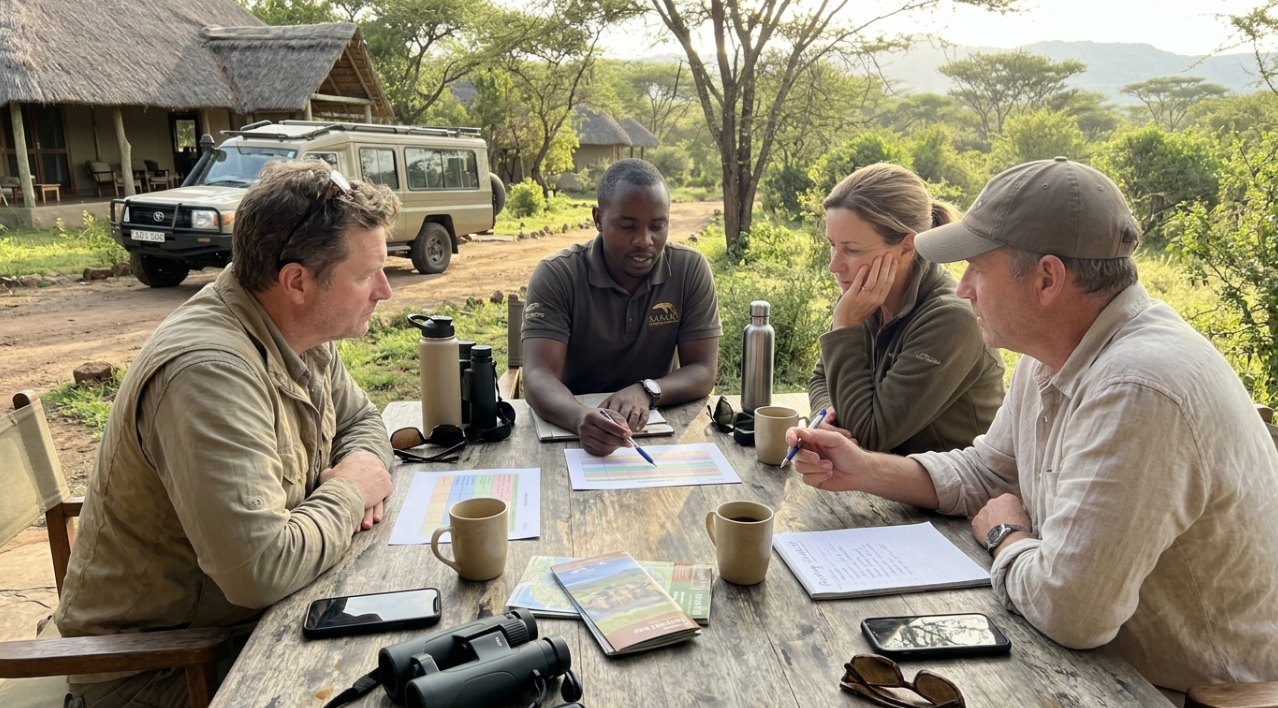
The group leader is the person who initiates planning, communicates with the safari operator, collects preferences, and (usually) handles payment logistics. Safari advisors typically work directly with this coordinator first, then loop in other participants as the itinerary takes shape.
Practitioners on travel planning forums emphasize that large groups benefit from designating specific people responsible for different coordination tasks, like one person handling accommodation preferences and another managing the activity wish list. Without defined roles, a group of 12 adults with 12 equal votes tends to stall.
One past Duma Explorer client, Linda, put it well after coordinating a 13-person family safari spanning ages 11 to 62: “Trying to please so many people and organize a trip with so many demands is an art.”
Why 12 Is the Natural Group Size Ceiling
Travel advisors who specialize in Africa consistently recommend capping groups at around 12 people. The number isn’t arbitrary. It aligns with two hard constraints:
Vehicle math: 12 people fit neatly into either 2 vehicles (at 6 per vehicle) or 3 vehicles (at the quality standard of 4 per vehicle)
Bush plane capacity: Domestic bush flights in Tanzania and Kenya typically seat 12 passengers, with a hard maximum of 14
Groups of 13 or more start hitting logistical friction. You need to split across flights, coordinate additional vehicles, and manage a party large enough that it begins to affect other guests at lodges and wildlife sightings.
Sub-Group
A sub-group is any smaller unit within the larger party that does a different activity on a given day. This might mean splitting by energy level (a walking safari for the adventurous half, a pool day for the rest), by interest (birders vs. big-cat enthusiasts), or by age (kids on a junior ranger program while adults do a sundowner drive).
Building sub-group options into the itinerary from the start, rather than treating them as disruptions, is one of the biggest quality-of-life improvements for large group travel. Read more about pacing for mixed-age groups.
Vehicle and Transport Terms
Safari Vehicle Capacity (6 Max, 4 Quality Standard)
The standard safari vehicle across Tanzania is the Toyota Land Cruiser 4×4, modified with a pop-up roof hatch for game viewing. It seats a maximum of 6 passengers.
But maximum capacity and ideal capacity are different things. In practice, 4 passengers per vehicle is the quality standard for a serious safari. With 4 people, every guest gets a dedicated window seat, an unobstructed position at the roof hatch, and enough room to handle a telephoto lens without elbowing a neighbor. With 6 people, two guests on each row are stuck in the middle. Photography is compromised. Personal space disappears.
For a complete breakdown of vehicle types and configurations, see the safari vehicle glossary.
How Many Safari Vehicles Does a Large Group Need?
The number of vehicles required depends on the operator’s approved passenger capacity and how much space your group wants. For planning purposes, the examples below compare a maximum of six passengers per vehicle with a more spacious target of four passengers per vehicle.
Assuming each private safari vehicle costs $250 per day, the following table illustrates the vehicle-cost share only.
Group Size | Vehicles at Up to 6 Passengers Each | Vehicles at Up to 4 Passengers Each | Daily Vehicle Cost per Person at 6-Passenger Capacity | Daily Vehicle Cost per Person at 4-Passenger Capacity |
|---|---|---|---|---|
8 | 2 | 2 | $62.50 | $62.50 |
10 | 2 | 3 | $50.00 | $75.00 |
12 | 2 | 3 | $41.67 | $62.50 |
14 | 3 | 4 | $53.57 | $71.43 |
How to read the table: The vehicle cost per person is calculated by multiplying the number of vehicles by $250 and dividing the total by the number of travelers. The four-passenger scenario uses enough vehicles to accommodate everyone without exceeding four passengers in any vehicle.
For example, a group of 12 could use two vehicles carrying six passengers each or three vehicles carrying four passengers each. The three-vehicle option costs more per traveler but offers more space.
These figures are illustrative, not supplier quotations. Actual vehicle rates and permitted passenger numbers depend on the operator and vehicle configuration. The calculation excludes accommodation, park fees, guides or services billed separately, flights, meals not included in the vehicle rate, and other trip expenses.
Inter-Vehicle Communication
A couple in one vehicle can respond to a sighting in seconds. Three vehicles carrying 14 people need to communicate by radio, reposition without blocking each other’s sightlines, and take turns at the sighting. The gap between a well-coordinated multi-vehicle group and a poorly managed one is the difference between an extraordinary shared experience and a frustrating logistical exercise.
Good operators ensure their guides have a communication protocol for exactly this. When evaluating quotes, ask how guides coordinate across vehicles.
Bush Plane Capacity and the 15 kg Rule
Bush plane capacity: Domestic bush flights (Coastal Aviation, Auric Air, Air Excel) typically seat 12 passengers with an absolute maximum of 14. Groups of 13 or more will almost certainly need to split across two flights, which may depart at different times.
The 15 kg rule: This is the single most misunderstood packing constraint for Tanzania safaris. Bush flights enforce strict per-person luggage limits, and that 15 kg includes everything: your soft-sided duffel and your day pack combined. Hard-shell suitcases are not allowed. This matters more for large groups because coordinating 12 people’s packing compliance is harder than coordinating two.
Road Safari vs. Fly-In Safari (Group Implications)
A road safari means driving between parks and camps. It’s cheaper, more flexible for stops, and doesn’t have luggage weight restrictions. But it’s slower, and drive days can eat 4 to 6 hours.
A fly-in safari uses bush flights between destinations. It saves time and opens up remote areas. For large groups, fly-in logistics are trickier because of the 12-seat plane capacity and luggage limits, but they compress the itinerary and reduce fatigue, which matters when you’re managing energy levels across a dozen people.
Accommodation Terms
Exclusive-Use Lodge / Lodge Buyout
An exclusive-use booking (also called a lodge takeover or lodge buyout) means your group books the entire property: every suite, every guide, the chef, the vehicles, the fire pit. For the duration of your stay, the lodge and its surrounding wilderness belong to your group alone.
This is the accommodation format most recommended for large groups, multigenerational families, and corporate retreats. Benefits include:
Complete privacy: No navigating shared dining schedules or common areas with strangers
Custom scheduling: Meals, game drives, and activities run on your group’s clock
Personalized service: Private guides, a dedicated chef, and activities tailored to your mix of ages and interests
Cost range: A stand-alone exclusive-use camp (6 to 12 guests) typically runs from approximately $9,000 to $25,000+ per night for the whole property, all-inclusive with dedicated staff. A private villa within a larger lodge (4 to 8 guests) ranges from roughly $4,500 to $12,000 per night. These figures vary widely by season, location, and lodge tier.
Minimum Age Restriction Waiver
Many safari lodges enforce minimum age requirements (often 6, 8, or even 12 years old) to protect the experience for other guests. When a lodge is booked for exclusive use, these restrictions are typically waived. The logic is simple: the only guests affected by a toddler’s noise are your own family.
This is a critical detail for multigenerational groups traveling with young children. If you’re planning a trip with grandchildren, the safari with toddlers planning guide covers park-specific age rules in detail.
Family Suite and Interconnecting Rooms
A family suite is an accommodation unit designed for parents and children, typically with a master bedroom and a connected children’s sleeping area. Interconnecting rooms are two standard rooms with an internal door between them.
For large groups, room configuration is a planning constraint, not an afterthought. Luxury tented camps usually have only 8 to 12 tents total, with a maximum capacity around 20 guests. If your group is 14 people, you’re filling the majority of a camp, which means booking early or considering an exclusive-use arrangement. For family-specific room options, see the family safari room guide.
PPPN (Per-Person-Per-Night)
PPPN is the standard pricing metric for safari accommodation. Unlike hotels priced per room, safari lodges and camps quote per person per night because the rate typically includes meals, drinks, game drives, and sometimes laundry.
For group budget planning, the key insight is that PPPN costs scale linearly with headcount. Adding one more person adds one more PPPN charge. Vehicle and guide costs, by contrast, are shared, which is where groups gain economies of scale.
Cost and Payment Terms
Park Fees (Non-Negotiable, Per Person)
Park entry fees in Tanzania are set by the Tanzania National Parks Authority (TANAPA) and charged per person per 24-hour period. There is no group discount.
Current rates for adult visitors:
Premium parks (Serengeti, Ngorongoro): $82.60 per adult per day
Select parks (Tarangire, Lake Manyara, Arusha): $59.00 per adult per day
These fees are the same whether you’re two people or twenty. For a group of 12 spending three days in the Serengeti, park fees alone total nearly $3,000. It’s a line item that surprises coordinators who assume larger groups get bulk pricing.
For a full breakdown of what makes up a Tanzania safari price, see the safari cost guide.
Concession Fee
A concession fee is a mandatory charge of $70.80 per person per 24-hour period, levied by TANAPA for every lodge and tented camp operating inside the Serengeti. This is separate from and in addition to the $82.60 park entry fee. It is not optional, and it applies to every person for every night spent inside the park.
Many group coordinators see the accommodation PPPN rate and assume that’s the total. The concession fee is the hidden line item that inflates the real cost.
Vehicle Cost Sharing (Economies of Scale)
This is where large groups actually save money. A private safari vehicle costing $200 to $300 per day works out to $33 to $50 per person when six passengers share it. The same vehicle with only two passengers costs $100 to $150 per person.
The larger the group, the more these fixed vehicle and guide costs are diluted across participants. Park fees, accommodation, and flights remain per-person regardless of group size, but vehicle-related costs drop significantly per head. This is the core financial argument for traveling as a group.
Large Group Safari Budget: Which Costs Are Shared?
When planning a large group safari, separate costs that are charged per traveler from those shared by the group. This makes it easier to compare proposals and calculate what each person owes.
Expense | Typical Pricing Basis | How to Allocate It |
|---|---|---|
Safari vehicle | Per vehicle per day or trip | Divide shared vehicle costs among assigned passengers |
Private guide | Per day or trip, depending on the operator | Share if the service is booked for the group |
Accommodation | Per person, per room, or per property | Allocate according to the actual room or occupancy arrangement |
Park and conservation fees | Per person, age category, and applicable entry period | Calculate for each eligible traveler |
Bush flights | Per passenger, sometimes with baggage or charter charges | Assign according to each person’s booking |
Meals and drinks | Included in the package or charged separately | Check the inclusions before dividing the balance |
Optional activities | Per person or per activity | Charge participating travelers only |
Travel insurance | Individual policy | Each traveler pays for their own cover |
Tips | Voluntary, based on local guidance and service | Agree on a transparent pooling method |
Card processing fees | Depends on the payment method and operator | Confirm the amount and agree how it will be allocated |
Example: Calculating a Shared Vehicle Expense
Suppose 12 travelers book three safari vehicles at $250 per vehicle per day.
Total daily vehicle cost: 3 × $250 = $750
Number of travelers: 12
Shared daily vehicle cost per traveler: $750 ÷ 12 = $62.50
This example covers only the vehicle charge. It is not a complete safari price estimate.
Before collecting money, ask your operator for an itemized quotation showing what is included, which charges are mandatory, what is billed separately, and whether the price changes with group size or room occupancy.
Safari Deposit and Balance Schedule
A safari deposit is an upfront payment, typically 20% to 30% of the total trip cost, that secures your booking with lodges, camps, and ground operators. The remaining balance is usually due 60 to 90 days before departure.
For large groups, the deposit stage is where coordination gets real. The group leader needs to collect deposits from 8 to 14 people, often with different comfort levels about committing money months in advance. Missing the deposit deadline can mean losing availability, especially for exclusive-use properties during peak season.
Group Cost-Splitting Methods
Practitioners on group travel forums consistently report that payment collection is the single biggest friction point for group coordinators. Data from SquadTrip, a platform built for group trip payments, confirms this.
For most safari groups, a hybrid cost-splitting approach works best:
Shared equally: Private vehicles, driver-guide fees, fuel, and other common services
Allocated by room: Accommodation costs, assigned by actual room occupancy (a couple in a double room pays differently than a solo traveler)
Individual responsibility: International flights, travel insurance, personal purchases, optional activities, and tips beyond the pooled amount
One practical tip from group travel coordinators: avoid Venmo or Zelle for groups over 5 people. There’s no booking page, no way to charge installments, and disputes become personal. A shared spreadsheet with clear deadlines and a designated collection method (bank transfer or a group payment platform) keeps things professional.
Credit Card Surcharge
Many safari operators accept credit cards but pass along a processing surcharge, typically around 3% to 5%. For a group trip totaling $40,000 or more, that surcharge adds $1,200 to $2,000. Wire transfers usually avoid this fee. Worth discussing with your operator early.
Tipping Terms for Groups
Guide Tipping Rates
Tipping norms differ for large groups:
Small groups (2 to 4 people): $10 to $20 per traveler per day for the safari guide
Large groups (5+ people): A collective tip of $30 to $40 per group per day is standard
The per-group approach keeps things proportional. A guide working with 12 people works harder than one with 2, but not six times harder. The collective amount recognizes the effort without creating the expectation that every person tips as if they were on a private safari for two.
Lodge Tip Box
Most safari lodges and camps have a communal tip box at reception. Tips placed here are distributed among all camp staff (housekeeping, kitchen, servers, laundry). The standard range is $10 to $15 per guest per night. For a group of 12 staying two nights, that’s $240 to $360 for the staff pool.
Tipping Coordinator
On day one or two of the safari, designate one person to coordinate the group tip. This doesn’t need to be a big conversation. Just: “Shall we pool the guide tip at the end?” works. The coordinator collects contributions, consolidates the cash, and presents it to the guide and camp staff at the appropriate time.
One etiquette point from TripAdvisor forum discussions: do not over-tip conspicuously in front of a shared group. If you want to give more than the pooled amount, do it privately.
If your trip includes Kilimanjaro, the Kilimanjaro tipping guide covers the separate (and more complex) tipping ceremony for mountain crews.
Activity and Itinerary Terms
Sighting Limit (5 Vehicles Maximum)
Tanzania’s national parks enforce a maximum of five vehicles at any single wildlife sighting. The rule exists to reduce stress on animals and maintain the wilderness experience.
This is especially relevant for large groups. A party traveling in 3 vehicles already occupies 60% of the sighting limit. If two other vehicles are already at a leopard sighting, only one of your three vehicles can join. Good guides manage this with communication and patience, hanging back and rotating positions rather than crowding in. But it’s a constraint that group coordinators should understand upfront.
Gorilla Trekking Group Cap (8 People Per Family)
If gorilla trekking in Uganda or Rwanda is part of the plan, a hard rule applies: a maximum of 8 visitors are permitted per gorilla family per day. Groups of 9 or more will be split into separate trekking groups, each assigned to a different gorilla family.
This means the sub-groups will have different trekking experiences, possibly on different trails of varying difficulty and duration. It also means the group needs enough gorilla permits for everyone, and permits are limited. For a group of 12, that’s 12 permits that need to be secured, potentially across two gorilla families. Book these early.
Details on permit costs, booking rules, and what to expect are covered in the gorilla trekking FAQ.
Pacing and Split-Day Itinerary
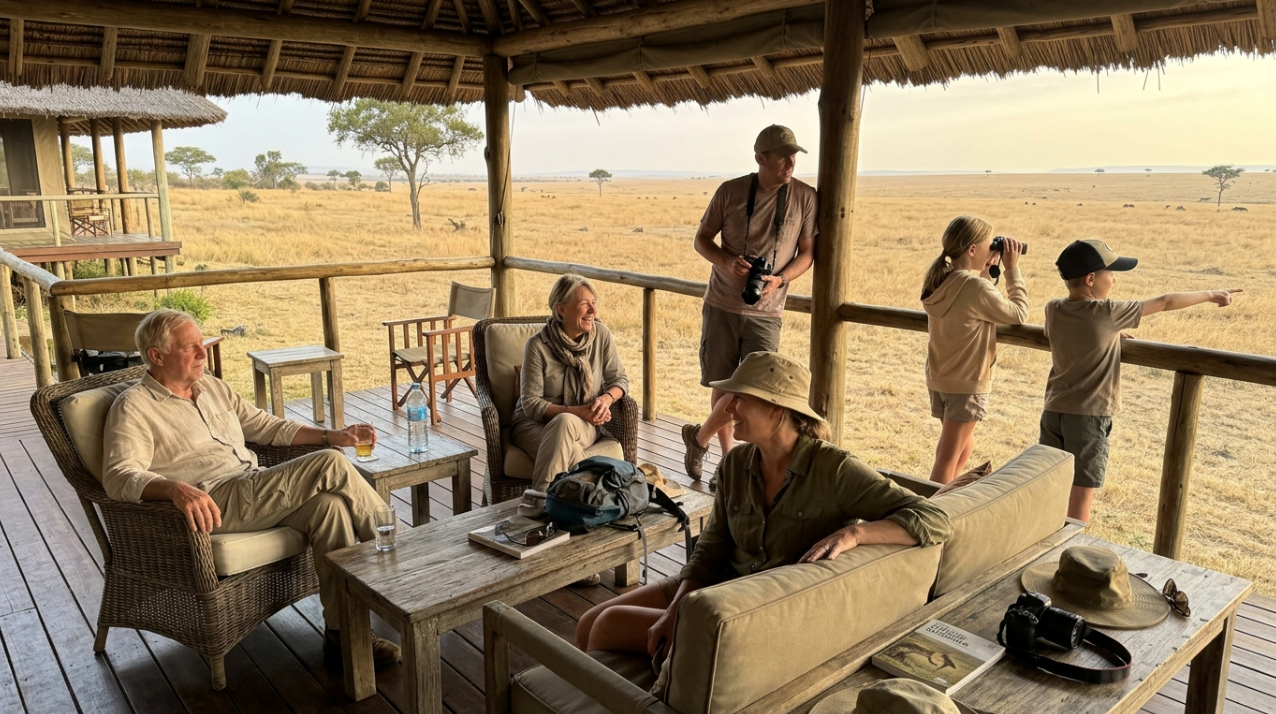
A split-day itinerary builds in optional time so that not everyone has to do the same thing at the same time. One family member may be ready for an afternoon game drive while someone else needs to rest. The itinerary should treat this as a feature, not a problem.
For multigenerational groups especially, pacing is the difference between a trip everyone remembers fondly and one where half the group felt dragged through someone else’s vacation.
Celebration Logistics
Many large group safaris are built around a milestone: a 50th birthday, a retirement, an anniversary, a family reunion. The term “celebration logistics” covers the practical details of making that happen on safari. Think: a bush dinner under the stars, a private sundowner setup, a cake that somehow appears in the middle of the Serengeti.
These are entirely possible, but they need to be communicated to your operator early. Lodge staff can work wonders with advance notice. They cannot improvise a surprise dinner for 14 people.
Booking Lead Time for Large Groups
Going as a group means booking as early as possible. For standard large group safaris during shoulder season, 6 months ahead is a reasonable minimum. For peak season (July through October in East Africa) or for exclusive-use lodge buyouts, 9 to 12 months is safer.
The constraint isn’t just availability. It’s coordination. A group of 12 needs flights, 2 to 3 vehicles, guides, accommodation that can handle the full party, and possibly permits. Every week of delay narrows the options.
Large Group Safari Planning Checklist
Use this checklist before requesting quotations or paying a group deposit.
Group Details
Confirm the number of travelers and the ages of all participants.
Appoint a group leader and identify a backup contact.
Collect each traveler’s preferred dates and approximate budget.
Record dietary requirements, accessibility needs, and other important requests.
Agree on the group’s main priorities, such as wildlife viewing, photography, cultural visits, or celebrations.
Vehicles and Flights
Confirm the passenger capacity and configuration of each safari vehicle.
Decide whether comfort, photography space, or the lowest possible cost is the priority.
Ask how vehicles will communicate and coordinate during game drives.
Confirm passenger limits, baggage allowances, and baggage dimensions with each airline.
Find out whether travelers may need to depart on separate flights.
Accommodation and Activities
Compare private-use accommodation with individually booked rooms.
Confirm room configurations, occupancy limits, and child policies.
Check which meals, drinks, game drives, and other services are included.
Reserve any limited-capacity activities or permits early.
Allow for different activity preferences and rest periods.
Budget and Payments
Request an itemized quote for the entire group.
Identify park fees, concession charges, taxes, and other mandatory expenses.
Confirm deposit deadlines, final-payment dates, and accepted payment methods.
Review cancellation, refund, and traveler-substitution policies.
Agree how shared costs, room upgrades, optional activities, and tips will be allocated.
Decide what happens financially if a traveler withdraws.
Final Confirmation
Verify passport, entry, visa, and travel-insurance requirements.
Confirm the final itinerary, accommodation, transport, and booking references.
Share the packing list, baggage rules, and emergency contacts with everyone.
Give the group one final statement of costs, payment deadlines, and responsibilities.
Planning tip: Do not collect non-refundable payments until the group understands the booking terms and has agreed on how cancellations or withdrawals will be handled.
What Your Operator Should Ask You
A good operator doesn’t just send you a brochure. They ask the questions that shape an accurate, well-matched proposal. If your operator isn’t asking these, consider it a red flag:
Total number of travelers and ages of all participants (including children)
Preferred accommodation tier (midrange, premium, luxury, or a mix)
Budget range per person (even a rough range helps enormously)
Priority activities (Great Migration, big cats, gorilla trekking, cultural visits, beach extension)
Dietary requirements and food allergies (across all travelers)
Mobility considerations (anyone with limited mobility, recent surgery, or fitness concerns)
Any celebration or milestone (birthday, anniversary, retirement)
How the group wants to handle cost splitting
Whether everyone has passports with 6+ months validity
Travel insurance status
Duma Explorer’s owner, Stacy Readal, has managed exactly this kind of complexity. For a 13-person family trip spanning ages 11 to 62, she patiently customized the itinerary with multiple revisions until every family need was met, including special food requests, all while working within the group’s budget. That process happened over Zoom calls, phone conversations, and email threads, reflecting the kind of responsiveness a group coordinator needs from their operator.
Plan a large group safari with Duma Explorer
Frequently Asked Questions
How far in advance should a large group book a safari?
Six months is a minimum for shoulder-season travel. For peak season (July to October) or exclusive-use lodge buyouts, aim for 9 to 12 months. The earlier you book, the more lodge and vehicle options remain available for a group of 8 or more.
How many people fit in one safari vehicle?
A standard Toyota Land Cruiser 4×4 seats a maximum of 6 passengers. However, 4 passengers per vehicle is the widely recognized quality standard, giving everyone a window seat and unobstructed roof-hatch access for photography and viewing.
Is an exclusive-use lodge worth it for a large group?
For groups of 8 or more, exclusive use is often the best way to travel. It eliminates schedule conflicts with other guests, removes minimum age restrictions for young children, and gives the group complete control over meals, activities, and pace. The per-person cost can actually be reasonable when split across 10 to 12 travelers.
How should a large group split safari costs?
A hybrid approach works best. Split vehicle, guide, and fuel costs equally. Allocate accommodation by room occupancy. Keep flights, insurance, optional activities, and personal expenses individual. Agree on payment deadlines early and designate one person to collect funds.
Do park fees decrease for larger groups?
No. Tanzania’s park entry fees are set per person per day by TANAPA and apply regardless of group size. There is no bulk discount. The Serengeti charges $82.60 per adult per day, and the concession fee adds $70.80 per person per night for camps inside the park.
How does tipping work for a large group safari?
Large groups (5+ people) typically pool a collective guide tip of $30 to $40 per group per day, rather than each person tipping $10 to $20 individually. Designate one tipping coordinator early in the trip to collect contributions and present the tip.
Can a large group do gorilla trekking together?
Only if the group is 8 people or fewer. Gorilla trekking permits are capped at 8 visitors per gorilla family per day. A group of 12 would be split into two trekking groups assigned to different gorilla families, potentially with different trail difficulties and durations. Permits should be secured well in advance.
What happens if someone drops out after the deposit is paid?
This depends on the operator’s cancellation terms and how close to the departure date the withdrawal occurs. Most operators require the remaining balance 60 to 90 days out, and cancellation penalties increase as the travel date approaches. The group should agree in advance on whether the departing member forfeits their deposit or whether the group absorbs the difference. Discuss this scenario before anyone sends money.
Leave a Reply