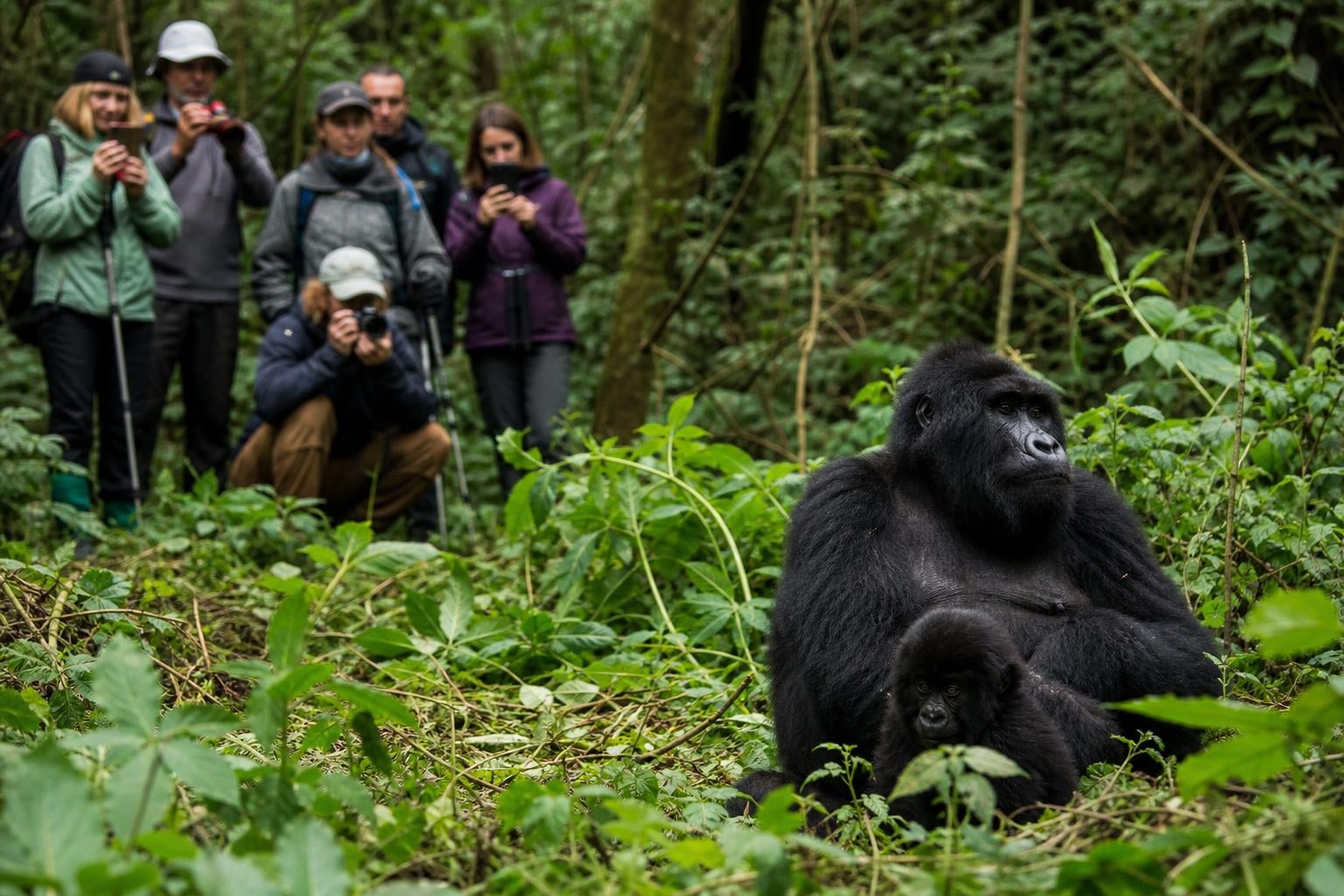
TL;DR: Gorilla trekking is a ranger led hike to spend one hour with a habituated mountain gorilla family in Uganda or Rwanda. Permits cost US$800 in Uganda (US$600 in low season) or US$1,500 in Rwanda, the minimum age is 15, and groups are capped at eight visitors. Trek duration ranges from 30 minutes to 7 hours depending on where gorillas are that day. DRC permits (US$400) exist on paper but gorilla treks in Virunga are closed until further notice. This glossary answers the most common gorilla trekking FAQs with current rules, pricing, refund policies, cross border logistics, and practical planning guidance for both countries.
Gorilla trekking is straightforward on the day. Park authorities control the experience tightly: small groups, trained rangers, professional trackers, strict time limits, distance rules. The planning is what trips people up. Permit timing, country choice, trekking sector, lodge location, health requirements, and wider itinerary all need to line up before you board a plane. These gorilla trekking FAQs cover the terms and decisions you will encounter while researching your trip, with current costs, official rules, and practical notes for both Uganda and Rwanda.
This is not a loose list of questions. It is organized by planning stage so you can start with the decision that matters most (usually the permit) and work outward from there.
For a full cost breakdown including lodge tiers, transfers, and tips, see gorilla trekking costs explained by country.
Gorilla Trekking FAQs: Quick Answers
The table below covers the gorilla trekking FAQs that most travelers ask first. Each topic is explained in more detail further down.
| Question | Quick answer |
|---|---|
| Do I need a permit? | Yes. No one treks without a valid permit. |
| How much is a permit? | Rwanda: US$1,500 for foreign visitors. Uganda: US$800 standard, US$600 in low season (April, May, November). DRC: US$400 on paper, but treks are currently closed. |
| How old must I be? | 15 or older in both countries. |
| How long with gorillas? | One hour once the family is located. |
| How many in a group? | Maximum eight visitors per gorilla family. |
| How hard is the hike? | Unpredictable. Uganda says 2 to 7 hours; Rwanda says 30 minutes to 4+ hours. |
| Should I hire a porter? | Yes. Helps with footing, mud, your daypack, and local employment. |
| Uganda or Rwanda? | Rwanda is simpler and more expensive. Uganda offers better permit value and more itinerary variety. |
| Can I get a refund? | Rwanda publishes formal refund and reschedule rules. Uganda’s policy is stricter and changed in 2026. |
| Is DRC an option? | Not for most travelers. Virunga’s tourism site says gorilla treks are closed until further notice. |
Permit and Booking Terms
The permit is the foundation of every gorilla trek. Get this right, and the rest of the planning follows. Get it wrong, and you risk wasting money, time, or both.
Gorilla permit
A gorilla permit is the official booking that allows one person to join a regulated gorilla trek on a specific date in a specific park. It covers park access, the ranger and tracker system, and one hour of viewing once the gorilla family is found.
It does not cover international flights, accommodation, meals, road transfers, domestic flights, porter fees, tips, visas, or insurance. As Horizon Guides explains in its permit guide, the permit fee includes park entrance plus guiding and tracking services, but nothing beyond the trek itself.
| Included in the permit | Not included |
|---|---|
| Right to join one regulated trek | International or domestic flights |
| Park authority ranger and tracker team | Lodge or hotel accommodation |
| One hour with a gorilla family | Road transfers |
| Park access for the trekking activity | Porter (optional, separate fee) |
| Conservation contribution | Tips, visa, vaccines, insurance |
Permit pricing by visitor category
Most North American and European travelers are classified as “foreign non residents,” which carries the highest published rate.
Uganda (UWA 2024 to 2026 tariff):
- Foreign non resident: US$800
- Foreign resident: US$700
- East African Community citizen: UGX 300,000
- Rest of Africa: US$500
Rwanda (RDB portal):
- Foreign visitor: US$1,500
- Promotional rates for Rwandan/EAC citizens (US$200) and African citizens or foreign residents in Africa (US$500), with blackout dates from June to October 2026
DRC (Virunga National Park):
- Foreign visitor: US$400 when treks are operational
- This is the lowest published gorilla permit price anywhere. However, Virunga’s own tourism site currently states gorilla and Nyiragongo treks are closed until further notice, and the U.S. State Department lists North and South Kivu as Level 4: Do Not Travel. The US$400 price is academic until security conditions change.
These rates are set by park authorities, not negotiable by operators. If someone offers a rate below the published tariff outside official promotional windows, treat it as a red flag.
For a detailed look at Uganda permit costs and booking rules, see the dedicated guide.
Foreign non resident, foreign resident, EAC citizen
These are the visitor categories that determine your permit price. “Foreign non resident” applies to most American, European, and other overseas travelers. “Foreign resident” applies to non citizens who legally reside in the destination country and can prove it with documentation. Rwanda’s RDB requires a minimum of four consecutive months of residency or a work permit to qualify for resident rates. Do not assume you can claim a resident rate without proper paperwork. “EAC citizen” refers to citizens of East African Community member states, who pay the lowest rates.
Low season permit
UWA introduced discounted gorilla tracking rates for April, May, and November starting in 2026: US$600 for foreign non residents and US$500 for foreign residents. The tradeoff is real. Low season permits cannot be rescheduled if your dates change, and those months bring heavier rain and muddier trails.
For flexible travelers with solid boots and good insurance, this is genuine savings. For anyone on a tight schedule or uncomfortable with weather uncertainty, the standard season permit may be worth the extra US$200.
Seven day reservation window (suspended)
Uganda previously allowed operators to hold permits for seven days before payment. UWA suspended this system effective March 1, 2026. Permits are now secured only after full payment at booking. If you have firm dates, expect your operator to need payment promptly before availability changes.
Permit availability per day in Rwanda
Rwanda’s Volcanoes National Park currently has roughly 12 habituated gorilla families open for tourism visits. With groups capped at eight visitors per family, that means a maximum of about 96 gorilla trekking permits are available on any given day. This sounds like a lot, but peak season months (June through September, December through February) consistently sell out weeks or months ahead.
Practitioners on Reddit report that August and September are the hardest months to secure Rwanda permits, with some travelers finding their preferred dates gone three to four months in advance. January and February also fill quickly because they coincide with dry weather and school holidays in parts of Europe and North America. If Rwanda is the priority, booking four to six months out is the safe move for peak dates. Shoulder months like March, October, and early November are easier to secure but come with higher rainfall risk.
Permit refund and reschedule policy
This is one of the gorilla trekking FAQs that causes the most stress, and for good reason. Permits are expensive and the policies differ between countries.
Rwanda (RDB): Rwanda publishes formal refund and reschedule terms on its booking portal. As of the current rules, cancellations made 90 or more days before the trek date are eligible for a refund minus an administrative fee. Cancellations between 30 and 89 days out may receive a partial refund or the option to reschedule. Cancellations fewer than 30 days before the trek date are generally non refundable. Rwanda also has a published reschedule policy for the rare situation where trackers fail to locate gorillas despite a full day of searching, which can result in a complimentary reschedule or partial refund at RDB’s discretion.
Uganda (UWA): Uganda’s policy is more rigid, especially since the 2026 tariff changes. Standard season permits may be rescheduled with advance notice and subject to availability, but refunds are difficult to obtain and often require formal written applications. Low season permits (April, May, November) are explicitly non reschedulable and non refundable. Multiple travelers on Reddit have shared frustration with UWA’s refund process, describing it as slow and inconsistent even when illness or flight cancellations were documented.
The practical takeaway: Buy travel and evacuation insurance that specifically covers “cancel for any reason” or trip interruption. A US$800 to US$1,500 permit with no guaranteed refund is exactly the kind of expense that justifies insurance. Read your policy carefully to confirm gorilla permit costs are covered as a prepaid, non refundable travel expense.
Permit scams
This FAQ deserves a blunt answer. Permit scams are real. A traveler on Reddit’s r/travel described trying to book what they believed were legitimate Uganda permits, being moved to WhatsApp for payment, wiring money, and then getting no permit and no response.
The booking rules are clear: Uganda’s official tariff states that foreign non resident and Rest of Africa gorilla permits must be booked through licensed tour operators. For Rwanda, use the official RDB booking portal or a vetted operator.
Scam warning signs:
- Payment requested via personal WhatsApp or unverifiable wire transfer
- Rates below published tariffs outside official promo periods
- “Last minute” discounted permits from unknown contacts
- Agents who cannot provide verifiable operator licensing
Where Gorilla Trekking Happens
Three countries host mountain gorilla trekking: Uganda, Rwanda, and the Democratic Republic of Congo. For most travelers, only the first two are practical options right now.
Bwindi Impenetrable National Park
Bwindi is Uganda’s most popular gorilla trekking destination and home to more than half the world’s mountain gorillas. UWA describes Bwindi as divided into four main trekking sectors: Buhoma, Ruhija, Rushaga, and Nkuringo. Each sector has its own staging area, assigned gorilla families, and nearby lodges.
This matters because “Bwindi” is not one trailhead. A lodge that markets itself as “near Bwindi” may be a poor match for your assigned permit sector, creating a very early, uncomfortable drive on rough roads before the trek even starts. One personal travel guide flagged this as the most common planning mistake: choosing a lodge without checking the trekking sector first.
For a detailed breakdown of each area, explore Bwindi’s trekking sectors before booking accommodation.
Mgahinga Gorilla National Park
Mgahinga is Uganda’s smaller gorilla park, located in the Virunga Mountains. UWA says it issues roughly eight permits per day, making availability tight. The appeal is significant, though. Mgahinga shares the same Virunga volcanic ecosystem as Rwanda’s Volcanoes National Park, potentially offering more open bamboo forest views than Bwindi’s dense jungle, all at Uganda’s lower permit price.
Practitioners on Reddit frequently describe Mgahinga as underrated. Several travelers who trekked both Bwindi and Mgahinga say they preferred the Mgahinga setting, noting the bamboo forest felt more open and the volcanic terrain reminded them of the Rwandan side. The constraint is simple: with only about eight daily permits, Mgahinga cannot be treated as a fallback plan. Book early or expect disappointment.
Volcanoes National Park (Rwanda)
Rwanda’s gorilla treks operate in Volcanoes National Park, about two to three hours northwest of Kigali. The RDB portal instructs visitors to report at registration centers by 07:00. Rwanda often wins on logistics because the drive from Kigali is shorter and on better roads than most Uganda routes.
A 2026 Reddit trip report described leaving Kigali around 4 a.m. for a same day trek, saving money by avoiding a night near the park. The same user still recommended staying near Volcanoes if budget allows, noting the early Kigali departure was manageable but not exactly relaxing.
Choose gorilla trekking lodges that match your permit sector and itinerary.
Virunga National Park (DRC)
Do not plan on this as a standard option. Virunga’s own tourism site currently states that gorilla and Nyiragongo treks are closed until further notice, and the U.S. State Department lists North and South Kivu as Level 4: Do Not Travel. Even when operational, DRC’s permit price of US$400 attracted a small number of adventurous travelers willing to accept the security risks and logistical challenges. For now, it remains off the table.
Choosing Between Uganda and Rwanda
Most gorilla trekking FAQs eventually land on this question: which country? The answer depends on what constrains your trip, not on which country is objectively “better.”
| Your primary constraint | Usually the better fit |
|---|---|
| Limited time | Rwanda. Volcanoes is easier to reach from Kigali. |
| Permit budget | Uganda. Standard permit is US$800 vs. US$1,500. |
| Luxury lodge priority | Either. Both have strong premium options near their parks. |
| Wildlife variety beyond gorillas | Uganda. Pairs naturally with chimps, Queen Elizabeth, Murchison Falls. |
| Tanzania or Kenya safari add on | Either works, but flight routing should drive the choice. |
| Mobility concerns | Discuss with your operator. Porter and sedan chair support may help. |
| Deep forest adventure feel | Bwindi often feels more rugged and immersive. |
| Time efficient extension | Rwanda’s Kigali access usually wins. |
Reddit and TripAdvisor discussions consistently echo this pattern. Travelers who prioritize simplicity and time lean Rwanda. Travelers who want permit savings and the option to combine gorillas with chimps, crater lakes, and other Uganda parks lean Uganda. Forum users also emphasize that Bwindi has multiple starting points, so the area choice matters as much as the country choice.
For a side by side comparison, see Rwanda vs Uganda gorilla trekking broken down by cost, logistics, and experience.
Cross Border Trekking Logistics
A growing number of travelers combine gorilla trekking with a wider East Africa trip, which often means crossing borders between Uganda, Rwanda, Tanzania, and Kenya. This creates real logistical questions that the standard gorilla trekking FAQs tend to skip.
Uganda to Rwanda (or reverse)
The Cyanika and Katuna (Gatuna) border crossings connect southwestern Uganda to northwestern Rwanda. Travelers doing gorilla treks in both countries sometimes trek Bwindi one day, cross the border, and trek Volcanoes a day or two later. The drive from Bwindi’s southern sectors (Rushaga or Nkuringo) to Volcanoes National Park takes roughly three to five hours depending on the border crossing used and road conditions.
The key requirements:
- Visas: The East Africa Tourist Visa (EATV) covers Uganda, Rwanda, and Kenya for US$100 and is valid for 90 days. It is the simplest option for multi country itineraries. Single entry visas for each country also work but add cost and complexity if you plan to re enter.
- Yellow fever: Both countries recognize each other’s yellow fever certificates. Carry your yellow card with your passport at every border crossing.
- Permit coordination: If trekking in both countries, the permit dates need to be spaced with at least one full day between treks for the border crossing and transfer. Trying to cross the border and trek on the same day is theoretically possible but extremely stressful and not recommended.
- Operator coordination: Some travelers use one operator for both countries, which simplifies vehicle handoffs, guide briefings, and permit logistics at the border. Others book separately in each country, which can save money but requires more self management at the crossing.
For broader visa guidance across the region, the East Africa visa guide covers the EATV and country specific requirements.
Tanzania to Uganda or Rwanda
Many travelers combine a Tanzania safari or Kilimanjaro climb with gorilla trekking. The most practical connection is a flight from Kilimanjaro International Airport (JRO) or Dar es Salaam (DAR) to Entebbe (Uganda) or Kigali (Rwanda). Direct flights between these hubs are available on several carriers and typically run one to two hours.
Overland crossings from Tanzania into Uganda (via Mutukula) or Rwanda (via Rusumo) are possible but add significant travel time and are rarely worth it unless the overland journey is part of the experience.
The critical planning point: the gorilla permit date anchors the entire multi country itinerary. Book the permit first, then schedule the connecting flight and safari dates around it. Practitioners on Reddit consistently flag this as the number one mistake in multi country trip planning: booking the safari first and then scrambling to find a permit that fits.
If you are combining gorilla trekking with Tanzania, Kenya, Kilimanjaro, or Zanzibar, plan your itinerary around permit availability first, then build the rest of the route.
Trek Day Terms
Understanding what happens on the day removes most of the anxiety around gorilla trekking FAQs.
Gorilla trekking vs. gorilla tracking
“Gorilla trekking” is the term most travelers use. “Gorilla tracking” is the term park authorities use. They refer to the same activity. UWA’s official page title is “Gorilla tracking,” and Rwanda’s RDB calls it “Mountain Gorilla Tracking.” The difference is only language, not experience.
Morning briefing and gorilla family allocation
Trek day starts with a briefing at the park staging area. Rangers explain rules, assign visitors to gorilla families, and organize groups of up to eight. You do not choose your gorilla family. Rangers consider fitness levels, group needs, family locations, and operational factors.
Family allocation is why trek difficulty cannot be guaranteed in advance. Gorillas move daily, so even within the same park, one group may reach gorillas in 30 minutes while another hikes for several hours. Reddit travelers who have trekked multiple times report very different durations even on consecutive days.
Rangers and trackers
Rangers lead visitors, enforce rules, and manage safety. Trackers are the field team that locates gorilla families based on previous nest sites, movement patterns, and radio communication. Trackers typically head out early, well before visitors begin hiking, which is why sightings are highly likely even though never 100% guaranteed.
One hour rule
Once the gorilla family is located, visitors spend one hour with them. Not longer. This rule protects gorillas from prolonged stress and disease exposure. Both UWA and RDB enforce this limit.
Many travelers say the hour passes quickly. Those for whom gorillas are the primary reason for the trip should consider whether a second trek, or Uganda’s gorilla habituation experience (up to four hours with a semi habituated group, currently US$1,500 for foreign non residents), is worth adding.
Habituated gorilla family
Habituation means a wild gorilla group has been gradually accustomed to controlled human presence for research, monitoring, or tourism. It does not mean tame. All distance, behavior, health, and photography rules still apply. The gorillas tolerate your presence; they have not been domesticated.
Porter
A porter is a local assistant you hire at the trailhead to carry your daypack and help you on difficult terrain. This is one of the gorilla trekking FAQs that deserves a strong recommendation: hire the porter.
Porters are not just for people who struggle with hiking. They help with mud, steep slopes, balance on uneven ground, and fatigue. They also provide direct conservation linked income for communities near the parks. A 2026 Reddit trip report on Rwanda recommended hiring a porter for every one to two people, saying the mud was a real factor even in generally pleasant February weather. On TripAdvisor, a Bwindi traveler called their porter “worth every cent of $20.”
Sedan chair
Some parks offer a sedan chair (sometimes called an “African helicopter”), a carried chair or stretcher that allows travelers with mobility limitations to participate. This must be arranged and budgeted in advance. A Reddit user reported that a friend used this option in Rwanda and was able to see the gorillas despite being unable to hike. If mobility is a concern, discuss it with your operator well before the trip, not at the trailhead.
Rules, Safety, and Gorilla Conservation
Distance rule
Uganda’s official tariff requires visitors to maintain 10 meters (about 33 feet) from gorillas. Rwanda’s official booking portal currently states 7 meters (about 23 feet). Best practice conservation messaging from Gorilla Doctors recommends at least 10 meters and highlights great apes’ susceptibility to human respiratory pathogens.
The honest answer: official rules can differ by country and may be updated. Follow the ranger briefing on your trek day, and use 10 meters as your personal conservation standard whenever terrain and gorilla movement allow.
Mask guidance
Bring surgical masks and expect to wear one during the viewing hour, especially if instructed by your guide. Visit Rwanda promotes the Gorilla Friendly Pledge, which includes wearing a facemask near gorillas. Gorilla Doctors explains that human respiratory pathogens pose a serious risk to mountain gorillas, citing a 2009 outbreak linked to human metapneumovirus that caused gorilla deaths in Rwanda.
Don’t trek when sick
If you have a cold, flu, fever, or any contagious symptoms, do not trek. Rangers can and will deny access. This is not bureaucratic caution. Great apes are genuinely vulnerable to human respiratory diseases, and a single sick visitor could endanger an entire gorilla family.
A useful way to think about it: if you would cancel dinner with a friend because you are coughing or feverish, you should skip the gorilla trek too.
For the full set of behavior rules during your trek, review gorilla trekking etiquette for Uganda and Rwanda.
No flash photography
Flash can disturb gorillas. Both UWA and RDB prohibit it. Turn off your flash before entering the viewing area. Phones are fine for photos but set them to silent and disable the flash. For dedicated camera gear and settings advice, see the gorilla trekking photography guide.
Mock charge
If a gorilla charges or vocalizes, do not run. Stand still, look away, and follow the guide’s directions. Mock charges are warning displays, not attacks. Rangers are trained to read gorilla behavior and will manage the situation. The key is to stay calm and listen.
Fitness, Terrain, and Altitude
How hard is the trek?
This is one of the most common gorilla trekking FAQs, and the answer is genuinely unpredictable. UWA says Uganda treks may last 2 to 7 hours. Rwanda’s RDB says hikes range from 30 minutes to 4+ hours depending on the family allocation and gorilla location.
You do not need to be an athlete, but you should be comfortable walking on uneven, uphill, often muddy forest trails for a potentially extended period. If you have knee, hip, or balance concerns, tell your operator before booking so they can advise on sector choice, porter support, or alternative options.
Mud is year round
Gorillas live in tropical montane forest. Even during dry season months (roughly June through September, December through February), rain can arrive without notice and trails can be muddy from the day before. A 2026 Reddit trip report from Rwanda described February conditions as pleasant in temperature but still muddy underfoot. Waterproof boots and gaiters are not seasonal gear. They are standard equipment for any gorilla trek in any month.
Altitude
Gorilla trekking parks sit at meaningful altitude. Rwanda’s Volcanoes National Park starts around 2,400 meters (roughly 7,900 feet). Bwindi’s sectors range from about 1,160 to over 2,600 meters. Rwanda’s RDB advises walking slowly and drinking water.
For park specific altitude and elevation details, check the guide by park.
What to Wear and Pack
Keep this simple. Rwanda’s RDB recommends long trousers, long sleeved shirts, sturdy walking shoes or hiking boots, and rain gear. Personal travel guides and YouTube packing videos consistently emphasize the same core items.
Essential gear:
- Waterproof hiking boots (broken in before the trip)
- Long pants tucked into socks or gaiters
- Long sleeved shirt
- Rain jacket
- Garden style gloves (for grabbing branches and avoiding nettles)
- Surgical mask
- Camera with flash turned off
- Small daypack (which your porter will carry)
- Water and a snack (consumed away from gorillas, not during viewing)
- Cash for porter fee and tips
Health, Vaccines, and Insurance
See a travel medicine provider
Both Uganda and Rwanda require health preparation. The CDC recommends malaria prophylaxis for both countries. Uganda requires yellow fever vaccination for all arriving travelers age one and older. Rwanda does not require it for travelers arriving directly from the U.S. but does require it for travelers coming from countries with yellow fever risk.
Consult a travel medicine clinician well before your trip, not a few days beforehand.
For malaria prevention around gorilla trekking areas, see the detailed risk and prevention guide.
Travel and evacuation insurance
Gorilla permits are expensive and often non refundable or difficult to reschedule (as outlined in the refund section above). Trekking areas are remote. The CDC advises travelers to review health insurance coverage and consider travel health and medical evacuation insurance.
For a trip costing several thousand dollars per person, insurance is not an optional add on. It protects both the permit investment and your ability to get medical care if something goes wrong far from a major hospital.
Is Gorilla Trekking Worth It?
The cost is high. One hour with gorillas, preceded by a muddy hike that could last most of the day, for US$800 to US$1,500 in permit fees alone, plus lodges, transfers, and tips on top. The question is fair.
Gorilla trekking is most worth it for travelers who value rare wildlife encounters, care about conservation, and appreciate being in a remote forest. The roughly 1,063 mountain gorillas alive today (based on combined census results from the Virunga and Bwindi Sarambwe populations) exist partly because the permit system funds their protection.
It is least worth it for travelers who are mainly after photos, dislike hiking and group experiences, or would feel resentful paying this much for a single activity.
Reddit threads on this topic are consistently split but revealing. Budget travelers sometimes question the value, while wildlife focused travelers call it one of their best travel experiences. One Reddit poster who did Uganda twice said one trek reached gorillas in about 30 minutes while the second took several hours, and found both deeply memorable. Another said it was the most expensive activity they had ever done and would not repeat it. The value is personal, and no article can decide it for you.
Decide whether gorilla trekking fits your priorities and budget.
Planning Gorilla Trekking as Part of a Larger East Africa Trip
Most gorilla trekking FAQs focus on the trek itself, but the bigger planning challenge is making the permit date work inside a wider itinerary. Gorilla trekking is often combined with a Tanzania safari, Kenya safari, Kilimanjaro climb, or Zanzibar extension. The permit date becomes the anchor around which flights, lodges, border crossings, and rest days must be built.
Five things to confirm before buying a gorilla permit:
- Country: Uganda or Rwanda?
- Date: Is the permit available for your travel window?
- Park and sector: Bwindi (which sector?), Mgahinga, or Volcanoes?
- Lodge match: Is your accommodation close to the correct briefing point?
- Itinerary fit: Does the trek date work with your flights, safari routing, and rest days?
Planning the permit in isolation is the most common mistake for travelers building multi country East Africa trips. The permit, lodge, and transfer logistics need to be coordinated together. This is especially true for cross border itineraries where visa requirements, vehicle handoffs, and flight connections all depend on the trekking date.
To start planning, share your travel dates, number of travelers, ages of any children or teens, preferred country (Uganda, Rwanda, or open), whether gorilla trekking is the main focus or an add on, accommodation level, mobility considerations, and any special occasion like a honeymoon or family milestone.
For help stitching together a multi country route, see East Africa itinerary planning with routes and permit coordination.
Frequently Asked Questions
Is a gorilla sighting guaranteed?
No wildlife sighting is ever truly guaranteed, but encounters are highly likely because professional trackers monitor habituated gorilla families daily. Trackers head out before visitors and communicate gorilla locations by radio. Rwanda’s RDB portal even publishes refund and reschedule rules for the rare situations where visitors fail to make contact despite a full day of tracking.
Can children go gorilla trekking?
Only travelers age 15 and older can participate in both Uganda and Rwanda. Families traveling with younger children need alternate activities or childcare logistics during trek day. Gorilla trekking can still be the centerpiece of a family trip, but the itinerary needs to account for this age restriction on that specific day.
How far in advance should I book a permit?
Three to six months is a safe window for most dates. Peak season months (June through September, December through February) and popular sectors can sell out earlier. Rwanda’s roughly 96 daily permits fill fastest during August and September. With UWA’s suspended seven day reservation window, Uganda permits now require full payment at booking, making early decisions more important than before.
What happens if I get sick on trek day?
Rangers can deny access if you show symptoms of a cold, flu, or contagious illness. This protects gorillas from human respiratory diseases. Check your travel insurance policy for trip interruption coverage in case you cannot trek after purchasing a permit. Rwanda’s RDB has published policies for this scenario; Uganda’s approach is less formalized and may require working through your operator.
What happens if my permit date no longer works?
Rwanda allows rescheduling with sufficient advance notice (generally 30+ days), subject to availability and possible administrative fees. Uganda’s standard season permits may be reschedulable but low season permits are explicitly non transferable. In both cases, starting the reschedule process as early as possible improves outcomes. Travel insurance with “cancel for any reason” coverage is the best safety net.
What should I wear?
Waterproof hiking boots (broken in), long pants tucked into socks or gaiters, a long sleeved shirt, rain jacket, and garden gloves. Bring a surgical mask for viewing time and turn off camera flash before approaching the gorillas.
Should I book through an operator or on my own?
In Rwanda, travelers can use the official RDB portal directly or book through a vetted operator. In Uganda, UWA’s tariff says foreign non resident and Rest of Africa permits must be booked through licensed tour operators. For multi country East Africa trips, using one reputable operator is typically safer and more efficient because permits, lodges, flights, transfers, and route timing all need to align.
Can I trek gorillas twice on one trip?
Yes, if permits are available. Some travelers book one trek in Rwanda and one in Uganda to compare the experiences (see cross border logistics above for how to connect the two). Others trek twice in the same park on consecutive days. Reddit discussions suggest a second trek is most worthwhile for travelers deeply interested in wildlife, because gorilla family behavior and trek conditions can vary significantly from one day to the next.
How does the DRC permit price compare?
At US$400, DRC’s Virunga National Park offers the cheapest gorilla permit by a wide margin. But the price is irrelevant for planning purposes because treks have been suspended indefinitely due to security conditions. Even when Virunga was open, infrastructure, safety, and insurance complications made it a niche choice for experienced, risk tolerant travelers. Uganda and Rwanda remain the only practical options.
Leave a Reply